

There is a number in Japan that functions the way the price of a gallon of gasoline functions in the United States. It is not a large number. It sits somewhere between ¥170 and ¥240, it is printed on a strip of film wrapped around a triangle of rice, and roughly the entire country knows what it should be.
At the end of August 2026, the three companies that between them operate the overwhelming majority of Japan’s convenience stores did something with that number that they had not done in years. Lawson announced it would take ¥10 to ¥11 off the shelf price of twenty hand-wrapped onigiri from 29 September. Seven-Eleven Japan said it would cut about ¥19 from two of its own hand-wrapped rice balls from 8 September. FamilyMart had already dropped its large kombu-and-tuna-mayonnaise musubi from ¥320 to ¥298 in late August.
Not a coupon. Not a two-for-one. Not a limited-time campaign with an end date buried in the small print. The base price, on the shelf, with the ingredient quantity and product specification explicitly unchanged.
In the same month, according to Teikoku Databank’s survey of 195 major Japanese food manufacturers, 4,923 food and beverage products went up in price — more than three times the September 2025 figure of 1,467, and the largest single-month total in over three years.
And here is the part that makes this worth an operator’s attention rather than a food blogger’s: at the moment the chains announced those cuts, the wholesale benchmark for Japanese rice was still well above its year-earlier level.
The Rice Ball as a National Price Gauge
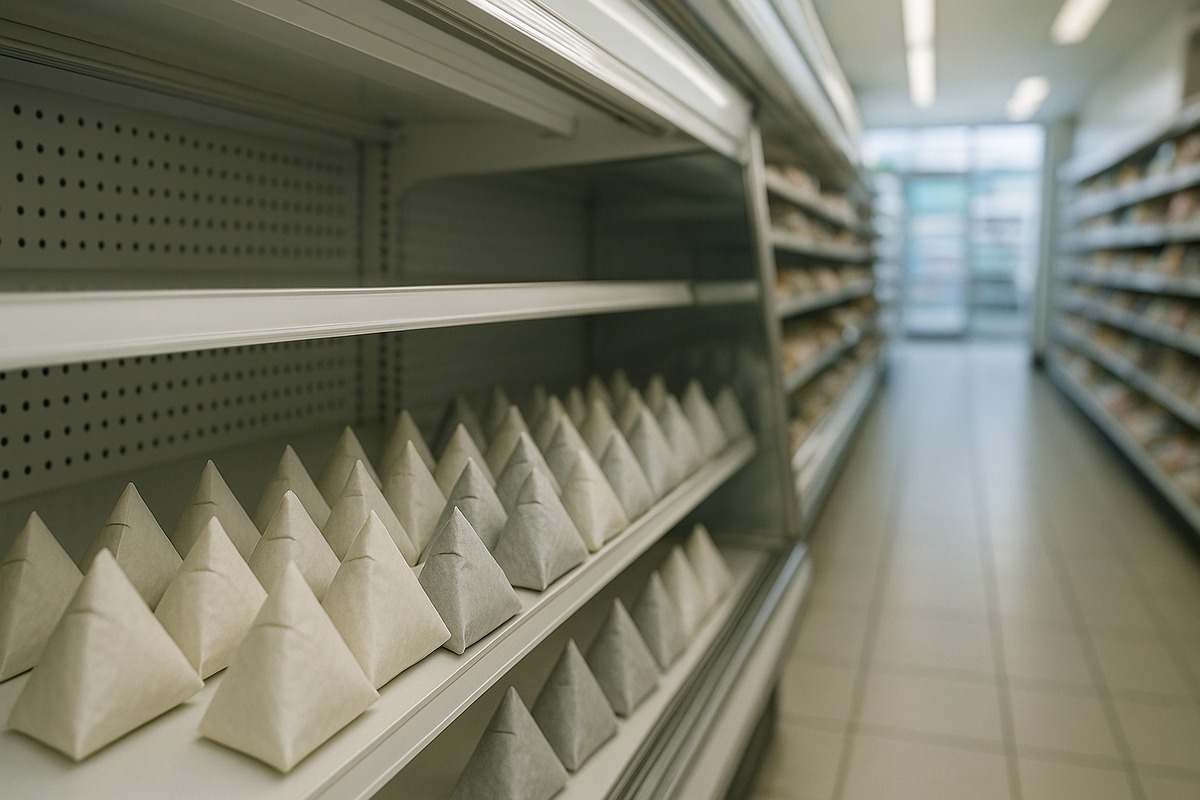
To understand why a ¥10 movement is news in Japan, you have to understand what the convenience store onigiri is inside the Japanese retail system. It is not really a product. It is a fixed point.
Japan has roughly 55,000 convenience stores. The hand-wrapped rice ball is among the most frequently repurchased items in most of them — a daily, habitual, low-consideration purchase made by office workers, students, construction crews and pensioners alike, in every prefecture, at essentially the same price. There is no other item in the Japanese consumer basket with quite that combination of ubiquity, frequency and price transparency. Bread varies by bakery. Coffee varies by cup size and chain. A rice ball is a rice ball.
That makes it the item Japanese consumers use to calibrate whether things are getting more expensive. When the price of an onigiri moves, it moves in the national conversation, on television, in the tabloids and in the specialist trade press within hours. Manufacturers of almost anything else can absorb a cost increase quietly through pack size, specification or channel mix. A convenience chain cannot quietly change the price of the thing that millions of people buy on their way to work.
This is a legacy of something overseas operators consistently underestimate: three decades of deflation trained an entire consumer population to treat a price increase as a moral event rather than an economic one. Japanese firms responded by developing an unusually sophisticated toolkit for not raising the headline number — shrinking contents, reformulating, downgrading packaging, splitting SKUs — precisely because the headline number was the thing customers policed.
When the rice crisis of 2024 and 2025 finally forced that number up anyway, it was genuinely painful for the chains, and the coverage was relentless. Which is why moving it back down, publicly, is not a routine merchandising decision. It is a statement.
What Actually Changed on the Shelf
The specifics matter, because the shape of each cut tells you something different about the chain making it.
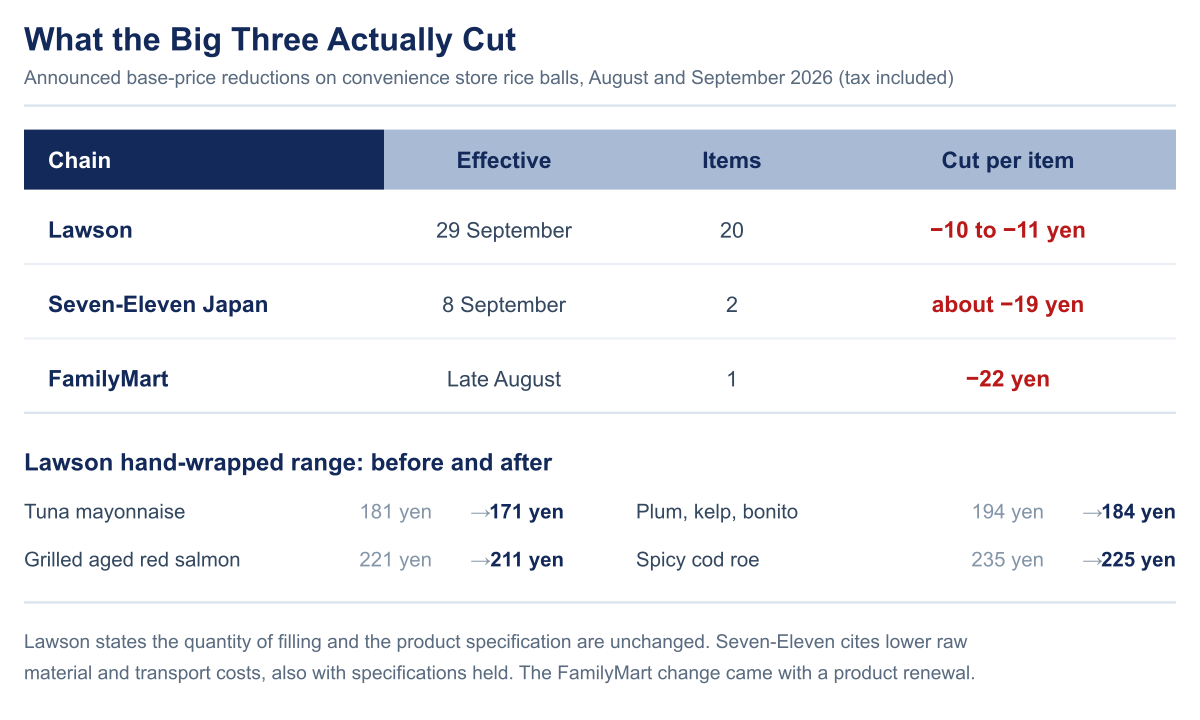
Lawson’s is the broadest and the most committed. Twenty hand-wrapped onigiri items, including regional variants, all cut by ¥10 or ¥11 including tax, effective 29 September. Sea Chicken Mayonnaise goes from ¥181 to ¥171. The ume, kombu and okaka varieties go from ¥194 to ¥184. Grilled aged red salmon goes from ¥221 to ¥211. Spicy cod roe goes from ¥235 to ¥225. The company has been explicit that the quantity of filling and the specification of the product are unchanged — which, in a market that has spent four years watching contents shrink while prices held, is the operative claim.
Seven-Eleven’s is narrower and earlier: two items, charcoal-grilled silver salmon and spicy cod roe, cut by roughly ¥19 from 8 September, attributed to reductions in raw material procurement and transport costs, again with specifications held. Two SKUs is a much smaller commitment than twenty, but Seven-Eleven moved three weeks ahead of Lawson on the calendar, and in a market where the competitive set watches each other’s shelf prices weekly, being early is its own kind of signal.
FamilyMart’s move came earliest and is the least clean of the three: the large kombu-and-tuna-mayonnaise musubi went from ¥320 to ¥298 in late August, but alongside a product renewal rather than as a pure price adjustment. That is the conventional way to move a price down in Japan — bundle it with a reformulation so that the comparison is never quite exact.
Taken together, three competitors moved the same headline number in the same direction within roughly five weeks. In a category this transparent, that is not three independent decisions. That is a category resetting a reference price.
The Same Month, 4,923 Other Things Got More Expensive
Now place that against the wider Japanese food shelf in September 2026, and the picture stops being a story about rice.
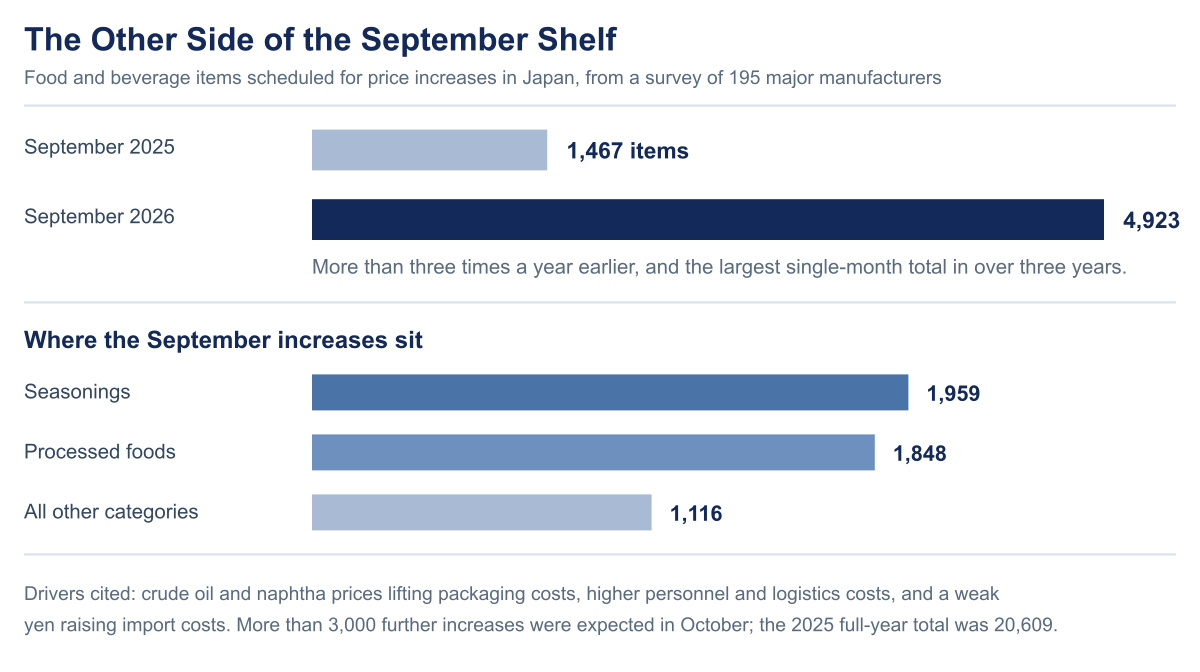
Teikoku Databank’s monthly survey found 4,923 food and beverage items with announced price increases in September — against 1,467 in September 2025. The count is of announcements by 195 major manufacturers, and it includes effective increases achieved by shrinking contents as well as repeat revisions to items raised earlier in the year, so it is a measure of pricing activity rather than of five thousand distinct products newly costing more. Seasonings led, at 1,959 items, including staples such as soy sauce and vinegar. Processed foods followed at 1,848. More than 3,000 further increases were expected in October, and the full-year 2026 total was on track to exceed 2025’s 20,609 items.
Why Everything Else Is Still Rising
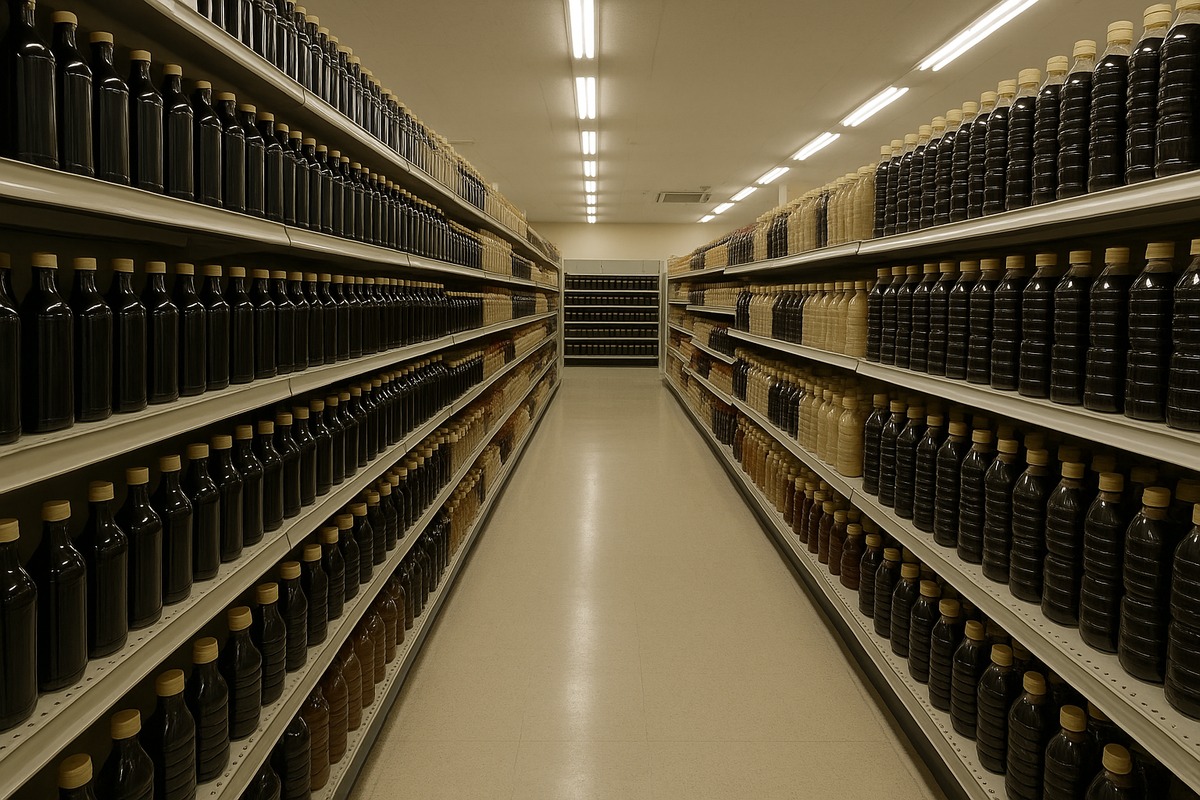
The drivers behind those 4,923 increases are largely energy, packaging, currency, labour and logistics, and none of them have anything to do with rice.
Crude oil and naphtha prices rose on Middle East tensions, which pushed up the cost of the plastic packaging that almost every processed food in Japan is sold in. Personnel costs rose, in a labour market where the statutory minimum wage has been climbing at a pace Japan has not seen in the postwar period. Logistics costs rose, against a well-documented shortage of drivers. And the yen stayed weak, which quietly raises the landed cost of every imported input in the country — wheat, soybeans, edible oils, dairy ingredients, packaging resin, and the energy used to process all of them.
Look at where the increases cluster and the pattern is unmistakable. Seasonings, at 1,959 items, are the single largest category: soy sauce, vinegar, cooking sauces, dressings. These are products with heavy glass or plastic packaging, imported agricultural inputs, long distribution chains and very low unit prices — which is to say, products where packaging, freight and currency are a large share of the delivered cost and where there is almost no room to absorb a shock. Processed foods, at 1,848 items, are the same story with a different label.
This is the part of the Japanese food shelf that no chain can fix with a good procurement year. A convenience store buys rice domestically and can benefit when a domestic crop normalises. Nobody buys naphtha domestically, and nobody can hedge the yen indefinitely.
So the September 2026 Japanese food shelf contains two opposite movements at once. Nearly five thousand items going up because of energy, packaging, labour, freight and currency. A handful of extremely visible items going down because of one domestic crop. Both are real. Only one of them is being discussed at the dinner table.
That asymmetry is the whole point. The chains did not cut prices on five thousand items. They cut the price of the item that everybody watches.
This Was Not a Pass-Through
Here is where the conventional reading — costs fell, so prices fell — breaks down.
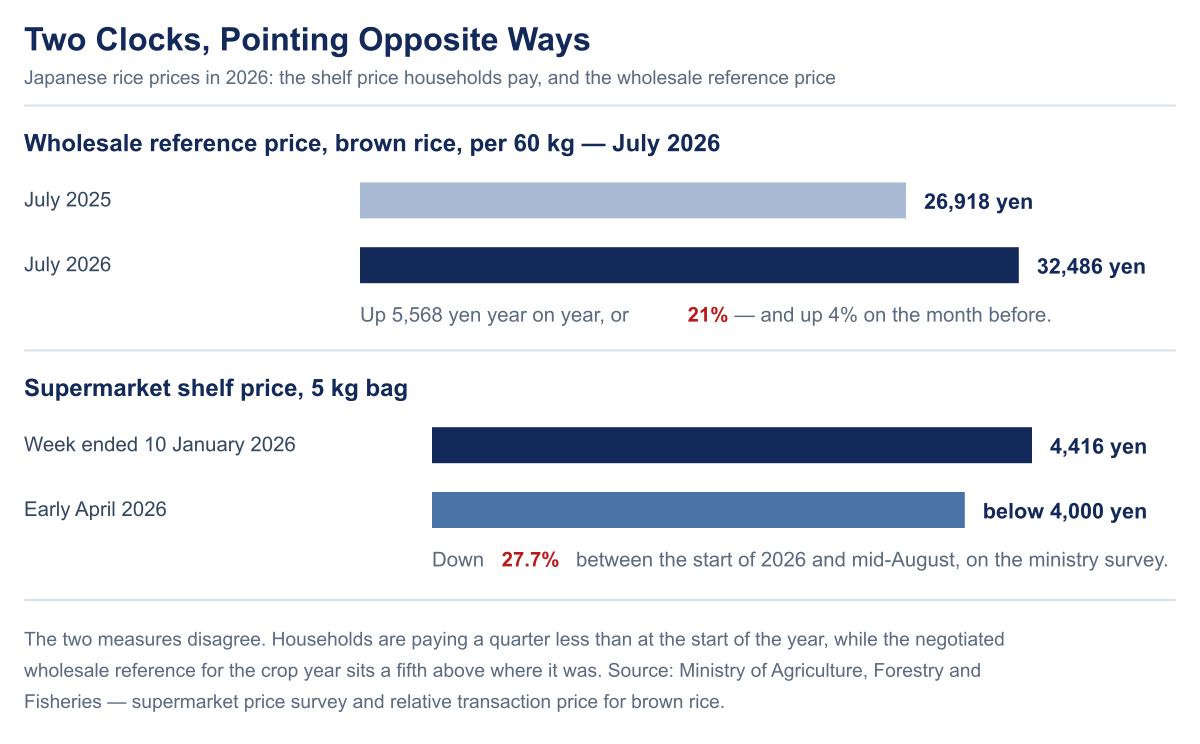
Japanese rice pricing runs on two clocks. The retail clock is the one consumers see: the Ministry of Agriculture, Forestry and Fisheries tracks the average supermarket price of a five-kilogram bag, which peaked at about ¥4,416 in the week ended 10 January 2026, fell below ¥4,000 by early April, and by mid-August was down 27.7% from where it had started the year. On that clock, the crisis is over.
The wholesale clock, which is closer to the one convenience chains actually buy on, tells a different story. The Ministry of Agriculture’s relative transaction price — the reference price for brown rice traded in 60-kilogram units — stood at ¥32,486 in July 2026. That was ¥5,568 higher than the same month a year earlier, an increase of 21%. It was also ¥1,181 higher than the month before, an increase of 4%.
Read that again, because it is the sentence the headlines skipped. At the moment these chains announced cuts to the shelf price of their most scrutinised product, the wholesale reference price of the main ingredient was a fifth above where it had been twelve months previously, and had risen month on month.
The two clocks are not measuring the same thing, and that is precisely the point. The supermarket price tracks what households pay for a bag of rice today, and it has fallen hard as supply normalised and consumers traded down. The relative transaction price tracks the negotiated wholesale reference between producers and distributors for a given crop year, and it reflects the cost of securing supply for the year ahead. A convenience chain’s own procurement sits somewhere between the two, on contracts negotiated forward.
But whichever number you weight, the conclusion is the same. A pure pass-through waits for input costs to sit below the level that justified the original increase, then returns the difference. Nothing in the wholesale data says that condition had been met. These chains cut on the strength of a direction of travel in retail and a forward procurement outlook, not on a realised saving that had already landed in their cost of goods.
Which means the cut was not an accounting event. It was a purchase — margin spent to buy something.
America Calls It a Rollback

The instructive contrast is with how the same downward pressure gets expressed in the United States, because the American grocery market in 2026 has also been full of price cuts. They are just a completely different instrument.
Walmart had rollbacks running on around 7,200 items early in 2026 and expanded that count to more than 11,000 by its next quarterly report. In July it cut prices across ice cream, ground beef, cherries, corn, potato chips and branded soft drinks, publicising a nine-item basket that fell from $73.42 to $54.70 — a 25% drop. Target lowered prices on a range of foods in March. The messaging volume around American grocery price cuts in 2026 has been, if anything, louder than in Japan.
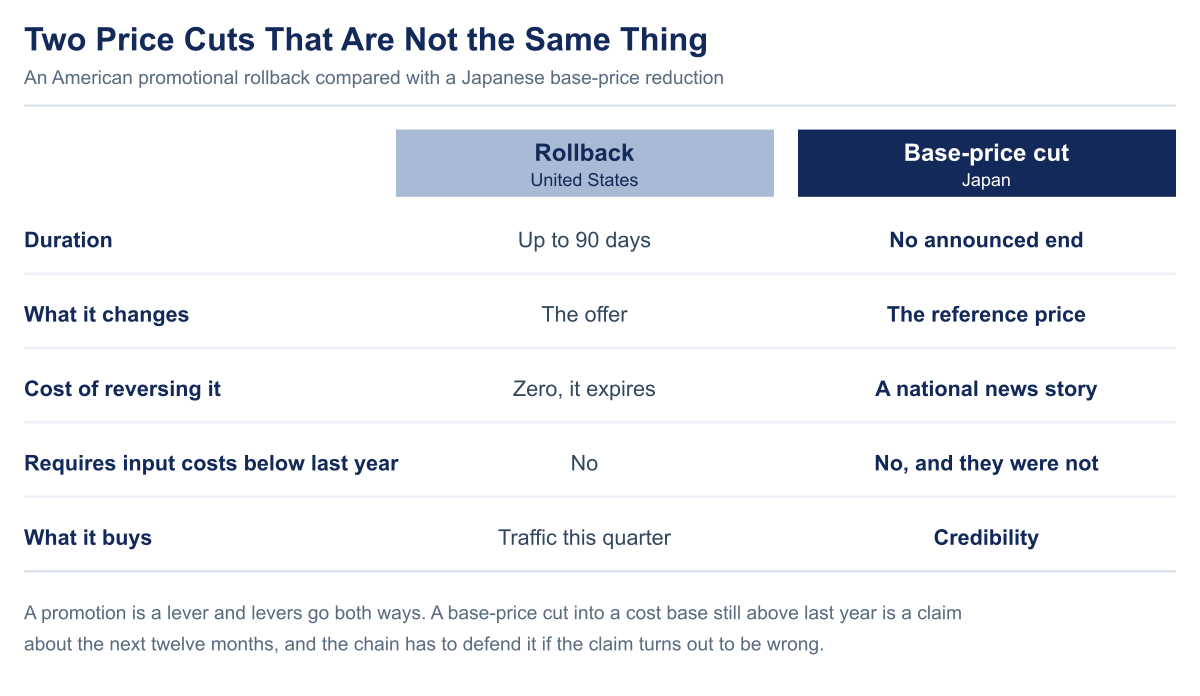
But a Walmart rollback is a defined, temporary mechanism. It is a time-boxed reduction on a specific item, typically running up to 90 days and sometimes as long as six months, after which the price returns to its regular level unless the rollback is renewed. It is a promotional tool with an expiry date, executed at enormous scale and with considerable operational sophistication, and it does exactly what it is designed to do — drive traffic and basket size in a given quarter.
Meanwhile the underlying trend line did not bend. American grocery prices were running roughly 3% higher year on year, and the USDA’s expectation for food-at-home prices in 2026 was around 2.7%, close to the long-run average of 2.6% and far below the 11.4% shock of 2022. Shoppers responded by buying fewer items, trading into private label, and concentrating spend at the cheapest operators.
So both markets produced the identical headline — big retailer cuts prices — from two structurally different actions. One is a promotion. The other is a reset of the reference price.
A Promotion Expires. A Price Cut Has to Be Defended.
The distinction is not semantic, and it is the single most transferable idea in this article.
A rollback is reversible by design. Its end is scheduled at the moment it begins. Nobody experiences its expiry as a price increase, because everyone understood it as temporary. That reversibility is precisely what makes it cheap: the retailer buys quarterly traffic without surrendering any pricing freedom, and can withdraw it the moment conditions change. It is a lever, and levers go both ways.
A base-price cut has no expiry. If input costs turn back up — and the wholesale reference price for Japanese rice was still a fifth above the prior year when these cuts were announced — the chain has three options, all bad. Absorb the cost and carry a thinner margin indefinitely. Raise the price back, and pay for it in a country where a rice ball price increase is a national news item. Or hold the number and take the cost out of the product, which is the shrinkflation route the chains have just publicly foreclosed by stating that specifications are unchanged.
In other words, the Japanese chains have written themselves a liability. Deliberately. That is what makes it credible.
This is a costly signal in the strict economic sense. The information is not in the ¥10. Ten yen is nothing; it is about six cents. The information is in the fact that the cut is expensive and hard to reverse, which is exactly why a competitor who did not genuinely believe procurement costs were heading down could not comfortably imitate it. A promotion anybody can run. A base-price cut into a still-elevated cost base is a claim about the next twelve months, backed by the balance sheet.
And the audience for that claim is not really the customer standing at the shelf. It is the entire consumer public that has spent two years being told Japanese inflation was structural and permanent. The chains just demonstrated, on the most-watched item in the country, that at least one price could come back down. In a market where the fear is not that prices are high but that they will never fall again, that demonstration is worth considerably more than the margin it costs.
What Operators Should Take From This

Three things, and none of them are about rice.
The first is that in Japan you should identify your reference SKU before you build your pricing strategy, not after. Nearly every Japanese category has one — the item whose price consumers actually track and treat as representative of your entire range. It is rarely your highest-margin product and often not your best seller. Price movements on that item carry many times the communicative weight of price movements anywhere else in your range, in both directions. Foreign operators routinely raise prices across a portfolio uniformly, on the theory that this is fair and simple, and are then surprised by the reaction. The reaction is not to the average. It is to the one item everyone was watching.
The second is that in a deflation-conditioned market, the ability to lower a price credibly is a strategic asset, and it has to be protected before you need it. Every reformulation, every quiet content reduction, every price increase not clearly tied to an explainable input cost spends down the same reserve of credibility. The chains could make this move in September 2026 because they had spent the rice crisis being visibly, and painfully, transparent about why prices were going up. Operators who spent the last four years disguising increases through pack size do not have that option available now, whatever their cost base does.
The third is about how to read Japanese price signals from abroad, which is where I see the most expensive mistakes. Do not read the onigiri cut as evidence that Japanese food inflation is over — 4,923 items went up the same month, more than 3,000 more were queued for October, and the full-year count was heading past 20,609. And do not read the September price-increase count as evidence that Japanese consumers are being squeezed uniformly, because the most visible item in the country just got cheaper. Both readings are wrong in the same way: they treat a signal as a summary. In Japan more than in most markets, the loudest price is deliberately chosen, and it is chosen precisely because it is not representative.
If you take one operating question away from this, make it that one. When your Japanese competitor moves a price, ask first whether they moved a number that matters commercially or a number that matters publicly. They are almost never the same number, and the second one is usually the decision.
Frequently Asked Questions
Q. How much are Japanese convenience store rice balls actually going down by?
A. Lawson is cutting twenty hand-wrapped onigiri items by ¥10 to ¥11 including tax from 29 September 2026 — for example Sea Chicken Mayonnaise from ¥181 to ¥171, and grilled aged red salmon from ¥221 to ¥211. Seven-Eleven Japan is cutting two hand-wrapped items by about ¥19 from 8 September. FamilyMart reduced its large kombu-and-tuna-mayonnaise musubi from ¥320 to ¥298 in late August, alongside a product renewal.
Q. Does this mean the Japanese rice crisis is over?
A. Not exactly. Retail rice prices have fallen a long way — the average supermarket price of a five-kilogram bag was down 27.7% between the start of 2026 and mid-August, after peaking around ¥4,416 in January. But the two measures diverge: the ministry’s relative transaction price for brown rice stood at ¥32,486 per 60 kg in July 2026, up ¥5,568 or 21% on the same month a year earlier, and up 4% on the month before. Household prices have fallen sharply; the wholesale reference price has not returned to pre-crisis levels.
Q. Is Japanese food getting cheaper overall?
A. No. Teikoku Databank counted 4,923 food and beverage items scheduled for price increases in September 2026, more than triple the 1,467 of September 2025, with seasonings and processed foods accounting for the largest share. The rice ball cuts are a narrow and highly visible exception inside a food shelf that is still broadly inflating.
Q. How is this different from Walmart cutting prices in the United States?
A. Walmart’s rollbacks are temporary reductions on specific items, typically lasting up to 90 days and sometimes six months, after which the price reverts. The Japanese convenience chains changed the standing base price with no announced end date and stated that product specifications are unchanged. One is a promotion; the other is a reset of the reference price.
Q. Why do convenience store rice balls get so much attention in Japan?
A. Because they are close to a universal purchase — bought daily, across every demographic and region, at a nationally consistent price — which makes them the item consumers use to judge whether the cost of living is rising. That visibility means chains cannot adjust the price quietly, and it means a cut carries a public message far beyond its commercial value.
Conclusion
The easy version of this story is that rice got cheaper and rice balls followed. That version is not wrong, but it explains the least interesting part of what happened.
What actually happened is that three competitors, in a market where the input cost was still above its year-ago level, chose to lower the standing price of the most closely watched item in the country during a month when nearly five thousand other food items were going up. They gave up margin they did not have to give up, on a schedule nobody forced on them, and they took away their own ability to quietly claw it back by promising the product would not shrink.
That is not a cost pass-through and it is not a promotion. It is a company spending money to say something in the only language a Japanese consumer fully trusts, which is the number on the shelf.
For international operators, the takeaway is not that Japanese prices are falling. It is that in this market a price is a message before it is a margin — and if you cannot say which of your prices your customers are actually reading, you are not yet pricing in Japan. You are just converting from your home currency.
If you’re interested in this topic, the Japanese market more broadly, or what KETCHUPs is working on, we’d love to hear from you — please reach out via our contact form.
Japan Market Pulse is a weekly read on what the Japanese consumer-tech, food, and mobility markets are choosing to do, written for international operators who want to know what is happening before it shows up in the global trade press.
Subscribe at ketchups.co/japan-market-pulse.