

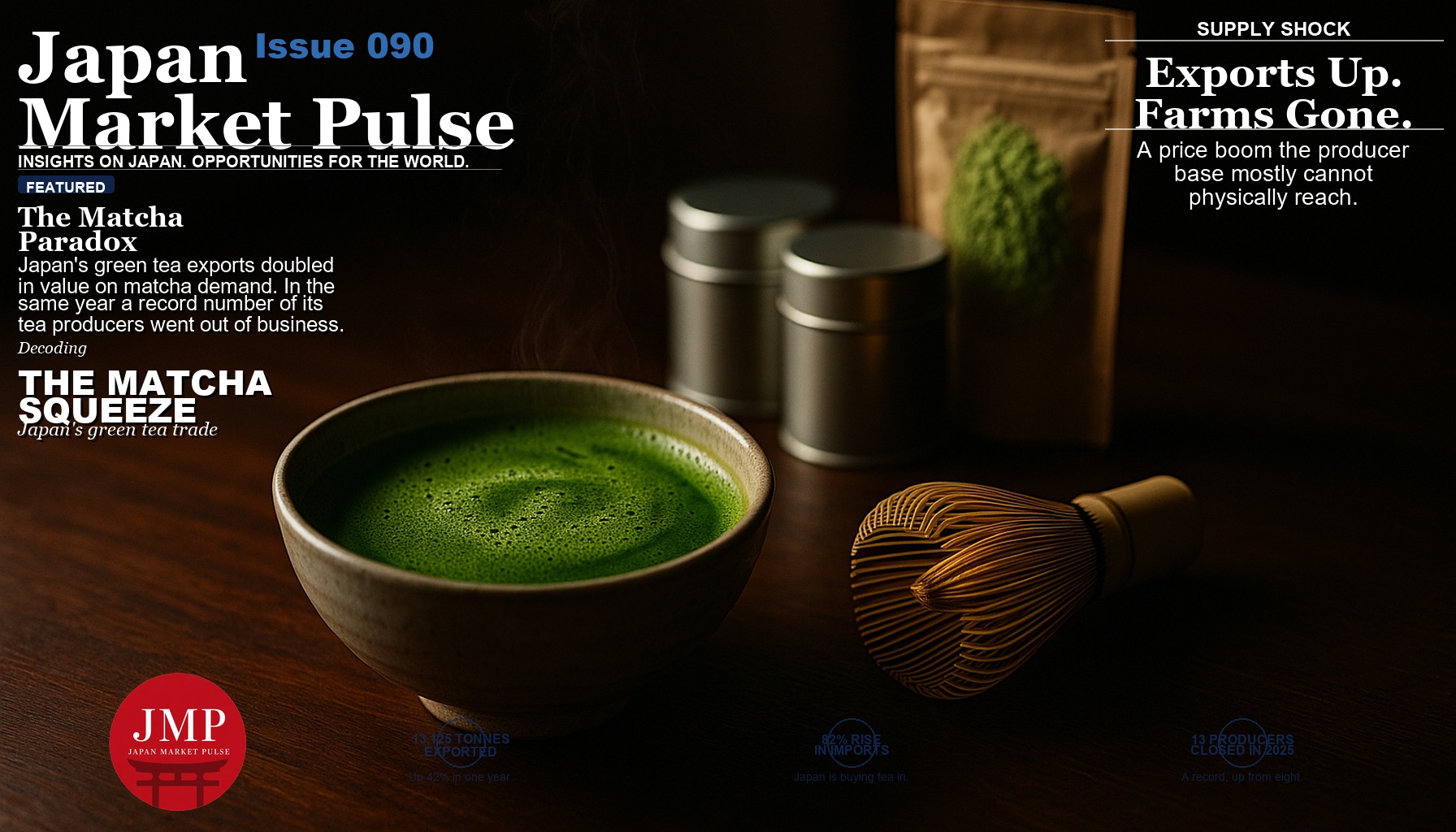
The first time I saw a purchase limit sign on a matcha tin in Kyoto, I assumed it was theatre. Japanese retailers love a good scarcity signal, and a laminated card asking each customer to please take only one 40-gram tin sits very comfortably inside that tradition. That was late 2024. By the spring of 2026 the same shops had stopped bothering with the sign, because the shelf it was supposed to govern was simply empty, and the staff had moved on to explaining the situation verbally, several times an hour, in three languages.
Then the trade data landed and made the whole thing legible. In the fiscal year that ended in March 2026, Japan exported 13,125 tonnes of green tea, a 42% jump in volume. The value of those exports rose to ¥84.7 billion — roughly $530 million at the exchange rates of this summer — which is a 2.2-fold increase. Volume up 42%, value up 120%. Roughly 70% of the export volume was powdered green tea. Powdered green tea, led by matcha, is now the export face of Japanese tea.
That is the headline any trade publication would run. Here is the part that did not make the headline: in the same period, Japan’s own green tea imports rose 82% to 5,801 tonnes, mostly from China. And in 2025 a record 13 Japanese tea producers suspended operations or dissolved, up from eight the year before — 14 left the market once bankruptcies are counted.
A record export year, a sharp rebound in imports, and a record number of producers shutting the gates. Those three facts are not a contradiction. They are the same fact, viewed from three positions in the supply chain — and if you buy, sell, or build anything that depends on a concentrated agricultural origin, the mechanism underneath them is worth understanding before it happens to your category.
The Export Number That Does Not Mean What You Think
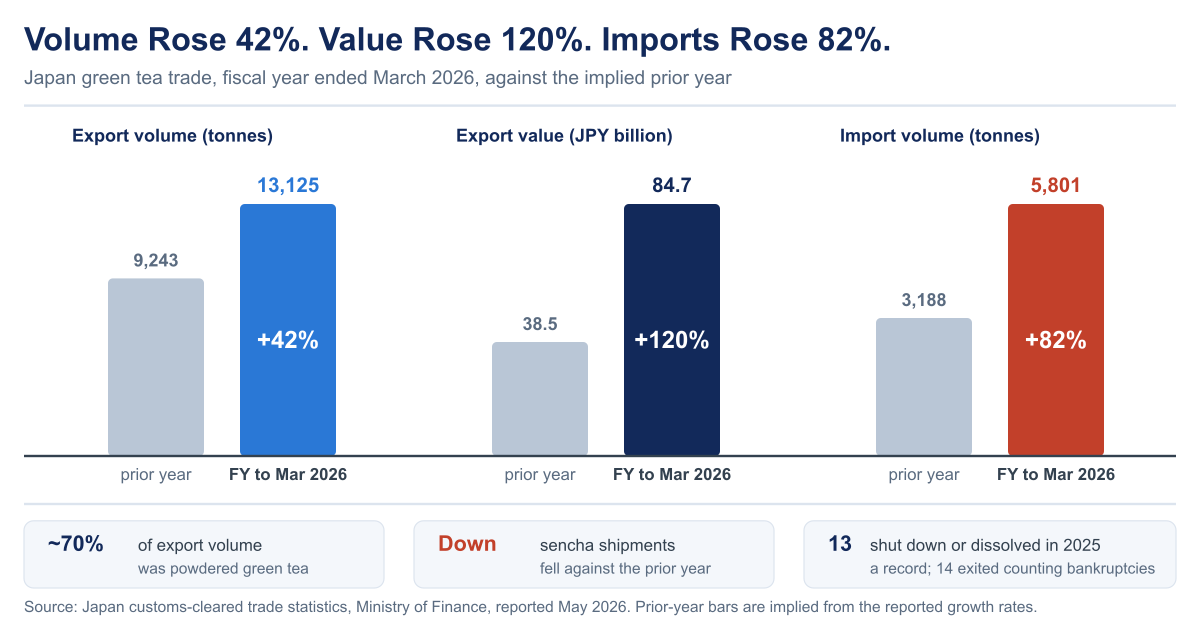
A 42% volume increase and a 120% value increase are not two versions of the same good news. The gap between them is the entire story. If Japan had simply grown more tea and sold more of it, the two lines would move together. They did not. Japan sold moderately more tea for dramatically more money, which is what a market looks like when demand outruns supply and price does the rationing.
There is a second distortion hiding inside the volume figure. Powdered green tea took about 70% of export volume, and shipments of the other categories — sencha, the ordinary loose-leaf tea that has been Japan’s domestic default for centuries — actually declined. So the export line is not “Japanese tea is booming.” It is “one product inside Japanese tea is booming, and it is cannibalising the rest.”
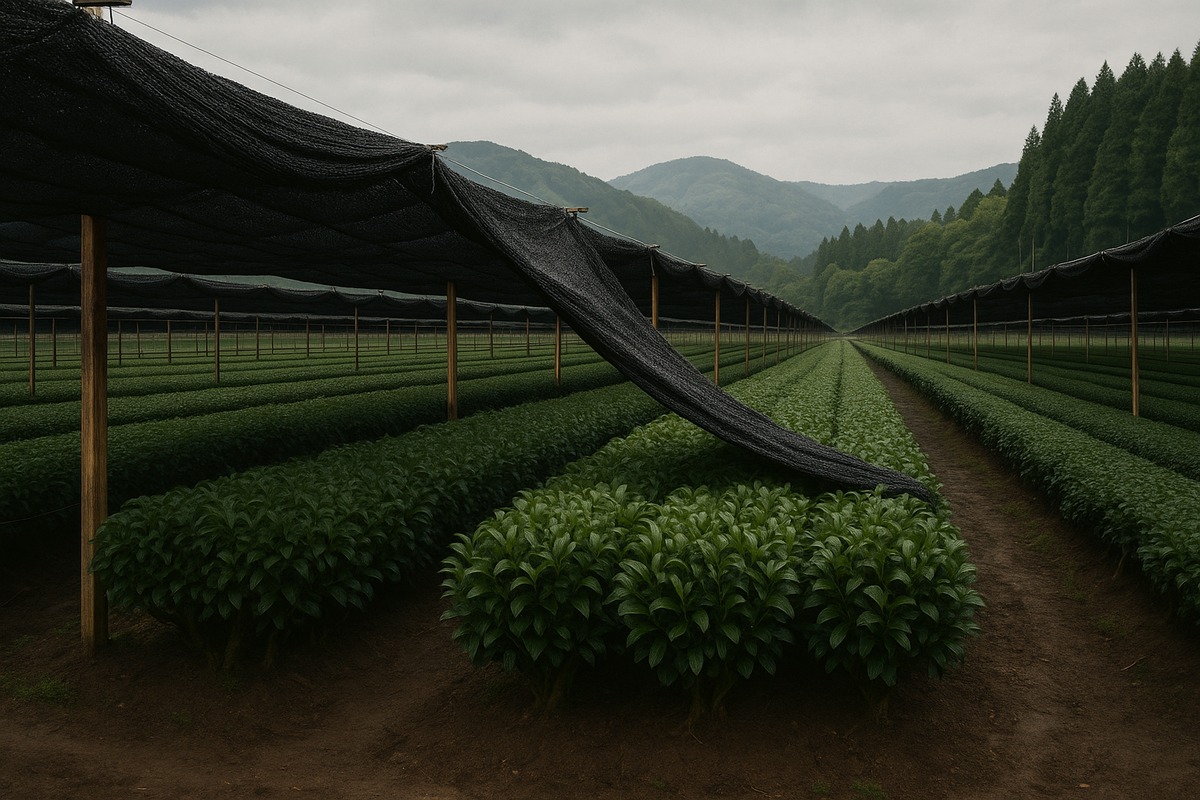
This matters commercially because matcha and sencha come from the same bushes and, up to a point, the same farms. They diverge at the field. Tencha, the raw leaf that gets stone-milled into matcha, is grown under shade for several weeks before harvest, which drives up chlorophyll and amino acids and gives matcha its colour and its sweetness. Sencha is grown in full sun. A farmer choosing to serve the matcha boom is not adding capacity to the system; in most cases they are moving capacity out of sencha and into tencha, because tencha is where the money went.
Output of tencha has now risen for four consecutive years through 2024. That sounds like the system responding correctly. But the response has been arriving into demand that grew faster, from a global consumer base that did not exist at this scale five years ago, and it has been arriving by subtraction from a different product line rather than by addition. The export chart looks like a boom. The production chart looks like a reallocation.
For an operator, the useful reading is this: when a category’s value grows twice as fast as its volume, you are not looking at a growth market you can enter on normal terms. You are looking at an allocation market, and allocation markets reward incumbency, contracts, and relationships rather than willingness to pay.
Japan Is Now Importing Tea to Cover Its Own Cups
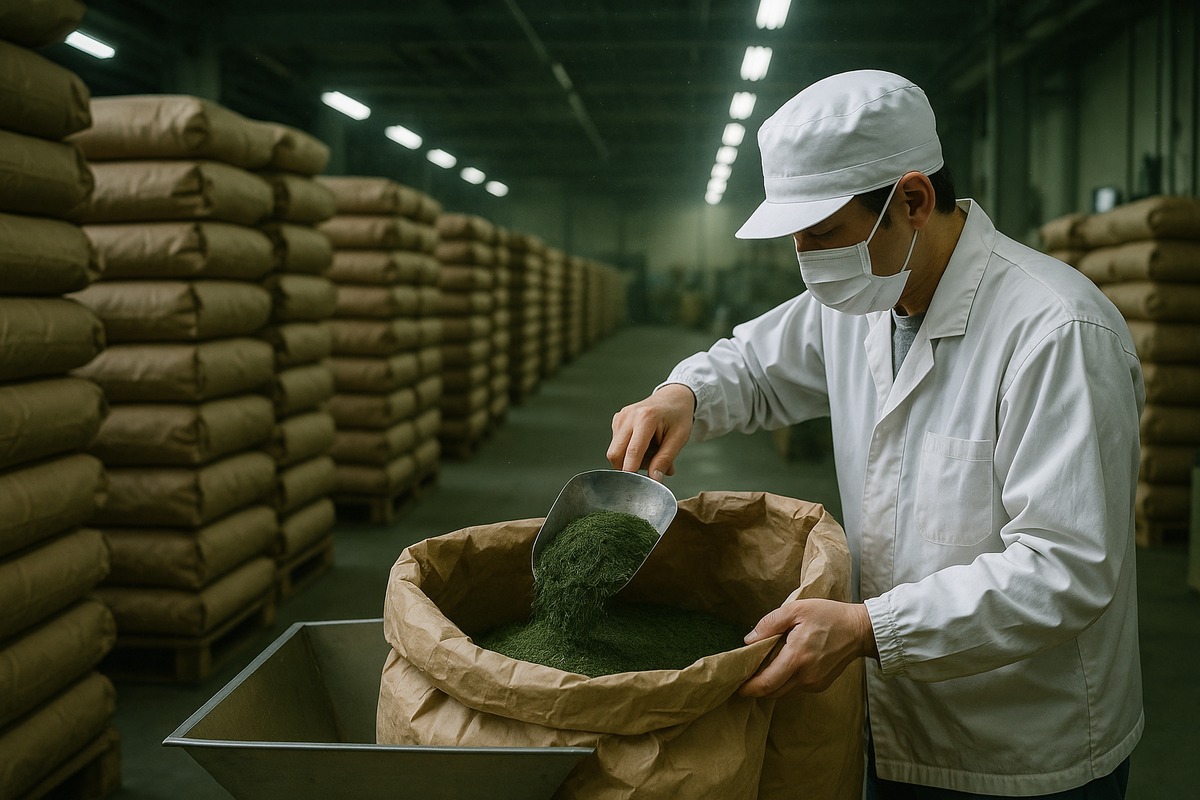
The 82% jump in Japan’s green tea imports — 5,801 tonnes, largely Chinese — is the single most revealing number in the dataset, and almost nobody outside the trade noticed it.
Japan is the country that refined this product into the form the world now recognises, holds the cultural authority over it, and is currently exporting it at record value. It is also, simultaneously, buying more foreign green tea than it has in years. Both things are true because they are happening at different ends of the quality and price ladder. The high-grade domestic leaf is being pulled out toward export buyers who will pay whatever the auction asks. The volume end of Japan’s own market — bottled tea, tea bags, food-service pours, the tea in confectionery and ice cream and canned lattes — still needs raw material, and it is the commodity-tier and mass-market applications that are most exposed to imported leaf.
I want to be careful about how this gets framed, because “Japan imports Chinese tea” is the kind of sentence that gets turned into something it is not. This is not a quality scandal. It is a substitution at the commodity tier, and it is exactly what economics predicts when a domestic input becomes too valuable to use domestically. A similar export-premium dynamic can show up in categories such as Japanese wagyu, Hokkaido scallops and aged Japanese whisky. Once the export price clears the domestic price by a wide enough margin, the home market gets served by the next-best source.
The consequence for anyone sourcing “Japanese matcha” is that the phrase has become significantly less informative than it was three years ago. Origin, grade, and mill are now doing work that the word “Japanese” used to do on its own. There is a real and growing incentive for products to be labelled in ways that imply more Japanese content than they contain — powder blended across origins, culinary grade sold on ceremonial-grade positioning, or green tea powder that is not tencha-derived at all. If your brand’s promise rests on a specific origin, this is the moment to move from trust to verification: prefecture-level documentation, mill relationships, lot traceability.
You Cannot Simply Grow More Matcha
Every commodity shortage story eventually reaches the same reasonable question. Prices are up, so why doesn’t supply respond? For tencha, there are four answers, and they compound.
The first is biological. A newly planted tea bush takes roughly five years before it yields a meaningful first harvest. A grower who decided in the spring of 2025 that matcha was the future is looking at 2030 before that decision produces usable volume. The signal arrives fast; the plant does not care.
The second is structural. Converting a sencha field into a tencha field is not a change of intent. It requires shading infrastructure — frames and covers erected over the rows for weeks before harvest — plus different pruning, different harvest timing, and different post-harvest handling. That is capital expenditure and new operational knowledge landing on farms whose owners are, on average, closer to retirement than to their first expansion.
The third is geographic. Around 40% of Japan’s tea plantations sit on hilly or mountainous terrain. Those fields resist mechanisation. They are the fields that get abandoned first when a farm shrinks, and they are the fields that cannot be scaled quickly when a farm wants to grow. Japan’s tea map is not a flat plain waiting for more acreage; it is a set of slopes with a labour problem.
The fourth is processing. Tencha becomes matcha by being ground, and the traditional method is a granite mill turning slowly enough to avoid heating and damaging the powder. The throughput figure quoted throughout the industry is on the order of tens of grams per hour per mill. Modern processing has faster options, but at the top of the market, the mill is the constraint, and mills are not something a farm buys on a quarterly forecast.
Put those four together and you get a supply curve that is nearly vertical in the short run. Demand can double in eighteen months because a drink went viral. Supply cannot. Everything in the price data follows from that asymmetry.
The Auction Record That Broke, and Then Broke Again
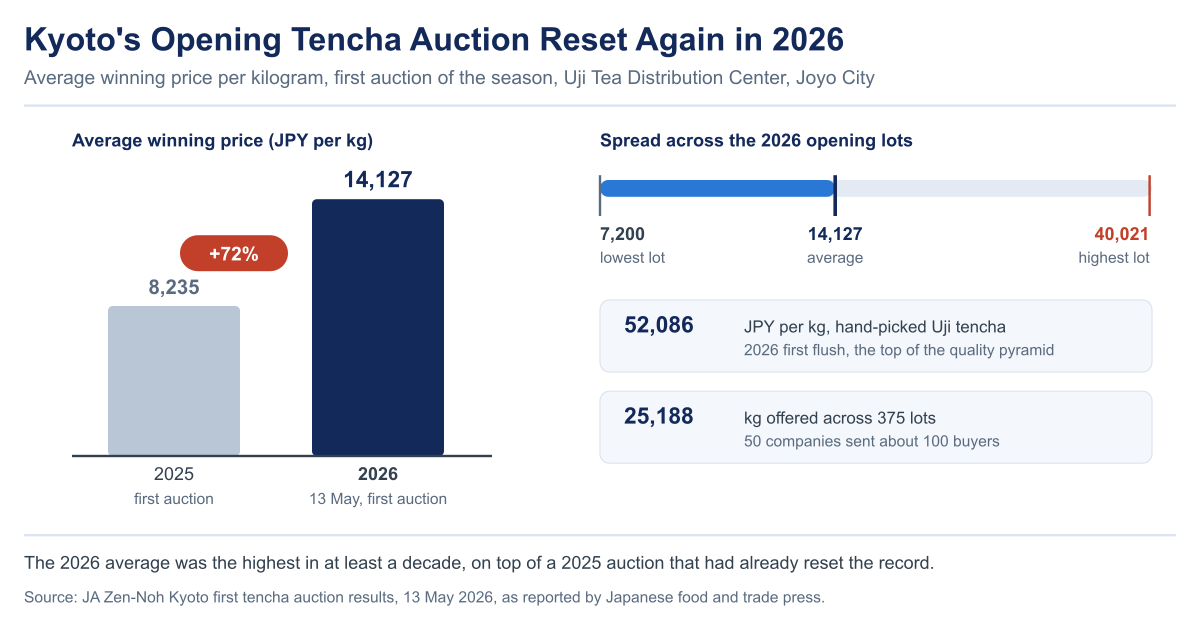
Japan’s tencha price is discovered in the open, at prefectural auctions, which makes it one of the more honest price signals in agriculture.
On 13 May 2026, at the Uji Tea Distribution Center in Joyo City, Kyoto, the season’s first tencha auction put up 375 lots totalling 25,188 kilograms. Fifty companies sent about a hundred buyers. The average winning price came in at ¥14,127 per kilogram — the highest in at least a decade. The top lot went at ¥40,021 per kilogram; even the cheapest cleared ¥7,200.
The year before, that same first auction had averaged ¥8,235 per kilogram, which at the time was itself treated as an extraordinary number. So the average price of the raw material for matcha rose about 72% in one year, on top of a previous year that had already reset the record. Hand-picked Uji tencha — the very top of the pyramid, the material that goes into ceremonial-grade product — was reported at ¥52,086 per kilogram in the 2026 first flush.
Sit with the 25,188 kilograms for a second. That is the entire opening lot volume for Kyoto’s flagship tencha auction. Twenty-five tonnes. Against a global market that market researchers size in the billions of dollars and expect to roughly double over the next decade. The mismatch between the size of the demand narrative and the size of the physical thing being auctioned is the whole shortage in one comparison.
The other thing to notice is what the price is doing structurally. Auction prices are volatile and individual sessions can and do come back down. What moves more slowly is everything downstream of them: farmgate expectations, multi-year supply contracts, and the retail price points that have already been reset. Anyone budgeting on matcha input costs returning to 2023 levels the moment “the shortage passes” is planning around the wrong variable.
A Record Export Year and a Record Number of Closures
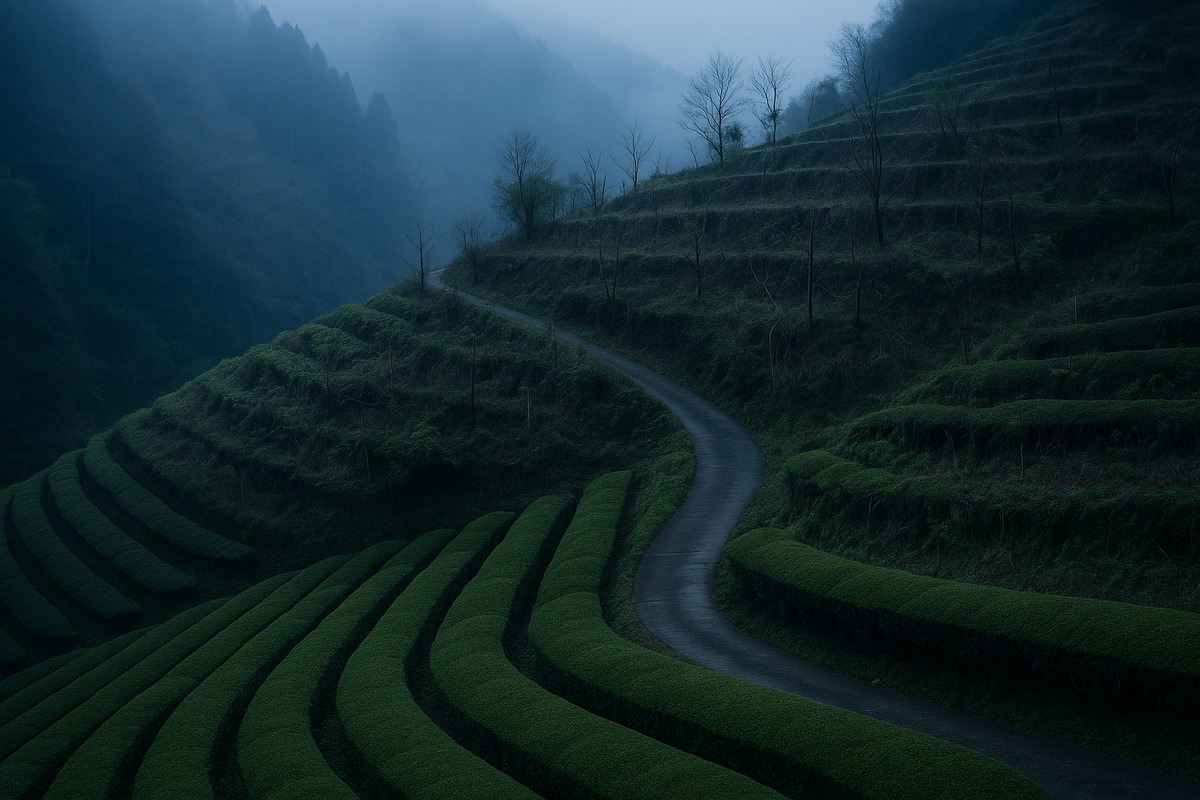
Here is where the story stops being about tea and starts being about how booms actually distribute themselves.
In 2025, a record 13 Japanese tea producers suspended operations or dissolved, up from eight the previous year, with 14 leaving the market once bankruptcies are included. That happened during the strongest export year the category has had in living memory. It is not an anomaly, and it is not irony. It is what happens when a price boom is concentrated in one product tier that most of the producer base cannot physically access.
If you are a grower with tencha-capable fields, shading infrastructure already amortised, a mill relationship, and a buyer who will take your first flush at auction, the last two years have been transformative. If you are a grower of ordinary sencha on a sloped field, with an ageing workforce, no shading structures, and a domestic bottled-tea buyer whose alternative supply is now arriving from China at a lower price — the same two years have been an accelerated squeeze. Your input costs rose. Your product’s price did not. Your neighbour’s did.
Industry bodies, including the Global Japanese Tea Association, have described the period since autumn 2024 as an unprecedented matcha shortage. That autumn is also when the consumer-facing symptoms became unmissable: Ippodo, one of Kyoto’s most established tea houses, suspended sales of some of its matcha lines and capped quantities, and Marukyu Koyamaen restricted what customers could buy. When houses of that standing start turning customers away rather than raising prices to clear the shelf, it is a signal that they have concluded the constraint is physical rather than commercial.
There is a version of this article that treats the closures as a tragic footnote to a success story. I do not think that is the right reading. The closures are the mechanism. Consolidation is how this industry is going to meet global demand — fewer, larger, better-capitalised operations with tencha infrastructure, serving an export market, while the diffuse base of small sun-grown sencha farms that defined Japanese tea for a century contracts. That is a structural transformation of a national agricultural sector, being driven almost entirely by consumer demand originating outside Japan.
What This Means If You Buy, Sell, or Build on Japanese Supply
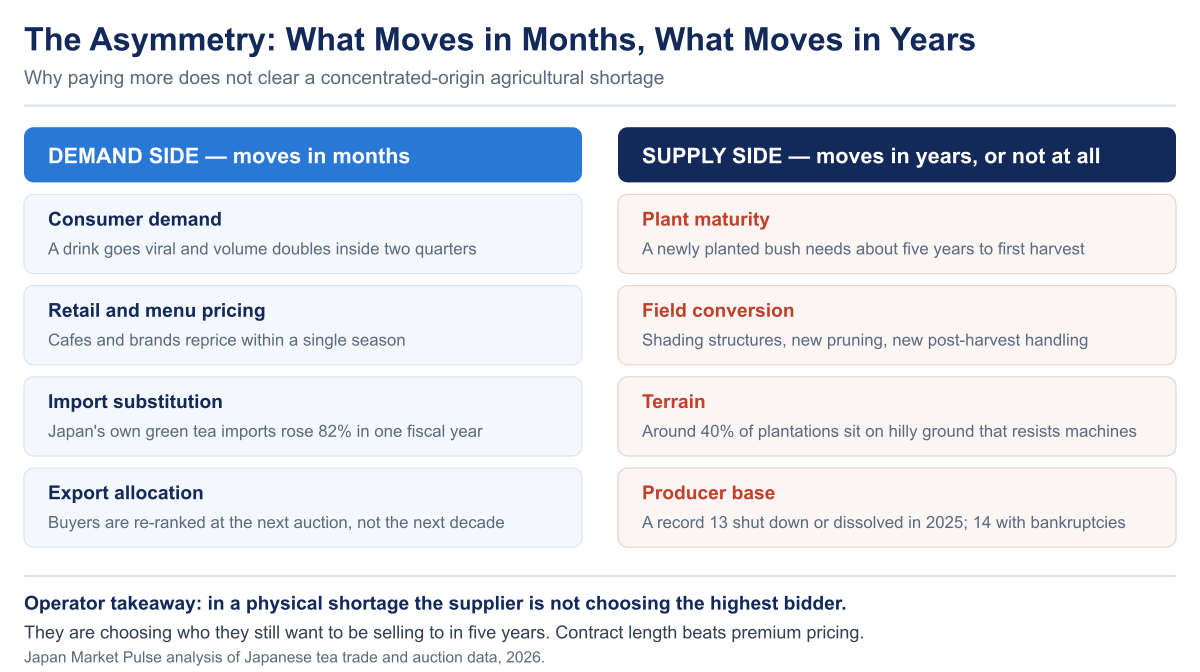
Most readers of this will never buy a kilogram of tencha. The transferable part is the pattern, and the pattern shows up wherever a global brand story is built on a geographically concentrated, agriculturally constrained, culturally authenticated input. Japanese matcha. Single-origin cacao. Mezcal agave. Vanilla. Saffron. Certain fisheries. The failure mode is identical, and it arrives in the same order.
Demand elasticity and supply elasticity are not symmetric, and your plan probably assumes they are. A marketing team can double demand in two quarters. An agricultural supply base cannot respond inside five years. If your growth model has a line that says “scale sourcing accordingly,” ask what the biological cycle time of the input is before you sign anything downstream of it.
Price is not the binding constraint; allocation is. In a genuine physical shortage, the supplier is not choosing the highest bidder. They are choosing who they still want to be selling to in 2031. Multi-year commitments, predictable order patterns, and the willingness to take a full grade range rather than cherry-picking the top lots are worth more than a premium bid. If your procurement strategy is “we’ll pay up when we need it,” you are the account that gets cut first.
The word on the label is doing less work than you think. As authentic supply tightens, definitional drift accelerates. Categories get stretched, blends get reclassified, and the gap between the consumer’s mental model of the product and its physical composition widens. If your brand equity is built on origin authenticity, the cost of verification has just become a cost of doing business, not a nice-to-have.
Watch the boring line in the trade data. The export headline was the exciting number. The import number — up 82% — was the one that told you what was actually happening to domestic availability, and it was buried. In every concentrated-origin category, there is an equivalent line. Find it before your competitors do.
Assume the price step is permanent. Plan the product architecture at the new input cost. That may mean smaller formats, a reformulated culinary tier that does not pretend to be ceremonial, or an explicit two-product strategy. What it should not mean is holding the old price and quietly diluting the specification, which is the standard response and the one that destroys the brand two years later when the market notices.
Frequently Asked Questions
Q. Is the matcha shortage over in 2026?
A. No. The spring 2026 harvest arrived into a market that was already short, and the auction data reflects it: Kyoto’s first tencha auction of 2026 averaged ¥14,127 per kilogram, up about 72% from the previous year’s already-record average. Supply is expanding, but from a small base and against demand that continues to grow faster.
Q. Where can I buy real Japanese matcha outside Japan?
A. Established specialty tea importers and the direct online stores of Japanese tea houses are the most reliable channels, though many run waitlists or purchase limits during peak season. For everyday use, widely distributed Japanese-sourced brands such as Jade Leaf ceremonial grade matcha are available on Amazon, and a broader selection can be found by browsing Japanese matcha powder listings. Check that the packaging names a specific Japanese prefecture of origin rather than only “Japanese-style.”
Q. Why is matcha so much more expensive than regular green tea?
A. Because it is a different agricultural product with a much higher cost structure. Tencha is shade-grown for weeks before harvest, which requires infrastructure and reduces yield, and it is then ground slowly — traditionally on granite mills — in small quantities. Top-grade hand-picked Uji tencha was reported at ¥52,086 per kilogram in the 2026 first flush. Ordinary sun-grown sencha carries none of those costs.
Q. Will Japan simply plant more tea to meet global demand?
A. Slowly, and not in a way that solves the near-term problem. A newly planted tea bush takes about five years before it yields a meaningful first harvest, converting a field to tencha requires shading equipment and new handling processes, and roughly 40% of Japan’s tea plantations sit on hilly terrain that resists mechanisation. Meanwhile the producer base is contracting — a record 13 producers suspended operations or dissolved in 2025.
Q. Is Japanese matcha being replaced by Chinese green tea?
A. Not at the premium tier, but substitution is real at the commodity end. Japan’s own green tea imports rose 82% to 5,801 tonnes in the year to March 2026, largely from China, as high-grade domestic leaf was pulled toward export buyers. Bottled tea, tea bags and food-service applications are where that imported material lands.
Conclusion
Japan’s tea industry just had its best export year in generations and its worst year for producer survival at the same time, and the two facts share a single cause: the world discovered a product that Japan cannot make significantly more of on any timeline that matters to a marketing calendar.
What I find genuinely interesting is how little of this was visible from the consumer side. The shortage showed up as a purchase limit card in a Kyoto shop, then as an empty shelf, then as a $9 latte in Brooklyn. Underneath it, a national agricultural sector is consolidating, a century-old crop mix is being rewritten, and the definition of a globally recognised product is quietly loosening.
If you operate anywhere near a concentrated-origin category, the number to internalise is not ¥84.7 billion. It is 25,188 — the kilograms of tencha that came up at Kyoto’s opening auction this year, against a global market being sized in the billions. That ratio is the shape of the problem, and it does not resolve by paying more.
This article contains affiliate links. If you purchase through these links, we may earn a small commission at no extra cost to you.
If you’re interested in this topic, the Japanese market more broadly, or what KETCHUPs is working on, we’d love to hear from you — please reach out via our contact form.
Japan Market Pulse is a weekly read on what the Japanese consumer-tech, food, and mobility markets are choosing to do, written for international operators who want to know what is happening before it shows up in the global trade press.
Subscribe at ketchups.co/japan-market-pulse.