

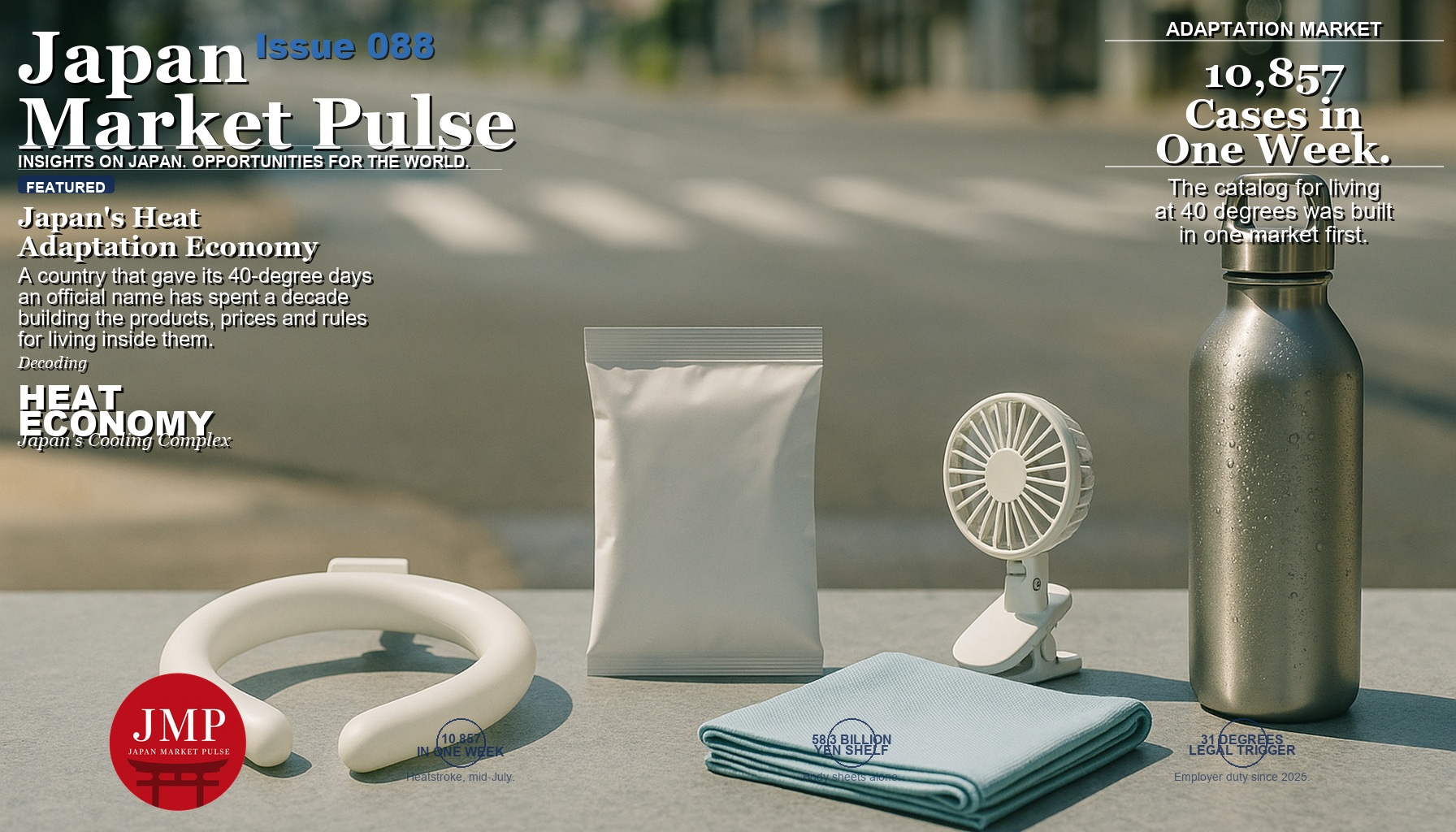
While the rest of the world argues about thermostats and stalled workplace rules, Japan has spent a decade building a full commercial stack — consumer, workwear and industrial — on the assumption that summer is now a hazard. Here is what that stack looks like, and why it is about to become an export category.
In April, Japan’s national weather agency did something it had not done in nineteen years. It added a new word to the official vocabulary of summer.
The Japan Meteorological Agency ran a public survey between late February and late March asking people what to call a day when the temperature reaches 40°C. Roughly 478,000 people responded. The winner, with nearly 203,000 votes — more than triple the runner-up — was kokushobi, written with the character koku, meaning harsh or cruel. On April 17 the JMA made it official.
It now sits at the top of a four-step ladder that Japanese people use casually, the way Americans talk about “the nineties.” A natsubi is a summer day, 25°C. A manatsubi is a midsummer day, 30°C. A mōshobi is an extremely hot day, 35°C — a term the JMA introduced in 2007 and the last one it had added until this spring. And now, above all of them, kokushobi: 40°C.
I have lived in Japan for two decades. I remember when 35°C was the number that made the evening news lead with a graphic. The fact that a government agency needed a new tier, held a national vote to name it, and got half a million people to weigh in tells you something that no market research deck can: heat has stopped being weather here and started being infrastructure.
And where a society decides something is infrastructure, it builds an industry.
The Country That Gave Its Heat a Name
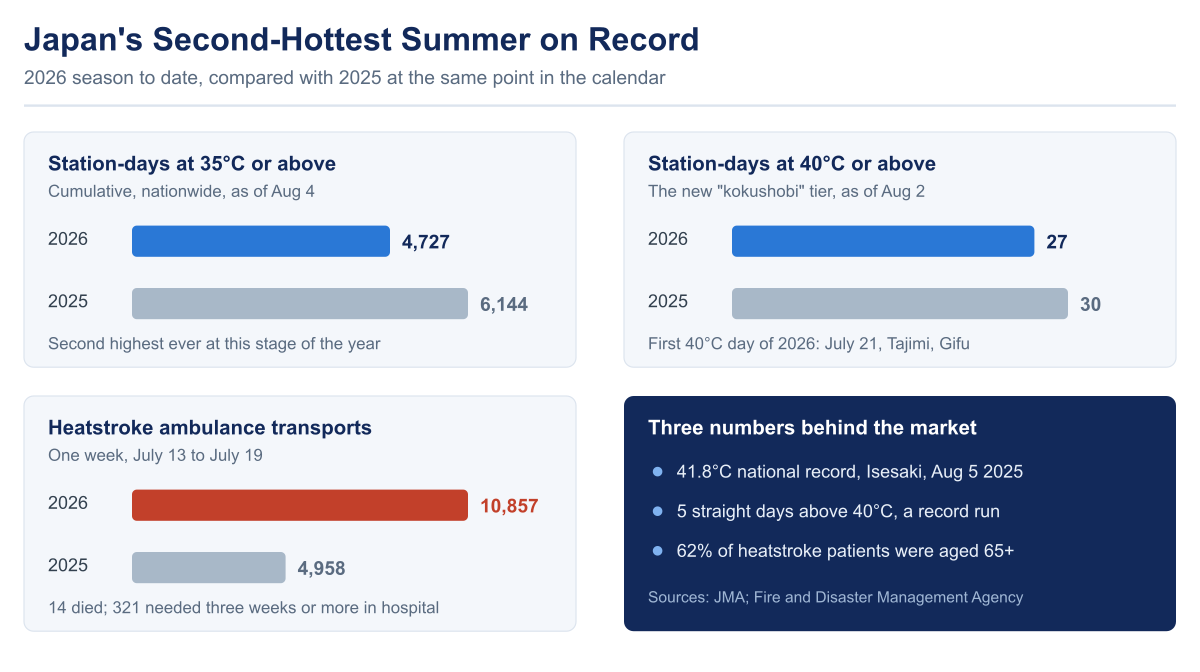
The numbers behind the vote are not subtle. Japan’s average temperature has risen roughly 1.44°C per century since national record-keeping began in 1898, and almost all of that has arrived recently. In the summer of 2025, 132 of 153 weather stations logged their highest-ever average summer temperature. On August 5 of that year, Isesaki in Gunma Prefecture hit 41.8°C — the highest temperature ever measured in Japan.
2026 has been the sequel. The first kokushobi of the year arrived on July 21 in Tajimi, Gifu Prefecture. Then somewhere in the country cleared 40°C on five consecutive days through late July, the longest such run on record. By August 2, Japan had accumulated 27 station-days at 40°C or above; by August 4, 4,727 station-days at 35°C or above. Both figures trail only 2025 at the same point in the calendar, which is another way of saying that Japan has now logged its two most extreme runs of high-temperature days back to back.
The human cost shows up in ambulance logs. In the week of July 13 to 19, Japan’s Fire and Disaster Management Agency recorded 10,857 people taken to hospital for heatstroke. That was roughly 2.4 times the previous week’s 4,580 and more than double the 4,958 logged in the same week of 2025. Fourteen people died. Another 321 were sick enough to need at least three weeks in hospital. And 6,734 of them — more than 60% — were 65 or older, in a country where nearly a third of the population is already past that line.
That combination is the part outsiders usually miss. Japan is not simply hot. It is hot, old, dense, and built out of concrete that holds the previous day’s heat overnight. A Tokyo summer night frequently fails to drop below 25°C. The elderly woman who does not turn on her air conditioner because she grew up thinking it was extravagant is not a stereotype here; she is a recurring cause of death.
So the demand for personal cooling in Japan is not a lifestyle preference. It is closer to a public health behavior, and it has been building for more than a decade.
The ¥58.3 Billion Shelf You Will Not Find in an American Drugstore
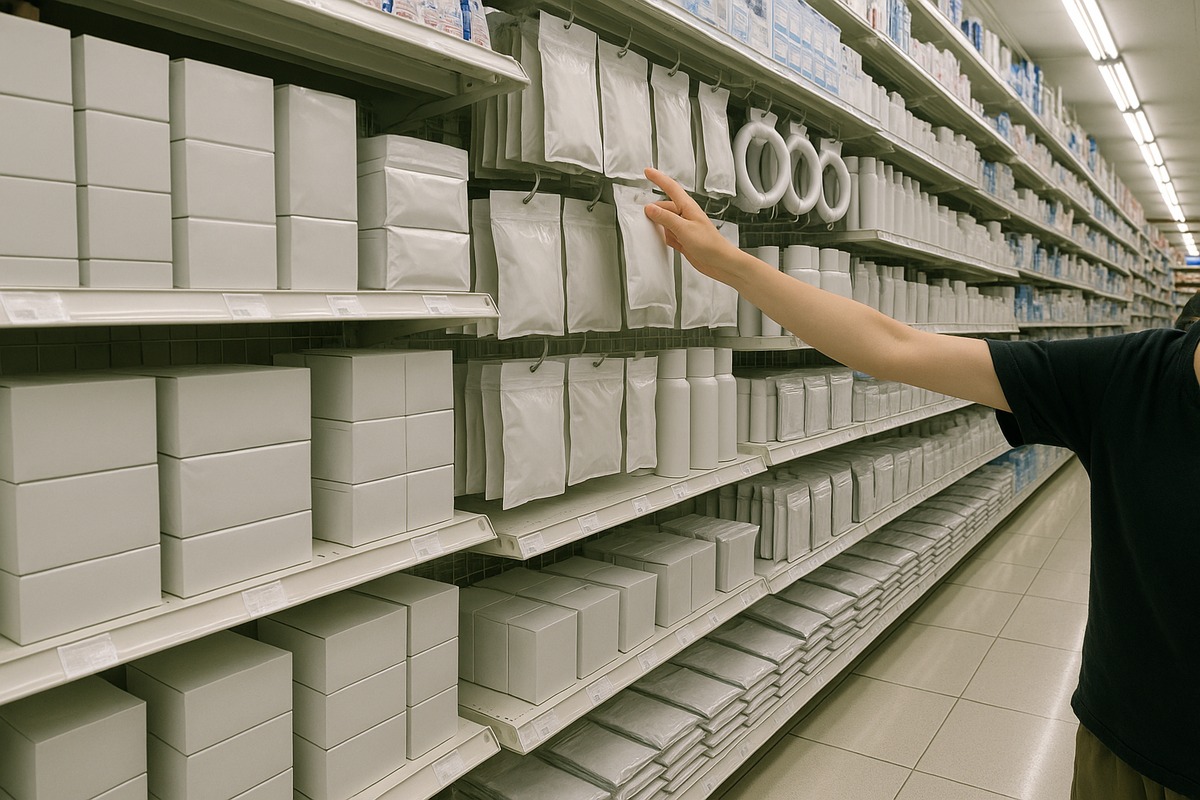
Walk into a Japanese drugstore in July and you will find an entire wall that has no clean equivalent in a CVS or a Boots.
There are body sheets — thick, alcohol-and-menthol wipes sold in packs of ten to thirty — that you use standing in an office bathroom to reset after a commute. There are cooling sprays that drop fabric surface temperature on contact. There are gel patches you stick to your forehead, sold in adult and child sizes, that have been a fixture in Japanese medicine cabinets for thirty years. There are cooling neck rings filled with a phase-change material that solidifies at 28°C, so it re-freezes in an office refrigerator over lunch. There are cooling wipes for pets, cooling pads for futons, and menthol-treated sanitary pads.
That slice of the market — cooling goods including cooling sheets and antiperspirants — was worth ¥58.3 billion last year, more than 50% larger than it was four years earlier. And that is only the drugstore aisle. It sits underneath a powered-wearable business, a fan-equipped workwear industry that trade research puts in the tens of billions of yen and forecasts at roughly ¥47.5 billion by 2030, and an industrial tier we will come to — none of which existed as commercial categories twenty years ago.
The product development is where it gets interesting for anyone who builds consumer goods. Shiseido sells a serum called Sorbet Serum, which is designed to be kept in the freezer: it goes in as a gel and comes out with a granular, sherbet-like texture that creates an immediate cooling sensation on contact. Kobayashi Pharmaceutical, the company most Japanese households associate with forehead cooling patches, has spent decades turning what began as a fever remedy into an everyday summer product, and now markets around the broken sleep that hot nights produce. Unicharm makes cooling-type sanitary pads and cooling sheets for dogs, and has pushed cooling and breathability claims into adult care products — a line aimed squarely at nursing homes, where residents often cannot regulate their own temperature.
Kao’s Bioré built a franchise on cooling body sheets and handheld cooling mists. Kobayashi also sells sprays you apply to clothing rather than skin, while Rohto competes in body-cooling deodorant sprays. None of these are novelty items. They are line extensions from the largest personal care companies in the country, which is the clearest possible signal that the category has graduated from seasonal opportunism to permanent shelf space.
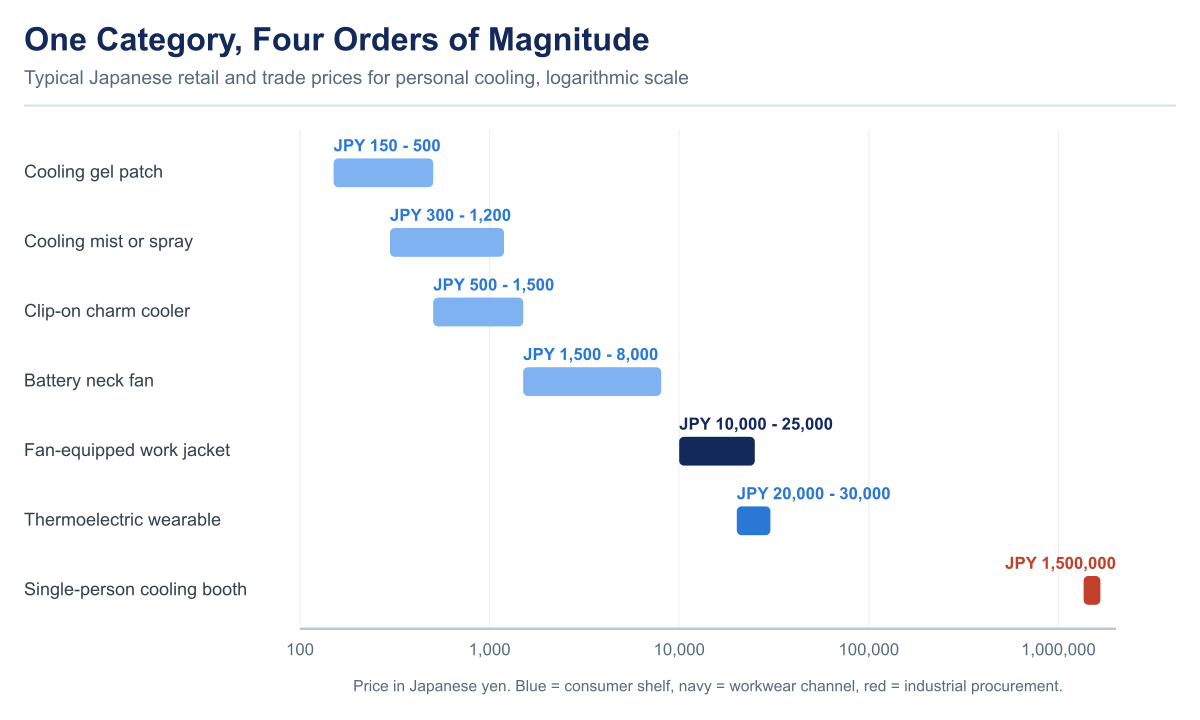
The price architecture is worth studying because it is unusually complete. A cooling patch runs ¥150 to ¥500. A mist is ¥300 to ¥1,200. A charm-style clip-on cooler is ¥500 to ¥1,500. A battery-powered neck fan is ¥1,500 to ¥8,000, while a thermoelectric wearable that actually removes heat from your skin sits closer to ¥20,000 to ¥30,000. Above that sits a whole industrial tier that most consumers never see, which we will get to. Very few consumer categories anywhere offer a continuous ladder from a hundred yen to a million yen, and that ladder is precisely what makes the Japanese heat market such a useful template.
Sony Spent Six Years Turning a Gadget Into a Category

The best evidence that this is a real market and not a seasonal curiosity is that Sony stayed in it.
The Reon Pocket started in 2019 as a crowdfunded experiment: a palm-sized thermoelectric module that sits against the base of your neck, inside a special undershirt, and pulls heat out of your skin using the Peltier effect. It was the kind of project that large electronics companies usually launch, photograph well, and quietly discontinue.
Instead Sony iterated. The device shed the special shirt and became a neckband. It gained a temperature and humidity sensor that reads your surroundings and adjusts automatically. It gained a smartphone app, then heating for winter, then a PRO tier with two independent thermo modules and roughly double the cooling contact area of its predecessor. Sony eventually moved the business into a dedicated subsidiary, Sony ThermoTechnology.
The results, disclosed this year, are the numbers that should make anyone in consumer hardware sit up. Sales in the 2025 fiscal year came in at roughly 1.5 times the prior year. Cumulative sales across the line reached 840,000 items as of April 2026 — a figure that counts the accessories and sensing kits alongside the devices themselves — and the company expects to clear a million within the year. That is a seven-year arc from a crowdfunding page to a million-item business, in a product category that did not previously exist.
Then, in May 2026, Sony announced the REON POCKET PRO Plus and brought the line into the United States for the first time, priced at $259 and sold through Sony’s own online store over the summer.
That last move is the story inside the story. The device had already been rolled out across a couple of dozen markets in Europe and Asia, but the United States — one of the world’s largest consumer electronics markets — was not one of them until this year. The category simply had no shelf there. Phoenix, Austin, Madrid and Dubai have all since had the kind of summers that build one.
The Fan Jacket Became Workwear Infrastructure
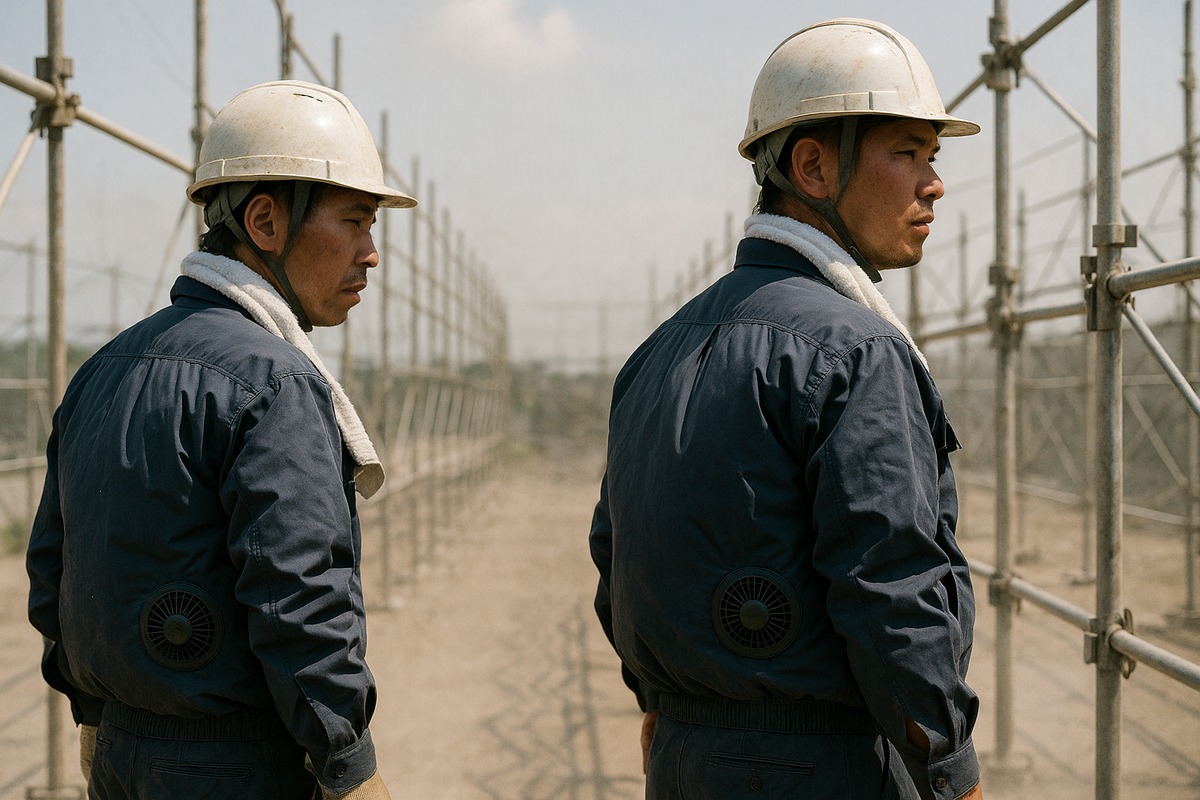
Consumer gadgets are the visible half of Japan’s heat economy. The industrial half is bigger and far less known outside the country.
If you have seen photographs of Japanese construction workers who appear to be wearing inflated jackets, you have seen kūchōfuku — fan-equipped workwear. Two small battery-powered fans mounted at the lower back pull air through the garment and across the skin, using evaporative cooling rather than refrigeration. It looks strange for about a day, and then you notice that traffic guards, delivery drivers, farmers, warehouse pickers and increasingly festival staff are all wearing them. Trade research put the category at roughly ¥20 billion in 2024 and forecasts about ¥47.5 billion by 2030.
The category has real competitive dynamics. Bartle has taken a commanding share of shipments. Workman, Japan’s dominant workwear retailer and one of the country’s more interesting retail stories, pushed hard in 2026 with a series it calls ZERO STAGE, engineered to deliver roughly 1.45 times the airflow of its predecessor while eliminating the balloon silhouette that kept fan jackets out of any setting where you meet customers. That is a telling product brief: the technology is settled, so the competition has moved to whether you can wear it without looking like you are wearing it.
At the top of the ladder is equipment that reads like satire until you understand the regulatory context. Trusco Nakayama, an industrial supplies distributor, sells a single-person stainless steel cooling booth called the Do Hiemon Box. It holds 15°C inside, blows 5°C air at whoever steps in, rolls on wheels, and runs off a standard electrical outlet. It costs about ¥1.5 million, roughly $9,500. Since launching earlier this year it has passed 300 units sold — to steel mills, construction sites, golf courses, universities, leisure facilities and emergency evacuation shelters.
Nobody buys a ¥1.5 million phone booth for their construction site because it is a nice perk. They buy it because of what changed in June 2025.
Regulation Did What Marketing Could Not
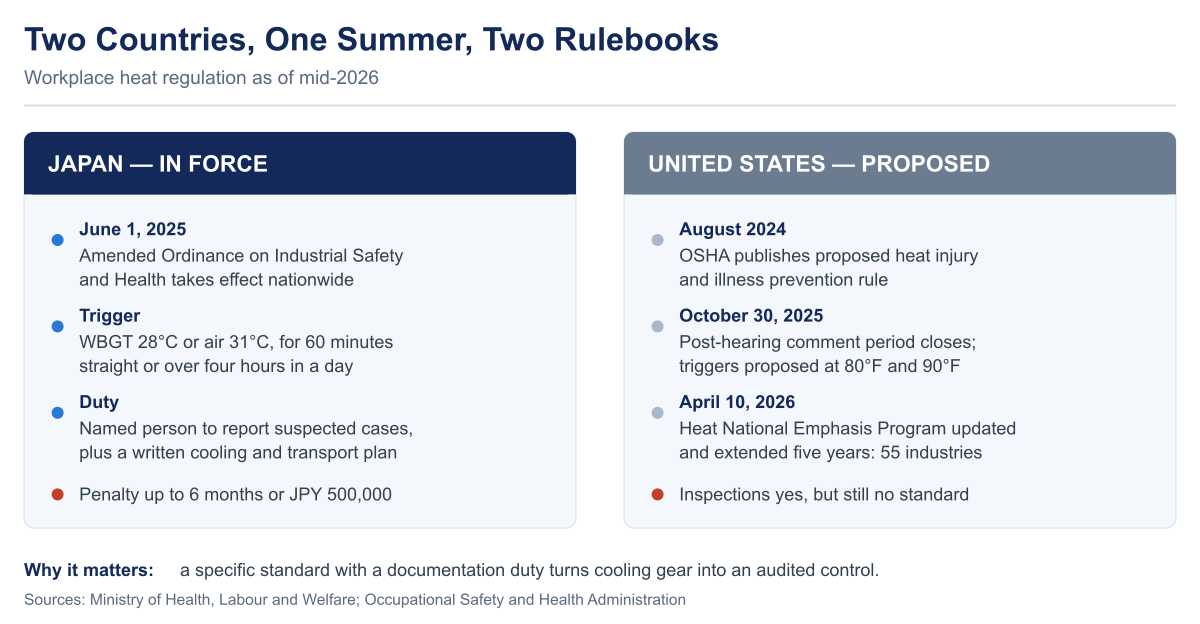
On June 1, 2025, an amendment to Japan’s Ordinance on Industrial Safety and Health took effect, and it converted heat management from a corporate virtue into a legal duty.
The rule bites where employees are expected to work either 60 consecutive minutes, or more than four hours in a day, in conditions above a wet bulb globe temperature of 28°C or an air temperature of 31°C. Employers covered by it must designate, and tell workers how to reach, the person responsible for receiving reports of suspected heatstroke, and must prepare and communicate written procedures for what happens next — cooling the worker, deciding when to stop work, getting them to a hospital. Failure to comply can, in serious cases, carry up to six months’ imprisonment or a fine of up to ¥500,000.
The practical effect was immediate and commercial. Overnight, cooling equipment moved from the “welfare” column of a corporate budget to the “compliance” column. A safety manager who cannot demonstrate a documented cooling plan has a legal exposure; a fan jacket, a cooling booth, an ice-slurry drink station and a WBGT meter are how you demonstrate one. This is why the Do Hiemon Box exists, and why a company with no consumer marketing operation can sell 300 of them in a few months.
Now compare the United States. OSHA published a proposed Heat Injury and Illness Prevention rule in August 2024, with a sensible structure: an initial trigger at an 80°F heat index requiring water, shade and acclimatization for new workers, and a high-heat trigger at 90°F adding mandatory paid 15-minute rest breaks every two hours and buddy-system monitoring. Public hearings ran from June 16 to July 2, 2025, and the post-hearing comment period closed on October 30 of that year. As of the summer of 2026 the rule has not been finalized and no date has been set.
Enforcement in the meantime runs through a National Emphasis Program, which OSHA updated on April 10, 2026 and extended for five years, targeting inspections at 55 high-risk indoor and outdoor industries. That is a real enforcement posture, and employers should not read it as toothless. But it is an inspection-targeting directive built on the general duty to provide a safe workplace, not a specific standard that tells an employer what to install and what to write down.
That distinction is the whole commercial story. One country has a rule with a temperature trigger, a designated reporting contact at covered worksites and a documentation requirement. The other has inspectors with a priority list and a rule that is still in drafting.
I am not making a political argument here. I am making a market one. Regulation is the single most reliable creator of durable B2B demand, and Japan has just spent a year demonstrating what it does to a product category. When the U.S. rule eventually lands — and heat is not going to stop making the case for it — American distributors are going to need a catalog. Japan already has one, tested at scale, priced at every tier, with a five-year head start on failure modes nobody else has hit yet.
What This Means If You Sell Anything
Four things travel out of this market, whether or not you sell cooling products.
The season has moved, and it is longer than your calendar. Cooling demand in Japan used to be a July–August spike. It now runs from roughly June through September, and the shoulder weeks are where the growth is. If you plan inventory, promotions or campaign flights against a legacy summer window, you are under-serving four to six weeks of live demand at both ends. This is happening across the northern hemisphere, and Japan is simply further along the curve.
Ubiquity beats intensity. The reason the Japanese heat market works is not that any single product is remarkable. It is that cooling has been added as an attribute to dozens of products people were already buying: wipes, pads, bedding, pet supplies, clothing, workwear, drinks. The category grew by colonizing existing purchase occasions rather than by asking consumers to adopt a new one. That is a cheaper and far more durable growth strategy than launching a hero SKU, and it is available to almost any manufacturer.
Follow the compliance budget, not the consumer budget. The most reliable revenue in Japan’s heat economy is not the ¥300 body sheet. It is the ¥1.5 million cooling booth bought by a safety officer who needs to document a control. Consumer demand is weather-dependent and price-sensitive; compliance demand is neither. If you are building a heat-adaptation product, the question that determines your margin is whether a corporate buyer can point at your product in an audit.
Channel matters more than category. In Japan the heat aisle lives in drugstores, home centers, variety chains and 100-yen shops far more than in convenience stores, and the industrial tier moves through workwear retailers and industrial distributors that most consumer brands have never called on. If you export a cooling product into a new market on the assumption it belongs next to sunscreen, you will likely find the actual buyer sitting in a completely different channel.
For international operators specifically: Japan is the best available preview of what a heat-adapted consumer market looks like, because it got there first for demographic and climatic reasons rather than because anyone planned it. The product architecture, the price ladder, the regulatory trigger and the channel structure are all visible and already stress-tested. That is a rare thing. Most of the time you have to guess what a market will look like in ten years. Here you can go and stand in it.
Frequently Asked Questions
Q. Where can I buy Japanese cooling products outside Japan?
A. It depends on the tier. Sony’s REON POCKET PRO Plus went on sale in the United States in the summer of 2026 at $259 through Sony’s own online store, and earlier models circulate through third-party sellers (search Reon Pocket on Amazon). Consumable cooling goods such as gel forehead patches and menthol body sheets are widely resold internationally (available on Amazon), though usually at a significant markup over Japanese retail. Fan-equipped workwear and industrial cooling booths are largely domestic-channel products and typically require an importer.
Q. How much do these products actually cost in Japan?
A. The ladder is unusually complete. Cooling patches run ¥150–¥500, cooling mists ¥300–¥1,200, clip-on charm coolers ¥500–¥1,500, and battery neck fans ¥1,500–¥8,000. Thermoelectric wearables such as the Reon Pocket sit around ¥20,000–¥30,000. Fan-equipped work jackets typically land in the ¥10,000–¥25,000 range with battery, and the industrial tier tops out around ¥1.5 million for a single-person cooling booth.
Q. Why is this market so much bigger in Japan than in the U.S. or Europe?
A. Three reasons compound. Japan’s summers are humid as well as hot, so evaporative comfort strategies matter more than raw temperature suggests. Nearly a third of the population is 65 or older, and older people both regulate temperature poorly and account for the majority of heatstroke hospitalizations. And since June 2025 employers have been under a legal obligation to manage workplace heat, which created a large, weather-independent commercial buyer.
Q. Is fan-equipped clothing actually effective, or is it a gimmick?
A. It works on a real mechanism — forced airflow accelerates sweat evaporation — which means its effectiveness falls as humidity rises and it does nothing for someone who is already dehydrated. Japanese occupational guidance treats it as one control among several, alongside scheduled rest, hydration and shaded cooling areas, not as a substitute for them. That framing is worth copying anywhere the category expands.
Q. Will this category grow outside Japan?
A. The demand driver is already global; the missing pieces are regulation and channel. The U.S. federal heat standard remains unfinished as of mid-2026, and until something like it lands, most Western demand stays consumer-discretionary rather than compliance-driven. Once a rule with a documentation requirement exists in a large market, expect the Japanese industrial catalog to travel very quickly.
Conclusion
The detail I keep coming back to is the vote. Half a million people took the time to tell their weather agency what to call a 40°C day, and the word they chose contains the character for “cruel.” That is a society that has finished negotiating with a problem and moved on to managing it.
Everything downstream follows from that acceptance. You do not get a ¥58.3 billion cooling-goods market, a million-item wearable cooler business, a fan-jacket industry heading for ¥47.5 billion or a ¥1.5 million rolling cold room unless a country has collectively agreed that summer is now something you engineer around rather than complain about. Japan reached that agreement early, for reasons it did not choose — an aging population, dense concrete cities, and a climate curve that arrived ahead of schedule.
The rest of the world is arriving at the same conclusion on a delay. When it does, the products, the price ladder, the channel logic and the regulatory playbook will already exist. They will just have Japanese names on them.
This article contains affiliate links. If you purchase through these links, we may earn a small commission at no extra cost to you.
If you’re interested in this topic, the Japanese market more broadly, or what KETCHUPs is working on, we’d love to hear from you — please reach out via our contact form.
Japan Market Pulse is a weekly read on what the Japanese consumer-tech, food, and mobility markets are choosing to do, written for international operators who want to know what is happening before it shows up in the global trade press.
Subscribe at ketchups.co/japan-market-pulse.