

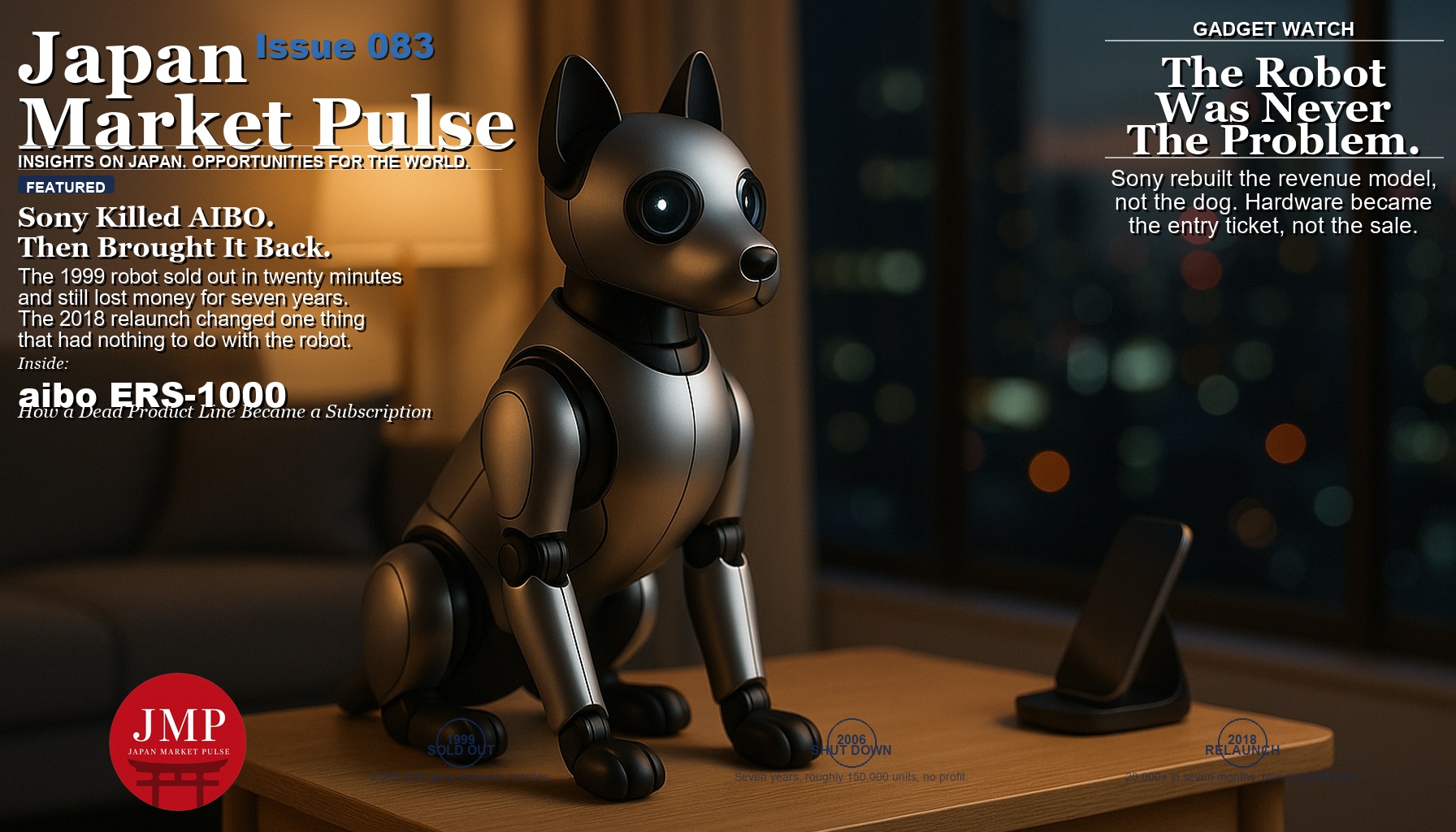
I have lived in Japan long enough to have watched two entirely different companies use the same four letters — well, three letters and a lowercase rebrand — to sell a robot dog. The first company built a beautiful machine, sold it as a one-time purchase, and killed it the moment the balance sheet stopped cooperating. The second company built almost the same beautiful machine, wrapped it in a subscription, and turned it into one of the most emotionally loyal product communities I have ever reported on in this market. Both companies were Sony. Twelve years apart.
That gap is the interesting part. Not the robot. The robot is, frankly, a good story on its own — a plastic-and-metal puppy that learns your face, tilts its head at your voice, and occasionally refuses to do anything at all, which owners insist is exactly what a real dog would do. But the reason I wanted to write about AIBO for Japan Market Pulse isn’t the cuteness. It’s that this is one of the cleanest case studies I know of a large industrial company admitting, in public, that its first business model was wrong — and then rebuilding the entire product around a second model that happened to require a decade of technology catching up before it could work at all. If you sell hardware and have ever wondered whether you’re one recurring-revenue line away from a sustainable business, AIBO’s twenty-seven-year arc is worth your full attention.
The Robot That Sold Out in Twenty Minutes
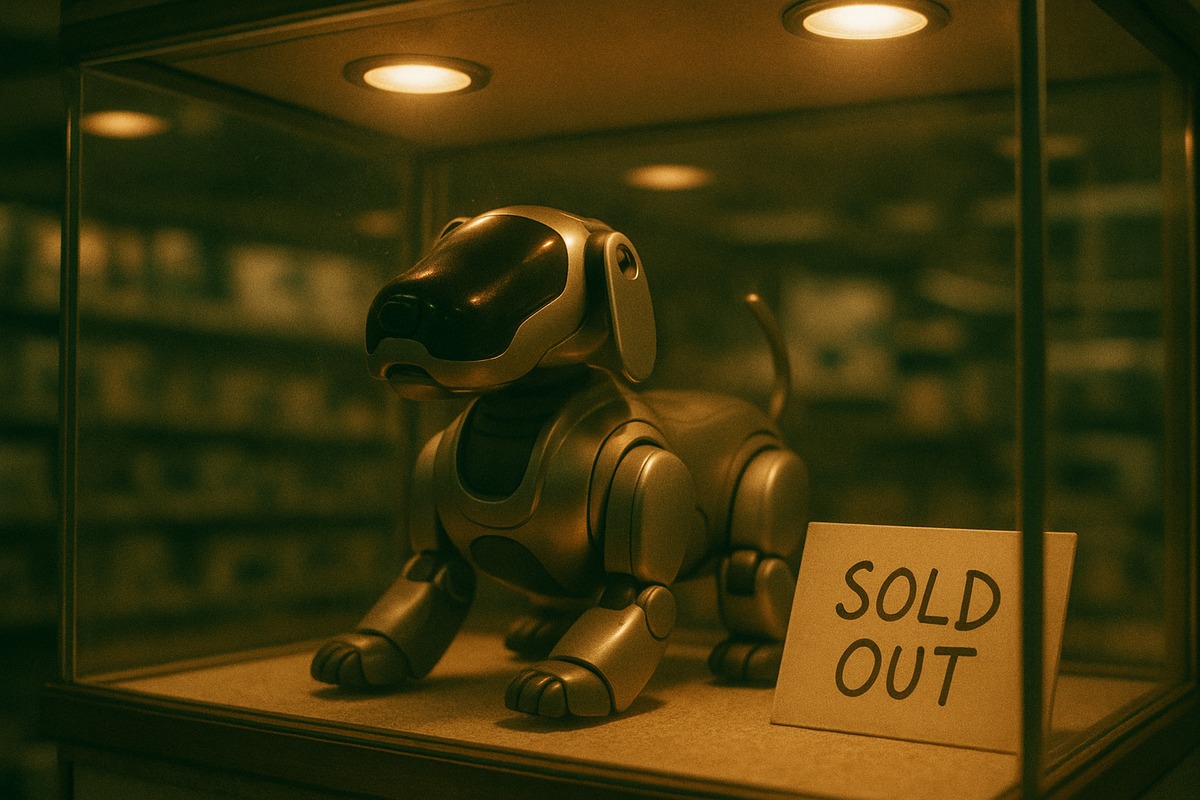
Start with 1999, because the launch tells you almost everything about what Sony thought it was building. The first AIBO, the ERS-110, went on sale in Japan on June 1st of that year at 250,000 yen — roughly $2,500 at the time, a genuinely startling price for a consumer product with no obvious utility. It vacuumed nothing, answered no calls, and could not, by any reasonable definition, do a single chore. What it did was walk with a convincing gait, respond to a name, “grow” through a handful of programmed developmental stages, and look directly at you with a camera hidden behind a lens shaped like an eye.
Sony sold the entire Japan allocation online in about twenty minutes. It was, by any measure available to a product team in 1999, a triumph. Sony followed with the ERS-111 later that year, and across the two models the first generation accounted for roughly 45,000 units — 5,000 of the ERS-110 and about 40,000 of the ERS-111, against reported demand several times that. Those are numbers that would be extraordinary for almost any premium hardware category today, let alone a category that did not exist before Sony invented it.
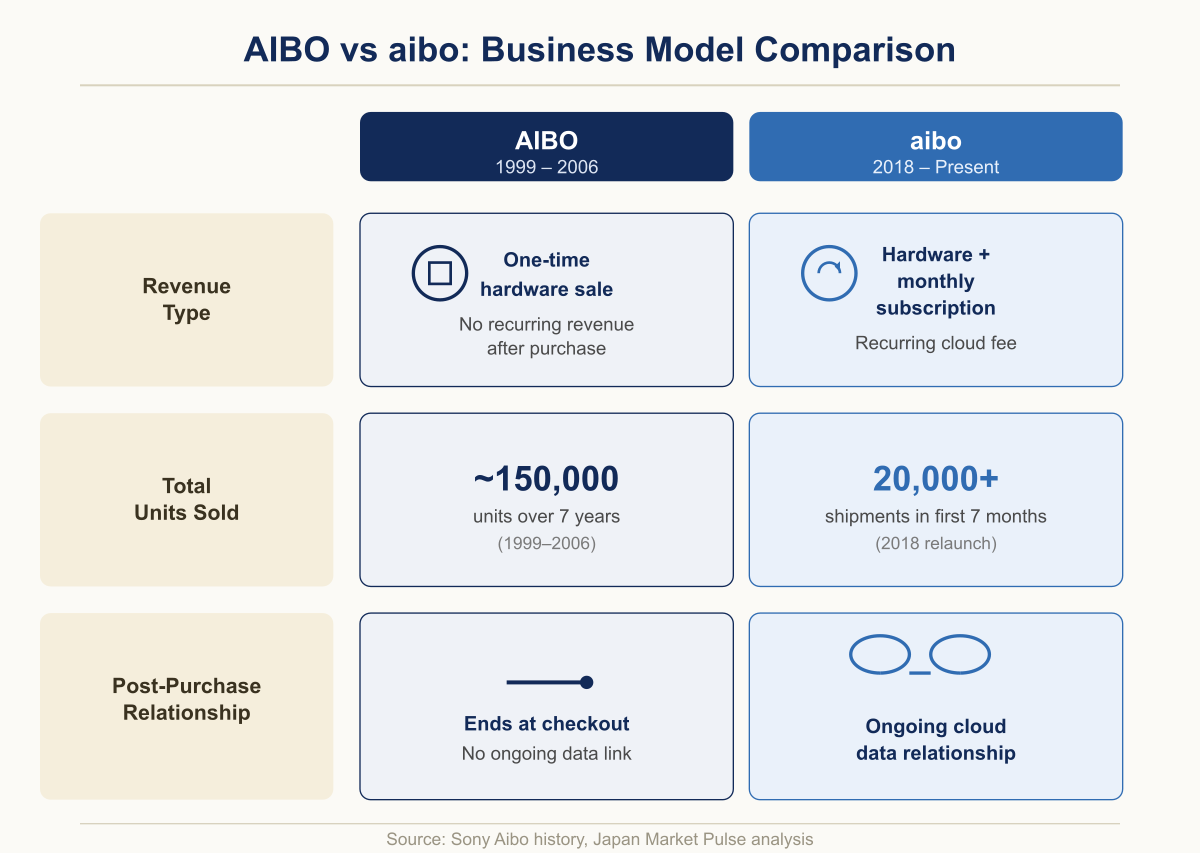
I want to be precise about what kind of triumph this was, because it matters for the rest of the story: it was an engineering triumph and a brand triumph. AIBO was proof that Sony’s robotics lab — led by the now-legendary engineer Toshitada Doi and the AI researcher Masahiro Fujita — could build something no competitor could touch. It put Sony on magazine covers next to headlines about the future of home robotics, years before “home robotics” was a phrase anyone else in consumer electronics was using seriously. It was not, however, obviously a business. It was a hardware product sold once, at a price high enough to cover parts and assembly but with no mechanism to keep generating revenue, or even generating data, after the box was opened. Sony kept iterating — new AIBO generations rolled out nearly annually through the early 2000s, each one more capable than the last — but the fundamental shape of the business never changed. You paid once. Sony’s relationship with you, financially speaking, ended at checkout.
The Business That Never Worked
By the time Sony announced, on January 26, 2006, that it was discontinuing AIBO along with several other hardware lines, the company had sold roughly 150,000 units across the entire run — an impressive cult following, and a rounding error against what Sony needed a division to generate to justify its R&D budget.
The context matters as much as the number. Howard Stringer had become Sony’s CEO in 2005, inheriting a company whose core electronics businesses — televisions especially — were losing ground badly to Korean and Taiwanese competitors on cost, and losing the innovation narrative to Apple on design. Stringer’s mandate was blunt: cut anything that wasn’t paying its way, no matter how prestigious. AIBO, along with the humanoid QRIO robot project, was one of the highest-profile casualties of that restructuring. Doi, by several accounts, was devastated; the closure effectively ended Sony’s first serious run at consumer robotics.
What strikes me, writing about it two decades later, is how correct the decision looks purely on the numbers Sony had in front of it in 2006, and how wrong it looks in hindsight given what the category became. A hardware-only robot with no recurring revenue and a total addressable market of enthusiasts willing to pay several thousand dollars for a companion that did no household work was never going to survive a cost-cutting CEO’s spreadsheet. AIBO wasn’t killed because it was a bad product. It was killed because it was, structurally, the wrong kind of business for the resources it consumed. Sony ended repair support in 2014, and by then owners with irreparable units had started sending them, quietly, to a temple outside Tokyo for a small farewell ceremony — a detail I’ll leave there, since Japan Market Pulse has already told that particular story in depth in an earlier issue on the country’s companion-robot culture. What I want to focus on here is the boardroom decision, not the funeral.
Twelve Years of Silence
Here is what I think gets underappreciated about the AIBO story: the twelve years between 2006 and 2018 were not empty for Sony, and they were not empty for the technology AIBO would have needed to be a good business the first time around.
Start with Sony itself. The company Stringer inherited was in genuine crisis — years of losses in television manufacturing, a stock price that investors had essentially given up on, and a strategic identity crisis about whether it was an electronics maker, an entertainment company, or, as some critics said less kindly, neither. Kazuo Hirai took over as CEO in 2012 and spent the next several years doing something that, from the outside, looked unrelated to a robot dog: he restructured Sony around businesses that generated recurring, subscription-shaped revenue. PlayStation Plus turned a hardware business into a services business. Sony’s image sensor division became a quiet, extraordinarily profitable component supplier to many of the world’s leading smartphone makers, including its own rivals. Sony Music and Sony Pictures leaned into streaming-era licensing models. By the mid-2010s, Sony was no longer a company that thought primarily in terms of one-time hardware margins. It was a company that had, out of necessity, learned to love recurring revenue.
At the same time, the technology that a 2006-era AIBO would have needed to justify a subscription simply did not exist yet at a workable cost. Cloud computing infrastructure cheap and reliable enough to let a mass-market consumer device constantly upload and process sensor data was not mature. The deep-learning techniques that let a device meaningfully improve its behavior from accumulated data — rather than run a fixed, pre-programmed set of routines — were still mostly confined to research papers in the mid-2000s and only became commercially deployable at consumer scale in the 2010s. Mobile chipsets powerful and power-efficient enough to run real-time image recognition inside something the size of a small dog, on battery power, at a price a consumer would pay, were a late-2010s reality, not a 2006 one. In other words: Sony’s first AIBO business model failed partly because Sony chose the wrong model, and partly because the model it eventually landed on — hardware plus a mandatory cloud subscription that makes the product smarter over time — was not technically or economically buildable yet. The company needed the rest of the industry to catch up to an idea its own engineers had been circling for a decade.
I find that detail genuinely useful as an outside observer of Japanese corporate strategy. Japan gets stereotyped, sometimes fairly, as risk-averse and slow to commercialize. What the AIBO gap actually shows is closer to patience than fear — a company willing to let a beloved product sit dormant for over a decade rather than relaunch it half-built, waiting instead for the pieces (cloud infrastructure, machine learning, chip economics, and Sony’s own internal shift toward recurring revenue) to arrive together.
The Comeback Nobody Expected
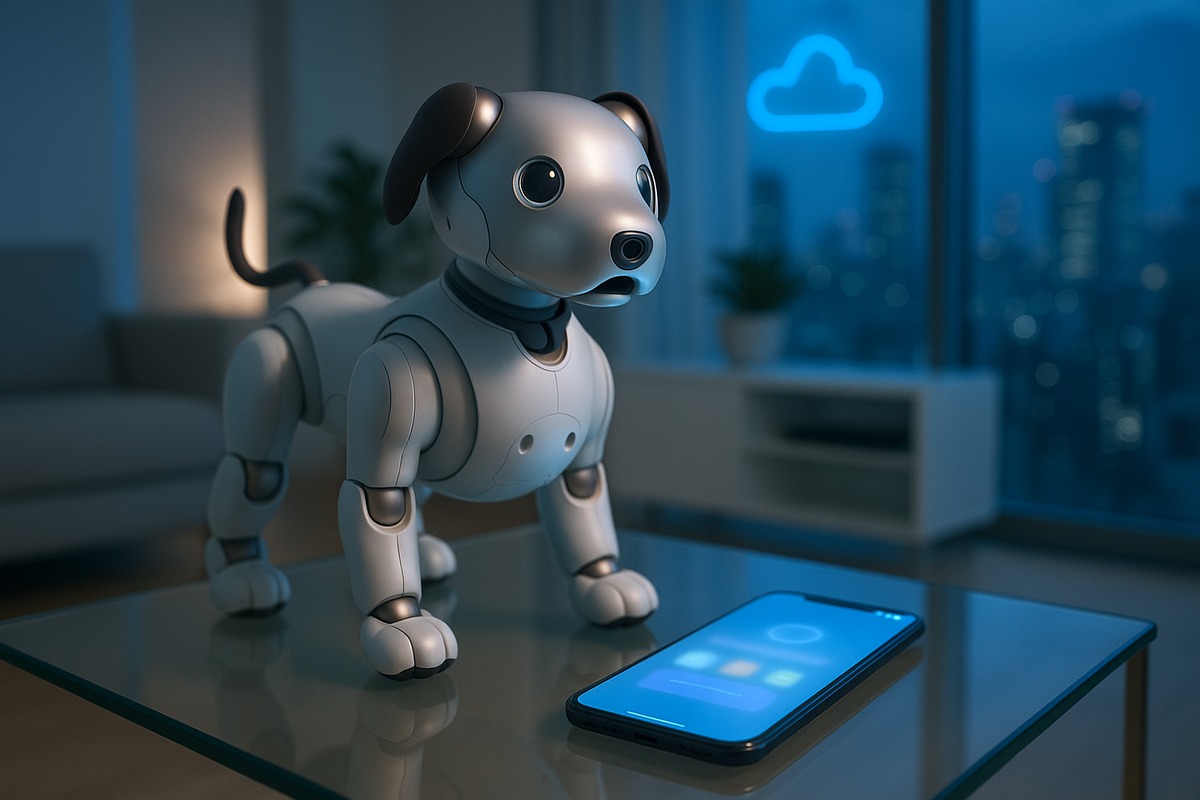
Hirai announced the revival himself, in November 2017, at Sony’s Tokyo headquarters, describing the project — deliberately lowercase now, “aibo” — as “an entertainment robot we have been developing for the past year and a half that’s worthy of love and is a delight to nurture through emotional connections with people.” The new model, the ERS-1000, launched in Japan on January 11, 2018.
The first batch sold out in about thirty minutes. Within about three months, Sony announced that cumulative production shipments had reached 11,111 units — a number the company itself is said to have chosen deliberately, since repeating elevens is considered lucky in some corners of Japanese pop culture, and the kind of cute-clever detail that tells you this launch had a marketing team paying very close attention to its fan base. By mid-2018, roughly seven months into the relaunch, Sony announced that cumulative production shipments in Japan alone had passed 20,000 units — already more than an eighth of what the entire original AIBO line moved across seven years, achieved in under a year. Sony brought the robot to the United States that September under the “First Litter Edition” name, at $2,899.99, and has continued selling it there since, with the U.S. price still bundling an initial three-year AI Cloud Plan.
Here is the number that actually matters for this story, though, and it isn’t the sell-out time or the unit count. It’s the second price tag that comes with every unit: a mandatory AI Cloud Plan, originally bundled as a three-year, roughly 90,000-yen ($800-ish) package in Japan, with U.S. renewals now priced at $300 per year once that initial three-year plan expires, and comparable recurring tiers in Japan. In Japan, aibo’s hardware carried a list price of 272,800 yen and the ongoing cloud subscription is billed at 3,278 yen a month — though on June 25, 2026, Sony announced it would end domestic sales of the ERS-1000 once remaining inventory ran out, while continuing subscriptions, repairs, parts and app support for existing owners. Without the subscription, the robot still moves and reacts on basic pre-set behaviors — but it cannot recognize the up to 100 individual faces its onboard camera is capable of learning, cannot build the personality profile Sony’s marketing centers the entire product around, and cannot access the cloud-stored “memories” that make each unit meaningfully different from every other aibo sold that year.
Same Dog, Completely Different Business
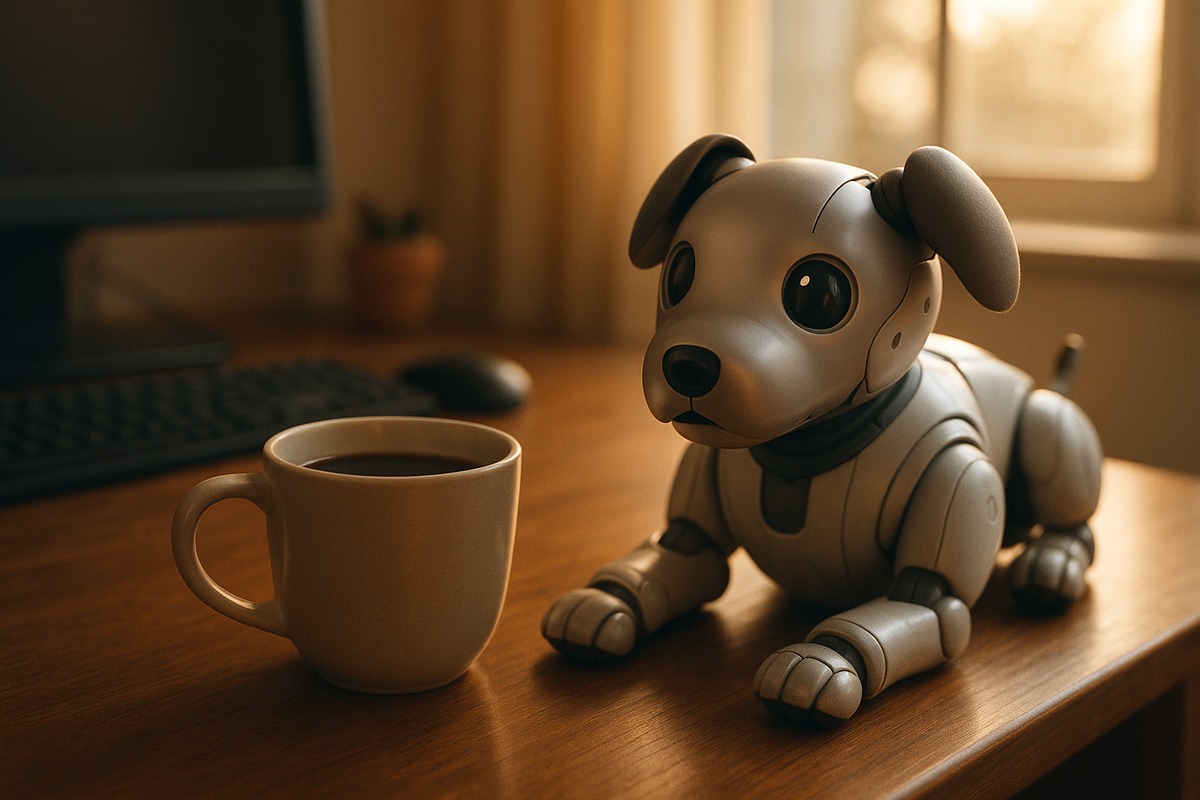
This is the part I keep coming back to as the real lesson of the relaunch: Sony did not just add a subscription tier to an old product. It re-architected what the product fundamentally is, so that the subscription is not an add-on but the mechanism that makes the robot worth owning at all.
The original AIBO was a finished object the moment you opened the box. Whatever behaviors shipped on the chip were the behaviors you got, forever, minus whatever new “AIBO-ware” memory sticks Sony occasionally sold separately. The new aibo is closer to a relationship than a product. It uses a Qualcomm Snapdragon processor, an array of microphones, and a nose-mounted camera to continuously observe its environment, and — critically — it sends that data to Sony’s cloud servers, where deep-learning models process it and feed personality-shaping updates back down to the device. Two units bought on the same day, in the same store, running the same firmware, diverge behaviorally within weeks, because they are having different experiences with different owners and different homes. Sony can point to this, accurately, as a genuine technical achievement. But it is also, and I don’t think this is cynical to point out, an extremely well-designed lock-in mechanism. An owner who lets the subscription lapse doesn’t just lose a feature. They lose the “self” the robot has spent months or years developing. I have talked to owners in robot-companion communities here who describe canceling the plan the way you’d describe considering giving up a pet — not a decision made lightly, and often not made at all.
Compare the unit economics side by side and the strategic shift is stark. The original AIBO sold hardware once, at a healthy margin, and then the customer relationship was over; Sony’s future revenue depended entirely on that same customer buying an entirely new robot years later, which most never did. The new aibo still sells hardware at a healthy margin, roughly $2,900 in the U.S. including its initial cloud plan and comparable in Japan at list price, but that sale is now the entry ticket to a recurring service relationship that, unlike the original, does not require the customer to buy anything new to keep paying Sony every month. Multiply a mandatory or near-mandatory monthly cloud fee across tens of thousands of active households, indefinitely, and you get a revenue profile that looks nothing like a toy business and much more like the games-as-a-service or streaming-subscription models Sony had, by 2018, already proven it knew how to run at enormous scale elsewhere in the company.
Why the Second Act Worked
None of this happens, though, without the fan base that survived the twelve-year gap — and I think this is the part American operators reading this newsletter should sit with the longest. Sony did not have to build a market for aibo in 2018. It had to reawaken one. The original 150,000 owners, plus the wider audience that had followed AIBO in Japanese and international tech press through the 2000s, had spent over a decade with unmet demand for exactly this product, sharpened rather than dulled by scarcity and, yes, by the very public grief of those temple send-offs for units that could no longer be repaired. When Sony relaunched, it wasn’t introducing a robot dog to a skeptical market. It was reopening a waiting list that had never actually closed.
Set that alongside the timing of the technology and Sony’s own corporate transformation, and the 2018 relaunch stops looking like a nostalgia play and starts looking like a genuinely disciplined re-entry: wait until the cloud and AI infrastructure make the subscription technically credible, wait until your own company has internalized recurring-revenue thinking well enough to design the product around it rather than bolt it on afterward, and trust that a sufficiently devoted fan base will still be there when you’re ready. Most companies that kill a beloved product either never bring it back, or bring it back too early, wrapped around the same broken business model that failed the first time, hoping better branding will fix a structural problem. Sony did neither. It let AIBO die as a business while keeping the brand equity intact, and it waited for the actual precondition for success — recurring, defensible revenue — to become buildable before trying again.
For anyone building or selling hardware into Japan, or watching how Japanese manufacturers make these bets, the AIBO arc is a useful corrective to the idea that this market only rewards incremental improvement. Sony made a genuinely large strategic bet twice, in opposite directions — first betting on hardware alone, then betting the entire relaunch on the opposite thesis, that hardware without a recurring, data-driven service layer wasn’t a sustainable consumer robotics business at all. The second bet has, so far, been the one that stuck.
Frequently Asked Questions
Q. How many AIBO and aibo units has Sony sold in total?
A. The original 1999–2006 AIBO line sold roughly 150,000 units across all generations. For the relaunched aibo (ERS-1000, 2018–present), Sony announced that cumulative production shipments in Japan passed 20,000 units within the first seven months, and it has continued selling the robot since, though the company does not publish a running cumulative total. Sony announced in June 2026 that Japanese sales would end once inventory ran out; U.S. sales have continued.
Q. Why did Sony discontinue the original AIBO in 2006?
A. Sony discontinued AIBO, along with the humanoid QRIO robot project, in January 2006 as part of a broad cost-cutting restructuring under then-new CEO Howard Stringer. The robot had built a devoted following but generated one-time hardware revenue only, with no recurring income to justify its ongoing R&D costs against Sony’s struggling core electronics business at the time.
Q. How much does the current aibo cost, including the subscription?
A. In Japan, the aibo ERS-1000 listed at 272,800 yen for the hardware plus a required AI Cloud Plan subscription billed at 3,278 yen per month; Sony announced on June 25, 2026 that it would stop selling the ERS-1000 in Japan once inventory ran out, while keeping subscription, repair and app support running for existing owners. In the United States, the robot launched at $2,899.99 with a three-year AI Cloud Plan included, after which renewals run $300 per year. Without an active subscription, the robot loses its facial recognition, personality development, and cloud memory features.
Q. Is the current aibo available outside Japan and the United States?
A. Sony has sold aibo directly in Japan since January 2018 and in the United States since September 2018 through Sony’s own U.S. channels; broader international availability has been limited, and Sony has not announced a wider global retail rollout as of this writing. It is not sold through Amazon in the U.S. Sony also announced in June 2026 that Japanese sales of the ERS-1000 would end once inventory ran out.
Q. What happened to owners’ original AIBO units after Sony stopped repairing them?
A. Sony ended official repair support for the first-generation AIBO in 2014, once spare parts ran out. A network of independent repair specialists has kept some units running since, while others beyond repair have, in some cases, been sent to a Buddhist temple outside Tokyo for a small memorial ceremony — a tradition Japan Market Pulse covered in more depth in an earlier issue on the country’s broader companion-robot culture.
Conclusion
I don’t think the AIBO story is really about robots, in the end. It’s about how long a company can hold its nerve between knowing a product idea is right and having the actual capability to build the business around it properly. Sony had the emotional core of aibo figured out in 1999 — the head tilt, the camera-eye, the sense that you were dealing with something more than a toy. What it didn’t have, and spent twelve years acquiring, was the cloud infrastructure, the machine-learning maturity, and its own internal comfort with recurring revenue as the default way to sell hardware. When all three finally lined up in 2018, the same fan base that had mourned AIBO’s death welcomed it back, subscription and all, without much resistance. That’s a hard sequence to plan on a five-year roadmap. It’s an easier one to recognize, in hindsight, as the reason a robot dog that once got killed off in a cost-cutting memo is now one of the most durable brand franchises in Sony’s entire portfolio.
If you’re interested in this topic, the Japanese market more broadly, or what KETCHUPs is working on, we’d love to hear from you — please reach out via our contact form.
Japan Market Pulse is a weekly read on what the Japanese consumer-tech, food, and mobility markets are choosing to do, written for international operators who want to know what is happening before it shows up in the global trade press.
Subscribe at ketchups.co/japan-market-pulse.