

On December 1, 2025, at an international financial conference in Tokyo, the leader of the most indebted major economy on Earth stood in front of a room full of global fund managers and quoted an anime.
“Just shut up and invest everything in me.”
The line comes from Attack on Titan, one of Japan’s biggest manga and anime franchises, and Prime Minister Sanae Takaichi delivered it in English, with a straight face, to an audience managing trillions of dollars. Some foreign commentators winced. Others laughed. But almost nobody in the room missed the underlying message: the country that Western financial media has spent three decades describing as a fiscal time bomb was not asking for patience or sympathy. It was demanding capital — confidently.
I’ve lived in Japan for twenty years, and I’ve lost count of how many times I’ve been asked some version of the same question by colleagues back in the States: “Isn’t Japan basically bankrupt?” It usually comes with a statistic attached — the famous one. Government debt at 250 percent of GDP. More than twice the size of the entire economy. The worst ratio in the developed world by a wide margin, far above the United States at roughly 125 percent, the United Kingdom at about 115 percent, or France at around 101 percent.
That number is real. It is also, I’d argue, one of the most misleading statistics in global finance — not because it’s false, but because of everything it leaves out. Even the IMF’s own headline tables, the ones that get quoted in every scary chart on financial television, are built on gross debt: a pure tally of what the Japanese government owes, with the asset side of the balance sheet ignored entirely. No company, no household, and no serious credit analyst would ever evaluate a borrower that way. Yet for Japan, it has become the default lens.
So let’s do what the headline number refuses to do. Let’s look at both sides of the ledger — the government’s assets, the nation’s household wealth, corporate cash piles, foreign reserves, and Japan’s position as one of the largest creditor nations on the planet — and then ask the question honestly: is 250 percent actually as terrifying as it sounds? And what does the answer mean for anyone doing business with, or in, Japan?
The Most Famous Scary Number in Global Finance
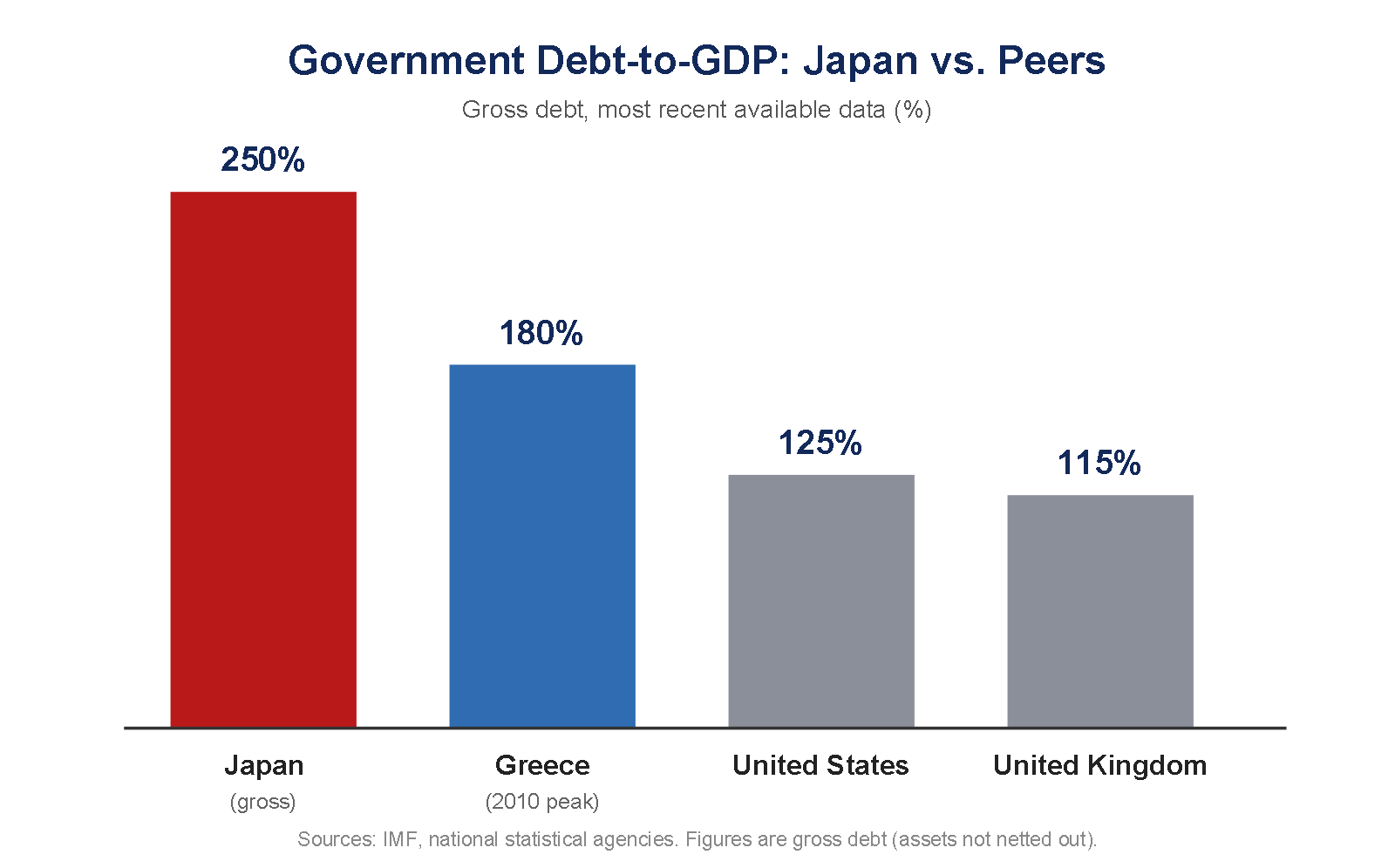
First, the number itself. Japan’s gross general government debt stands somewhere between roughly 230 and just over 250 percent of GDP, depending on which institution is counting, which year’s data vintage you use, and whether local governments and social security funds are included. The IMF’s recent World Economic Outlook figures put it around 230 percent; older vintages and broader measures have run into the 250s. Media shorthand has settled on “250 percent,” and the shorthand is what sticks.
In absolute terms, we’re talking about well over ¥1,300 trillion — more than $8 trillion at current exchange rates — accumulated over three decades of deflation-fighting stimulus, an aging society’s swelling social security bills, and the emergency spending of the 2008 financial crisis, the 2011 earthquake, and the pandemic.
For context, Greece triggered a full-blown European sovereign debt crisis in 2010 with a debt-to-GDP ratio of about 130 percent, peaking near 180 percent. Argentina has defaulted repeatedly at far lower ratios. So when investors see Japan sitting at roughly double Greece’s crisis-era level, the instinctive conclusion writes itself: this cannot possibly end well.
And yet. Japanese government bond yields spent most of the past decade near zero — at times below zero. The yen, for all its recent weakness, remains one of the world’s most traded currencies. Japan has never defaulted on its postwar debt, never needed an IMF rescue, and continues to fund itself with ease at auctions week after week (with some recent wobbles we’ll get to honestly later). Something about the simple “250 percent = doom” arithmetic clearly isn’t capturing reality.
The missing piece is the other side of the balance sheet.
What “250 Percent” Actually Counts — and What It Deliberately Ignores
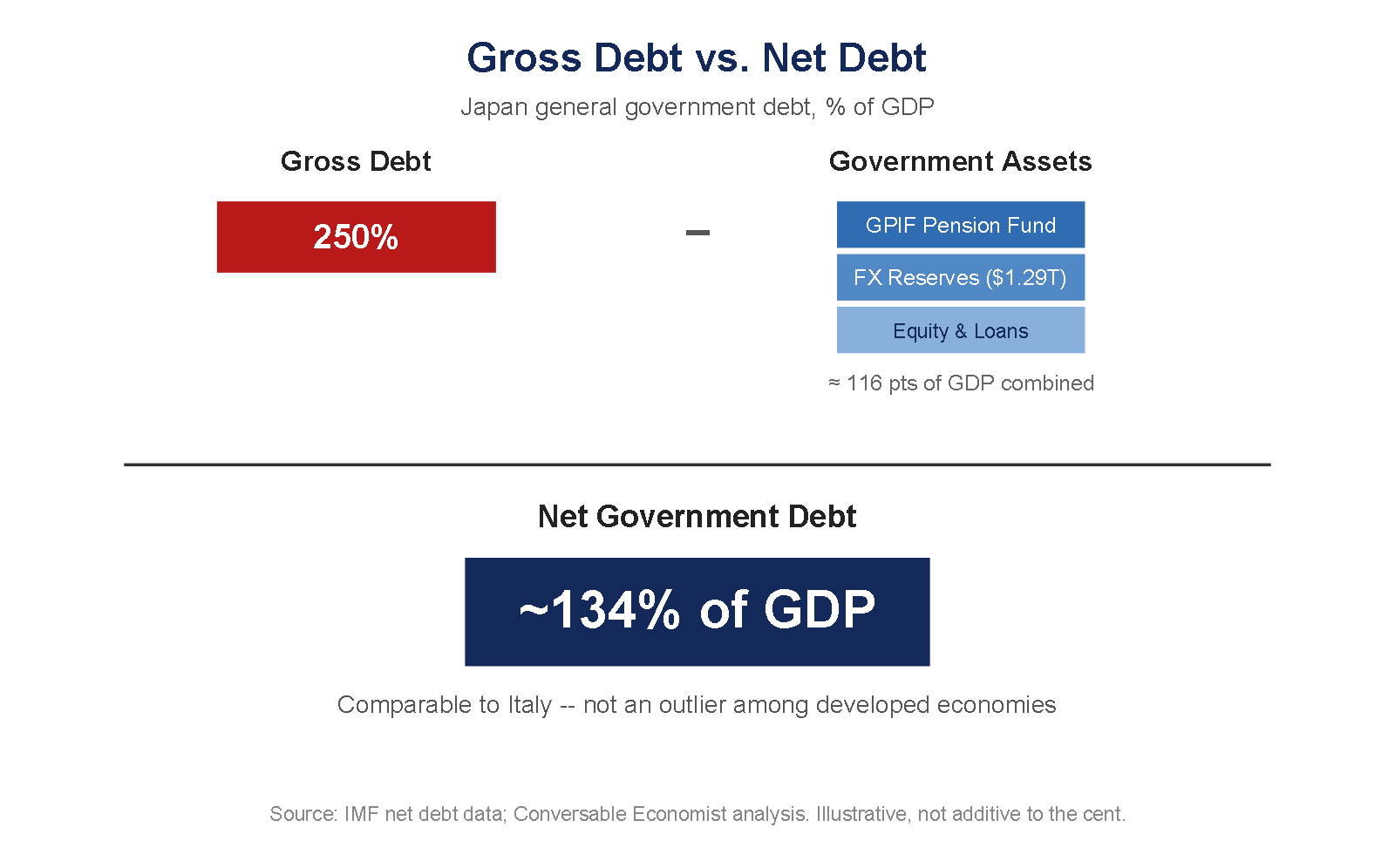
Here’s the thing about gross debt: it’s a one-column spreadsheet. It counts every bond the government has ever issued and stops there. It does not care what the government owns.
Imagine applying that logic to a person. Someone with a $800,000 mortgage and a $400,000 salary looks catastrophically over-leveraged — a debt-to-income ratio of 200 percent! — until you notice they also own the $1.2 million house, a stock portfolio, and a pension. Gross debt figures describe Japan the way a divorce lawyer describes an estranged spouse’s spending: technically accurate, strategically incomplete.
The Japanese government is, by a comfortable margin, one of the largest asset owners in the world. Its holdings include:
– The Government Pension Investment Fund (GPIF) — the largest pension fund on Earth, managing roughly ¥260 trillion in global stocks and bonds. – Foreign exchange reserves of about $1.29 trillion (roughly ¥190 trillion) as of mid-2026 — the second-largest war chest of any nation, including over $120 billion in gold and more than $930 billion in foreign securities, mostly U.S. Treasuries. – Loans, equity stakes, and financial investments accumulated across decades of industrial policy, including government holdings of domestic stock that one recent analysis valued at roughly 42 percent of GDP, plus foreign investments worth another 60-plus percent of GDP.
Net all of this out and the picture changes dramatically. The IMF itself — in the less-quoted columns of its own database — puts Japan’s net government debt at roughly 130 to 134 percent of GDP. That’s still high. But it’s Italy’s neighborhood, not some uncharted fiscal wilderness. It is, in fact, in the same broad range as the gross figures of the United States once you adjust for measurement differences.
To be clear: net debt of 134 percent is not a clean bill of health. But there is an enormous difference between “the most indebted nation in human history, twice as bad as crisis-era Greece” and “somewhat worse than Italy, with the world’s largest pension fund and second-largest FX reserves as a cushion.” The first framing dominates headlines. The second is closer to what a credit analyst actually sees.
The Nation’s Balance Sheet: Half a Quadrillion Yen Abroad
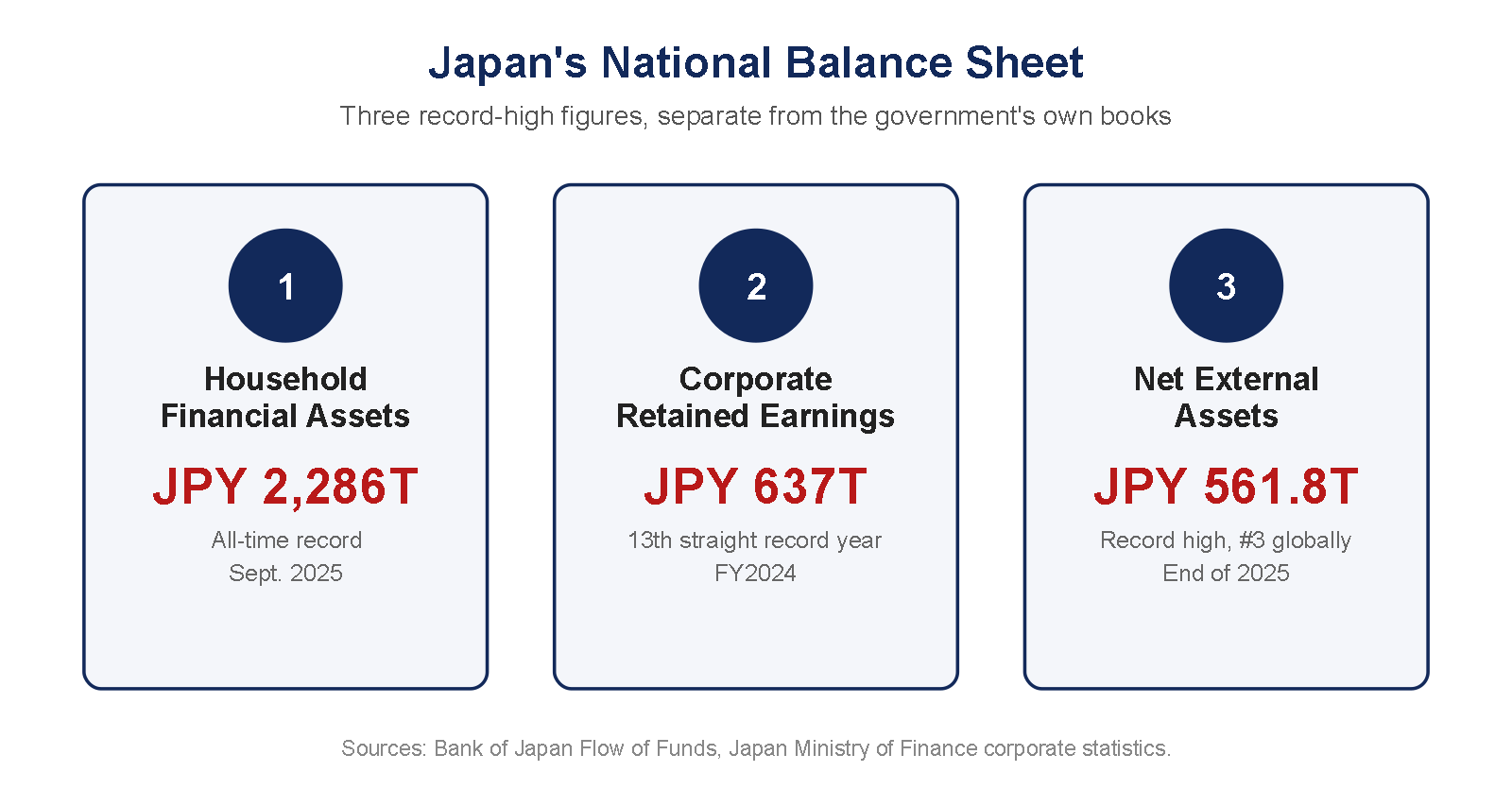
The government’s own assets are only the first layer. Zoom out to Japan as a country — households, corporations, and the nation’s investment position against the rest of the world — and the “bankrupt Japan” narrative gets even harder to sustain.
Start with households. Japanese families held ¥2,286 trillion in financial assets as of September 2025 — an all-time record, and a figure that has kept climbing as decades of cautious saving meet a rising stock market. That’s roughly $15 trillion, held by a population of 124 million. About half of it still sits in cash and bank deposits, which is precisely why the government can borrow so cheaply: those deposits flow through banks and insurers into government bonds. In a very real sense, Japan’s public debt is Japan’s private savings, wearing a different hat.
Corporate Japan tells the same story. Internal reserves — retained earnings accumulated on company balance sheets — hit ¥637 trillion in fiscal 2024, a record high for the thirteenth consecutive year. Japanese firms are, if anything, criticized for hoarding too much cash rather than investing it; an odd complaint to level at the corporate sector of a supposedly insolvent nation.
Then there’s the number I find most underappreciated: Japan’s net external assets — everything Japanese entities own abroad, minus everything foreigners own in Japan — reached a record ¥561.8 trillion (about $3.5 trillion) at the end of 2025. For 34 consecutive years, Japan was the world’s largest creditor nation. It was finally overtaken by Germany in 2025 and then by China in 2026 — not because Japan’s overseas assets shrank (they hit an all-time high), but because others grew faster. The world’s supposedly most indebted country is simultaneously one of the world’s three largest lenders.
One important honesty note: you can’t simply add these numbers together and declare the debt “covered.” Household assets, corporate reserves, and external assets overlap — a household’s investment trust may hold foreign bonds that also show up in the external position, and nobody is proposing to confiscate private savings to retire government bonds. These are different lenses, not additive line items. But each lens shows the same underlying reality: Japan is not a poor country drowning in debt. It is an extraordinarily wealthy country whose government owes a great deal of money largely to its own citizens.
Who Actually Holds Japan’s Debt (Hint: Mostly Japan)
This brings us to the structural feature that separates Japan from every historical debt-crisis casualty: the ownership and currency of the debt itself.
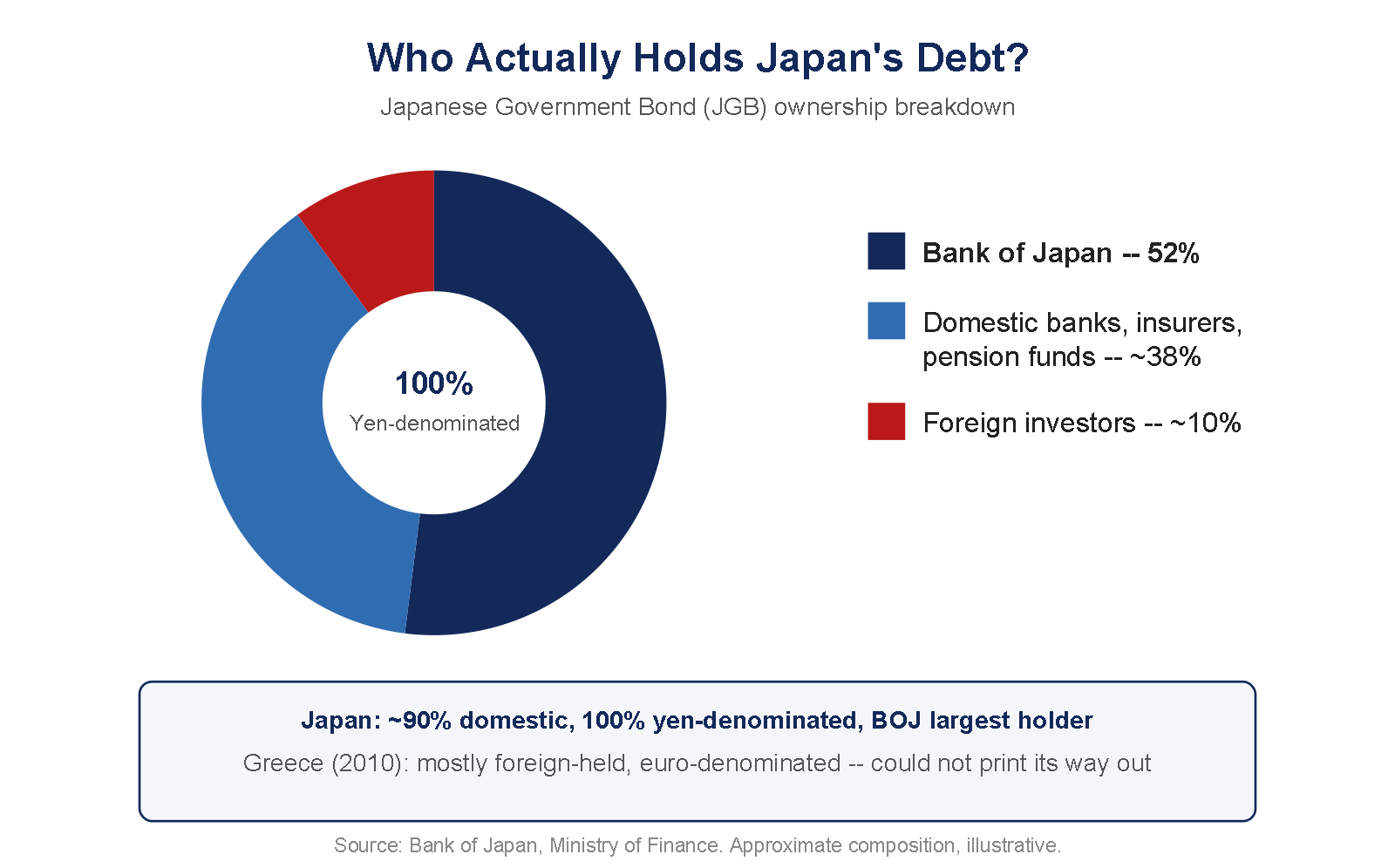
Roughly 52 percent of all Japanese government bonds are held by the Bank of Japan — the government’s own central bank, which remits its interest income right back to the treasury. The overwhelming majority of the remainder sits with Japanese banks, insurers, and pension funds. Foreign investors hold only a small slice of the market, and — critically — every single yen of the debt is denominated in yen, a currency Japan issues.
Compare that to the actual debt crises of living memory. Greece borrowed in euros, a currency it could not print, from foreign creditors it could not control. Argentina borrowed in dollars. Asian economies in 1997 collapsed under dollar-denominated debts as their currencies fell. In every case, the fatal combination was foreign-currency debt plus foreign creditors — the moment confidence broke, there was no domestic mechanism to absorb the shock.
Japan has neither ingredient. A country that borrows in its own currency, from its own citizens, with its own central bank as the largest single holder, faces a fundamentally different set of risks. It can experience inflation. It can experience currency depreciation. What it essentially cannot experience is the Greece scenario — a hard default forced by creditors it cannot repay in money it cannot create.
This is the argument that a growing number of economists and commentators have been making for years against the “Japan is doomed” consensus, and it’s the reason the doomsday predictions — which have been made continuously since at least the late 1990s — keep failing to arrive. Hedge funds have lost so much money shorting Japanese government bonds over the decades that the trade earned its own nickname: “the widowmaker.”
The Honest Caveats: What Could Still Go Wrong

Now, I promised honesty, and honesty requires this section, because the cheerful version of this story has real cracks in 2026 — and pretending otherwise would be exactly the same sin as the doom headlines, just in reverse.
Interest rates are rising. Twenty-year JGB yields recently touched their highest levels since 1999, and some bond auctions have seen notably weak demand. For thirty years, Japan’s debt was nearly free to service; at higher yields, interest costs start consuming a meaningful share of the budget. The arithmetic that made 250 percent sustainable at zero percent interest gets uncomfortable at two or three percent.
The yen has been under sustained pressure. Japanese authorities spent a record ¥11.7 trillion on yen-buying intervention in a single stretch through May 2026 — a sign that markets are testing Tokyo’s resolve. A weak yen is partly a policy choice and partly a symptom, and economists like Robin Brooks have argued forcefully that intervention treats the symptom while the underlying disease is fiscal.
The creditor crown has slipped. Falling from first to third among global creditor nations doesn’t change the absolute numbers, but it does signal a relative shift in financial firepower toward Germany and China.
Demographics remain the deep current. An aging, shrinking population means rising social security costs and a gradually eroding domestic savings base — the very foundation of the “Japan owes itself” stability could thin over decades.
So the balanced verdict isn’t “nothing to worry about.” It’s this: Japan’s debt is a genuine long-term structural challenge that will play out over decades through inflation, currency, and interest-rate channels — not a Greece-style cliff that global investors should price as imminent. The distinction matters enormously, because the two scenarios call for opposite business strategies.
What This Means If You’re Doing Business With Japan

Here’s where I put on my operator hat, because this isn’t just macro trivia — the “Japan is bankrupt” meme has real commercial consequences.
I’ve watched foreign companies hesitate on Japan market entry because a board member read one scary debt headline. I’ve seen procurement teams demand extra payment protections from Japanese partners whose balance sheets were, ironically, far stronger than their own. The gap between Japan’s media image and its balance-sheet reality is a market inefficiency — and market inefficiencies are where opportunity lives.
Consider what the actual picture implies. Takaichi’s government has broken from decades of fiscal restraint to pour public money into what it calls “crisis-management investment” and “growth investment” — AI, semiconductors, shipbuilding, energy security. Her February 2026 policy address named capital investment as the single thing Japan lacks most, and her administration has made courting foreign capital an explicit strategy, anime quotes and all. Meanwhile the weak yen — whatever its causes — has made Japanese assets, factories, talent, and market entry cheaper in dollar terms than at almost any point in modern memory.
And on the consumer side, that record ¥2,286 trillion in household financial assets is slowly starting to move. The government’s expanded NISA tax-free investment program has pushed a historic share of savings from deposits into equities — the deposit share of household assets recently fell below 50 percent for the first time. A population this wealthy, finally putting its money to work, is not the demand profile of a collapsing economy.
For American and European operators, the practical takeaway is simple: evaluate Japan on its actual balance sheet, not its headline ratio. The companies quietly building positions here — in robotics, in content, in premium consumer goods — are betting that a nation with $15 trillion in household wealth, record corporate cash, and top-three creditor status will remain one of the world’s most bankable consumer markets. The 250-percent crowd keeps waiting for a collapse that the underlying numbers have never actually supported.
Frequently Asked Questions
Q. Is Japan’s debt really 250 percent of GDP?
A. The gross figure — total government liabilities with assets ignored — sits roughly between 230 and just over 250 percent of GDP depending on the source and measurement. But net debt, which subtracts the government’s substantial financial assets such as the ¥260 trillion GPIF pension fund and $1.29 trillion in foreign reserves, is around 130 to 134 percent — high, but comparable to Italy rather than uniquely catastrophic.
Q. Why hasn’t Japan defaulted like Greece did?
A. The two situations are structurally opposite. Greece borrowed in euros — a currency it couldn’t issue — largely from foreign creditors. Japan’s debt is entirely in yen, roughly 90 percent domestically held, and about 52 percent is owned by the Bank of Japan itself. A country that borrows in its own currency from its own citizens faces inflation and currency risk, but not a Greek-style forced default.
Q. Could Japan’s debt still cause problems for global markets?
A. Yes, through indirect channels. Rising JGB yields have pushed Japanese institutions to repatriate capital from U.S. and European bond markets, and sharp yen movements can transmit volatility worldwide — the market turbulence of recent years around the yen carry trade showed how connected these flows are. The realistic risk is gradual pressure through rates and currency, not a sudden default event.
Q. What does this mean for foreign companies considering the Japanese market?
A. Arguably the opposite of what the headlines suggest. The weak yen has cut the dollar cost of Japanese market entry, partnerships, and acquisitions dramatically, while households sit on a record ¥2,286 trillion in financial assets and the government actively courts foreign investment in AI, semiconductors, and advanced manufacturing. Companies that dismiss Japan based on the gross debt ratio alone are leaving one of the world’s wealthiest consumer markets to their competitors.
The Bottom Line
Sanae Takaichi’s “shut up and invest everything in me” moment was theater — but it was theater backed by a balance sheet that the world’s most famous scary statistic systematically hides. Gross debt of 250 percent of GDP, viewed alone, describes a country on the edge of ruin. Add back the world’s largest pension fund, the second-largest foreign reserves, record household wealth of ¥2,286 trillion, record corporate reserves of ¥637 trillion, and a half-quadrillion-yen net creditor position, and you get something far stranger and far more interesting: the most indebted rich country on Earth, which is also one of the richest indebted countries on Earth.
Japan’s fiscal path has genuine risks — rising yields, a soft currency, and demographics chief among them — and I wouldn’t want to minimize them. But after twenty years of watching this economy defy confident predictions of its collapse, I’ve learned to be suspicious of any analysis that fits in a single number. The investors who understood that earned decades of quiet returns. The ones who didn’t gave the widowmaker trade its name.
If you’re interested in this topic, the Japanese market more broadly, or what KETCHUPs is working on, we’d love to hear from you — please reach out via our contact form.
Japan Market Pulse is a weekly read on what the Japanese consumer-tech, food, and mobility markets are choosing to do, written for international operators who want to know what is happening before it shows up in the global trade press.
Subscribe at ketchups.co/japan-market-pulse.