

Twice a year, a business newspaper most Americans have never heard of publishes a ranking that Japanese marketers quietly treat as gospel. It is not a bestseller list, not a box office chart, and not a stock index. It is a sumo-style leaderboard — complete with the sport’s actual rank names, yokozuna down to maegashira — for consumer products. And every June and December, Nikkei MJ, the retail and marketing offshoot of Japan’s largest business daily, sits down with retailers, brand managers, and economists to argue over which products, people, and cultural moments best captured the country’s mood over the previous six months.
I’ve been reading this ranking for most of the two decades I’ve lived in Tokyo, and it has never once been boring. It is, in effect, Japan’s own version of a Word of the Year list crossed with a stock market report — except instead of tracking a single number, it tracks the emotional temperature of 124 million consumers. The 2026 first-half edition, published in early June, landed with a theme its own editors summed up in three words: “Pu no Arashi” — the Storm of P. Two very different kinds of “P” were doing battle for the Japanese wallet: the “P” of pain (bukka, or price inflation, and energy costs) and the “P” of passion (premium goods, limited editions, and fandom). Reading through the full list — which stretches from a geopolitical oil shock at the very top down to an American AI chatbot buried in the middle ranks — you get a strikingly clear picture of what it actually feels like to be a consumer, or a brand trying to sell to one, in Japan’s third year of sustained inflation.
For anyone running a business that touches Japan, or thinking about entering the market, this ranking is worth fifteen minutes of your time. Here’s what it says, and what I think it means if you’re building a product, a brand, or a market entry strategy for this country in the second half of 2026.
The East Yokozuna: A Strait 4,600 Miles Away Set Japan’s Grocery Prices

The single highest-ranked entry on the entire chart wasn’t a product at all. It was a geopolitical event: “Hormuz Shock,” Nikkei MJ’s shorthand for the disruption of oil shipping through the Strait of Hormuz, the narrow waterway between Iran and Oman that carries roughly 20% of global oil consumption, or about a quarter of the world’s seaborne oil trade. For most countries, that’s an abstract statistic. For Japan, it’s closer to a lifeline: an estimated 90% of the crude oil Japan imports passes through that strait.
In late February 2026, after US and Israeli strikes on Iranian targets, Iran signaled it would mine the strait and target shipping there. Major maritime insurers cancelled or sharply restricted war-risk coverage for vessels transiting the area within days. Japan’s two largest shipping lines suspended passage through the strait almost immediately. Japanese trade press reported tanker traffic that had averaged around 24 vessels a day before the crisis falling to roughly four — with most of the remaining traffic made up of Iranian-flagged ships, largely exempt from the risk calculus facing everyone else.
The knock-on effects reached well beyond gas station price boards. Electricity costs, logistics costs, food prices, and household goods all absorbed some portion of the shock, layering onto an economy that had already logged four consecutive fiscal years of core inflation through 2025. By the time Nikkei MJ’s editors sat down to build the June chart, “Hormuz Shock” wasn’t a single news story anymore — it was the atmospheric pressure sitting over every other purchase decision Japanese consumers made in the first half of the year. That’s precisely why it topped the list: not because anyone “liked” it the way they liked a new snack or a hit song, but because it explains almost everything else on the chart.
If you sell into Japan, the lesson isn’t really about oil. It’s about how directly and quickly a supply shock on the other side of the world shows up in a Japanese consumer’s grocery basket, given how import-dependent the country’s energy picture is. Pricing strategies and inventory assumptions that don’t account for that kind of volatility are working from an outdated model of the Japanese market.
The West Yokozuna: How a 30-Year-Old Video Game Still Wins
Sitting at equal rank with an oil crisis was something considerably lighter: Pokemon’s 30th anniversary. Pokemon Red and Green launched in Japan on February 27, 1996, and the franchise spent the first half of 2026 marking three decades with a rolling campaign across gaming, merchandise, and retail tie-ins that Japanese trade press has been tracking almost weekly. The Pokemon Company created more than a thousand 30th-anniversary logo variations for the celebration, and the Pokemon Center chain has been shipping anniversary orders in special commemorative packaging throughout the year. Suntory ran a national tie-in with its BOSS coffee brand built around the franchise’s three starter creatures. And the Pokemon Trading Card Game — a business that has, on its own, become one of the more remarkable collectibles stories of the decade — is gearing up for its own 30th-anniversary milestone in October, with major 30th Celebration products beginning to arrive as early as September and celebration sets, promo cards, and premium collector boxes already commanding attention (and secondary-market markups) well ahead of the October date. If you want a sense of how far that enthusiasm has already traveled outside Japan, the Pokemon TCG 30th anniversary First Partner holographic card set is already listed on Amazon’s US storefront months ahead of the anniversary.
What’s notable isn’t that Pokemon is popular — it has been for three decades. It’s that a franchise old enough to have its original 1996 players now buying merchandise for their own children can still out-rank almost everything released in the past six months. Nikkei MJ’s own analysis pointed to exactly this: three generations of the same family engaging with the same intellectual property at the same time, each for a different reason. Grandparents remember the Game Boy. Parents remember the anime’s Saturday morning run. Kids are playing the newest mobile title. That’s not nostalgia marketing — that’s an IP that has genuinely never stopped being current, re-earning its relevance every few years instead of coasting on a single generation’s memory.
For any brand with global IP of its own — whether that’s a legacy product, a founder-era company story, or a piece of cultural history — the operating lesson here is that longevity is not automatically a liability in the Japanese market. Handled well, it’s an asset that compounds across generations in a way few purely new launches can match.
The Storm of “P”: A Stock Market at 60,000 Points and a Consumer Who Can’t Decide What Kind of Year This Is
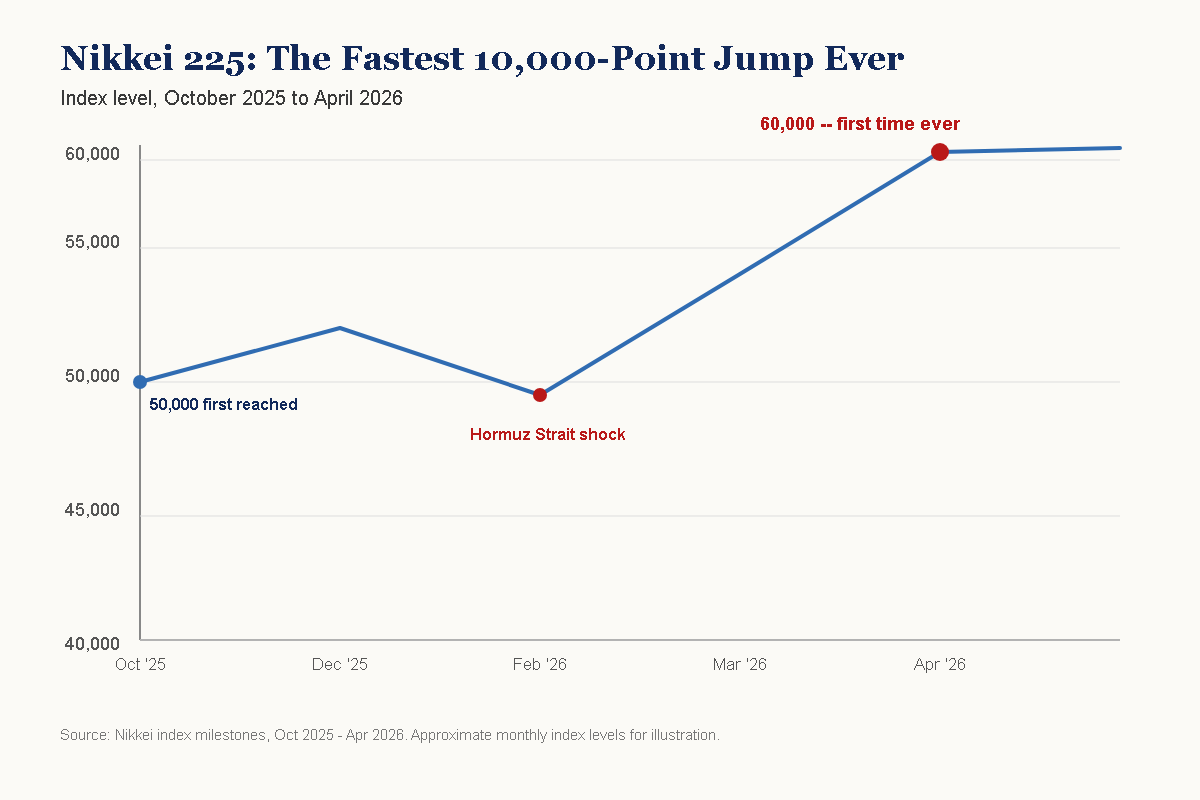
To understand why these two very different entries could sit at the same rank, you need the other number that defined Japan’s first half of 2026: the Nikkei 225 stock index crossed 60,000 points for the first time in its history in April, just six months after first touching 50,000 in October 2025 — the fastest 10,000-point jump in the index’s history, driven largely by global capital flowing into AI and semiconductor names. On paper, Japan is in the middle of a historic bull run.
And yet the same six months produced the fourth consecutive year of core inflation and an oil shock that pushed household costs higher across the board. Those two facts — a booming stock market benefiting asset holders and a cost-of-living squeeze hitting everyone else — are, in miniature, the entire emotional plot of this ranking. Nikkei MJ’s own write-up of the chart used two words repeatedly to describe the resulting consumer mindset: nattoku-kan (“a sense of being convinced it’s worth it”) and hitto no kotsubu-ka (“the miniaturization of hits”). Rather than one or two blockbuster products dominating the way, say, a single viral gadget might in a more uniform market, 2026’s first half produced a long tail of smaller, more specific hits, each satisfying a narrower slice of consumer demand.
You can see the split running through the rest of the ranking almost like a fault line. On one side, the frugal, “prove it’s worth it” side: a revived Showa-era canned beer riding pure nostalgia pricing, a hamburger-steak seasoning mix designed to stretch ground meat further as beef prices climbed, and a wave of budget-conscious dining and grocery hacks that Japan Market Pulse has covered elsewhere on its own. On the other side, the “I’ll spend on this one thing” side: limited-run sticker collaborations that sold out within hours, a beloved boy band’s farewell concert that became the single hardest ticket in the country, and premium versions of ordinary items — a toothbrush, a mechanical pencil — priced at multiples of their standard counterparts and selling anyway. Japanese consumers in 2026 aren’t uniformly cautious or uniformly indulgent. They’re doing both at once, just about different things, and reading which is which is quickly becoming a core skill for anyone pricing a product here.
Sekiwake and Komusubi: A Boxer, a Skating Pair, a Chatbot, and a Fox
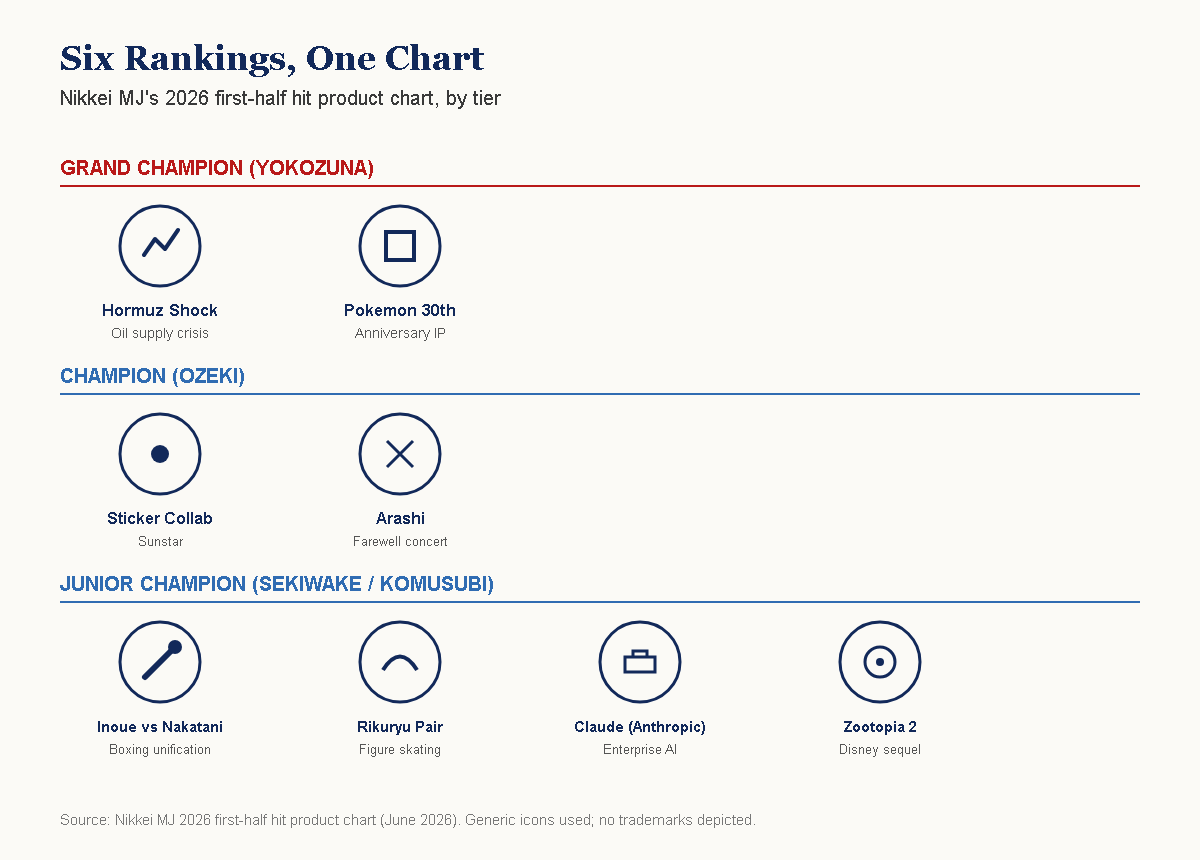
Move down a rank and the chart gets even more interesting, because this is where individual people and single companies — rather than macro forces or 30-year franchises — start to show up.
On May 2, 2026, at Tokyo Dome, undisputed champion Naoya Inoue defended his title against Junto Nakatani in a fight that Japanese sports media had been building toward for years: two unbeaten, four-belt-caliber Japanese boxers, from the same country, in the same weight class, finally sharing a ring. Inoue won by unanimous decision (116-112, 115-113, 116-112), extending his professional record to 33-0 with 27 knockouts and handing Nakatani the first loss of his own 33-fight career. It’s the kind of matchup that, in most countries, would have split fans along regional or promotional lines. In Japan, it became a unifying national event precisely because both fighters were homegrown and both were undefeated — there was no “beating the outsider” narrative available, only two of the country’s own at the absolute top of a genuinely global sport. Inoue’s profile outside Japan, incidentally, is no longer a niche one either; he’s routinely covered by international boxing press as one of the sport’s most avoided fighters, pound for pound.
A notch below Inoue and Nakatani, figure skating pair Riku Miura and Ryuichi Kihara — competing together as “Rikuryu” — logged another standout season, part of a broader run of Japanese success in a sport where the country has historically punched below its weight in the pairs discipline specifically.
But the entry that stopped me longest wasn’t a person at all. It was Anthropic’s AI assistant Claude, ranked komusubi — a genuinely unusual placement for enterprise software on a chart built almost entirely around things Japanese households buy, eat, or watch. The placement reflects a real shift that’s happened over the past year: in April 2026, NEC became the first Japanese company to sign on as an Anthropic Global Partner, rolling Claude out to roughly 30,000 employees across the group. Nomura Research Institute expanded its own enterprise deployment of Claude via AWS across its entire organization. Anthropic opened a Tokyo office in the fall of 2025 and has been rolling out Japanese-language product support since. None of that is consumer-facing in the way a snack or a concert ticket is — and that’s exactly the point. Claude’s appearance on a household consumer trends chart is a signal that AI adoption inside corporate Japan has crossed a threshold where ordinary consumers are now aware of it as a cultural fact, not just a workplace tool. (As the operator of this newsletter, I’ll flag the obvious: Claude is the AI I’m writing this piece with, so take my read on its significance with that context in mind. I’d argue the placement is newsworthy regardless of who made the model — enterprise AI rarely lands on a chart built for toothbrushes and boy bands.)
Rounding out the same tier, Disney’s “Zootopia 2” continued to prove that a well-executed global franchise sequel travels just as well in Japan as it does anywhere else, a reminder that for all the very Japan-specific dynamics elsewhere on this chart, some things — a good sequel to a beloved animated film — just work everywhere.
What This Chart Actually Means If You’re Building a Business Here

Step back from the individual entries and a few practical patterns emerge for anyone doing business with or in Japan right now.
First, macro shocks translate into consumer behavior here faster and more directly than in less import-dependent economies. A shipping-lane disruption 4,600 miles from Tokyo showed up in Japanese grocery prices within a single fiscal quarter. Any pricing model, inventory plan, or promotional calendar for the Japanese market needs a wider margin for geopolitical volatility than you might build in for a more energy-independent economy.
Second, the market is not one consumer — it’s at least two, moving in opposite directions at the same time. A “prove it’s worth it” segment is trading down, hunting for value in nostalgia brands and stretch-your-budget product reformulations. A “spend on what matters” segment is trading up, willing to pay real premiums for limited runs, fandom goods, and elevated versions of everyday items. Brands that pick a lane clearly — either disciplined value or genuine premium scarcity — are outperforming brands stuck communicating a muddled middle.
Third, longevity is an underused asset. Japan’s consumer base rewards brands and franchises that can credibly claim decades of continuity, not despite their age but because of it. If your company or product has real history, Japan is a market where that history is a selling point rather than something to hide behind a rebrand.
Fourth, and maybe most relevant if you’re reading this from outside Japan: enterprise AI adoption here has quietly moved from an IT department conversation to a cultural one. A single trade press ranking putting an AI assistant on the same list as a boxing match and a Disney sequel doesn’t happen without real momentum behind it. If your business sells software, services, or expertise into Japan, the audience’s baseline comfort with AI tools is higher, right now, than most outside observers assume.
Frequently Asked Questions
Q. What exactly is the Nikkei MJ Hit Product Chart, and why does a foreign business audience need to know about it?
A. Nikkei MJ is the retail, marketing, and distribution-focused sister publication of Nikkei, Japan’s dominant business newspaper (comparable in stature to the Wall Street Journal’s relationship to Dow Jones). Twice a year, its editors and a panel of retail and marketing experts rank the six months’ most significant consumer products, trends, and cultural moments using sumo wrestling’s ranking terms, from yokozuna (grand champion) down through ozeki, sekiwake, komusubi, and maegashira. It has run for decades and is treated by Japanese brand managers as one of the more reliable snapshots of where consumer sentiment actually sits, as opposed to where marketing campaigns hoped it would sit.
Q. Why did an enterprise AI product like Claude end up on a consumer trends chart?
A. Its komusubi ranking reflects a wave of large-scale corporate adoption in Japan through the first half of 2026 — including NEC becoming Anthropic’s first Japanese Global Partner and rolling the tool out to roughly 30,000 employees, and Nomura Research Institute expanding its own enterprise deployment. The chart’s editors read that momentum as having crossed into general public awareness, not just IT-department awareness, which is unusual for enterprise software of any kind.
Q. How is the Hormuz Strait situation affecting everyday prices for consumers in Japan right now?
A. Roughly 90% of Japan’s crude oil imports pass through the Strait of Hormuz, so the reduction in tanker traffic that followed the February 2026 escalation has pushed costs higher across fuel, electricity, logistics, and — with a lag — food and household goods, compounding an inflationary run that was already in its fourth consecutive fiscal year.
Q. Is any of the Pokemon 30th-anniversary merchandise available to buy outside Japan?
A. Yes — global demand for the anniversary has been strong enough that products like the Pokemon TCG 30th Anniversary Ultra-Premium Collection and the First Partner holographic card set are sold through Amazon’s US storefront and major US retailers, with major 30th Celebration products beginning to arrive as early as September ahead of the trading card game’s own October 2026 anniversary.
Q. What does Naoya Inoue’s win over Junto Nakatani mean for boxing’s standing in Japan?
A. It cemented what had already been building for several years: Japan now produces genuine pound-for-pound elite talent in boxing, and the sport can command the kind of national attention usually reserved for Japan’s biggest sporting moments. Inoue’s undefeated record and international press coverage have made him one of the most recognized Japanese athletes among Western sports audiences, and a unification fight between two unbeaten Japanese champions drew the kind of domestic attention usually reserved for the Olympics or the World Baseball Classic.
Conclusion
No single ranking can capture something as large as a national mood, and Nikkei MJ’s editors would be the first to admit theirs is an imperfect, occasionally idiosyncratic exercise — a food seasoning mix and an oil crisis don’t belong on the same axis by any strict logic. But that’s also what makes it useful. It’s not trying to be a clean economic indicator. It’s trying to capture what people actually talked about, bought, watched, and worried over, all at once, in the messy way real consumer behavior actually happens. Read that way, the first half of 2026 in Japan looks less like a single story and more like two economies running in parallel: one anxious and careful, one splurging on exactly the right thing at exactly the right moment, and — in Claude’s unlikely appearance near the bottom of the list — a third one quietly getting used to AI running in the background of both.
This article contains affiliate links. If you purchase through these links, we may earn a small commission at no extra cost to you.
If you’re interested in this topic, the Japanese market more broadly, or what KETCHUPs is working on, we’d love to hear from you — please reach out via our contact form.
Japan Market Pulse is a weekly read on what the Japanese consumer-tech, food, and mobility markets are choosing to do, written for international operators who want to know what is happening before it shows up in the global trade press.
Subscribe at ketchups.co/japan-market-pulse.