

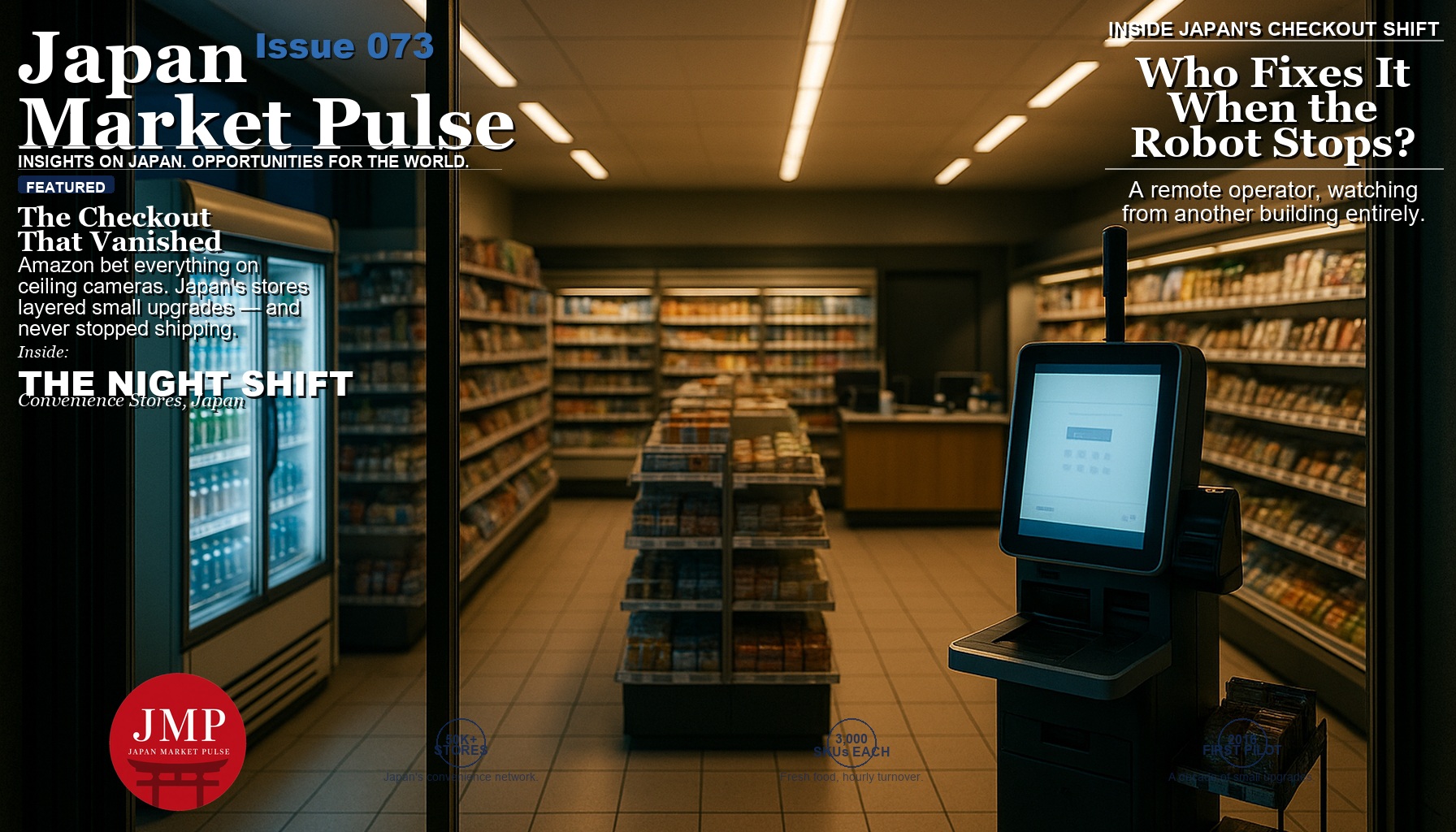
Amazon announced in January that it would close its Amazon Go and Amazon Fresh physical stores, with most locations shutting their doors by February 1. The company that spent eight years and, by most estimates, well over a billion dollars trying to convince the world that cashierless retail was the future is walking away from the format that started it all — the ceiling cameras, the “Just Walk Out” sensors, the entire choreography of a store that was supposed to know what you picked up before you did. Executives pointed to a strategic refocus on Whole Foods and grocery delivery. Reporters covering the announcement treated it as the end of a particular Silicon Valley fantasy: that enough computer vision and enough capital could simply delete the checkout line from human experience.
I read that news from my apartment in Tokyo, a five-minute walk from a Lawson that has not had a cashier present between midnight and five in the morning for years, and a ten-minute walk from a 7-Eleven where, on a visit last spring, I watched a squat little robot glide along a track bolted above the drink cooler, scan the shelf with a ring of cameras, and quietly restock canned coffee without anyone standing behind the counter to see it happen. Neither of those things made international news. Neither was framed as a moonshot. And that, I’ve come to think, is exactly why they worked while Amazon’s version didn’t.
This is a story about two very different bets on the same idea — a store that doesn’t need a person standing at the register — and about why the quieter, less photogenic bet placed by Japan’s convenience store chains has been running in production, at scale, for the better part of a decade, while the flashier American version just got switched off.
The Register That Disappeared While Nobody Outside Japan Was Watching
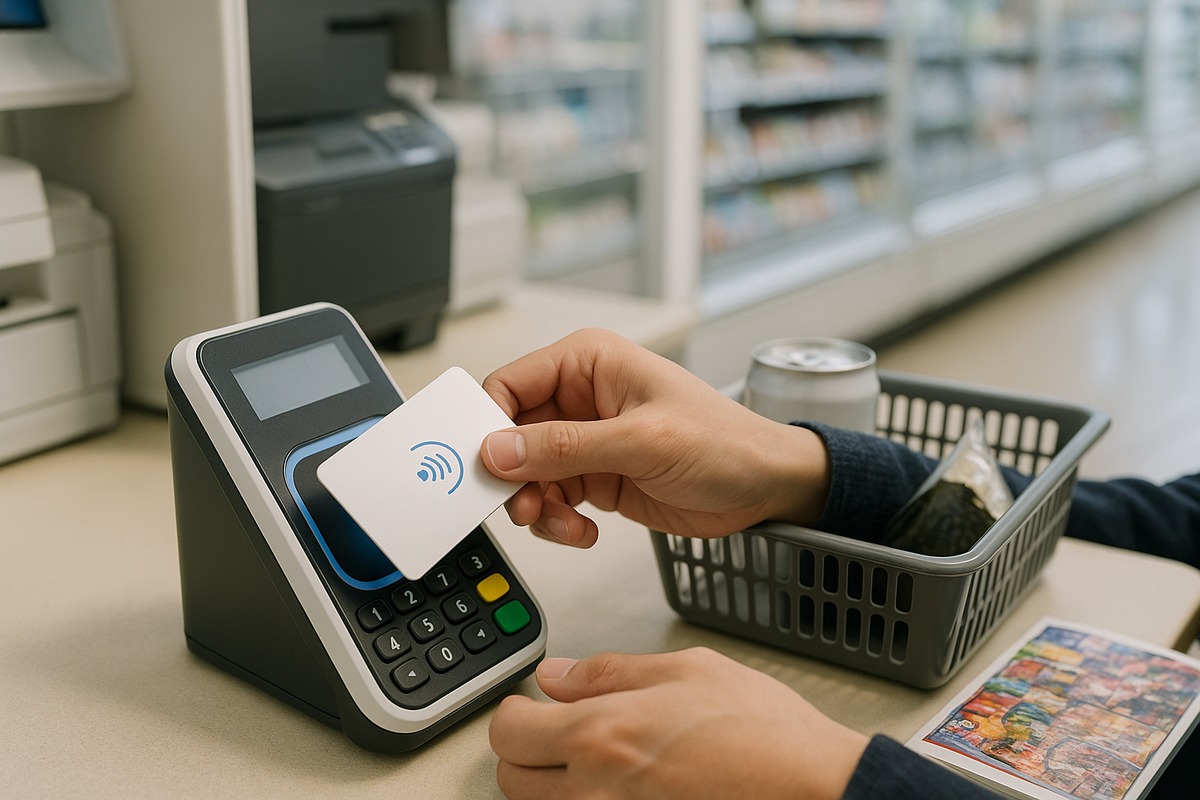
The first serious public trial of an automated convenience-store checkout in Japan happened in December 2016, at a single Lawson location in Osaka built specifically for the experiment, in partnership with the electronics giant Panasonic. The system, built around a fully automated register the companies nicknamed “Regi-Robo,” had customers scan each item’s barcode themselves into a dedicated smart basket, which the machine then read in one pass to calculate the total and even handle bagging — a task American self-checkout kiosks still leave entirely to the customer. A follow-up test in February 2017 swapped in RFID electronic tags embedded in packaging, showing how item-level chips could eventually remove the scanning step altogether. It wasn’t a public product yet. It was a proof of concept, tested quietly in one store, with modest ambitions: cut labor costs by roughly a tenth and shave time off the queue during the lunch rush.
What followed wasn’t a dramatic unveiling. It was a slow, almost bureaucratic scaling process typical of how Japan’s convenience store industry tends to move. By 2017, Japan’s economy ministry had brokered an unusually coordinated agreement among the five major chains — 7-Eleven, Lawson, FamilyMart, Ministop, and NewDays — to work toward putting electronic tags on essentially every item they sell, an effort publicly nicknamed the “100 Billion Tags Declaration” for the rough number of products the chains move through their registers annually. The idea was that once every rice ball, drink, and snack carried a scannable chip rather than a printed barcode, a shopping basket could be read in an instant, checkout could become close to automatic across the entire industry, and the labor savings wouldn’t depend on any single chain’s proprietary technology.
The tag rollout didn’t hit its original target on schedule — tagging every single item across five national chains turned out to be a bigger supply-chain undertaking than anyone initially priced in, and it’s still an ongoing effort rather than a finished one. But the direction was set, and it mattered less that the finish line moved than that an entire industry, working with its regulator, had committed to the same automation path at the same time. By 2019, Lawson was running a six-month trial in Yokohama where a single store operated with no staff at all between midnight and five in the morning — customers let themselves in with a smartphone app or a facial scan at the door, rang up their own purchases at self-checkout terminals, and simply couldn’t buy cigarettes or alcohol during those hours, since Japanese law requires an adult to verify those sales in person. Lawson used the trial to work through the operational, security, sales, and customer-response questions that come with running a store nobody is standing in. Around the same period, FamilyMart opened its own unmanned pilot store, stripped down to roughly seven hundred items instead of the three thousand a normal location carries, monitored by more than forty ceiling cameras tracking what shoppers picked up.
None of this arrived with a keynote presentation. It arrived the way most infrastructure does in Japan — store by store, chain by chain, without a press cycle built around the idea that checkout lines were about to become extinct.
Why Ringing Up a Rice Ball Is Actually Harder Than It Looks
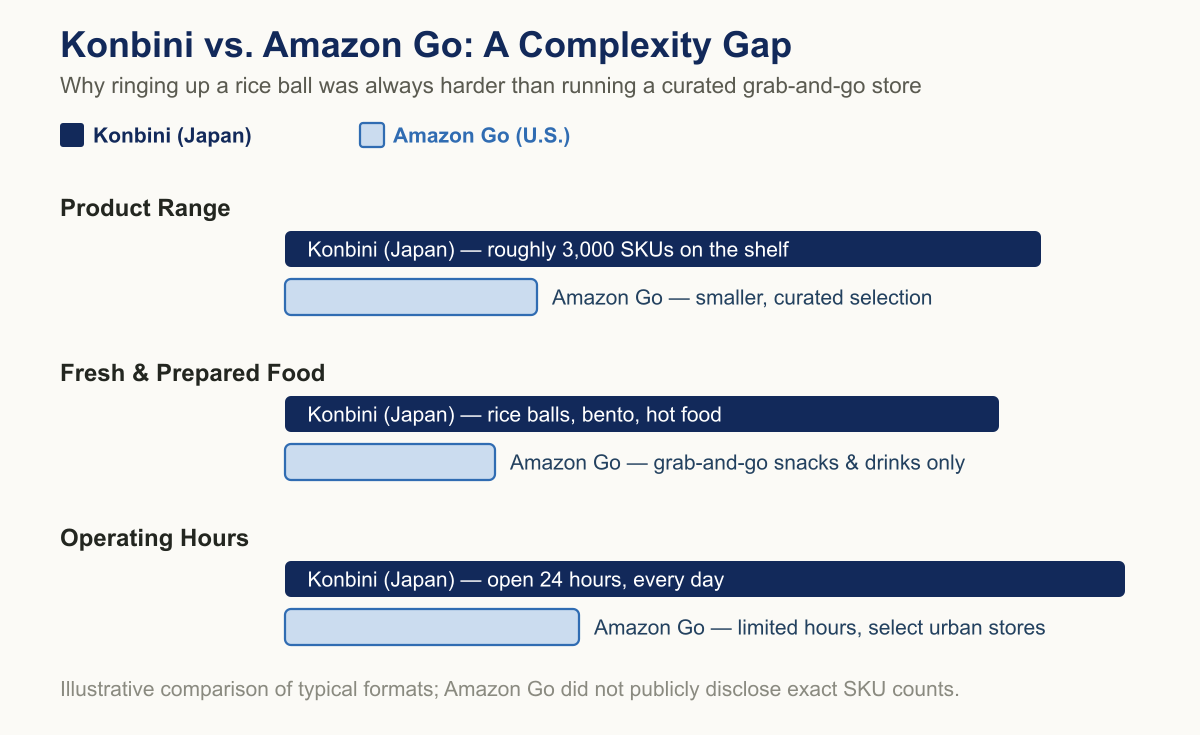
It’s worth pausing on why this was hard in the first place, because the difficulty is exactly where the American and Japanese approaches diverge. A typical konbini — the catch-all Japanese word for convenience store — stocks something in the range of three thousand distinct items in a footprint you could walk across in about fifteen seconds. A meaningful share of that inventory is fresh or semi-fresh food: onigiri rice balls in a dozen near-identical triangular wrappers, fried chicken and steamed buns sitting in a heated case by the register, bento boxes that get swapped out on a schedule measured in hours rather than days, plus soft drinks, magazines, phone chargers, cosmetics, and a rotating wall of seasonal snacks that changes every few weeks. Amazon Go, by contrast, was a curated grab-and-go format with a far smaller and more visually distinct product set, operating in a handful of dense urban US markets, without the added burden of restocking a hot food case multiple times a day or verifying age for alcohol and tobacco at three in the morning.
That complexity is a large part of why Japan’s chains never bet everything on one silver-bullet technology the way Amazon effectively did with ceiling-mounted computer vision. Self-checkout kiosks handle the barcode-scannable majority of a basket. Electronic tags, where they’ve been rolled out, let a whole basket be read in one pass without individual scanning. Face recognition or app-based entry controls who’s allowed into an unmanned store during off hours. And a layer of human backup — sometimes on-site, sometimes remote — catches everything the automated systems can’t yet handle cleanly, which for a Japanese convenience store still includes plenty: verifying an age-restricted purchase, resolving a jammed hot-food warmer, or handling the kind of customer question a camera array simply can’t answer. Rather than one system trying to do everything perfectly, it’s several partial systems layered so that no single point of failure takes the whole store offline.
I noticed this myself the first time I used a self-checkout lane at a FamilyMart near Shinjuku a few years ago. I scanned a can of coffee, a rice ball, and a magazine myself, tapped my transit card to pay, and the entire transaction took maybe twenty seconds — but there was still a staff member two meters away, restocking a shelf, glancing over periodically, present but not required. That’s a meaningfully different design philosophy from a store engineered around the premise that no human needs to be in the building at all.
The Robots Working the Night Shift You Never See
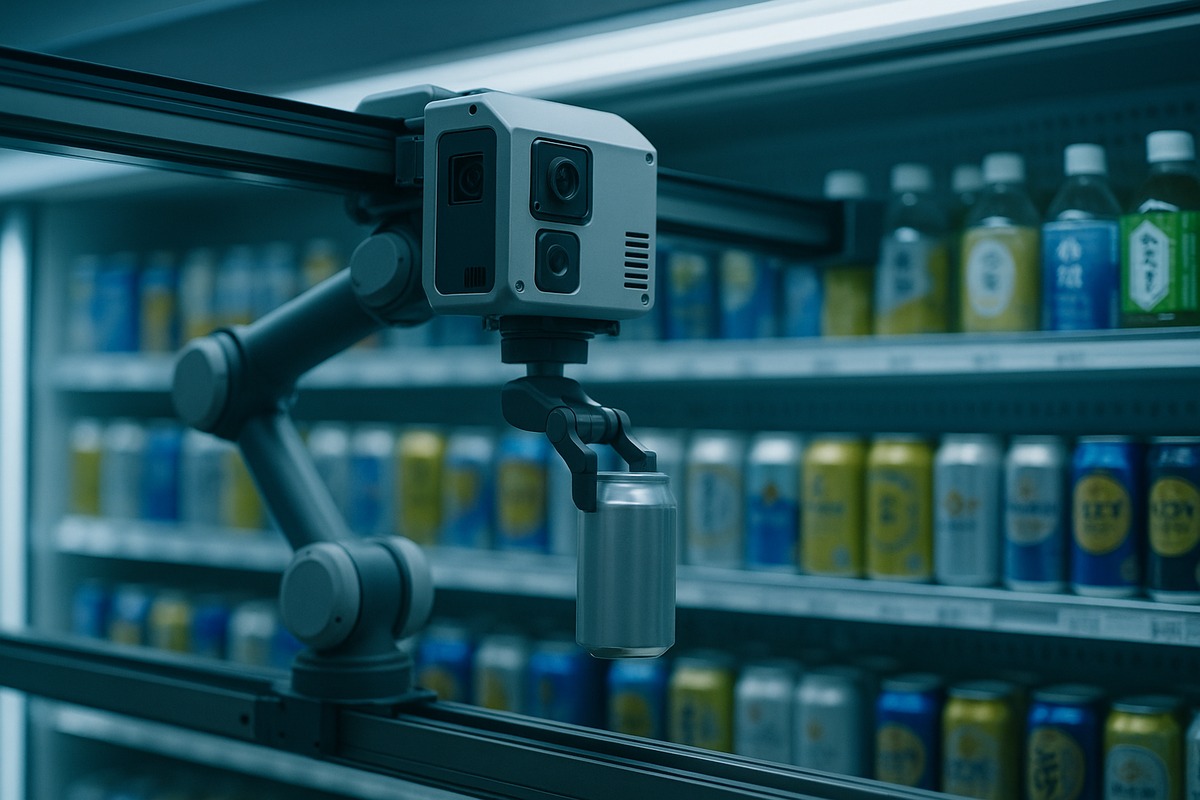
The most recent phase of this rollout has moved past the checkout counter entirely and into the parts of the store customers rarely think about. A Tokyo robotics company called Telexistence has spent the past several years deploying autonomous restocking robots — mounted on rails above refrigerated beverage cases — across hundreds of FamilyMart and, more recently, 7-Eleven locations. The robot uses an array of cameras to scan the shelf, identify which drinks are running low, and place a fresh can or bottle in the gap, all without a staff member climbing in and out of a walk-in cooler dozens of times a shift, a task that is physically taxing in a way that’s easy to underestimate until you’ve done it. By the company’s own figures, the system successfully restocks the correct product in the correct spot well over ninety-eight times out of a hundred — and for the rare cases where the robot gets confused or something falls out of place, a remote human operator wearing a VR headset can take manual control for a few seconds and fix it before handing control back to the machine. Nobody has to physically be in that store to solve the problem. They just have to be watching, from somewhere else, ready to step in.
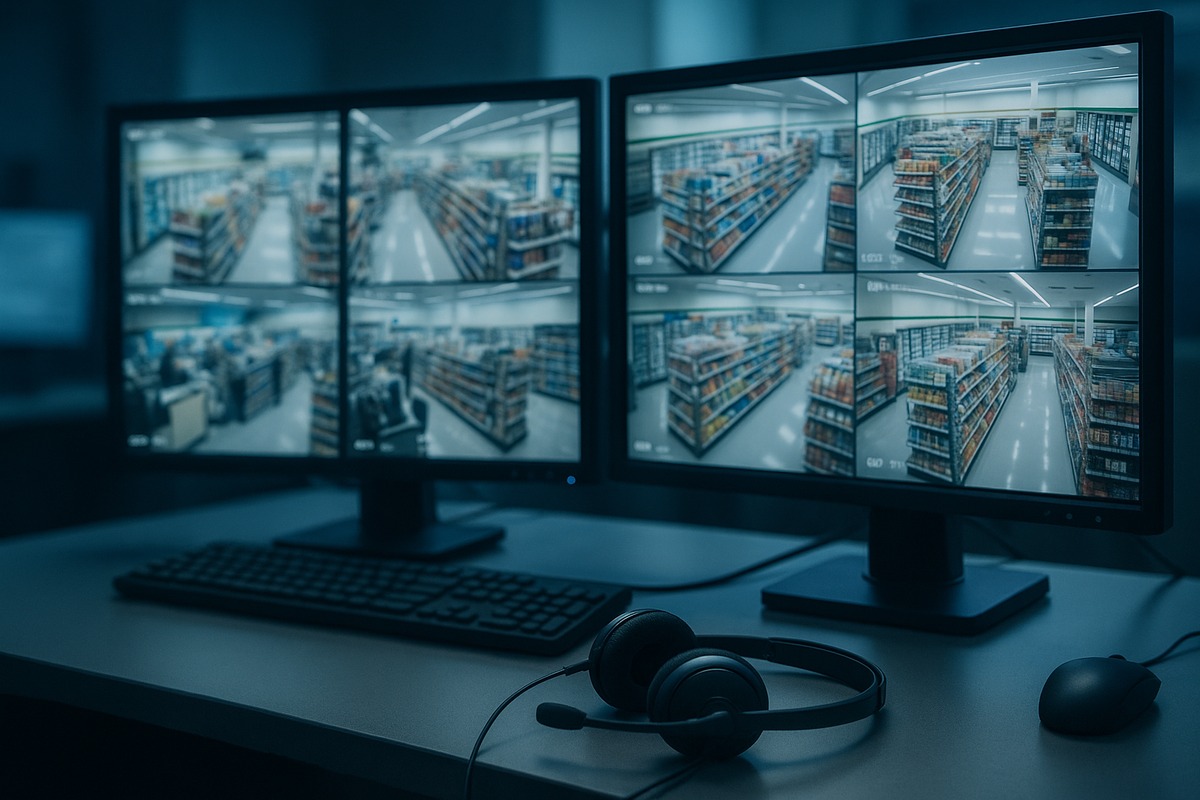
That last detail is the part I find most telling, because it quietly answers the question of what happens to the humans in this story. They don’t disappear. They move — from a walk-in cooler in one specific store to a monitoring station that can service dozens of stores at once, the same way an air traffic controller doesn’t stand next to every runway. 7-Eleven Japan has been piloting an even more direct version of this idea: a store where a customer struggling at a self-checkout terminal can talk to a “virtual clerk” displayed on a screen, connected in real time over a high-bandwidth network to a staff member working from an entirely different location, who can walk them through the transaction, answer a question, or flag an issue for a supervisor — offering multilingual support to a foreign tourist without needing a multilingual employee physically on-site. The pilot has run in a single Tokyo neighborhood store so far, explicitly framed by the company as a test of whether the approach is ready to scale, not a finished rollout. But the shape of the idea — a remote employee “staffing” several physical locations simultaneously through a screen — is the part worth watching, because it’s a genuinely different labor model than either “robot replaces worker” or “worker stays exactly where they were.”
None of this is happening in a vacuum. Japan’s working-age population has shrunk by roughly fifteen percent since the mid-1990s, and the country’s own economic planners project the labor shortfall could reach into the low millions by 2030 and climb further after that as the population continues to age. Retail and food service — sectors that are hard to automate entirely and historically dependent on part-time and shift labor — have been among the hardest hit by the resulting staffing crunch. Surveys of Japanese employers over the past couple of years have repeatedly shown labor shortages sitting near multi-decade highs. Automating the parts of a convenience store’s operations that don’t require a human judgment call isn’t a cost-cutting experiment for these chains anymore. It’s closer to a structural necessity, arrived at years before most other developed economies felt the same pressure as acutely.
Why Amazon’s Bet Failed Where Japan’s Incrementalism Didn’t
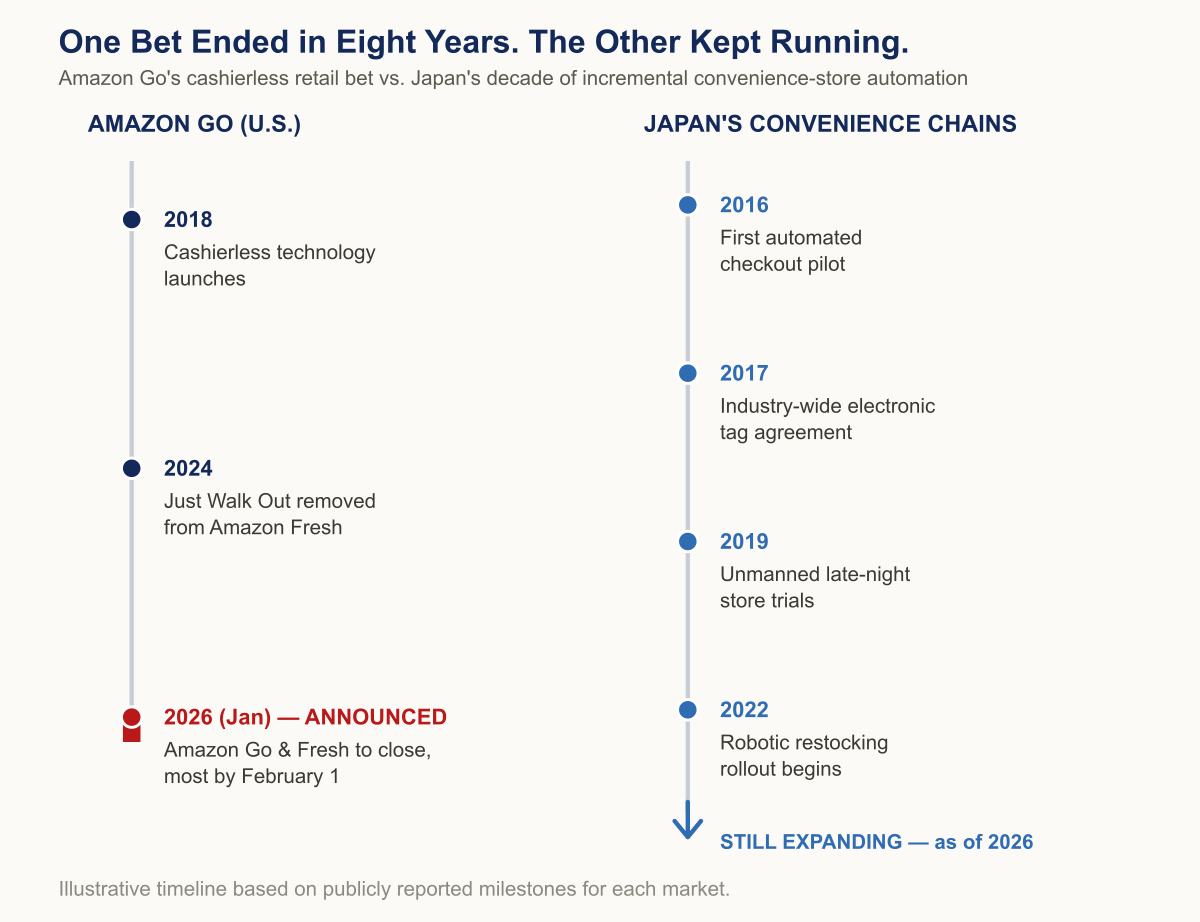
Amazon Go was, in retrospect, a moonshot dressed up as a convenience store. The entire proposition rested on a single, extremely difficult technical bet: that ceiling-mounted cameras and machine learning could track every item a shopper picked up, put back, or carried out, with total accuracy, in real time, without a cashier or a barcode scan anywhere in the loop. When that bet worked, it looked like magic — walk in, grab a sandwich, walk out, get a receipt on your phone a few minutes later. When it didn’t quite work reliably enough at scale, the company had no fallback layer to catch the gap, because the entire store format had been engineered around removing humans from the loop entirely rather than repositioning them. By April 2024, Amazon had already pulled the underlying “Just Walk Out” technology out of its larger Amazon Fresh grocery stores, shifting instead toward AI-assisted shopping carts. Store closures followed through 2024 and into this year, and executives were candid that even where the technology worked, the underlying real estate and labor economics of a small-format cashierless store in an expensive American city simply didn’t pencil out.
Japan’s convenience store chains never made that all-or-nothing bet, and I don’t think that was an accident so much as a reflection of how differently the two industries approached the same underlying problem. They treated checkout automation as a portfolio of smaller, individually useful technologies — self-checkout kiosks, electronic tagging, restocking robots, remote human support — layered onto existing stores rather than replacing the store format outright, deployed gradually across chains that already operate on razor-thin margins and couldn’t afford a single expensive bet that might not pay off. Where a piece of technology fell short of expectations, like the electronic-tag rollout missing its original deadline, the response wasn’t to scrap the whole program; it was to keep shipping the parts that worked and keep iterating on the parts that didn’t. A remote employee stepping in through a screen isn’t as clean a story as a fully autonomous store, but it’s dramatically cheaper to build, easier to fix when it breaks, and — critically — it doesn’t require solving computer vision perfectly before it can go into a single store, let alone fifty thousand of them.
What International Retailers Should Actually Take From This
The lesson for operators outside Japan isn’t “buy robots” — it’s about sequencing and where you put the human. Japan’s convenience store chains didn’t wait for a perfect autonomous solution before automating anything; they started with the boring, low-risk piece (self-checkout for barcode-scannable goods), added infrastructure that made the next step easier (electronic tagging, even on a slower timeline than planned), and only then moved into robotics for the genuinely dangerous or repetitive back-of-house tasks, keeping a human in the loop remotely rather than removing them from the picture entirely. That sequencing meant every stage of the rollout was already profitable and functional on its own before the next stage was layered on top of it, which is a meaningfully different risk profile than building an entire store format around a single unproven technology and hoping the economics work out once you scale it.
It’s also worth noting that this playbook is already being packaged for export. Telexistence has been explicit that its Japanese convenience-store deployments are a proving ground for expanding its robot-as-a-service model into other markets, including the United States, and it’s not hard to see why: any retailer contending with an aging workforce and a tight labor market — which increasingly describes South Korea, much of Western Europe, and parts of the US grocery sector — is looking at a preview of a problem Japan has been living with for years longer. The specific technologies may not transplant directly; American shoppers have different habits, US labor law shapes automation differently than Japan’s does, and no other country’s convenience-store format carries quite the density of fresh food SKUs that a Japanese konbini does. But the underlying strategy — automate incrementally, keep a human reachable rather than absent, and let the boring infrastructure work (tagging, connectivity, remote support systems) mature before betting on the flashy robotic layer — is a far more exportable idea than any single piece of hardware, and it’s the one part of this story that a retail operator anywhere can start applying immediately, with nothing more exotic than a self-checkout lane and a customer-service phone line staffed from a call center rather than a storefront.
Frequently Asked Questions
Q. Is Japan’s convenience store checkout technology similar to what Amazon Go used?
A. Not really. Amazon Go relied almost entirely on ceiling-mounted cameras and computer vision to track shoppers without any checkout step at all. Japan’s convenience store chains instead layered several partial technologies — self-checkout kiosks, electronic product tags, and remote human support — on top of an existing store format, rather than betting on one system to replace the checkout process outright.
Q. Are Japanese convenience stores actually unmanned now?
A. Most are still staffed during the day, but a growing number of pilot stores operate with no staff present during late-night hours, using app-based or facial-recognition entry and self-checkout terminals. Fully unmanned locations remain a minority of the roughly fifty thousand convenience stores across Japan, but the technology has moved well past the experimental stage into steady, chain-by-chain expansion.
Q. What do the restocking robots in Japanese convenience stores actually do?
A. The robots deployed by companies like Telexistence run on rails mounted above refrigerated beverage cases, using cameras to identify which drinks are running low and automatically placing new stock in the gap. They handle a task that used to require staff to repeatedly climb in and out of a walk-in cooler, and a remote human operator can take manual control for a few seconds if the robot gets stuck.
Q. Why did Japan automate convenience stores faster than the United States?
A. The biggest driver is demographic. Japan’s working-age population has been shrinking for decades, and the resulting labor shortage has hit retail and food service particularly hard, giving convenience store chains a structural reason to automate that most American retailers didn’t feel nearly as acutely until much more recently.
Q. Could this remote-clerk and robotics model work outside Japan?
A. Operators in the US, South Korea, and much of Western Europe are watching closely, and at least one Japanese robotics company has already said its convenience-store deployments are a testbed for expanding into other markets. The core strategy — automate in layers, keep a human reachable remotely rather than removing people entirely — is more transferable than any single piece of hardware, even if local labor laws and shopping habits will shape how directly it translates.
Japan’s convenience store industry never promised anyone a store with no people in it. What it built instead — a shifting mix of self-checkout, tagged inventory, restocking robots, and remote staff who can appear on a screen when needed — turned out to be more durable than the version that made international headlines, because it was never staked on one technology being perfect. Amazon spent eight years and a great deal of money finding out what happens when a moonshot doesn’t quite land. Japan’s convenience stores spent roughly the same stretch of time quietly proving that you don’t need a moonshot at all — you need infrastructure that improves gradually, a willingness to keep a human in the loop even if they’re no longer standing behind the register, and the patience to let a five-year-old pilot program become an industry standard without ever needing a launch event.
If you’re interested in this topic, the Japanese market more broadly, or what KETCHUPs is working on, we’d love to hear from you — please reach out via our contact form.
Japan Market Pulse is a weekly read on what the Japanese consumer-tech, food, and mobility markets are choosing to do, written for international operators who want to know what is happening before it shows up in the global trade press.
Subscribe at ketchups.co/japan-market-pulse.