

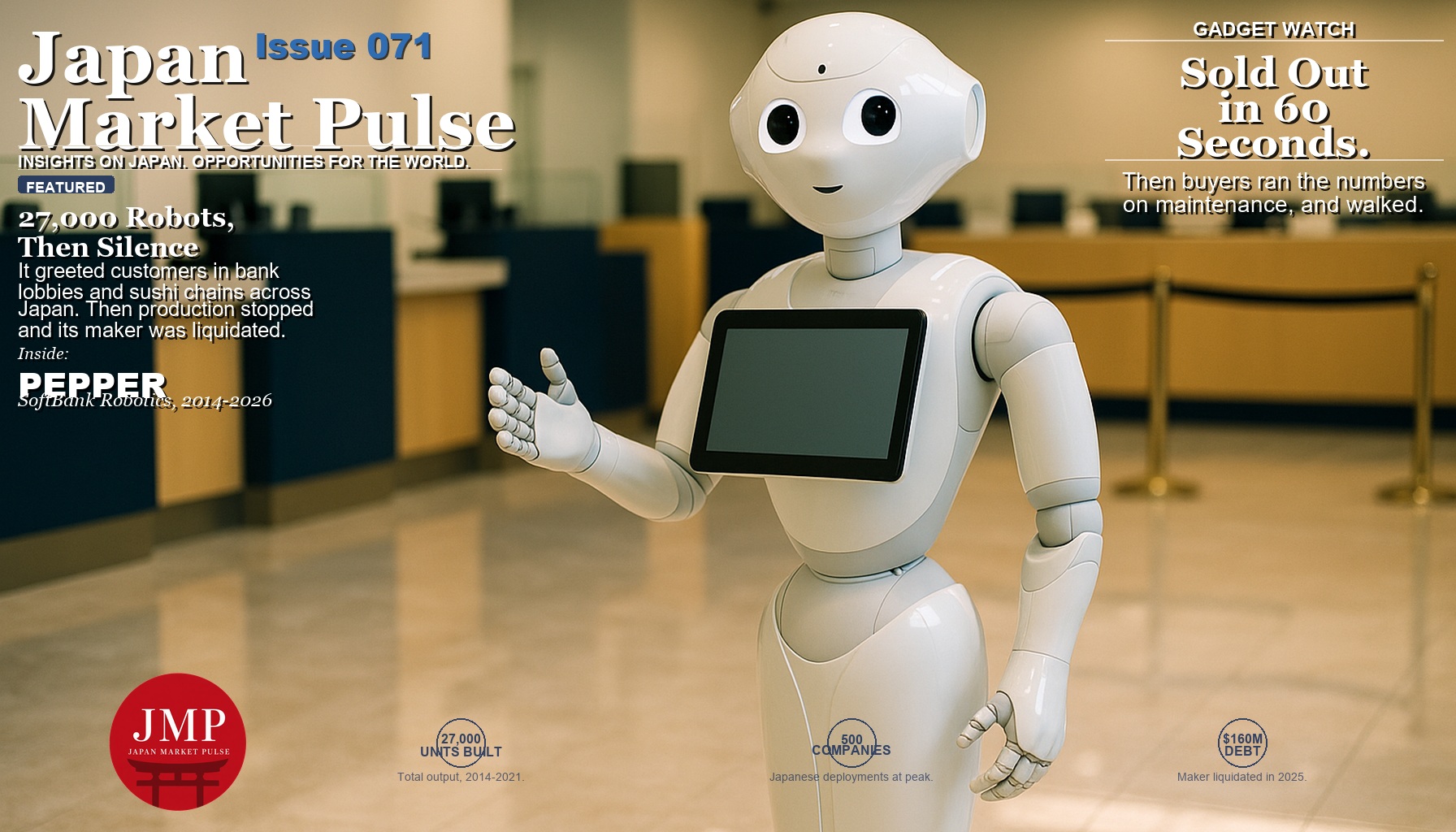
I still remember the first time a Pepper robot tried to sell me a phone plan. It was 2016, in a SoftBank shop in Shibuya, and the robot rolled up on its wheeled base, tilted its head at an angle that was clearly meant to read as curiosity, and asked me — in perfectly cheerful Japanese — whether I was interested in hearing about a new data package. I said no. It asked again, almost identically, thirty seconds later. A staff member nearby smiled the particular smile of someone who has explained this robot’s limitations to a foreign customer more times than they’d like to count.
That interaction, in miniature, is the story of Pepper’s entire commercial life. It was genuinely charming for the first ninety seconds and genuinely frustrating by the third minute, and somehow SoftBank spent the better part of a decade betting that the gap between those two experiences would close. It never really did. By the time you read this, the humanoid robot that once stood in bank lobbies, ramen shops, and airport terminals across Japan has been out of production for years, its French manufacturer has been liquidated, and its intellectual property now belongs to a Chinese electronics company that has announced no production timeline for a new one. And yet — in a twist that says as much about Japan’s relationship with robots as the original launch did — SoftBank quietly brought Pepper back this year in a form nobody quite expected.
This is the story of what actually happened to Pepper: not the hype cycle version, but the decade-long business decision underneath it, and what it should tell any foreign operator thinking about bringing hardware into the Japanese market.
The Robot That Sold Out in 60 Seconds
Masayoshi Son unveiled Pepper in Tokyo in June 2014 with the kind of showmanship that has defined SoftBank’s public persona for thirty years. This was not going to be an industrial robot or a toy. It was going to be, in Son’s framing, the first robot designed to read human emotion — to look at your face, register whether you seemed happy or sad or bored, and adjust its own behavior accordingly. It had big anime-adjacent eyes, a tablet bolted to its chest for the interactions its voice recognition couldn’t handle cleanly, and a price tag that undercut almost every prior humanoid robot on the market by an order of magnitude.
When Pepper actually went on sale to consumers in June 2015, at roughly 198,000 yen (then under $2,000), the first batch of 1,000 units sold out in about sixty seconds. I was living in Tokyo by then, and I remember the coverage treating it less like a product launch and more like a cultural moment — proof that Japan, a country whose relationship with robots has always run deeper and warmer than the West’s, was finally getting the companion robot it had been promised since the Astro Boy era. SoftBank leaned into that mythology hard, and for a couple of years, the bet looked reasonable. Business customers in particular found Pepper appealing for a much simpler reason than emotional connection: it was a novelty that drew foot traffic, and in Japanese retail, foot traffic is sacred.
Everywhere You Looked, There Was a Pepper
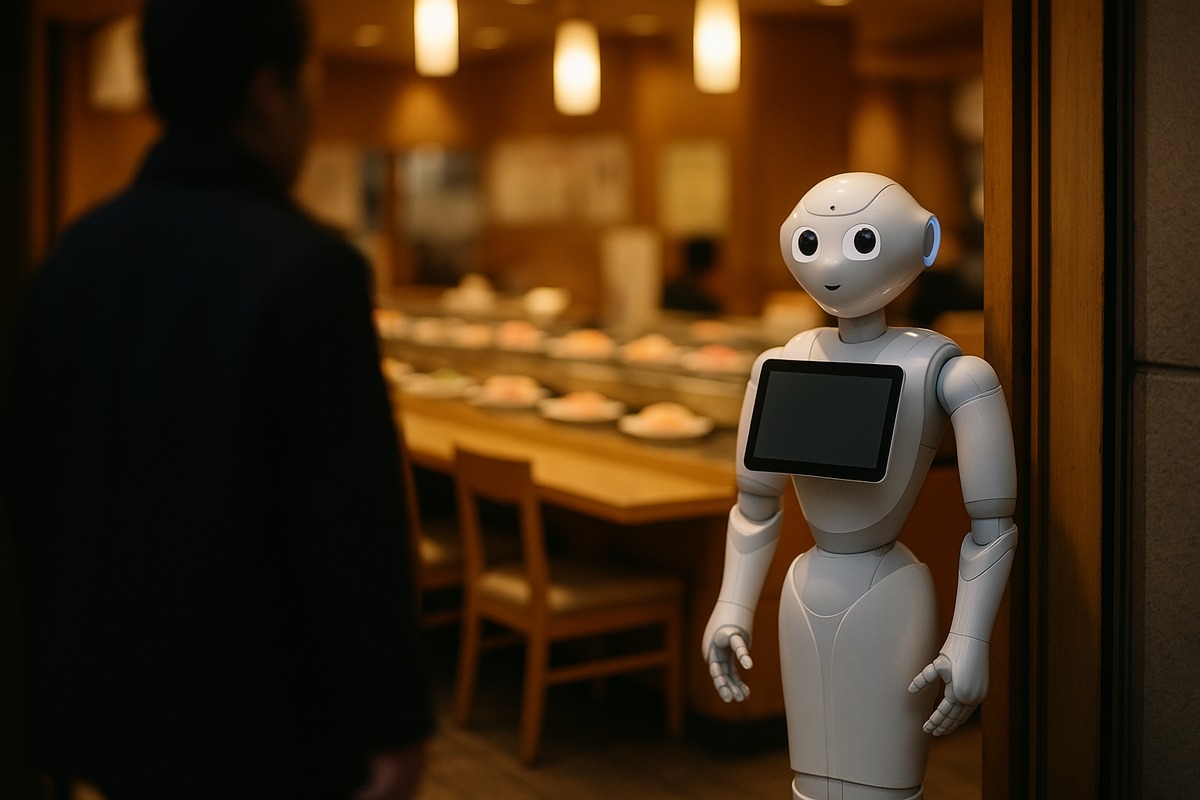
What’s easy to forget now is just how ubiquitous Pepper became, in a very specific, very Japanese way. This wasn’t a robot confined to trade show booths. Mizuho Bank, one of Japan’s largest banks, started rolling Pepper units into Tokyo branch lobbies in July 2015, using them to greet customers, explain basic products, and generally soften the notoriously bureaucratic experience of Japanese retail banking. Hamazushi, the conveyor-belt sushi chain, deployed Pepper across its entire national footprint to handle table assignments and light customer interaction. SoftBank opened an experimental all-Pepper mobile phone shop in Tokyo where the robots handled walk-in customers almost entirely on their own for a trial week. In December 2019, SoftBank even opened Pepper Parlor, a dedicated café in Tokyo where the robots took orders and chatted with diners between courses.
At its commercial peak, something like 500 companies in Japan had Pepper units doing some kind of customer-facing work, and roughly 200 of them had built their own custom software on top of the robot’s development kit — hotel concierge scripts, museum tour guides, elder-care check-in routines, event greeters. For a foreign business audience, imagine a friendly, mid-cost robot rolling into thousands of retail stores and bank branches at once, with businesses across a dozen industries independently deciding it was worth building software for. That’s roughly the scale of adoption Pepper achieved by the late 2010s, and it’s genuinely rare for consumer-facing hardware to earn that kind of cross-industry buy-in this fast.
Europe followed a similar, if smaller, curve: by May 2018, SoftBank Robotics Europe counted roughly 12,000 Pepper units in service worldwide and some 700 business clients in Europe, built through retail partners like the French chain Darty and airport deployments at hubs including Montréal–Trudeau and Prague. SoftBank was, by any measure, winning the distribution game. What it hadn’t solved — what nobody in the humanoid robot category has fully solved even now — was what happens after the novelty wears off.
The Conversation Pepper Could Never Have
Here is the uncomfortable truth that took the market about five years to fully absorb: Pepper was good at conversations that had already been written for it, and bad at almost everything else. Ask it one of the dozen or so scripted questions its deployment partner had programmed — where’s the restroom, what are your hours, can you tell me about this savings account — and it performed beautifully, complete with head tilts and hand gestures timed to sound cheerful rather than robotic. Ask it anything slightly outside that script, which is to say ask it the kind of question a real customer actually asks, and the illusion collapsed fast. The tablet on its chest existed specifically because SoftBank’s own engineers knew the voice interface alone wasn’t reliable enough to carry a full interaction.
The hardware had its own quiet limitations that mattered more in daily operation than in a launch demo. Pepper had arms and expressive hands, but no ability to grasp or manipulate objects — it could gesture at a product, not hand it to you. It moved on a wheeled base that worked fine on flat bank-lobby tile and failed completely anywhere with a step or an uneven threshold, ruling out a surprising number of real-world Japanese retail floors. Pepper was rated for up to 12 hours of continuous operation, but some real-world deployments reported overheating warnings — particularly in the neck motors — that forced units to rest mid-shift, an awkward failure mode for a robot whose entire value proposition was being present on a sales floor all day. The outer shell cracked and yellowed with the kind of daily handling any public-facing hardware in Japan should have been built to expect.
None of this was fatal on its own. What made it fatal, over time, was the math on the other side of the ledger. Pepper wasn’t cheap to run: units required ongoing cloud subscriptions to handle the voice processing that made the “emotional” interactions work at all, plus maintenance visits, plus staff time spent babysitting a robot that often needed a manual reboot. Post-deployment reports from institutional users — libraries and universities that adopted Pepper for exactly the low-stakes, high-foot-traffic environments it was theoretically built for — described units needing frequent manual reboots, with some going permanently offline once cloud subscriptions lapsed and nobody renewed them. For a business owner running the numbers, “charming greeter that requires a subscription and IT support” is a much harder sell than “charming greeter” alone, especially once the press coverage stops generating extra foot traffic.
Why the Pandemic Didn’t Save It
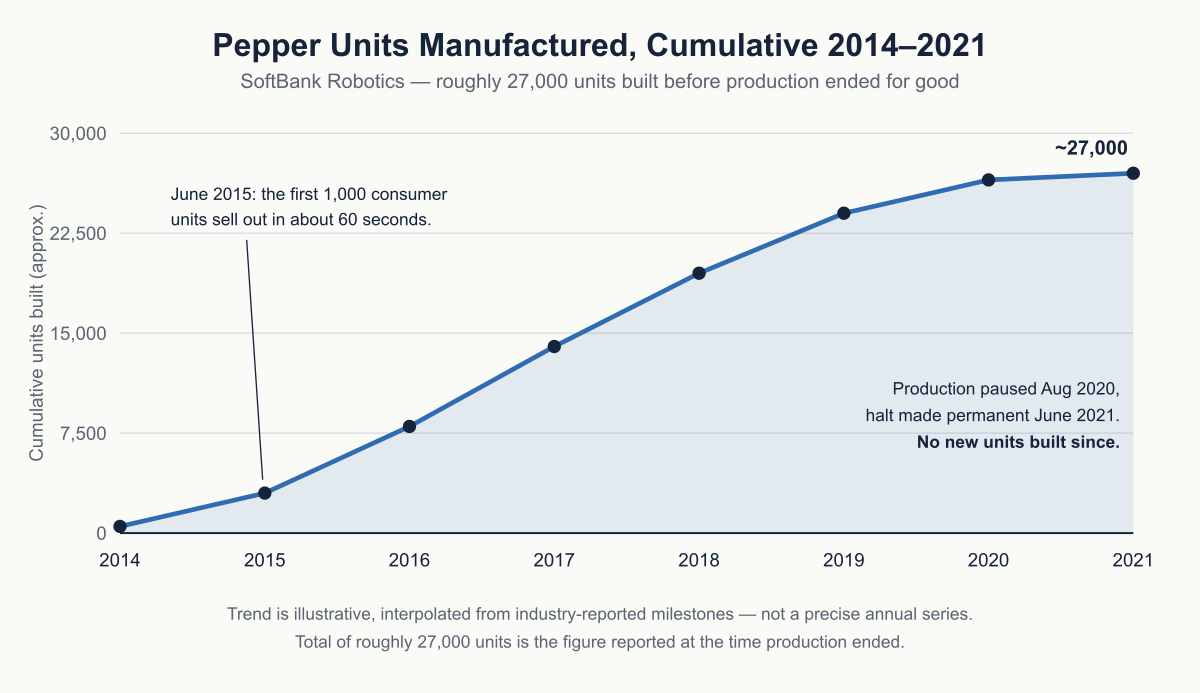
There’s a version of this story where COVID-19 should have been Pepper’s moment. A robot capable of handling routine customer interactions without a human standing six feet away sounds, on paper, exactly like what a pandemic-era service business would want. That’s not what happened. SoftBank quietly halted Pepper production in August 2020, in the middle of the crisis. When Reuters reported the halt in June 2021, restarting was said to be costly and demand had been weak — though SoftBank maintained it would keep selling from inventory and servicing existing units rather than retiring the robot outright.
The disconnect between theory and reality came down to two things. First, businesses under pandemic-era cost pressure were cutting discretionary technology spending, not adding it, and a robot whose primary value was “delightful but not essential” sat near the top of most budget review lists. Second, and more structurally, the market’s appetite for solving “contactless interaction” had already shifted toward software: QR-code menus, app-based ordering, kiosk check-in, and chatbot service all did the same basic job as Pepper’s greeter role, at a fraction of the capital cost, with none of the maintenance overhead, and — critically — with the ability to scale to a thousand locations without shipping a single piece of hardware. Pepper was competing against a solution that had gotten dramatically cheaper and more reliable in the exact years it needed to prove it was worth the investment.
Roughly 27,000 Pepper units had been manufactured in total by the time production stopped — a number that looks impressive until you set it against the volumes any consumer electronics category needs to reach sustainable unit economics. SoftBank’s robotics division responded by cutting deep: SoftBank Robotics Europe reduced its Paris-based workforce by roughly 40 percent, around 165 positions in France alone were eliminated, and the company’s remaining U.S. sales operations were consolidated under a third-party distributor rather than run directly.
What Killed the Company Behind Pepper
Pepper’s hardware was designed by Aldebaran, the French robotics company SoftBank acquired a controlling stake in back in 2012 (volume manufacturing was contracted out, reportedly to Foxconn). Aldebaran’s troubles didn’t start with the 2021 production halt — they compounded quietly for years afterward, as the company kept the lights on servicing an installed base that was shrinking, not growing. By 2024 it had accumulated debts reported at up to roughly €150 million (about $160 million, with some reports citing lower figures), and its backers stopped extending fresh funding. The company filed for bankruptcy protection in February 2025 and, after failing to find a buyer, was placed into judicial liquidation by a French court that June.
For the universities, libraries, and businesses still running Pepper units on their sales floors and in their classrooms, this was the moment the robot’s mortality became unavoidable. Without Aldebaran maintaining the cloud infrastructure that powered Pepper’s voice recognition and behavior updates, existing units faced a slow but certain decline into uselessness — no bug fixes, no new content, and eventually, expired backend services that would strand the hardware entirely. In July 2025, the Chinese electronics firm Maxvision acquired the intellectual property rights to both Pepper and its smaller sibling robot, Nao, out of Aldebaran’s asset sale. As of this writing, no new production timeline has been announced, and the acquisition reads more like the purchase of a patent portfolio than the relaunch of a product line.
The Reincarnation Nobody Expected: Pepper+
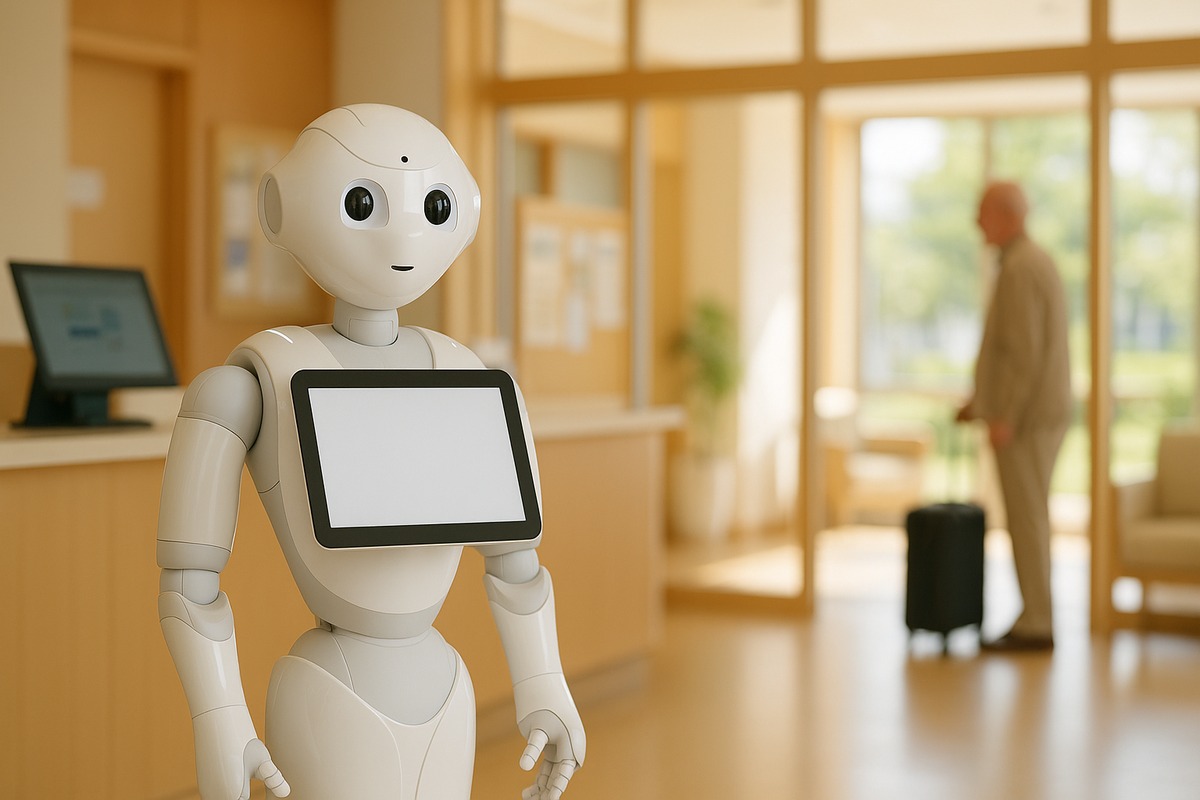
Here’s the turn that makes this story worth revisiting rather than treating as a closed case. In February 2026, SoftBank Robotics in Japan announced Pepper+ — the same familiar humanoid body, reintroduced with a fundamentally different AI engine and a redesigned chest tablet. Rather than selling the hardware outright, SoftBank is offering Pepper+ purely as a rental: roughly 79,800 yen a month on an annual plan for the customer-service configuration (care-facility plans start around 39,800 yen a month, and single-month use runs about 150,000 yen), aimed squarely at tourism sites and elder-care facilities rather than the broad retail and banking rollout the original pursued.
It’s a telling redesign. SoftBank isn’t trying to relitigate the “robot for every business” ambition that defined the 2014 launch. It’s targeting two use cases where Pepper’s core strengths — scripted, repeatable, warmly delivered interactions — actually map well onto the job: guiding foreign tourists through a fixed set of directions and recommendations, and providing structured, predictable engagement for elderly residents in care settings, a context where Japan’s demographic pressures create genuine, durable demand regardless of hype cycles. The rental model also solves the maintenance economics that sank the original: SoftBank, not the customer, now owns the burden of keeping the AI backend current, which was precisely the point of failure that stranded so many original Pepper deployments after Aldebaran’s collapse.
Whether Pepper+ becomes a real business or a face-saving footnote is genuinely unclear from where I’m sitting in mid-2026. But the fact that SoftBank chose to resurrect the brand at all, rather than let it die quietly alongside Aldebaran, tells you something about how much residual brand equity “Pepper” still carries in Japan. People here remember it fondly, even the people who found it annoying.
What Replaced Pepper on Japan’s Sales Floor
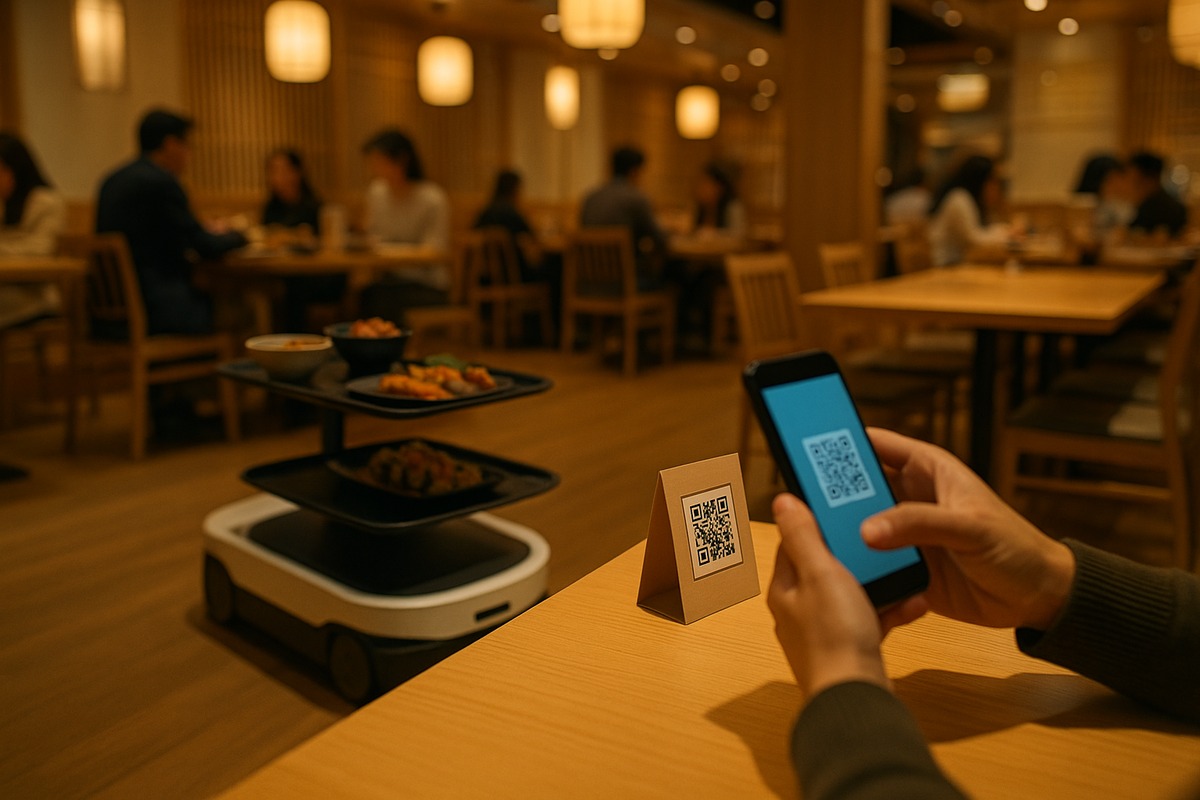
Walk into a mid-size Japanese restaurant or retail store today and you’ll likely encounter the technology that actually won the battle Pepper was supposed to fight. It isn’t one thing — it’s a stack. QR-code table ordering, where diners scan a code and browse a full menu on their own phone, has become close to standard at casual dining chains, a habit that hardened during the pandemic and never really receded. Tray-delivery robots — flatter, wheeled, far less anthropomorphic than Pepper, brands like Servi being a common example — now glide food across restaurant floors, handling the purely mechanical task of carrying plates rather than attempting conversation. Conveyor-belt sushi chains like Genki Sushi run multilingual tablet ordering at each table, tracking orders in real time and delivering food via small dedicated rail systems.
What’s notable is that none of these replacements tried to be Pepper. They deliberately narrowed the job. A QR menu doesn’t pretend to read your emotional state; it just takes your order accurately. A delivery robot doesn’t attempt small talk; it just gets the plate from kitchen to table without dropping it. Japanese businesses, having run the Pepper experiment for the better part of a decade, converged on a lesson that should sound familiar to any American operations executive: automation tends to succeed when it does one narrow thing extremely reliably, and struggles when it tries to be a generalist that approximates human warmth. Pepper tried to be the second thing. Its replacements are almost uniformly the first.
The Engineer Who Learned From Pepper’s Mistakes
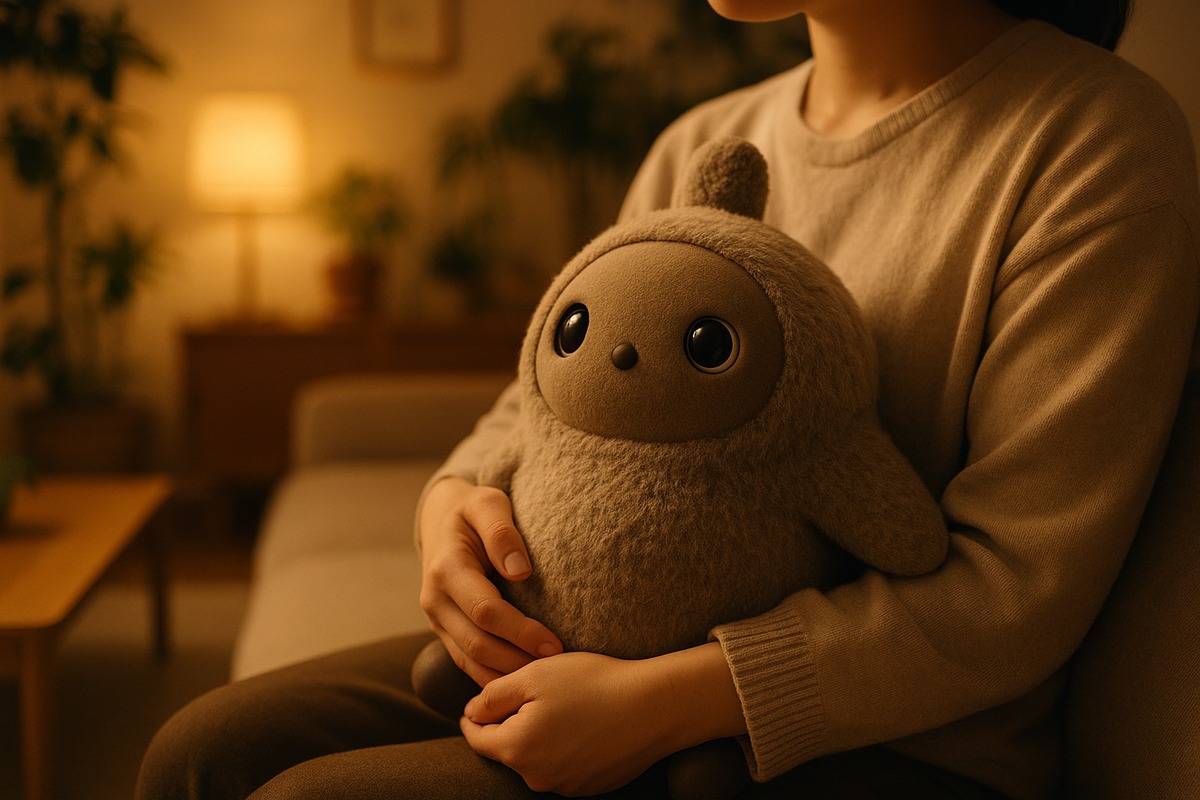
One of the more interesting threads in this story runs through a single person. Kaname Hayashi worked on Pepper’s development inside SoftBank before leaving in 2015 to found his own company, Groove X. Three years later, in December 2018, Groove X launched LOVOT — a small, round, deliberately non-humanoid robot with fur-textured skin, oversized eyes, and, pointedly, no practical function at all. It can’t answer questions, can’t process a bank transaction, can’t take a food order. What it does is track you around a room, respond to being held, and behave in ways designed to trigger the same caretaking instinct a puppy does.
Hayashi has been candid in interviews about what shaped that design choice, framing it as a direct response to what he saw play out with Pepper: robots that promise usefulness get judged, unforgivingly, against how useful they actually are, and lose. A robot that promises only companionship gets judged against a much gentler standard, and Hayashi’s bet — which by 2022 had reportedly found a receptive market among Japanese consumers dealing with the isolation of urban life — was that Japan had more unmet demand for the second category than the first. It’s a genuinely interesting inversion: the country that built the most ambitious “useful” service robot of the 2010s also produced, from inside that same failed project, one of the most successful arguments that usefulness was never really the point.
What American Operators Should Take From Pepper’s Decade
For a foreign business audience weighing whether to bring hardware or robotics into the Japanese market, Pepper’s ten-year arc offers a few concrete lessons that go beyond “robots are hard.” First, Japan’s appetite for novelty-driven adoption is real and fast — the sellout launches and the 500-company rollout prove that initial distribution here is genuinely easier than in most Western markets, particularly for anything that photographs well and generates foot traffic. Second, that same market is unusually disciplined about long-term operating costs; retail and banking customers ran the actual math on maintenance and staff overhead, and pulled back once the numbers stopped working, regardless of how much affection remained for the product. Third, any hardware model that depends on a manufacturer’s continued cloud infrastructure is fragile in a way that isn’t obvious at launch — Aldebaran’s liquidation didn’t just end Pepper’s production, it threatened to brick every unit already in the field, a risk any operator selling connected hardware into Japan should price into contingency planning from day one.
Pepper wasn’t a failure of imagination. It was, if anything, too imaginative for the operating discipline the business case required. The robots that are quietly succeeding in Japan today — the delivery bots, the QR systems, even Pepper+ in its narrower rental form — all share a trait Pepper’s original version lacked: they know exactly what job they’re being asked to do, and they don’t try to do much else.
Frequently Asked Questions
Q. Can you still buy a Pepper robot today?
A. Not as a new unit for outright purchase. Production has been paused since 2020, and Aldebaran, the robot’s original developer, was liquidated in 2025. SoftBank’s current channel is rental rather than sale — Pepper+ and Pepper rental plans in Japan — while used and refurbished units occasionally surface through robotics resellers and academic surplus channels, and distributors like RobotLAB still service existing units.
Q. Why did SoftBank stop making Pepper?
A. SoftBank paused production in 2020 amid weak demand, and by 2021 restarting was reported to be costly; production has not resumed since. Underneath that statement was a harder set of problems: Pepper’s conversational ability broke down outside scripted interactions, its mobility and durability were limited, and the ongoing cost of cloud subscriptions and maintenance made the economics hard to justify once the novelty wore off.
Q. What is Pepper+, and how is it different from the original Pepper?
A. Pepper+ is a February 2026 relaunch that reuses Pepper’s original body but replaces its AI system with a modern engine and an updated chest tablet. Unlike the original, which was sold outright, Pepper+ is offered only as a monthly rental, and SoftBank is targeting it at tourism sites and elder-care facilities rather than the broad retail and banking rollout Pepper originally pursued.
Q. What happened to LOVOT, and is it related to Pepper?
A. LOVOT is a separate robot made by Groove X, founded in 2015 by Kaname Hayashi, who had previously worked on Pepper’s development at SoftBank. Rather than performing useful tasks, LOVOT is designed purely for companionship, with no practical function — a philosophy Hayashi has described as a direct reaction to the expectations Pepper struggled to meet.
Q. Is Pepper available outside Japan today?
A. Historically yes — Pepper reached meaningful international scale, with roughly 12,000 units worldwide and some 700 European business clients by 2018, plus airport deployments in Canada and the Middle East. But new production has been paused since 2020 and Aldebaran’s 2025 liquidation closed off new international sales. Pepper+ is currently a Japan-only rental program with no announced international expansion.
Conclusion
Pepper’s decade is easy to file away as a cautionary tale about humanoid robots overpromising and underdelivering, and there’s truth in that framing. But the more useful reading, for anyone watching Japan as a market rather than as a curiosity, is that Pepper succeeded exactly where Japan makes adoption easy — fast distribution, enthusiastic early partners, genuine cultural affinity for robots — and failed exactly where Japan makes staying power hard: relentless scrutiny of ongoing cost, and zero patience for a product that can’t reliably do the one job it was hired for. That combination isn’t unique to robots. It’s close to a general operating manual for bringing anything physical into this market, and it’s worth remembering the next time a piece of hardware sells out in sixty seconds and everyone assumes the hard part is over.
If you’re interested in this topic, the Japanese market more broadly, or what KETCHUPs is working on, we’d love to hear from you — please reach out via our contact form.
Japan Market Pulse is a weekly read on what the Japanese consumer-tech, food, and mobility markets are choosing to do, written for international operators who want to know what is happening before it shows up in the global trade press.
Subscribe at ketchups.co/japan-market-pulse.