

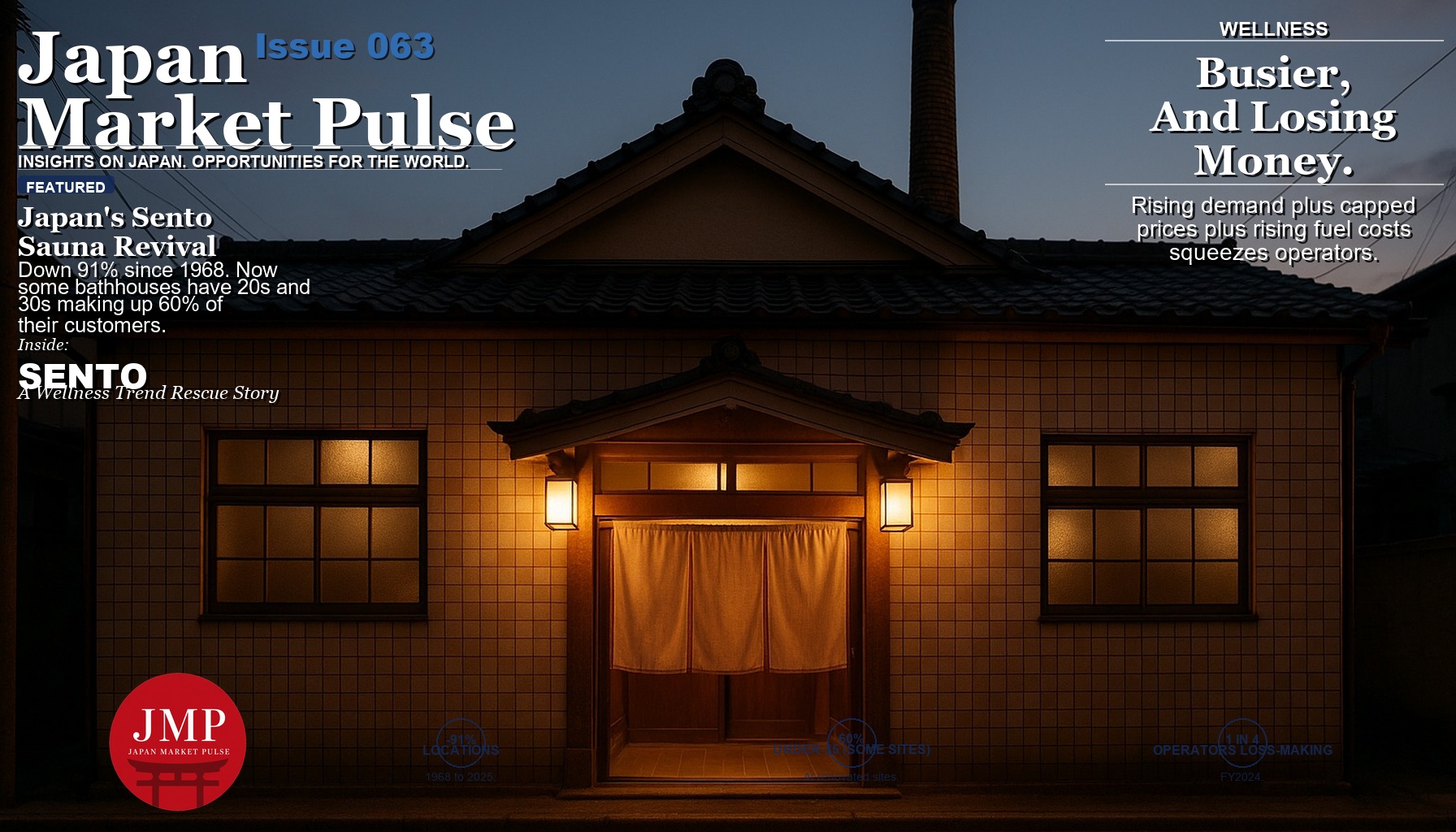
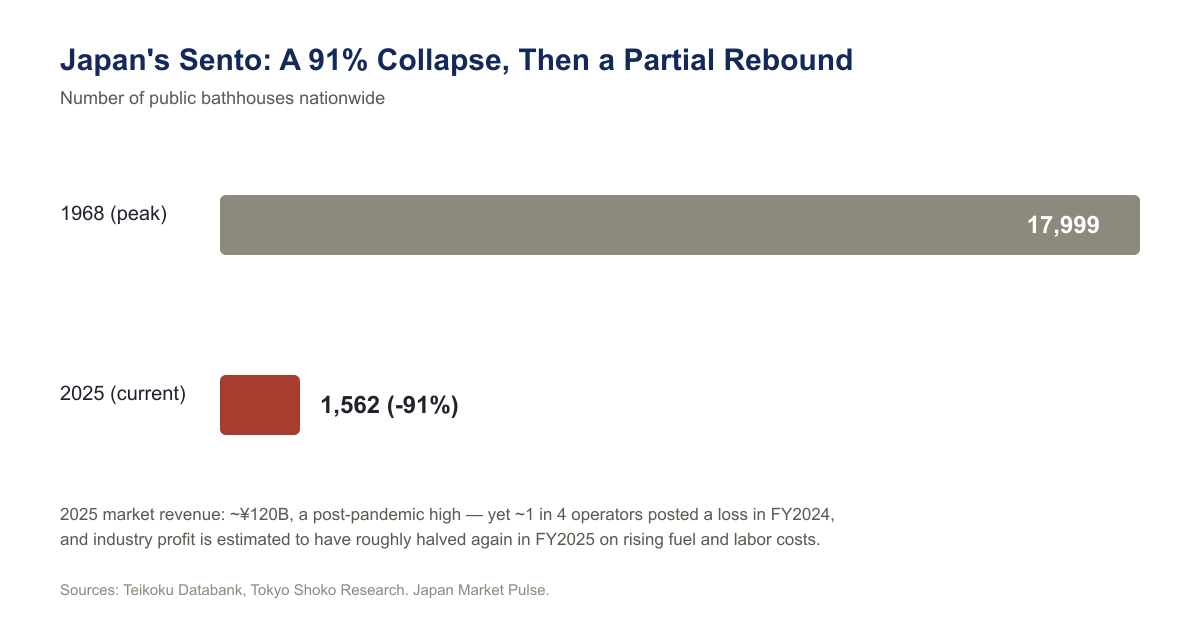
Japan’s neighborhood public bathhouses — sento — have gone from 17,999 locations at their 1968 peak to just 1,562 today, a 91% collapse driven by decades of in-home bathing becoming standard and an aging, shrinking customer base. And yet in 2025, the sento market posted roughly ¥120 billion in revenue, its highest level since before the pandemic, and at some individual locations, customers in their 20s and 30s now make up as much as 60% of the clientele — a demographic that, a decade ago, had almost entirely stopped walking through the door.
This isn’t a simple recovery story. Sento operators are simultaneously busier and under more financial pressure than they’ve been in years: roughly one in four operators posted a loss in fiscal 2024, and industry-wide profit levels roughly halved again in fiscal 2025 as fuel and labor costs climbed faster than the price of a bath, which in most of Japan is capped by local government regulation rather than set freely by the operator. Closures have actually slowed — down to seven in fiscal 2025 from nine the year before — but that’s happening precisely as the format finally attracts back the young, disposable-income customers who abandoned it a generation ago. Understanding why a shrinking, financially squeezed legacy category is suddenly fashionable again is a useful lesson in how a wellness trend can rescue a format that demographics alone were killing.
From Daily Necessity to Near-Extinction
Sento exist because, for most of the 20th century, a large share of Japanese homes simply didn’t have their own bath. The neighborhood public bathhouse wasn’t a leisure destination — it was infrastructure, as routine as a corner grocery store, and at their 1968 peak there were nearly 18,000 of them serving that basic utility function across the country. As home construction standards changed and in-unit bathing became the default even in modest apartments, the core reason to visit a sento evaporated for most households, and the closures that followed were remorseless: 91% of locations gone, concentrated overwhelmingly among operators serving an aging neighborhood customer base that was itself shrinking and not being replaced.
By the 2010s, the sento that remained largely served two groups: elderly regulars who’d been going for decades out of habit, and a scattering of tourists or bathing enthusiasts drawn to the aesthetic of a fading cultural format. Revenue reflected exactly that — a slow, managed decline toward eventual extinction, the kind of trajectory that looks terminal on a spreadsheet even if no single year’s numbers look catastrophic.
What Actually Brought Young Customers Back
The reversal didn’t come from nostalgia marketing or heritage preservation campaigns. It came from sauna culture, and specifically from a wellness ritual known in Japanese as totonou — roughly “getting dialed in” — built around cycling through a hot sauna session, a cold plunge, and a period of rest, repeated several times in a single visit. The ritual itself draws on Nordic sauna tradition, but its explosive popularity in Japan over the past several years turned “does this place have a good sauna” into one of the most searched, most socially shared criteria young Japanese use when choosing where to spend a Friday night out.
Sento were unusually well positioned to catch that wave, for a reason that has nothing to do with sauna culture specifically: they already had the physical infrastructure — large communal bathing facilities, often with existing sauna rooms that had gone underused for years — and, crucially, government-capped pricing that undercuts nearly every private sauna club or premium wellness facility on cost. A dedicated urban sauna club in Tokyo can easily charge several thousand yen for a single visit. A sento offering an equivalent sauna-and-bath experience, because its core bathing fee is price-regulated, often costs a small fraction of that. For a generation of young, comparison-shopping consumers who discovered the totonou ritual through social media rather than through decades of habit, sento became the wellness bargain hiding inside a format they’d previously written off as something their grandparents did.
Individual operators who leaned into this directly — renovating sauna rooms, improving cold-plunge facilities, redesigning interiors to photograph well, and marketing explicitly to the sauna-enthusiast community rather than the traditional elderly regular base — are the ones now reporting 20-somethings and 30-somethings making up as much as 60% of their customer mix. That’s not an industry-wide average; it’s a sign of what’s possible for an operator willing to renovate and market toward the new audience rather than simply keep serving the old one.
A Recovery That’s Squeezing Operators, Not Rescuing Them
The uncomfortable part of this story is that rising demand hasn’t translated into rising financial health for the industry as a whole. Roughly one in four sento operators still posted a loss in fiscal 2024, and industry profit levels are estimated to have roughly halved again in fiscal 2025, even as overall market revenue climbed to a post-pandemic high. The reason is straightforward: fuel and utility costs, along with labor costs, have risen sharply, while the core bathing fee at most sento remains capped by local government regulation designed originally to keep a basic hygiene utility affordable for everyone — a regulatory structure built for the era when sento were daily-use infrastructure, not a discretionary wellness destination competing with private sauna clubs that can price however they like.
That combination — genuine demand recovery colliding with a cost structure the operator doesn’t fully control — is why closures have slowed rather than reversed. Fewer operators are being driven out by empty rooms; more are being squeezed by a widening gap between what it costs to run a hot-water, high-energy facility and what regulation allows them to charge for it. A sento that successfully attracts a full house of sauna enthusiasts every evening can still lose money if its energy bill outpaces a bathing fee it’s not permitted to raise freely.
What International Operators Should Take From This
For wellness, hospitality, and legacy-infrastructure operators outside Japan, sento’s partial revival is a specific and transferable case study: an aging, shrinking physical-infrastructure category can be rescued by an adjacent trend it didn’t create, provided it already owns the underlying asset the new trend actually wants. Sento didn’t invent the sauna boom. They already had large communal bathing facilities and often-idle sauna rooms sitting there, and when the totonou wellness ritual created new demand for exactly that physical setup, sento were simply closer to that demand than a from-scratch sauna club would be to build, at a price point regulation made accidentally competitive.
The pricing lesson is a genuine double-edged one, though. Regulated, capped pricing is precisely what made sento the affordable entry point into a wellness trend that priced out plenty of younger consumers elsewhere — but that same price cap is now squeezing the operators who successfully rode the trend, because their cost base rose in a way their revenue structurally cannot follow. Any operator sitting on underused legacy physical infrastructure that happens to overlap with an emerging consumer trend should treat that overlap as a real opportunity — while going in clear-eyed that regulatory or structural pricing constraints built for a previous era of demand may not flex fast enough to keep the operator financially healthy even as customer volume genuinely recovers.
Frequently Asked Questions
Q. How many sento are left in Japan today?
A. Roughly 1,562, down from a peak of nearly 18,000 in 1968 — a 91% decline driven mainly by the spread of in-home bathing.
Q. Why are young people suddenly going to sento again?
A. The main driver is Japan’s sauna boom and the totonou wellness ritual (sauna, cold plunge, rest, repeated), which sento can offer at a fraction of the cost of dedicated private sauna clubs because their core bathing fee is government price-capped.
Q. Is the sento industry financially healthy again?
A. Not uniformly. While market revenue hit a post-pandemic high in 2025, roughly one in four operators posted a loss in fiscal 2024, and industry profit levels are estimated to have roughly halved again in fiscal 2025 due to rising fuel and labor costs colliding with regulated, capped pricing.
Q. Is this recovery happening at every sento, or only some?
A. It’s concentrated at operators who actively renovated and marketed toward the sauna-enthusiast audience; some individual locations report 20s-and-30s customers making up as much as 60% of their clientele, well above any industry-wide average.
If you’re interested in this topic, the Japanese market more broadly, or what KETCHUPs is working on, we’d love to hear from you — please reach out via our contact form.
Japan Market Pulse is a weekly read on what the Japanese consumer-tech, food, and mobility markets are choosing to do, written for international operators who want to know what is happening before it shows up in the global trade press.
Subscribe at ketchups.co/japan-market-pulse.