

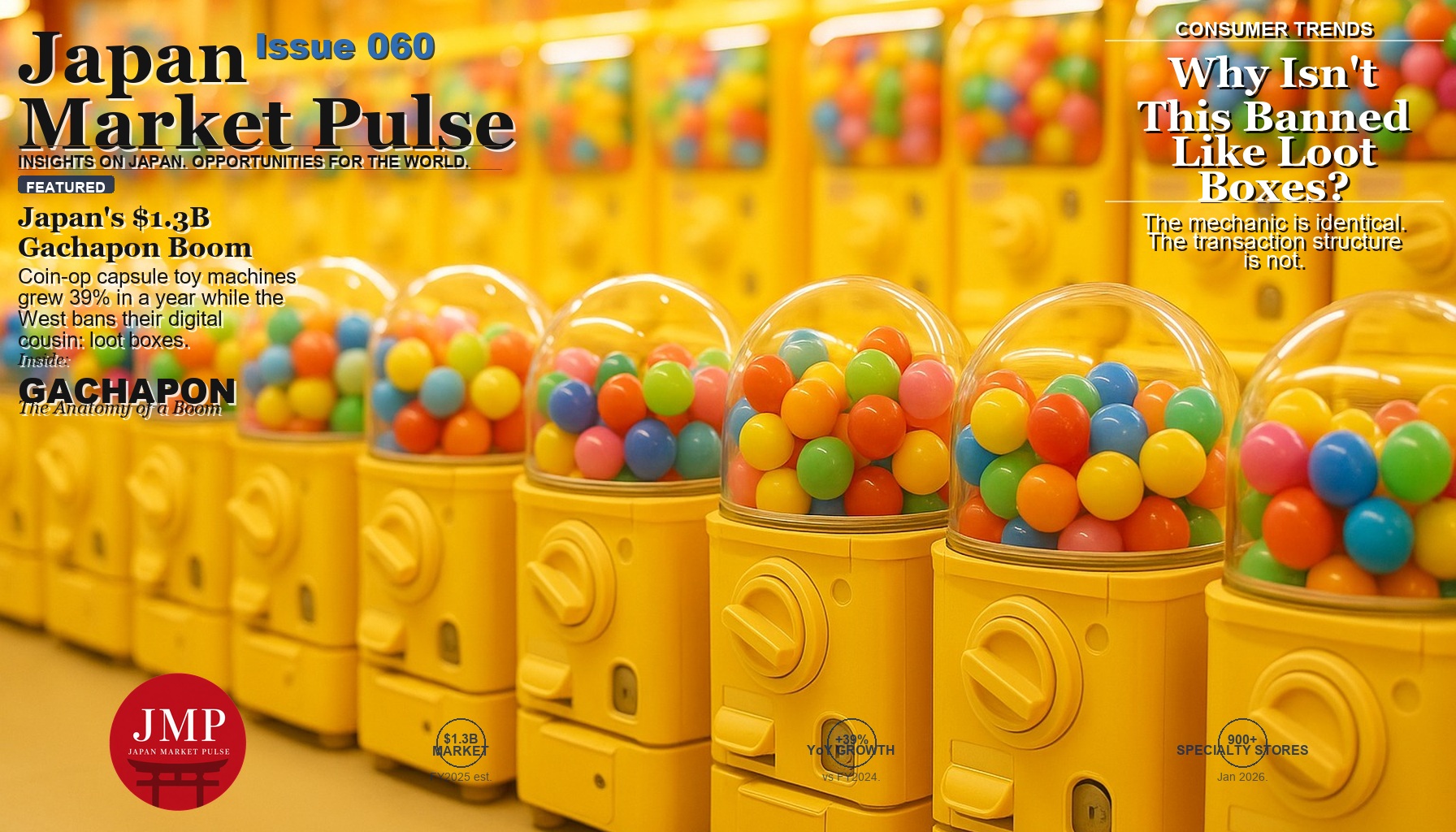
Japan’s capsule toy market — the coin-operated machines that dispense a small plastic-encased toy for a few hundred yen — grew to roughly ¥196 billion in fiscal 2025, up 39% from the year before, according to industry tracking. That’s nearly triple the ¥72 billion the category was worth just three years earlier, in fiscal 2022. Over the same window, the number of dedicated capsule-toy specialty stores crossed 900 nationwide, up more than 200 locations in a single year.
Here’s the part that should catch the attention of anyone in gaming, retail, or consumer product design outside Japan: this is a random-reward retail mechanic scaling rapidly, in public, with zero regulatory backlash — at the exact moment governments across Europe and several U.S. states are restricting or investigating the digital version of the same idea. Belgium banned loot boxes in games outright in 2018. The Netherlands followed with its own restrictions. Multiple U.S. states have introduced bills targeting loot-box mechanics as predatory, particularly toward minors. Japan’s capsule toy machines run on the identical psychological engine — pay, pull a lever, don’t know what you’ll get — and instead of facing crackdown, they’re opening in shopping malls, train stations, and dedicated multi-floor retail destinations at a pace that outstrips almost every other physical retail category in the country.
Understanding why one version of this mechanic is thriving in plain sight while the other is being legislated into a corner is a useful case study in what separates acceptable randomized commerce from the kind that draws regulatory fire.
What’s Actually in the Machine
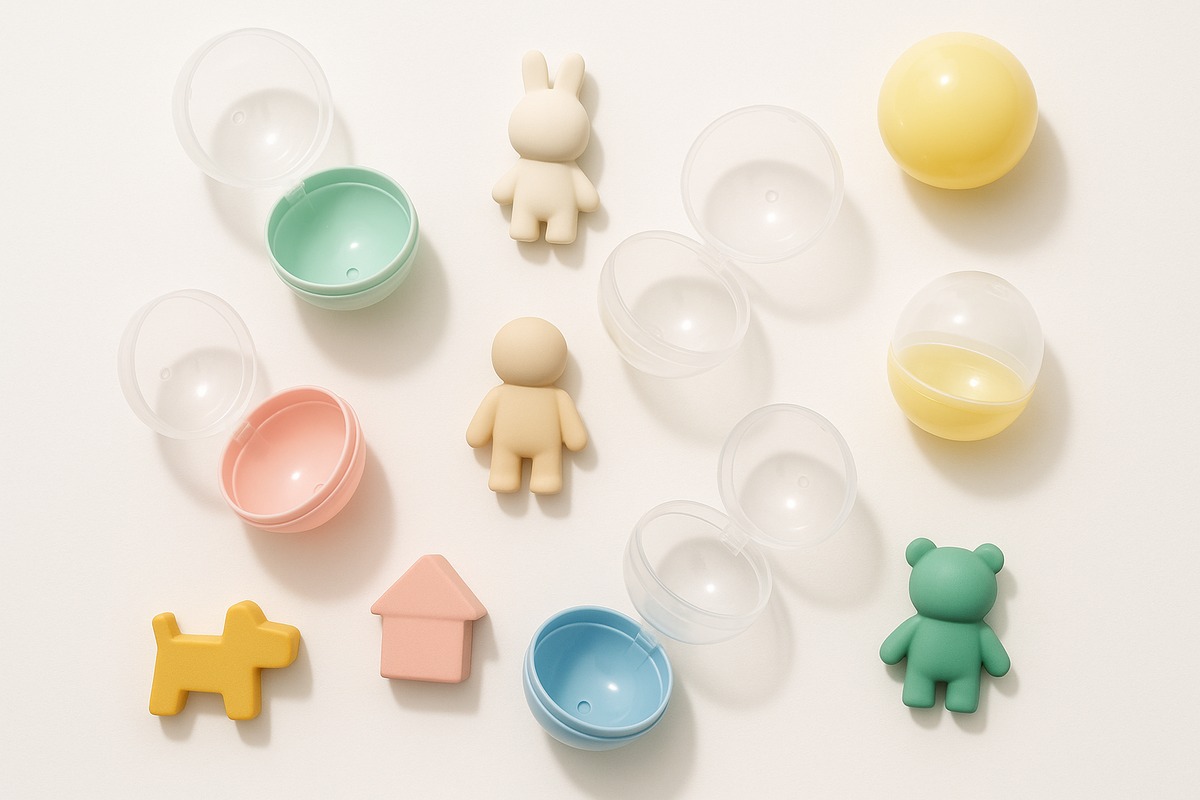
The Japanese term is gachapon or gacha-gacha, an onomatopoeia for the crank-turn-and-drop sound the machines make. A single pull typically costs ¥200 to ¥500 (roughly $1.35 to $3.30) and dispenses a plastic capsule containing a miniature figure, keychain, or novelty object tied to a themed series — anime characters, food replicas, animals, office-desk gag items, licensed collaborations with brands ranging from convenience store chains to luxury fashion houses. Collectors chase full sets; casual buyers pull once out of impulse while waiting for a train.
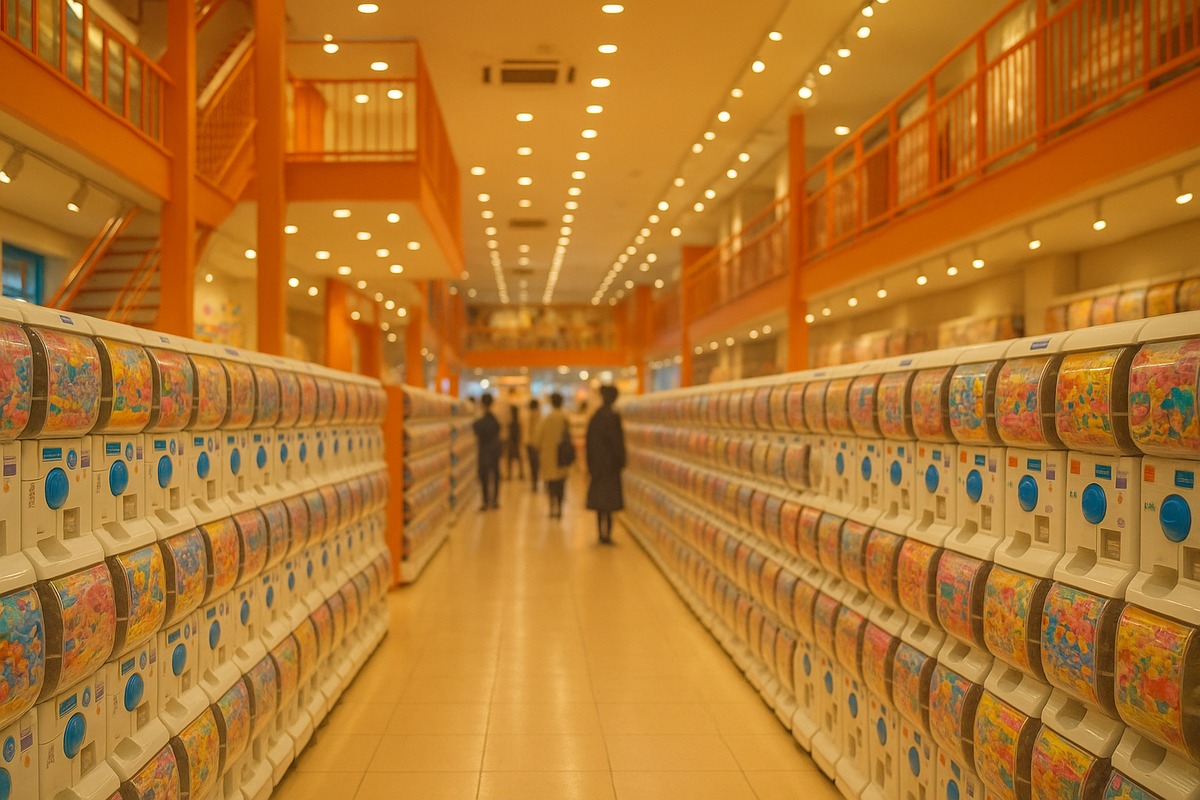
The category isn’t new — capsule toy machines have existed in Japan since importing the format from the U.S. six decades ago, a milestone the industry is marking this year. What’s new is the retail infrastructure built around it. Specialty stores devoted entirely to gachapon, some housing hundreds of machines across multiple floors, have become destination retail in their own right, particularly in areas with heavy tourist and youth foot traffic like Ikebukuro and Akihabara. This isn’t machines placed as an afterthought near a supermarket checkout. It’s a category with its own real estate strategy.
The Numbers Behind the Boom
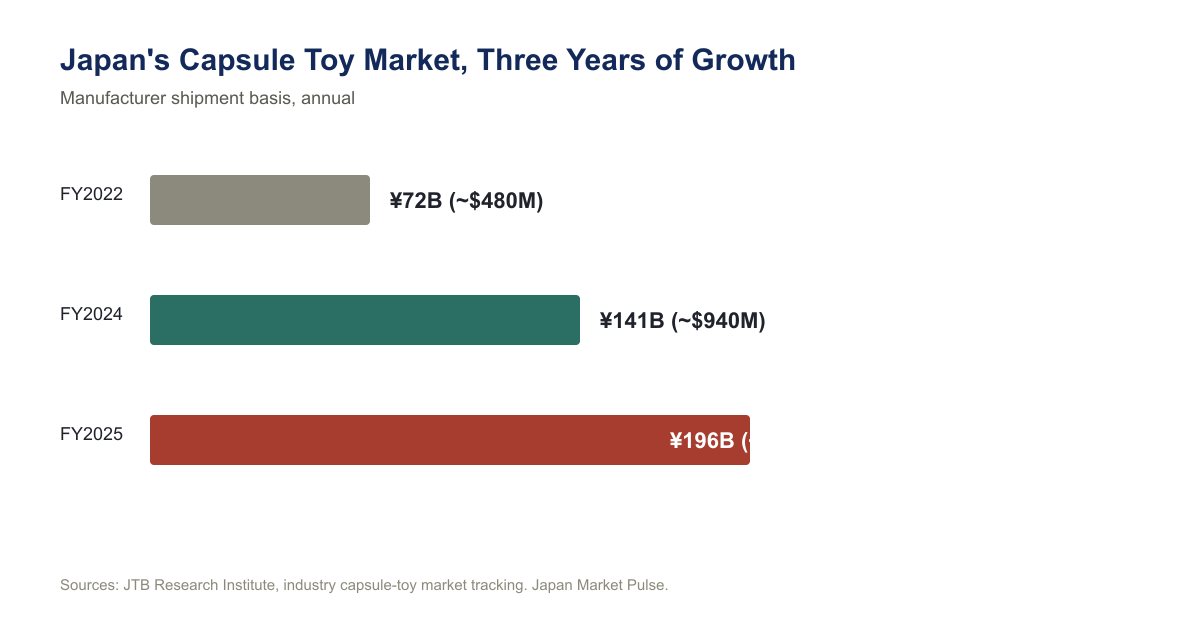
The scale of the recent growth is what makes this worth studying rather than filing under “quirky Japan retail.” Fiscal 2022 shipments, measured at the manufacturer level, totaled approximately ¥72 billion. By fiscal 2024 that had grown to roughly ¥141 billion. The fiscal 2025 figure of around ¥196 billion represents 39% year-on-year growth on top of an already-elevated base — a compounding growth rate that would be remarkable in any consumer category, let alone one built on a decades-old, low-tech mechanical format.
Specialty store count tells the same story from a different angle. As of the end of January 2026, Japan had more than 900 stores dedicated specifically to capsule toy retail, an increase of over 200 locations from the prior year. That’s not incremental expansion. That’s an industry actively building out physical footprint at a rate that assumes the growth is structural, not a temporary spike.
Part of the acceleration is demographic. What began as a category aimed squarely at children has become, over the past decade, disproportionately an adult purchase — office workers buying novelty desk items, young adults building character collections, tourists picking up souvenirs that photograph well for social media. The adult share of the buyer base has grown enough that manufacturers now design entire product lines — detailed food replicas, deadpan corporate-humor objects, nostalgia-driven throwback series — explicitly for adult buyers rather than children, a shift that maps directly onto the same “kidult” consumer behavior reshaping toy retail globally.
The Product Categories Actually Driving the Numbers
Walk into one of the larger specialty stores and the product mix explains a lot about why growth has accelerated rather than plateaued. Hyper-detailed food replica capsules — a single dumpling, a slice of convenience-store fried chicken, a miniature bowl of ramen rendered with unsettling accuracy — have become one of the most reliably strong-selling categories, popular precisely because they photograph well and read as a small, harmless joke rather than a collectible investment. Deadpan corporate-humor items are their own genre: capsules containing a tiny “resigned salaryman” figure slumped at a desk, or a miniature stamp reading a phrase every Japanese office worker recognizes instantly, sell briskly to the exact demographic that would never buy a children’s toy but will absolutely buy an in-joke about their own workday. Nostalgia-driven throwback series — reissues or reinterpretations of toy lines from the 1980s and 1990s — pull older adult buyers back into a format they associate with childhood, now priced and marketed for someone with disposable income rather than allowance money.
Licensed collaboration series are the category’s premium tier, pairing gachapon’s cheap, high-frequency mechanic with brand names that would otherwise never appear in a ¥300 impulse purchase — convenience store chains, regional mascots, and in some cases luxury and fashion names lending a design for a limited run. For the licensing brand, it’s a low-cost, high-frequency touchpoint; for the gachapon operator, it’s a premium price point without needing to raise costs on the core low-end lineup.
None of this would scale the way it has without a secondary market absorbing the excess. Resale platforms — the Japanese equivalent of eBay, dominated by an app called Mercari — carry a constant, liquid market in gachapon results, particularly for short-run or discontinued series. A healthy resale market does two things for the primary industry simultaneously: it signals to manufacturers which series are underpriced relative to demand, and it gives buyers a release valve for “misses,” softening the one real downside of a random-reward purchase. A duplicate or unwanted pull isn’t dead money — it’s inventory with a functioning market.
A Sixty-Year-Old Format That’s Still Accelerating
The 60th anniversary Japan is marking this year isn’t for the invention of the capsule toy machine — that credit belongs to American vending equipment makers, whose coin-op capsule dispensers date back further. It’s for the year Japanese manufacturers imported the format and began building the domestic industry around it. Most consumer categories that reach a sixth decade are managing decline, not posting their strongest growth numbers on record. Gachapon is doing the opposite: the compounding growth of the last three years is happening at the exact moment the category should, by the normal logic of product lifecycles, be maturing into a stable, low-growth utility business.
What’s actually happening is that a mature mechanical format got a genuinely new distribution layer bolted onto it. The machines themselves haven’t changed much in decades. What changed is everything around them: dedicated multi-floor retail environments that turn browsing into an activity in its own right, a product design discipline that treats adult buyers as a primary audience rather than an afterthought, a resale market that de-risks the purchase, and a social-media culture that rewards displaying and photographing a good pull. None of that required reinventing the core mechanic. It required building a modern commercial structure around an old one — a pattern worth remembering any time a “mature” physical retail format looks like it has no room left to grow.
Why This Isn’t Getting Regulated Like Loot Boxes
The uncomfortable comparison sitting underneath this entire category is the loot box. Both mechanics share the same core structure: pay a fixed amount, receive a randomized reward, and don’t know exactly what you’re getting until after you’ve paid. Regulators in Belgium and the Netherlands have targeted loot boxes specifically because that structure resembles gambling closely enough to warrant restriction, particularly for products marketed to or accessible by minors. Several U.S. states have introduced or debated legislation aimed at the same mechanic inside video games.
Japan’s capsule toy machines run on the same underlying logic, at massive and growing scale, without triggering the equivalent regulatory response. The difference isn’t that Japanese regulators are more permissive in general — Japan has its own gambling-adjacent regulations governing prize-redemption arcade games (crane games and the like) that are considerably stricter than most Western equivalents. The difference is structural, and it’s worth being precise about what actually separates the two mechanics:
The transaction is capped and terminal. A gachapon pull costs a fixed, small amount — typically under $3 — and the transaction ends the moment the capsule drops. There’s no escalating spend loop, no in-app currency conversion designed to obscure the real-money cost, no algorithmic encouragement to pull again immediately after a “bad” result. A loot box exists inside a system explicitly engineered to encourage repeat purchases through variable-reward psychology tuned by a live product team; a gachapon machine is a fixed mechanical object that dispenses the same odds every time and has no way to adapt its behavior to a specific player.
The reward is guaranteed and physical. Every pull produces a tangible object with real, if modest, resale and display value — even a “miss” result is something a buyer can hold, use, or trade. Digital loot boxes frequently produce cosmetic or duplicate items with no function and, in many jurisdictions, no legal resale market at all, which is part of what pushed regulators toward treating them as closer to pure chance-for-money gambling than a product purchase.
Access skews toward adults with disposable income at the point of sale, not toward minors inside a game they’re already playing. A twelve-year-old can walk up to a gachapon machine, but the transaction requires physical cash or IC card payment at a specific location, not a stored payment method one tap away inside an app already handed to a child.
What International Operators Should Take From This
For any operator building a product around randomized reward mechanics — game studios, collectible-toy brands, subscription-box businesses, even retail loyalty programs experimenting with surprise-and-delight mechanics — Japan’s gachapon boom is a working demonstration that randomized commerce isn’t inherently the problem regulators are responding to. The structure of the transaction is. A capped, one-time, physical-good purchase with guaranteed tangible value sits in a completely different category, both legally and reputationally, than an open-ended digital spend loop tuned to maximize repeat purchases from an audience that includes minors.
The category also offers a distribution lesson independent of the regulatory question. Gachapon’s growth has been driven as much by retail format innovation — dedicated specialty stores, mall placement, tourist-corridor locations — as by product variety. International toy, collectibles, and even QSR brands experimenting with blind-box or mystery-item mechanics have a live, well-documented Japanese case study for how to scale a randomized physical product line into genuine destination retail rather than an impulse add-on near the register. The clearest evidence that this model travels well is already visible outside Japan: the global blind-box collectible boom built around brands like Pop Mart runs on the identical mechanic — fixed price, guaranteed physical object, randomized specific result — and has scaled into a multibillion-dollar international business without attracting the regulatory scrutiny aimed at digital loot boxes, for exactly the structural reasons described above.
There’s also a resale-market lesson worth lifting directly: building or at minimum tolerating a healthy secondary market for a randomized physical product isn’t leakage to be minimized. It’s a pressure-release valve that makes the primary purchase feel lower-risk, and a demand signal that tells a manufacturer which series to reprint. A Western collectibles brand treating its own resale market as purely adversarial is arguably leaving both data and goodwill on the table that its Japanese counterparts are actively capturing.
Frequently Asked Questions
Q. How much does a typical gachapon pull cost?
A. Most machines charge between ¥200 and ¥500 per pull, roughly $1.35 to $3.30, though premium or licensed collaboration series can run higher.
Q. Why is the capsule toy market growing so fast right now?
A. Growth is being driven by a broadening adult buyer base, a rapid build-out of dedicated specialty stores, and product lines increasingly designed for collectors and social-media-driven impulse buyers rather than children alone.
Q. Is gachapon regulated in Japan the way loot boxes are regulated elsewhere?
A. No. Japan does regulate certain prize-redemption arcade games more strictly than many Western markets, but capsule toy machines fall outside that framework because each transaction is capped, terminal, and produces a guaranteed physical object rather than a variable digital reward inside an ongoing spending loop.
Q. Can this model be exported outside Japan?
A. Elements of it already are — global blind-box toy brands have adapted a similar physical-random-reward structure successfully. The Japanese case shows the model scales well when paired with genuine retail-format investment, not just product variety.
If you’re interested in this topic, the Japanese market more broadly, or what KETCHUPs is working on, we’d love to hear from you — please reach out via our contact form.
Japan Market Pulse is a weekly read on what the Japanese consumer-tech, food, and mobility markets are choosing to do, written for international operators who want to know what is happening before it shows up in the global trade press.
Subscribe at ketchups.co/japan-market-pulse.