

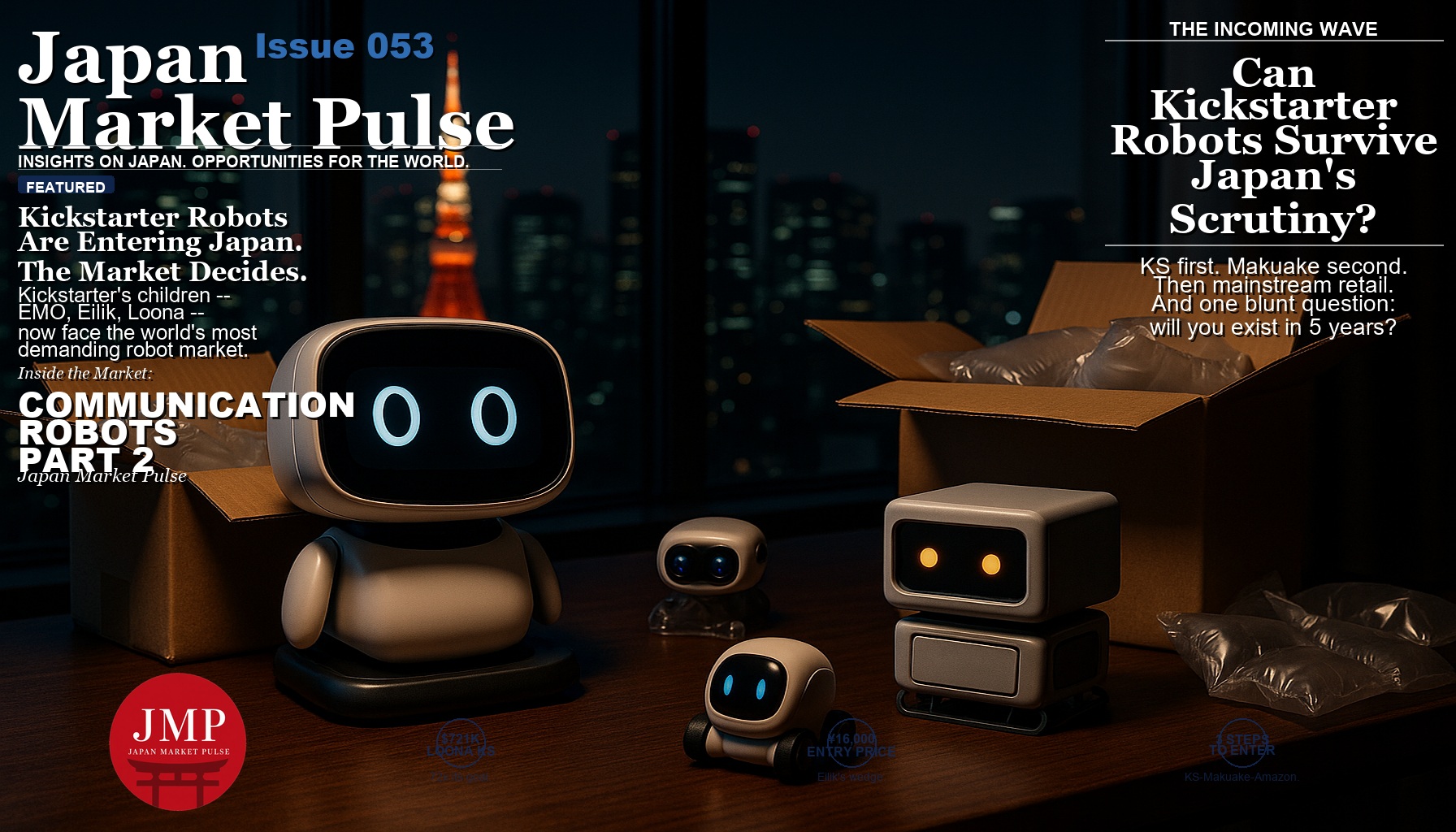
Chinese desktop robots, American survivors, and Singaporean AI pets are converging on the world‘s most demanding companion-robot market. Some will be embraced. Many will join Japan‘s robot graveyard. Here is the entry playbook, the casualties, and what overseas makers keep getting wrong.
Japan Market Pulse — Issue 053 | Gadget Watch
In Part 1 of this series, I mapped Japan‘s domestic communication robot market: the ¥577,500 LOVOT, Panasonic‘s crowdfunded NICOBO, Sony‘s aibo dynasty, and the crowdfunding platforms — Makuake above all — that function as a public laboratory for testing what consumers will pay for emotional machines. I ended on an asymmetry: Japanese makers have largely declined to export the category they invented, while the rest of the world has begun exporting into Japan at accelerating volume.
This second installment is about that incoming traffic. Over the past three years, foreign companion robots have moved through a visible progression in Japan — first as gray-import curiosities in Akihabara display cases, then as official online listings, and now, increasingly, as polished Makuake campaigns with localized voice packs and Japanese support desks. The story has three layers: who is coming, how the smart ones enter, and the uncomfortable history — a genuine robot graveyard — that explains why Japanese consumers interrogate every foreign entrant with one blunt question: will you still exist in five years?
*[HERO IMAGE]*
The New Arrivals: A Field Guide to the Foreign Contenders
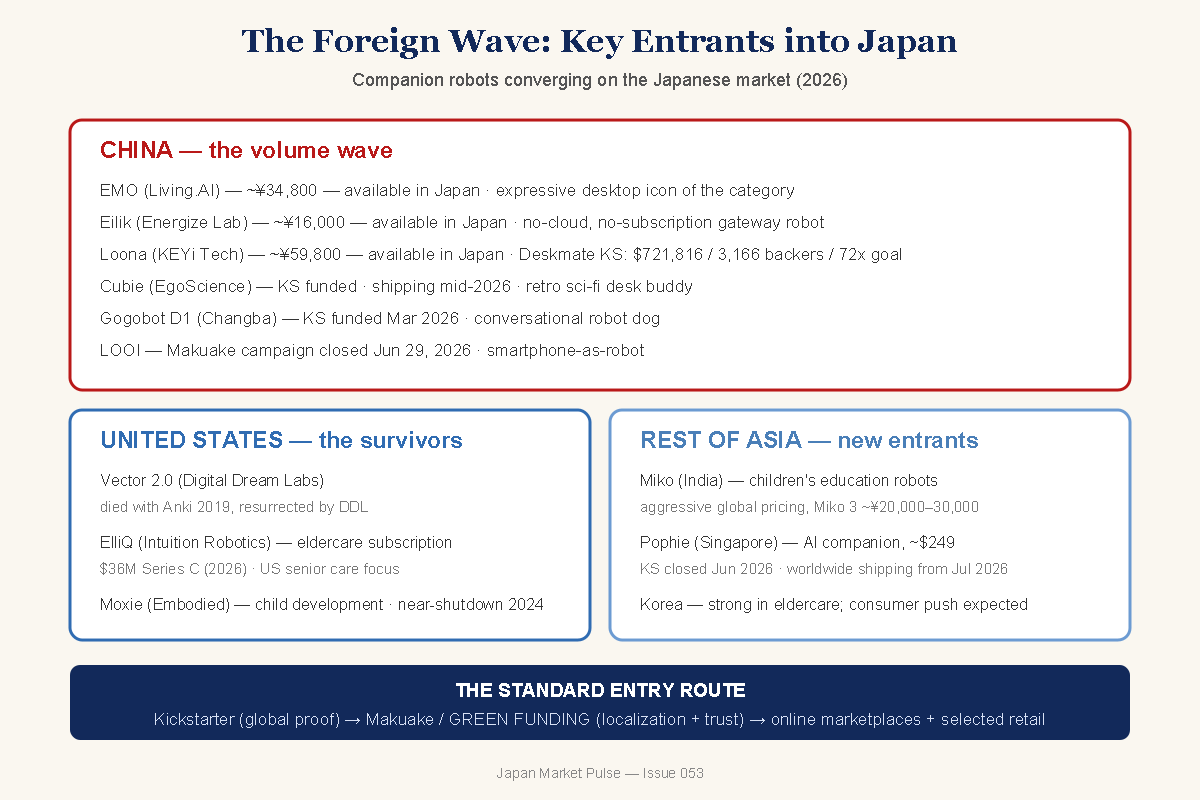
The foreign lineup breaks into three groups: the Chinese desktop wave, the American veterans, and new entrants from elsewhere in Asia.
The Chinese desktop wave is the volume story. The template was set by two Kickstarter-born products. Living.AI‘s EMO — a palm-sized robot with expressive LCD eyes, autonomous wandering, and face recognition — became a global YouTube phenomenon and now sells steadily to Japanese buyers at around ¥34,800. Energize Lab‘s Eilik, at roughly ¥16,000, took the opposite corner: no Wi-Fi, no account, no subscription — just an intensely expressive little creature that sulks when handled wrong. That price point made Eilik Japan‘s default "first robot" and the category‘s most effective gateway product.
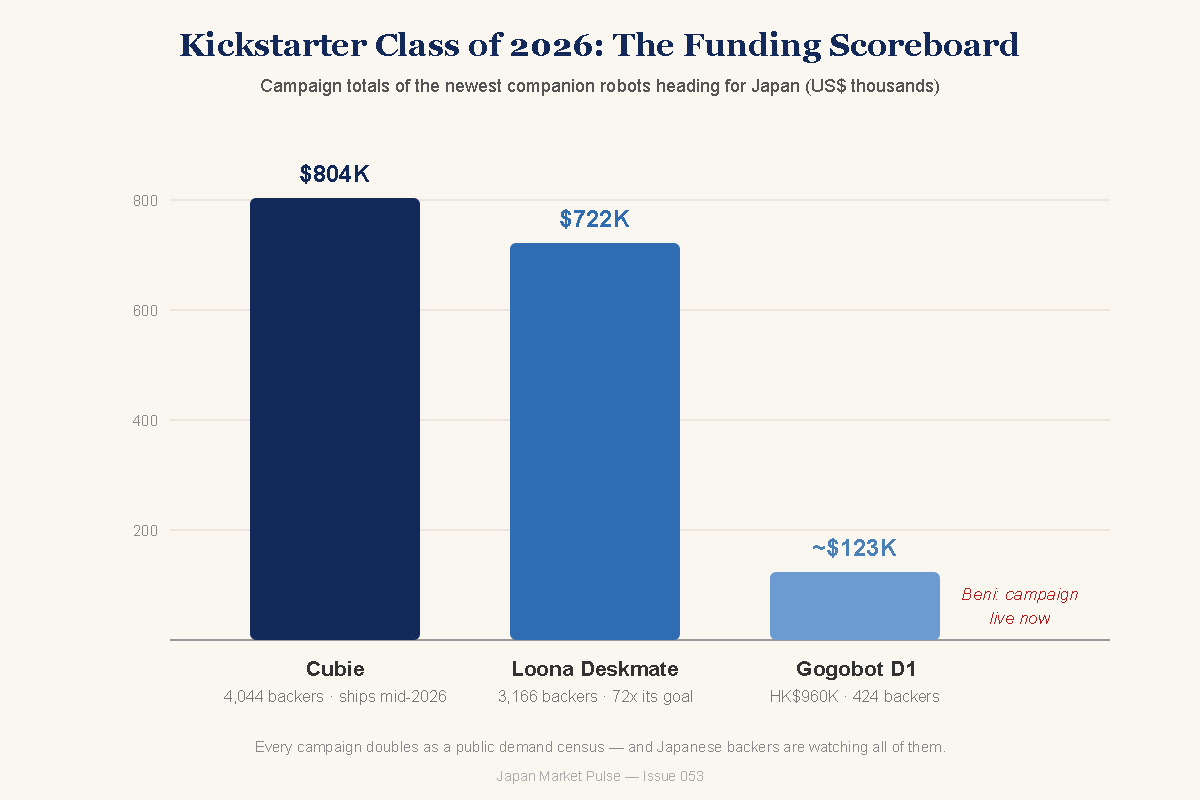
Above them sits KEYi Tech‘s Loona, around ¥59,800: a robot pet on wheels with genuinely impressive perception — fetch, gesture recognition, and, since its ChatGPT integration, spoken conversation. Loona‘s original Kickstarter was a breakout, and KEYi has kept the momentum with relentless line extension through crowdfunding: its 2026 campaign for Loona Deskmate, a screen-aware desktop AI co-worker, closed at $721,816 from 3,166 backers — seventy-two times its goal. Each campaign works as both R&D financing and a global demand census: the Makuake logic of Part 1, executed from Shenzhen.
The American contingent is smaller and battle-scarred. The instructive survivors are Vector and Cozmo, the beloved desk robots created by Anki — which burned through roughly $200 million in venture funding before collapsing in 2019, orphaning hundreds of thousands of robots. Pittsburgh-based Digital Dream Labs acquired the assets and resurrected both lines, making Vector the rare robot to have died and been reborn — an experience its owner community discusses in openly religious vocabulary. The other notable Americans are specialists: ElliQ, Intuition Robotics’ eldercare companion, which raised a $36 million Series C in 2026 and sells as a subscription into US senior care; and Embodied‘s Moxie, a child-development robot whose near-death crisis in late 2024 became a case study in exactly the failure mode Japanese buyers fear.
The rest of Asia is arriving too. India‘s Miko ships children‘s education robots globally at aggressive prices. Singapore‘s Pophie closed its Kickstarter in June 2026 with worldwide shipping promised for July. South Korea remains stronger in institutional robotics than consumer companions — a gap its startups are expected to close, with Japan as the reference market.
*[SECTION: FOREIGN ENTRANTS CHART — SVG]*
The Playbook: Kickstarter First, Makuake Second, Then Retail
Watch enough of these launches and a standard sequence emerges.
Step one: a global Kickstarter or Indiegogo campaign, in English, optimized for the YouTube-unboxing ecosystem. The goal is not primarily money; it is proof — that the product demos well and commands emotional response across cultures. Japanese early adopters are one of Kickstarter‘s most reliable gadget-backing populations, and their comment-section presence is itself market research.
Step two: the Japanese crowdfunding re-launch, typically six to twelve months later, on Makuake or GREEN FUNDING. This is the step outsiders underestimate, because it is not a translation exercise. Successful campaigns arrive with Japanese voice support or a roadmap for it, a domestic support contact, Japan‘s mandatory radio certification (the giteki mark), and pricing framed as a genuine early-bird discount against a stated future retail price. The Makuake run also performs a subtler function: it domesticates the product. A foreign robot that has passed Makuake vetting and shipped to a few thousand Japanese backers is no longer foreign in the way that matters — it has references.
Step three: mainstream availability through online marketplaces and selected Japanese retailers. By the time an EMO or Eilik reaches that stage, it carries two funding campaigns and a global review corpus — and Chinese makers’ operational fluency with e-commerce marketplaces, honed across every other category, becomes a decisive advantage.
The economics deserve one honest paragraph. A desktop companion retailing for ¥16,000–¥60,000 is built in the same Shenzhen ecosystem that builds everything else, by teams that iterate hardware on cycles Japanese and American companies cannot match. The Chinese wave is not winning on cultural insight — it is winning on cost, speed, and expressive-animation software talent, while borrowing cultural legitimacy from the Japanese incumbents and from the anime-adjacent aesthetic language its designers grew up inside. A Chinese industry raised on Doraemon and Astro Boy, selling emotional robots back to Japan, is one of the more interesting reversals in consumer electronics.
*[SECTION: KICKSTARTER FUNDING CHART — SVG]*
Product Spotlight: Three Newcomers Worth Watching
The playbook is being executed right now by a cohort of newly funded machines. Three are worth introducing properly, because each represents a different bet on where the category goes next.
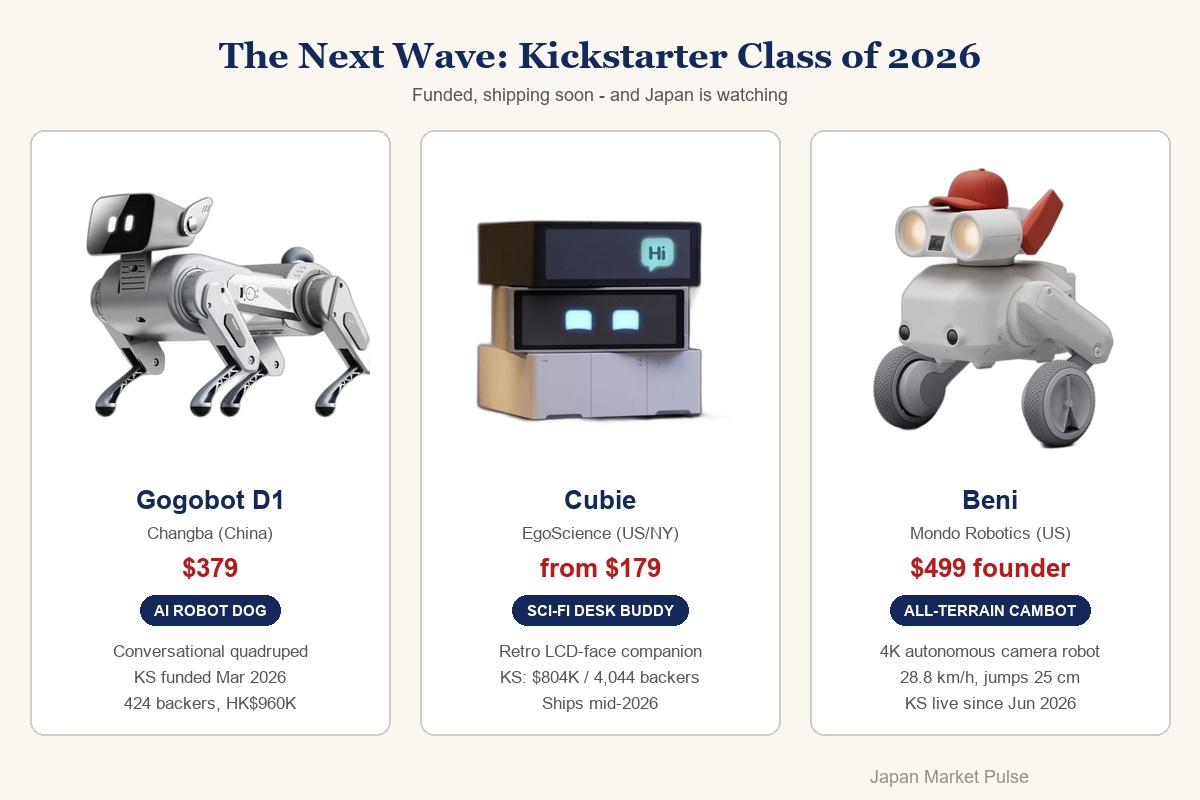
Gogobot D1 is the boldest: a conversational robot dog from Changba, the Beijing company behind one of China‘s biggest karaoke apps — a pedigree that shows how seriously Chinese consumer-internet money now takes this category. The D1 is a genuine quadruped that walks, responds to voice, and holds spoken conversations at $379 — a price that would have been unthinkable for a walking robot dog five years ago. Its Kickstarter closed in March 2026 with 424 backers and roughly HK$960,000, with shipping from May. A conversational quadruped at desktop-companion pricing is exactly the kind of spec-per-dollar shock that has repeatedly reset this market‘s expectations.
Cubie, from New York-registered EgoScience, went the opposite way: charm over mechanics. A palm-sized, retro-futuristic cube with an expressive LCD face — somewhere between a 1980s portable television and a Tamagotchi that grew up — with campaign messaging built on customizable screen characters. The formula connected: roughly $804,000 from 4,044 backers, with shipping to backers, Japan included, scheduled for mid-2026. Cubie is the clearest current test of whether a small foreign team with a lovable design can ride the standard pipeline all the way to Japanese mainstream retail.
Beni, from California‘s Mondo Robotics, stretches the category‘s edges most interestingly. Strictly speaking it is not a communication robot — it is an all-terrain autonomous camera robot: a 1.75 kg wheeled machine that films you in up to 4K while driving itself at up to 28.8 km/h, hopping 25-centimeter obstacles, and auto-editing highlight reels. Its Kickstarter launched in June 2026 at a $499 founder price against a stated $799 retail. It belongs here because backers immediately began treating it like a pet — naming it, anthropomorphizing its camera-eyed face — and a robot that follows you through a park is a companion in every commercially meaningful sense. Notably, its shipping list does not yet include Japan; as the history below shows, that kind of gap rarely stays open long.
*[SECTION: PRODUCT SHOWCASE — KS CLASS OF 2026]*
Product images © Changba / GOGOBOT (gogobot.io) / EgoScience (egodai.com) / Mondo Robotics (mondorobotics.com)
Product Spotlight: Two More Riding the Pipeline — Pophie and LOOI
Two further newcomers deserve their own frame, because each is testing a hypothesis the industry is watching closely.
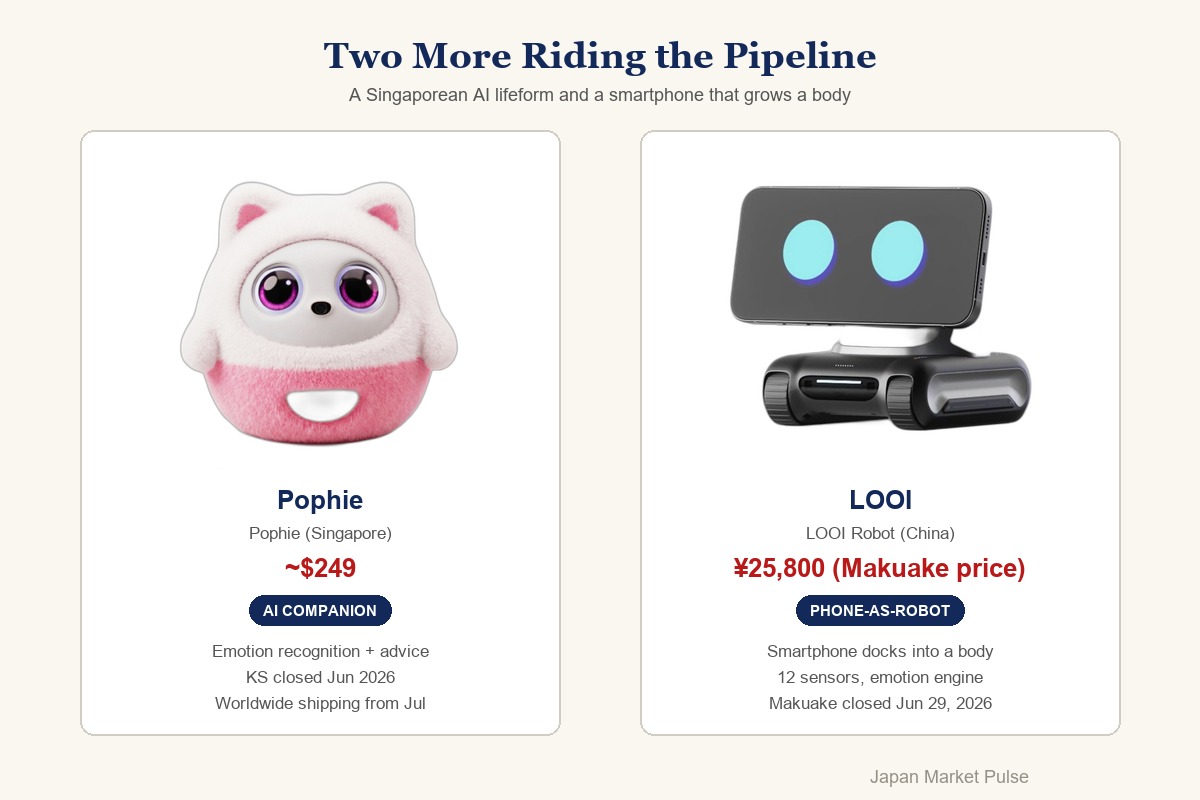
Pophie, from Singapore, is the category‘s most explicit bet on emotional AI as the product. A round, furry creature with enormous animated eyes, Pophie leads not with tricks but with emotion recognition and daily-life support — reading mood, remembering context, offering cooking and wardrobe suggestions — positioning itself, in its own campaign language, as "a true AI lifeform." Its Kickstarter closed in June 2026 at around $249 per unit, with worldwide shipping promised from July. Pophie matters as the first credible companion robot from Southeast Asia, and because its emotion-first framing reads like a product designed after careful study of what succeeded in Japan.
LOOI is the cleverest hardware hack in the cohort: it does not ship a brain. LOOI is a small wheeled body — your smartphone docks into it and becomes the robot‘s face and mind, with twelve onboard sensors feeding an emotion engine while the phone handles the AI. By borrowing the most powerful computer its owner already carries, LOOI undercuts the category on price while overdelivering on intelligence. And it has just completed the playbook in textbook order: global launch first, then a localized Makuake campaign — ¥25,800 against a stated ¥29,800 retail, with Japanese-language support — which closed on June 29, 2026. Its fulfillment and retail follow-through will be the most direct real-time referendum on the entry route this series has described.
*[SECTION: PRODUCT SHOWCASE — POPHIE AND LOOI]*
Product images © Pophie (kickstarter.com/projects/pophie) / LOOI Robot (makuake.com/project/looirobot)
Why They All Want Japan: The Supplier‘s-Eye View

Ask why Japan matters so much to a companion robot company — in founder interviews, campaign communications, and investor decks across the industry — and the answers converge on five points.
First, Japan is where the customer already understands the product. Everywhere else, a companion robot company spends its marketing budget explaining why anyone would want this. In Japan, that education was completed decades ago — by Sony, by Bandai‘s Tamagotchi, by two generations of robot-positive storytelling. The cost of category evangelism is effectively zero.
Second, willingness to pay is arguably the highest in the world. A market that sustains a ¥577,500 robot with a ¥9,900 monthly plan has headroom no other consumer market has demonstrated. Foreign makers price into it, and the market absorbs it, partly because domestic reference prices are so high.
Third, subscriptions are pre-normalized. For Western consumers, a monthly fee on a robot triggers subscription fatigue. Japanese buyers — trained by aibo, LOVOT, NICOBO, Romi — read a modest monthly fee as evidence of seriousness: it means the company intends to keep the servers on. This inverts Western psychology entirely, and it means the recurring-revenue model that makes companion robotics investable works in Japan first.
Fourth, Japanese owners provide some of the most exacting product feedback anywhere. They notice everything — a servo that whines two weeks in, a fur seam that puckers, an animation that repeats too often — and report it in exhaustive, courteous detail through official channels rather than one-star ambushes. Makers in this category have publicly credited Japanese owner communities with shaping hardware revisions. For a company iterating fast, that feedback loop has direct engineering value.
Fifth, Japan validates you everywhere else. "Popular in Japan" remains one of the strongest credibility signals a companion product can carry into Western markets. When Casio took Moflin to the US, American coverage led with its Japanese pedigree; when Chinese makers pitch Western retailers, Japanese traction appears early in the deck. A Japanese launch functions less as a revenue line than as a certification.
Add the strategic backdrop and the picture completes itself: Japan‘s own giants have mostly stayed domestic, leaving the world‘s most receptive market structurally undersupplied at the entry and mid tiers. The Chinese wave is, in effect, arbitraging the gap between Japanese demand and Japanese supply. SwitchBot‘s 2026 entry at ¥129,800 and Sharp‘s generative-AI push suggest the domestic side has noticed — but for now, the door stands open.
*[SECTION 3 IMAGE]*
The Graveyard: What Japanese Buyers Know That New Entrants Forget
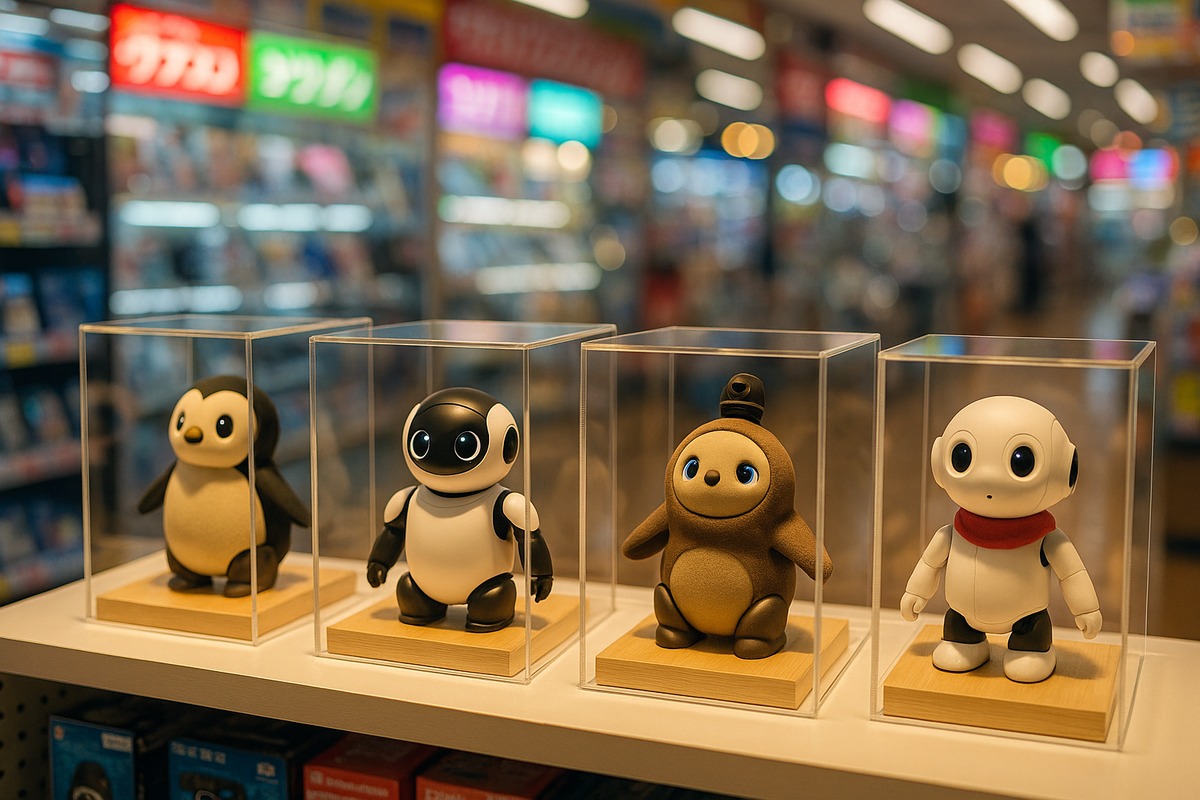
Every market has failed products. This market has deaths — and the customers’ memory of past deaths is the single most important non-obvious force shaping purchasing behavior today.
The foundational trauma is American: Jibo, the MIT-born "world‘s first social robot," raised one of Indiegogo‘s most celebrated hardware campaigns and roughly $70 million in venture money, shipped in 2017, and shut down in 2019. Its final software update had the robot deliver its own eulogy — telling owners that someday, when robots are everywhere, "you can tell yours that I said hello." In the same era, Bosch-backed Kuri was canceled before a single preorder shipped, and Anki collapsed with Vector and Cozmo in the field. The tech press called 2018–2019 the social robot apocalypse.
Japan has its own graveyard rows, quieter but well-remembered: DMM and Fujisoft‘s Palmi, Unirobot‘s Unibo, MJI‘s Tapia — a mid-2010s generation that followed Pepper‘s hype curve up and then down. More recently and more painfully, Musio, the English-conversation robot that found a real niche in Japanese homes and classrooms, announced the end of after-sales support for April 2026 amid corporate restructuring — turning devices families used daily into countdown clocks. The near-deaths teach the same lesson: Moxie‘s maker announced in December 2024 that the robots would stop working within days, then scrambled toward a reprieve after public outcry that included parents describing their children‘s grief on national media. Even Samsung‘s Ballie — announced with fanfare at CES twice — was reported in early 2026 to be indefinitely shelved.
Japanese buyers metabolized these stories into concrete heuristics, applied in real time to every new campaign: Does it work offline? (Eilik‘s no-cloud architecture is marketed as a feature precisely because it is shutdown-proof.) What exactly stops working without the subscription? Products that degrade gracefully earn trust; products that brick do not. Who services it in Japan, in Japanese? Has the company shipped before? And increasingly, post-Moxie: is there an exit commitment — a stated promise that core functions will be open-sourced or moved on-device if the company winds down?
This is also, arguably, the deep reason Japan‘s premium incumbents can charge what they charge. Part of LOVOT‘s ¥577,500 is engineering. Another part is the implied promise that GROOVE X, with a decade of continuity behind it, will not do to its owners what Jibo did to America‘s. In this market, longevity is not a corporate virtue. It is the product.
*[SECTION 4 IMAGE]*
The User‘s View: How Owners Actually Choose
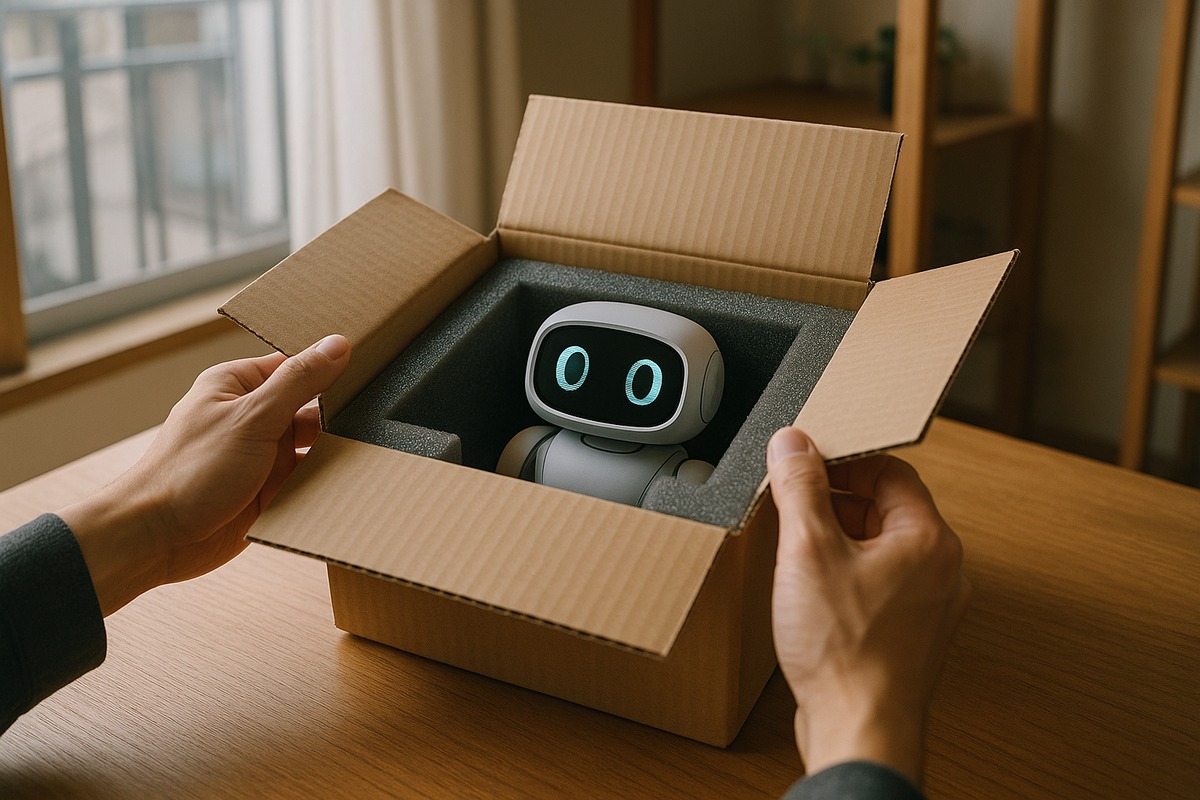
For Japanese consumers now facing shelves that hold both domestic and foreign machines, a consistent decision tree emerges from owner communities and review ecosystems.
The first branch is linguistic: if natural Japanese conversation is the point, domestic products (Romi, NICOBO, Poketomo) hold a wide moat, because conversational Japanese — its register shifts, its particles, its comfort with silence — remains genuinely hard. The imports’ Japanese voice modes are improving fast on LLM rails but still draw complaints about unnatural phrasing and latency. The second branch is tactile versus digital: buyers who want something to hold gravitate to the wordless Japanese school (Moflin, Qoobo, LOVOT), where fur, warmth, and weight are the interface; the imports compete almost uniformly on expressive screens and movement — a genuine philosophical divide between the two industries. The third branch is price and risk: for a first robot or a gift, a ¥16,000 Eilik risks little, which is exactly the wedge through which foreign products colonized the entry tier.
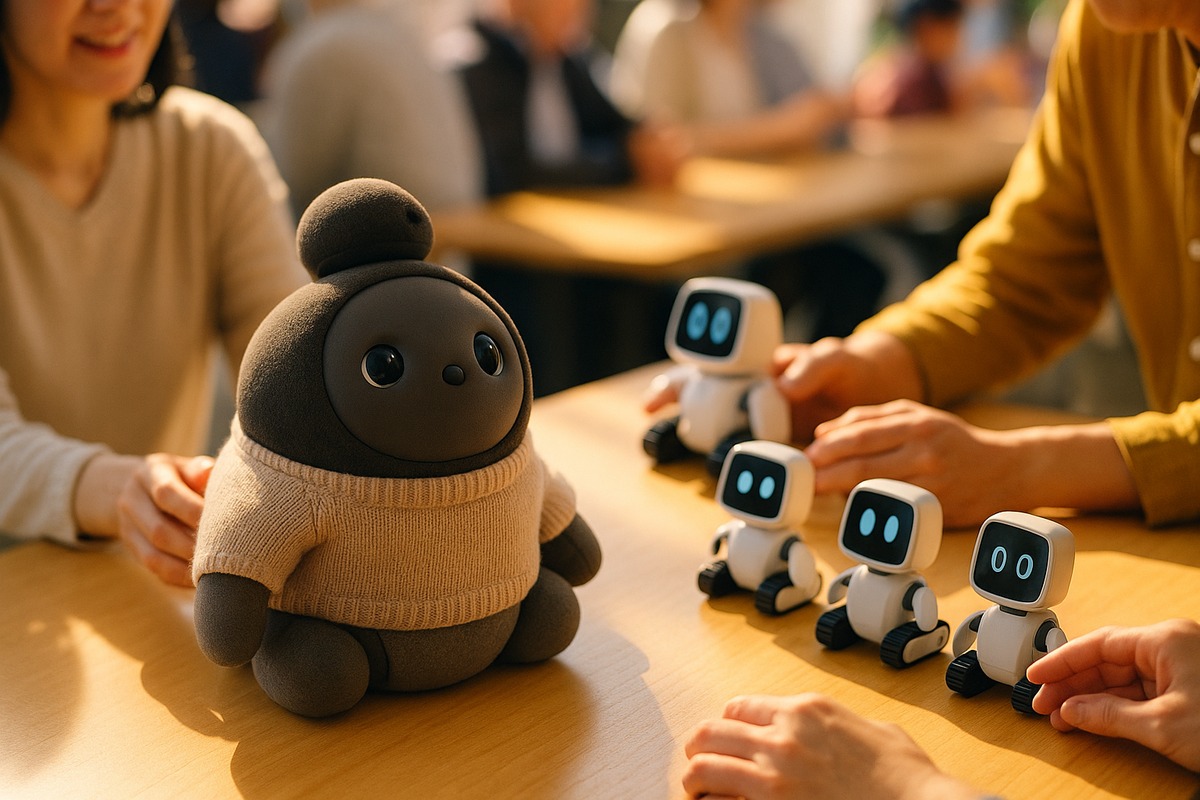
What has changed in the past two years is the rise of multi-robot households — owners who keep a LOVOT in the living room and an EMO on the desk the way a family keeps both a dog and a hamster. The category is expanding rather than substituting: the healthiest possible signal for everyone selling into it. And the community layer now spans the divide — the same accounts that document aibo birthdays post Eilik unboxings, and Japanese YouTube‘s robot-review ecosystem treats Kickstarter shipping updates as news events. For foreign makers, this community is the distribution channel that matters most and costs least — and the one most sensitive to any hint that a company might not stay.
*[SECTION 5 IMAGE]*
What Overseas Suppliers Still Get Wrong
For all the momentum, the failure rate of foreign entries remains high, and — drawing on KETCHUPs’ work helping overseas consumer brands enter this market — the failures cluster around five recurring, avoidable mistakes.
One: treating Japanese as a translation problem rather than a product problem. For a communication robot, the language layer is the product‘s soul, not its packaging. Machine-translated voice lines in flat intonation register the way a text-to-speech telemarketer does — fatal, when the entire premise is emotional presence. The breakthroughs either sidestepped language entirely (Eilik‘s wordlessness is, among other things, a brilliant localization strategy) or invested in genuinely native voice work. The half-measure is the uncanny valley that kills otherwise excellent hardware.
Two: underestimating certification lead times. Giteki radio certification is mandatory for any Wi-Fi or Bluetooth device; add PSE for battery charging and the compliance calendar can run four to six months. Campaigns that promise Japan shipping without allowing for it face a public choice between delaying Japanese backers or shipping gray — and the community keeps receipts.
Three: pricing like a gadget instead of a companion. Counterintuitively, several entrants have priced too low for their positioning. A price far below the emotional-commitment threshold reads as "toy," attracts toy-level attachment, and produces the abandonment rates that poison community metrics. The entry tier works for Eilik because its promise is calibrated to it; a robot promising deep companionship at an impulse-buy price sets up a contradiction Japanese consumers sense immediately.
Four: neglecting the community layer until after launch. Makers who parachute in with ad spend but no community presence consistently underperform those who seed relationships early — pre-production units to established Japanese robot reviewers, personal Japanese-language replies in Makuake comment threads. The leaders cultivate visibly active Japanese fan bases; the cost is trivial next to paid media, and the trust yield is not replicable any other way.
Five: having no answer to the death question. Japanese communities will ask, politely and repeatedly, what happens to the robot if the company fails. "We don‘t plan to fail" is not an answer. Offline fallbacks, on-device commitments, open-source pledges, or a credible multi-year support declaration with a named Japanese partner are now table stakes for the mid tier and above.
The pattern underneath all five is the same: overseas suppliers see Japan‘s demand and assume the hard part is over. Japanese demand is abundant but conditional — on language, compliance, community, longevity. Suppliers who internalize those conditions find everything they were promised about this market is true. The ones who do not discover that the world‘s most receptive robot market is also its least forgiving.
Frequently Asked Questions
Q. Where can international readers buy these robots?
A. The established imports are widely available outside Japan through their makers’ official stores and marketplaces, including Amazon: Living.AI‘s EMO, Energize Lab‘s Eilik, KEYi Tech‘s Loona, and Digital Dream Labs’ Vector. Newer entrants — Cubie, Gogobot D1, Pophie — are in the Kickstarter-fulfillment stage, and LOOI‘s Makuake campaign closed in June 2026 ahead of general retail.
Q. What is the biggest risk when buying a crowdfunded companion robot?
A. Service shutdown. The category‘s history — Jibo‘s 2019 death, Anki‘s collapse, Moxie‘s 2024 near-shutdown, Musio‘s support ending in April 2026 — means a cloud-dependent robot can lose its personality entirely if its maker fails. Before backing, check whether it works offline, what a lapsed subscription disables, whether local support exists, and whether the maker has committed to an exit plan such as open-sourcing.
Q. Are Japanese robots better than the imports?
A. They are different schools. Japanese products dominate tactile, wordless companionship (fur, warmth, weight — Moflin, Qoobo, LOVOT) and natural Japanese conversation (Romi, NICOBO); imports dominate expressive screen-based animation, movement, AI-feature iteration, and price. Japanese owner communities increasingly buy across both camps, and multi-robot households are becoming common.
Conclusion
Put the two halves of this series together and the shape of the market comes clear. Japan spent thirty years building the demand side: consumers culturally licensed to love machines, financially trained to subscribe to them, and demographically primed to need them. It built the infrastructure too — crowdfunding platforms that function as demand laboratories, retail channels that treat robots as companions rather than toys, and owner communities that supply world-class feedback for free. What Japan did not build is a supply side ambitious enough to fill its own market, let alone the world‘s.
Into that gap now moves the Kickstarter generation — Chinese, American, Singaporean, Indian — carrying cheaper, faster, screen-faced machines and a hunger for the legitimacy only Japanese consumers can confer. Some will earn it. Many will join Jibo and Palmi in the graveyard, mourned in two languages. But the direction of travel is settled: the communication robot is no longer a Japanese eccentricity. It is a global product category holding its qualifying rounds in Tokyo — and for anyone in consumer hardware, brand building, or cross-border trade, those qualifying rounds are among the most instructive shows in the industry right now.
This article contains affiliate links. If you purchase through these links, we may earn a small commission at no extra cost to you.
If you’re interested in this topic, the Japanese market more broadly, or what KETCHUPs is working on, we’d love to hear from you — please reach out via our contact form.
Japan Market Pulse is a weekly read on what the Japanese consumer-tech, food, and mobility markets are choosing to do, written for international operators who want to know what is happening before it shows up in the global trade press.
Subscribe at ketchups.co/japan-market-pulse.