

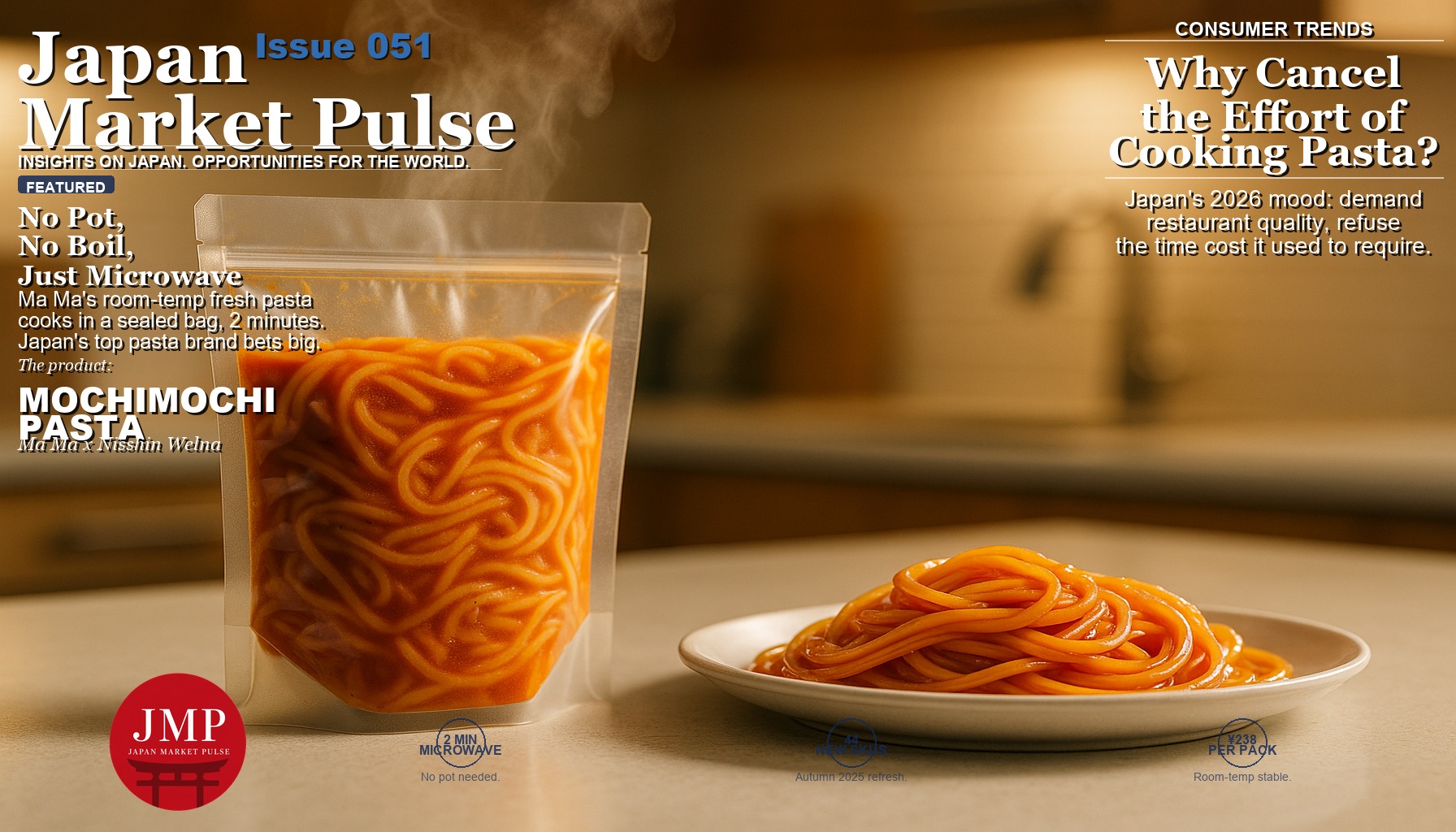
I have lived in Japan long enough to have opinions about pasta that would get me laughed out of most rooms in Rome. One of them is this: the single greatest kitchen convenience I have adopted since moving here is a bag of noodles I never have to boil.
For years, my relationship with fresh pasta followed the same tired choreography every other home cook I know goes through. Fill a pot. Wait for it to boil, which always takes four minutes longer than you remember. Salt it aggressively, because someone on the internet told you to. Drop the noodles in, set a timer, hover nearby so you don‘t overcook them, drain them at exactly the wrong moment because you got distracted by your phone, and then clean a pot that somehow still has starch cemented to its sides an hour later. It is not a hard ritual. It is just a ritual, and in a country where both members of a household increasingly work full-time, commute an hour each way, and still want to eat something that tastes like it came from a restaurant rather than a vending machine, rituals are exactly what get cut first.
So when a bag of pasta showed up in my local supermarket in Tokyo last year that promised none of that — no pot, no boiling water, no draining, just two minutes in a microwave with the bag still sealed — I was skeptical in the specific way that only someone who has eaten a lot of bad "convenience" pasta can be skeptical. I bought it anyway. And it was, unmistakably, better than it had any right to be. Not "good for a shortcut." Actually good. Chewy in the way fresh pasta is supposed to be chewy, with a bite that dried pasta from a box simply cannot replicate no matter how carefully you time it. That single grocery-store purchase is what sent me down the rabbit hole that became this article, because it turns out I was not discovering a clever product. I was watching a 70-year-old company make one of the more interesting bets in Japanese food manufacturing in years.
The Bag That Ended My Relationship With Boiling Water
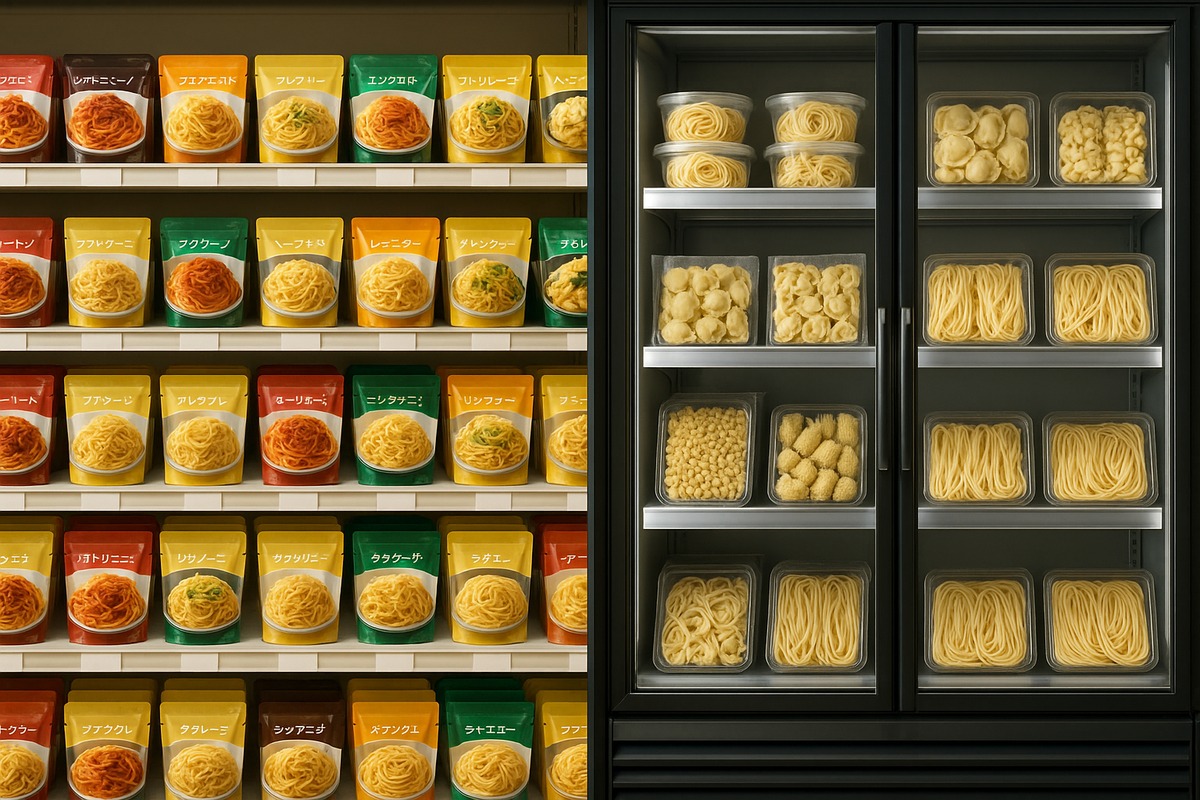
The product is called, in the wonderfully literal way Japanese packaging often is, "Ma Ma Range de Nifun Mochimochi Nama Pasta" — roughly, "Ma Ma: Fresh Pasta, Two Minutes in the Microwave, Wonderfully Chewy." It comes from Nisshin Seifun Welna, the food division of Japan‘s largest flour milling group, under the Ma Ma brand, which has been the No. 1 pasta name in Japanese households for seven decades. The pitch is almost aggressively simple: take the bag out of the box, do not open it, put it in the microwave for two minutes, and you have fresh-style pasta with none of the labor.
What makes this more than a gimmick is the storage claim sitting quietly next to it. This is not a frozen product that needs freezer space and a thaw cycle. It is shelf-stable at room temperature. That is a genuinely different manufacturing problem than either dried pasta (which is stable because nearly all the moisture has been removed) or fresh pasta (which is delicious specifically because the moisture has not been removed, and which is therefore usually either refrigerated with a short shelf life or frozen solid). Nisshin Welna‘s engineers found a way to keep the "fresh" texture — that dense, slightly springy, unmistakably not-dried bite the Japanese market has taken to calling "mochimochi," a word more commonly used to describe the pull of good mochi rice cake — while making the product stable enough to sit in a pantry for months. That is the actual innovation here, and it is the reason food industry trade press in Japan covered the launch as seriously as they did.
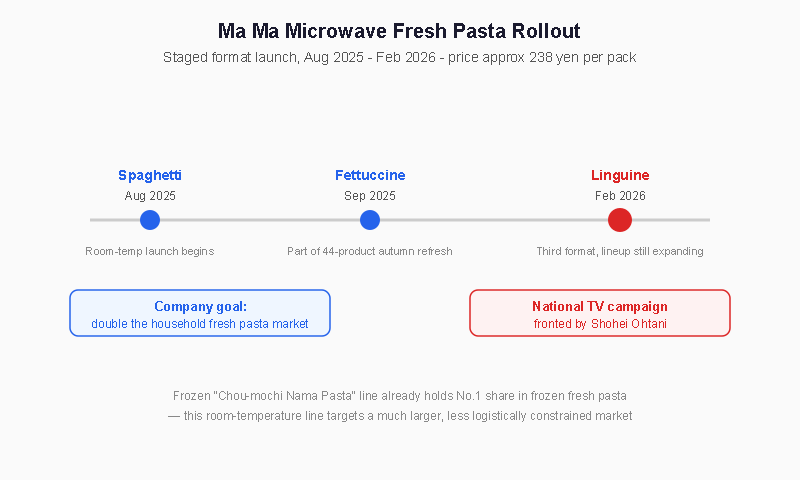
The rollout tells its own story about how confident the company is in what it built. Spaghetti launched first, in August 2025. Fettuccine followed within weeks. By February 2026, the lineup had expanded again with linguine, part of a broader autumn 2025 refresh that included 44 new or renewed household products from the company. This is not a single experimental SKU quietly tested in a handful of stores. It is a coordinated, multi-format product launch backed by a company willing to put real manufacturing capacity behind the bet — and, as I‘ll get to, willing to put a very famous face behind it too.
A 70-Year-Old Brand Reinvents Itself
Ma Ma is not a startup chasing a viral moment. It is the pasta equivalent of a legacy detergent or toothpaste brand — the name your grandmother‘s generation trusted, sitting in nearly every Japanese pantry for as long as pasta has been a mainstream part of the Japanese diet. Brands with that kind of institutional weight do not usually move fast. They protect what already works. Which is what makes this launch notable: Nisshin Welna is treating the room-temperature fresh pasta line as the second act of a deliberate 70th-anniversary rebranding effort, not a side project.
The marketing spend backs that up. The new microwave pasta line is fronted by Shohei Ohtani, arguably the single most bankable endorsement figure in Japan right now, in a national commercial campaign built around the tagline that Ma Ma is creating a "new era" for pasta through fresh-format innovation. When a company puts its biggest star behind a product, it is telling you something about how much internal conviction sits behind the R&D spend that got it there. This is not a brand testing the waters. This is a brand that ran the numbers on room-temperature fresh pasta and decided it was worth staking real reputation on.
There is also a quieter signal in the timing. Ma Ma‘s frozen "Chou-mochi Nama Pasta" line — the "super-mochi fresh pasta" that predates this launch — already holds the top market-share position in Japan‘s frozen fresh pasta category. In other words, the company was not entering a category it needed to prove itself in. It already had the category. What it did not have was a room-temperature version that could sit on a shelf, travel through non-refrigerated supply chains, and be stockpiled the way Japanese households increasingly like to stockpile shelf-stable food — a habit that, in a country prone to earthquakes and typhoons, is about preparedness as much as convenience. Solving for that made a winning frozen product into something that could compete in a much larger, much less logistically constrained market.
The Science of "Mochimochi" — What‘s Actually Happening in the Bag
I am not a food scientist, and I want to be honest about the limits of what a company will disclose about its own proprietary process. But the outlines of the problem are clear enough from how the industry talks about it, and they are worth walking through because they explain why this is harder than it sounds.
Dried pasta is stable at room temperature because it has been dehydrated to a moisture content low enough that nothing can grow in it, and the texture you get from cooking it is a function of rehydrating starch that has been compacted and dried under controlled conditions. Fresh pasta, the kind you‘d get from a proper Italian pasta shop, is a completely different product: high moisture content, softer gluten structure, a texture that comes specifically from not having gone through that dehydration. That is exactly why fresh pasta has traditionally needed refrigeration or freezing — the moisture that makes it taste like fresh pasta is also what makes it perishable.
Making a product that has fresh pasta‘s moisture-driven texture but dried pasta‘s shelf stability means solving a contradiction that the category has mostly avoided by picking one side or the other. The methods used to get there generally involve some combination of controlled partial cooking before packaging, precise moisture management, and packaging technology that manages internal atmosphere and prevents the microbial growth that would normally accompany that moisture level — essentially recreating fresh texture through a process closer to what‘s sometimes called high-moisture retort or semi-dried technology, executed well enough that the eating experience doesn‘t feel like a compromise. The "two minutes in a sealed bag" cooking method is itself part of the solution: rather than boiling in water, which would need to rehydrate the product from a fully dried state, the microwave step is finishing a product that already has most of its target moisture and texture locked in, using steam generated inside the sealed bag to bring it to serving temperature and complete the last stage of texture development.
Whatever the exact mechanism, the result is a texture that reviewers and everyday customers alike consistently describe as closer to fresh pasta shops than to the boxed dried pasta most households have used for decades. That is a real technical achievement, and it is the kind of packaging and food-science capability that does not show up overnight. It is the product of a large milling and food-technology company applying decades of starch science to a specific, previously unsolved convenience problem.
Effort-Cancellation: Japan‘s Mood Going Into 2026
None of this happens in a vacuum, and the cultural context matters as much as the food science. Japanese trend forecasters, including the influential Nikkei Trendy, have been circling a specific idea heading into 2026: they call it "kurou kyanseru" — effort-cancellation. The theory is that generative AI and a wave of convenience-engineering across categories — from instant translation to grocery delivery to, yes, pasta you never boil — are collectively normalizing the idea that spending less effort on a task is not laziness, it is simply optimization. The trend forecasters point to things like room-temperature-stable fresh ramen sold through convenience stores, self-serve noodle-cooking machines appearing in retail spaces, and microwaveable fresh pasta as evidence of the same underlying shift: Japanese consumers want the result of effort — a good meal, a good outcome — without paying the time cost that used to be attached to it.
This lines up with something I‘ve written about before in this column: Japan‘s growing "solo economy," the enormous cohort of people living alone, working long hours, and making food decisions for a household of one. It also lines up with dual-income families where neither partner has the 45 minutes a proper pasta dinner used to require on a Tuesday night. It is worth being precise about what is and is not happening here. This is not a story about Japanese consumers eating worse, or trading down to lower-quality food because they are busy. If anything, it‘s closer to the opposite. Japanese consumers are demanding restaurant-adjacent quality and simply refusing to accept that quality requires the labor it has always required. That is a meaningfully different demand than "I want cheap, fast food," and it is a much harder demand for a manufacturer to satisfy, because it requires solving the labor problem without touching the quality the customer is unwilling to sacrifice.
That distinction is exactly why this product category is worth paying attention to if you sell food, kitchenware, or consumer packaged goods anywhere in the world. The Japanese market has a long track record of being an early adopter of "premium convenience" — the idea that convenience and quality are not opposites, they are two variables a good manufacturer solves for simultaneously. Categories that look this way in Japan tend to arrive in other developed markets on a lag of a few years, usually once the manufacturing and packaging technology has been proven at scale.
The Numbers Behind the Bet
Some of the specifics help size how seriously Nisshin Welna is taking this. The new room-temperature pasta line carries a suggested retail price around 238 yen per pack for both the spaghetti and fettuccine formats — positioned meaningfully above a typical box of dried pasta, but well within impulse-purchase range for a household meal solution, and comparable to what a household might already spend on a mid-tier frozen pasta meal. The staged rollout — spaghetti in August 2025, fettuccine weeks later, linguine by February 2026 — suggests a company testing consumer response format by format rather than gambling everything on a single SKU, while still moving with enough confidence to keep adding formats on a roughly quarterly cadence.
The frozen predecessor line, "Chou-mochi Nama Pasta," already holds the No. 1 share position in Japan‘s frozen fresh pasta segment, which gives the company a built-in customer base primed to try a room-temperature version of a texture they already trust. And the strategic framing from the company itself, reported in Japanese trade press, is explicit: this is part of an effort to double the size of the household fresh pasta market, not simply capture share within the market as it exists today. That is a category-expansion bet, not a market-share bet, and it is backed by a national ad campaign fronted by one of the most recognized athletes on the planet. Companies do not spend that kind of marketing capital on a product they consider a minor line extension.
What This Means for Food Manufacturers Outside Japan
If you make, distribute, or invest in packaged food anywhere in the world, there are three things worth taking from this that go beyond "pasta is interesting."
The first is that shelf-stable-fresh is a genuinely underexploited category outside Japan. In the United States, the fresh pasta aisle is almost entirely refrigerated — think Giovanni Rana‘s tortellini and ravioli lines, which built a real business on refrigerated fresh pasta but have not, as far as I‘ve been able to find, cracked room-temperature shelf stability at anything like this scale. A shelf-stable product with genuinely fresh texture solves a real distribution problem: refrigerated supply chains are expensive, geographically limiting, and vulnerable in ways a shelf-stable product simply is not. Whoever solves that problem well in the U.S. or European market is not just launching a product, they are unlocking distribution into channels — convenience stores, vending, direct mail, disaster preparedness retail — that refrigerated fresh pasta has never been able to reach.
The second is about packaging and process technology as the actual competitive moat, not the recipe. The interesting intellectual property here is not the pasta formula, it is the combination of moisture management, partial-cook processing, and packaging engineering that makes the shelf stability possible without sacrificing the texture that makes fresh pasta worth choosing over dried in the first place. That is exactly the kind of process innovation that is licensable, patentable, and transferable across categories — noodles, dumplings, other starch-based fresh foods — for a manufacturer willing to invest in food-science R&D rather than simply reformulating flavors.
The third is softer but no less real: watch what large, historically conservative food brands do with their biggest marketing budgets. A 70-year-old brand putting its most expensive endorsement deal behind a genuinely new manufacturing capability, rather than a flavor extension or a limited-edition flavor, is a strong signal about where that company‘s own internal data says the growth is. Conservative, legacy brands do not bet big on categories they think are fads. If you are tracking Japan as a leading indicator for premium-convenience trends headed toward other developed markets, this is exactly the kind of signal worth logging.
Frequently Asked Questions
Q. Where can I buy Ma Ma‘s microwave fresh pasta in Japan?
A. The spaghetti, fettuccine, and linguine formats are widely available in Japanese supermarkets and convenience stores nationwide, typically shelved in the room-temperature pasta and rice aisle rather than the refrigerated or frozen section. Major chains including Aeon, Ito-Yokado, and most regional supermarket groups stock the line as part of Nisshin Welna‘s standard household distribution.
Q. Is this product, or something like it, available outside Japan?
A. Not yet in the same room-temperature, sealed-bag microwave format. The closest equivalents available internationally are refrigerated fresh pasta lines such as Giovanni Rana‘s fresh pasta products, which require refrigeration and a short cook in boiling water rather than a sealed microwave format, but aim at a similar "fresh texture without the full effort of homemade" positioning for busy households.
Q. How much does it cost?
A. The suggested retail price is approximately 238 yen (roughly $1.60 at recent exchange rates) per single-serving pack, positioning it above standard dried pasta but well within the price range of a typical convenience meal in Japan.
Q. Why is room-temperature storage such a big deal if frozen fresh pasta already existed?
A. Frozen storage requires freezer space, a thaw or reheat cycle, and a cold supply chain from factory to store to home — all of which limit where a product can be sold and how a household can stock it. A shelf-stable version removes all of those constraints, opening up convenience store distribution, longer at-home storage without freezer space, and the kind of disaster-preparedness stockpiling that is a meaningful purchase driver in earthquake-prone Japan.
Q. Is "effort-cancellation" a real, tracked consumer trend, or just marketing language?
A. It originates from Japanese trend-forecasting research, most notably from Nikkei Trendy‘s annual consumer trend predictions, which pointed to convenience-engineered food and AI-assisted daily tasks as a defining thread heading into 2026. Whether or not the label sticks, the underlying behavior — consumers demanding quality outcomes while actively rejecting the time and labor traditionally required to get them — is well documented across multiple category launches in the same period, not just this one.
The Real Story Isn‘t the Pasta
Strip away the noodles and what you‘re left with is a case study in how a legacy Japanese manufacturer reads its own consumers with genuine precision, and is willing to spend real R&D money and its biggest endorsement budget acting on what it finds. Nisshin Welna did not simply make convenience food faster. It identified the exact point of friction — boiling water, watching a pot, cleaning up — sitting between a busy household and a meal they‘d actually enjoy, and then spent years of food science solving specifically for that friction without compromising the thing that made the meal worth having in the first place.
That is a more useful lesson for anyone building or selling consumer products than "pasta is popular in Japan." The companies winning in Japan‘s 2026 consumer environment are not the ones cutting corners to save their customers time. They are the ones spending serious money to remove the corners entirely, so nothing has to be cut at all.
This article contains affiliate links. If you purchase through these links, we may earn a small commission at no extra cost to you.
If you’re interested in this topic, the Japanese market more broadly, or what KETCHUPs is working on, we’d love to hear from you — please reach out via our contact form.
Japan Market Pulse is a weekly read on what the Japanese consumer-tech, food, and mobility markets are choosing to do, written for international operators who want to know what is happening before it shows up in the global trade press.
Subscribe at ketchups.co/japan-market-pulse.