

This article is published by KETCHUPs, a Tokyo-based trading and brand-development firm. All content is editorial.
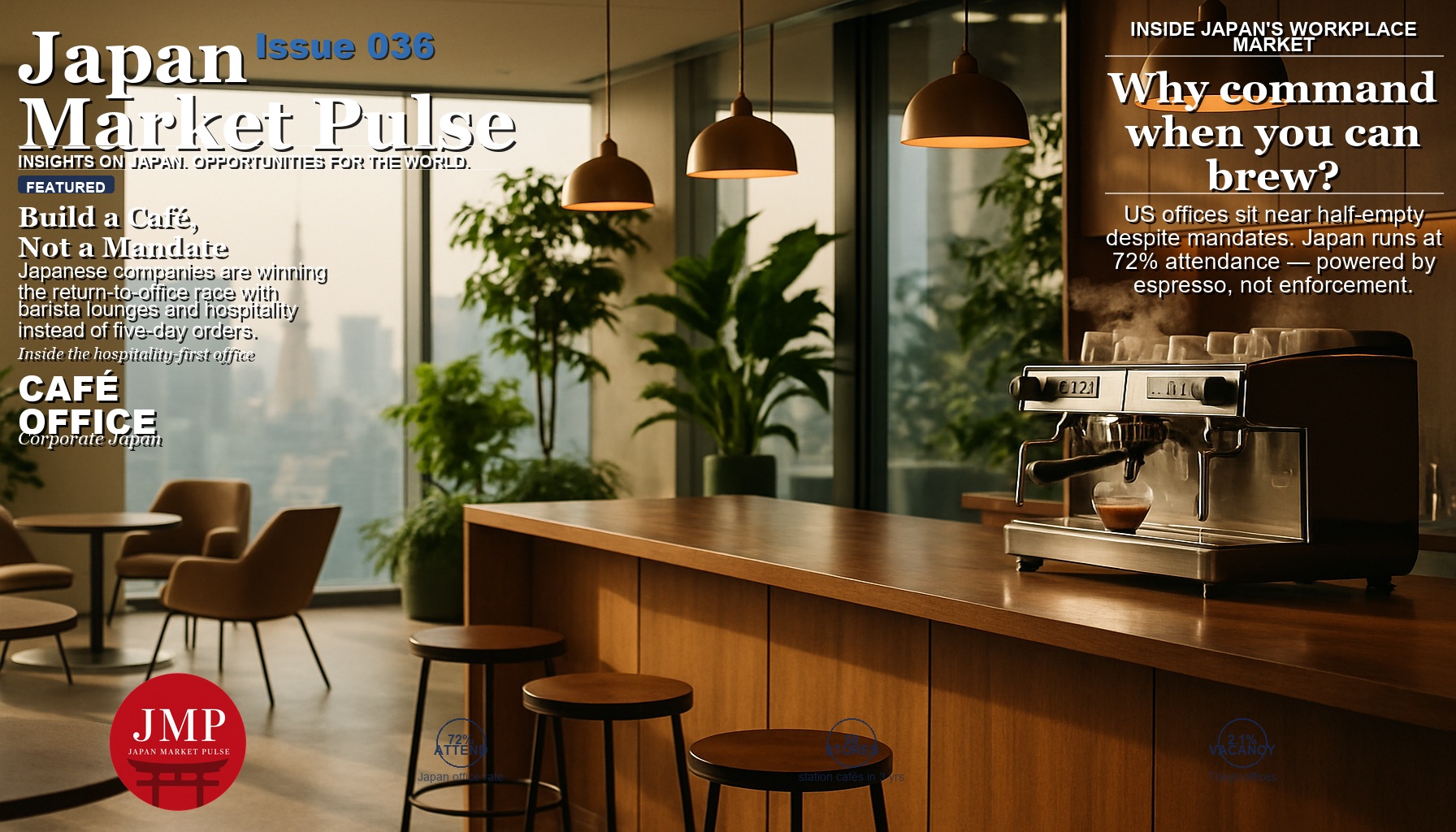
After twenty years of working in and around Tokyo offices, I have developed a theory: you can tell where corporate Japan is headed by what the lobby smells like. In 2005, it smelled like photocopier toner and cigarette smoke drifting in from the designated smoking room. In 2015, it smelled like nothing at all — sterile, fluorescent, efficient. In 2026, an increasing number of Japanese headquarters smell like freshly ground coffee beans and warm pancake batter.
That is not an accident. It is a strategy.
While American corporations spent the last two years issuing return-to-office ultimatums and then dealing with the petitions, the resignations, and the quiet sabotage that followed, Japanese companies have been quietly running a completely different play. Instead of ordering people back to the office, they are building reasons to come. Barista counters in the executive lobby. Full café lounges occupying entire floors of new headquarters. Hawaiian-themed coffee shops opening next to train stations specifically to catch commuters on their way to work. The bet is that hospitality scales better than coercion — and the early numbers suggest Japan might be right.
This week I want to walk through what that looks like on the ground, why a udon chain is suddenly one of the most interesting players in Japan’s office economy, and what international operators should take from a country that is solving the same problem as everyone else with the opposite tool.
America Orders People Back. Japan Sets the Table.

Let’s start with the contrast, because it is stark.
In January 2025, JPMorgan Chase told its entire workforce of roughly 317,000 people that hybrid work was over: five days in the office, full stop. The reaction was immediate and ugly. Employees launched a petition demanding the hybrid model be retained. Internal message boards filled up with angry comments — until the company simply disabled the comment function. Amazon pushed approximately 350,000 corporate employees back to five days a week in the same month. Dell eliminated hybrid work entirely for employees near its offices as of March 2025.
The pattern repeats across corporate America: announce a mandate, absorb the backlash, hold the line, and accept the attrition. And the attrition is real. Survey data from early 2025 found that 46% of workers who work from home at least part of the time said they would be unlikely to stay at their job if remote work were scrapped. One widely cited estimate puts the value employees place on hybrid flexibility at the equivalent of an 8% raise. When you mandate people back, you are effectively cutting compensation and daring your best people to leave.
Now look at Japan. I have been watching this market through every phase of the pandemic and its aftermath, and what strikes me most is what has not happened: there has been no wave of headline-grabbing five-day mandates, no viral petitions, no executives publicly daring employees to quit. Japanese companies largely kept hybrid arrangements on the books — surveys suggest roughly two-thirds of Japanese companies offer some form of hybrid work, rising to nearly nine in ten among large enterprises with over 1,000 employees. And yet Japanese offices are full.
The Japanese answer to “how do we get people back?” has not been a memo. It has been a renovation. New headquarters buildings are being designed with café lounges as anchor amenities rather than afterthoughts. Office furniture makers and design firms report that “an office people actually want to commute to” has become the standard client brief. Facility managers are hiring baristas the way they used to hire security guards. The underlying logic is pure hospitality culture: if you want guests to come, you do not command them. You prepare for them.
The Numbers Tell Two Very Different Stories
Skeptics will say culture explains everything here — that Japanese employees simply comply, and American employees simply resist. The data says it is more interesting than that.
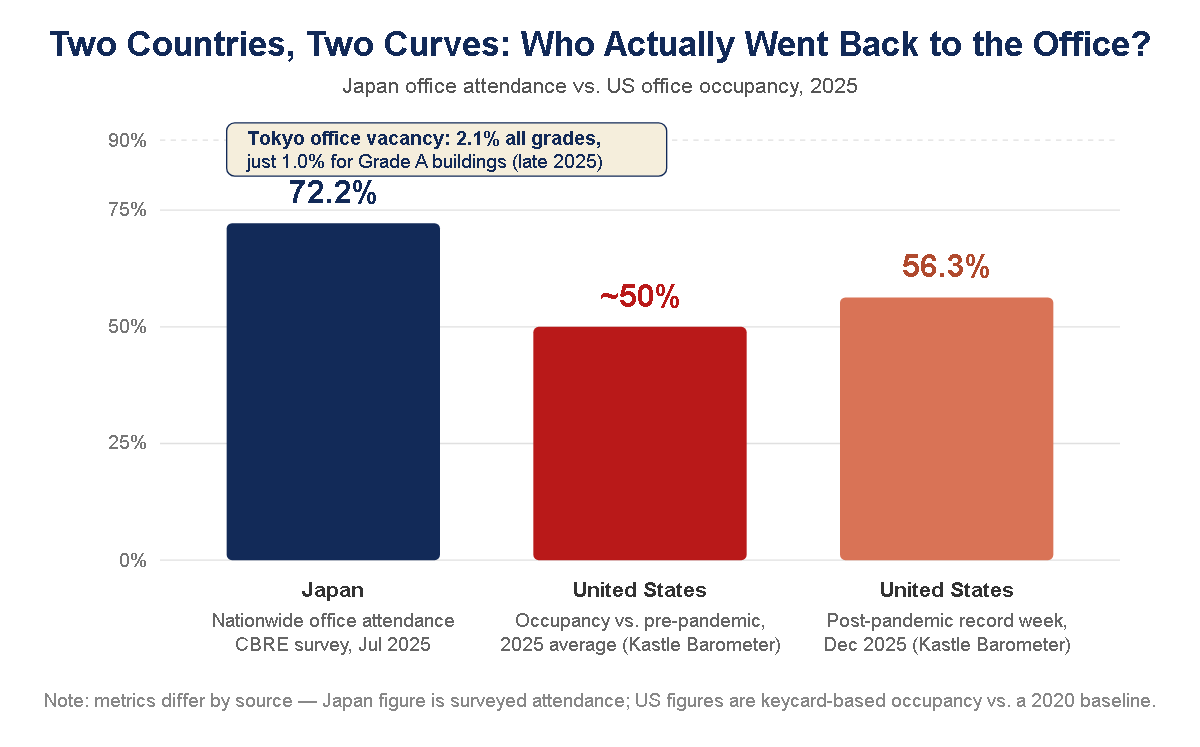
According to CBRE’s July 2025 survey of office usage in Japan, the nationwide office attendance rate stands at 72.2%. A separate 2025 survey of Japanese office workers found that 37.6% are in the office five days a week, with another quarter or so coming in three to four days. Fully remote workers make up less than 9% of the sample. Meanwhile, Tokyo’s office vacancy rate fell to roughly 2.1% across all grades in late 2025 — and just 1.0% for Grade A buildings — with rents climbing to their highest levels in nearly two decades. Japanese companies are not shrinking their footprints and hoping people show up. They are competing for more space.
The American picture is far weaker. Kastle Systems’ Back to Work Barometer, which tracks keycard swipes across thousands of US office buildings, spent most of 2025 hovering around 50% of pre-pandemic occupancy. Even the post-pandemic record set in early December 2025 — a weekly average of 56.3% — would be considered a crisis number in Tokyo. Years of escalating mandates from the largest employers in the country have moved the needle from roughly half-empty to slightly-more-than-half-empty.
Here is the nuance that makes Japan’s case genuinely instructive rather than just culturally exotic: Japanese employees do not actually love commuting either. The same CBRE research found that workers across every generation said they would prefer to come in less often than they currently do. The preference gap exists in Japan just as it does in Chicago or London. The difference is what companies are doing about it. American firms treat the gap as a discipline problem. Japanese firms treat it as a service problem — and service problems, in Japan, get solved with omotenashi, the deep-rooted practice of anticipating a guest’s needs before they articulate them.
That reframing changes everything downstream. A discipline problem calls for monitoring software and badge-swipe quotas. A service problem calls for better coffee.
It also changes who owns the problem inside the organization. In the American framing, return-to-office belongs to HR and legal — the departments that write policies and enforce them. In the Japanese framing, it belongs to general affairs, facilities, and increasingly to brand teams, because the office is being treated as a product whose users can churn. Product teams do not write memos demanding that customers use the product more. They ship a better version. That, in one sentence, is what corporate Japan has been doing to its own headquarters for the past three years.
Toridoll’s Bet: Put Hawaii Next to the Train Station

100% Kona Coffee (Hawaiian-Grown)
The same Hawaiian-grown bean category behind Kona’s Coffee’s two-hour vacations — brew the escape at your own desk.
View on Amazon →As an Amazon Associate, we earn from qualifying purchases.
If you want to see where this is heading, watch Toridoll Holdings — the Japanese food-service group best known internationally for its Marugame Udon noodle chain. Toridoll has quietly built the most instructive case study in Japan’s “come hither” office economy, and it started in the suburbs.
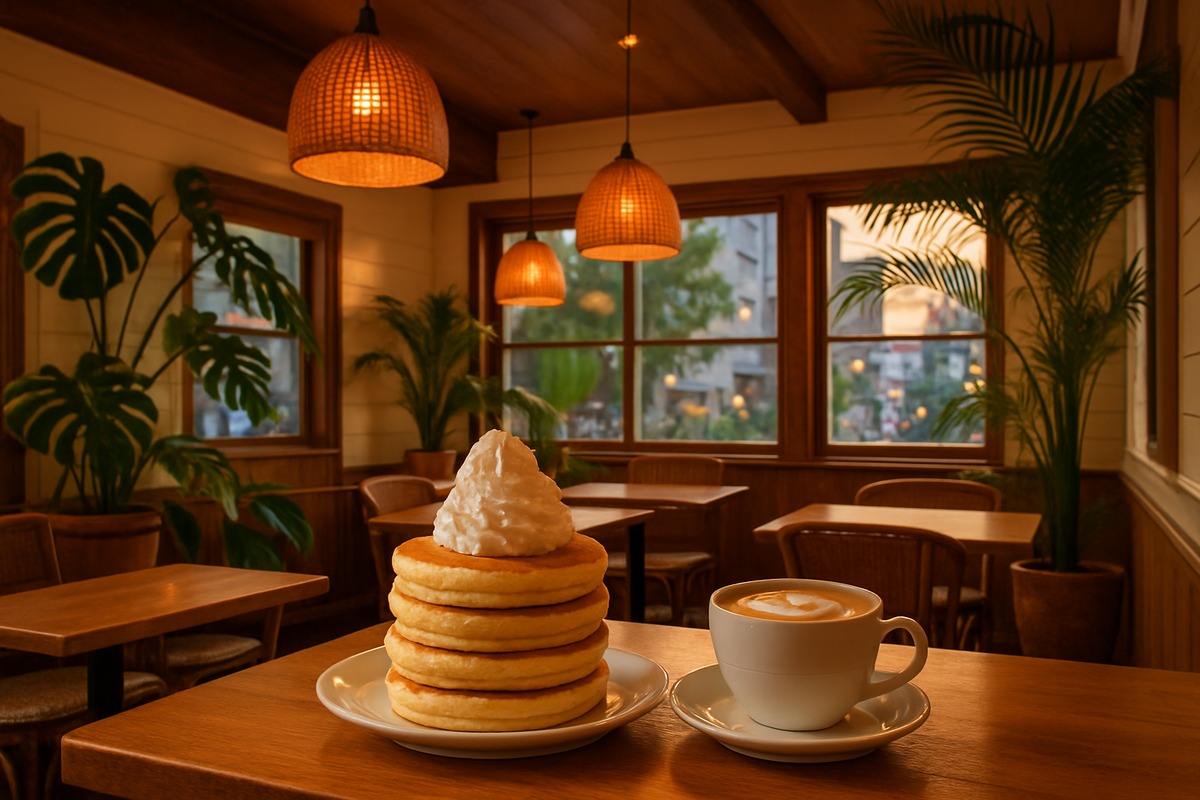
Its Hawaiian café brand, Kona’s Coffee, opened its first store in December 2013 and grew through the pandemic when nearly every other sit-down restaurant concept in Japan was retreating: between 2019 and 2022, the chain expanded from 33 to 41 stores while revenue grew more than 1.5 times and operating profit nearly tripled. By fiscal year ending March 2025, sales reached 11.4 billion yen — up 32% year over year — making it Toridoll’s number-two brand behind Marugame itself, with more than 50 locations nationwide. The product is not really coffee; it is escape. Stores are built to look like Hawaiian plantation houses, deliberately located on quiet suburban roads rather than prime station-front real estate, and customers stay an average of two hours. On weekends, people line up for two to three hours to get in. For readers who want to taste what the fuss is about, the chain’s signature 100% Kona coffee is the same Hawaiian-grown bean category you can find stateside — Japan just wrapped a two-hour vacation around it.
Here is where it connects to the office story. In March 2026, Toridoll’s café subsidiary launched a new small-format spin-off called KNOWS COFFEE, opening its first store inside a shopping mall in Chiba, just outside Tokyo. The format is everything Kona’s is not: less than half the floor space, located at or near train stations and commercial buildings, open from 7 a.m., with all 55 seats wired with power outlets. The concept, in the company’s own words, is “the closest sunset” — a pocket of Hawaiian downtime inserted directly into the commuting day. The expansion target: 50 stores within roughly three years, concentrated in greater Tokyo’s station hubs.
Read that strategy again through the lens of office attendance. Toridoll is betting that as Japanese workers spend more days commuting, the winning retail position is not the destination café you drive to on Saturday — it is the decompression chamber between the train platform and the office tower. Power outlets at every seat tell you exactly who this is for: the hybrid worker easing into the workday, the salesperson killing time between client visits, the employee who left home early to beat the rush and wants twenty minutes of Hawaii before the morning meeting. The commute itself is being turned into a hospitality product.
And Toridoll practices what it sells. The company’s own headquarters in Shibuya is a free-address, café-style workspace spread across two floors of a modern tower — the kind of office that gets featured in workplace design magazines rather than complained about on anonymous job boards.
Inside the Barista Office: Hospitality as Infrastructure

The in-house version of this trend is even more telling, because it shows up in capital expenditure rather than marketing copy.
Across corporate Japan, the office café has graduated from a coffee machine in the corner to a designed, staffed, budgeted facility. Workplace services firms now market barista-staffed in-house cafés as a standard corporate offering, and real estate advisors report rising demand for them as engagement infrastructure. Design firms publish annual roundups of new headquarters projects, and the recurring centerpiece is no longer the executive boardroom — it is the café lounge. One pharmaceutical company dedicated an entire floor of its new headquarters to a café-lounge space designed to pull employees from every department into the same room. Tech companies tout their in-house baristas in recruiting materials. The going rate for a build-out runs from a few hundred thousand yen for a modest corner to several million yen for a full barista-counter installation — a rounding error compared to the salary costs of the attrition that a five-day mandate can trigger.
What makes this more than an amenities arms race is the evidence that it works on the metrics executives actually care about. CBRE’s 2025 survey of Japanese office occupiers found that younger workers in particular gravitate toward buildings with lounges, cafés, and shared amenity spaces — and, critically, that companies that had carried out office renewals reported more success in hiring than those that had not. In a country running at structural full employment, where the labor shortage is the binding constraint on growth for nearly every industry, that finding converts directly into boardroom language. The café is not a perk. It is a recruiting weapon and a retention hedge, priced at a fraction of what either function costs through a staffing agency.
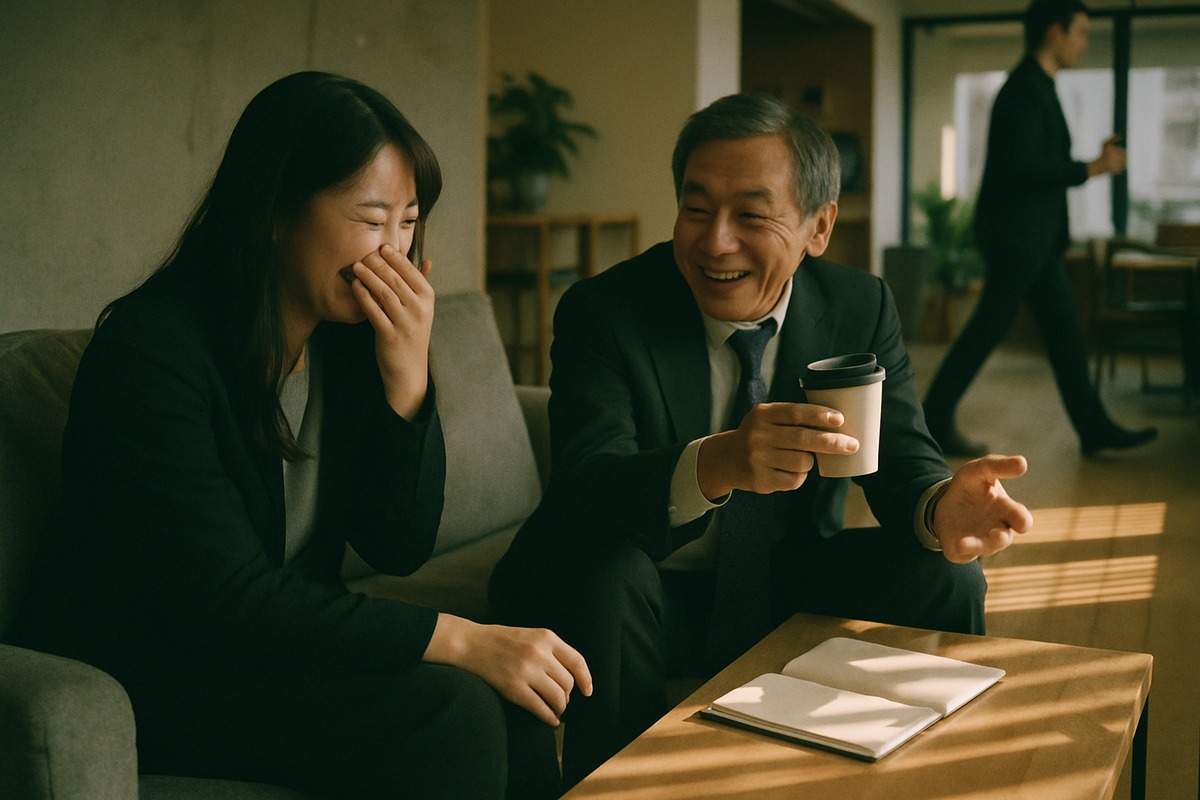
I have sat in a few of these spaces over the past year, and the thing that surprises a Western visitor is how unironically good they are. This is not the lukewarm-carafe-and-styrofoam tier of American office coffee. These are spaces built by people who grew up in the world’s most demanding café culture — the same culture that made Japan one of the most sophisticated specialty coffee markets on earth — and who see no reason an office should fall below the standard of a decent neighborhood kissaten. The message embedded in the espresso machine is the entire strategy in miniature: we expected you, we prepared for you, and your presence here is treated as a visit rather than an obligation.
Why the Hospitality Play Beats the Mandate Play
Strip away the cultural texture and there is a hard economic argument underneath, one that American operators should take seriously.
A mandate is a one-time policy lever with compounding costs. It generates immediate compliance and immediate resentment; it selects for the employees with the fewest outside options; and it converts office attendance from a choice into a grievance that resurfaces in every engagement survey and exit interview thereafter. The American data bears this out — nearly half of remote-capable workers say they would consider leaving over a full mandate, and the workers most able to act on that threat are precisely the senior, high-performing ones a company can least afford to lose.
A hospitality investment is the opposite shape: a one-time capital cost with compounding returns. The café floor does not expire, does not generate petitions, and does not show up in attrition models. It changes the emotional accounting of the commute — the office stops being the place that costs you ninety minutes a day and starts being the place where someone makes your flat white and remembers your order. Crucially, it preserves the employee’s sense of agency, which is the thing mandates destroy. People defend choices they made themselves. Nobody defends a memo.
The math is not subtle. Replacing a mid-career professional in a tight labor market routinely costs a large fraction of an annual salary once recruiting fees, lost productivity, and training are counted. A barista-staffed café, fully built and staffed, costs less per year than losing two or three of the people the mandate would have pushed out. Any CFO can run that comparison on a napkin; the remarkable thing is how rarely the American version of this debate ever gets framed as a comparison at all. The mandate is treated as free because it requires no budget line — when in fact it is the most expensive option on the table, paid for out of accounts nobody reconciles.
There is also a second-order effect that I think is underappreciated. Japan’s approach keeps the entire downtown service economy intact. When attendance is high and voluntary, the station cafés, the lunch counters, the after-work izakaya — the whole ecosystem that makes a business district worth commuting to — stays funded and alive, which in turn makes the office more attractive, which sustains attendance. Tokyo’s 2.1% office vacancy and eighteen-year-high rents are the visible surface of that flywheel. Half-empty American downtowns are the visible surface of the opposite one, where each shuttered ground-floor café makes the mandate a slightly worse deal than it was the month before.
None of this means Japan has solved hybrid work. Japanese employees would still prefer more flexibility than they get, and a 72% attendance rate built partly on smaller homes, world-class transit, and social expectation is not fully exportable. But the direction of corporate effort — spend money making presence pleasant rather than making absence punishable — is exportable, and it is the part American firms keep skipping.
What International Operators Should Steal From This
For the B2B readers who follow this newsletter for the actionable layer, here is how I would translate Japan’s office-café moment into moves worth evaluating.
First, if you sell workplace services, food service, or coffee programs, Japan just handed you the business case your sales deck was missing. The argument “a barista costs less than attrition” now has a national-scale natural experiment behind it, complete with vacancy data, attendance data, and hiring-outcome survey results. The same logic applies to the buy side: if your company is fighting an RTO battle, price out a hospitality build before you price out the badge-monitoring software. One of them generates LinkedIn complaints; the other generates LinkedIn photos.
Second, watch the station-adjacent small-format café category as a real estate and franchise signal. Toridoll’s 50-store KNOWS COFFEE plan is a publicly visible bet that Japanese commuting volume is durable and growing — a thesis with implications for anyone holding or developing transit-oriented retail, in Japan or in any dense market where attendance recovers. If the format hits its numbers, expect the model — small footprint, breakfast hours, universal power outlets, resort-flavored branding — to be studied and cloned, the way Marugame’s open-kitchen udon theater was cloned across Asia and into the US.
Third, and most broadly: treat Japan as the control group in the world’s biggest workplace experiment. Two advanced economies faced the same pandemic, the same technology, and the same employee preference for flexibility. One chose enforcement and is stuck near half-occupancy after three years of escalating mandates. The other chose hospitality and is operating at nearly three-quarters attendance with record-low vacancy — without ever making attendance a loyalty test. When the same problem produces opposite strategies and measurably different outcomes, that is not a culture story. That is a free lesson, and the tuition has already been paid by someone else.
The next time someone in your leadership meeting proposes a five-day mandate, it might be worth asking the Japanese question instead: what would it take for people to want to be here? Somewhere in Tokyo this morning, a barista on a corporate payroll is steaming milk on the 19th floor, and the floor is full. That is the answer working in production.
This article contains affiliate links. If you purchase through these links, we may earn a small commission at no extra cost to you.
If you’re interested in this topic, the Japanese market more broadly, or what KETCHUPs is working on, we’d love to hear from you — please reach out via our contact form.
Japan Market Pulse is a weekly read on what the Japanese consumer-tech, food, and mobility markets are choosing to do, written for international operators who want to know what is happening before it shows up in the global trade press.
Subscribe at ketchups.co/japan-market-pulse.