

This article is published by KETCHUPs, a Tokyo-based trading and brand-development firm. All content is editorial.
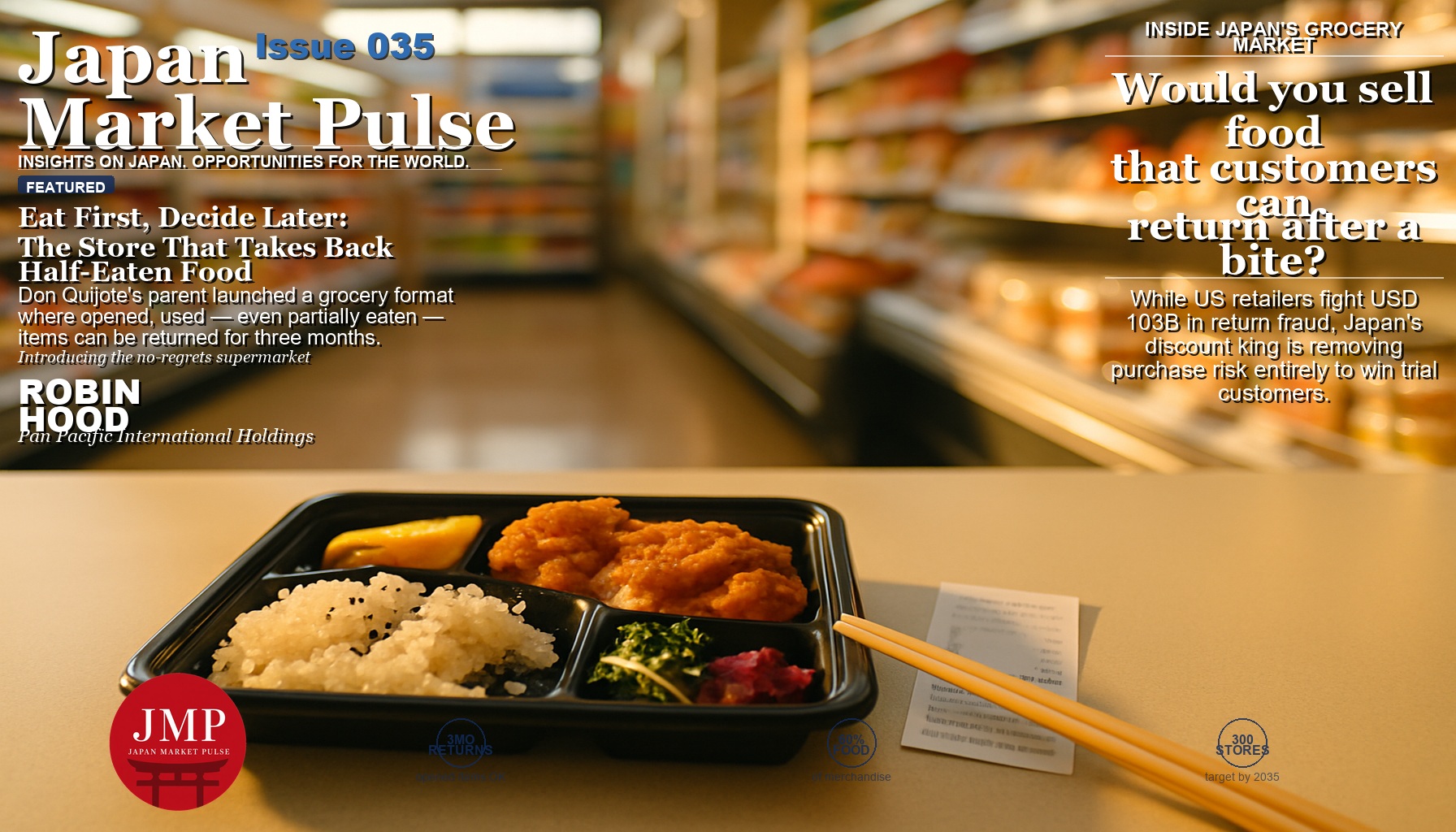
There is a new supermarket in Aichi Prefecture where you can buy a bento box, eat a bite of it, decide you don’t like it, and bring it back for a refund. Not quietly, not as an under-the-counter customer-service exception, but as the headline promise of the entire store.
I have lived in Japan for two decades, and I thought I had seen every flavor of retail theater this country can produce — the tuna-cutting shows, the singing jingles, the discount stores stacked to the ceiling like a cargo hold. But when I first read about the return policy at Robin Hood, the new food-focused chain from the company behind Don Quijote, I had the same reaction most American retail people will have: that’s insane. You cannot run a grocery store where customers return food they have already eaten. In the United States, that policy would be stripped for parts by fraudsters within a week.
And yet here it is, operating in suburban Nagoya, backed by one of the most consistently profitable retailers in Japan, with a plan to scale to as many as 300 stores by 2035. The bet is the exact inverse of where American retail is heading. While US chains tighten return windows and deploy AI to catch serial refunders, Japan’s discount king is removing purchase risk entirely — on food, the one category nobody else will touch — because it believes that the cheapest way to win a new customer is to make trying something cost nothing.
This is a story about that bet: what the policy actually says, why it can exist in Japan and probably nowhere else, and what it teaches anyone who sells things to consumers in 2026.
A Supermarket That Wants You to Take the First Bite
Robin Hood is the newest format from Pan Pacific International Holdings (PPIH), the roughly $20-billion-revenue group that operates Don Quijote, Japan’s famously chaotic discount chain. PPIH announced the format in March 2026 under a deliberately contradictory tagline that translates as “like a supermarket, but not a supermarket,” and opened the first store — Robin Hood Jimokuji — on April 24, 2026, in Ama City, Aichi Prefecture, in a building converted from a Piago supermarket the group acquired with its purchase of the Uny chain.
The store itself is a hybrid that only PPIH would build. Roughly 60 percent of the merchandise is food, anchored by the fresh-grocery procurement muscle PPIH inherited from Uny. The other 40 percent of the floor — three to four times the non-food share of a typical Japanese supermarket — is classic Don Quijote territory: cosmetics, household goods, toys, liquor. The Jimokuji store packs about 30,000 items into roughly 2,300 square meters and runs lean, with seven full-time employees, around sixty part-timers, electronic shelf labels, and none of the hand-drawn signage Don Quijote is famous for. Where the original Donki is designed to make you get lost, Robin Hood is explicitly designed around not making shoppers wander — a quick, legible store for families doing the weekly food run.
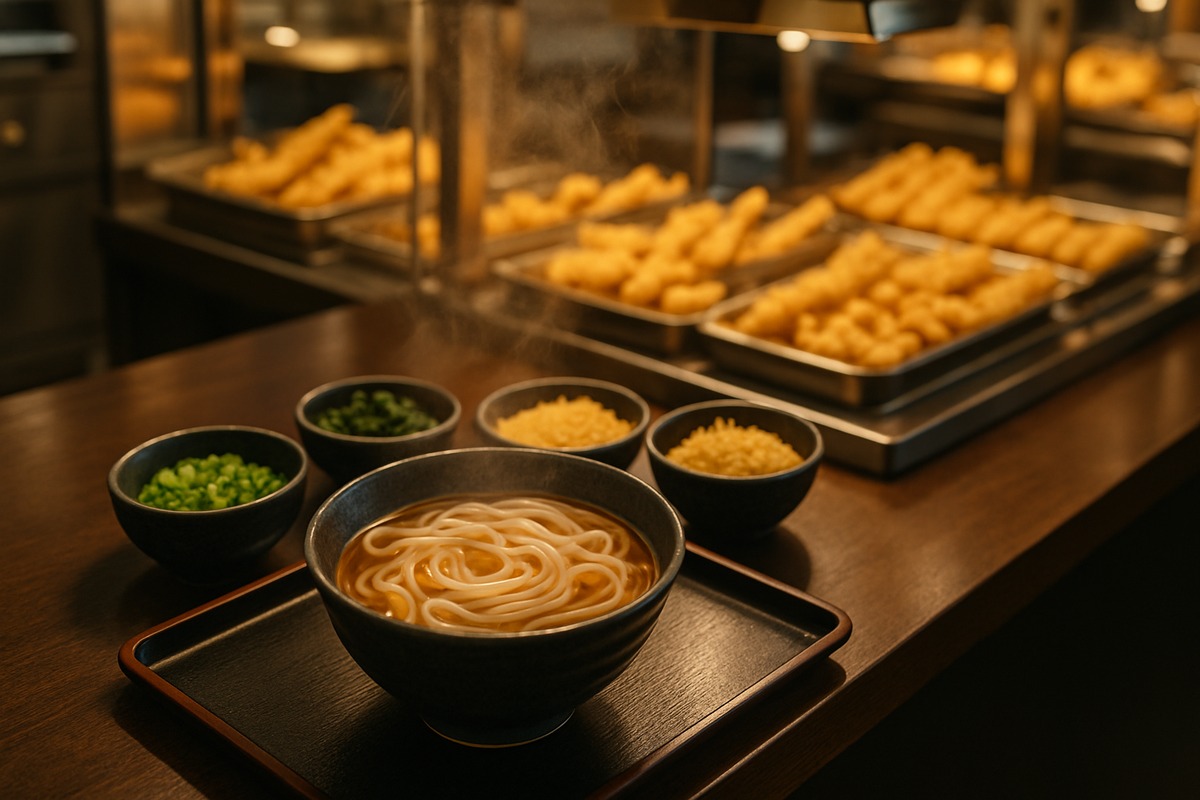
The food hall is the showpiece. There is a self-serve udon station where a basic bowl costs 214 yen — about a dollar and a half — with free green onion, wakame, and tempura flakes, and fried toppings at 141 yen apiece. A Nagoya-specialty deli counter sells the region’s beloved tebasaki chicken wings from 106 yen for a single wing. Compact bento boxes start at 323 yen, sized and priced so that lunch with a drink stays under 500 yen. A bag of shredded cabbage goes for 96 yen. In an economy where households have spent four straight years absorbing food-price inflation, the merchandising message is not subtle.
But low prices are table stakes in Japanese food retail. Every chain in the country is fighting on price right now. What makes Robin Hood interesting — what got it national media coverage far beyond its suburban-Nagoya footprint — is the guarantee stapled on top.
The “No-Regrets Declaration”: How the Policy Actually Works
PPIH calls it a promise not to let customers regret a purchase — a pledge, marketed under its own campaign name, that if you buy something at Robin Hood and you don’t like it, you can bring it back. The terms, as reported when the first store opened, are worth reading slowly, because they go far beyond any return policy I have seen in food retail anywhere.
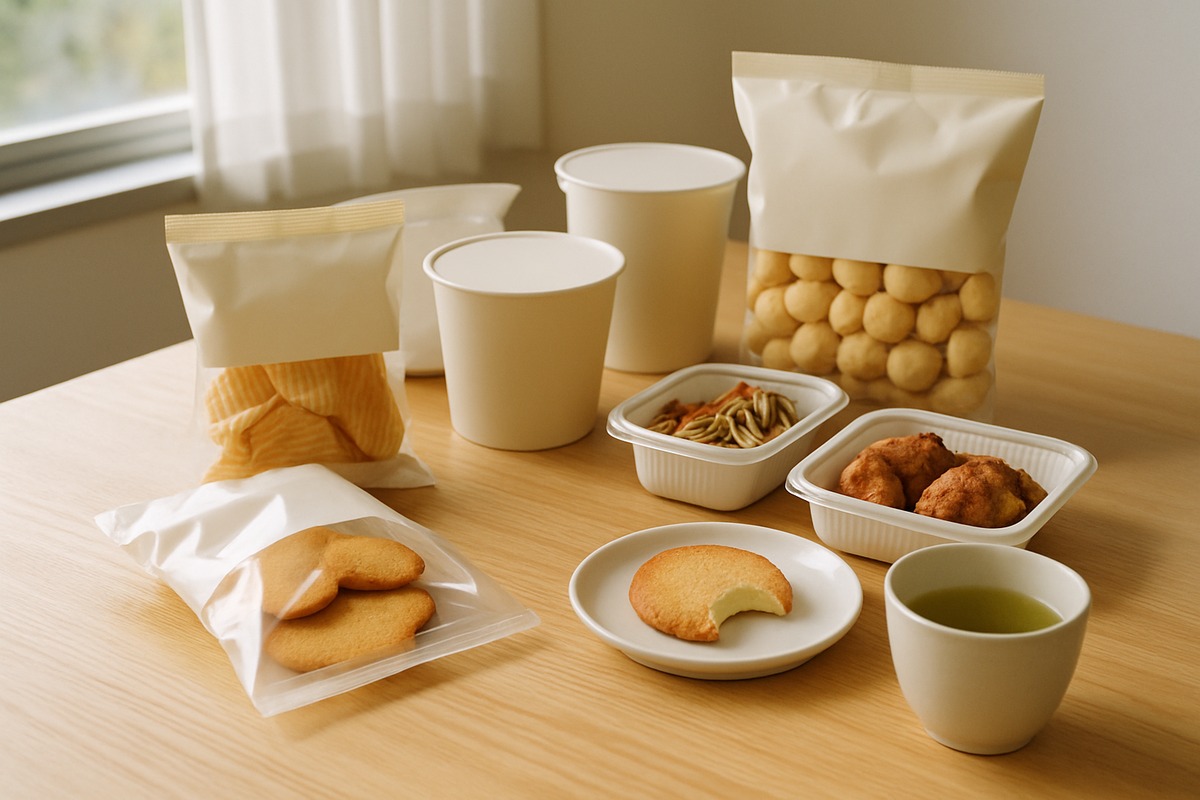
Returns are available to members of majica, PPIH’s loyalty app, which already counts tens of millions of Japanese users. The window is not seven days, not thirty — it is three months from purchase. Opened items qualify. Used items qualify. And, most strikingly, food that has been partially eaten qualifies. The coverage that introduced the format to the Japanese public led with exactly that point: take a bite, and if it isn’t good, bring it back. “It didn’t taste good” and “it wasn’t what I imagined” are explicitly acceptable reasons. A small number of categories are excluded, and you need the item and your purchase record, but the spirit of the policy is the opposite of fine print: the company wants you to know that trying something new at Robin Hood carries zero downside.
To appreciate how radical this is inside PPIH’s own house, consider that the standard return policy at regular Don Quijote stores is the Japanese norm: seven days, unopened, receipt in hand. Robin Hood didn’t loosen that policy; it detonated it.
The first time I explained this to a friend who runs e-commerce operations for a US brand, his immediate question was the right one: what stops someone from eating ninety percent of a bento and returning the last bite? The honest answer is: nothing, mechanically. The policy is enforceable only in the sense that majica membership creates an identity layer — every return is tied to a registered account, which means serial abusers are visible to the company even if no public limit is advertised. But fundamentally, PPIH is not relying on enforcement. It is relying on Japan.
Why This Policy Can Exist in Japan — and Would Be Eaten Alive in America
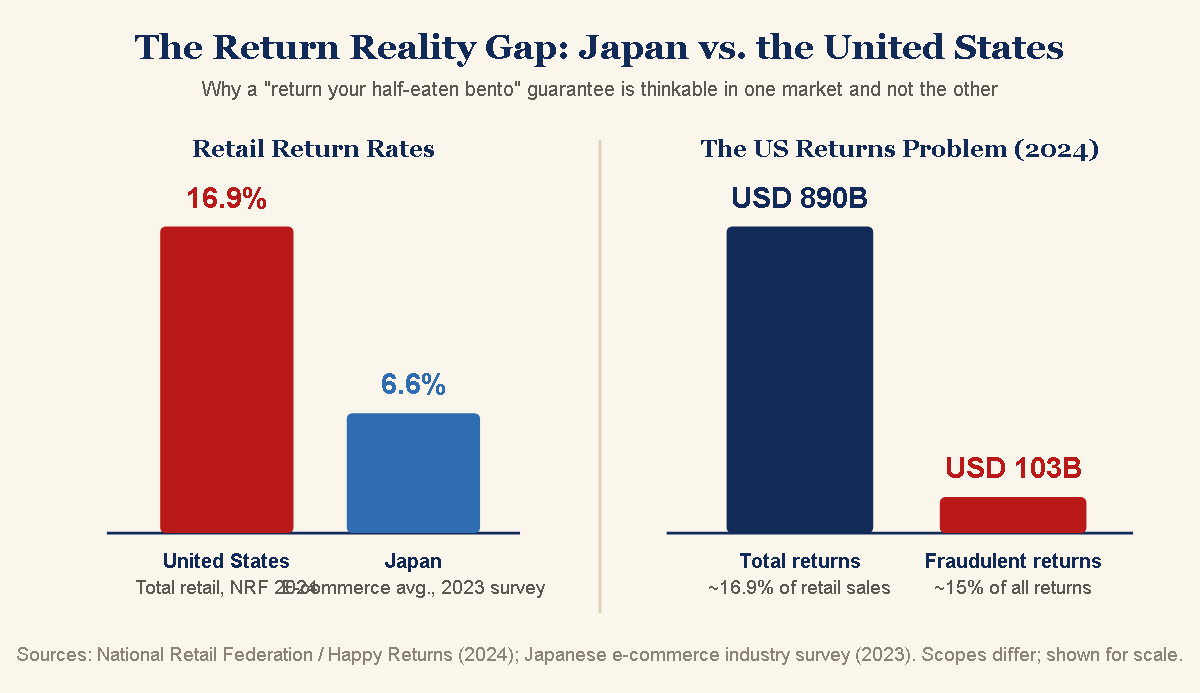
Here is the context that makes the whole bet legible. Japan has one of the lowest return rates in the developed world. Industry surveys put the average e-commerce return rate in Japan at roughly 6 to 7 percent, and major domestic platforms report figures as low as 3 to 5 percent. The National Retail Federation pegged total US retail returns in 2024 at about 890 billion dollars — roughly 17 percent of retail sales. Depending on which figures you compare, Japanese consumers return goods at one-half to one-third the American rate, and in physical grocery the gap is wider still, because returning food in Japan has historically been close to a cultural taboo. You bought it, you own it.
American readers should sit with the asymmetry on the fraud side too. The NRF estimated that fraudulent returns and claims cost US retailers about 103 billion dollars in 2024 — roughly 15 percent of all returns were judged fraudulent. Retailers surveyed reported wardrobing, overstated claims, empty-box returns, and counterfeit swap-outs as routine occurrences. That is the environment in which US chains have spent the past three years shortening return windows, charging restocking fees, and feeding return histories into machine-learning models that quietly blacklist heavy returners. The entire direction of travel in American returns policy is toward friction.
Robin Hood is running the experiment in the other direction, and the reason it is even thinkable is that the social baseline is different. When your honest-customer rate is structurally high, a zero-risk guarantee is cheap insurance rather than an open vault. PPIH is effectively arbitraging Japanese consumer norms: it can offer an American-sounding, Costco-grade satisfaction guarantee — extended even to half-eaten food — at a fraction of what that promise would cost in the US, because the population that would weaponize it barely exists here.
I want to be careful not to romanticize this. Japanese consumers are not saints; they are simply operating in a system with strong identity rails (the returns run through a registered app), high social cost for visible rule-bending, and decades of retail culture in which returning an opened product feels vaguely shameful. PPIH’s innovation is recognizing that this reservoir of restraint is an exploitable asset — a form of social capital sitting on the national balance sheet that no retailer had ever monetized directly. The guarantee converts cultural trust into marketing.
The Real Target: Trial Customers in an Inflation-Weary Market
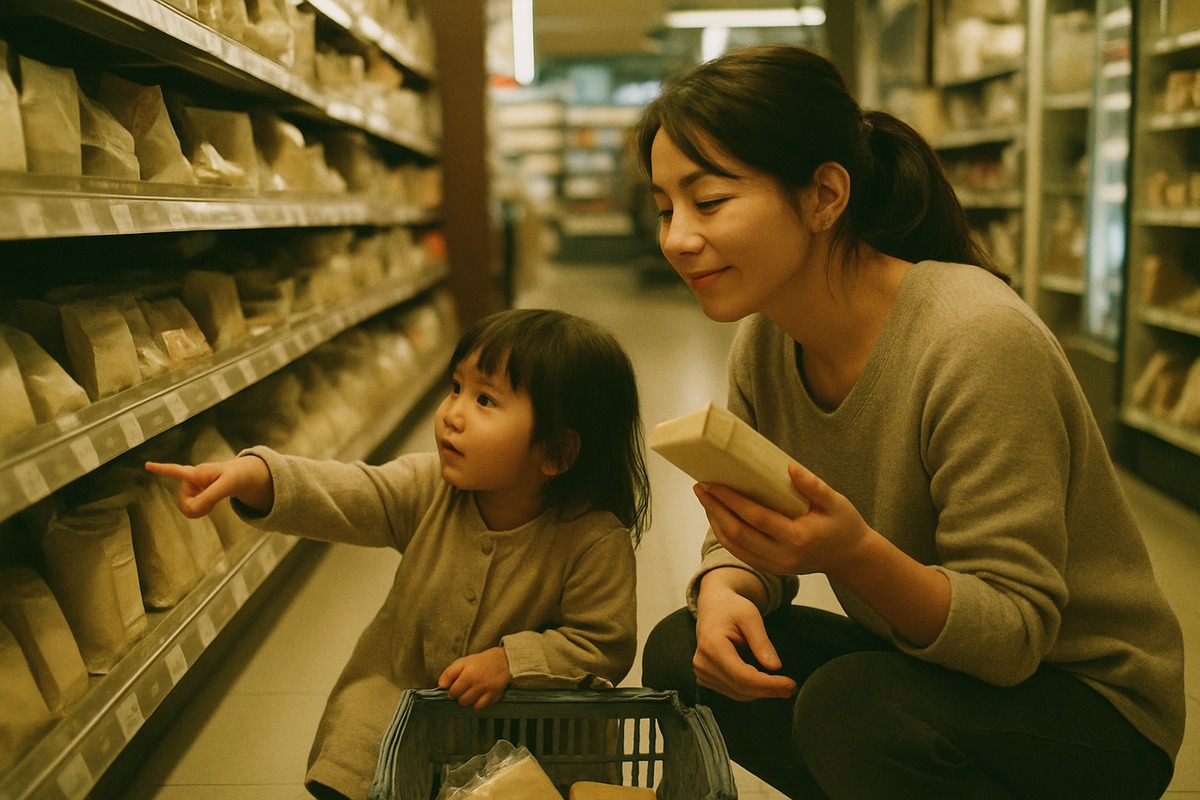
So what does PPIH actually buy with this policy? The company’s own framing, repeated across its launch communications and the business press, is one word: trial.
Four years of food inflation have made Japanese shoppers — already among the world’s most risk-averse consumers — even more conservative. When the household budget is squeezed, you stop experimenting. You buy the same rice, the same curry roux, the same brand of frozen gyoza you have bought for fifteen years, because a failed experiment is wasted money. For a new store format with a new private-brand lineup, that conservatism is lethal. Nobody samples the unknown house brand when money feels tight.
The return guarantee attacks exactly that psychology. If the new PB instant noodles turn out to be terrible, you get your money back — so the rational move flips from “stick with what you know” to “try it, you literally cannot lose.” PPIH is using the policy as a customer-acquisition tool aimed at shoppers who currently default to rival supermarkets and convenience stores, lowering the switching cost of a first basket to zero. The guarantee is less a service feature than a paid-media substitute: instead of buying TV spots to convince you the food is good, the company posts a bond on every individual item.
The private-brand strategy makes the intent obvious. Robin Hood launched its own PB line organized around four promises — cheap, rewarding, fast, easy — starting at around 50 items and planned to expand to 100. Private brands are where retail margin lives, and they are precisely the products consumers hesitate to try. A no-questions return policy is the cheapest possible PB sampling program: the “free sample” is the entire product, and the customer only redeems the guarantee if the product genuinely fails.
The scale ambitions tell you PPIH thinks this math works. The plan announced at launch calls for five stores in the Chubu region by mid-2026, expansion into greater Tokyo from 2027, and 200 to 300 stores by 2035, with a sales target of 600 billion yen — roughly 4 billion dollars — at a 6 percent operating margin. For a company that built Don Quijote from one Tokyo shop into Japan’s dominant discounter, those are not fantasy numbers.
The Ghost of Domise: PPIH Has Run This Experiment Before
One reason to take the policy seriously — and one reason for caution — is that PPIH has tested radical returns before, and the results were instructive in both directions.
A few years ago, the group operated a format called Domise in Tokyo’s Shibuya district, a flagship showcase for Don Quijote’s private brands. At that store, PPIH ran a campaign allowing returns on every private-brand item within 30 days of purchase, opened or used, no questions about condition — customers simply brought the product and receipt and filled out a feedback survey explaining what disappointed them. Note the structure: the “price” of the refund was information. Every return came packaged with structured product feedback, turning the returns desk into a consumer-research lab that paid for itself in saved survey costs.
Domise itself closed in April 2024 after weak sales. The honest reading is that a generous return policy is not, by itself, a business model — a store in one of Tokyo’s most expensive retail districts could not survive on the novelty. But the returns experiment evidently did not bankrupt the campaign or produce an abuse wave dramatic enough to scare the company off; instead, PPIH took the mechanism, attached it to a format with real traffic drivers — fresh food, prepared meals, genuine everyday-low prices in converted suburban supermarkets with parking lots — and made it a permanent pillar rather than a promotion.
That iteration pattern is very PPIH, and very Japanese retail in general: run a small, weird experiment in a high-visibility location, harvest the data, kill the vehicle without sentimentality, and redeploy the learning at scale. American retailers tend to pilot policies in spreadsheets; PPIH piloted this one on Shibuya foot traffic.
What Foreign Operators Should Actually Take From This
For the American or European operator reading this, the tempting takeaway is the policy itself, and that is the wrong lesson. Transplanted directly into the US market — 103 billion dollars of annual return fraud, professionalized refund-abuse services sold openly on Telegram — a “return your half-eaten sandwich” guarantee would be a write-off generator. The policy is not portable. What is portable is the underlying logic, which I’d break into three pieces.
First, risk reversal is most powerful exactly where it is least expected. Satisfaction guarantees are wallpaper in apparel and software; nobody even reads them. Food is the category where a guarantee still shocks, because nobody offers one — which means it generates earned media, word-of-mouth, and genuine behavioral change per yen of cost like nothing else PPIH could have bought. The general principle: find the category where your industry has collectively agreed guarantees are impossible, and ask what it would cost you to be the only one offering it.
Second, identity infrastructure is what makes generosity affordable. The guarantee is gated behind the majica app. That single design choice transforms an anonymous, abusable promise into an accountable relationship: PPIH sees every return, tied to a person, across every store, forever. The lesson for operators is that loyalty programs are usually framed as discount-delivery mechanisms, but their deeper value is that they make trust scalable — they let you extend policies to identified members that would be suicidal to extend to the anonymous public.
Third, returns are data, and Japanese retailers price them that way. The Domise survey requirement made it explicit: a returned product that arrives with a reason attached is cheaper than most forms of consumer research. A returned bento that “tasted too salty” is a product-development signal worth far more than the 400 yen refunded. US retail treats returns purely as a cost center to be minimized; PPIH is treating them as a sensing mechanism for a private-brand engine that needs rapid feedback to iterate from 50 items to 100.
There is also a humbler observation underneath all of this. Japan’s low return rate is usually described as a quirk of consumer politeness. Robin Hood reveals it as a national competitive asset — a pool of trust that allows business models that are simply unavailable to markets where that trust has eroded. Operators entering Japan consistently underprice this: the same honest-customer base that makes returns rare also makes unmanned stores, honor-system pricing, and 3-month food guarantees economically rational here and nowhere else.
The Bet, Restated
Strip away the udon station and the 96-yen cabbage, and Robin Hood is a clean hypothesis: in a low-trust-abuse market hit by inflation, the binding constraint on grocery growth is not price but the customer’s fear of a failed purchase, and the retailer who removes that fear — credibly, structurally, on every shelf — converts cautious shoppers into experimenters and experimenters into regulars.
I find myself rooting for the experiment, partly because it is such a pure piece of contrarian thinking, and partly because the alternative future — the American one, where every return is a suspect transaction and every shopper a potential adversary — is grimmer for everyone. Whether the model survives contact with 300 stores and the harder-edged shoppers of greater Tokyo is the open question; suburban Aichi is friendly territory, and the format’s predecessors remind us that PPIH kills what doesn’t work without ceremony.
But if it does work, the most chaotic discounter in Japan will have proven something genuinely useful: that in the right conditions, the most profitable thing you can do with risk is hand it back to the seller — one bite at a time.
If you’re interested in this topic, the Japanese market more broadly, or what KETCHUPs is working on, we’d love to hear from you — please reach out via our contact form.
Japan Market Pulse is a weekly read on what the Japanese consumer-tech, food, and mobility markets are choosing to do, written for international operators who want to know what is happening before it shows up in the global trade press.
Subscribe at ketchups.co/japan-market-pulse.