

This article is published by KETCHUPs, a Tokyo-based trading and brand-development firm. All content is editorial.
When a wave of Kit Kat thefts became a news story, Nestlé Japan launched a tracking website. What looks like crisis management is actually a masterclass in a distinctly Japanese brand management philosophy.
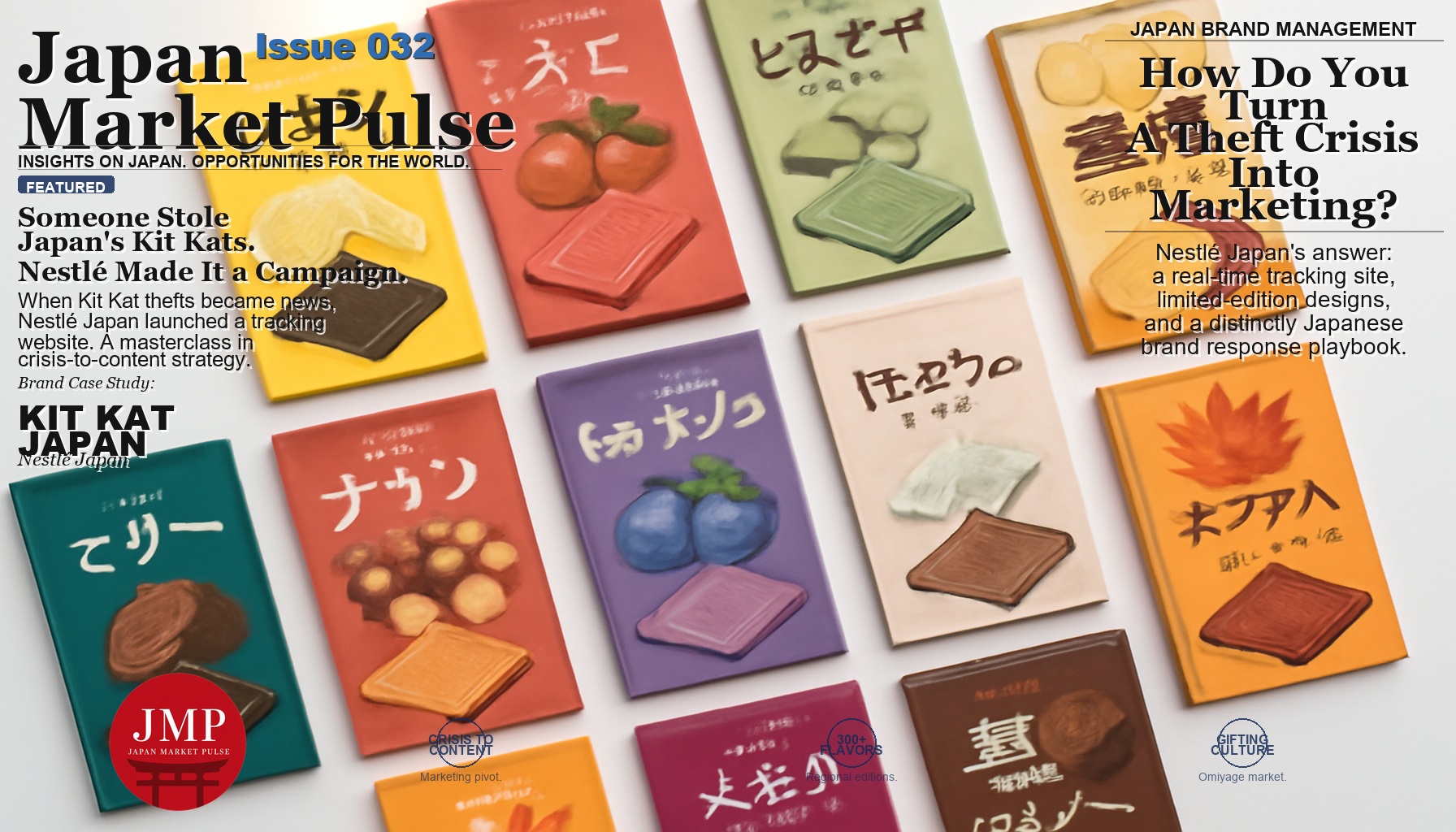
In the spring of 2026, Japan experienced a wave of Kit Kat thefts. The specific details are not the point — Kit Kats were being stolen in sufficient quantity and with sufficient regularity that the phenomenon attracted media coverage. This is the kind of problem that brand managers typically handle with careful silence, a few quiet calls to law enforcement, and a memo about the importance of not commenting on ongoing investigations.
Nestlé Japan launched a tracking website.
The site — playful in design, earnest in apparent purpose, and completely aware of its own absurdity — allowed visitors to report Kit Kat theft incidents, track the geographic spread of the problem, and participate in what was framed as a collaborative community effort to address the crisis. It was, of course, a marketing campaign. But it was a marketing campaign that required a very specific kind of organizational confidence to execute: the confidence that your brand is strong enough to joke about the fact that people want your product badly enough to steal it, and that your audience is sophisticated enough to appreciate the joke.
The campaign became a minor internet phenomenon. More importantly, it became an example of something Japanese brand management has done better than almost any other market context: turning the crisis into the content.
The Tradition This Campaign Belongs To

To understand why the Kit Kat tracking site worked, you have to understand the context of Kit Kat in Japan — which is, by any reasonable measure, one of the more remarkable case studies in culturally adaptive brand strategy of the past thirty years.
Kit Kat entered Japan in 1973. For most of the following two decades, it performed as a competent but unremarkable imported confection — present in the market, modestly popular, but not a cultural phenomenon. The transformation began in the 1990s and accelerated through the early 2000s, driven by a combination of factors that are now well-documented in marketing literature: the phonetic similarity between “Kit Kat” and kitto katsu (roughly, “surely win” or “you can do it” in Japanese), which made the chocolate bars a popular gift for students before university entrance examinations; Nestlé Japan’s decision to lean into this usage rather than simply acknowledge it; and, subsequently, an aggressive and sustained limited-edition regional flavor strategy that turned Kit Kat into a collector’s item and a tourism souvenir.
By the 2010s, Kit Kat Japan was selling hundreds of flavors — matcha, sakura, wasabi, sweet potato, sake, and dozens of region-specific varieties available only at specific locations. The brand had moved from generic imported chocolate to a category of its own: a Japanese cultural object that happened to be produced by a Swiss multinational. Nestlé Japan’s Kit Kat operation had become a case study taught in business schools, a fixture in Japan market analysis, and a source of genuine commercial advantage.
This background matters because it explains why the theft tracking site could work. Nestlé Japan’s Kit Kat brand is not merely well-known — it is culturally embedded in a way that gives it latitude to do things that a less established brand could not. When a brand is genuinely loved, humor about that love reads as confidence. When a brand is merely tolerated, the same humor reads as desperation.
What the Campaign Actually Did
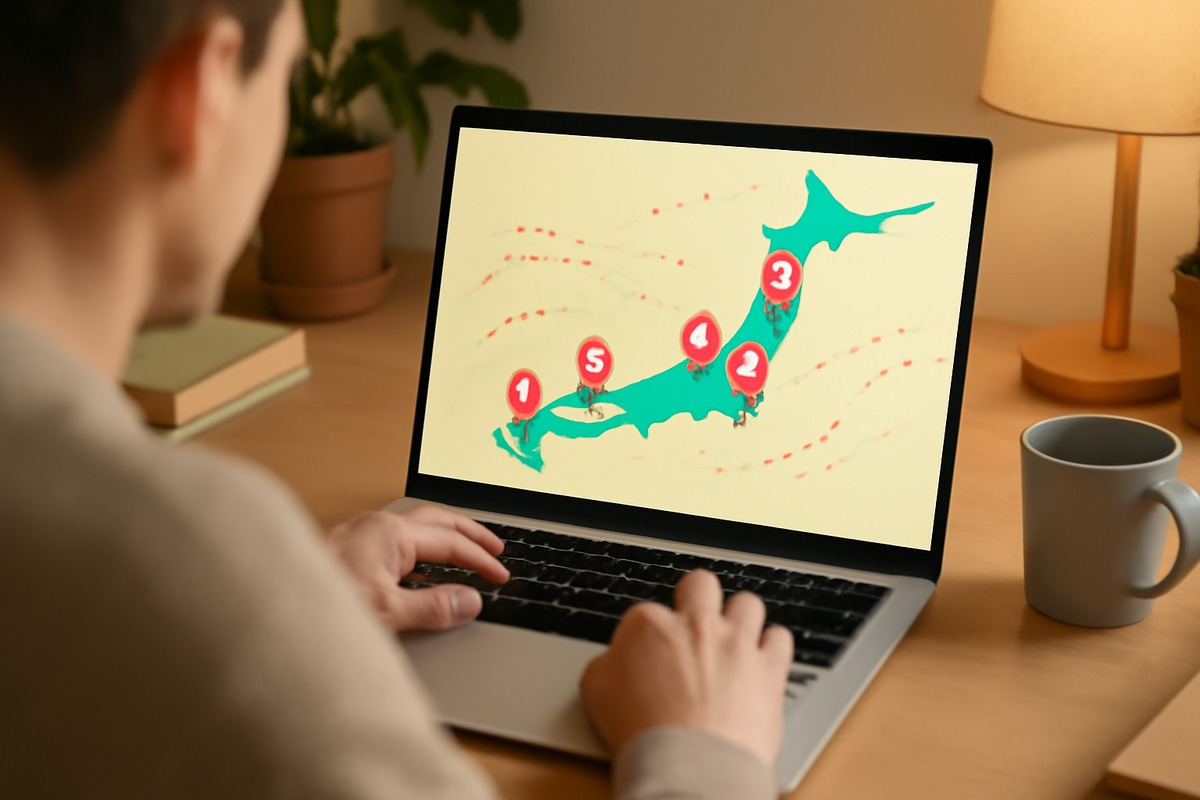
The Kit Kat theft tracking site was announced without extensive media buying or traditional campaign infrastructure. It spread primarily through social media sharing — the kind of organic distribution that happens when a piece of content is sufficiently surprising, clever, or both, to prompt people to forward it to others.
The structure of the campaign was simple. The site presented the theft wave as a genuine community concern — Kit Kats are being taken; here is what we know; here is how you can help. The data visualization elements were designed to evoke real-time tracking tools. The tone was earnest enough to land the joke without explaining it, which is the hardest thing to do in any form of humor.
Underneath the playfulness was a genuine insight about brand health. Kit Kats are being stolen in quantity. That is, when you examine it without the crisis-management instinct, an interesting signal. Theft at scale is a form of revealed demand — the market is telling you that your product is desirable enough to be worth the risk of acquiring it illegally. Most brands that find themselves in this position communicate nothing about it, because the communications risk seems obvious.
Nestlé Japan communicated about it by building a website that made the implicit explicit: people want our product so much they steal it. That is, when stated directly rather than hidden, a form of brand validation. The campaign turned potential reputational damage into social proof.
The Heisei Nostalgia Connection

The same newspaper page that covered the Kit Kat tracking campaign also carried coverage of a related phenomenon: the renewed international interest in Japanese culture from the Heisei era — the roughly three-decade period from 1989 to 2019 that covers Japan’s economic stagnation, the rise of its distinctive youth subcultures, and the development of the global pop culture infrastructure that now makes Japanese IP a major international commercial force.
The Heisei era is now an object of nostalgia in Japan — for people who lived through it — and an object of fascination internationally, for people who are discovering its cultural artifacts through streaming services, social media, and the ongoing globalization of anime, manga, gaming, and J-pop. This dual audience — domestic nostalgic and international curious — creates an unusual market condition for brands associated with that era.
Kit Kat Japan is, among other things, a Heisei-era brand story. The development of the limited-edition flavor strategy, the examination culture tie-in, the collector community that grew around regional flavors — all of this happened during the Heisei period. For Japanese consumers, Kit Kat carries that cultural memory. For international consumers, it is a legible entry point into Japanese consumer culture because it is a familiar product form (chocolate bar) expressing an unfamiliar cultural logic (regional specificity, collector behavior, gift-giving occasion).
The theft campaign works in this context because it implicitly acknowledges the cultural weight the product carries. You do not build a tracking website for generic chocolate. You build it for something that people care about enough to make a joke worth making.
The Japanese Art of Kiki wo Chansu ni

There is a phrase in Japanese business culture — kiki wo chansu ni — that translates roughly as “turning crisis into opportunity.” It appears in business school curricula, management training materials, and post-mortem analyses of successful Japanese corporate responses to difficult situations. It is, in many ways, a genuine organizing principle for how the more agile Japanese brand management operations think about adverse events.
The principle is not unique to Japan — every culture has some version of making lemonade from lemons — but the specific form it takes in Japanese brand management is distinctive. It tends to involve humor, community engagement, and an implicit trust in the audience’s intelligence that is not always present in Western crisis communications.
Western crisis management tends to default to a posture of control: contain the narrative, minimize the surface area of the problem, communicate on a restricted basis with approved stakeholders. This approach is rational from a legal risk management perspective and is deeply embedded in the communications infrastructure of most large corporations.
Japanese brand management — at its best — takes a different approach that might be summarized as: find the thing about the crisis that is interesting, make that interesting thing the story, and invite the audience to participate in enjoying the story with you. This approach requires two things that not every organization can muster: a genuine tolerance for ambiguity about outcomes, and a brand relationship strong enough that humor does not read as dismissive.
Nestlé Japan’s Kit Kat operation has both. The tracking site was not a calculated risk managed to within an inch of its life by a legal team; it was a creative decision made by people who understood the brand relationship they had built and trusted it to absorb a joke.
What International Operators Should Understand
The Kit Kat theft story is a useful lens for international operators thinking about brand management in Japan for several specific reasons.
Brand latitude accumulates over time and through cultural investment. Nestlé Japan’s ability to run the tracking campaign is a dividend of thirty years of investment in the Kit Kat brand — investment that included the regional flavor strategy, the examination season positioning, and the deliberate cultivation of collector behavior. That latitude cannot be purchased with a campaign budget. It is built through sustained engagement with cultural moments and consumer occasions that extend the brand’s meaning beyond its product function.
The convenience store channel is a brand relationship accelerator. Kit Kat’s deep presence in Japan’s convenience store network — which includes all-channel distribution across Seven-Eleven, FamilyMart, and Lawson — means that the brand is present at a high frequency in daily consumer life. That presence compounds brand familiarity in ways that more selective distribution cannot match. For international brands considering Japan, convenience store distribution is not just a volume channel; it is a relationship-building mechanism.
Humor in Japanese marketing requires cultural context to land. The Kit Kat tracking site worked because the brand had the cultural standing to make the humor land correctly. A brand without that standing attempting a similar campaign would likely face the opposite response — confusion about the intent, skepticism about the sincerity, or simple incomprehension. International operators should not take from this story that Japanese consumers respond well to humor; they should take from it that Japanese consumers respond well to humor from brands that have earned the right to be funny.
The theft story validated the brand’s cultural position. This is perhaps the most counterintuitive lesson. An event that could have been read as a brand management problem was instead an indicator of brand health — evidence that Kit Kat Japan had built something worth wanting badly enough to steal. Brands operating in Japan should learn to read these kinds of signals accurately: not everything that looks like a problem is one, and not every crisis requires a defensive response.
Japan’s Kit Kat story is almost three decades old and still generating new chapters. That kind of sustained brand narrative, built through consistent cultural investment and a willingness to engage with the audience as partners in the story rather than passive recipients of messaging, is among the rarest and most valuable things in consumer goods marketing. The tracking site is one small expression of a much larger brand relationship — and understanding the relationship is more important than analyzing the campaign.
This article contains affiliate links. If you purchase through these links, we may earn a small commission at no extra cost to you.
If you’re interested in this topic, the Japanese market more broadly, or what KETCHUPs is working on, we’d love to hear from you — please reach out via our contact form.
Japan Market Pulse is a weekly read on what the Japanese consumer-tech, food, and mobility markets are choosing to do, written for international operators who want to know what is happening before it shows up in the global trade press.
Subscribe at ketchups.co/japan-market-pulse.