

Disclosure: This article is published by KETCHUPs, a Tokyo-based trading and brand-development firm. All content is editorial.
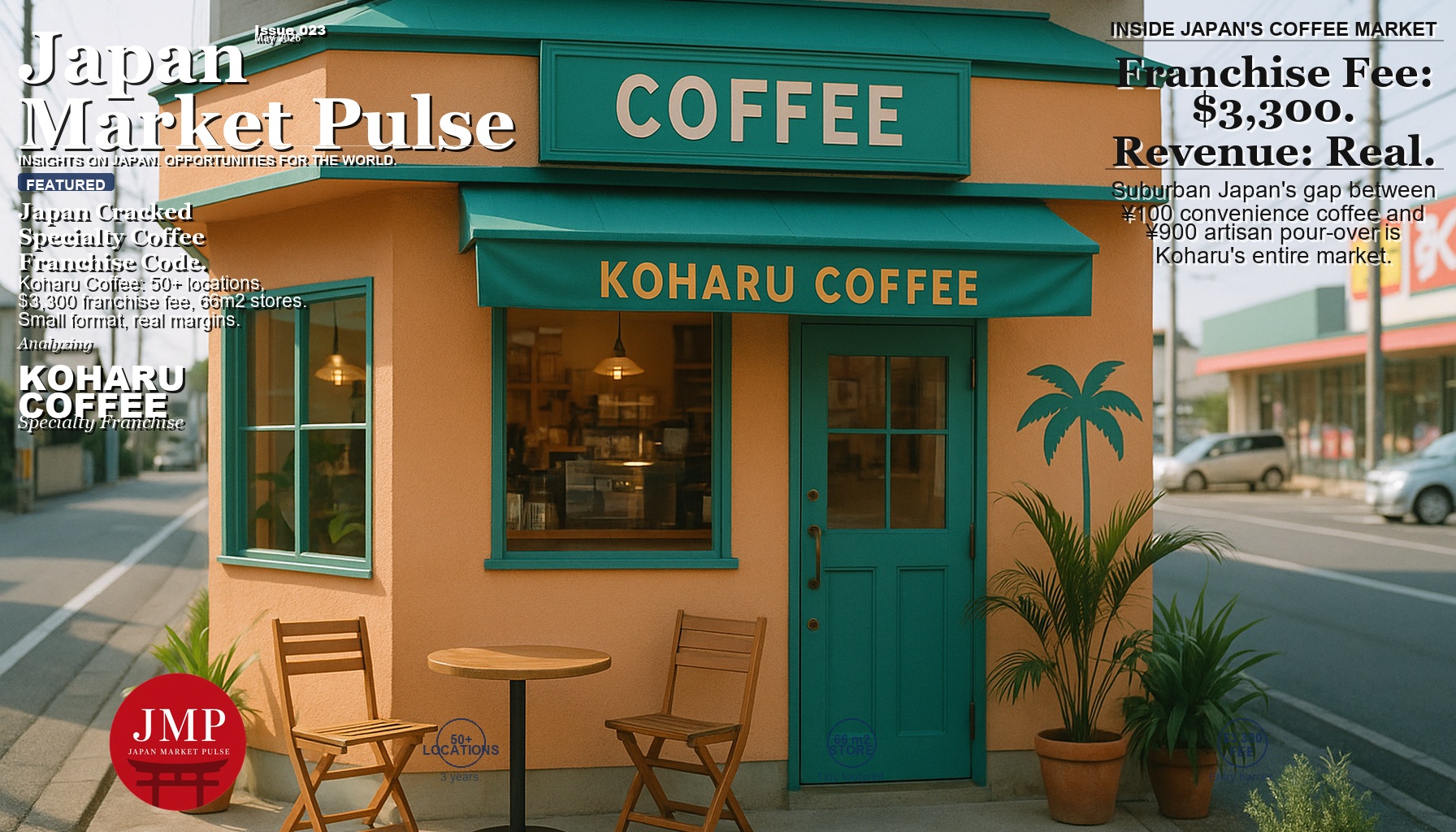
Drive along any mid-sized Japanese city’s commercial strip — the kind of road lined with home centers, drugstores, and family restaurants that constitutes the economic backbone of suburban Japan — and you will increasingly encounter a small, brightly colored café with tropical imagery and a menu board featuring matcha lattes and espresso drinks priced between ¥500 and ¥700.
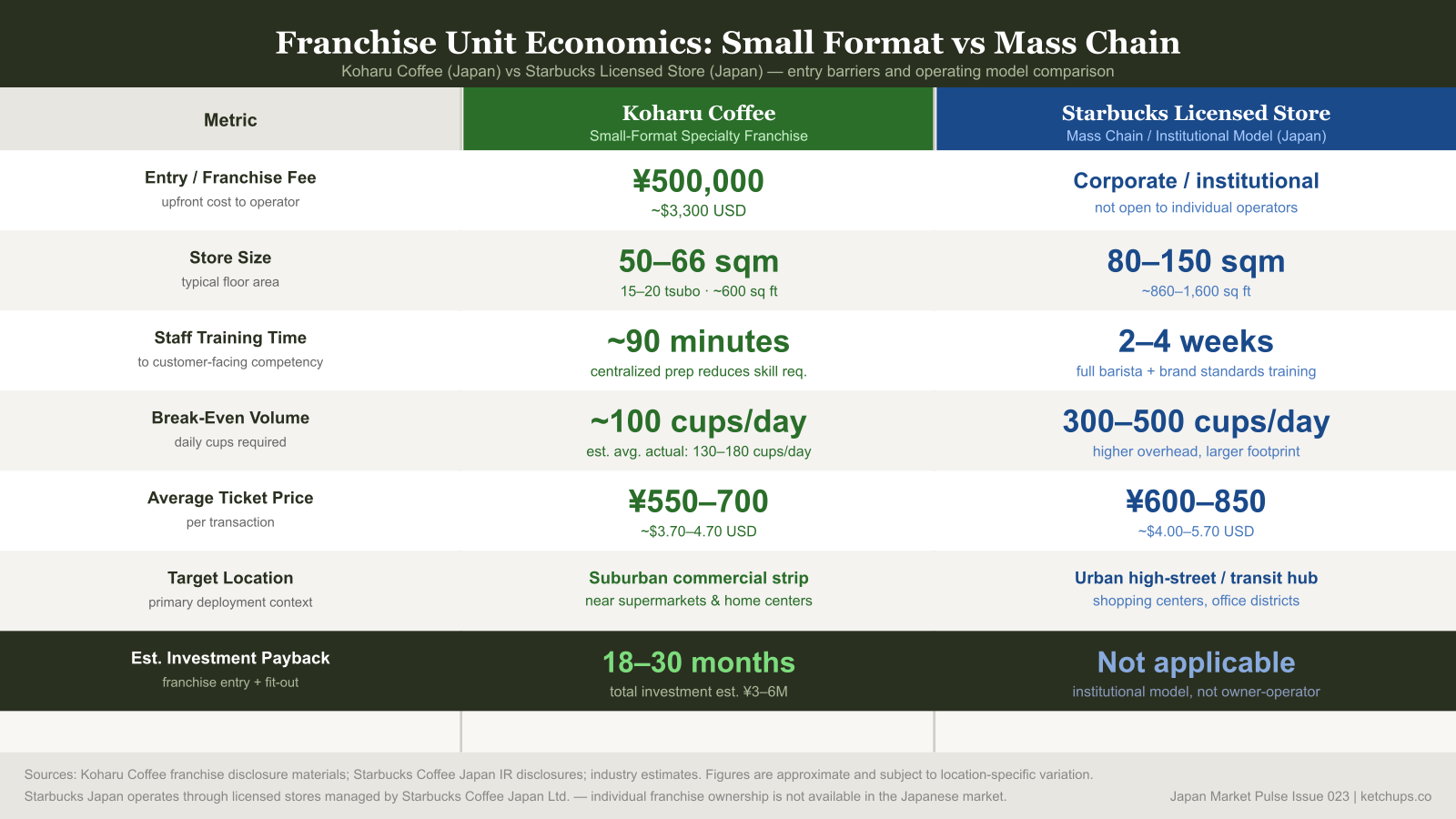
This is Koharu Coffee, and it is one of the more quietly significant retail format stories in Japan right now. Founded around 2021, Koharu Coffee had opened more than 50 locations by 2024. The franchise fee is ¥500,000 — roughly $3,300. The standard store footprint is 15 to 20 tsubo, approximately 50 to 66 square meters. For context: a standard Starbucks in Japan runs 80 to 150 square meters. A Koharu Coffee location is roughly one-third to one-half the size, with a fraction of the rent exposure and a fraction of the staff requirement.
That combination of operational efficiency, accessible aesthetics, and precise market positioning has produced something that Western specialty coffee has been trying and largely failing to build for a decade: a scalable, franchise-able, premium-adjacent coffee concept that works at the unit economics level without requiring luxury rents or celebrity baristas.
The Market Gap Koharu Is Filling
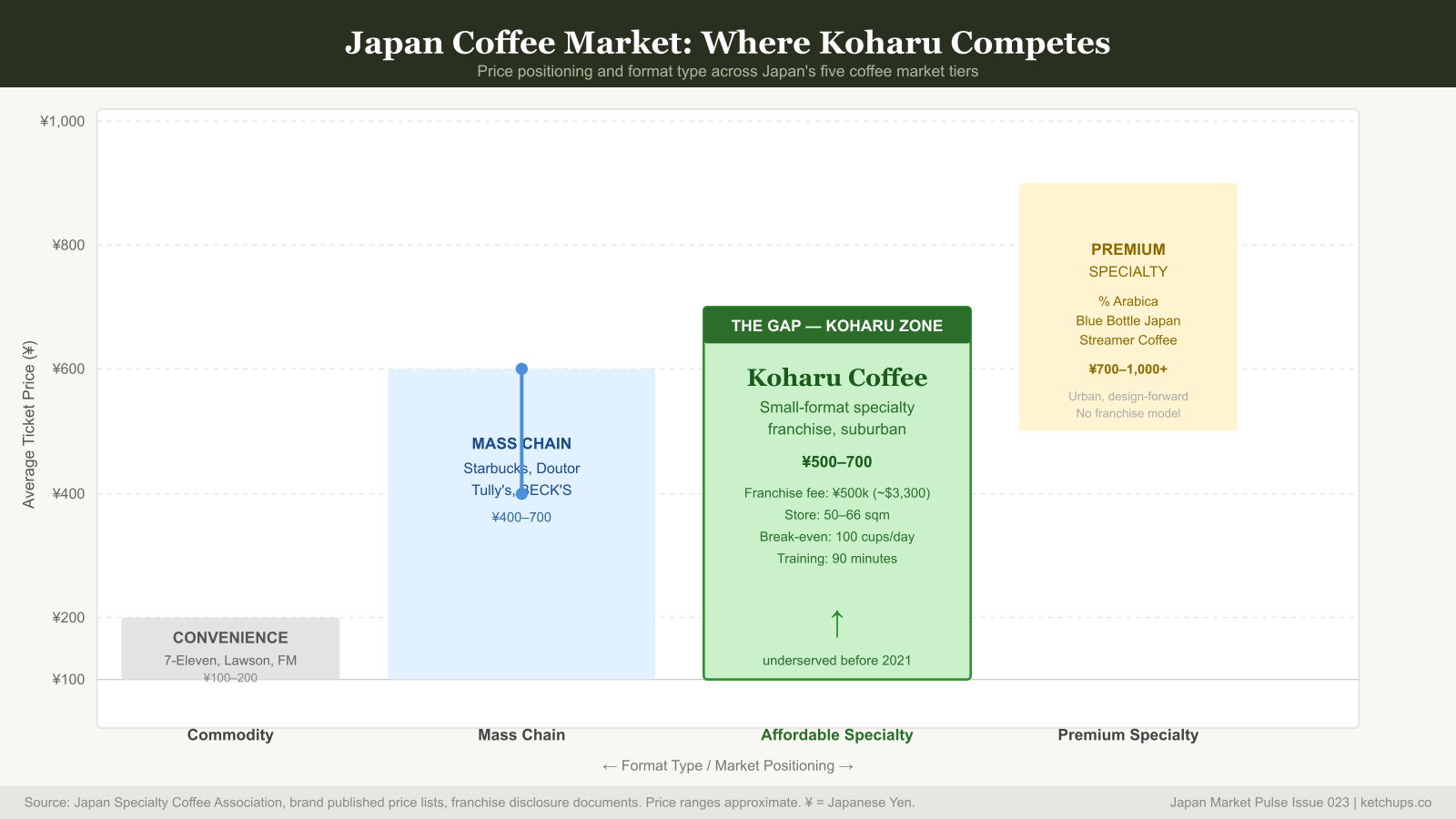
Japan’s coffee market runs approximately ¥2.6 trillion annually — around $17 billion — making it one of the largest per-capita coffee consumption markets in Asia. The structural problem in the Japanese coffee retail landscape is the gap between commodity and premium. Convenience store coffee offers decent drip coffee at ¥100 to ¥200. Starbucks and its mass-market tier operate at ¥400 to ¥700. Then there is a hard jump to the genuine specialty tier — % Arabica, Blue Bottle Japan — where average tickets run ¥700 to ¥1,000 and the format is urban and fundamentally incompatible with suburban commercial strip retail.
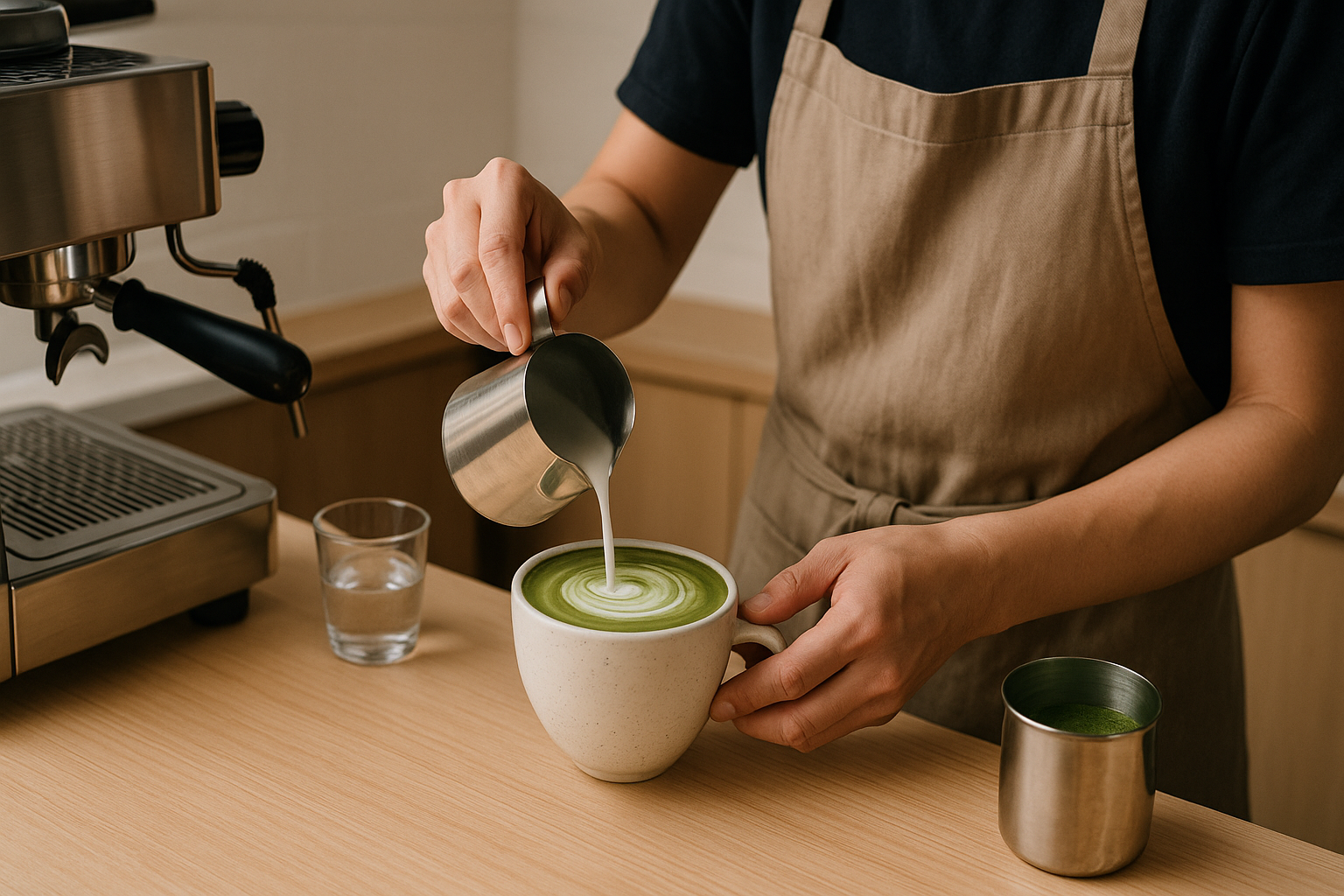
Koharu targets that gap with disciplined precision. The Hawaiian visual language communicates “fun, quality, approachable” without communicating “expensive.” The menu is broad enough — matcha, espresso, fruit-based drinks, seasonal specials — to serve multiple occasions without requiring skilled barista labor that would blow out labor costs. The location strategy puts the café where suburban consumers already are.
The Operational Engineering Behind the Format

Koharu Coffee’s approach to the unit economics problem is instructive and specifically Japanese in its methodology. Central production and distribution: syrups, cold brew concentrate, and base preparations are produced centrally and delivered to stores on a regular schedule. This eliminates the need for each location to maintain expertise and raw material inventory to produce these components from scratch, standardizes quality across locations, and dramatically reduces the skill ceiling for in-store staff.
Equipment standardization means every Koharu location runs the same configuration — maintenance is predictable, training is transferable, and the franchisor can negotiate favorable procurement terms at scale. The reported training time for a new Koharu staff member is approximately 90 minutes to reach operational competency on core menu items. The break-even point is approximately 100 cups per day, with estimated average throughput of 130 to 180 cups at performing locations — a 30% to 80% margin above break-even.
The Competitive Landscape and Why the Gap Stays Open
Convenience store coffee is operationally formidable but anchored inside a convenience store — no brand identity, no café atmosphere, no reason for destination visits. Starbucks Japan’s licensed model requires institutional partners, not individual owner-operators. The premium specialty tier is deliberately incompatible with suburban commercial strip retail. What this leaves is a wide, durable band between ¥200 commodity and ¥900 premium where Koharu operates with limited direct competition from any operator with comparable franchise infrastructure or brand recognition.
Why Western Coffee Hasn’t Solved This
Western specialty coffee culture has a structural tension with the kind of operational standardization that makes Koharu work. Third-wave coffee identity is built on craft, origin transparency, and visible skilled preparation. Systematizing those processes — reducing barista training to 90 minutes, delivering pre-made syrups from a central facility — is experienced as ideologically incompatible with specialty coffee values in much of the Western market. This is not an unreasonable position, but it is a commercially limiting one.
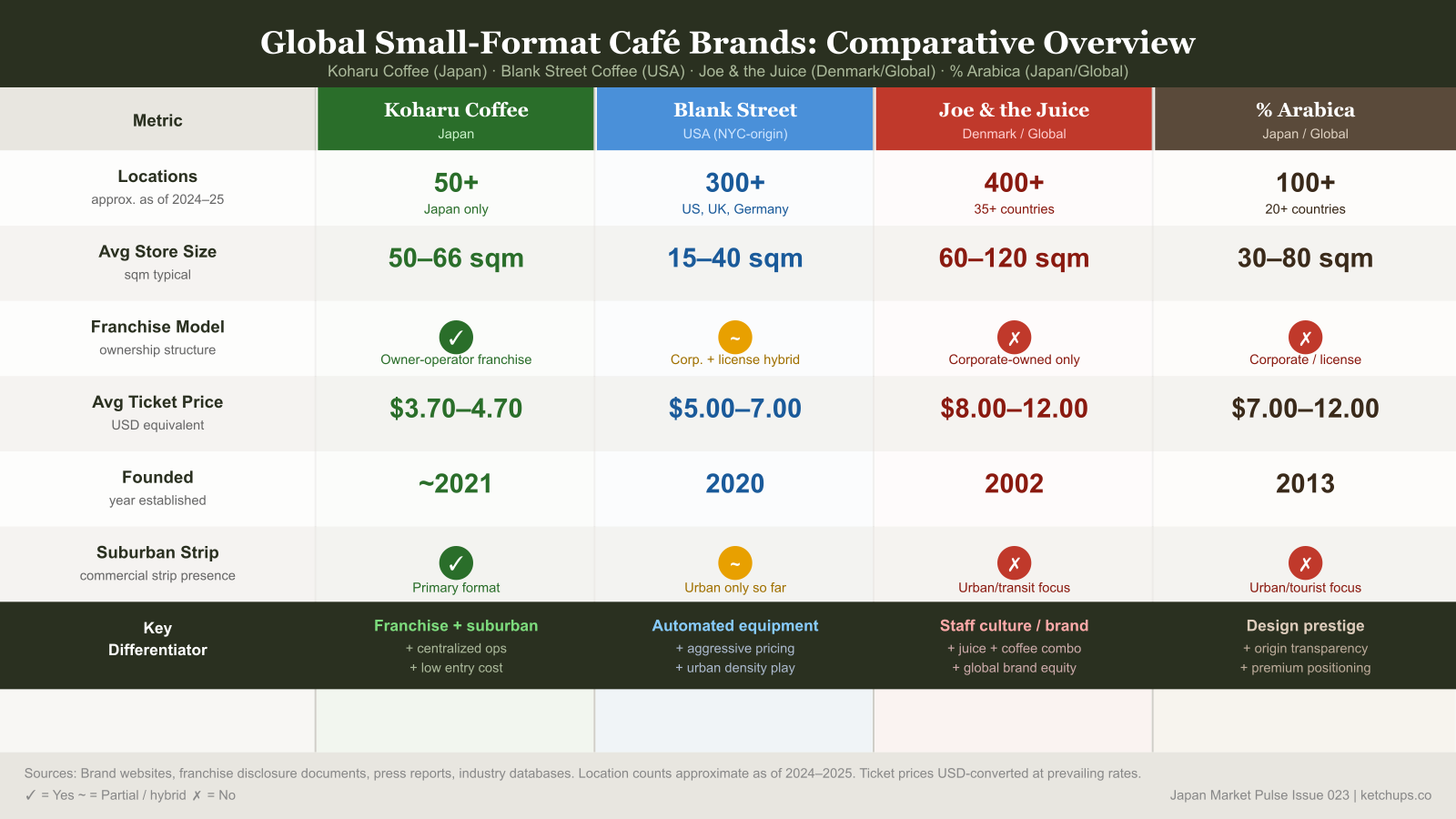
Blank Street Coffee (NYC, 2020) is the closest American analog — small footprint, automated equipment, aggressive pricing. But it remains primarily an urban phenomenon; it has not cracked suburban commercial strip retail at franchise scale. Joe & the Juice solves the format problem with high training and culture investment on a corporate-owned expansion model, limiting the speed and economics of scale. Neither has achieved what Koharu has done: a genuinely franchise-able format, accessible entry costs, systematic operational efficiency, and 50+ suburban locations in three years.
The Exportability Question
The specific format — Hawaiian aesthetic, matcha-forward menu, Japanese suburban positioning — is culturally calibrated for Japan. But the underlying operational architecture is not Japan-specific. The core innovations — central production of base components, deep equipment standardization, compressed training protocols, sub-100sqm footprint, franchise-accessible entry costs — are applicable in any market with a gap between commodity coffee and premium specialty, suburban commercial density, and car-dependent consumer behavior.
Southeast Asia is the most natural near-term analog: hypermarket-anchored retail corridors, high car ownership, middle-class consumers with rising coffee expectations, and franchise economics that become even more attractive in lower-rent suburban markets. The Gulf Cooperation Council countries are another plausible target — high disposable income, established specialty coffee culture, and a franchise ecosystem that values Japanese operational precision.
What to Watch Next
The Koharu story is still early. Fifty locations in three years is a real achievement, but the format’s durability through a full economic cycle has not yet been stress-tested. The franchisee’s break-even buffer of 30-80 cups per day above the 100-cup threshold is meaningful but not enormous. Menu evolution — cold brew formats, non-dairy milk alternatives, functional additions — and the system’s ability to propagate centrally produced component updates across 50+ locations will determine whether the format stays relevant as the market evolves.
The broader signal, though, is less about Koharu specifically and more about what it represents. Japan has long been a laboratory for retail format innovation that later influences global development. The small-format specialty coffee franchise, Japanese-engineered and suburban-optimized, is the kind of concept that tends to look prescient in retrospect. If you are in the coffee industry, food service franchising, or retail real estate and you have not paid attention to what is happening in Japanese suburban commercial strips, this is a reasonable moment to start.
If you’re interested in this topic, the Japanese market more broadly, or what KETCHUPs is working on, we’d love to hear from you — please reach out via our contact form.
Japan Market Pulse is a weekly read on what the Japanese consumer-tech, lifestyle, and adult-collectibles markets are choosing to do, written for international operators who want to know what is happening before it shows up in the global trade press.
Subscribe at ketchups.co/japan-market-pulse.