

Disclosure: This article covers Japanese consumer-tech and energy infrastructure. Vehicles in this article are sold via dealer channels, not Amazon — no affiliate links. Concept-driven analysis.
The story is not about EVs as transportation. It is about EVs as rolling home batteries. In Japan, the Nissan ARIYA (¥6.6M base), the Mitsubishi eK X EV (¥2.5M kei-class), and the Honda N-VAN e: (commercial kei) are not primarily optimized for range, acceleration, or charging speed. They are optimized to answer a single structural question: How do you power a Japanese home for four days using the battery in your driveway? This question, shaped by two decades of earthquake risk, typhoon season, and the cultural memory of 2011, has produced a market that looks—to Western eyes—peculiar. Tesla does not dominate Japan because Tesla does not support V2H. The reason Japanese EVs are designed so differently from American and European EVs is not innovation theater. It is national resilience infrastructure, marketed as consumer vehicles.
Japan Market Pulse — Issue 017 | Consumer Trends
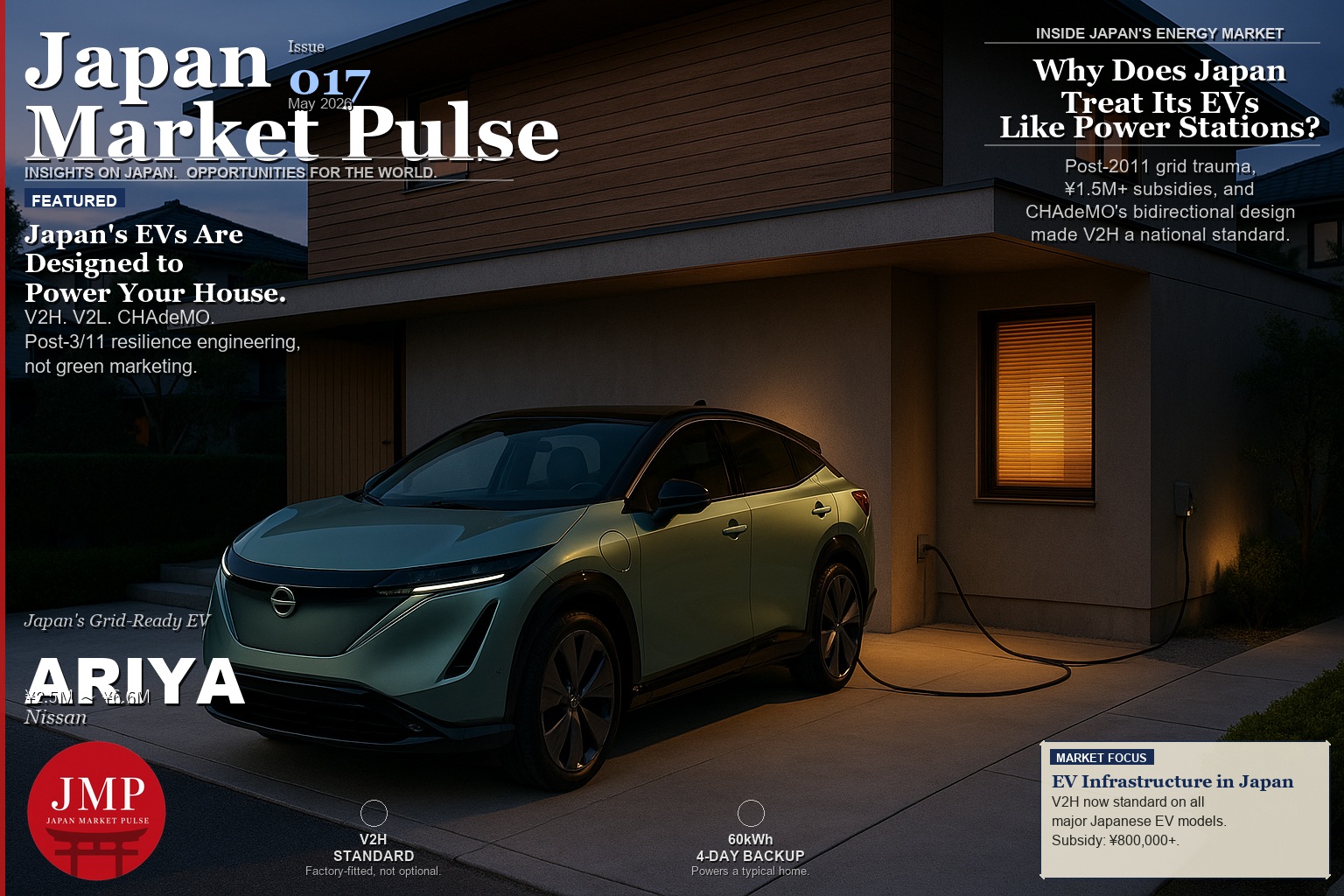
This is the story of V2H (Vehicle-to-Home) and V2L (Vehicle-to-Load), the twin technologies that define Japan’s EV market, and why international operators should understand them now, before V2H becomes the global standard.
Three of four flagship open-ear earbud models available in 2026 Japan are available on Amazon US. Huawei’s FreeClip 2, though technically the most advanced, is not. This matters for how we think about innovation centers. The same logic applies to EV architecture: Japan’s V2H framework is the most mature in the world, and it did not emerge from Silicon Valley.
The 3/11 Reset: When the EV Became a Resilience Device
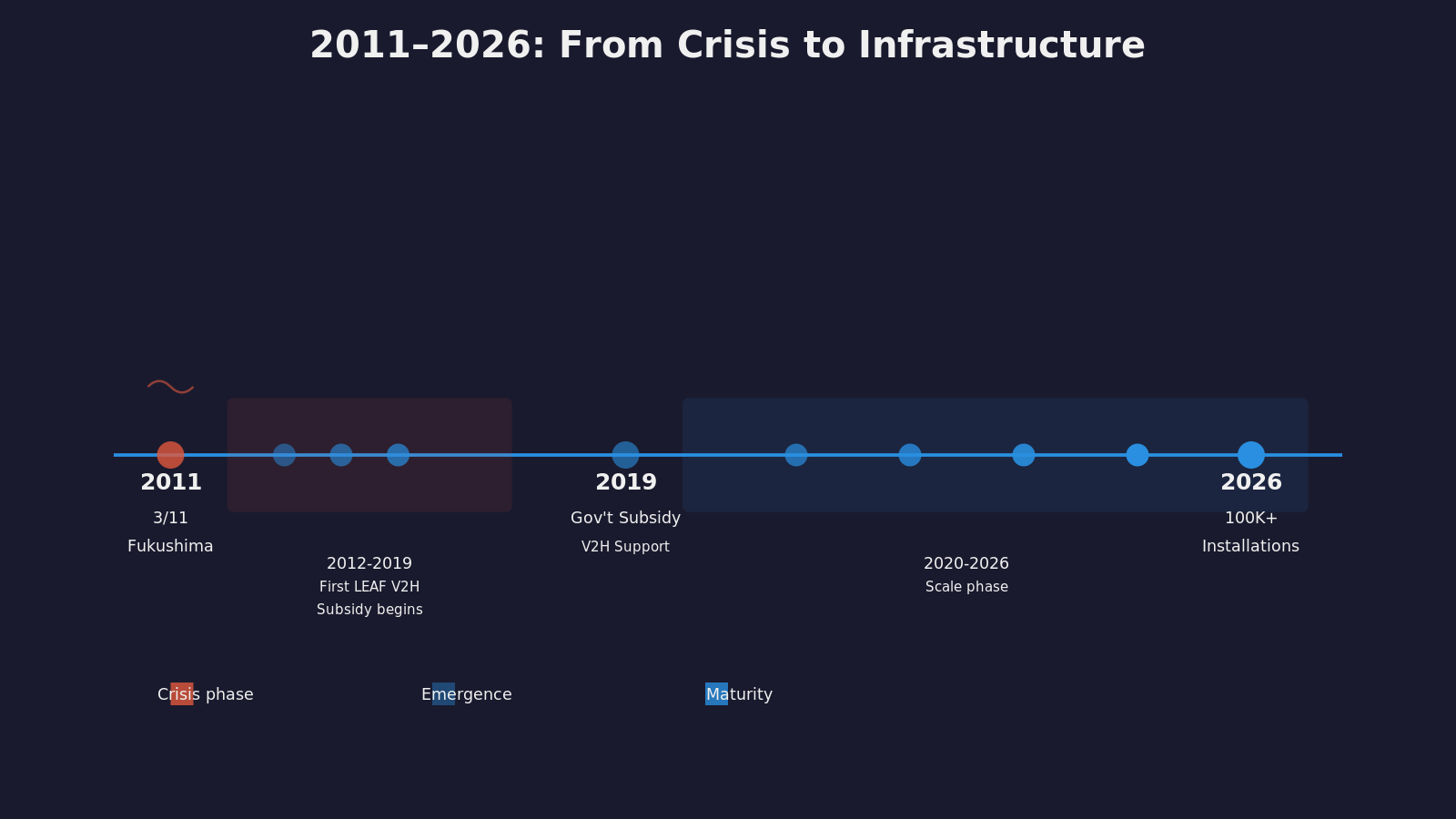 From crisis to infrastructure: The 2011 Fukushima earthquake reset Japan’s relationship with home energy. By 2026, V2H had moved from concept to scale with 100,000+ installations.
On March 11, 2011, the Fukushima earthquake demonstrated a structural vulnerability in modern industrial societies: dependency on grid power for basic household survival. In Japan, the consequence was a twenty-year cultural shift in how citizens conceptualized home energy.
The EV industry picked up on this reframing earlier than Western analysts recognized. In 2012, Nissan began promoting the LEAF—the world’s best-selling EV until recently—not as a replacement for gasoline cars, but as a mobile power supply. The messaging was direct: Your car can power your home during grid outages. This was not marketing copy. It was infrastructure design.
By 2019, Japan’s government had begun awarding subsidies for V2H-compatible EVs and home wallboxes. By 2023, V2H installations had become a standard product category in Japanese new-home construction. By 2026, the calculus is complete: a 60-kWh EV can supply 4 days of home electricity in a typical Japanese residence. The annual typhoon season—which knocks out power to hundreds of thousands of homes—has become, structurally, a V2H use case.
That calculation would be irrelevant in California or Germany, where grid reliability is higher and disaster frequency lower. In Japan, it is not an edge case. It is the primary market positioning.
CHAdeMO vs. CCS: Why Japan’s Charging Infrastructure Looks Different
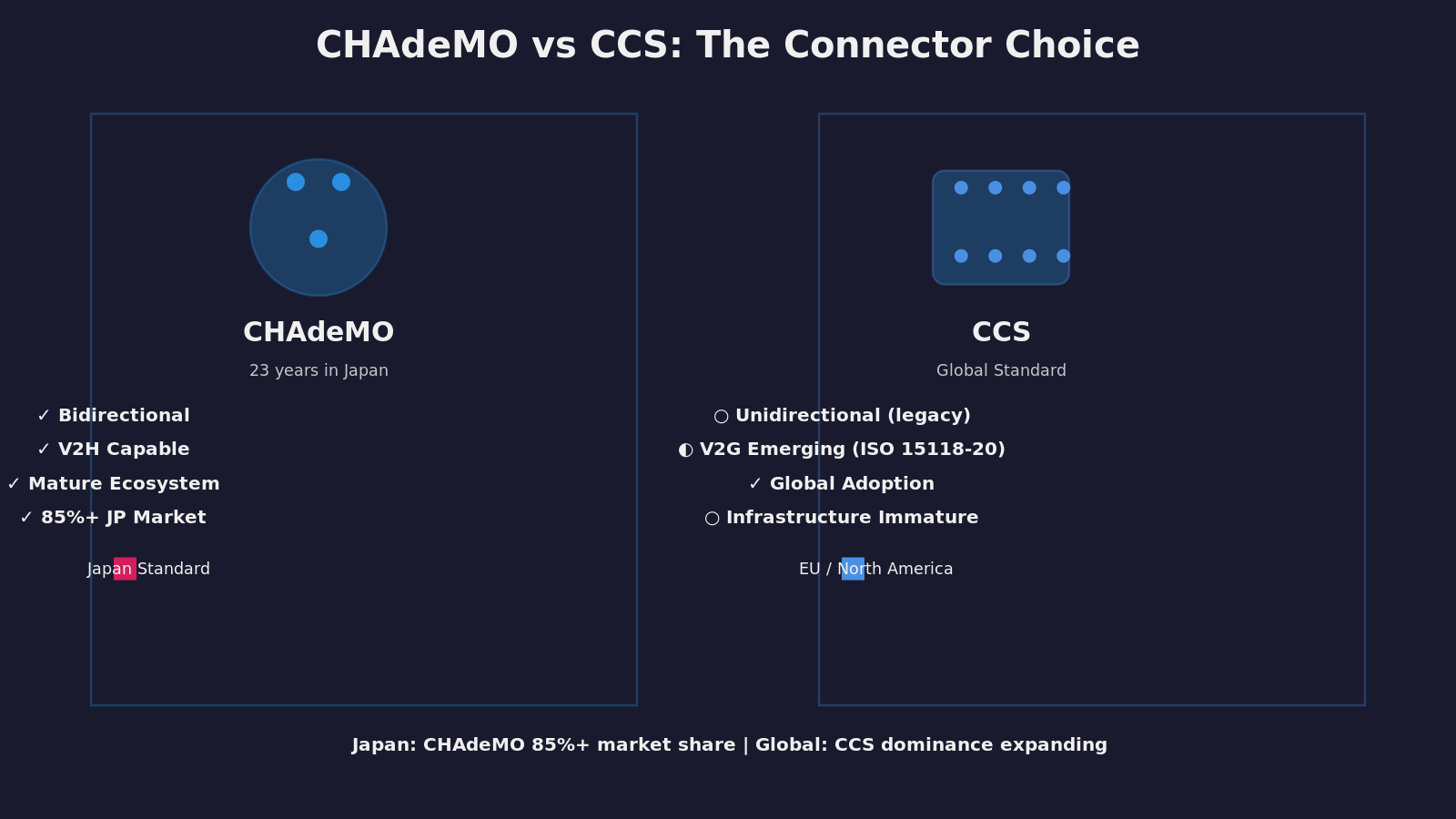 The connector choice: Japan chose CHAdeMO—a 23-year-old bidirectional standard—while the world standardized on CCS. This single technical choice created structural divergence in global EV markets.
The global EV industry has converged on CCS (Combined Charging System) as the standard connector for fast charging. The EU mandates it. Tesla adopted it. North America is transitioning to it. Japan chose differently: CHAdeMO (an acronym for CHArge de MOve, originating in 2003) remains the dominant fast-charging standard in Japan, with more public chargers and an embedded ecosystem of over two decades.
The critical difference is not performance. It is bidirectionality. CHAdeMO was engineered from inception to support V2H—vehicle-to-home power flow—with a standardized protocol for two-way communication between the vehicle, the home wallbox, and the utility grid. CCS, designed primarily for unidirectional charging, only recently began supporting similar bidirectional standards (e.g., ISO 15118-20), and the infrastructure is immature.
This single technical choice has produced a structural divergence:
- Japan: CHAdeMO + V2H wallbox (government subsidy ¥800,000) + utility grid buyback program (Feed-in Tariff successor) → mature ecosystem
- Europe: CCS + nascent V2G pilots (UK, Germany) with no unified subsidy structure
- North America: CCS + proprietary Tesla V2H (US-only, California-focused) + fragmented state-level EV subsidies
For international operators, the lesson is stark. A 23-year-old connector standard that Western press dismissed as a “regional quirk” is now the backbone of the world’s most mature V2H market. Japan did not adopt CHAdeMO because it was innovative. It adopted it because the infrastructure predated the questions it answers.
Nissan ARIYA: Global SUV Platform With Japan-Specific V2H
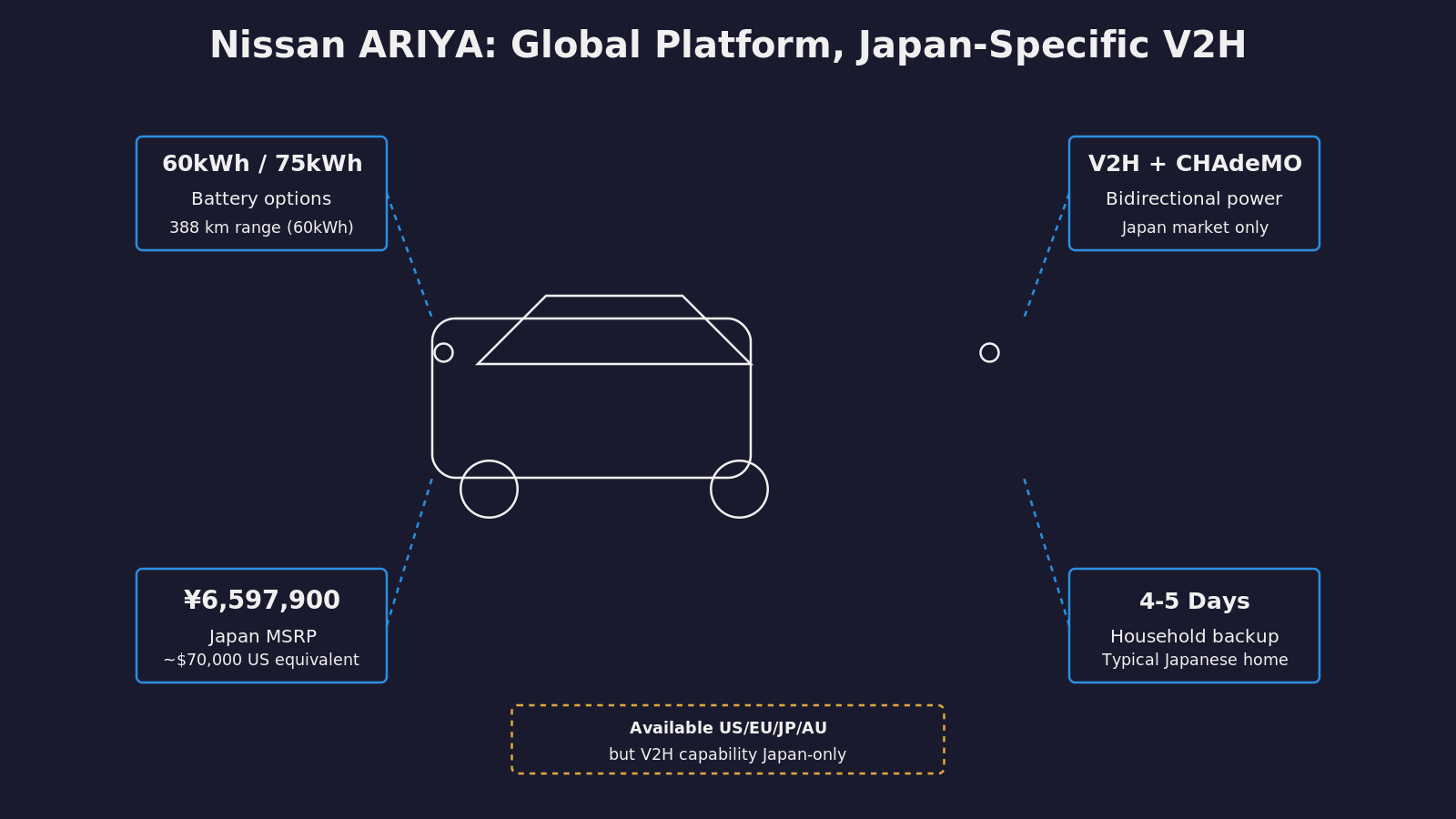 The Nissan ARIYA is a global vehicle with a Japan-specific feature set. In the US and Europe, it charges conventionally. In Japan, it is equipped for V2H and sold as a home resilience system.
The Nissan ARIYA is perhaps the clearest proof point. It is a global product—available in the US, Europe, Australia, and Japan—with a unified platform and battery architecture. And yet, it is functionally two different vehicles depending on market.
In the United States and Europe, the ARIYA is a conventional EV. It charges from a conventional wallbox. It supplies electricity to the home via proprietary mechanisms (if at all). The global version prioritizes miles-per-charge and charging speed.
In Japan, the ARIYA is equipped with CHAdeMO hardware and V2H communication protocol. The standard package includes a home wallbox (or subsidy support for one). The OEM messaging emphasizes backup power, grid services, and disaster resilience. A 60-kWh ARIYA—identical battery to the US version—is marketed and understood as a ¥7 million household power system that happens to drive.
Nissan ARIYA specs:
- Price: ¥6,597,900 (Japan) / ~$70,000 (US, similar size class)
- Batteries: 60 kWh (FWD, 388 km range), 75 kWh (options)
- V2H: Yes (Japan version with CHAdeMO); No (US/EU versions with CCS)
- Backup home power: 4-5 days typical household
- Maker link (global): https://www.nissanusa.com/vehicles/electric-cars/ariya.html
The ARIYA is not exceptional because it invented V2H. It is exceptional because it demonstrates that a global OEM can build V2H into the platform, and that the choice to include it depends entirely on market structure. For international operators evaluating multi-market EV strategies, this is instructive: market infrastructure precedes buyer preference.
Kei-Class Democratization: The ¥2.5M V2H Entry Point
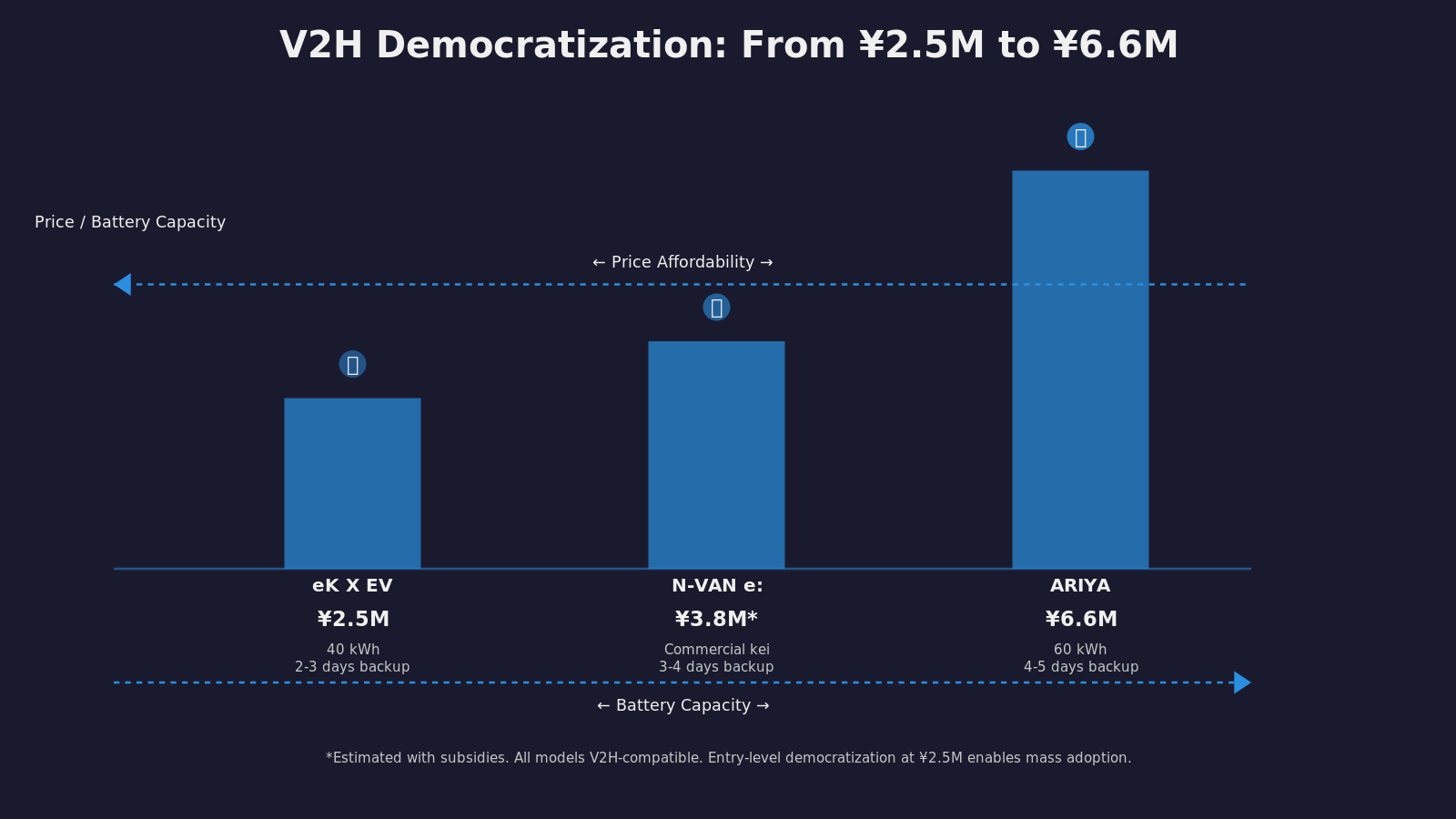 V2H democratization: For the first time, a Japanese household can purchase a V2H-equipped EV for under ¥3.5M installed cost (vehicle + wallbox subsidy). This price point opens the category to rural and suburban buyers.
The true revolution in Japan’s V2H market is not the ARIYA. It is the democratization of V2H into the kei-class segment—the ultra-small, under-660cc displacement category that dominates Japanese urban and rural markets.
Mitsubishi eK X EV (¥2,565,500):
- 40 kWh battery / 180 km range
- V2H compatible (with wallbox subsidy)
- Japan-only distribution (different SKU from EU kei-EV market)
- Home backup: ~2-3 days
- Maker link: https://www.mitsubishi-motors.co.jp/lineup/ekxev/
Honda N-VAN e: (commercial kei-vehicle):
- V2H compatible / targeted at tradespeople and small-business operators
- One-way and two-way power delivery
- Maker link (Japan): https://www.honda.co.jp/N-VAN-e/
For the first time, a Japanese household can purchase a new EV, qualify for government subsidies on both the vehicle and the wallbox, and have a functioning home backup power system—for under ¥3.5M total installed cost. This pricing point is critical. A 40-kWh battery is not—by Western standards—a large power system. But in the Japanese household context, 2-3 days of backup is meaningful for typhoon season. The eK X EV has become the entry-level gateway to V2H adoption across Japan’s rural and suburban owner-driver population.
This is not the same as the Chevrolet Bolt EV or the Volkswagen ID.3. Those are single-purpose urban commute vehicles. The eK X EV is V2H-primary, commute-secondary in its market positioning.
The Subsidy Architecture: Three Layers of Government Support
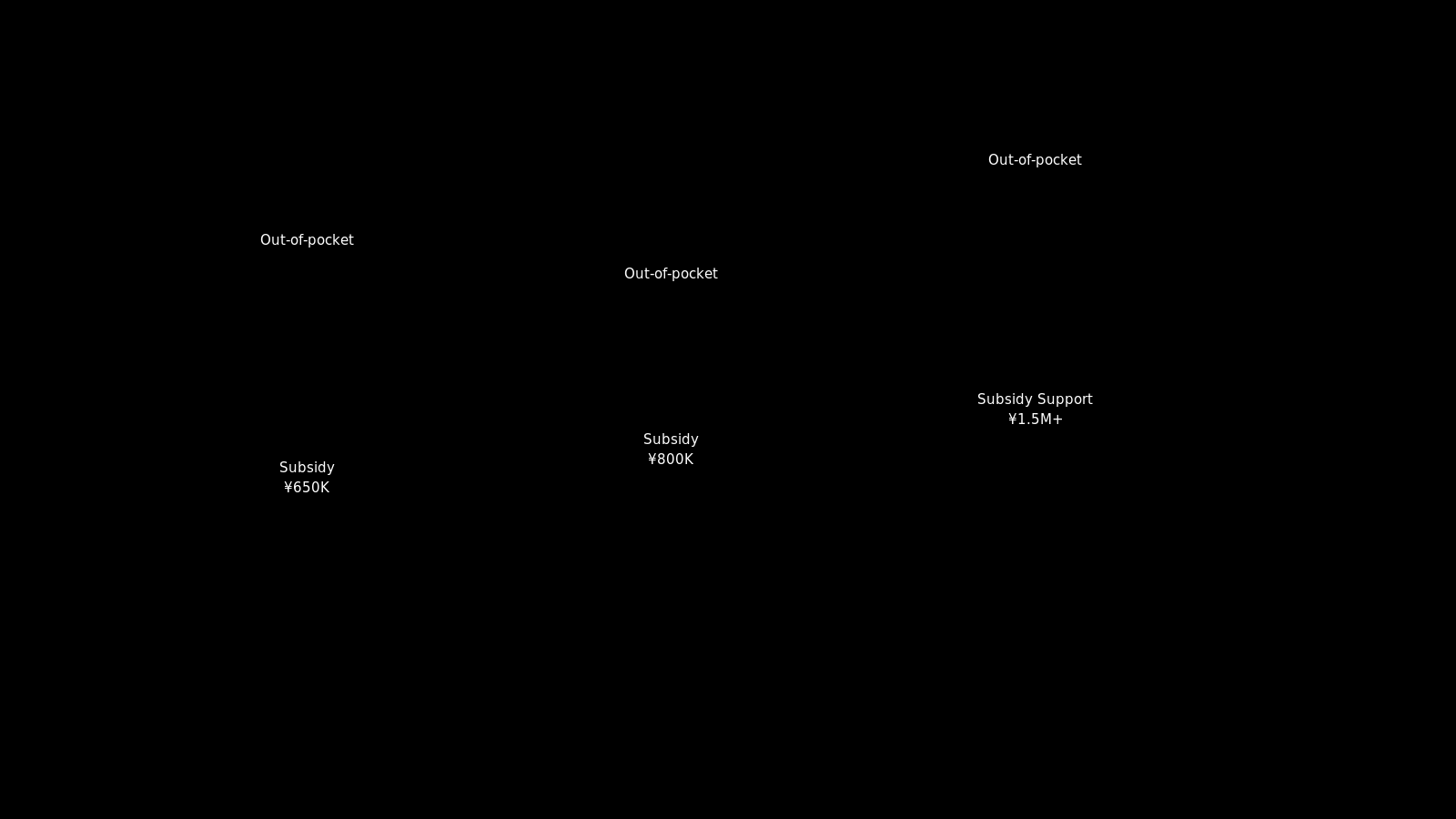 The three-layer subsidy stack: Japan’s government coordinates EV purchase subsidies, home wallbox subsidies, and utility grid-buyback programs. Total support exceeds ¥1.5M per household—a structure no other market has yet replicated.
Japan’s V2H market does not exist in a vacuum. It is explicitly subsidized across three tiers, creating an incentive structure that no other market has yet implemented at scale.
Layer 1: EV Purchase Subsidy
- ¥650,000 (~$4,500) for battery-electric vehicles
- Scaled by battery capacity
- Applies to all new BEVs, including kei
Layer 2: V2H Wallbox Installation Subsidy
- Approximately ¥800,000 (~$5,500) for home V2H charger installation
- Covers hardware, electrical work, grid interconnection
- Applied only when the EV supports CHAdeMO
- Available to new and retrofit installations
Layer 3: Utility Grid Buyback (FIT Successor)
- Reverse-flow electricity pricing (not yet universal, but expanding)
- EV owners in solar+battery households can sell excess capacity back to the grid
- Mechanism similar to the legacy Feed-in Tariff scheme
- Incentivizes V2H as a grid-service asset
Total subsidy ecosystem: ¥1.5M+ per household for vehicle + wallbox + grid integration. This reduces the effective cost of V2H adoption to below ¥5M—a critical threshold for middle-class Japanese households.
The contrast with Western approaches is instructive. The Inflation Reduction Act (US) and UK government EV grants exist. But none have yet aligned EV subsidies, home-infrastructure subsidies, and utility buyback mechanisms in a unified stack. Japan’s structure is intentional policy design, not accidental market discovery.
What the Global V2H Pilots Can Learn From Japan’s Mature Framework
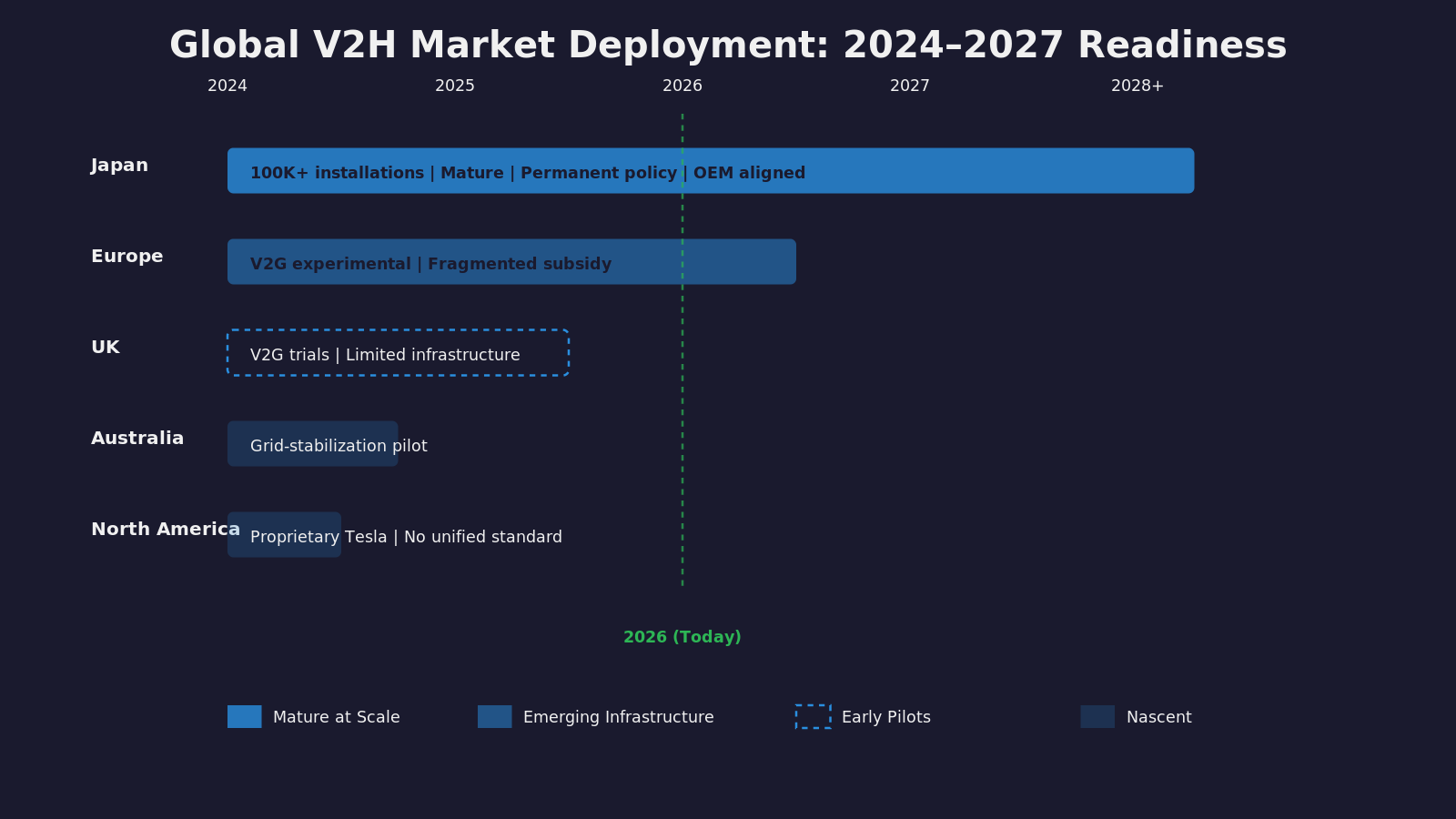 Global V2H deployment readiness: Japan at scale with 100K+ installations and permanent policy. Europe and Australia in pilots. North America relies on proprietary systems and fragmented incentives.
Across Europe, Australia, and parts of North America, V2H pilots are underway. The UK’s V2G programs, Germany’s battery-storage regulations, Australia’s grid-stabilization initiatives—all are experimental.
Japan is not experimental. By 2026, V2H installations exceed 100,000 units. The technical stack is mature. The regulatory framework is settled. The consumer awareness is high. The subsidy structure is permanent.
This distinction matters for international operators. The three conditions that created Japan’s V2H dominance—natural disaster frequency, mature CHAdeMO infrastructure, and government subsidy alignment—will not replicate everywhere. But the business model will.
Watch for these markers as V2H globalizes:
- Regulatory clarity on bidirectional power: Which standards (CHAdeMO, CCS, proprietary Tesla) will each market mandate for V2H?
- Subsidy stacking: Will governments coordinate EV purchase subsidies with wallbox and grid-service subsidies?
- Utility grid readiness: Can utilities handle reverse-flow electricity from distributed EV batteries?
- OEM commitment: Will global makers (beyond Nissan) integrate V2H into multi-market platforms?
Japan has answered all four affirmatively. Most other markets have not. This is the gap.
For International Operators: The Next Five-Year Window
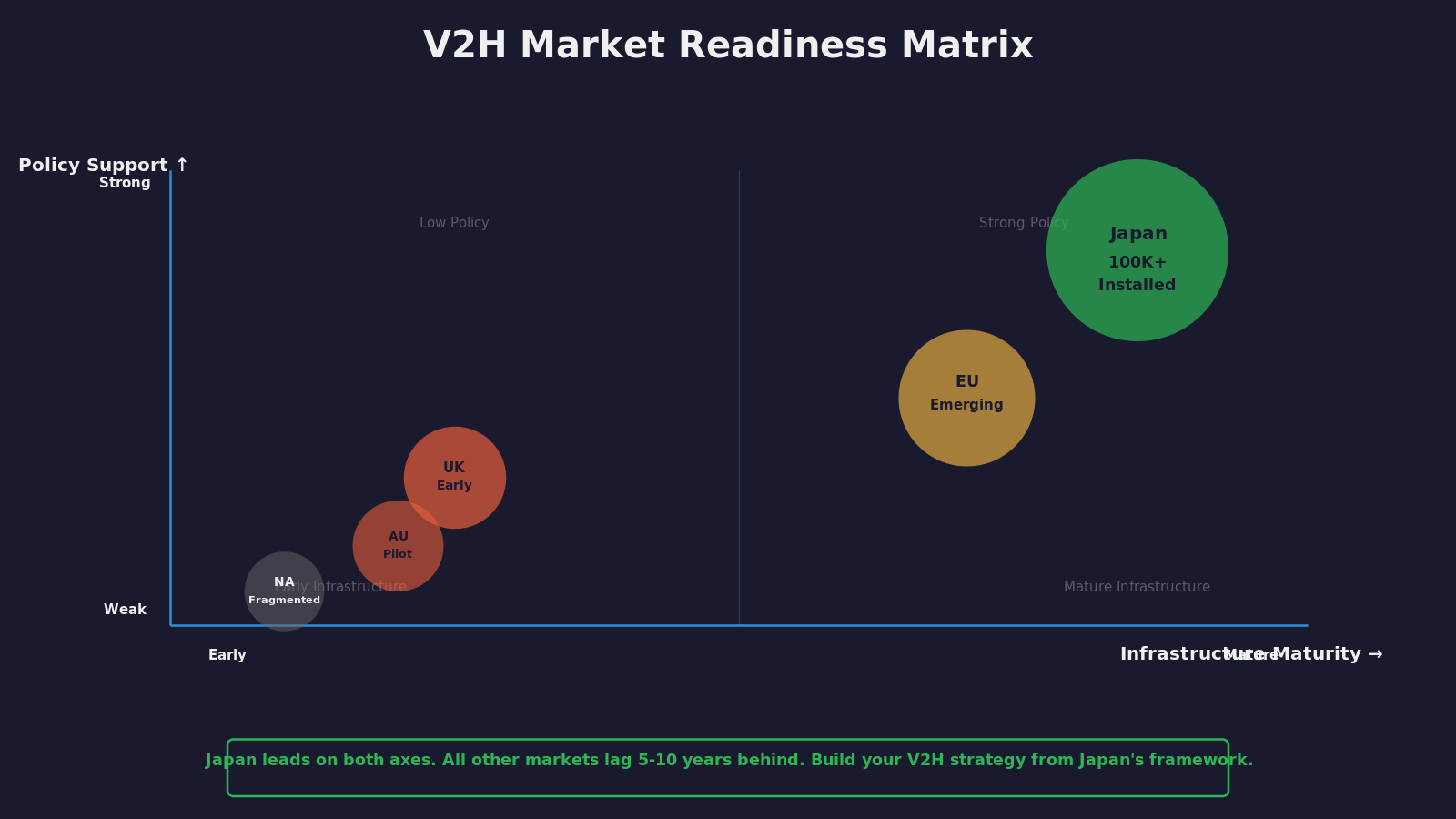 The V2H readiness matrix: Japan leads on both infrastructure maturity and policy support. Europe shows emergence. UK, Australia, and North America lag 5-10 years behind, with no unified standards yet.
If you operate in energy infrastructure, automotive, grid management, or home technology, Japan’s V2H maturity is your roadmap.
The sequence is now clear: natural disaster risk → government resilience investment → standardized EV charging infrastructure → subsidized home wallbox deployment → V2H becomes baseline. Japan moved through this sequence in 15 years. Europe and North America are 5 years behind.
The implication: V2H is not a future feature. It is a current major EV market requirement, visible first in Japan, arriving everywhere else by 2030.
For automotive makers, the decision is operational: invest in V2H-compatible platform design now, or retrofit later. For energy utilities, the decision is grid architecture: prepare for distributed battery storage and reverse-flow power management. For policy makers, the decision is subsidy alignment: create a stack (vehicle + infrastructure + grid incentive), not individual programs.
Japan’s market is not the largest by absolute vehicle count. But it is the most mature by infrastructure and policy integration. Build your V2H strategy from here.
The EV industry spent a decade optimizing for range and charging speed. Japan’s market has moved on to the next vector: resilience and grid integration. The rest of the world is following, 5 years later.
TL;DR — What to Watch
If you want to see V2H integration at the luxury tier: The Nissan ARIYA in Japan (any dealer) demonstrates how a global OEM adapts platform features for regional markets. The ¥6.6M price point shows that V2H adds ~¥1M to effective ownership cost vs. Western EVs.
If you want to see V2H democratized: The Mitsubishi eK X EV at under ¥2.6M is your reference. This price point is what happens when kei-class design meets V2H subsidy stacking. Watch for similar entries from Honda, Daihatsu, and Suzuki through 2027.
If you want to understand the subsidy architecture: Japan’s Ministry of Economy, Trade and Industry (METI) publishes EV/V2H subsidy guidelines annually. The ¥1.5M+ stacking effect is the most complete V2H adoption incentive globally.
If you want to see global V2H standards emerge: Watch CCS evolution. The ISO 15118-20 standard (bidirectional CCS) is immature. Japan’s CHAdeMO ecosystem (already mature, already subsidized) will remain the reference until CCS catches up. This is a 5-10 year competition.
If you are a utility or grid operator: Japan’s FIT successor programs, reverse-flow pricing, and EV-as-battery-asset models are live. This is not theoretical grid management. This is operational, deployed, and scaling.
Japan Market Pulse is a weekly read on what the Japanese consumer-tech, food, and mobility markets are choosing to do, written for international operators who want to know what is happening before it shows up in the global trade press.
Subscribe at ketchups.co/japan-market-pulse.
Sources
- Nissan ARIYA — Global product page (US market)
- Mitsubishi eK X EV — Official Japan site
- Honda N-VAN e: — Official Japan site
- Japan Ministry of Economy, Trade and Industry (METI) — EV/V2H subsidy programs
- CHAdeMO Organization — Charging protocol and ecosystem
- ISO 15118-20 — CCS bidirectional charging standard (emerging)
- IEA — Vehicles using grid power (V2G) — Global deployment status
- Japan Electric Power Exchange — FIT and reverse-flow pricing mechanisms
If you’re interested in this topic, the Japanese market more broadly, or what KETCHUPs is working on, we’d love to hear from you — please reach out via our contact form.
Japan Market Pulse is a weekly read on what the Japanese consumer-tech, food, and mobility markets are choosing to do, written for international operators who want to know what is happening before it shows up in the global trade press.
Subscribe at ketchups.co/japan-market-pulse.