

Disclosure: This article covers Japanese consumer-food trends. Some links lead to brand or franchise pages.
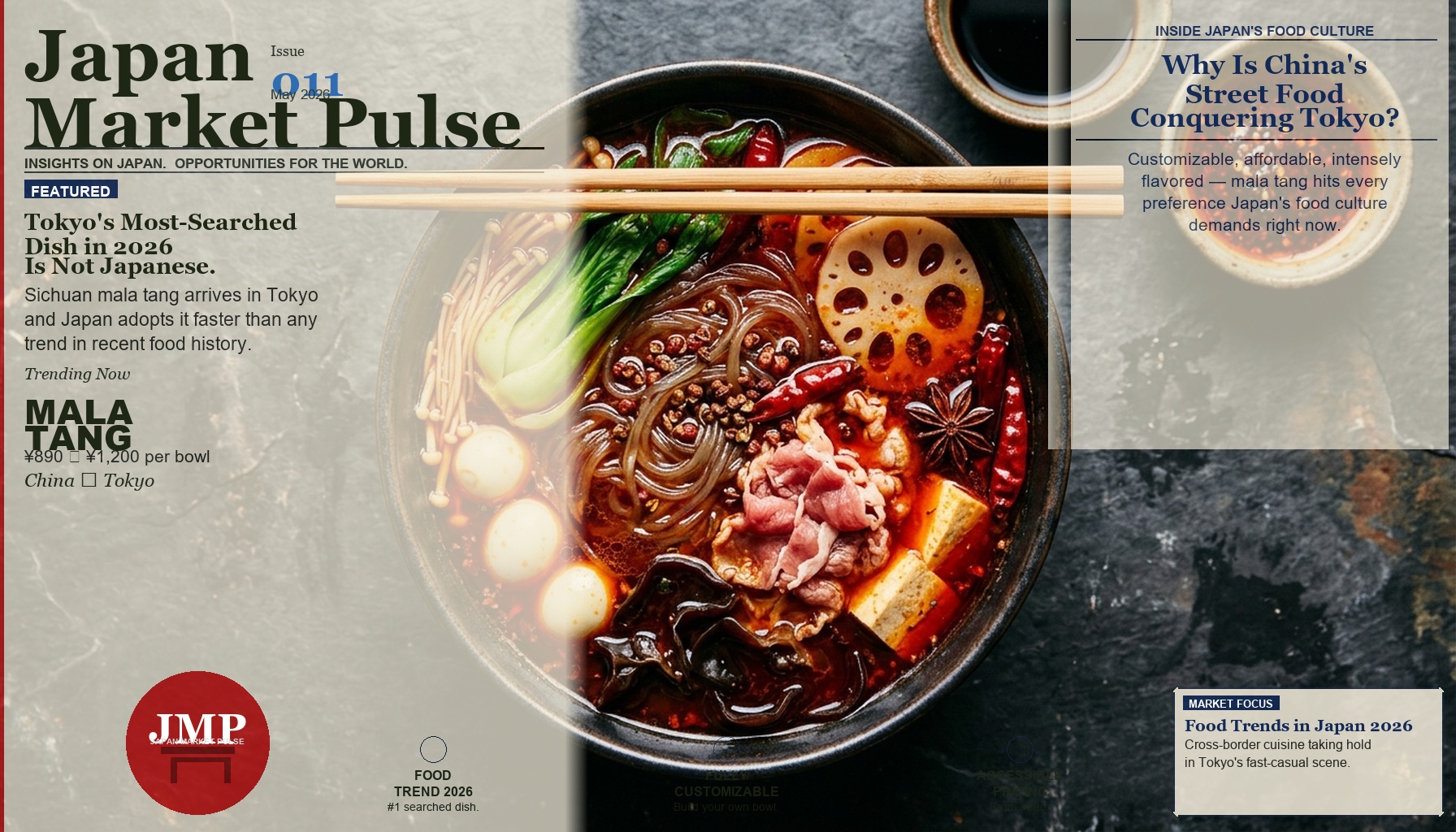
The hottest fast-casual category in Japan in 2026 is not ramen. It is not gyudon. It is not the next iteration of katsu. It is a build-your-own bowl of Sichuan numbing-and-spicy soup that the Japanese language transliterates as mala tang — and Cookpad just named it the #2 food trend of 2025. Here is how a 2,000-year-old Chinese street food displaced ramen-shop foot traffic in three short years, and what that says about the Japanese fast-casual market English-language coverage has not yet caught up to.
Japan Market Pulse — Issue 011 | Consumer Trends
A confession to begin. The author has spent two decades writing about Japanese food retail in two languages, and the strongest residual instinct from that work is the assumption that the Japanese consumer’s relationship with Chinese food is, in 2026, more or less what it was in 2006. Chuka — the Japanese word for casual Chinese cuisine — meant gyoza, fried rice, mapo tofu, ramen, and the eternal chukadon rice bowl. The category had its high-volume chains (Bamiyan, Gyoza no Ohsho, Hidakaya). It had its premium tier (Akasaka Rikyu, Ginza Aster). It had a long, stable mid-market. And it had not produced a genuinely new category in roughly fifteen years.
That sentence was true through 2022. It was wobbly through 2023. By the November 2025 announcement of Cookpad’s annual food trend rankings, in which the recipe-search platform’s editorial team named the year’s most influential dishes based on search-traffic and recipe-upload data, it stopped being true. The #1 trend of 2025 was the one-plate seiro (a single-bamboo-steamer style of cooking). The #2 trend was the dish this article is about: mala tang — a Sichuan-origin, broth-based, build-your-own-bowl soup that, in three years, has gone from a handful of specialty shops in Tokyo’s Chinese-immigrant neighborhoods to a nationwide chain category opening at the rate of roughly one new store per week.
The build-your-own-bowl mechanic that Western readers know from Chipotle and sweetgreen has, in the form of mala tang, finally arrived in Japan — and the consumer it has captured is not who you would guess.
This article is the story of how that happened, why it is structurally different from previous Chinese-food trends in Japan, and what international operators should know about a category that is, today, real and accelerating.
What Mala Tang Actually Is
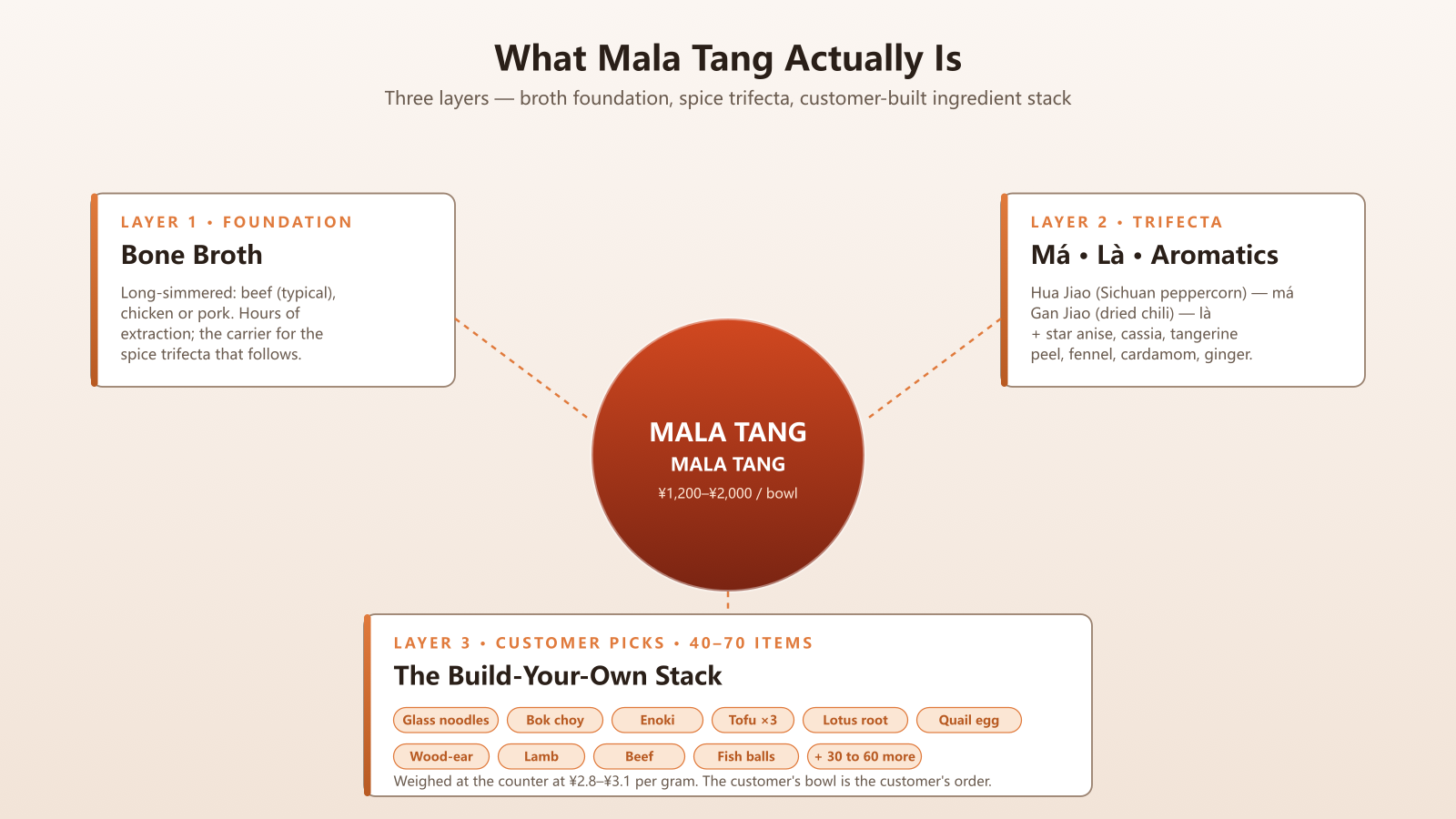
For the international reader, a one-paragraph briefing. Mala tang is a Sichuan-origin street-food preparation. The base is a long-simmered bone broth (typically beef, sometimes chicken or pork) that has been infused with the Sichuan trifecta of Sichuan peppercorn for the má numbing sensation, dried red chili for the là burning sensation, and a working pharmacy of supporting aromatics — star anise, cassia bark, dried tangerine peel, dried ginger, white pepper, fennel, cardamom — that the Chinese tradition catalogues as medicinal spices. The customer chooses ingredients from a refrigerated case that typically contains forty to seventy items: leafy greens, mushrooms, root vegetables, tofu in five different forms, fish balls, lotus root, quail eggs, lamb, beef, and the dish’s signature carbohydrate, glass noodles made from sweet-potato starch. The chosen ingredients are weighed, dropped into a hot-pot basket, blanched in the spiced broth, and served as a single bowl with the broth ladled over the top.
The dish in this exact form has existed in mainland China for at least two decades; the broader Sichuan-soup tradition behind it goes back roughly two thousand years. The format originated as Sichuan boatman’s food along the Yangtze, evolved into a Heilongjiang street-food category in the 1980s and 1990s under the influence of northeastern Chinese chains, and crossed into Korea via the Chinese-immigrant neighborhoods of Seoul in the late 2010s. What is new in 2026 is its commercial arrival in Japan as a specialist fast-casual category, with dedicated single-product shops, a build-your-own ordering mechanic, and a price point (¥1,200–¥2,000 per bowl) that places it squarely above ramen and slightly below the kaiten-zushi premium tier.
The closest comparison for an American or European reader is not ramen. It is Chipotle — or, more precisely, the load-balanced cousin of Chipotle’s mechanic that operates at sweetgreen, Cava, and the build-your-own poke chains. The user-facing logic is the same: walk in, pick a base, build the bowl down a line of toppings, pay by what you put in, eat. What Japan has done is take that mechanic — long absent from the country’s restaurant categories outside the imported burrito and salad chains — and apply it to a hot, brothy, deeply aromatic Sichuan soup. The resulting product is, by every available data signal (search-traffic, recipe uploads, store-count expansion, packaged-goods velocity), the breakout fast-casual format of the mid-2020s in urban Japan.
The Cookpad Verdict — Number Two of 2025
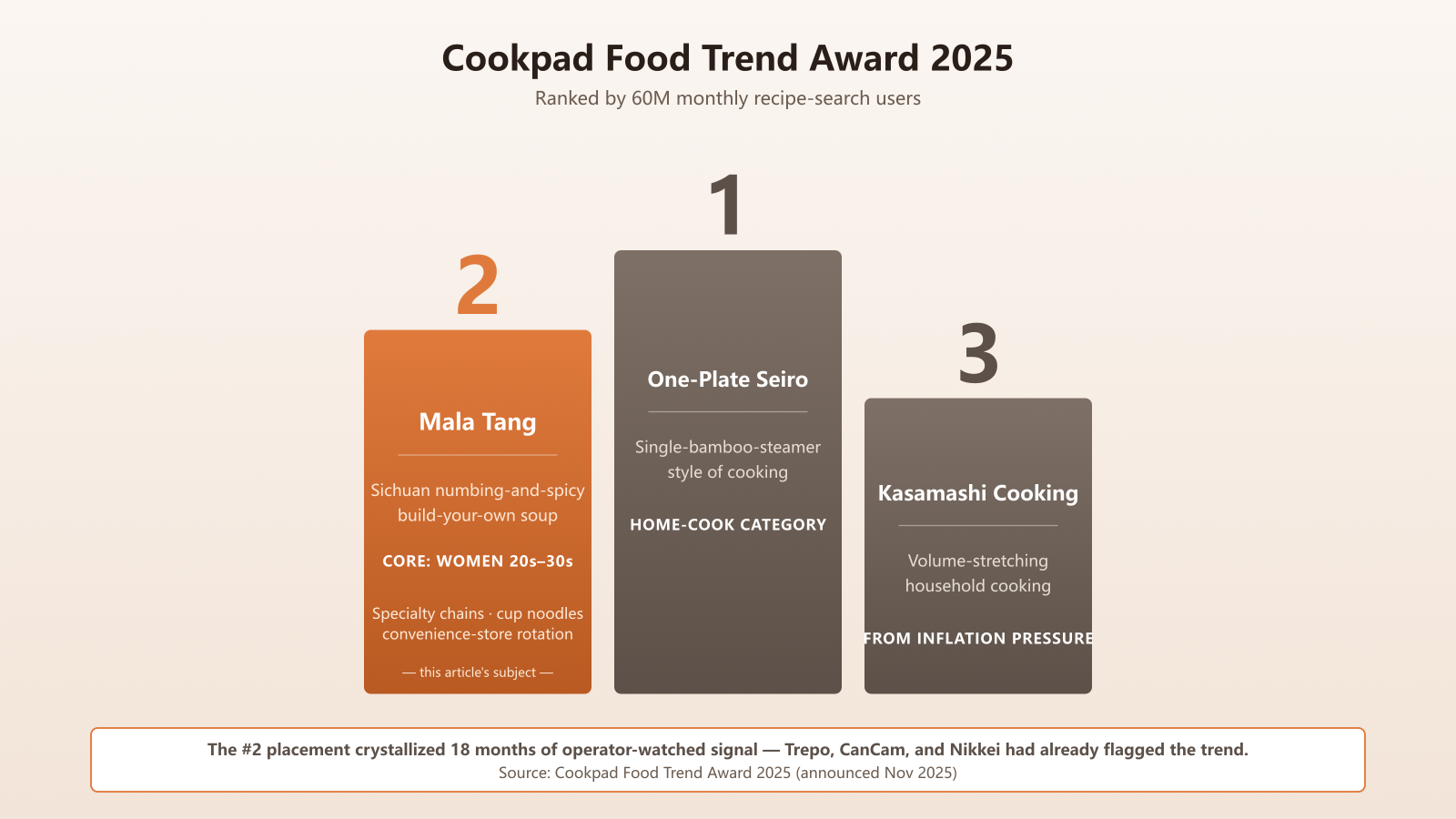
The data point that crystallized the trend for the Japanese food press was Cookpad’s 2025 (Food Trend Award 2025), announced in late November 2025. Cookpad is Japan’s dominant home-cooking recipe platform — roughly 60 million monthly users at its peak, with a recipe corpus that operates as a kind of reverse-thermometer of what Japanese households are actually cooking and searching for. When Cookpad’s editorial team ranks the year’s food trends, the rankings are not marketing artifacts. They are derivatives of search-traffic and recipe-upload signal that the platform sees in real time.
The 2025 rankings put one-plate seiro at #1, mala tang at #2, and kasamashi (volume-stretching) cooking at #3. Cookpad’s editorial framing on the #2 placement is, for an English reader, worth quoting in essence: mala tang has won a “passionate following especially among women in their 20s and early 30s,” with specialist shops drawing daily lines and the category becoming a recurring SNS topic.
What makes the Cookpad placement structurally important — rather than a one-off magazine moment — is that it confirmed a signal that operators in the food space had been watching for eighteen months. The Trepo media network’s 2024 H2 Gen Z Trend Ranking had already placed mala tang at #1 in its Gourmet category. CanCam’s 2025 Z-generation ranking included it. Nikkei’s quarterly food-service review flagged it. By the time Cookpad confirmed it on a national platform with 60 million users in the loop, the category had crossed the threshold from “trend to watch” to “trend that has happened.”
The Chains: Who’s Building Where, How Fast
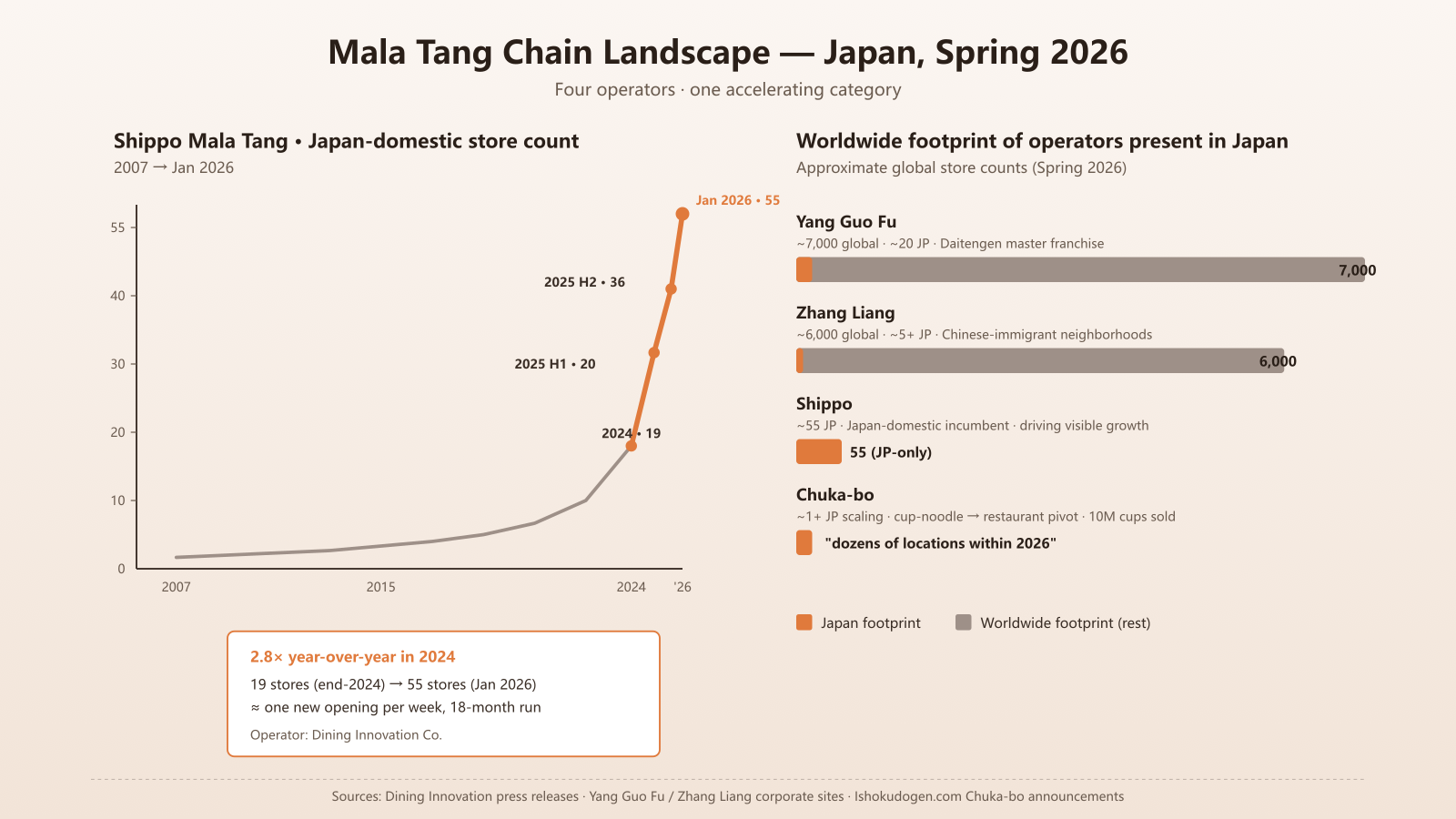
The chain landscape in spring 2026 is a four-player picture, with one Japan-domestic franchise driving most of the visible growth and three China-origin global chains filling in around it.
Shippo Mala Tang is the Japan-domestic incumbent and the chain that, in commercial terms, opened the category. Founded in 2007 by Dining Innovation Co., Shippo spent its first fifteen years as a quietly successful niche operator with a handful of Tokyo locations. The acceleration started in late 2023. By the end of 2024, Shippo had 19 locations. By autumn 2025, the count was 20, then 36, with new openings in Kyushu (Fukuoka), Kansai (Osaka), Niigata, Tohoku (Sendai), Hokuriku (Kanazawa), and Hokkaido (Sapporo). The chain has publicly stated a target of 53 locations by December 2025 and 55 locations following a January 2026 dual-store opening in Sapporo. That is a 2.8x year-over-year store-count expansion in 2024 alone, with the 2025 expansion taking the chain from “Tokyo-centric” to “national.”
Yang Guo Fu Mala Tang is the largest of the three China-origin global chains, with roughly 7,000 locations worldwide centered on mainland China. Yang Guo Fu entered Japan in 2017, primarily through a master franchise relationship operated by Daitengen Co. The Japanese footprint is now around 20 stores, including a notable May 2025 opening at Kinshicho Marui — the first time the major Japanese department-store retailer Marui had hosted the chain, an indicator that the category had crossed into mainstream commercial real-estate planning.
Zhang Liang Mala Tang is the second of the global Chinese chains, with roughly 6,000 locations outside Japan. Its Japanese operations are smaller and concentrated in Chinese-immigrant neighborhoods: Ikebukuro, Shin-Okubo, Yokohama Chinatown, Nagoya Osu (opened July 2025). Zhang Liang’s positioning in Japan is more “authentically expat-Chinese” and less aggressively franchised than Shippo or Yang Guo Fu.
Chuka-bo Mala Tang is the most interesting late-2026 entry — and the most strategically significant. Chuka-bo started not as a restaurant but as a cup-noodle product sold by Ishokudogen.com, a Japanese specialty-food e-commerce operator. The cup noodle, marketed primarily through SNS, accumulated 10 million units sold cumulatively before the company decided to backwards-integrate into a physical-restaurant chain. The first store opened in February 2026, with the company publicly targeting “dozens of locations within the year.” This pivot — SNS-discovered cup-noodle product → cumulative 10M units → physical-restaurant chain — is a uniquely 2020s-Japanese commercial sequence, and one that the international food press has missed almost entirely.
Shippo Mala Tang’s store count went from 19 in 2024 to a planned 55 by January 2026. That is roughly one new opening per week, sustained for eighteen months.
The Build-Your-Own-Bowl Mechanic
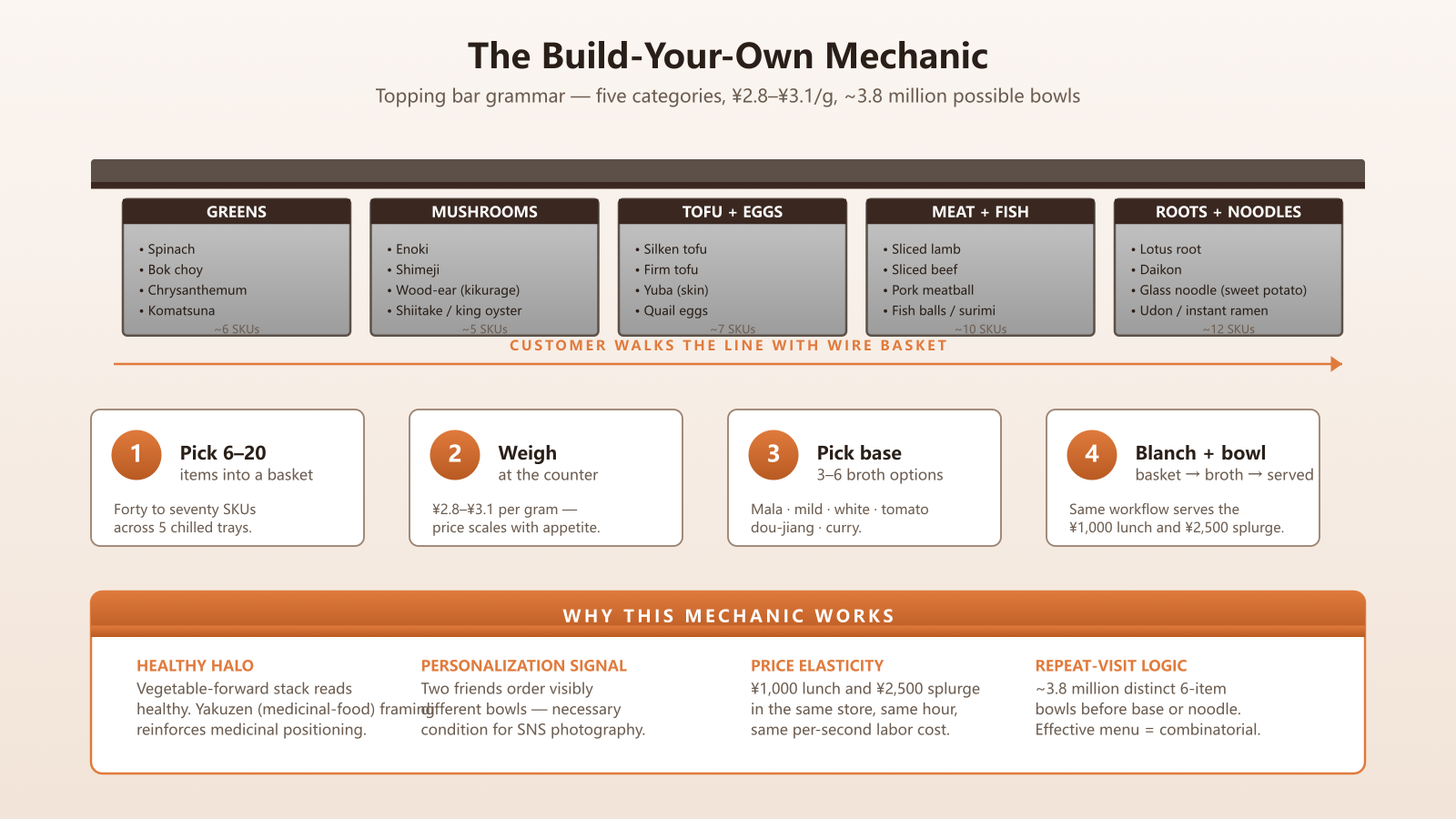
The single most important thing to understand about the Japanese mala tang category, as distinct from earlier Chinese-food trends, is that it is structurally a customization product, not a recipe product.
A Japanese ramen shop sells a recipe. The shop’s tonkotsu-shoyu is the shop’s, and the customer’s role is to choose between the shop’s recipe and a competitor’s. A mala tang shop sells a mechanic. The customer enters, takes a wire basket, walks the length of a refrigerated topping bar, and chooses anywhere from six to twenty individual ingredients. The basket is weighed at the counter. The customer chooses a soup base from a menu of typically three to six options — original mala, mild mala, white-broth (no chili), tomato, dou-jiang, curry. The customer chooses a noodle (sweet-potato glass noodles by default; udon, instant ramen, rice noodles, no noodles as alternatives). The total is calculated by weight, with toppings priced at ¥2.8–¥3.1 per gram (about USD $0.02 per gram, or roughly $7 per quarter-pound of mixed toppings). The bowl assembled in this way runs ¥1,200–¥2,000 at the median, with the upper tail trending toward ¥2,500 for heavily customized orders.
That mechanic does several things at once that Japanese fast-casual had not previously combined.
It produces a healthy halo. The customer who chooses six vegetables and three protein items reads their own bowl as healthy in a way that the same customer would not read a ramen as healthy, even if the calorie counts ended up similar. The vegetable-forward presentation, combined with the marketing emphasis on medicinal spices (the “yakuzen / ” aesthetic), reinforces a reading of the dish as nutritionally serious rather than indulgent.
It produces personalization signaling. Two friends ordering at the same shop will assemble visibly different bowls, and the difference is legible — colors, ingredients, the geometry of how things sit in the bowl. That visual differentiation is the necessary pre-condition for the SNS-photography mechanic that drives the trend’s viral spread.
It produces price elasticity. A diner who wants a ¥1,000 lunch can order a ¥1,000 lunch by choosing fewer ingredients. A diner who wants to splash out can hit ¥2,500. The same store serves both customers in the same hour, with the same kitchen workflow, at the same per-second labor cost.
It produces repeat-visit logic. The customer who came last week and ordered the spinach-tofu-mushroom-quail-egg-bok-choy combination can come this week and order something different. The shop’s menu is, in effect, the combinatorial space of its toppings — for a forty-item topping bar with six-item bowls, the customer has roughly 3.8 million possible distinct orders before considering soup base and noodle choices.
Why Gen Z Japan Picked This One
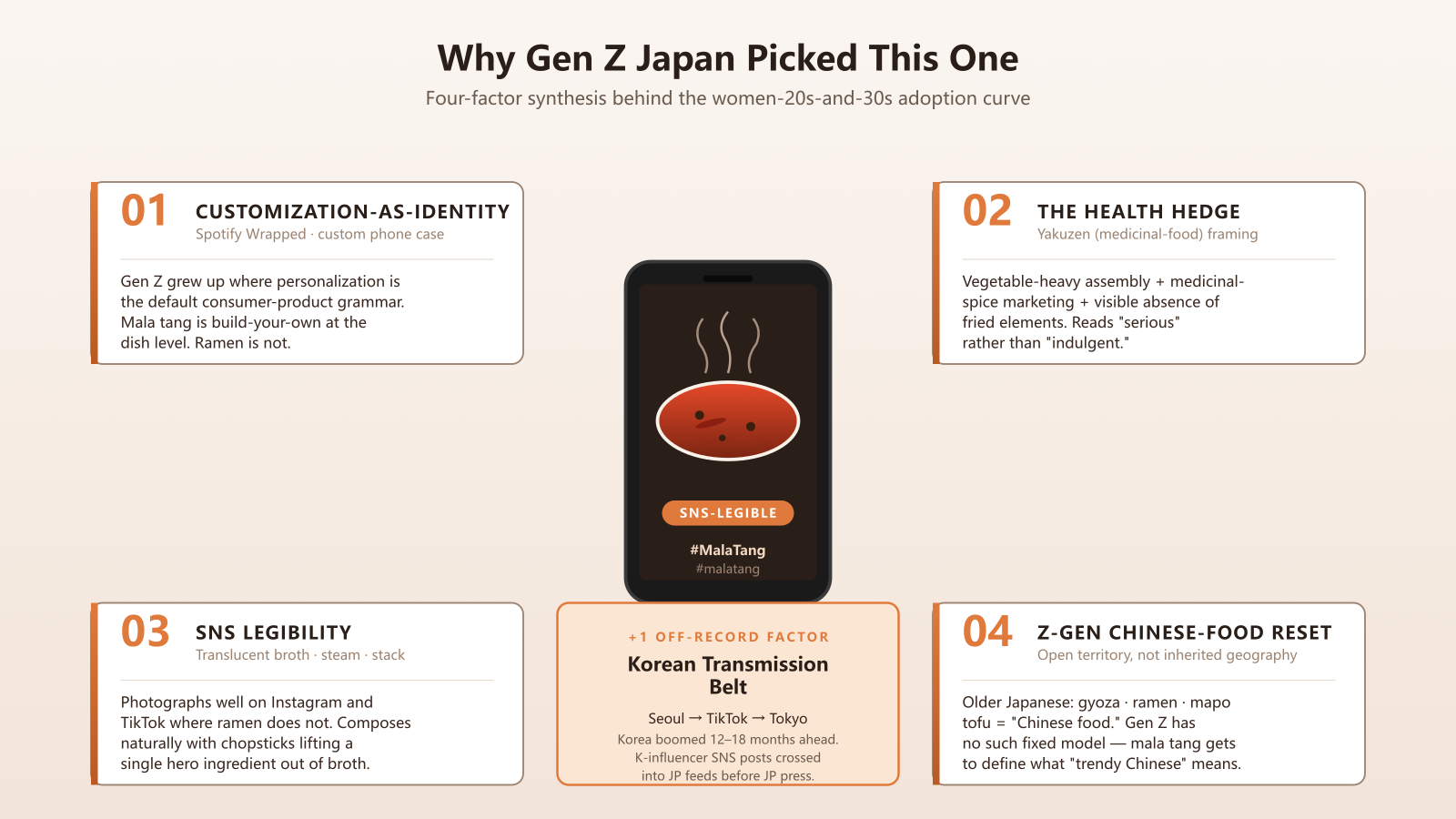
The Cookpad and Trepo data point to women in their 20s and early 30s as the core demographic. The Japanese food press has spent considerable ink on the question of why this demographic, specifically, has anchored the trend. The answer is a four-factor synthesis that is worth understanding precisely because the same logic applies to other emerging fast-casual categories the international market should be watching.
Factor one: customization-as-identity. The Gen Z consumer has been raised in a media environment where personalization — Spotify Wrapped, Pokémon teams, custom phone cases, build-your-own bubble tea — is the default consumer-product grammar. A category that fails to offer build-your-own logic is, structurally, less appealing to this demographic than one that does. Mala tang is build-your-own at the dish level. Ramen is not.
Factor two: the health hedge. Japanese Gen Z consumers track their nutritional intake and, in survey data, rank “healthy” as a more important meal attribute than any Japanese demographic above them. The vegetable-heavy assembly logic of mala tang plays directly into this. So does the medicinal-spice framing. So does the visible absence of fried elements (most ramen contains them; mala tang does not).
Factor three: SNS legibility. A bowl of mala tang photographs well on Instagram and TikTok in a way that a bowl of ramen does not. The translucent red broth, the visible ingredient stack, the steam rising off the surface, and the ability to compose the photo with the customer’s chopsticks lifting a single hero ingredient out of the bowl — all of this is, in the strict marketing sense, made for SNS. The category’s spread in 2024–2025 was substantially driven by Korean influencers (Korea had its own mala tang boom roughly twelve months before Japan) whose content cross-posted into Japanese feeds.
Factor four: the Z-generation Chinese-food reset. Older Japanese consumers grew up with a fixed mental model of Chinese food: gyoza, ramen, mapo tofu. Gen Z has, on average, no such model. The Chinese-restaurant category is, for them, open territory rather than an inherited geography. Mala tang has won the right to define what “trendy Chinese” means for this generation, and the chain operators are actively reinforcing that positioning.
For Japanese Gen Z, mala tang is not a Chinese dish that displaces ramen. It is a Chinese dish that displaces the previous mental model of what Chinese food in Japan even is.
There is also a fifth factor that the Japanese food press has been more reluctant to name explicitly but that operators discuss openly off the record: the Korean influence transmission belt. South Korea experienced its own mala tang boom roughly twelve to eighteen months ahead of Japan, with Seoul’s Daerim and Konkuk-dae neighborhoods anchoring the category and Korean K-pop and lifestyle influencers documenting the trend continuously on TikTok and Instagram. Japanese Gen Z consumers, who follow Korean lifestyle media at a rate substantially higher than any previous Japanese cohort, picked up the trend through that channel before it appeared in domestic Japanese media. The Korean-Japanese trend-import dynamic — once dominated by music, then beauty, then fashion — has become, in the 2024–2026 cycle, food. Mala tang is the most visible example. Tanghulu (the Chinese candied-fruit skewer that hit Korea before Japan), mara xiang guo (the dry-mala stir-fried cousin of mala tang), and several variants of Sichuan barbecue have followed the same pathway with smaller boom curves.
The Industrial Tail: Convenience Stores, Cup Noodles, and the 10-Million-Cup Pivot
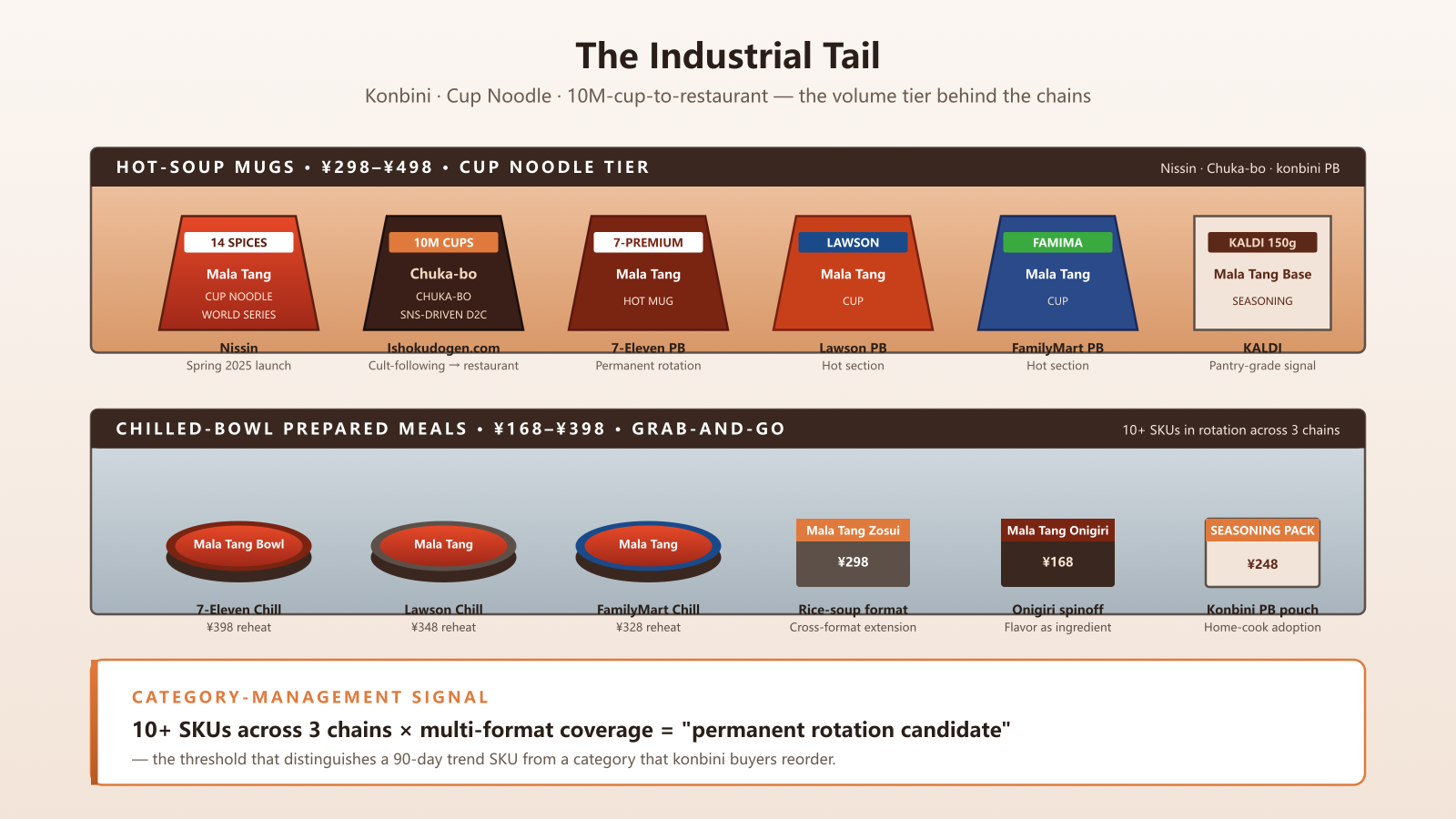
The chain-restaurant story is half of the picture. The other half is the industrial tail — the supermarket, convenience-store, and instant-noodle products that have followed the dish into mainstream Japanese retail and that, in volume terms, are now larger than the restaurant tier.
The breakthrough product on this side was Nissin’s “Cup Noodle 14 Spices Mala Tang,” first released in spring 2025 as part of the company’s “World’s Cup Noodle” series and re-released in April 2026 to meet the trend’s continued momentum. Nissin is the dominant Japanese instant-noodle operator and its decision to commit a Cup Noodle SKU to the mala-tang flavor profile is, by industry reading, a statement that the category has crossed the durability threshold. Nissin does not produce volatile-trend Cup Noodles. It produces SKUs it expects to sell for at least three years.
And then there is the Chuka-bo phenomenon. Ishokudogen.com’s “Chuka-bo Mala Tang” cup noodle — a single-product SKU sold primarily through SNS-driven direct-to-consumer channels — sold 10 million cumulative units before the company opened its first physical restaurant in February 2026. That is not the normal sequence. Restaurants typically expand into packaged goods. Chuka-bo did the reverse: a packaged good built a cult following, and the cult following supported a restaurant chain that the company is now scaling toward “dozens of locations” within 2026. This sequence is, as far as the author can determine, unique to Japan’s 2020s social-commerce environment, and worth flagging for any international food-service operator who is thinking about how SNS cult-following dynamics might inform expansion planning.
The convenience-store mala-tang category itself rewards a closer look. As of March 2026, the major chains — 7-Eleven, Lawson, FamilyMart — collectively rotate more than ten distinct mala-tang products across hot-soup mugs, chilled-bowl prepared meals, instant cups, and seasoning packets, at a price band running from ¥168 to ¥498. That breadth is, in the Japanese convenience-store category-management vocabulary, the signal that distinguishes a “trend SKU” (one experimental product per chain, 90-day shelf life) from a “permanent rotation candidate” (multiple products per chain, multi-format coverage, repeat reorders). Mala tang has, by spring 2026, clearly crossed that line. KALDI’s pre-portioned 150 g seasoning has likewise become one of the chain’s higher-velocity Asian-spice SKUs since launch — the kind of pantry-grade product that signals home-kitchen adoption rather than just dining-out novelty.
What This Means for International Operators
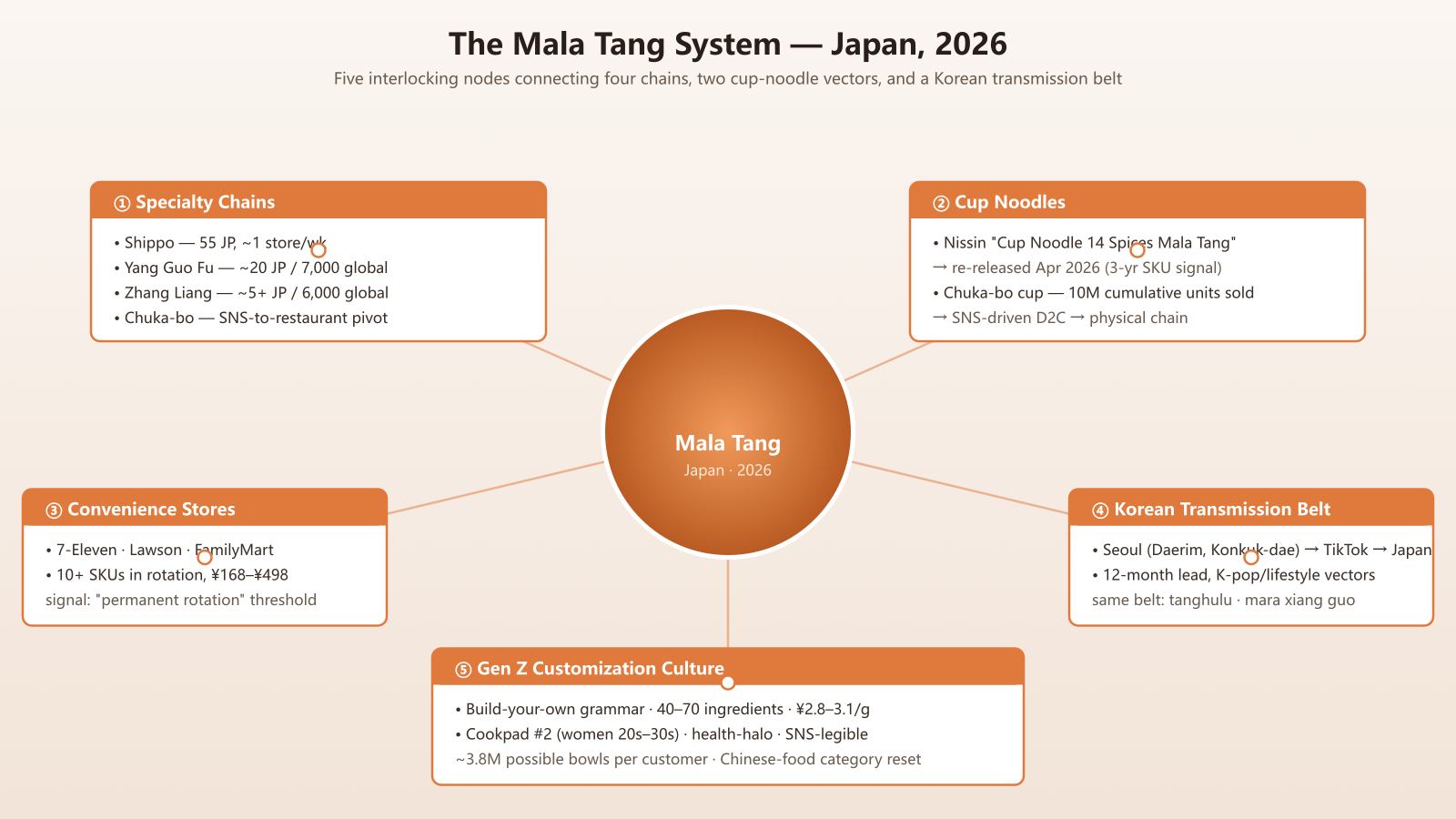
Step back from the Japanese chain story and the structural picture for English-language readers comes into focus.
A 2,000-year-old Sichuan soup, almost unknown in mainstream Japanese retail in 2020, is now the #2 food trend of 2025, with four chain operators expanding at roughly one new location per week, a Cup Noodle SKU committed to the flavor profile, ten or more convenience-store products on rotation at any given time, and a 10-million-cup direct-to-consumer SKU that has now backwards-integrated into restaurants. The category has produced a specialist fast-casual format with a build-your-own mechanic in a market that, six years ago, was considered closed to that kind of structural innovation.
For international operators, three implications are worth taking seriously.
The first is that the Japanese fast-casual market is not closed. A category that did not exist as a chain format in 2022 produced four competing chain operators by 2026, with no apparent ceiling on the expansion. The “Japanese consumer prefers full-service ramen and izakaya” assumption — long taken as axiomatic in Western trade-press coverage — needs revising.
The second is that the build-your-own mechanic is now naturalized in Japan. A demographic raised on bubble-tea customization has accepted, and is actively rewarding, the same logic at the savory-soup level. Operators with build-your-own concepts in adjacent categories — poke, salad, grain bowls, congee — should treat the Japanese market as more open than the 2020-era consensus suggested.
The third is that Japan’s instant-noodle and convenience-store distribution remains the world’s most efficient industrial tail for new flavor categories. A trend that takes a chain of restaurants 18 months to consolidate in the U.S. or Europe consolidates in Japan in 6–9 months because the convenience-store and cup-noodle channels move that quickly. This is not a marketing cliché. It is an operational reality that determines which markets are worth entering first.
TL;DR — What to Watch
If you want to see the category at its purest: Shippo Mala Tang in Tokyo (Shibuya, Akasaka, Iidabashi locations, ¥925 base, toppings at ¥3.1/g). The Japan-domestic chain is the best read on what the trend looks like as a mature, optimized format.
If you want to see the global Chinese-chain comparison point: Yang Guo Fu at Kinshicho Marui or any of the 20 Japanese locations. Closer to the mainland-China original recipe, with a denser broth and a wider ingredient case.
If you want to see the SNS-to-restaurant pivot in action: watch Chuka-bo’s rollout through 2026. The 10M-cup-noodle base preceded the physical chain, which is the inverse of every previous restaurant-expansion playbook.
If you are an international operator evaluating Japan: the conditions that produced mala tang’s 2024–2025 acceleration — Gen Z customization preference, SNS-driven discovery, convenience-store and cup-noodle distribution capacity — apply equally to any well-built build-your-own category. The window for first-mover advantage in adjacent formats is, today, open.
The mala tang chains are real. The customization mechanic is real. The Cookpad #2 placement is real. The 1,000-store global trajectory the Chinese chain operators have described to Japanese trade press is, on present evidence, deliverable. The rest of the world is approximately one trend cycle behind.
Get in Touch
If you’re interested in this topic, the Japanese market more broadly, or what KETCHUPs is working on, we’d love to hear from you — please reach out via our contact form.
Japan Market Pulse is a weekly read on what the Japanese consumer-tech, food, and mobility markets are choosing to do, written for international operators who want to know what is happening before it shows up in the global trade press.
Subscribe at ketchups.co/japan-market-pulse.
Sources
- Cookpad — 2025 (Food Trend Award 2025 announcement)
- Shippo Mala Tang — Official site
- Yang Guo Fu Mala Tang Japan — Daitengen Co.
- Zhang Liang Mala Tang Japan
- Chuka-bo — Ishokudogen.com
- Nissin Cup Noodle — World’s Cup Noodle 14 Spices Mala Tang series
- Trepo — Gen Z Trend Ranking 2024 H2 (Gourmet category)
- KALDI Coffee Farm — pantry-grade mala-tang seasoning SKU
If you’re interested in this topic, the Japanese market more broadly, or what KETCHUPs is working on, we’d love to hear from you — please reach out via our contact form.
Japan Market Pulse is a weekly read on what the Japanese consumer-tech, food, and mobility markets are choosing to do, written for international operators who want to know what is happening before it shows up in the global trade press.
Subscribe at ketchups.co/japan-market-pulse.