

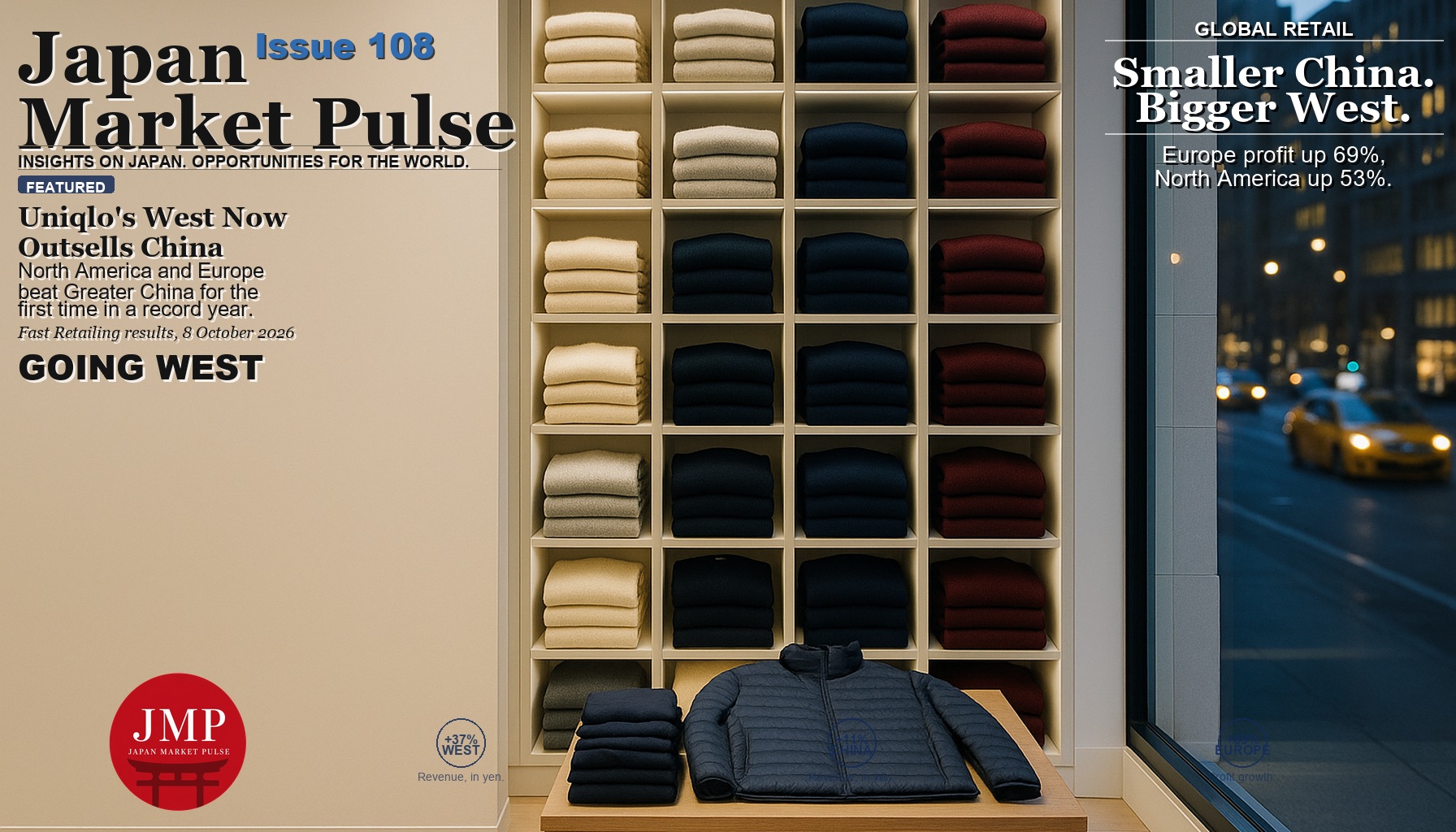
On 8 October 2026, Fast Retailing, the Tokyo-listed company behind Uniqlo, reported its results for the year to 31 August. The headline numbers were the kind that usually get one paragraph in the business press: revenue up 16.6% to ¥3.96 trillion, operating profit up 31.7% to ¥743.1 billion, a fifth consecutive year of record profit, and a result that beat both the company’s own forecast and the average of the analysts who follow it.
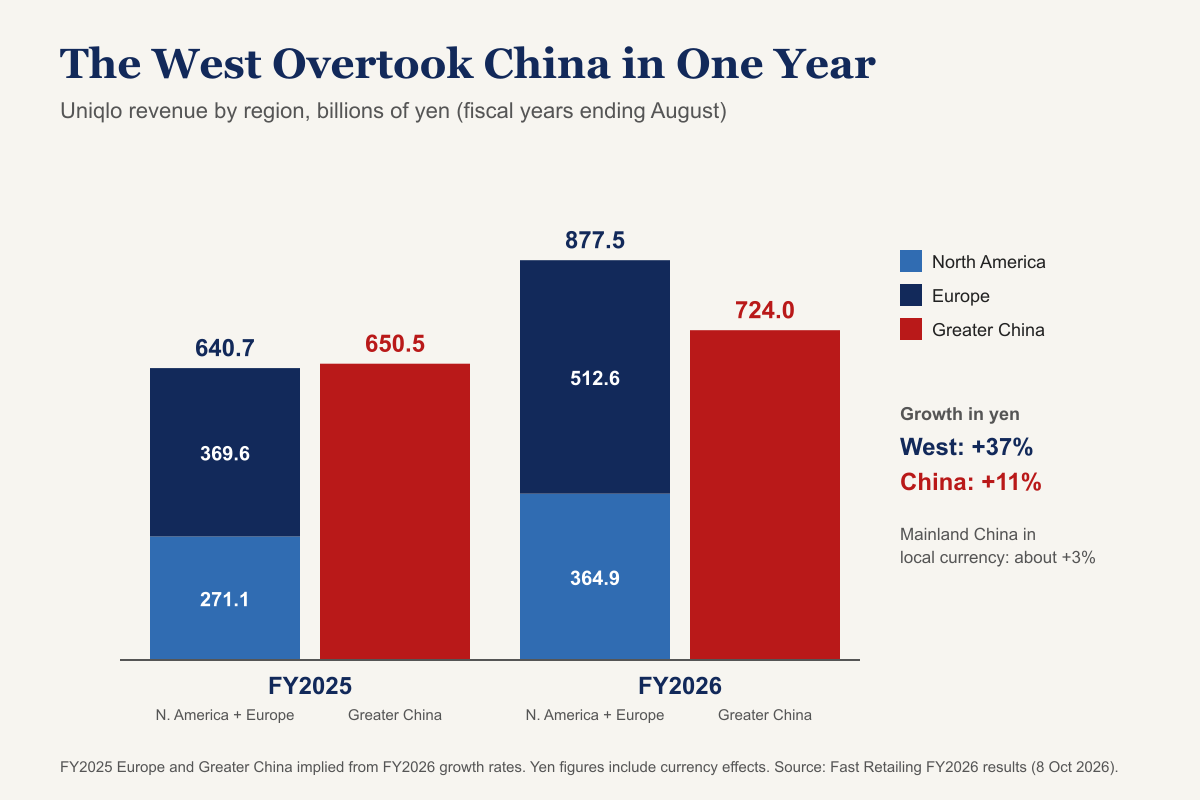
Buried a few lines lower was a number that matters far more to anyone who sells consumer products across borders. For the first time, Uniqlo’s combined revenue in North America and Europe — ¥877.5 billion — was larger than its revenue in Greater China, which came in at ¥724.0 billion.
That sentence would have sounded unlikely five years ago. China was the market that turned Uniqlo from a Japanese casual-wear chain into an Asian giant. It was the region every investor presentation led with. Western markets, by contrast, were where the brand had spent the better part of two decades closing stores, rethinking formats and losing money. The United States in particular was treated for years as Uniqlo’s expensive education.
Now the education is paying. In one fiscal year, Uniqlo North America grew revenue by 34.6% and business profit by 53.3%. Uniqlo Europe grew revenue by 38.7% and business profit by 69.0%. Meanwhile, the company shrank its store network in mainland China by 74 stores from the peak and still raised profit there.
I have watched Uniqlo for a long time from the Tokyo side — the folded-knitwear walls in Ginza, the suburban roadside stores where families buy the same stretch trousers every spring, the yearly ritual of HEATTECH displays going up in October. What is new is not that Uniqlo is good at retail. It is that the company has worked out how to be good at retail in markets that do not share Japan’s habits, and that its centre of gravity is visibly moving west.
This is the long version of what happened. It covers the numbers behind the flip, how a single shop in Hiroshima became a ¥3.96 trillion business, why Europe quietly became the star, what changed in America, why fewer stores in China produced more profit, how a saturated home market still grew, how Uniqlo now stacks up against Zara and H&M, what the founder’s ¥10 trillion ambition implies, and what any brand selling internationally should take from all of it.
The Number That Flipped: ¥877.5 Billion vs ¥724 Billion
Start with the segment table, because the flip is easy to state and easy to misread.
Fast Retailing reports Uniqlo’s overseas business as a single segment called Uniqlo International, which booked revenue of ¥2.41 trillion in fiscal 2026, up 26.2%, and business profit of ¥439.8 billion, up 44.1%. Inside that segment, the company breaks out four regions.
Greater China — mainland China, Hong Kong and Taiwan — produced revenue of ¥724.0 billion, up 11.3%, and business profit of ¥112.0 billion, up 24.6%.
South Korea, Southeast Asia, India and Australia, which Fast Retailing groups together, produced revenue of ¥809.4 billion, up 30.7%, and business profit of ¥168.3 billion, up 44.0%.
North America produced revenue of ¥364.9 billion, up 34.6%, and business profit of ¥67.9 billion, up 53.3%.
Europe produced revenue of ¥512.6 billion, up 38.7%, and business profit of ¥91.7 billion, up 69.0%.
Add North America and Europe together and you get ¥877.5 billion — more than Greater China, and also more than the South Korea, Southeast Asia, India and Australia block. On a regional basis, the West is now Uniqlo’s largest overseas market.
Work the growth rates backward and the speed of the change becomes clear. In fiscal 2025, North America’s revenue was ¥271.1 billion. Europe’s, implied by this year’s growth rate, was roughly ¥370 billion. Together that is about ¥641 billion — a little below Greater China’s implied ¥650 billion that year. In a single year, the West went from just behind China to more than ¥150 billion ahead.
There is an important caveat, and it is one any operator reading yen-denominated results should keep in mind. A weak yen inflates overseas revenue when it is translated back into yen. The clearest evidence is in Fast Retailing’s own disclosure for mainland China: revenue there rose about 3% in local currency, while Greater China revenue in yen rose 11.3%. Part of every overseas growth number in this report is currency, not customers. That does not change the ranking — the Western regions grew far faster than China on any measure the company gives — but it does mean the yen figures flatter the absolute scale of growth.
The profit picture is also worth pausing on. On the company’s numbers, business profit as a share of revenue was about 18.6% in North America and 17.9% in Europe, compared with about 15.5% for Greater China. For years, the assumption was that Uniqlo earned its money in Asia and spent it in the West. In fiscal 2026, the Western regions were among the most profitable parts of the group.
From a Hiroshima Side Street to 2,500 Stores
To understand why this matters inside Japan, it helps to remember how small Uniqlo once was.
The first store, called Unique Clothing Warehouse, opened in Hiroshima in 1984. It was a casual-wear shop attached to a family clothing business run out of Yamaguchi Prefecture by Tadashi Yanai, who is still the company’s chairman, president and chief executive, and who is now regularly described as Japan’s richest person. The business became famous at home in the late 1990s with cheap, well-made fleece jackets. It became a national institution in the 2000s with HEATTECH thermal underwear and AIRism cooling basics — functional products developed with the Japanese materials company Toray and sold under a philosophy the company calls LifeWear.
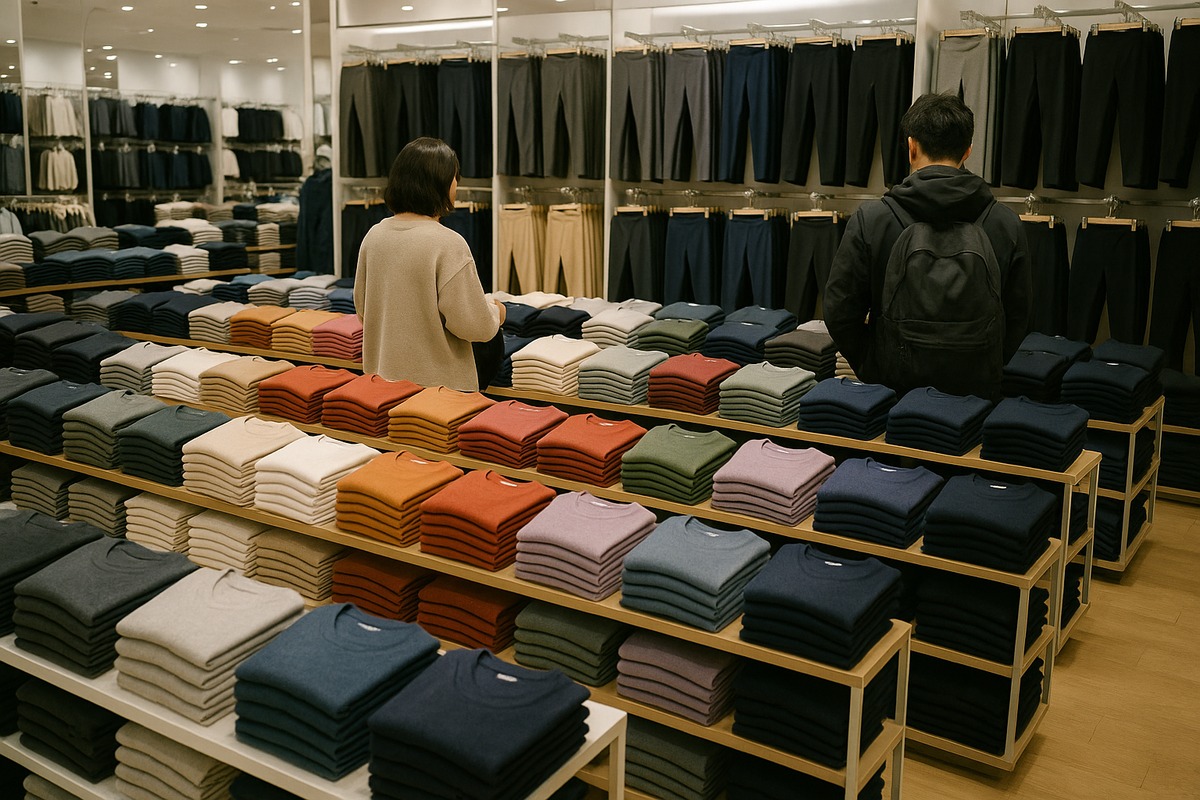
The LifeWear idea is the key to everything in this story. Uniqlo does not try to sell the season’s trend. It tries to sell the basic garment people will buy again: the T-shirt, the down jacket, the stretch trousers, the merino sweater, the bra top. It aims for fabric technology, consistent fit and reasonable price rather than novelty. That is a fundamentally different model from Zara or H&M, which are built around speed and newness.
In Japan, that model became almost a utility. Uniqlo is the store people go to for the thing they already know they need. That reliability is why the brand could grow to roughly 2,500 Uniqlo stores worldwide, and why its home business still produced revenue of ¥1.08 trillion in fiscal 2026.
The same reliability was, for a long time, the brand’s problem abroad. In markets where shoppers did not already know the products, a store full of plain basics in neat stacks did not automatically read as exciting. Customers in New York or London had to be taught why a ¥1,990 T-shirt was different from any other cheap T-shirt. That teaching took years, and it is a large part of why the Western business lost money for so long.
What changed is that Uniqlo stopped trying to win the West with lots of ordinary stores and started trying to win it with fewer, bigger, louder ones — combined with product that Western customers now actively seek out. The fiscal 2026 results credit new flagship stores, brand communication and on-trend items such as curved-hem trousers with attracting new customers. That is the playbook. The rest of this article is about how it played out market by market.
Europe: The Region Nobody Was Watching
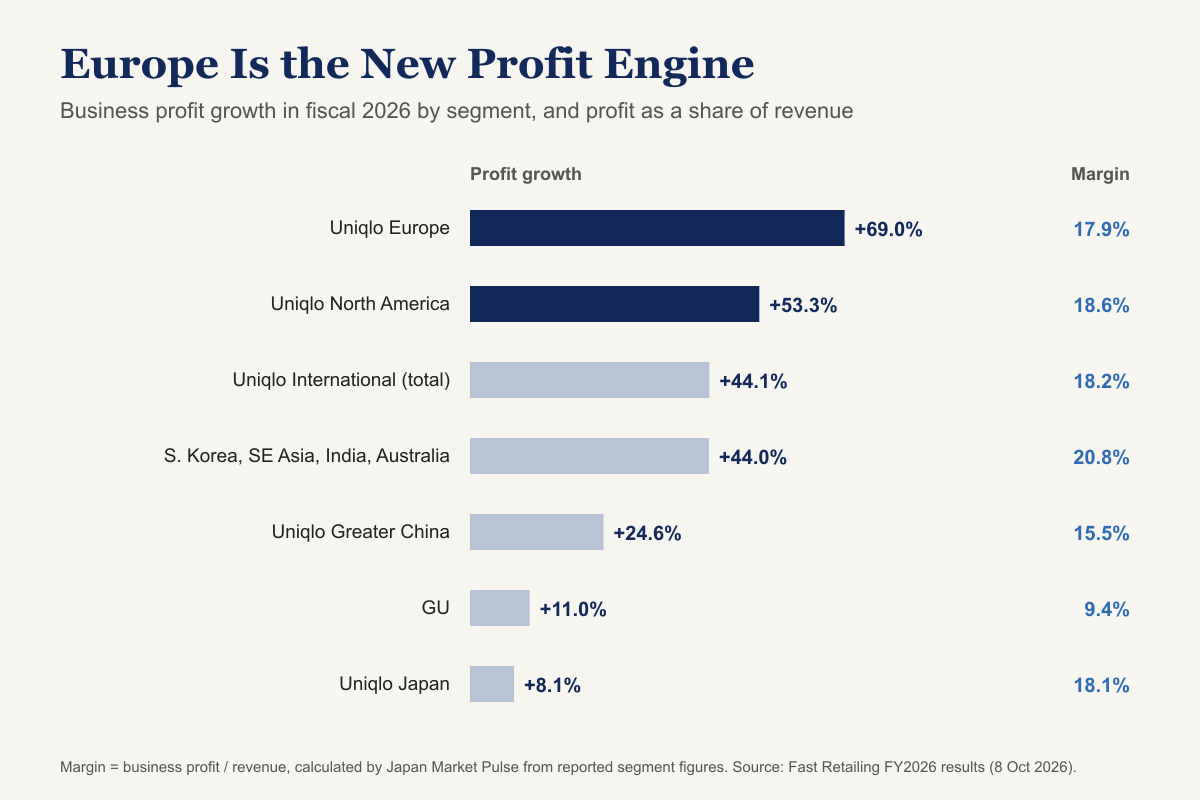
If you had asked most retail analysts five years ago which of Uniqlo’s overseas regions would post the fastest profit growth in fiscal 2026, very few would have said Europe. Yet Europe is the standout of this report: revenue of ¥512.6 billion, up 38.7%, and business profit of ¥91.7 billion, up 69.0%. Europe alone now generates more revenue than North America, and more business profit.
Why Europe, and why now?
Part of the answer is format. Uniqlo’s European growth has been built largely on large city-centre stores in capitals and major shopping streets rather than on dense networks of smaller units. Flagship stores in prominent locations work as advertising as well as retail. They tell shoppers what the brand is, in a way that a mall unit cannot.
Part of the answer is product. The LifeWear proposition — technical basics that last — lines up neatly with a European consumer mood that has been moving away from disposable fast fashion. European regulators and media have spent several years criticising ultra-cheap, short-lived clothing. A brand that sells durable basics at moderate prices sits on the right side of that argument without having to make it loudly.
And part of the answer is competition. Inditex and H&M are both European companies with mature European store networks. Their growth in their home region has slowed. Uniqlo, starting from a much smaller base, has room to grow where the incumbents are looking for efficiency.
Fast Retailing’s own segment commentary does not break Europe down by country, and I will not pretend to more precision than the company provides. But the scale of the result is enough to make a point that matters for every Asian brand looking at Western expansion. A non-European brand can grow very fast in Europe if it offers something the local leaders do not: in Uniqlo’s case, a clear product promise built on materials and fit rather than on trend speed.
America: Flagships, Baseball and a 200-Store Target Still Out of Reach
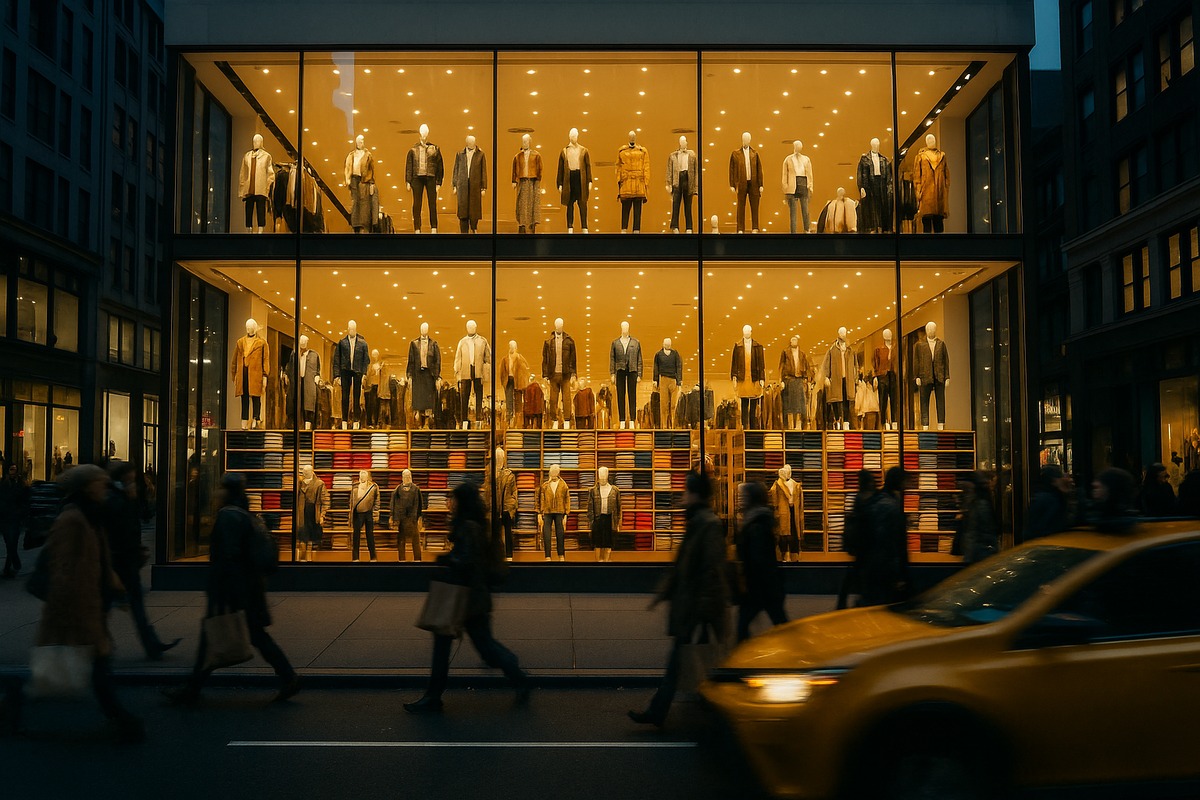
The American story is the one with the longest history of disappointment, which is what makes this year’s numbers stand out.
Uniqlo entered the United States in 2005 with stores in New Jersey malls that struggled and closed. It reset with a large store in New York’s SoHo in 2006 and a Fifth Avenue flagship in 2011, then went through another round of expansion and retrenchment in the 2010s. For much of that period, the North American business either lost money or made very little.
In fiscal 2025, North America generated revenue of ¥271.1 billion and business profit of ¥44.2 billion. In fiscal 2026, it generated ¥364.9 billion and ¥67.9 billion. At Reuters’ reference rate of 158.2 yen to the dollar, that is roughly $2.3 billion of revenue — still small by American apparel standards. Old Navy alone, Gap Inc.’s largest brand, reported net sales of $8.7 billion for its fiscal 2025. Uniqlo is growing fast in the United States, but it is growing from a modest base.
The growth is coming from a deliberate push. In January 2026, Uniqlo announced a slate of new U.S. stores for the year, including flagship stores in Chicago and San Francisco, four stores across New York City and the brand’s first store in Miami, along with locations in Boston, Maryland, Washington, D.C., and the Seattle area. At the time, the company said it operated 78 stores in the United States. Fast Retailing has repeatedly talked about reaching around 200 stores in North America by 2027, and trade publications such as Inside Retail have noted that the company remains well behind that pace.
Marketing has shifted too. Uniqlo has become a visible sponsor in American sport, most conspicuously through its partnership with the Los Angeles Dodgers, whose playing field now carries the name Uniqlo Field. That is a striking choice for a brand that, a decade ago, was still explaining to American shoppers what it was. It also fits the flagship logic: put the brand in front of very large audiences in a setting that signals scale and confidence.
There is a cost side as well. Fast Retailing executives have been open about the effect of U.S. tariffs on prices, and the company’s U.S. operation said in 2025 that it planned to raise some prices. According to the commercial real-estate outlet Bisnow, most Uniqlo products sold in America are made in South and Southeast Asia rather than China, which would soften but not remove the impact. That the North American business grew profit by more than half in this environment suggests that pricing power, not just volume, is improving.
China: 74 Fewer Stores and Higher Profit
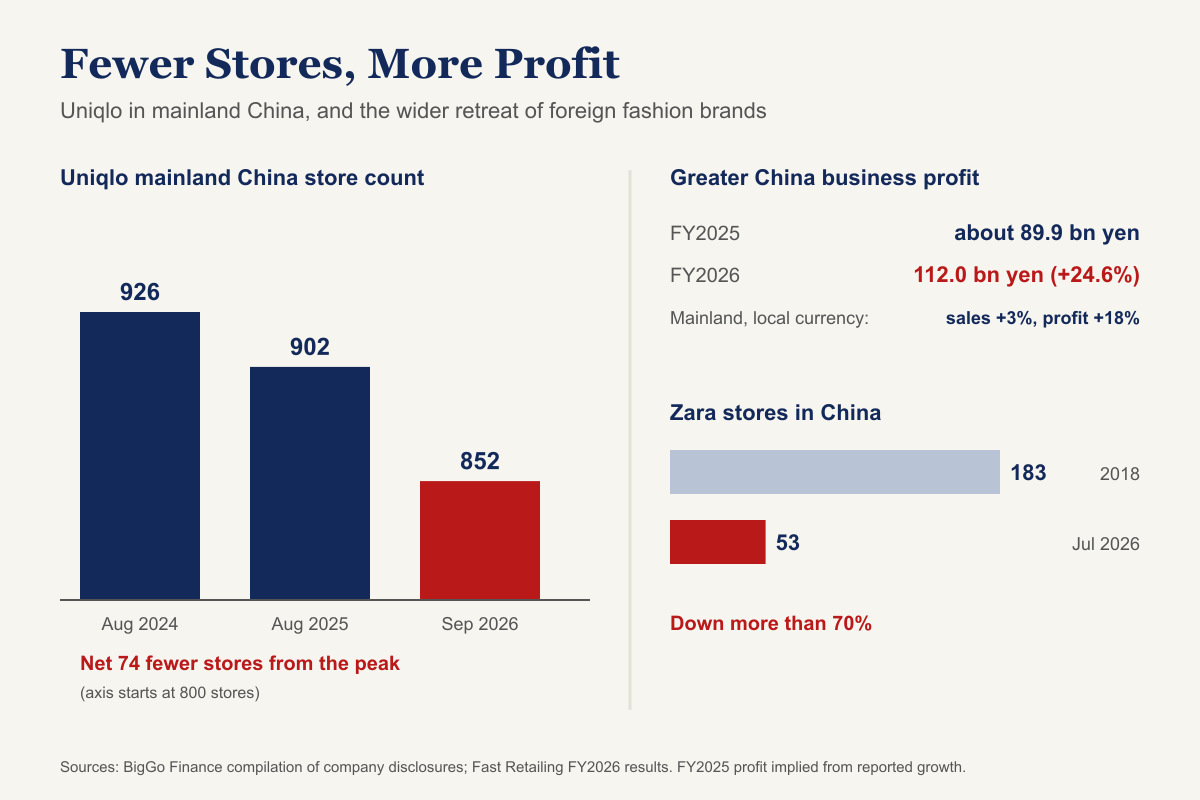
The China story is the mirror image of the Western one, and it is just as instructive.
For more than a decade, mainland China was Uniqlo’s growth engine. The company opened stores at a pace few foreign retailers could match; in 2022 it was still talking about adding 80 to 100 stores a year there. Then Chinese consumer spending slowed, domestic brands improved quickly, and the arithmetic of opening ever more stores stopped working.
According to figures compiled from company disclosures by the Chinese financial outlet BigGo Finance, Uniqlo’s mainland China store count peaked at 926 in August 2024 and fell to 902 by the end of August 2025. BigGo Finance put the count at 852 as of 30 September 2026, which would be a net reduction of 74 stores from the peak. In fiscal 2025, Greater China revenue fell 4% and business profit fell 12.5%.
In fiscal 2026, with fewer stores, Greater China revenue rose 11.3% in yen to ¥724.0 billion and business profit rose 24.6% to ¥112.0 billion. In local currency, mainland China revenue was up about 3% and business profit up about 18%, with the profit margin improving to around 16%.
The company’s explanation is a strategy shift from store expansion to sales and profit per store: closing small or poorly located stores, relocating and enlarging others, and improving the ones that remain. Some relocated and renovated stores have reached around 1.5 times their previous monthly sales, according to the same report. The most visible example is in Shanghai, where Uniqlo’s large Huaihai Road flagship is moving a short distance along the same street, reopening on 30 October 2026 in a smaller but newer space of about 2,800 square metres.
Fast Retailing’s leadership has been careful not to overclaim. Chief operating officer Daisuke Tsukagoshi acknowledged that profit improvement is clearly running ahead of sales recovery in the mainland, and that the company still needs to show that efficiency gains can translate into sustainable sales growth.
Uniqlo is not alone. Inditex’s Zara brand had 53 stores in China as of July 2026, down more than 70% from 183 in 2018, according to the same BigGo Finance report, and H&M has also sharply reduced its mainland network. For foreign apparel brands, China has moved from a market where you win by being everywhere to a market where you survive by being excellent in fewer places. Uniqlo appears to be handling that transition better than most, but the transition itself is the story.
Japan: A Saturated Home Market That Still Grew 5.1%
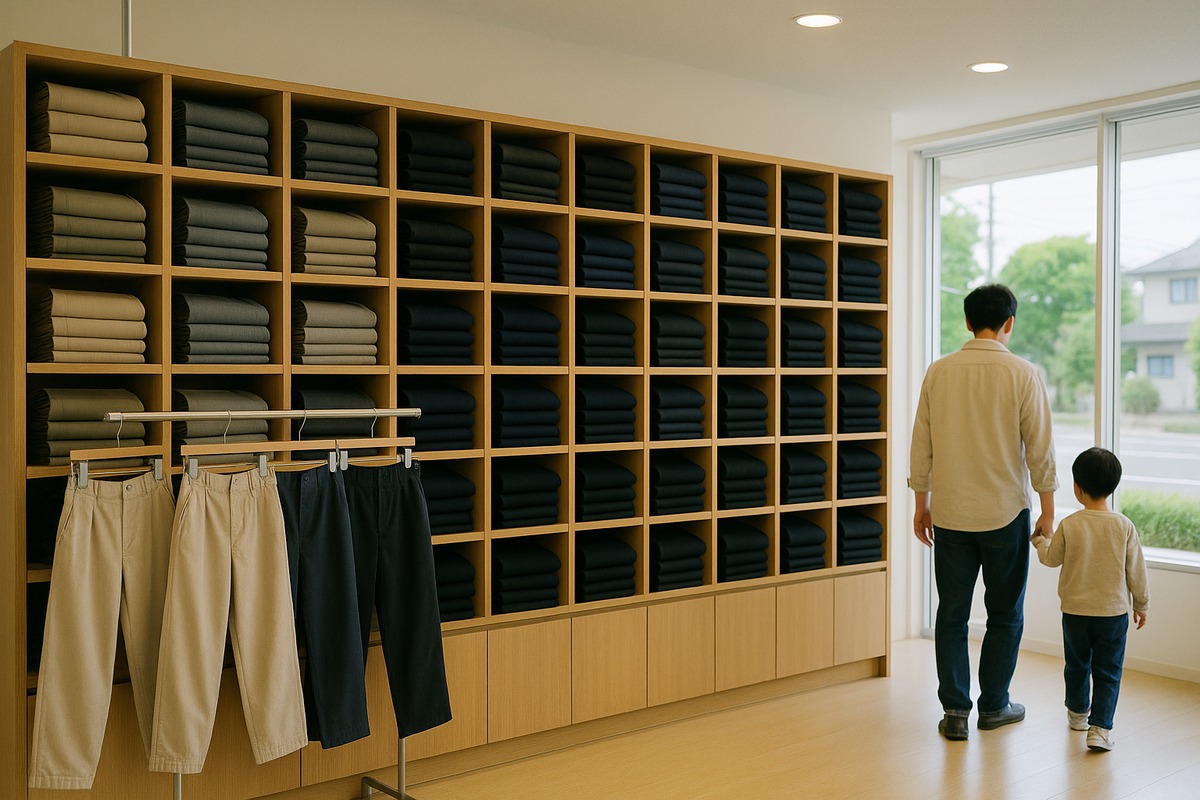
If China is the cautionary tale and the West is the growth story, Japan is the foundation that pays for both.
Uniqlo Japan reported revenue of ¥1.08 trillion in fiscal 2026, up 5.7%, and business profit of ¥196.0 billion, up 8.1%. Same-store sales rose 5.1%. The selling, general and administrative expense ratio improved by 0.4 percentage points to 32.6%. For a brand that has been in nearly every Japanese town for two decades, and whose store count has more or less levelled off, those are strong numbers.
The company credits two kinds of product. The first is functional: ranges like Ultra Stretch trousers and UV-protection items, which matter more every year as Japanese summers get longer and hotter. The second is fashion: on-trend shapes such as curved-hem trousers. In other words, the home business grew by doing what Uniqlo has always done — selling basics people rebuy — while adding just enough newness to give regulars a reason to visit more often.
Japan is also where the company is most exposed to the downside of the weak yen. Management warned that the weak currency is making conditions harder at home, because higher import costs feed into the cost of goods and are expected to lead to price increases. Uniqlo, like nearly every Japanese apparel retailer, makes most of its products overseas and buys them in dollars. A weak yen makes Western revenue look bigger in yen and makes Japanese margins harder to protect. The two effects are linked; the company is effectively being rewarded abroad and squeezed at home by the same exchange rate.
The forecast reflects that. For fiscal 2027, Fast Retailing expects Uniqlo Japan to grow revenue but keep business profit broadly flat, while Uniqlo International delivers double-digit growth in both. Yanai told the Nikkei in August that the company plans to double the number of large flagship stores in Japan to 20 within a decade — a sign that even in a saturated home market, the answer is fewer, bigger, more theatrical stores rather than more of the same.
There is a broader point here for international brands entering Japan. A market that looks saturated on store counts can still grow on same-store sales if the product keeps solving real problems. Japanese consumers are not short of clothing shops. They are short of reasons to change their habits. Uniqlo’s home result is a reminder that the habit is the asset.
The Scoreboard: Uniqlo, Zara and H&M
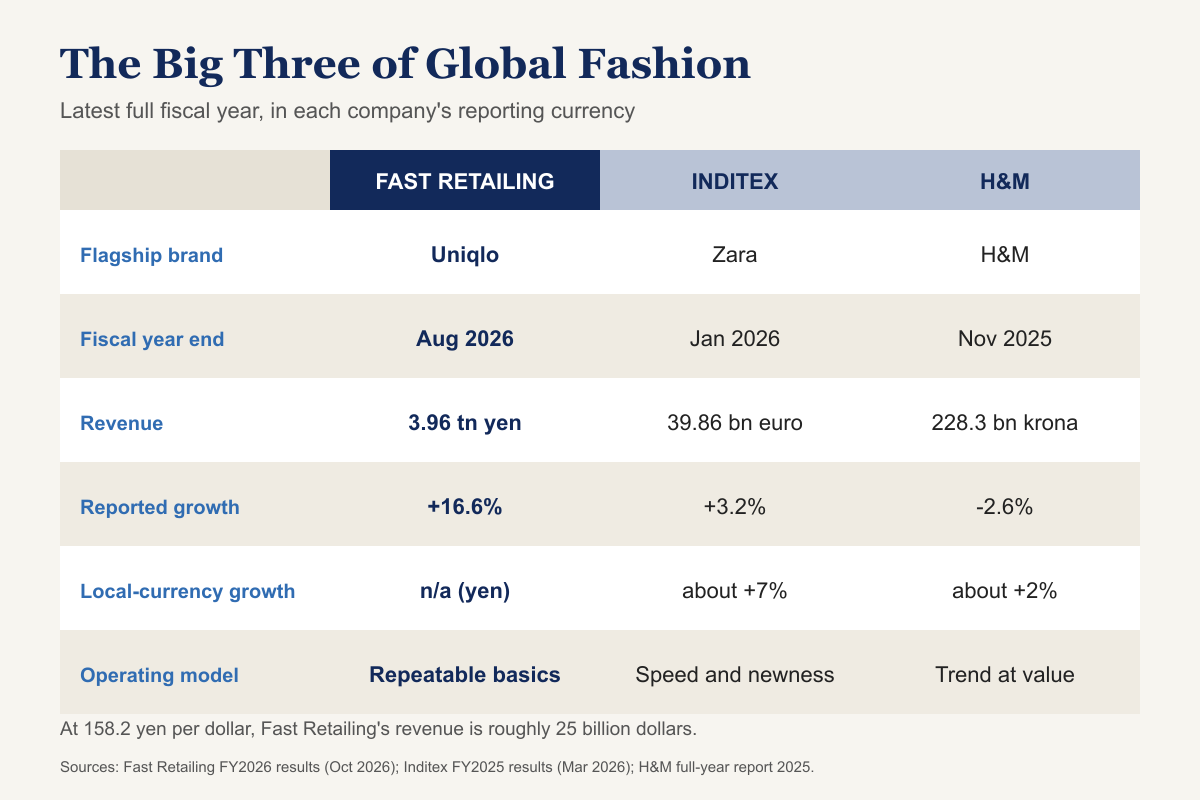
Yanai has said for years that he wants Fast Retailing to become the world’s largest clothing retailer. How close is it?
The two benchmarks are Inditex, the Spanish owner of Zara, and H&M of Sweden. Comparing them precisely is tricky because their fiscal years end in different months and they report in different currencies, so it is more useful to compare scale roughly and growth precisely.
Inditex reported sales of €39.86 billion for its fiscal 2025, which ended in January 2026, up 3.2% in euros and about 7% at constant exchange rates, with net profit of €6.22 billion. It remains clearly the largest of the three.
H&M reported net sales of SEK 228.3 billion for its fiscal 2025, which ended in November 2025 — down in Swedish krona because of a stronger currency, though up about 2% in local currencies — and operating profit of SEK 18.4 billion.
Fast Retailing reported revenue of ¥3.96 trillion for fiscal 2026, ended August 2026, up 16.6%. At Reuters’ reference rate of 158.2 yen to the dollar, that is roughly $25 billion. BigGo Finance cited an estimate of about SEK 222.7 billion, or roughly $22 billion, for H&M’s year to November 2026. On those figures, Fast Retailing has drawn level with or moved past H&M in dollar terms, though exchange rates move and the comparison depends heavily on the rate chosen.
The growth gap is less ambiguous. Fast Retailing grew revenue by double digits for another year and profit by roughly a third. Inditex grew sales by single digits. H&M’s sales were roughly flat in local currencies. Whatever the precise ranking on a given day, Uniqlo is the one of the three that is still growing like a challenger.
The models are also different in a way that matters for the future. Zara wins with speed: fast design cycles, short production runs and a constant flow of new items. H&M has been trying to restore profitability in a similar model. Uniqlo wins with repetition: fewer products, made in enormous volumes, refined every year. In a period when consumers and regulators are both questioning disposable fashion, the slower model has a tailwind. Yanai has said that Inditex and Uniqlo each play to their own strengths, and that is a fair description. But only one of those strengths is getting more fashionable.
UBS analyst Takahiro Kazahaya summed up the company’s position bluntly in comments reported this week: “They are almost a one-of-a-kind existence.”
The ¥10 Trillion Math
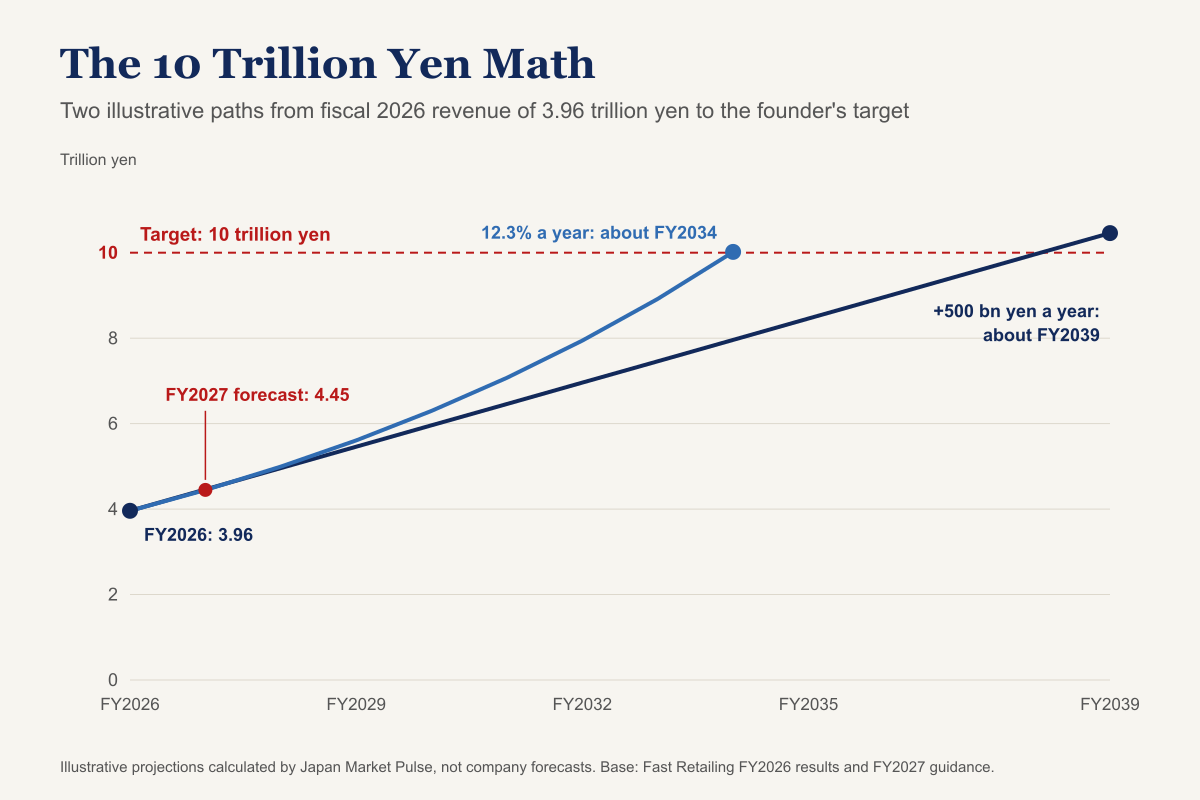
Yanai repeated a target this week that he has talked about for years: annual sales of ¥10 trillion. At Reuters’ rate, that is about $63 billion — well above what any fashion retailer sells today.
His framing was characteristically blunt. The plan, as he described it, is to add around ¥500 billion of new sales each year. “When you say 500 billion yen, in our clothing retail sector, that’s a massive company,” he said. In other words, Fast Retailing intends to add the equivalent of a large clothing company to its revenue every single year.
The arithmetic is worth doing, because it shows how ambitious the target is. Starting from ¥3.96 trillion and adding a flat ¥500 billion a year, Fast Retailing would still be just short of ¥10 trillion after twelve years and would cross it in the thirteenth, around fiscal 2039. If instead it kept growing at the 12.3% rate it forecasts for fiscal 2027 — ¥4.45 trillion — it would get there in about eight years, around fiscal 2034. The company’s own fiscal 2027 forecast implies an increase of roughly ¥490 billion, so the “¥500 billion a year” pace is, for now, roughly what management is guiding to.
Where would the money come from? Yanai has pointed to Southeast Asia, Australia and India as key future growth regions, and the company continues to describe North America and Europe as the main sources of incremental growth over the next year. Fast Retailing projects 1,752 Uniqlo stores outside Japan by the end of fiscal 2027.
Two things could slow the path. The first is currency: a sustained recovery of the yen would make overseas revenue look smaller when translated back, even if customer demand stayed the same. The second is execution in America. The 200-store North American target has not been met on schedule, and any brand that has tried to scale in the United States knows how quickly real estate, labour and marketing costs can eat into margins.
Still, the direction is unambiguous. A company that started as one shop in Hiroshima is now planning on the assumption that most of its future growth will come from outside Asia.
What This Means If You Sell Across Borders: Seven Lessons
For international brands — whether you are a Western company looking at Japan, or an Asian company looking at the West — Uniqlo’s year contains a set of practical lessons.
1. Lead with the product promise, not the price. Uniqlo’s Western breakthrough did not come from being the cheapest option. It came from a clear and repeatable promise about materials, fit and durability. In mature markets, “cheap” is crowded. “Reliably good at a fair price” is not.
2. Flagships are marketing, not just retail. Uniqlo’s turnaround in both America and Europe has been built around large stores in prominent locations. A flagship explains a brand faster than any campaign. For a new entrant, one great store in the right place can do more than twenty adequate ones in the wrong places.
3. In a slowing market, shrink to grow. In mainland China, Uniqlo closed a net 74 stores from its peak and raised profit. More stores is not always more business. When a market matures, the winners are the brands willing to close weak locations quickly and reinvest in the strong ones.
4. Read yen-denominated growth with care. If you benchmark against Japanese companies, separate local-currency growth from translation effects. Uniqlo’s mainland China revenue was up about 3% in local terms and 11.3% in yen. The same distortion runs through every Japanese company’s overseas segment while the yen is weak.
5. Design for rebuying. Uniqlo’s Japanese business grew 5.1% on a same-store basis in a saturated market because people come back for the same products. Products that become habits create the most durable revenue in retail. The question for any brand is which of its products a customer would buy again without thinking.
6. Your home market can be your funding engine, not your ceiling. Uniqlo Japan’s ¥196 billion business profit funded years of Western losses until the Western business could stand on its own. Brands expanding overseas need a home business strong enough to subsidise a long education period abroad. Fast Retailing’s patience in the United States lasted roughly two decades.
7. Sustainability positioning can be structural. Uniqlo does not need to make loud claims about slow fashion; its model of repeatable basics is inherently less disposable than trend-driven fashion. Brands entering Europe in particular should think about whether their model, not just their messaging, fits the regulatory and cultural direction of travel.
Frequently Asked Questions
Q. Is Uniqlo bigger than Zara?
A. Not yet. Inditex, Zara’s parent company, reported sales of €39.86 billion for its year to January 2026, which is substantially larger than Fast Retailing’s ¥3.96 trillion, or roughly $25 billion at 158.2 yen to the dollar. On some exchange-rate assumptions, Fast Retailing has drawn level with or overtaken H&M, but Inditex remains clearly the world’s largest fashion retailer.
Q. Why did Uniqlo’s Western sales overtake China?
A. North America and Europe grew revenue by 34.6% and 38.7% respectively in fiscal 2026, driven by new flagship stores, stronger brand communication and on-trend products, while Greater China grew 11.3% in yen and only about 3% in local currency in the mainland. The company has also been shrinking its mainland China store network to improve profitability rather than chasing volume.
Q. Does the weak yen explain Uniqlo’s overseas growth?
A. Partly. A weak yen inflates overseas revenue when translated back into yen, as the gap between mainland China’s local-currency and yen growth shows. But the Western regions grew much faster than China under the same currency conditions, and their profit margins improved, so the shift is not only a currency effect. At home, the weak yen is a headwind, raising import costs for Uniqlo Japan.
Q. How many Uniqlo stores are there in the United States?
A. Uniqlo said in January 2026 that it operated 78 stores in the United States and announced a slate of new openings for the year, including flagships in Chicago and San Francisco, additional stores in New York City and its first store in Miami. Fast Retailing has long talked about reaching around 200 stores in North America, a target it has not yet met.
Q. What is Fast Retailing’s forecast for next year?
A. For the year ending August 2027, the company forecasts revenue of ¥4.45 trillion, up 12.3%, business profit of ¥830 billion, up 15.5%, and net profit of ¥560 billion, up 3.2%, with double-digit growth expected in Uniqlo International and broadly flat profit in Uniqlo Japan.
Conclusion
For most of its international history, Uniqlo was a Japanese brand that had conquered Asia and was still struggling to be understood in the West. Fiscal 2026 is the year that description stopped being true. North America and Europe together now outsell Greater China. Europe has become the company’s most dynamic profit engine. America, after two decades of false starts, is growing profit by more than half a year. China is being made smaller and better. Japan, saturated as it is, still grew.
Some of the yen-denominated growth is currency, and the ¥10 trillion ambition remains a long way off. But the strategic shift is real, and it carries a message that reaches well beyond clothing. A brand built on a clear product promise, sold through a small number of excellent stores, and backed by a home business patient enough to fund a long education abroad, can change continents. Uniqlo took roughly forty years to get from a single shop in Hiroshima to this point. The next chapter of its story is being written in New York, London, Paris and Miami.
If you’re interested in this topic, the Japanese market more broadly, or what KETCHUPs is working on, we’d love to hear from you — please reach out via our contact form.
Japan Market Pulse is a weekly read on what the Japanese consumer-tech, food, and mobility markets are choosing to do, written for international operators who want to know what is happening before it shows up in the global trade press.
Subscribe at ketchups.co/japan-market-pulse.