

Foodpanda, DiDi Food, DoorDash and Wolt all left. Ten years after launching with about 150 Tokyo restaurants, Uber Eats Japan says it is profitable, in all 47 prefectures and preparing for a planned food-tax cut that, if enacted, could tilt the market further its way. Here is how the last of the first-wave global platforms still standing won, and what it tells anyone trying to sell into Japan.
On 4 March 2026, the Finnish delivery company Wolt switched off its service in Japan. It had arrived about six years earlier, starting in Hiroshima rather than Tokyo, and in 2022 it had become part of DoorDash, the leading US food delivery platform. When DoorDash announced the exit in February 2026, alongside withdrawals from Qatar, Singapore and Uzbekistan, it said the decision reflected the level of investment needed to build a best-in-class product in each country. In plain English: Japan was going to cost too much to win.
Seven months later, on 13 October 2026, Uber Eats Japan held a party in Tokyo. It was celebrating ten years in the country. Its general manager, Yulia Brovkina, told reporters the service had passed one billion cumulative orders, now covered all 47 prefectures with roughly 140,000 partner stores, and had been profitable for three consecutive years with sales continuing to grow. Nikkei Asia called it the clear leader of Japan’s food delivery market. Celebrity guests, including a comedian who also delivers for the platform, were on stage to talk about how often they order.
The contrast is the story. Japan is a country where the world’s largest delivery platforms have repeatedly concluded that the economics do not work. Delivery Hero’s foodpanda came and went. China’s DiDi Food came and went. DoorDash came, folded its own brand into Wolt, and then took Wolt home too. Japan’s largest domestic player, Demae-can, has been losing money for years despite heavy backing from the LINE messaging group. Yet one American platform has not only survived but turned a profit, and is now positioning itself for a government tax cut that, by its own executives’ reading, could push more of Japan’s food spending through its app.
This is a longer read than usual. It covers how the market got here, why Japan is such an unforgiving place to run a delivery business, how the price war of 2025 and 2026 is being fought, what the April 2027 food tax change could do, and what international operators — whether you run a restaurant brand, a consumer goods company or a marketplace — should take from the last app standing.
The Graveyard: Four Global Delivery Brands That Left Japan
It helps to start with the exits, because they explain how unusual the survivor is.
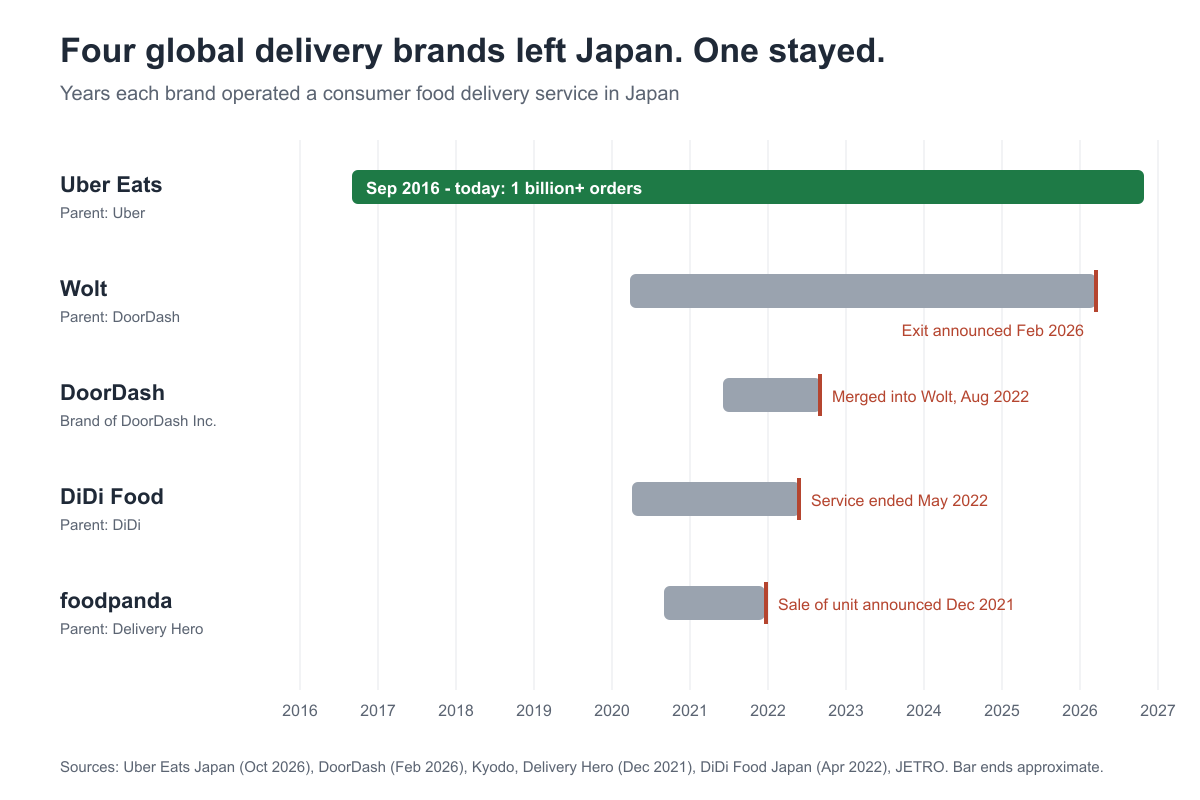
Foodpanda. Delivery Hero, the Berlin-based group behind foodpanda, brought the brand to Japan in September 2020, in the middle of the pandemic boom. Fifteen months later, on 22 December 2021, it announced plans to divest the Japanese unit as part of a broader shift of resources toward growth markets and quick commerce, and the service ended in January 2022. In delivery terms, that is a very short life.
DiDi Food. The food arm of China’s ride-hailing giant launched in Osaka in April 2020 and expanded to nine prefectures. In April 2022 it announced it would end the service on 25 May 2022, citing local market conditions and saying it would concentrate on ride-hailing in Japan. Most of its roughly 200 employees were expected to be let go.
DoorDash (the brand). DoorDash launched in Sendai in June 2021, its first Asian market after Australia and Canada. Within months it had agreed to buy Wolt in a share deal valued at about US$8.1 billion, completed in 2022. DoorDash’s Japanese app was switched off on 31 August 2022 and its operations merged into Wolt, which became DoorDash’s only brand in Japan.
Wolt. Wolt set up its Japanese subsidiary in Tokyo in October 2019 and launched in Hiroshima in 2020, deliberately building in regional cities before Tokyo. It expanded steadily, but in February 2026 DoorDash said it would wind down Wolt in Japan. The service ended on 4 March 2026, after about six years in the country.
Look at those four together and a pattern emerges. These were not undercapitalised startups. They were subsidiaries of some of the best-funded delivery companies in the world, and each one arrived with a credible playbook from markets where it was winning. Three of the four entered between 2020 and 2021, when Japanese households were staying home and delivery demand was surging. All four were gone by early 2026.
The casualties are not only foreign. In August 2026 the telecom operator KDDI announced that it would close menu, the delivery app it had backed, and dissolve the operating company; the service ended on 30 September 2026. Japanese media reported that KDDI saw little prospect of improving profitability in a fierce fight for share with Uber Eats and others. Meanwhile, new challengers keep arriving: since 2025 there has been Rocket Now, run by the Japanese arm of Coupang, the US-listed company behind South Korea’s dominant shopping app. Circana Japan’s analyst Sayaka Azuma told Kyodo she expects the cycle of exits and new entries to continue. The graveyard, in other words, is still taking new residents.
Ten Years, One Billion Orders: How Uber Eats Got Here
Uber Eats started in Japan in September 2016 with about 150 restaurants in parts of central Tokyo. For a company whose ride-hailing business had been largely blocked by Japan’s taxi regulations, food delivery was a way into the country’s daily life that did not require changing the law.
The early years were slow. Japan already had a deep culture of demae — restaurants running their own delivery staff on scooters, especially for sushi, soba and pizza — and the convenience store on every corner made “I need food now” a problem most urban Japanese had already solved. Marketplace delivery from restaurants that had never offered delivery was a new behaviour, not a replacement for an old one.
Then 2020 happened. The pandemic turned delivery from an occasional luxury into a weekly habit for millions of households, and it brought a flood of gig workers onto the road — including many whose events, tourism or hospitality jobs had disappeared. At the October 2026 anniversary event, the comedian TAIGA, who also works as an Uber Eats delivery partner, said his delivery earnings sometimes exceed his income from his entertainment agency, and that delivery demand rose just as his event work dried up during the pandemic, according to Ketai Watch’s report of the event.
What Uber Eats did differently from the companies in the graveyard is less a single decision than a long accumulation of coverage. In March 2025, its then-representative Shintaro Nakagawa said the service had more than 120,000 partner stores and about 100,000 delivery partners, and that domestic sales in 2024 had grown by double digits. He also made a point that matters for anyone sizing the market: many Japanese consumers have never used food delivery at all, but once they start, how often they order tends to rise.
By October 2026, the numbers had moved again:
– More than 1 billion cumulative orders since the 2016 launch. – About 140,000 partner stores, across all 47 prefectures. – Service launched or expanded in about 300 municipalities in 2026 so far, with around 350 targeted by year-end, per figures reported from the event. – Three consecutive years of profit, according to Brovkina, with sales continuing to grow.
The coverage point is underrated. In a country where the delivery fight is often described as a Tokyo story, Uber Eats spent the post-pandemic years pushing into regional cities and smaller municipalities where a rival’s presence was thin. Coverage is expensive to build, but once a platform is the only one that reliably works in a mid-sized city, it becomes the default habit. Wolt tried the regional-first strategy too, starting in Hiroshima; the difference is that Uber Eats kept funding it.
There is also the brand halo of the wider Uber group. Uber Technologies reported in August 2026 that its global delivery gross bookings grew 25% year over year in constant currency in the second quarter. Japan is one market among dozens for the parent, but it is a market where the parent has been willing to keep investing. Brovkina said as much at the anniversary event: the company sees room to grow in Japan and plans to keep investing.
A Market That Doubled, Then Stalled at About ¥824 Billion
To understand why so many platforms left, look at the size of the prize and how it has behaved since the pandemic.
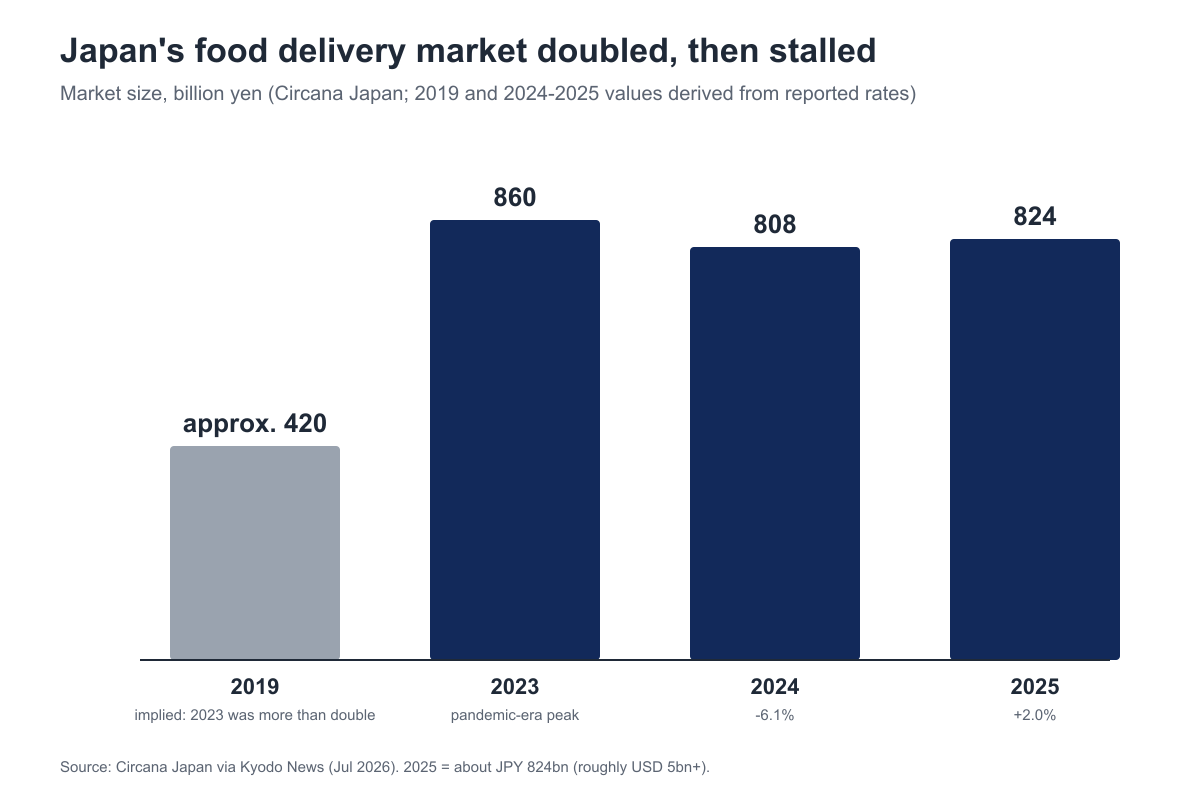
According to Circana Japan, Japan’s food delivery market was worth ¥860.3 billion in 2023 — more than double its 2019 level. It then shrank 6.1% in 2024 as post-pandemic behaviour normalised and inflation squeezed household budgets, before growing 2.0% in 2025. Working from those figures, the 2025 market comes out at roughly ¥824 billion, or a little over US$5 billion.
That is a substantial market, but it is not an enormous one by the standards of the companies that have competed for it, and it is not growing fast. Kyodo News, reporting in July 2026, described a sector at a crossroads: delivery prices that are generally higher than in-store prices, customers cutting back on spending as prices rise, and a business model long regarded as low-margin and high-volume, with courier pay and advertising weighing heavily on operators.
Put a ¥824 billion market that grew 2% last year next to a cost base that rises with every courier minute and every marketing campaign, and the exits begin to make arithmetic sense. A late entrant in that environment has to buy customers, buy restaurants and buy couriers at the same time — and the incumbent can simply match its promotions in the neighbourhoods where it attacks.
Demae-can’s results show how hard this is even for a well-funded domestic player. The company, which received a large capital injection from the LINE group and its Korean parent Naver around 2020 and rebranded itself around its delivery app, was expected by Kyodo to post its eighth consecutive loss-making year for the business year ending August 2026. It is not that Demae-can lacks customers or restaurants; it is that the market does not pay enough per order for two national-scale platforms to fight for share without at least one of them bleeding.
That is the uncomfortable conclusion of the market data: Japan’s delivery market may be big enough for one highly efficient national platform to make money, and perhaps a second to survive, but it has not been big enough for four or five well-funded ones.
Why Japan Is an Unforgiving Delivery Market
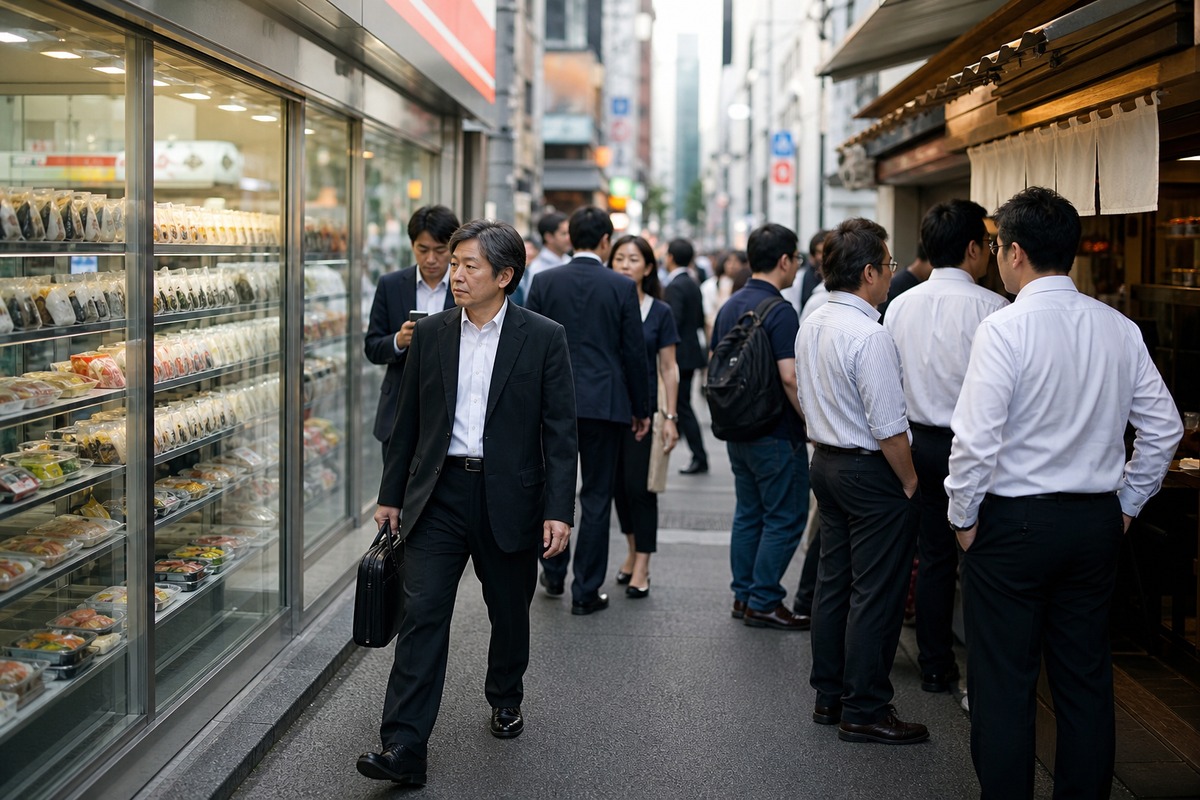
The size of the market is only half the explanation. The other half is what Japanese consumers already have before they open a delivery app.
Stand on almost any street in central Tokyo at lunchtime and count the alternatives within a five-minute walk. There will usually be at least one convenience store selling rice balls, sandwiches and bento for a few hundred yen, freshly stocked several times a day. There will be standing-noodle shops, set-meal restaurants, department-store food halls and supermarket deli counters selling discounted prepared food in the evening. Japan has more than 55,000 convenience stores, and most of them sit in exactly the dense urban neighbourhoods where delivery apps want to be strongest.
That changes the competitive set. In much of the United States, the alternative to ordering delivery is getting in a car. In central Tokyo, the alternative is a three-minute walk to a shop that sells a perfectly good dinner for less than the delivery fee alone. Delivery apps in Japan are competing less with restaurants than with the extraordinary convenience of the physical retail network around them.
Several other structural factors make the business harder:
Small homes, small orders. Japanese households are small — a large share of homes are occupied by one person — and apartments in big cities are compact. Single-person orders tend to have smaller baskets, which makes the fixed cost of a courier trip harder to cover.
Price sensitivity in an inflationary moment. After decades of near-zero inflation, Japanese consumers are living through repeated waves of food price increases. When thousands of grocery and packaged-food items go up in price in a single month, the mark-up between a restaurant’s in-store menu and its delivery menu becomes more visible, not less.
Couriers on bicycles and scooters, in dense streets. Japanese cities are dense and well suited to bicycle and motor-scooter delivery, which keeps per-trip costs lower than car-based delivery. But density also means short trips and small baskets, and competition for courier time at peak hours is fierce.
Restaurants with their own delivery tradition. Many traditional restaurants already ran their own delivery before the apps arrived, and some resist paying commissions that, by one software vendor’s estimate, can reach 35% to 40% per order on the major platforms. That figure comes from a company selling an alternative, so treat it as an upper-end estimate, but the tension is real: the platforms need restaurants, and the restaurants are often the most cost-conscious participants in the chain.
None of these factors makes delivery impossible. They make it a game of operational efficiency and long-term habit-building rather than a land grab. That favours whichever platform reaches national scale first and keeps investing — and penalises any entrant that hopes to win quickly through promotions.
The Price War: Rocket Now and the “Store Price” Counterattack
The most direct challenge to Uber Eats in the last two years has come from Rocket Now, which Coupang began testing in central Tokyo in 2025 through a local subsidiary that recruited its own riders. It started small, with a pilot in central Tokyo’s Minato ward, and has since expanded to other major cities including Osaka, Nagoya, Fukuoka and Sapporo, according to Korean business media.
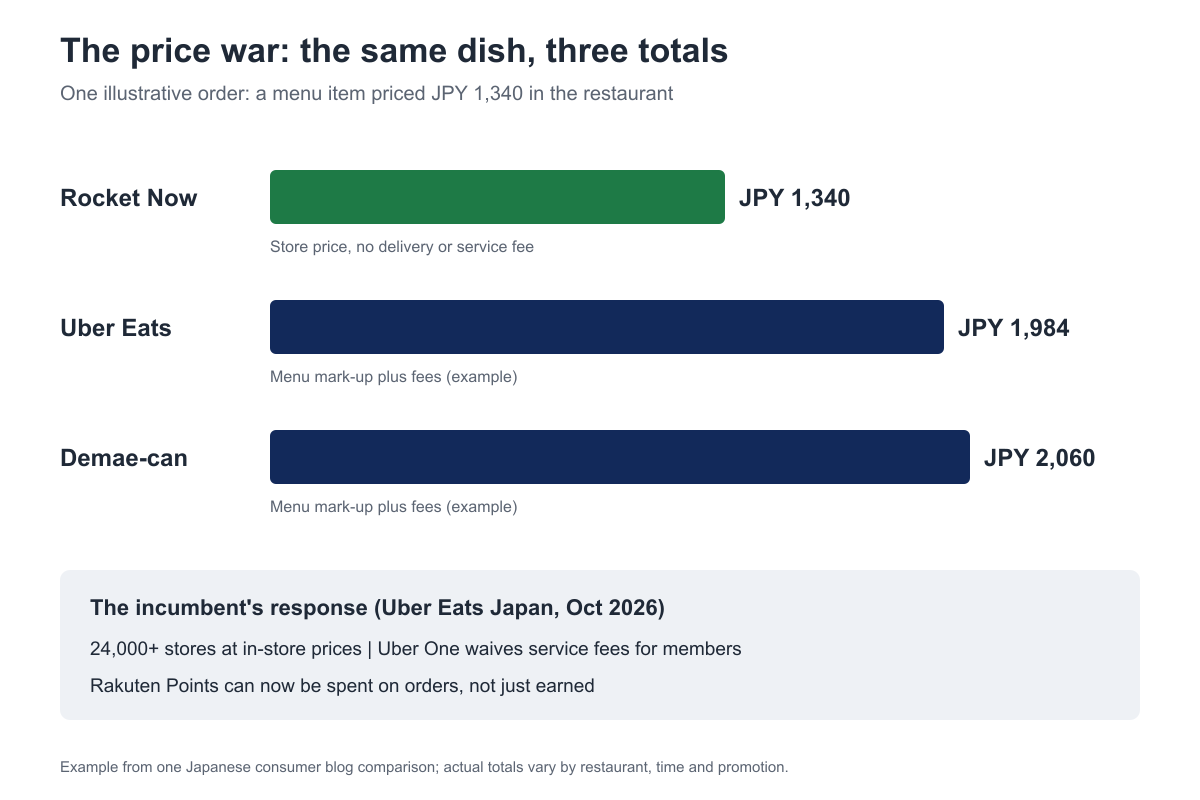
Rocket Now’s pitch is simple: on participating restaurants, it charges no delivery fee and no service fee, and the food costs the same as it would in the restaurant. For a Japanese consumer who has grown used to delivery menus marked up above dine-in prices, that is a strong message. Kyodo described the newcomer’s pledge to match in-store prices as intensifying the price war.
How big is the gap it attacks? One consumer comparison published by a Japanese money-saving blog gives a single illustrative example: a ¥1,340 menu item came to about ¥1,984 on Uber Eats and about ¥2,060 on Demae-can once menu mark-ups and fees were included, versus ¥1,340 on Rocket Now. That is one case from one blog, not a systematic survey, and individual results depend on the restaurant, the time and the promotions running. But it captures why the “store price” message resonates.
Uber Eats did not ignore the challenge. At its October 2026 anniversary briefing, according to Ketai Watch’s report, the company said more than 24,000 stores on its platform were available to order at in-store prices. It has also leaned on its subscription, Uber One, which it says waives service fees for members and has helped grow both membership and order volume. And it expanded its Rakuten partnership so that from October 2026 customers can spend Rakuten Points on orders, not just earn them — a meaningful lever in a country where loyalty points are a mainstream form of payment.
This is the classic incumbent response, and it is worth spelling out. Rather than matching a challenger’s pricing everywhere, the leader matches it where it matters, uses a subscription to lock in its most frequent customers, and plugs itself into an existing loyalty ecosystem that the challenger does not control. The challenger, meanwhile, has to fund zero-fee orders out of its own pocket until it reaches a scale where restaurants will accept lower margins in exchange for volume.
It is too early to say how the Rocket Now fight ends. Coupang has deep pockets and a track record of patiently subsidising growth in South Korea until rivals give up. But Japan’s history suggests the market punishes slow paths to profitability, and the incumbent now has three profitable years to fund its defence.
Beyond Restaurants: Drugstores, Groceries and the “Anything” Pitch
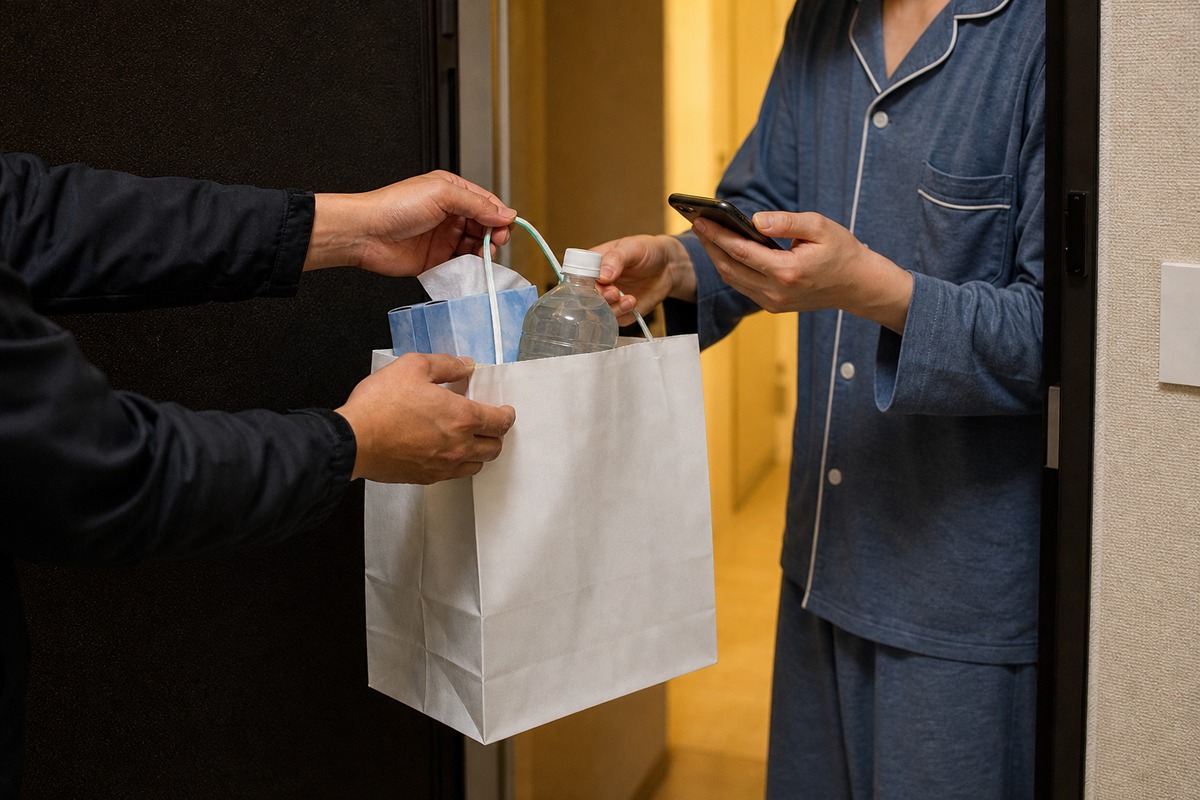
If the restaurant market is stalling at about ¥824 billion, the obvious next move is to deliver more than restaurant food. That is exactly where Uber Eats Japan is pushing.
At the anniversary event, Brovkina described the goal as a world of “anything” — getting people what they need, when they need it. The specifics presented at the briefing, as reported by Ketai Watch, were telling:
– Instant retail delivery from a growing number of stores, covering everyday goods rather than restaurant orders. – Active drugstore locations up 50% compared with 2025. – Uber Direct, the service in which Uber Eats handles delivery for a retailer’s own ordering channel, expanding into pharmaceutical products. – Ordering patterns that hint at new use cases: more late-night orders, and sports drinks rising when people feel unwell.
Drugstores are a particularly interesting choice in Japan. Japanese drugstore chains sell far more than medicine — they are major sellers of food, drinks, household goods and cosmetics, and in many suburbs they compete directly with supermarkets. A sick person who wants cold medicine, sports drinks and something easy to eat is a high-intent, time-sensitive customer, and the alternative — walking to the shop while unwell — is exactly the kind of friction delivery solves best.
This also helps with the basket-size problem. Restaurant orders from single-person households are small. A drugstore or grocery order that combines several essentials is larger, and it can be fulfilled at times of day when restaurant demand is quiet, helping keep couriers busy outside the lunch and dinner peaks.
For the international audience, this is the same playbook Uber, DoorDash and others are running in the United States and Europe: use the restaurant business to build a courier network and an app habit, then use that network to deliver groceries, convenience items, pharmacy goods and retail products. What is different in Japan is the starting point. Because Japanese convenience stores and drugstores are so dense, the delivery promise has to be faster and more convenient than an already excellent physical network. That raises the bar — but it also means the retailers themselves have strong reasons to partner rather than build their own fleets.
The Tax Cut That Could Tilt the Table
The most important variable for the next two years is not a competitor. It is a tax.
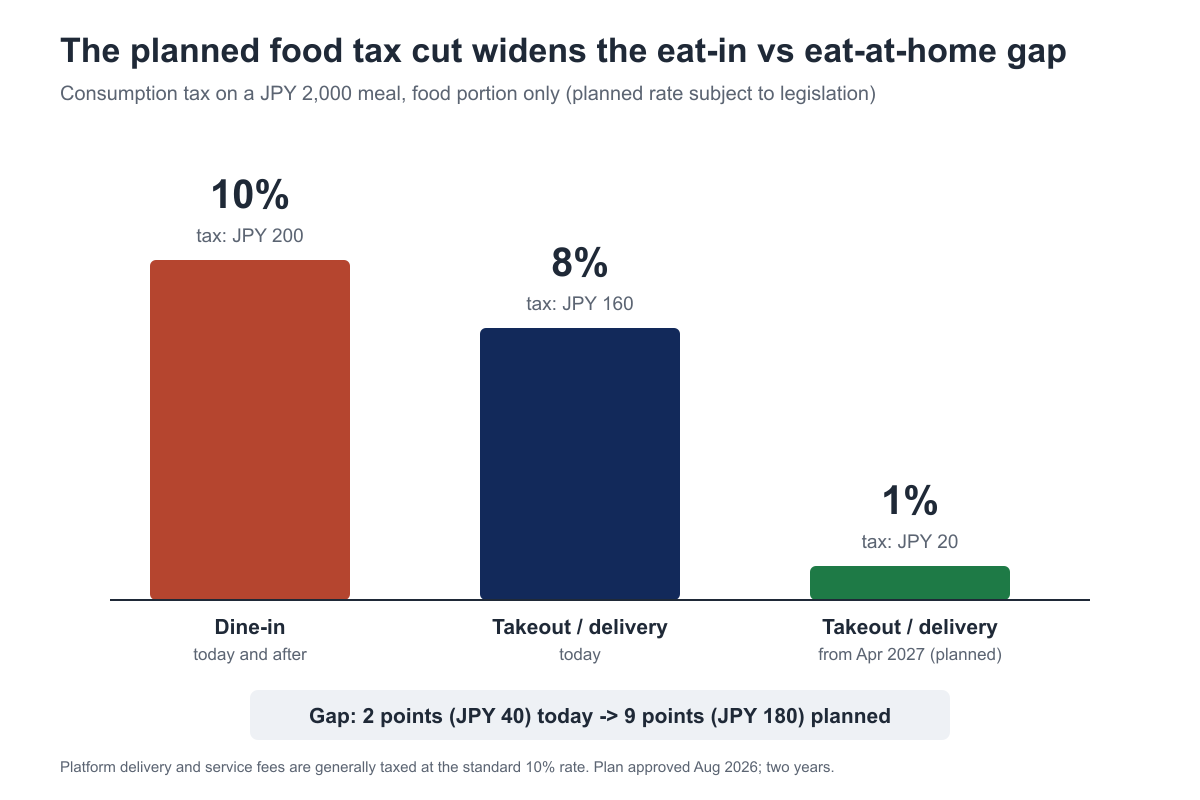
Japan’s consumption tax is 10% at the standard rate, with a reduced 8% rate for food and non-alcoholic beverages. Since the reduced rate was introduced in 2019, Japan has drawn a line that surprises many visitors: food eaten inside a restaurant is taxed at the standard 10%, while the same food taken away or delivered is taxed at the reduced 8%. Platform service and delivery charges are generally taxed separately at the standard rate.
In August 2026, the government of Prime Minister Sanae Takaichi approved a plan to cut the consumption tax on food from 8% to 1% for two years, starting in April 2027. The plan is paired with support measures for lower-income households, and it still needs legislation; the details, including exactly which items qualify, could change before a bill becomes law. Takaichi had originally proposed a zero rate; reports on the compromise at 1% cited practical concerns, including how retail and accounting systems would handle a zero rate.
If the plan goes through as described and the dine-in rate stays at 10%, the gap between eating in and taking food home or having it delivered would widen from two percentage points today to about nine. On a ¥2,000 order, that is a difference of roughly ¥180 in tax between the restaurant table and the sofa, against about ¥40 today.
Uber Eats Japan has said openly that it sees this as an opportunity. Brovkina told reporters that the cut could help food shops and retailers expand delivery and takeout, and Nikkei Asia’s report on the anniversary noted that the platform is positioned to benefit from the cut. She also said the company is considering ways to make the service accessible to more users if the cut goes ahead.
Three caveats matter. First, the fees that platforms charge are not covered by the reduced food rate, so the tax advantage applies to the food, not the whole order. Second, the cut is temporary — two years, as currently planned — which makes it a window rather than a permanent shift. Third, convenience stores and supermarkets benefit from exactly the same tax change, and they do not charge a delivery fee. The tax cut makes eating at home more attractive; it does not by itself make delivery more attractive than walking to the shop.
Still, for a platform that has spent ten years building coverage and habits, a two-year window in which eating at home becomes noticeably cheaper than eating out is close to ideal timing. If Uber Eats can use that window to convert more of the “never tried delivery” households Nakagawa described in 2025, it may keep many of them after the tax rate goes back up.
Japan vs America: Same Brand, Opposite Position
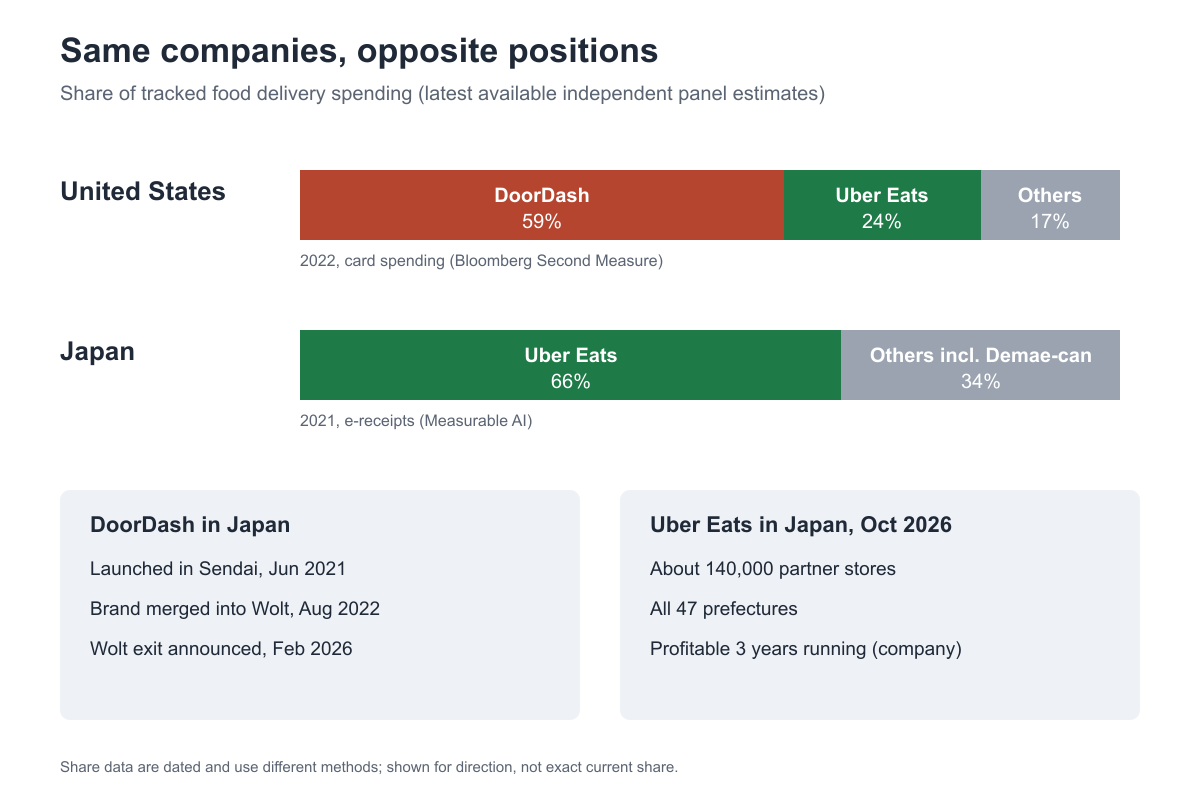
For readers in the United States, the most striking part of this story is how differently the same companies sit in the two markets.
In the United States, DoorDash is the dominant player. Bloomberg Second Measure’s analysis of consumer card spending put DoorDash at 59% of the US meal delivery market in 2022, with Uber Eats a distant second at 24%. More recent estimates from secondary sources suggest DoorDash’s share has, if anything, grown since. Uber Eats in America is a strong number two, competing against a rival that wins on suburban coverage and restaurant selection.
In Japan, the positions are reversed. DoorDash’s Japanese journey ended with its own brand folded into Wolt in 2022 and Wolt itself withdrawn in 2026. Uber Eats is the leader. The most recent independent share estimate I could find is old — a 2021 analysis by Measurable AI, using e-receipt data, put Uber Eats at 66% of tracked food delivery spending in Japan, ahead of Demae-can — and both the market and the competitive set have changed since. But every recent account, from Kyodo to Nikkei Asia, describes Uber Eats as the leader, and its two biggest global rivals in the country are no longer there.
Why the reversal? The most persuasive explanation is timing and persistence. Uber Eats arrived in 2016, four to five years before the pandemic-era entrants, and spent those years building restaurant relationships and courier supply in Tokyo, Osaka and other big cities. When the pandemic surge came, it already had the network to absorb the demand. Competitors that arrived in 2020 and 2021 had to build networks in the middle of a demand spike, at peak courier and marketing costs, and then faced a shrinking market in 2024 as the surge faded.
There is a second lesson in the comparison. The US market rewarded DoorDash for prioritising suburban coverage that Uber Eats initially neglected. In Japan, the equivalent of the suburbs is the regional city and the smaller municipality. Uber Eats chose to push into those areas — launching or expanding in about 300 municipalities in 2026 alone — rather than fight only in central Tokyo. In both countries, the winner is the platform that goes where the other one is not.
What International Operators Should Take From This
The story of the last first-wave global delivery platform standing in Japan is not only for platform companies. It carries lessons for anyone entering or operating in Japan.
1. Japan rewards persistence more than speed. The four exits share a pattern: arrival during a boom, rapid spending, and departure once the boom ended. The survivor had been building for years before the boom and kept investing after it. If you are entering Japan, budget for a slow ramp and plan to still be there when the first wave of enthusiasm fades.
2. Your real competitor may be the convenience store. For food and everyday goods, the benchmark in Japan is not another app or another brand; it is a dense physical retail network that is already fast, cheap and good. Any value proposition — delivery, direct-to-consumer, subscription — has to beat what is available a three-minute walk away.
3. Price transparency is becoming a weapon. Rocket Now’s “store price” pitch and Uber Eats’ 24,000 in-store-price stores show that Japanese consumers are increasingly sensitive to mark-ups. For restaurant brands, this means delivery menu pricing is a brand decision as much as a margin decision. For consumer goods brands selling through quick-commerce channels, it means shoppers will compare the app price with the shelf price.
4. Plug into the ecosystems that already exist. Uber Eats’ partnership with Rakuten, which lets customers spend points as well as earn them, is a reminder that Japan’s loyalty ecosystems — Rakuten, PayPay, d Point, Ponta and others — are a primary route to the consumer. Foreign brands that try to build their own loyalty system from scratch are competing with programmes most Japanese adults already use every day.
5. Watch the April 2027 tax window. If the food consumption tax cut passes as planned, eating at home becomes noticeably cheaper than eating out for two years. Restaurant brands should plan takeout and delivery menus, packaging and pricing for that window now. Food and beverage companies selling into Japanese retail should expect a shift in where meals are eaten and adjust promotions accordingly.
6. Regional Japan is under-served — and winnable. Most foreign companies think of Japan as Tokyo plus Osaka. The delivery market shows that coverage of regional cities and smaller municipalities can be a durable advantage. For retailers, restaurant franchises and consumer brands, the regional market is often less crowded and more loyal.
7. Profitability is the strategy. In a ¥824 billion market growing at about 2%, the platform that wins is not the one with the biggest launch budget but the one that reaches profitability first and can then fund its defence. That applies far beyond delivery: in a mature, ageing, price-sensitive consumer market, the companies that endure are the ones whose unit economics work at Japanese prices.
Frequently Asked Questions
Q. Which food delivery apps operate in Japan in 2026?
A. The major apps are Uber Eats, Demae-can and Rocket Now, the Coupang-run newcomer that began operating in Tokyo in 2025. Wolt, which was owned by DoorDash, ended its Japanese service on 4 March 2026, and menu, backed by KDDI, ended service on 30 September 2026. Coverage varies widely by city, and Uber Eats says it now operates in all 47 prefectures.
Q. Why did Wolt and DoorDash leave Japan?
A. DoorDash said in February 2026 that it would wind down Wolt in Japan after reviewing country-specific conditions, including the level of investment needed to build a best-in-class product. Japan’s delivery market of roughly ¥824 billion grew only about 2% in 2025, and Kyodo describes the sector as low-margin, with courier and advertising costs weighing on operators.
Q. Is Uber Eats profitable in Japan?
A. Uber Eats Japan’s general manager, Yulia Brovkina, said at the company’s tenth-anniversary event in October 2026 that the business had been profitable for three consecutive years, with sales continuing to grow. The company does not publish detailed Japanese profit figures in its global results.
Q. How will Japan’s food consumption tax cut affect delivery?
A. The government plans to cut the consumption tax on food from 8% to 1% for two years from April 2027, subject to legislation. Takeout and delivered food already falls under the reduced food rate, while dine-in meals are taxed at 10%, so the gap between eating in and eating at home would widen. Platform fees are generally taxed at the standard rate, so the benefit applies to the food portion of an order.
Q. Is food delivery more expensive than eating in a restaurant in Japan?
A. Often, yes. Many restaurants set higher prices on delivery menus to cover platform commissions, and platforms add delivery and service fees. Uber Eats said in October 2026 that more than 24,000 of its stores offer in-store prices, Rocket Now prices participating restaurants at dine-in levels with no fees, and subscriptions such as Uber One waive some fees for members.
Conclusion
Ten years ago, Uber Eats started in Japan with about 150 restaurants in central Tokyo, in a country that already had convenience stores on every corner and restaurants with their own delivery traditions. In the years since, some of the best-funded delivery companies in the world — Delivery Hero, DiDi, DoorDash and its subsidiary Wolt — tried to build businesses in Japan and left. The domestic champion, Demae-can, is still losing money, and KDDI’s menu closed in September 2026.
The survivor did not win with one clever idea. It won by arriving early, building coverage patiently — eventually across all 47 prefectures — absorbing the pandemic surge with a network it already had, and reaching profitability while rivals were still subsidising growth. Now it is defending its position against a new price-war challenger with in-store pricing, subscriptions and Japan’s loyalty-point ecosystem, extending into drugstores and retail, and preparing for a food tax cut that could make eating at home noticeably cheaper than eating out for two years.
For international operators, the message is not really about delivery. It is about Japan. The market is large, mature and demanding. It punishes companies that arrive for the boom and leave when it fades, and it rewards those that build slowly, go where competitors are not, and make the numbers work at Japanese prices. One billion orders later, the last of Japan’s first-wave global delivery platforms still standing is the clearest recent proof.
If you’re interested in this topic, the Japanese market more broadly, or what KETCHUPs is working on, we’d love to hear from you — please reach out via our contact form.
Japan Market Pulse is a weekly read on what the Japanese consumer-tech, food, and mobility markets are choosing to do, written for international operators who want to know what is happening before it shows up in the global trade press.
Subscribe at ketchups.co/japan-market-pulse.