

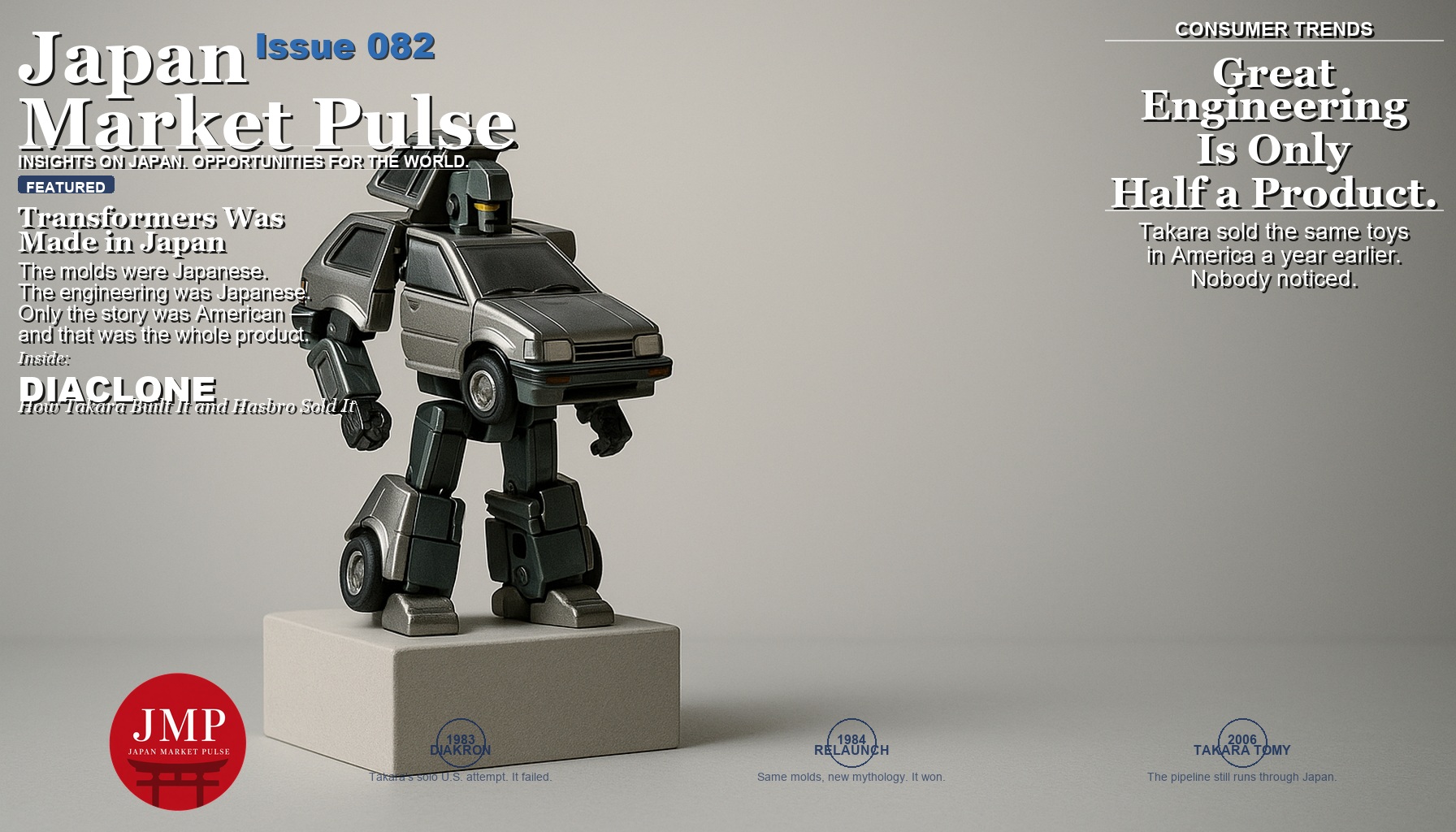
Here is the sentence that stops most Americans mid-sip of their coffee when I say it to them at a Tokyo bar: Optimus Prime is not an American invention. He never was. The robot that millions of kids in Ohio and Texas and California grew up believing was a homegrown Hasbro creation started life on a factory floor in Japan, inside a toy line most Americans have never heard of, built by a company most Americans still can’t pronounce correctly.
I’ve lived in Japan for twenty years now, long enough to stop being surprised when a piece of “American” pop culture turns out to have a quiet Japanese engine humming underneath it. But even by that standard, the Transformers story is a special case. This wasn’t a case of “inspired by” or “borrowed elements from.” Hasbro’s original 1984 Transformers toys were, in the most literal sense possible, Japanese toys wearing new packaging and a new mythology. The molds were Japanese. The transformation engineering was Japanese. The vehicles, the robots, the very idea of a toy that could fold itself from a car into a fighting machine — all of it came from a Tokyo toy company called Takara, by way of two toy lines called Diaclone and Microman that most of the franchise’s biggest fans still know surprisingly little about.
This is the story of how that happened, why Hasbro’s role was less about invention and more about a genius act of curation and storytelling, and what the whole episode still says about where the real engineering muscle of the global toy industry has quietly lived for the last fifty years.
A Toy Company Built on Small Machines
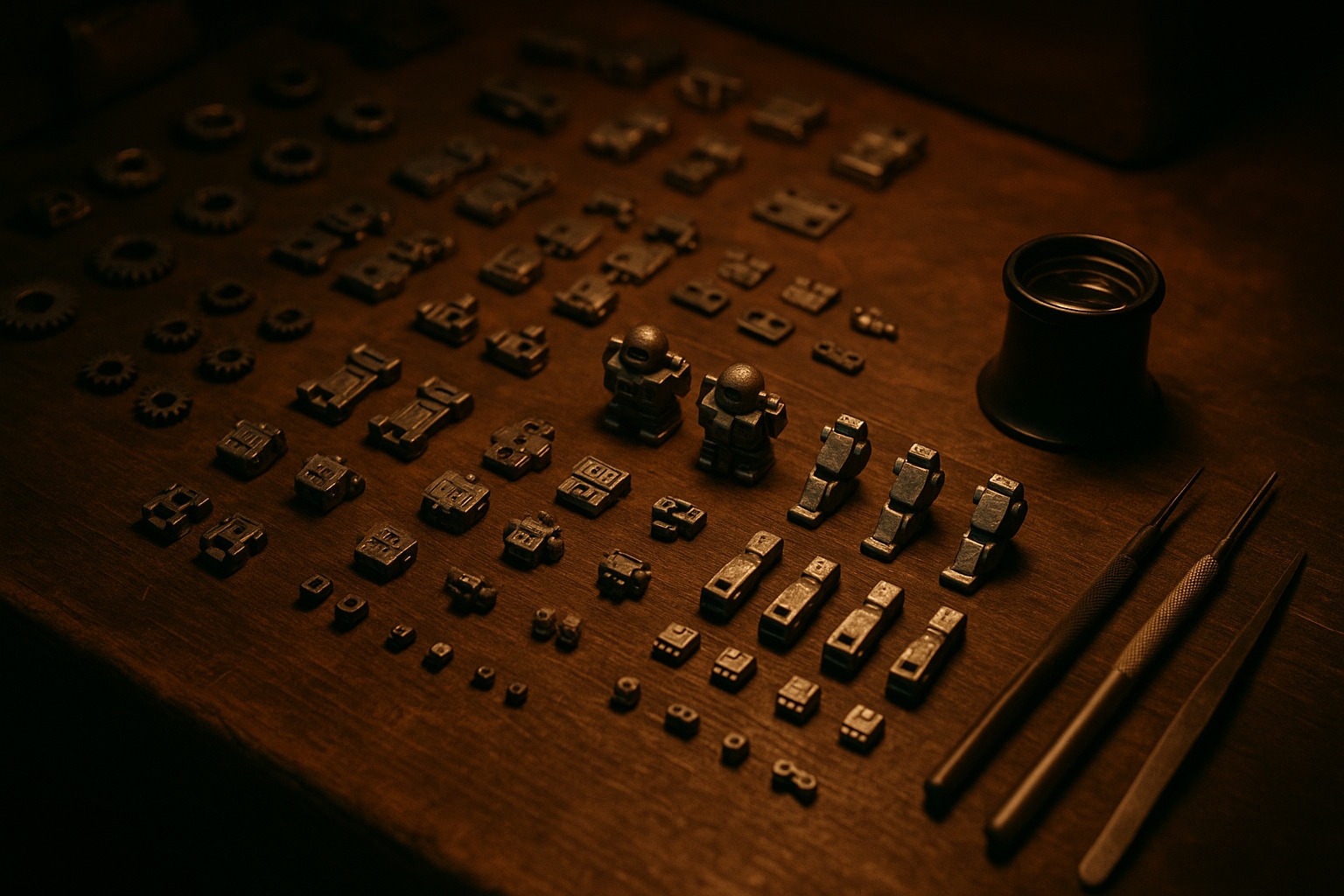
Takara’s roots go back to the mid-1950s, when a small Tokyo firm called Satoh Vinyl Industries began making vinyl dolls in the wreckage of postwar Japan. By the late 1960s the company had rebranded as Takara and spent the next decade building a reputation less for characters and more for mechanisms — the internal engineering of a toy, not just its face. That distinction matters enormously to this story, because the skill Takara was quietly mastering through the 1960s and 70s wasn’t storytelling. It was miniaturized machine design: gears, joints, hinges, and the kind of tight-tolerance plastic and die-cast engineering that lets a toy do something a toy isn’t supposed to be able to do.
Japan as a whole had been building toward this moment for a decade before Takara ever touched a robot. In 1974, a company called Popy — later absorbed into Bandai — began producing die-cast robot figures under the name Chogokin, or “super alloy,” tied to the anime Mazinger Z. Chogokin toys were heavier, more mechanically ambitious, and more durable than anything Western toy companies were putting out at the time, and they set a new bar for the entire Japanese industry. Competing toy makers, Takara very much included, had to raise their own engineering game just to stay in the conversation. That competitive pressure, arguably more than any single creative spark, is what pushed Japanese toy engineering into the territory where “a toy that physically reconfigures itself” started to look less like science fiction and more like a Tuesday product meeting.
By 1980, Takara had turned that engineering culture into Diaclone, a toy line built around small pilot figures — magnet-footed astronaut types — who could be inserted into transforming vehicles and robots. Diaclone’s first wave of designs reportedly involved Shoji Kawamori and Kazutaka Miyatake, two designers who would shortly go on to define the mecha aesthetic of the anime series Macross, itself a show now remembered internationally, in heavily altered form, as part of the Robotech franchise — which tells you something about how often this exact pattern of quiet Japanese design work reappearing under new Western branding has played out across the anime and toy industries, not just once with Transformers. In 1982, Takara expanded the line with the Car-Robots sub-series, largely credited to a designer named Kōjin Ōno, which introduced the transforming car-to-robot format that would become instantly recognizable a few years later under a very different name. These weren’t gimmick toys with one folding panel. They were genuine feats of packaging engineering — full-sized die-cast cars that unfolded, without any pieces coming loose in a child’s hands, into compact humanoid robots, often only several inches tall.
The Other Half of the DNA: Microman
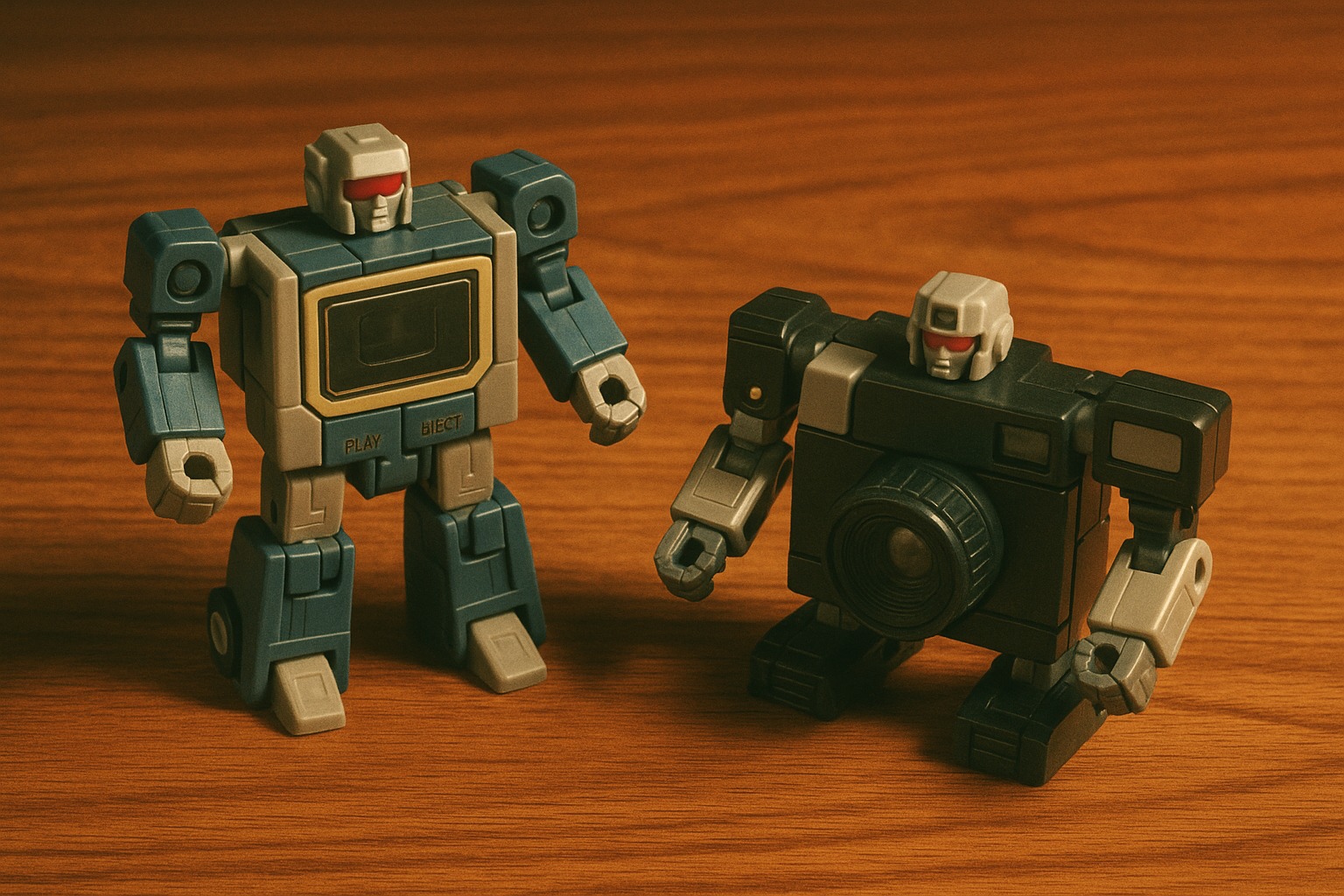
Diaclone alone doesn’t tell the whole story, and this is the part even a lot of lifelong Transformers fans skip past. Takara had another toy line running in parallel called Microman, which by the early 1980s had spun off a sub-line called Micro Change. Where Diaclone was about big machines, Micro Change specialized in something stranger and, in its own way, more technically impressive: toys that transformed into ordinary consumer objects. A robot that folded down into a handheld cassette player. A robot that became a small pistol. A robot that became a microcassette recorder or a hand-held calculator. It was a different flavor of the same underlying obsession — using precision mechanical engineering to disguise a robot as something mundane.
When Hasbro assembled what would become Transformers, it didn’t pull from Diaclone alone. It pulled from both lines simultaneously, merging Diaclone’s car-robots with Micro Change’s disguise-as-everyday-object robots into a single unified toy concept. That’s why the earliest Transformers roster is such a strange mix in retrospect — muscular robot cars sitting alongside tiny robots that turned into cassette players and handguns. They came from two different Takara product families that had never been designed to share a shelf, let alone a mythology.
Takara’s Quiet, Failed First Attempt at America
Here’s a detail that rarely makes it into the popular version of this story: Takara tried to crack the American market on its own before Hasbro ever got involved, and it didn’t work. In 1983, Takara test-marketed a small selection of Diaclone toys directly into US specialty toy shops under the name Diakron. It was a modest release — reportedly just a handful of vehicles and robots — with essentially no advertising, no cartoon, no comic book, and critically, no story. American kids in 1983 had no framework for understanding what they were looking at. A toy car that turned into a robot, sitting quietly on a shelf with a generic package and zero narrative hook, wasn’t going to out-compete Star Wars figures or G.I. Joe for a kid’s allowance money, no matter how well-engineered the transformation mechanism was underneath the plastic. Diakron came and went almost unnoticed, and it’s a useful reminder of something that applies just as much to global business strategy today as it did to toy shelves in 1983: extraordinary product engineering, on its own, does not guarantee market success. Distribution, marketing, and narrative packaging are not afterthoughts. They’re half the product.
The Tokyo Toy Show, and the Deal That Changed Everything
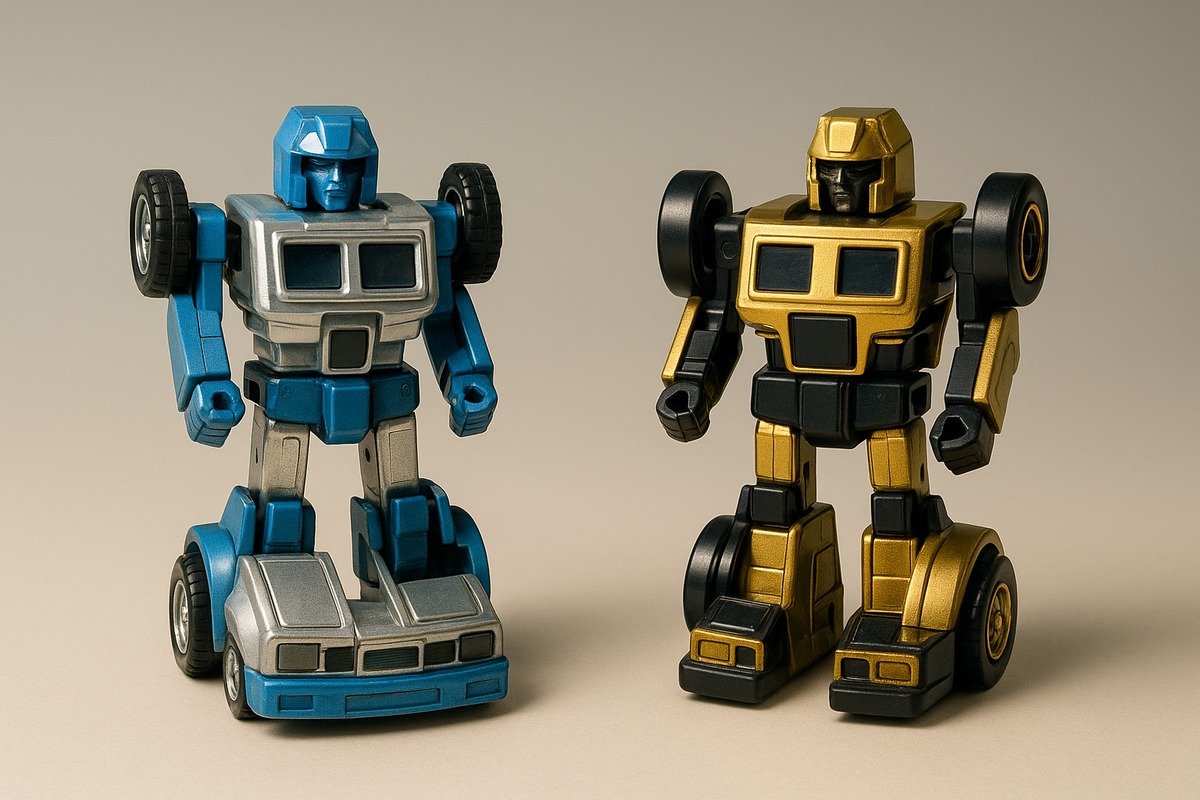
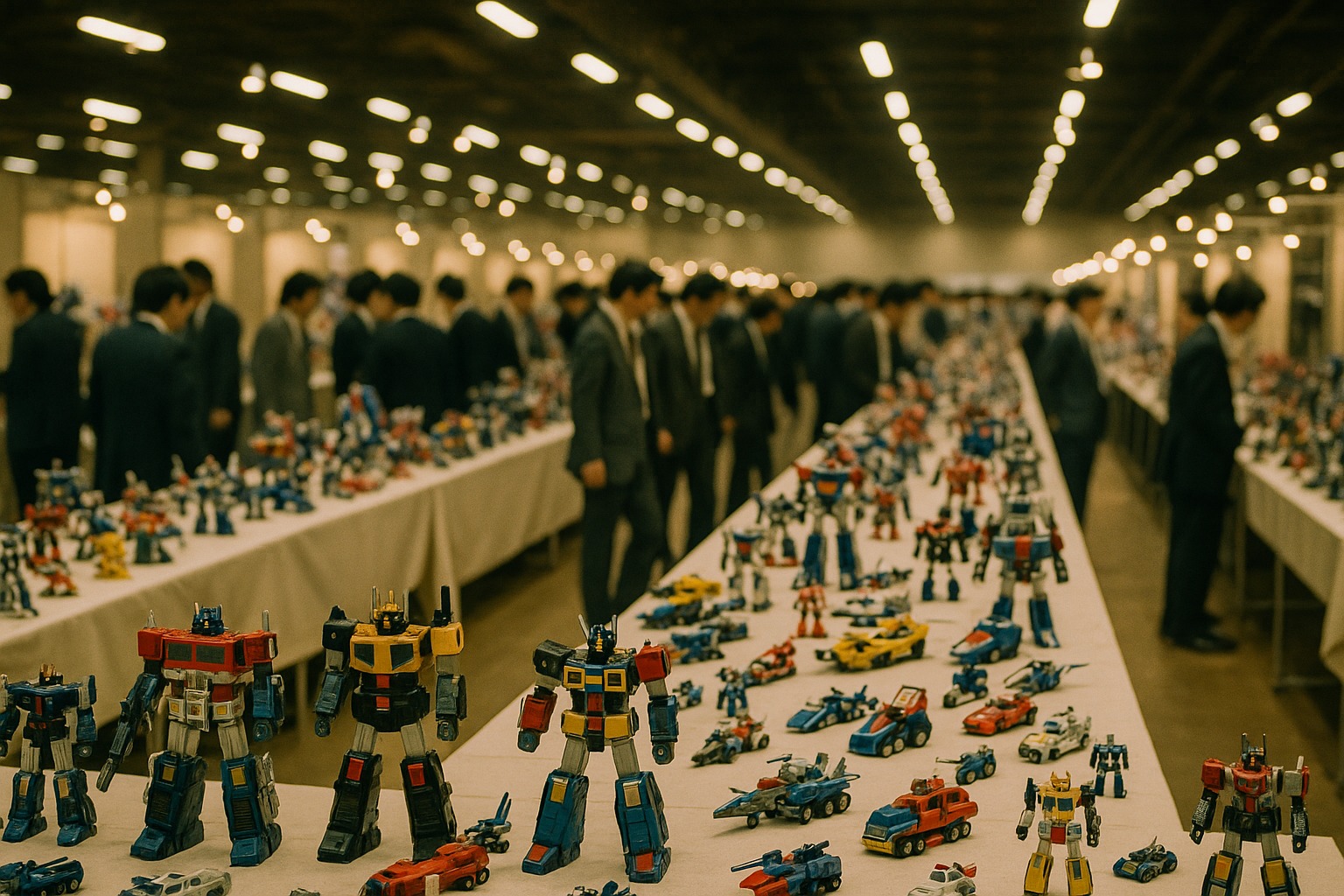
The turning point, as it’s generally told, happened in 1983 at the Tokyo Toy Show, where Hasbro representatives were reportedly scouting the floor specifically for Japanese toy concepts that could be imported and repositioned for the American market — a fairly standard practice for American toy companies at the time, who leaned heavily on Japanese manufacturing and design talent even when the final product carried a purely American brand identity. Takara’s booth, with its transforming Diaclone vehicles and Micro Change disguise-robots, reportedly caught their attention immediately.
What Hasbro did next is really the heart of the business lesson in this whole story. Rather than simply importing Diaclone as Diaclone, or Micro Change as Micro Change, Hasbro made the decision to license both toy lines, discard the existing Japanese branding entirely, and unify everything under a single new name and a single new fictional universe. That decision — to collapse two unrelated Japanese product lines into one coherent American brand story — is arguably the single most important business decision in the entire Transformers origin. It solved the exact problem that had sunk Diakron a year earlier: instead of asking American kids to make sense of an unfamiliar toy with no context, Hasbro built the context first and let the toys slot into it.
Hasbro brought in Marvel Comics to build out the mythology, and this is where names most Transformers fans do recognize start to enter the picture. Writer and editor Bob Budiansky became the primary architect of the toy line’s fictional identity, reportedly responsible for naming the vast majority of the characters and writing the “tech spec” biography cards that shipped on the back of every toy package — the character bios that gave a die-cast robot a personality, a rank, a set of strengths and weaknesses, before a single episode of television had aired. Marvel also produced the launch comic book miniseries in 1984, and a Sunbow-produced animated series arrived that same year, giving the toy line something Diakron never had: a complete, cross-media story that made owning the toy feel like joining something larger.
The result is one of the cleanest case studies I know of in the difference between invention and productization. Takara had already invented the hard part — the mechanical engineering that let a die-cast car become a robot without falling apart in a kid’s hands. What Hasbro invented was the story, the packaging, and the media ecosystem that made a Japanese engineering achievement legible and desirable to an American audience that had no idea what it was looking at otherwise.
A Crowded Field: Transformers Wasn’t the Only Robot in the Room
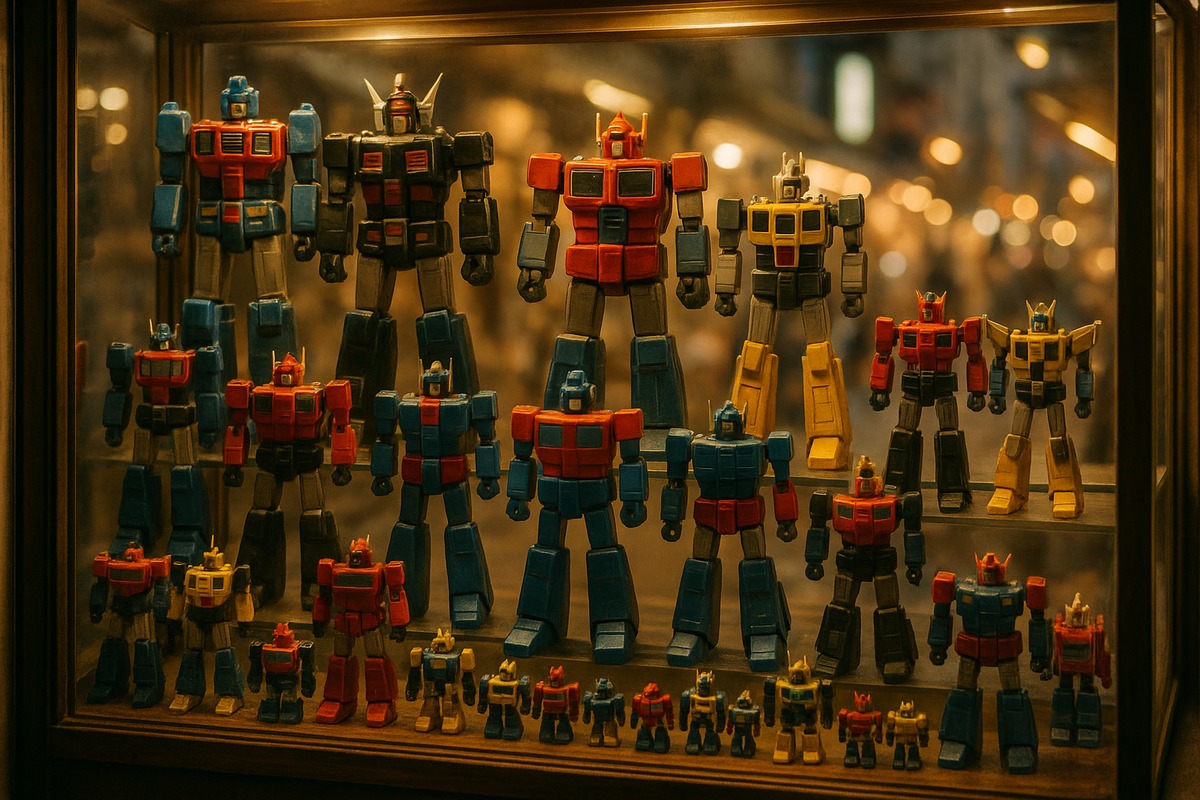
It’s worth pausing on something else that gets lost in the retrospective glow around Transformers: it wasn’t the only transforming-robot toy line racing toward American shelves in 1984, and it wasn’t even drawing from a uniquely Japanese well of engineering talent. Around the same time, American toy company Tonka licensed a separate Japanese transforming-robot line, Bandai’s Machine Robo, and launched it in the US as GoBots. For a brief period the two lines were treated by American retailers and kids alike as genuine, roughly equal competitors — both Japanese in engineering origin, both repackaged with new American names and new fictional backstories, both racing to define what a “transforming robot toy” meant to a generation of Western kids.
GoBots initially held its own commercially. But it lost the long game, and the reasons it lost are instructive. Hasbro invested more heavily in storytelling depth — richer characters, a larger cast, a more ambitious ongoing narrative — and paired that with a more sustained media push. Transformers ran for years as a cultural phenomenon; GoBots faded within a few years and later became partially referenced within Transformers-related continuity after Hasbro acquired Tonka. Two Japanese engineering traditions went into that 1984 shelf war. Only the one wrapped in the stronger story came out the other side as a global franchise.
What Happened to Diaclone and Microman
Back in Japan, the toy lines that started it all didn’t get to watch their offspring conquer the world from the sidelines for long. Takara reportedly discontinued both Diaclone and Microman as standalone product lines by late 1984 or 1985, redirecting its engineering and marketing resources into the Transformers brand instead — including, eventually, releasing Transformers-branded toys domestically in Japan under Takara’s own name, effectively re-importing the very concept it had exported a year earlier, just wearing Hasbro and Marvel’s new mythology instead of its own.
Takara itself would go on to merge with fellow Japanese toy giant Tomy in 2006, forming Takara Tomy, which remains Hasbro’s manufacturing and co-development partner on the Transformers franchise to this day. Every modern Transformers movie, every new toy wave, every “Masterpiece” collector-grade release still runs through a Japanese engineering pipeline that traces an unbroken line back to that Diaclone and Micro Change design work from the early 1980s. In recent years, Takara Tomy has even circled back to release “Diaclone Reboot” toys — modern, highly articulated update figures explicitly marketed under the original Diaclone name, sold to a collector audience that now, four decades later, actually understands and values the Japanese origin story that 1983 American shoppers had no context for at all.
There’s a particular kind of irony in walking through a Tokyo hobby shop today, as I have more times than I can count, and finding a glass case with a vintage Diaclone Car-Robot sitting a few shelves below a “Masterpiece” Transformers reissue of essentially the same mold. The Japanese collector market treats the two as cousins rather than strangers, and prices for original 1980s Takara-branded pieces have, if anything, climbed faster than their Hasbro-branded siblings in recent years, precisely because so few Japanese buyers held onto them at the time. Nobody in Tokyo in 1980 thought they were buying a piece of what would become a global media franchise. They thought they were buying a well-made toy robot. That gap between what a product is engineered to do and what the market eventually decides it means is, in miniature, the entire Transformers story.
The Business Lesson Underneath the Nostalgia
What strikes me most, watching this story from twenty years inside the Japanese business culture that produced it, isn’t really about robots at all. It’s about a pattern that keeps repeating across Japanese consumer industries, from toys to electronics to automobiles: extraordinary product-level engineering developed quietly, methodically, often with limited flair for self-promotion, that only becomes a global commercial phenomenon once it’s paired with the right storytelling, branding, and market entry strategy — frequently supplied by a foreign partner who understood a market that the original engineers didn’t.
Takara built something genuinely remarkable in Diaclone and Micro Change: transformation mechanisms sturdy and clever enough that, with essentially no redesign, they anchored one of the most successful toy franchises in history for the following four decades. But Takara’s own attempt to sell that engineering directly to Americans, without a story wrapped around it, quietly failed within a year. Hasbro didn’t out-engineer Takara. It out-storied Takara’s own product, using a set of narrative and marketing instincts Takara didn’t have, and Marvel’s mythology-building capacity that Takara did not apply to Diaclone in the U.S. market.
For anyone operating a business that touches the Japan-to-global pipeline today — sourcing Japanese manufacturing, licensing Japanese IP, or trying to bring a genuinely excellent Japanese product to a Western audience — that’s the piece of the Transformers story worth sitting with longer than the nostalgia. The engineering excellence was never the bottleneck. The story was.
Frequently Asked Questions
Q. Did Hasbro actually design any of the original Transformers toys?
A. Not the physical toys themselves in any meaningful sense. The vehicles-to-robots and disguise-object mechanisms came from Takara’s existing Diaclone and Micro Change toy lines, developed in Japan years before Hasbro got involved. Hasbro’s contribution was licensing those existing toys, unifying them under a single brand, and — working with Marvel Comics — building the character names, backstories, and fictional universe around them.
Q. Is Diaclone still available to buy today?
A. Yes. Takara Tomy has released “Diaclone Reboot,” a modern update line sold under the original Diaclone name to collectors, including vehicle sets such as the Takara Tomy Diaclone Vehicles Set 2, which is available through Amazon. Original 1980s Diaclone and Micro Change figures also circulate actively in the vintage collector market, where they typically sell at a premium over comparable early Transformers figures because of their scarcity and historical significance.
Q. Why did Hasbro merge two separate toy lines instead of launching them as two brands?
A. Fragmenting the concept across multiple similarly-themed toy lines risked confusing retailers and shoppers with several competing “transforming robot” products from the same company. A single unified brand with one coherent fictional universe was easier to market, easier to build a cartoon and comic book around, and easier for a child to explain to a parent standing in a toy aisle.
Q. Was Transformers the only Japanese transforming-robot toy line imported to the US around this time?
A. No. Bandai’s Machine Robo toy line was licensed by American company Tonka and launched in the US the same year as GoBots, using a similar formula of Japanese engineering wrapped in new American branding and a new backstory. GoBots sold well initially but was ultimately outpaced by Transformers’ deeper storytelling and more ambitious media strategy, and the line was discontinued within a few years.
Q. Does Takara Tomy still make Transformers toys today?
A. Yes. Takara Tomy remains Hasbro’s manufacturing and co-development partner for the Transformers franchise, including collector-focused “Masterpiece” toys and the toy lines tied to the ongoing Transformers film series. The Japanese engineering lineage that started with Diaclone and Micro Change in the early 1980s has never actually left the franchise — it simply changed its name.
This article contains affiliate links. If you purchase through these links, we may earn a small commission at no extra cost to you.
If you’re interested in this topic, the Japanese market more broadly, or what KETCHUPs is working on, we’d love to hear from you — please reach out via our contact form.
Japan Market Pulse is a weekly read on what the Japanese consumer-tech, food, and mobility markets are choosing to do, written for international operators who want to know what is happening before it shows up in the global trade press.
Subscribe at ketchups.co/japan-market-pulse.