

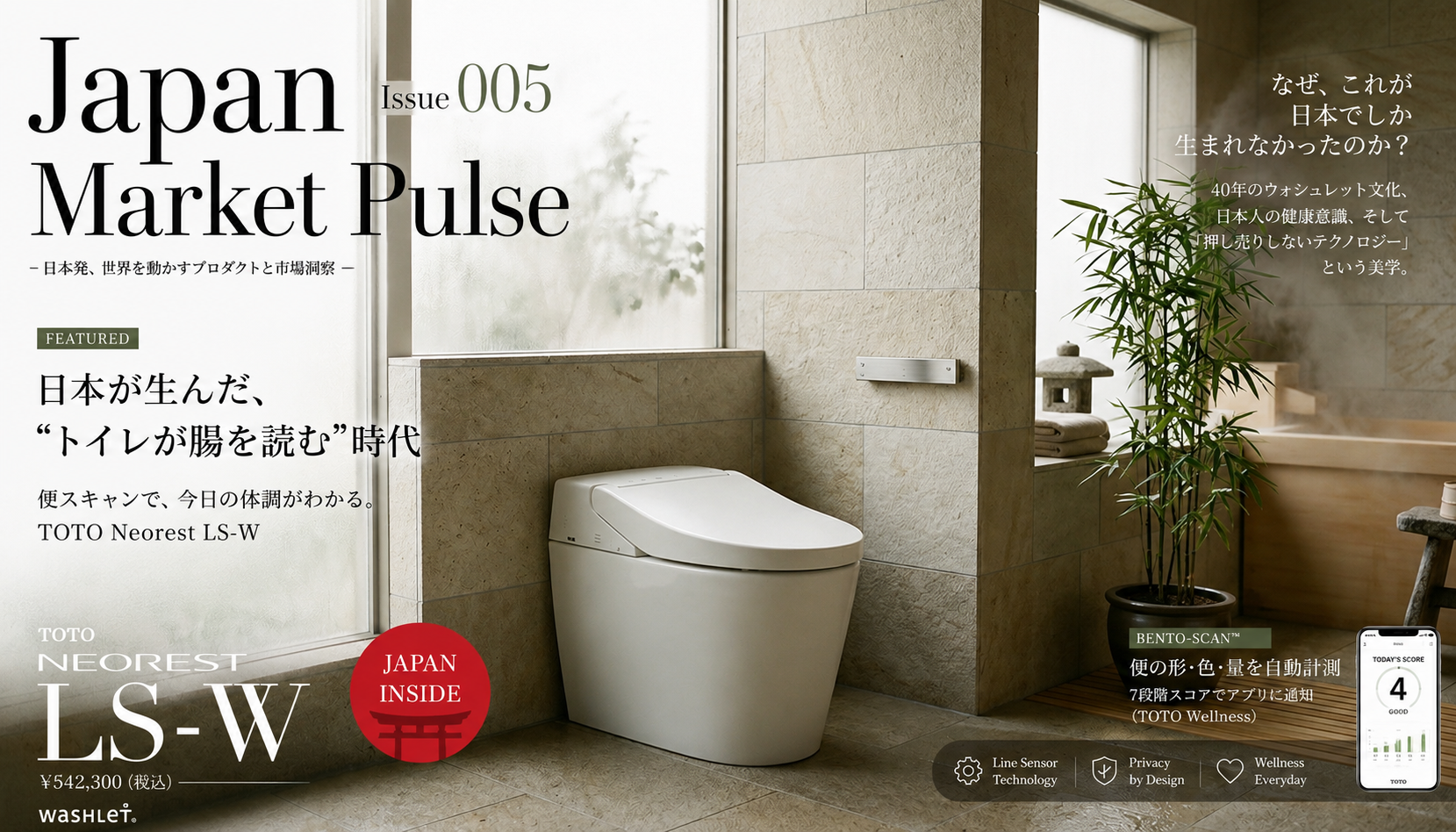
You sit down. The seat warms against the back of your thighs at exactly 36°C, the way every TOTO Washlet has done for forty years. You finish. You stand. By the time you’ve washed your hands, your phone has buzzed once: “Type 4 — normal. Color: medium brown. Volume: typical. Three-day trend: stable.”
This is not a wearable. It is not an app. It is not a startup’s at-home test kit. It is your toilet.
In August 2025, TOTO began selling the Neorest LS-W and AS-W, the first consumer toilets in the world with a built-in digestive-output sensor. The flagship LS-W lists at ¥542,300 (about USD 3,650). The slightly less seamless AS-W lists at ¥493,900. The new feature, marketed by TOTO as Bento-Scan (, ben-sukyan), is a small line sensor mounted next to the washlet’s water nozzle. As intestinal output passes the sensor, the system reads its shape, color, and quantity, classifies it on a clinical seven-point scale, and sends the result to a smartphone app called TOTO Wellness. *
The product is, by any reasonable measure, the most Japanese thing launched in 2026. It is also a small but significant landmark in the history of ambient health monitoring. It is worth thinking about why this exists, why it had to be Japanese, and what the rest of the world will eventually do with it.
What the Toilet Actually Does
The technical heart of the Neorest LS-W is unspectacular — and that’s the point.
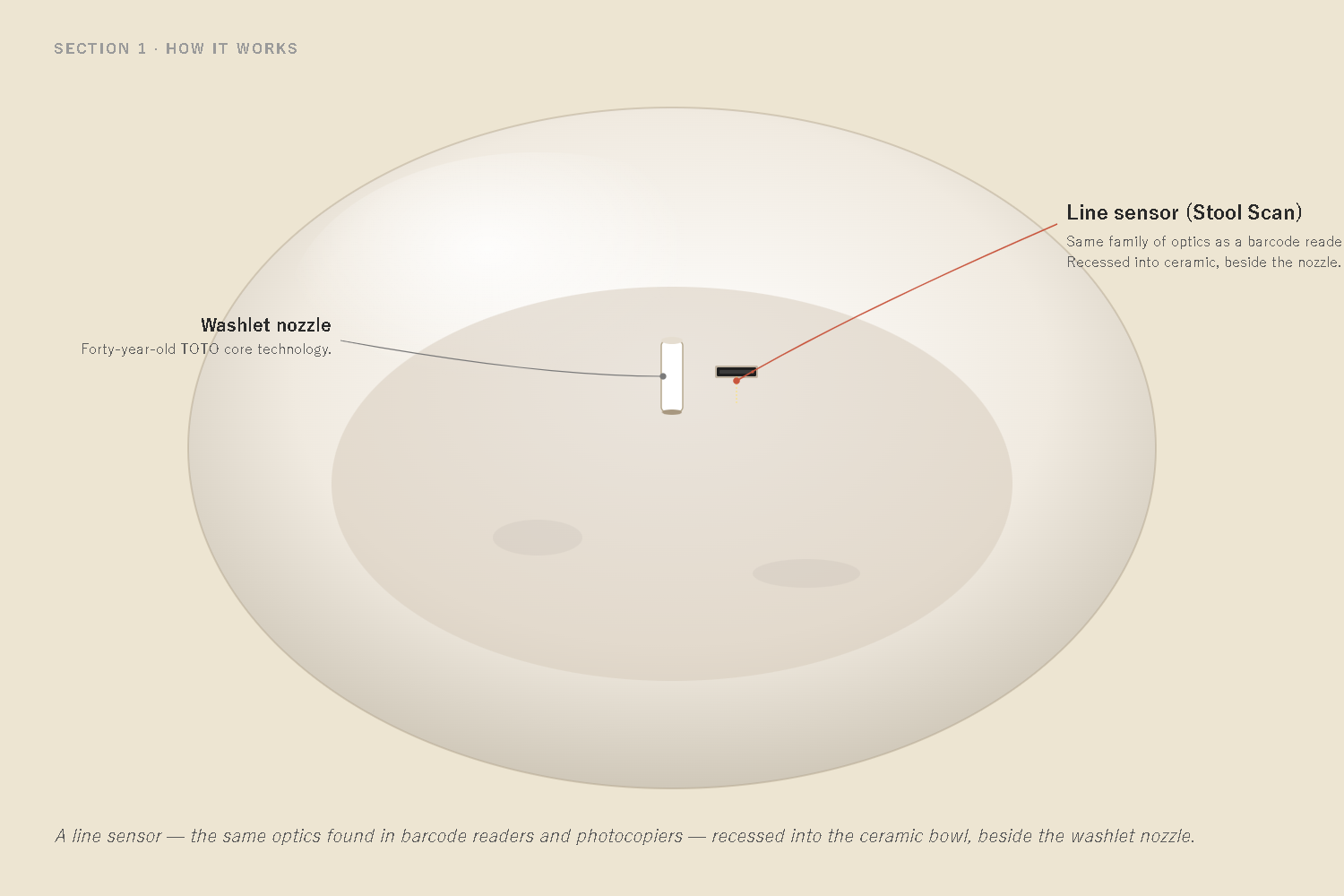
A line sensor, the same family of optics found in barcode readers and office photocopiers, sits inside the bowl, angled to catch the brief moment when biological waste falls into the trap. In about a second of imaging, the sensor logs three things. First, shape and consistency, classified into seven categories: clumps, lumpy, cracked, normal, semi-solid, muddy, liquid. Second, color, sorted into three brown bands — light, medium, dark. Third, volume, derived from the imaging area.
The numbers don’t go anywhere unless you ask them to. The user presses the personal-settings button on the remote — the same kind of long, slim remote that has hung beside Japanese toilets for thirty years — and the next reading is logged to whichever family member’s app is currently active. The data lives in the TOTO Wellness app, where a clean, calendar-style dashboard shows daily entries, weekly tendencies, and a small text recommendation drawn from a fixed library: try more fiber, drink more water, the trend has been stable for ten days, see a doctor if liquid output persists for three days. The app does not prescribe. It does not warn. It does not sell you supplements.
That restraint is more interesting than the sensor.
TOTO’s own pre-launch research found that 76% of Japanese adults already glance at their elimination patterns — and don’t record anything. The company’s design brief, in effect, was: don’t ask people to start a habit; just close the loop on the habit they already have.
Why This Is a Japanese Product, Not an American One
You could not have built the Neorest LS-W in any other country, and not because of the technology. The technology is trivial. You could have built it because Japan is the only market on Earth where the necessary cultural and physical infrastructure already exists.
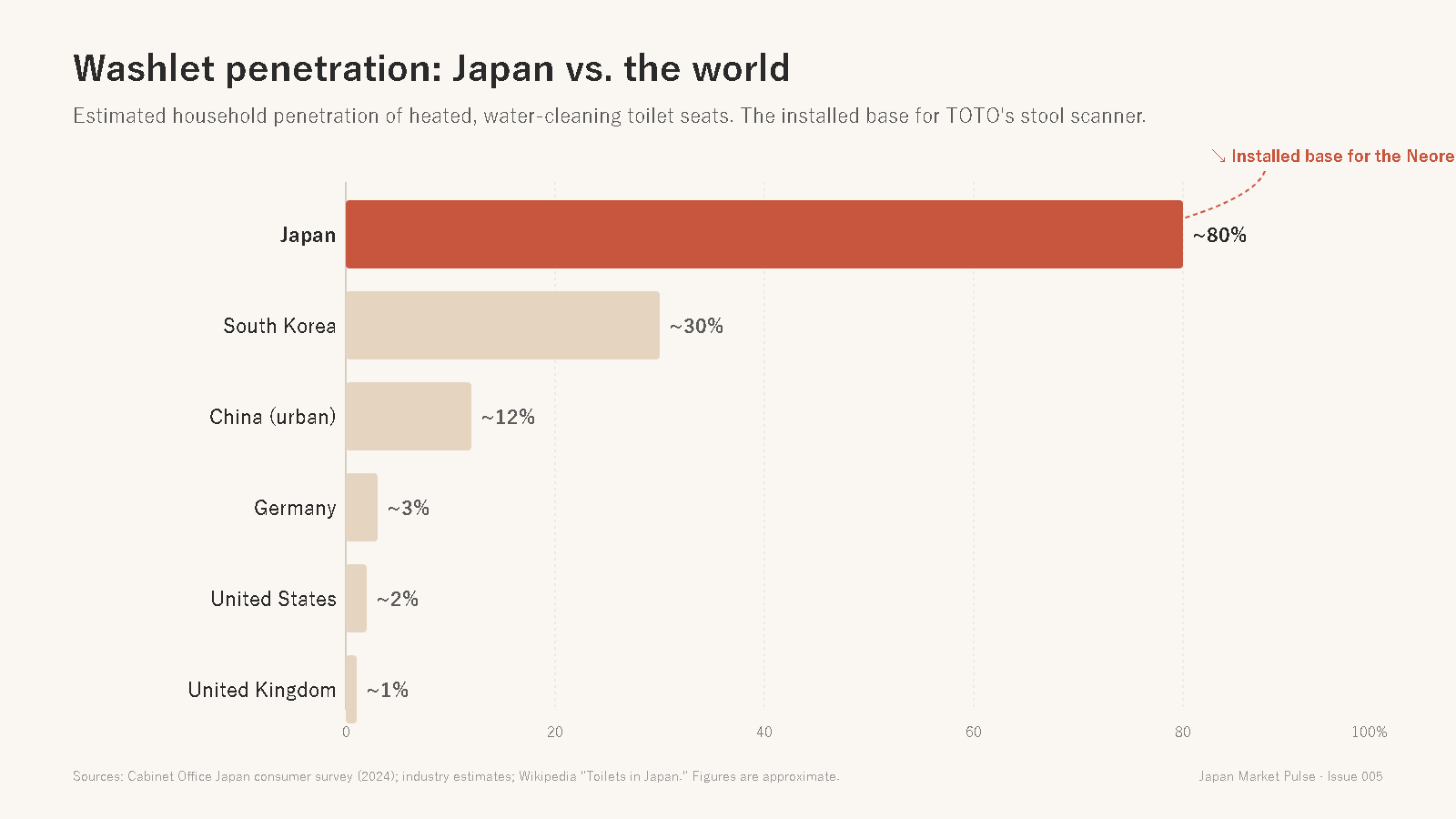
Start with the obvious number. Roughly 80% of Japanese households have a Washlet — a heated, water-cleaning, frequently sensor-laden toilet seat — installed today. In the United States, the comparable household-penetration figure is in the low single digits. In Germany, the UK, and France, it is similarly tiny, with Washlet adoption mostly visible in luxury hotels. (TOTO has reported that around 40% of five-star hotels in London and Paris install Washlets at the high end. The mass market hasn’t followed.)
That gap matters because the Neorest LS-W is not a gadget bolted to a toilet. It is a toilet. The same chassis, the same drainage geometry, the same heated seat, the same long thin remote. The Bento-Scan sensor sits inside an object that 80% of Japanese homes already replace, repair, and budget for. In an American home, the equivalent product would have to be a separate device, sold separately, installed separately, charged separately, and explained separately to a household that doesn’t think of its toilet as electronics. In Japan, the toilet is electronics.
Behind the household number is a corporate one. TOTO, founded in 1917, recorded sales of around ¥1.2 trillion (~USD 11 billion) in fiscal 2024, and shipped its 70-millionth Washlet in 2025. International revenue contributes roughly 25–30% today, with a stated target of 35% by fiscal 2026. TOTO is, in other words, a global plumbing company sized like a mid-cap consumer-electronics maker, with the manufacturing depth to put a tiny optical sensor into a mass-produced ceramic-and-plastic object and ship it nationwide on day one. Casana, the most prominent American smart-toilet startup, received FDA 510(k) clearance in 2023 for a heart-rate-monitoring toilet seat. It is a clip-on. It is not a toilet.
This is a recurring pattern in Japanese consumer technology: the country builds infrastructure where other markets build accessories. The Walkman did this for music. The Washlet itself did it for personal hygiene. Now the Bento-Scan is doing it for gut health. The accessory market in the U.S. and Europe will probably arrive eventually. Japan is just first because Japan has the wall socket.
The Science: Bristol Meets Ambient Sensing
The seven-point scale that the Neorest LS-W reports is not new. It is the intestinal health classification developed in 1997 by Dr. Kenneth Heaton at the Bristol Royal Infirmary in southwest England, more commonly known as the Bristol scale. It is one of the most widely used clinical tools in modern gastroenterology and is part of the Rome diagnostic criteria for irritable bowel syndrome. *
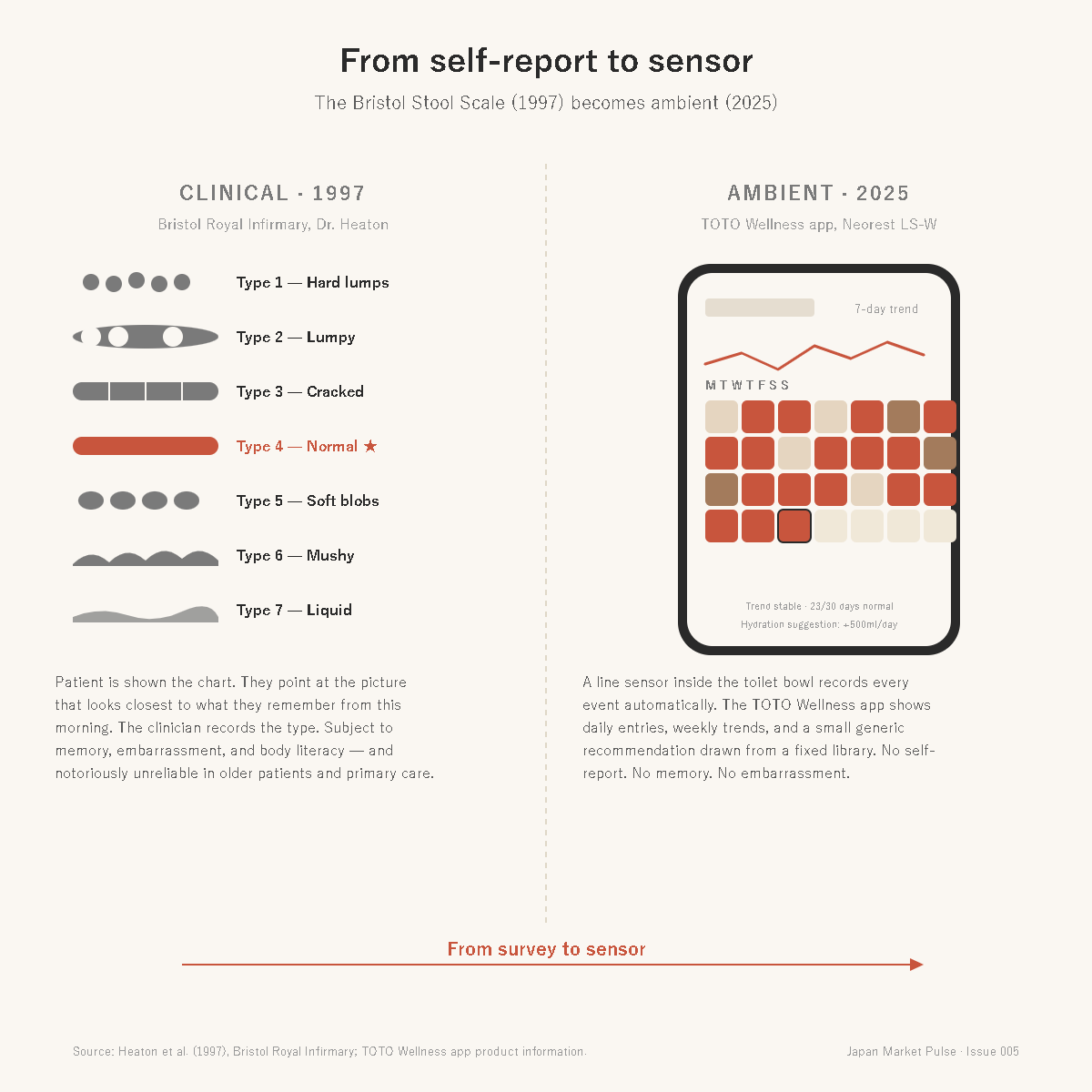
In its original clinical use, the scale is a printed chart. The clinician hands it to the patient. The patient points at the picture that looks most like what they remember from this morning. The doctor writes down a number. The accuracy is bounded — by memory, by embarrassment, by literacy in body-awareness. Studies have repeatedly shown that self-reported classification of digestive output is unreliable, especially in older patients and in primary-care settings.
What TOTO has done, with the Neorest LS-W, is break the self-report loop. Instead of asking a person what they observed, the toilet observes it. The data is captured every time, without effort, in the room where the event physically occurs. From a research-design perspective, this is the difference between a survey and a sensor — and the difference, broadly, between twentieth-century epidemiology and twenty-first-century ambient health.
It is worth saying clearly what the toilet does not do. It does not look for blood (though future models almost certainly will). It does not screen for pathogens. It does not sequence microbiomes. It does not measure pH or hormones or markers of colorectal cancer. The 2025 device is a Bristol-style classifier, a colorimeter, and a volume estimator — and that is enough to take a meaningful, longitudinal cut at one of the most common questions in primary care: is your gut behaving consistently this month, or has something changed?
The point of the device, in other words, is not diagnosis. It is trend awareness — the kind of background signal that prompts a person to mention something to a doctor a month earlier than they otherwise would have. Multiplied across millions of Japanese bathrooms, that is potentially a meaningful public-health intervention. It is also a posture — measure, don’t diagnose — that the Japanese smart-toilet industry seems to have agreed on in advance, and that probably reflects regulators’ preferences.
The Privacy and Regulatory Tightrope
For a product whose core function is to image private bodily output, the Neorest LS-W is striking for the things it does not do.
It is not registered as a medical device under Japan’s Pharmaceutical and Medical Device Act. It is a household appliance with a sensor. The TOTO Wellness app does not output diagnoses. It does not predict disease. It returns a category, a color band, a volume, and a piece of generic lifestyle advice from a fixed library.
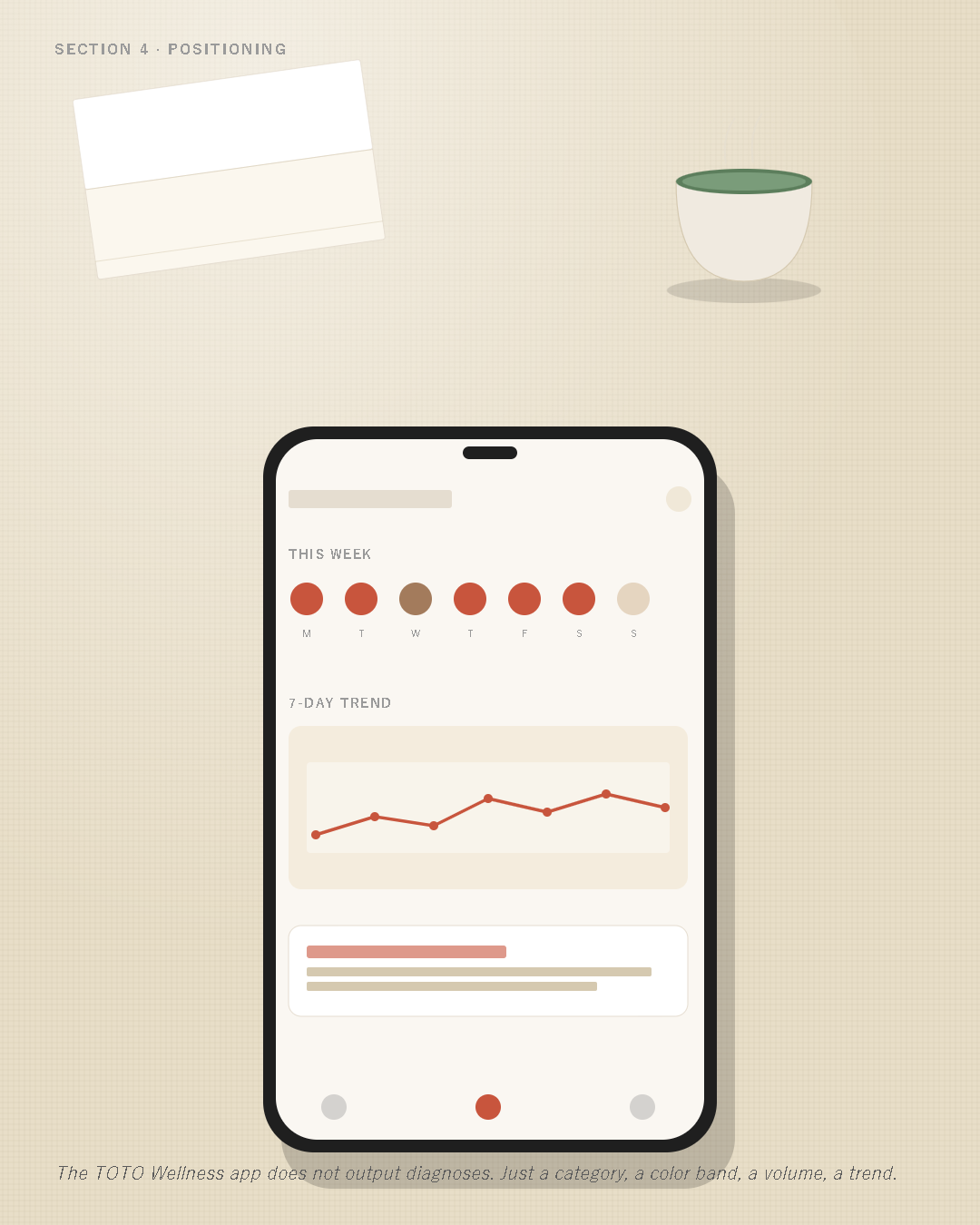
That positioning is deliberate, and it is the same positioning Apple has taken with the Apple Watch’s ECG (when not used in medical mode), Oura with its readiness score, and Whoop with its strain metrics. Stay below the medical-device threshold, return useful patterns, and let the user — or eventually the user’s doctor — interpret. TOTO appears to have read the playbook carefully.
Three things follow. First, data sovereignty: readings are stored locally on the toilet, encrypted in transit to the app, and synced to the cloud only on opt-in. Second, multi-user identification remains the unsolved problem; the toilet currently relies on the active app session, not on biometric identification of who is using the toilet. (A Washlet in a four-person household will, in practice, know whose data belongs to whom only as well as the family is disciplined about pressing the right button.) Third, non-portability of the data: in Japan there is no equivalent of HIPAA that would treat output-shape data as protected health information when it sits on a TOTO server. Whether that is a privacy risk or a privacy non-event is, mostly, a function of how much you trust TOTO. Most Japanese consumers, on the available evidence, trust TOTO a lot.
For the export market, this is where the conversation gets harder. A version of the Neorest LS-W sold in California in 2027 will run into questions Japan has not had to answer: Is the app a covered health-tech entity? Are the readings discoverable in litigation? What happens to your seven-day output history after a divorce, a custody dispute, an insurance claim? The American smart-toilet industry has barely begun thinking about these. The Japanese industry has, so far, sidestepped them by drawing a clear line: measurement, not medicine.
That line will hold for as long as the device’s claims stay modest. The first manufacturer that claims a smart toilet detects colorectal cancer will redraw the regulatory map for the entire category.
What the World Should Learn From a Toilet
The technology arc of personal health monitoring has, over fifteen years, moved through three layers. First came the wearable — the Fitbit, the Apple Watch, the Oura ring — devices you put on your body. Second came the surface — smart mirrors, bed-mounted heart-rate sensors, sleep-tracking pads. Third, now, comes the fixture: sensors built into the structures of a home, activated by ordinary use, invisible until they speak.
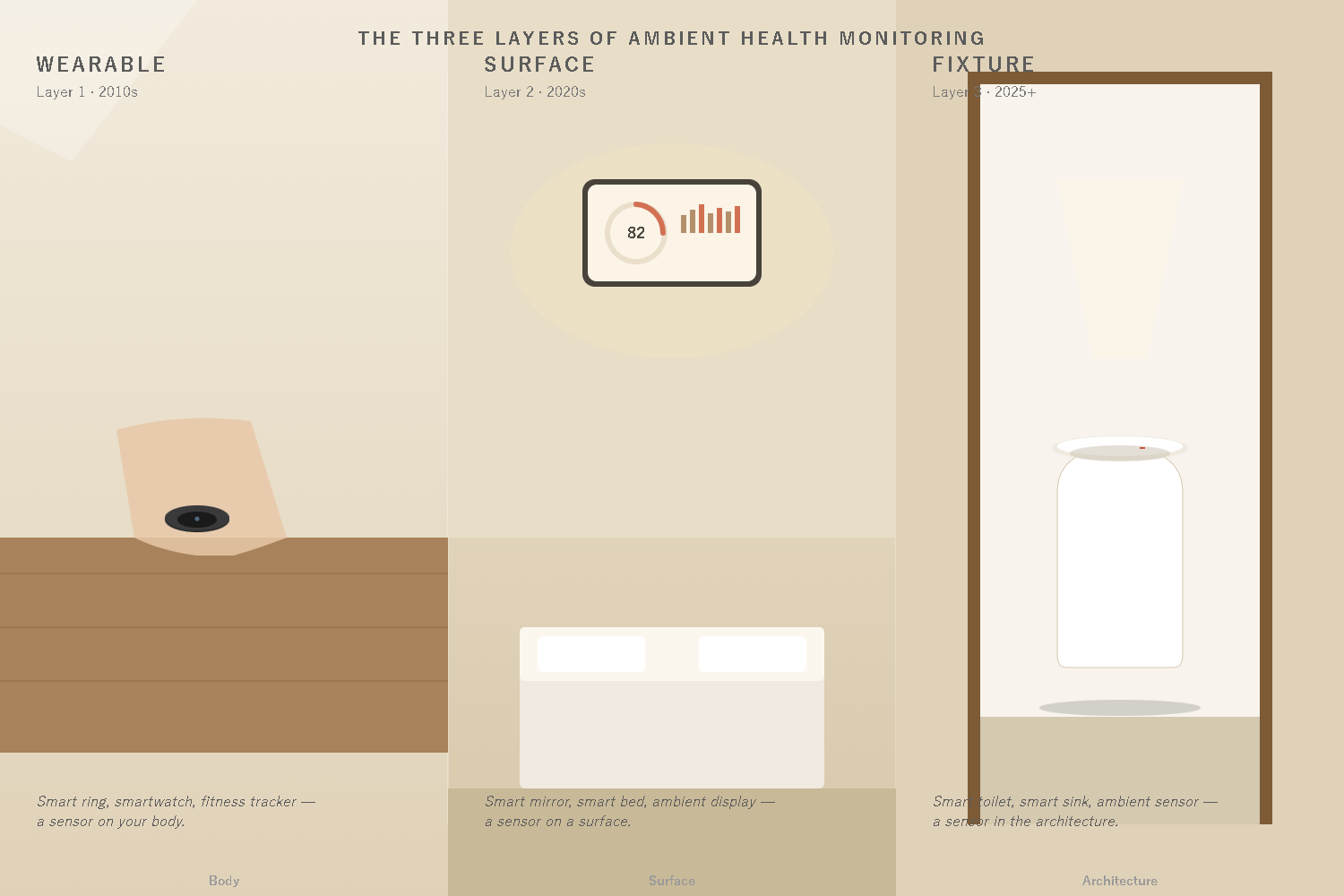
The toilet is, in retrospect, the obvious place for the third layer to land. It is used multiple times a day by every adult on the planet. It is used in solitude. It involves a brief period of stillness in a known posture. It already has a power supply and, in millions of homes, plumbing-grade hardware engineered to last twenty-plus years. And the substance that crosses it carries, in its color, shape, and consistency, signals about gut motility, hydration, fiber intake, dehydration, and the early phases of multiple gastrointestinal conditions. It is, frankly, the most information-rich single moment of a healthy person’s day, and the world has been flushing the data away since the Romans built the Cloaca Maxima.
If the Neorest LS-W’s Bento-Scan is the start of a category — and TOTO’s market position suggests it will be — three predictions seem reasonable.
Western brands will follow, slowly. Kohler, American Standard, Duravit, Geberit will all have output-sensing trim levels by the end of the decade. They will arrive first in luxury hotels and high-end residential projects, exactly the way Washlets did. The mass-market timing depends on whether toilet replacement cycles in the U.S. and Europe ever accelerate to Japanese norms, which is partly a function of plumbing-code reform and partly of cultural acceptance of “electronic toilets” as a normal home category.
Insurers and primary-care networks will find the data first, not consumers. The most valuable use of longitudinal digestive data is not the lifestyle nudge — it is the early signal of change in a population. Within five years, expect to see optional integration between smart-toilet data and primary-care portals in Japan, with insurance-funded pilots focused on elderly populations and IBS patients. The Japanese health system, which has spent two decades preparing for an aging country, is unusually motivated to underwrite this kind of passive monitoring.
The next sensor in the toilet is urine. TOTO showed an experimental “wellness toilet” concept at CES 2022 that included urinalysis. The Neorest LS-W ships only the Bento-Scan; the urine scanner is, in industry-watcher consensus, the obvious next addition. Once the toilet reads both outputs, the bathroom becomes, in a quiet and undramatic way, the most informative routine health checkpoint in the average Japanese household.
The interesting thing about the Neorest LS-W is not that it is futuristic. It is that it is, in the most ordinary sense, a TOTO toilet — the same shape, the same warm seat, the same long remote, in a market where 80% of households already own its predecessor. The future of ambient health monitoring will be like that almost everywhere it works: an invisible upgrade to an object the user already trusts, returning a small, useful number to the people who care.
That kind of upgrade has been, for a hundred years, a Japanese specialty. The sun-care display in a UNIQLO storefront knows the weather. The heated seat in a Japanese bathroom now knows your gut. The pattern is the same: take a public domain — meteorology, gastroenterology — and make it the quietest layer of an everyday product.
The world’s other consumer-electronics powers will get to this eventually. Japan is just first, again, in a category that no one else even knew was a category.

* Editorial note on terminology. This article uses neutral language — “digestive output,” “intestinal output,” “elimination patterns,” “output characteristics” — to describe what TOTO’s product literature, the Japanese press, and the underlying clinical instrument all call by its plain name: stool. The Bento-Scan (, literally “stool scan”) performs a visual classification of fecal form, color, volume, and frequency. The seven-point scale referenced throughout this piece is the Bristol Stool Scale, developed at the Bristol Royal Infirmary in 1997 by Dr. Kenneth Heaton, and is one of the most widely used clinical reference tools in gastroenterology worldwide. It is part of the Rome diagnostic criteria for irritable bowel syndrome. The technical and medical specifics in this article are intentional, not euphemistic; the neutralized vocabulary is an editorial choice for tone and readability, not a softening of TOTO’s stated medical-monitoring intent. Readers who want to dig into the underlying clinical reasoning should consult TOTO’s product page (linked below) and the Bristol Stool Scale literature.
If you found this useful, you might also enjoy Japan Market Pulse Issue 003 — “UNIQLO Now Sells Sunglasses by the Millivolt”, on Japan’s emerging tradition of putting public data into private retail floors.
Japan Market Pulse is a fortnightly briefing on consumer-and-retail trends in Japan, written for non-Japanese brand strategists. Subscribe at ketchups.co.
Sources & further reading
- TOTO press release — Neorest LS-W / AS-W release announcement, May 28, 2025 — official launch information and pricing.
- TOTO product page — Neorest LS-W / AS-W — sensor specifications and TOTO Wellness app overview.
- Spoon & Tamago — Flushing into the Future: Toto’s High-Tech Health Tracker — feature article on the Bento-Scan launch.
- Japan Today — Toto to release next-gen toilet tech that scans and keeps track of your poop — English news coverage with technical detail.
- Ukiyo Journal — Acquiring Bowel Movement Data Just by “Sitting” — analysis of the healthcare positioning.
- Tokyo Weekender — This 500,000 Yen Japanese Toilet Analyzes Your Poop Health — consumer-facing English coverage.
- Cleveland Clinic — Bristol Stool Chart: Types & What They Mean — medical reference for the seven-point scale.
- Wikipedia — Bristol stool scale — history of the 1997 Heaton scale and its clinical use.
- Wikipedia — Toilets in Japan — household Washlet penetration figures.
- Construction World — TOTO Crosses 70 Million WASHLET Sales — global sales milestone, FY2024 figures.
- PMC — Passive monitoring by smart toilets for precision health — peer-reviewed analysis of smart-toilet ambient sensing.
- Rochester Beacon — Casana receives FDA clearance for smart toilet seat — comparison point: U.S. clip-on smart toilet seat with FDA 510(k).
Source magazine: GetNavi 20265 pp. 82, 83, 89.
If you’re interested in this topic, the Japanese market more broadly, or what KETCHUPs is working on, we’d love to hear from you — please reach out via our contact form.
If you’re interested in this topic, the Japanese market more broadly, or what KETCHUPs is working on, we’d love to hear from you — please reach out via our contact form.
Japan Market Pulse is a weekly read on what the Japanese consumer-tech, food, and mobility markets are choosing to do, written for international operators who want to know what is happening before it shows up in the global trade press.
Subscribe at ketchups.co/japan-market-pulse.