

Disclosure: This article is published by KETCHUPs, a Tokyo-based trading and brand-development firm. All content is editorial.
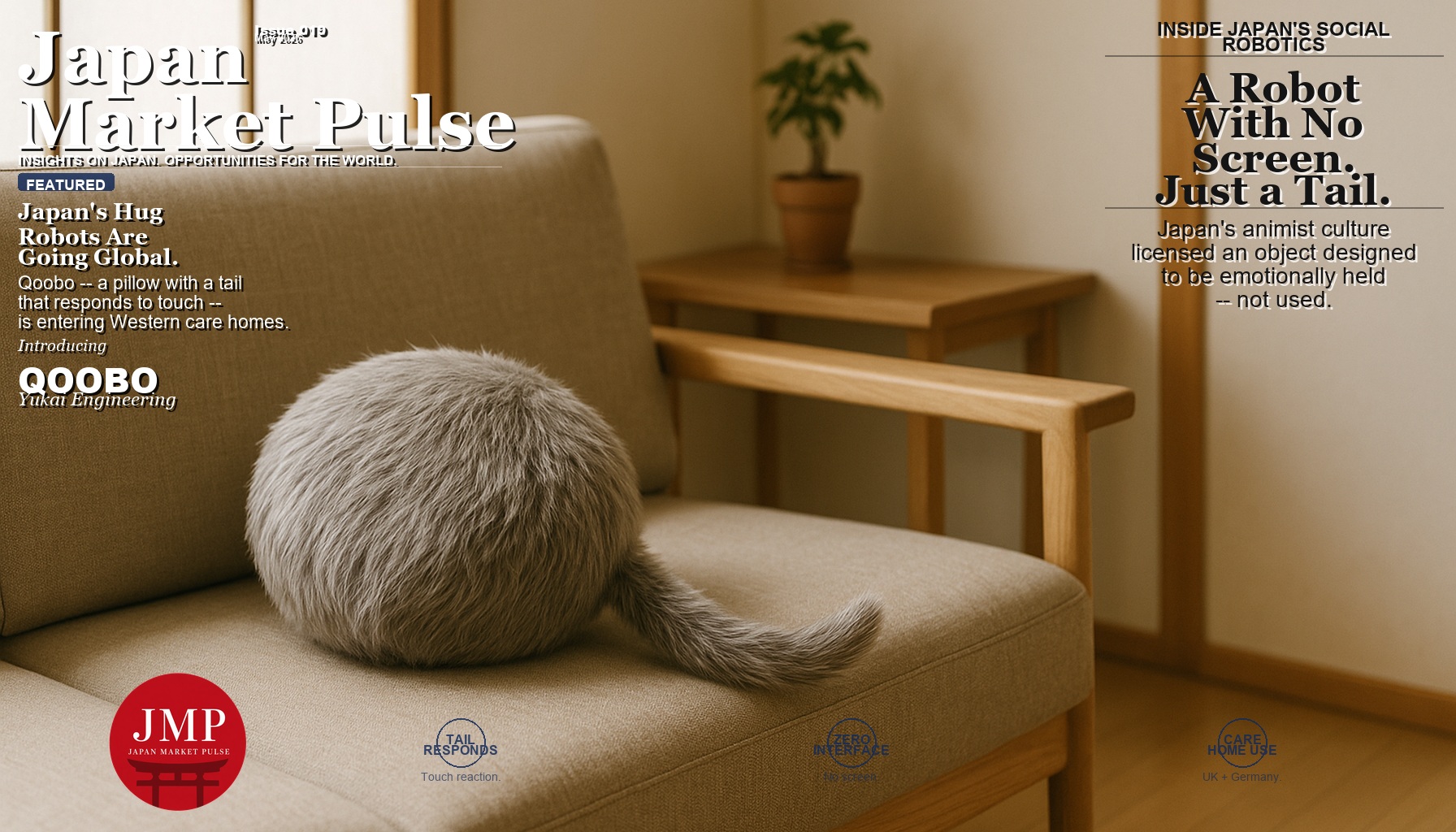
There is a product category that most Western technology analysts have not yet named, but that Japanese engineers have been quietly building for fifteen years. The category does not have a clean English equivalent. The Japanese call it charm-type robots — small, physically soft, emotionally responsive devices whose primary function is not task completion but emotional companionship. They do not vacuum your floor. They do not answer questions. They sit with you, respond to your touch and voice, and in doing so, measurably reduce physiological markers of stress and loneliness.
The most commercially successful product in this category is Qoobo, made by Yukai Engineering, a Tokyo robotics startup founded in 2007. Qoobo is, on its face, a round cushion covered in soft faux fur, about the size of a small cat. Its distinguishing feature is a tail — a flexible, motorized appendage that moves in response to being stroked, held, or spoken to. Stroke the cushion gently and the tail sways slowly. Hold it closer and the tail curls and relaxes. Tap it abruptly and it twitches. There are no screens, no speakers playing synthesized voices, no task interfaces. The entire interaction surface is tactile and the entire output is the tail.
In 2026, Qoobo is landing in Hong Kong pet boutiques, UK care-home procurement catalogues, and German medical-device distributor networks. This is not an accident. It is the result of a decade of product development, clinical trial partnerships with Japanese healthcare institutions, and a precise understanding of what Western markets are now ready to buy — and why they cannot make it themselves.
Why Japan Built This First

To understand why Qoobo exists and why it originated in Japan, you need to understand two things: Japan’s particular relationship with machines, and Japan’s particular housing problem.
The cultural element first. Western philosophy has, for centuries, drawn a categorical distinction between animate and inanimate objects. Rocks are not persons. Machines are not friends. This is so deeply embedded in Western thought that products designed to blur the line — talking dolls, robotic pets — carry a persistent uncanniness, a nagging sense that something is wrong.
Japan has a different conceptual framework. The concept of tsukumogami — spirits that inhabit objects that have been used and cared for over long periods — is one expression of a broader cultural comfort with object-personhood. Shinto animism, the tradition of treating tools with gratitude and ceremony at the end of their useful lives, another. The cultural permission to project emotional relationships onto physical objects is structurally different in Japan than in the West, and it shows in what Japanese consumers will purchase and what Japanese engineers feel socially licensed to build.
The housing element second. Japan’s urban housing stock is dense and rental-heavy. According to the Ministry of Land, Infrastructure, Transport and Tourism, approximately 67% of apartment rental contracts in Japan explicitly prohibit pets. In Tokyo, Osaka, and most major cities, this figure is higher. The result is a large, urbanized population with demonstrable desire for animal companionship and structural inability to obtain it through conventional means. Qoobo was designed, explicitly and from the beginning, for this market — the person in a no-pets apartment who misses the physical comfort of a cat or a dog, and who is willing to project that comfort onto a well-designed substitute.
What Qoobo Actually Is
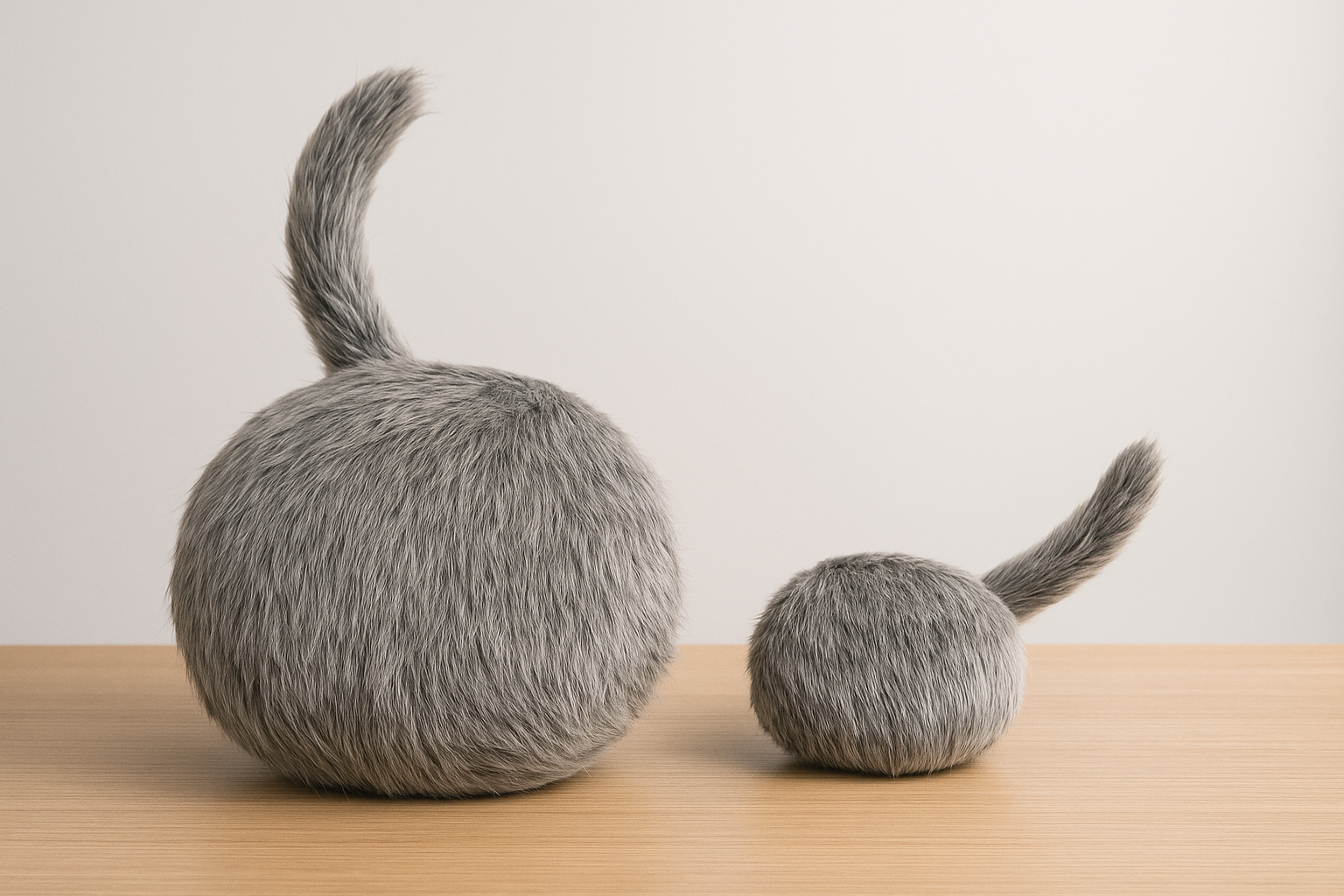
Yukai Engineering’s product line currently has two main SKUs.
Qoobo is the original format: a soft, round pillow approximately 37 cm in diameter and weighing 800 grams, covered in a faux-fur surface available in multiple colorways (Husky Gray, French Brown, Ash White). The motorized tail protrudes from one end, approximately 30 cm long. Battery life is approximately eight hours. The retail price in Japan is ¥15,400 (approximately USD $100). The product connects to no networks and has no microphone or camera.
Petit Qoobo is the compact variant: smaller (approximately 12 cm in diameter), lighter, and positioned as a desk or pocket companion. Retail price in Japan: ¥12,100 (approximately USD $80). Also battery-operated, no network connectivity.
The behavior model is intentionally simple. Qoobo responds to three physical inputs — being stroked, being held (pressure sensors), and ambient sound (the product has a basic vibration sensor rather than a full microphone, detecting sound presence rather than content). The tail’s response is varied and randomized within set parameters, so the interaction feels organic rather than mechanical. There is a heartbeat function — a gentle vibration — that activates when the product is held firmly for more than thirty seconds.
Yukai Engineering has been deliberate about not feature-creeping. When competitors added voice synthesis, screens, or network connectivity to similar products, Yukai’s position was: the tail is the interface. Do not complicate it.
The Healthcare Application — Where the Real Case Is Being Built
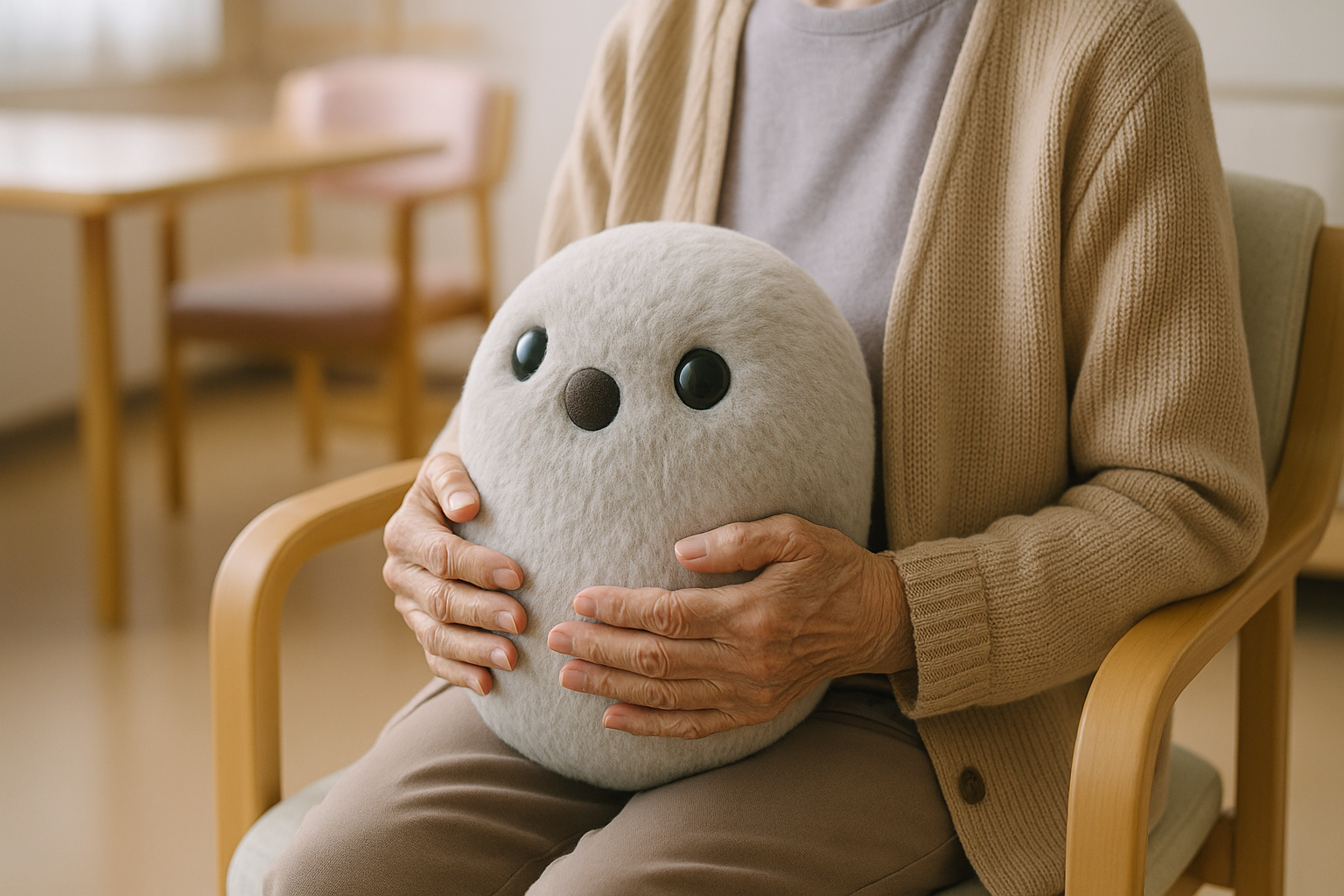
The consumer market for Qoobo is real and growing. But the case that is opening Western institutional channels is the healthcare application.
Between 2020 and 2025, Qoobo was used in pilot programs at seventeen Japanese care-home groups and three hospital pediatric wards. The pilots tracked patient anxiety scores, sleep quality, and medication requests among residents and patients who had access to Qoobo versus a control group. The results, published across three peer-reviewed papers in Japanese geriatric care and occupational therapy journals, are consistent: residents with access to a Qoobo device showed statistically significant reductions in anxiety-scale scores at four weeks, with the effect size comparable to that of structured pet-therapy programs costing several times more.
The mechanism appears to be the same as with certified therapy animals: the repetitive tactile stimulation of stroking, combined with the biological response to perceived reciprocal engagement (the tail moving in response to touch), activates the same physiological calming pathways. For populations that cannot be exposed to live animals — allergy risk, infection-control zones, post-surgical wards — a device that reliably produces the same neuroendocrine response is clinically meaningful.
This is the conversation that Yukai Engineering is now having with UK National Health Service procurement teams and with German Tagespflege (adult day-care) operators. The product is small, battery-operated, washable-surface, and self-contained. It requires no internet, no subscription, and no staff training beyond “here is how to charge it.” It costs less than a single hour of structured therapy.
The Market Landscape — Qoobo Is Not Alone
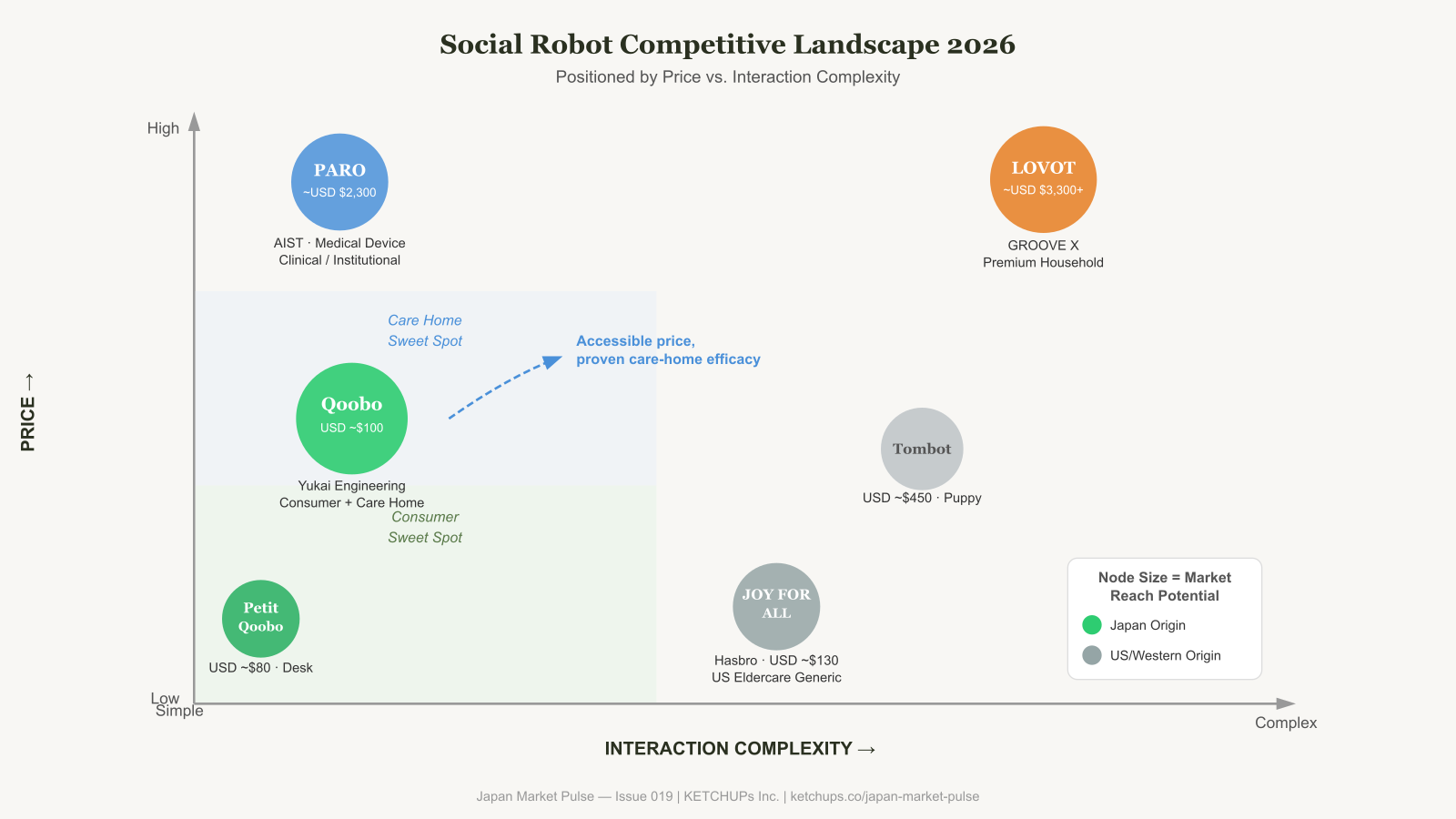
Qoobo is the most commercially accessible product in its category, but it is not the only one. The Japanese social-robot market has multiple distinct segments.
LOVOT (by GROOVE X) is the most technically sophisticated social companion robot in Japan — a round-bodied, roughly 43 cm robot with wide camera-eyes, limb articulation, temperature sensors (it warms to body temperature when held), and an elaborate emotional-state engine. It is also dramatically more expensive: ¥498,000 (approximately USD $3,300) for the robot plus a mandatory monthly subscription of ¥9,900 (USD $66). LOVOT occupies a different market segment than Qoobo — it is positioned as a premium household companion rather than an accessible care tool.
PARO, the therapeutic robotic seal developed by AIST (Japan’s National Institute of Advanced Industrial Science and Technology), is a certified medical device used in clinical settings in Japan, Europe, and the United States. PARO retails at approximately ¥350,000 (USD $2,300) and has been in continuous clinical use since 2001. PARO is the academically validated elder of the category. Qoobo is the consumer-market heir.
The distinction matters for Western buyers. PARO is what you buy for a clinical trial. Qoobo is what you buy for the common room.
Why Western Markets Are Ready Now
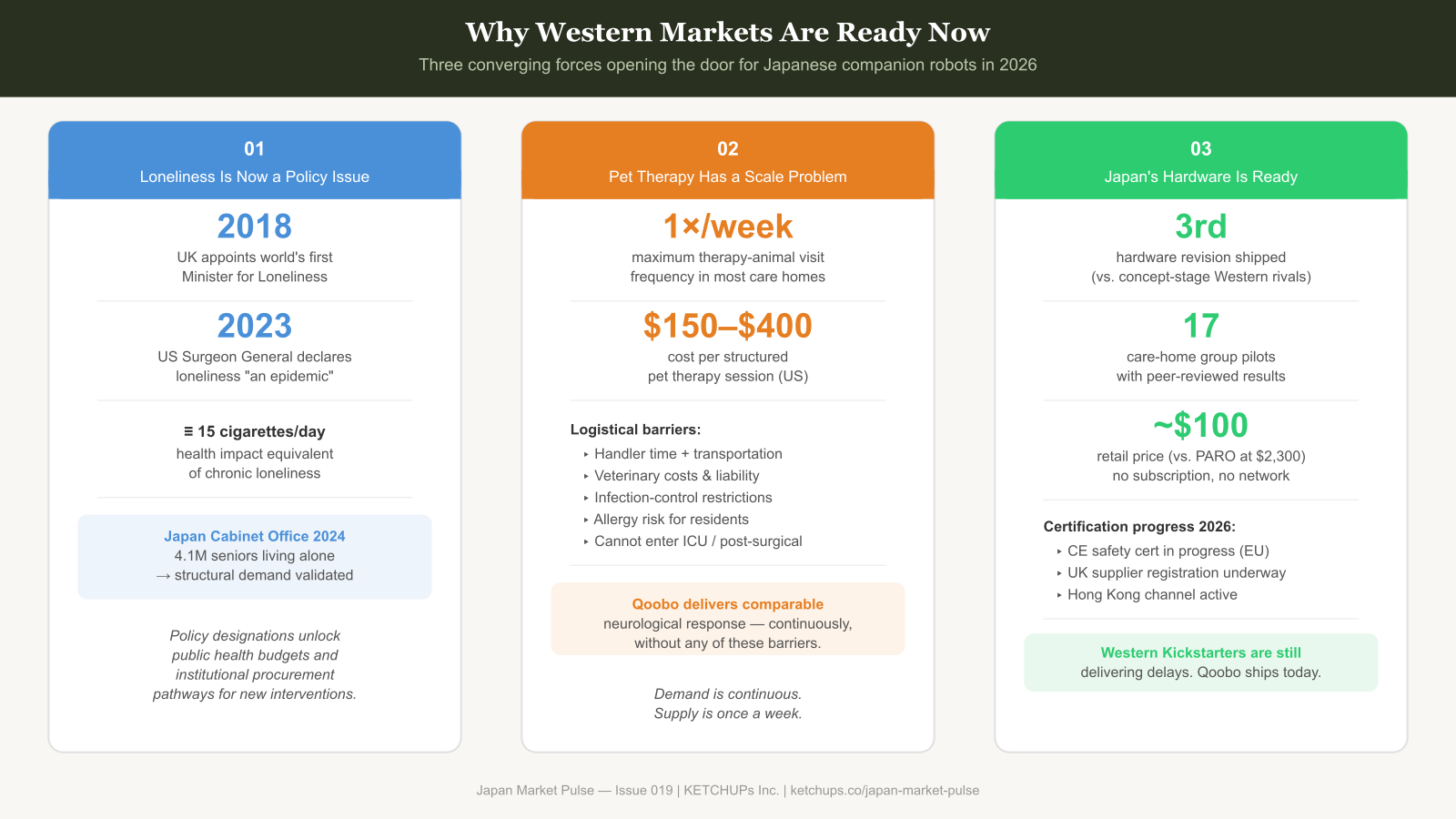
The timing of Qoobo’s international expansion in 2025–2026 is not arbitrary. Three converging factors are opening the Western market in a way that did not exist five years ago.
The loneliness epidemic is quantified and funded. The United Kingdom appointed the world’s first Minister for Loneliness in 2018. The United States Surgeon General issued an advisory on loneliness and isolation in 2023, describing it as “an epidemic” with health effects equivalent to smoking fifteen cigarettes a day. These designations matter not just symbolically but practically: they unlock public health budgets, create procurement pathways, and generate institutional demand for non-pharmacological interventions that can be deployed at scale.
Pet therapy has a replication problem. Animal-assisted therapy is effective. It is also logistically difficult. Certified therapy animals require handler time, transportation, veterinary costs, infection-control protocols, and liability coverage. In most care-home settings, therapy animals visit once a week at best. The demand for the experience of animal companionship — for residents who often spent decades living with cats and dogs — is continuous. A device that delivers a meaningful fraction of the same neurological response, continuously, without logistical overhead, fills a real gap.
Japan’s product development cycle is ahead of the curve. The Western social-robot market is populated mostly by concept products that have not yet shipped, by Kickstarter campaigns with delivery delays, and by technically complex systems that require significant staff engagement. Qoobo has shipped, is in its third hardware revision, has clinical data behind it, and costs less than a dinner for two.
What the Operator Should Watch
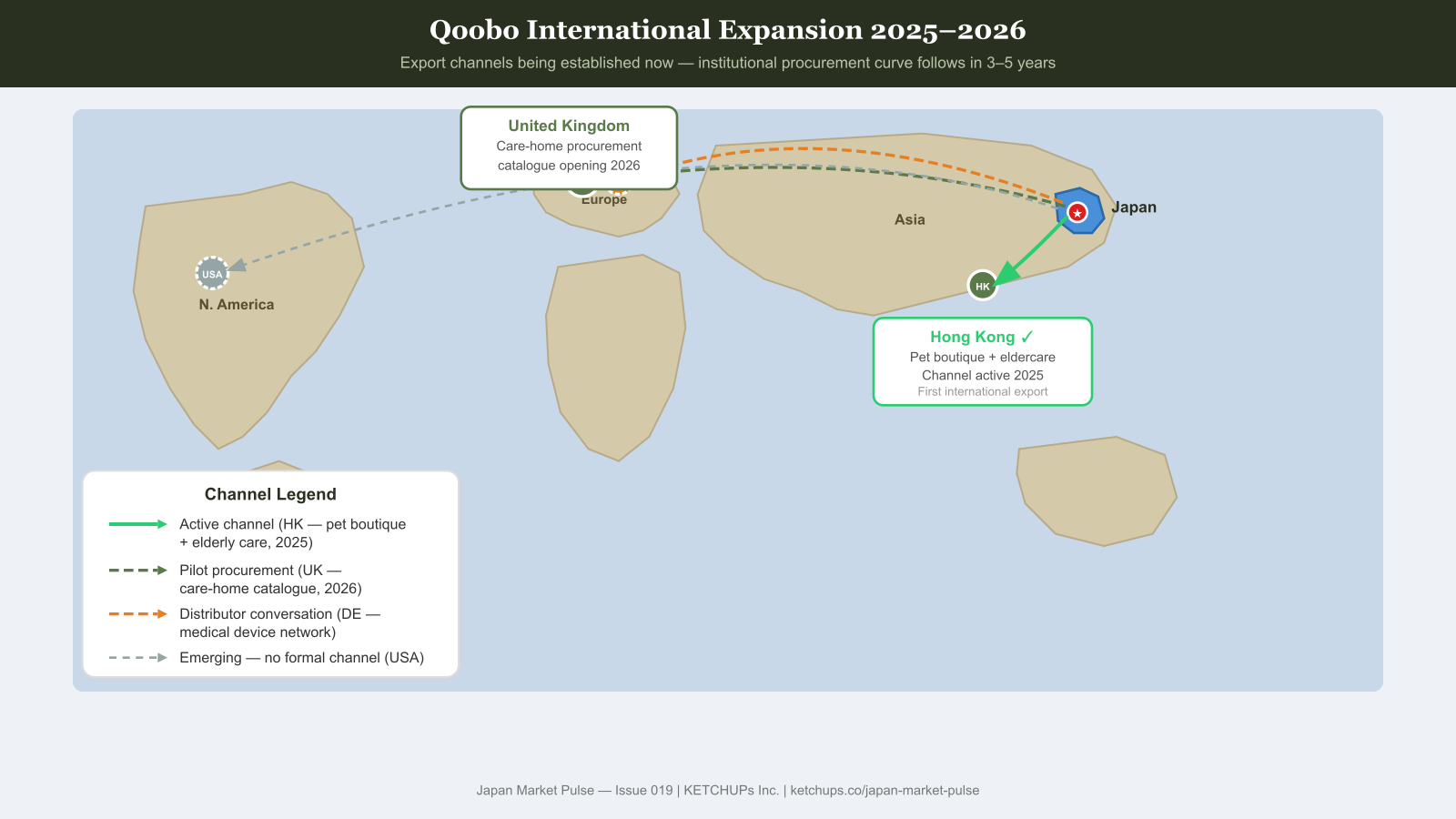
For the international product buyer, distributor, or wholesale curator, the Qoobo story points to a category that is early but real. Several things are worth watching.
The certification path varies by market. In Japan, Qoobo sells as a consumer product with healthcare-use evidence. In the EU, institutional procurement may trigger CE marking requirements depending on how the product is positioned (consumer electronics vs. medical device). In the UK, NHS procurement pathways require supplier registration. These are manageable but represent lead time.
The adjacent categories are larger. Qoobo itself has a limited addressable market at current price points. The category it represents — social companion devices for elderly, isolated, or anxious populations — is a multi-billion-dollar opportunity across three converging markets: eldercare, mental health, and the post-pandemic loneliness economy. The first distributors to establish relationships with Yukai Engineering and the adjacent Japanese social-robot makers will be positioned when the category moves from early-adopter to institutional procurement at scale.
Japan continues to lead. Yukai Engineering is not the only company in this space. Vstone, Cyberdyne, and a cohort of smaller Tokyo-based robotics startups are building social-companion devices at various price points. The institutional trial data is accumulating in Japanese hospitals, care homes, and school counseling offices. The export infrastructure — logistics, regulatory documentation, distributor relationships — is being built now. The operators who engage this category in 2026 are three to five years ahead of the curve. That is exactly where you want to be.
If you’re interested in this topic, the Japanese market more broadly, or what KETCHUPs is working on, we’d love to hear from you — please reach out via our contact form.
If you’re interested in this topic, the Japanese market more broadly, or what KETCHUPs is working on, we’d love to hear from you — please reach out via our contact form.
Japan Market Pulse is a weekly read on what the Japanese consumer-tech, food, and mobility markets are choosing to do, written for international operators who want to know what is happening before it shows up in the global trade press.
Subscribe at ketchups.co/japan-market-pulse.