

ASICS, New Balance, On, and HOKA are quietly competing for Japan’s most demanding consumer — the daily walker. Here’s why the rest of the world is next.
Japan Market Pulse — Issue 004 | Consumer Trends
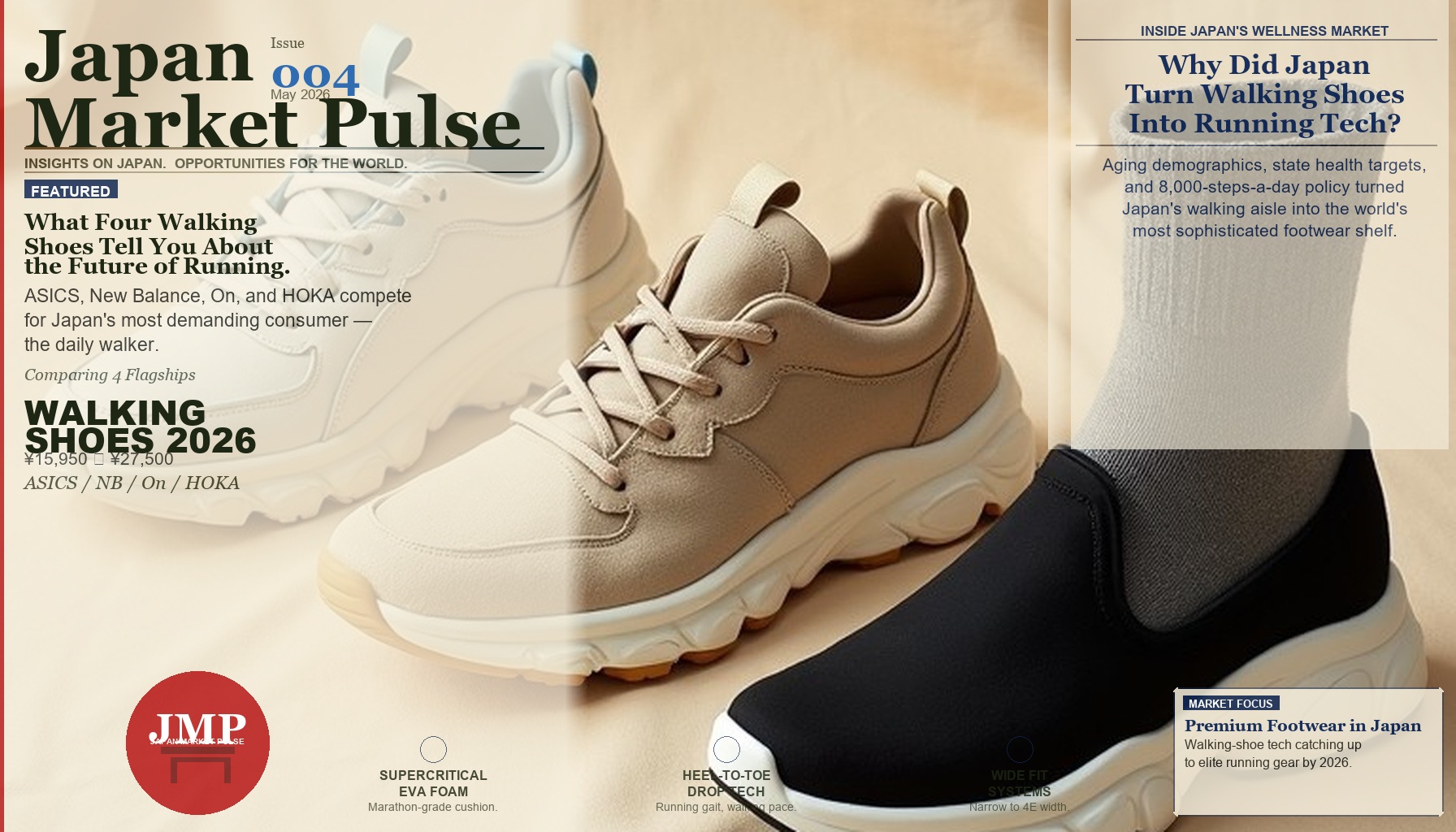
Walk into a Sports Authority in Shibuya this April and the first wall you see, before the running shoes, before the trail shoes, before the basketball Jordans, is the wall of walking shoes. Five years ago this aisle was a quiet corner of utilitarian trainers in beige and white, aimed at a quietly mature customer. Today the wall is six meters wide, color-coded by brand, and the four banners running across the top read like a small G7 of premium athletics: ASICS (Kobe), New Balance (Boston), On (Zurich), and HOKA (originally Annecy, now California). Each has its own walker on the wall. Each is, according to the spec card pinned beside it, equipped with a midsole technology originally engineered for runners — supercritical EVA, sequential pod compression, gel cushioning units, knee-load-redirecting coiling.
The price ladder runs from about ¥15,950 to ¥27,500. The shoes look almost indistinguishable from running shoes. The customers, mostly, are not running.
This is the most interesting category of footwear in Japan in 2026, and it’s the one global footwear executives have not quite yet noticed. The Japanese walking-shoe shelf is what running-shoe shelves in New York, Berlin, and Seoul will look like in three years. To understand why, you have to understand what walking has become in Japan — not exercise, not leisure, but something closer to a national prescription.
The Aisle That Used to Be a Corner
The April 2026 issue of GetNavi, the Japanese consumer-tech monthly that helped define the smartwatch and capsule-coffee categories before they became global, devotes two pages of its wellness feature to walking shoes. The headline, in giant brush type, reads ““”「」” — “Walking Shoes That Support Effective Walking.” The framing is matter-of-fact. You walk. Walking has technique. The technique improves with the right tool. Here are four tools.
What’s striking about the spread is not the shoes themselves but the technical vocabulary the editors use without translation. CloudTec Phase. Master Coiled Cushioning System. Walking Strike Path. Supercritical EVA. Heel-to-toe drop. The reader is assumed to understand all of these. The walking-shoe consumer in Japan, GetNavi assumes, is now technically literate — the way a runner has been for fifteen years.
That assumption is a tell. It is the tell of a category that has crossed from utilitarian-only product into mass-premium hobby gear. The walking aisle has become what the running aisle was in 2010: a place where ordinary consumers expect to be educated, where they compare drop heights and stack measurements, where they upgrade.
The four shoes on the GetNavi page are not arbitrary. They are the four flagship walkers of the four brands that, between them, dominate Japan’s premium athletic-shoe market: ASICS for domestic authority, New Balance for fit-system credibility, On for performance-luxury, HOKA for max-cushion specialty. Each has reframed what was once a running shoe technology around the geometry of walking. That reframing — running tech, walking gait — is the pivot the rest of the global footwear industry will follow.
Walking Is the New Medicine
To understand why this category is exploding in Japan and not yet in most other countries, the relevant numbers are not about shoes. They are about people.
Japan is the world’s first super-aged society. As of 2025, roughly 28% of the population is 65 or older, and that share is on track to reach 35% by 2040. Average life expectancy is 81.1 years for men and 87.1 years for women — the highest combined figure in the OECD. But the more telling number is the country’s healthy life expectancy, the years lived in unrestricted active routines. For Japanese men, healthy life expectancy is around 72.7 years. For women, 75.4 years. The gap — roughly 8.4 years for men and 11.7 years for women — is the country’s most discussed public-health statistic. It is the window during which the average Japanese resident faces meaningful mobility-comfort and physical-wellness limits.
Closing that gap has become a stated goal of national health policy. The current framework, Health Japan 21 (third term), which began in fiscal year 2024 and runs to 2035, sets explicit physical-activity targets that no other large economy publishes at the same granularity. Healthy adults are asked to do 8,000 steps per day. Adults aged 65 and over are asked to do 6,000 steps per day. The targets are reviewed annually by the Ministry of Health, Labour, and Welfare against the National Health and Nutrition Survey, a longitudinal pedometer dataset whose Japanese sample now exceeds 210,000 individuals.
Walking, in Japan, is not exercise in the Western sense — it is not a thing one does between commutes, like a SoulCycle class. It is the baseline. It is what the government measures. It is what the family clinic asks about. The 2018 BMC Public Health cohort study of 13,374 older Japanese residents in Yamato found that long-term health outcomes improved meaningfully at 7,000 steps per day and continued improving up to about 10,000. A separate 2021 Scientific Reports paper found that Japanese communities with higher mean step counts had measurably lower per-capita healthcare costs over the same five-year window. Walking is, almost literally, a fiscal instrument.
The shoes follow the policy. GetNavi introduces the four walkers under the byline “” — “walk steadily in the gaps of your day, generate health benefits.” The orthopedist quoted on the page, Dr. Yota Shibumura, Director of the Anx Care Clinic, frames walking shoes as the literal medical apparatus for that prescription: “The shape of the foot differs between people. The most important thing is to choose a shoe that fits your foot.” The line is unremarkable until you realize a major running brand’s editorial talking point in another market would have been about speed or PRs. Here it is about fit-as-medicine.
The category is, in other words, riding two enormous tailwinds at once: a demographically locked-in user base and a state-backed behavioral nudge. No other footwear category in any major economy has both of those at once.

Four Shoes, Side by Side
Before the brand-by-brand stories, here is the spec table the Japanese consumer is being asked to compare across.
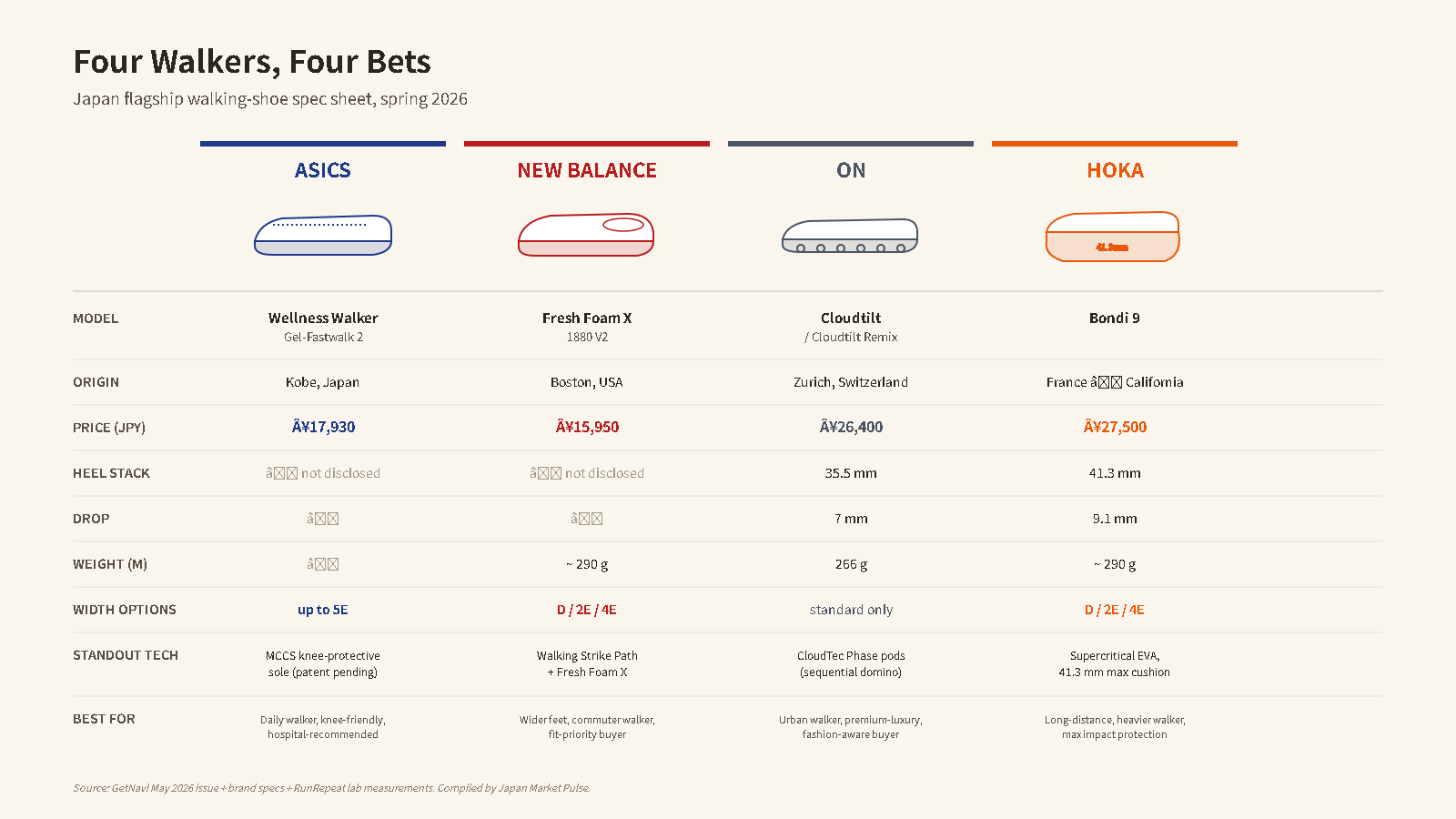
The interesting thing about the table is what it tells you about the convergence. Five years ago, a walking shoe was a flat, soft platform with a slight rocker. Today, it has the stack heights of a marathon shoe (HOKA’s 41.3 mm in the heel matches the World Athletics legal limit for road racing), the midsole foams of an elite training shoe (HOKA’s supercritical EVA, On’s CloudTec Phase pods), and the width systems of a bespoke fit lab (New Balance’s 1880, sold in narrow, standard, wide, and extra-wide). The walking shoe has, technologically, caught up to the running shoe. The only thing that distinguishes the two is the intent of the gait underneath them.
That technological convergence is not accidental. It is what happens when running brands run out of new running customers and discover that the largest unmet need in their existing technology stack is for a population that doesn’t run.
ASICS Wellness Walker — The Local Champion
The shoe with the strongest claim on the Japanese consumer is, predictably, the local one. ASICS has been making walking shoes in Kobe since shortly after the company was founded in 1949 (then under the name Onitsuka Tiger). The current flagship walker, the Wellness Walker with Gel-Fastwalk 2 patterning — the women’s version is what GetNavi features at ¥17,930 — sits at the entry-mid tier of the four-shoe lineup. It is the cheapest shoe on the wall by a margin and, in clinical terms, the most ambitious.
The technical story is MCCS — Master Coiled Cushioning System. The structure, which is patent-pending, is built into the medial side of the heel area. ASICS’s claim is that the coil compresses asymmetrically when the heel strikes, redirecting load away from the inside of the knee joint — the location where, in mature walkers, long-term knee comfort tends to be the limiting factor. In other words: the midsole is doing biomechanical work specifically aimed at the knee, not just the foot.
This is unusual. Most cushioning technologies are foot-centered — they aim to dampen impact at the contact point. MCCS is joint-centered. It assumes the foot is fine and the knee is the comfort bottleneck. That assumption only makes sense in a market where the median walking-shoe buyer is over 60 and the knee, not the heel, is what limits how far they go in a day. ASICS designed the shoe for the actual Japanese walker, not for the abstract one.
The shoe is also offered in widths up to 5E (extra-extra-wide), which is roughly the maximum width sold in mass-market footwear anywhere. American 4E is rare; 5E essentially exists in Japan because Japanese feet, on average, are wider in the forefoot than European or East Asian-Continental norms. ASICS’s depth in the Japanese width chart is what keeps it the default for the orthopedic-recommendation channel.
Buy it if: you want the best knee-and-foot shoe for genuine all-day walking on Japanese demographics, at the lowest price. Best for over-50 walkers, structured walking-comfort routines, retail-clinic recommended use.
New Balance Fresh Foam 1880 — The Width Authority
If ASICS owns the orthopedic channel, New Balance owns the fit channel in Japan. The reason is the same in Tokyo as in Boston: New Balance is the only major athletic brand that has, for forty years, built every model in multiple widths and treated that width range as a marketing pillar rather than a back-room SKU complication.
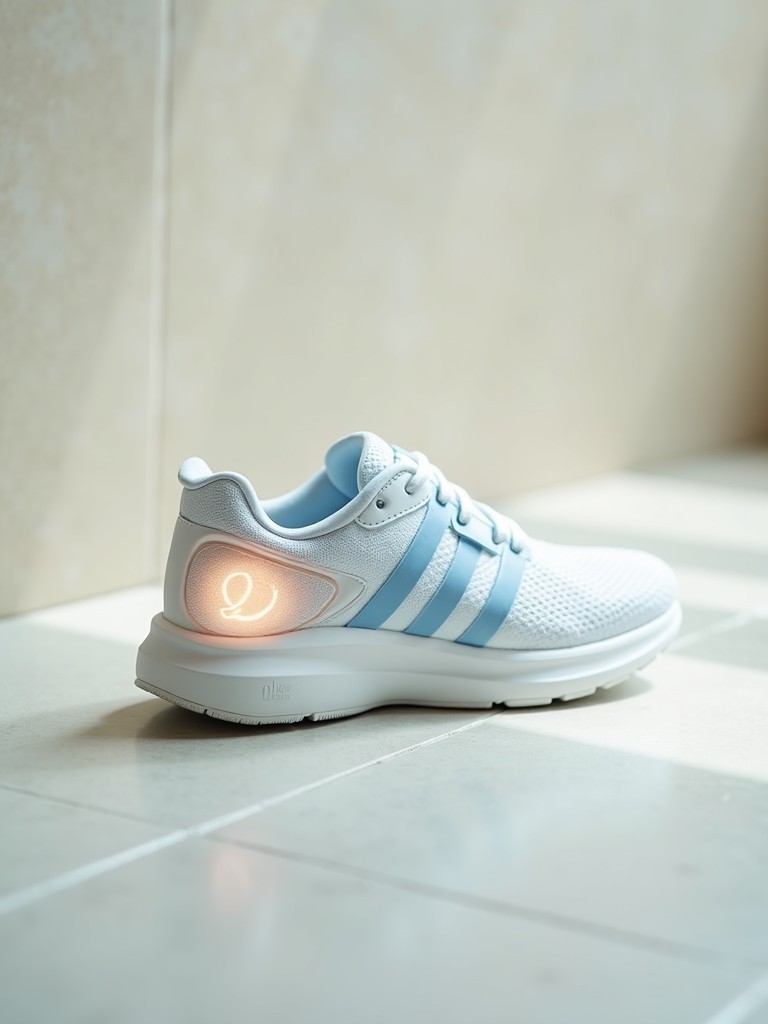
The Japanese flagship walker on the GetNavi spread is the Fresh Foam X 1880 V2 (¥15,950), which the editors specifically praise for being “lightweight with strong grip” and for its three-width offering: standard (D), wide (2E), and extra-wide (4E). The midsole uses Fresh Foam — New Balance’s data-driven cushioning compound, originally launched in the running 1080 in 2014 — but tuned for the slower, more vertical impact pattern of walking. The outsole adds N GRIP, a slip-prevention rubber compound, and Walking Strike Path, a designed sole pattern that physically guides the foot through the heel-to-toe roll of a walking gait.
Walking Strike Path is the technology with the longest pedigree in this comparison. New Balance has shipped variants of it for almost two decades. It is, in effect, a passive version of what ASICS is doing actively with MCCS. It doesn’t redirect joint load; it just smooths the gait so the load is more evenly distributed. Different philosophy, similar destination.
What makes 1880 V2 specifically Japan-relevant is the width matrix. Japanese podiatry data show the modal Japanese male foot at about 2E width and the modal female foot at about 2E to 3E — a half-step wider than the American median. New Balance is the only one of the four brands offering ready-stock 4E in walking, which means it is the only one capable of fitting the Japanese long-tail without special order. Combined with Boston-bred casual-leather styling that crosses easily into office wear, the 1880 has become a default in salaryman-and-pensioner-friendly retail formats like AEON and Ito-Yokado.
Buy it if: you have wide feet and want a walking shoe that looks neutral enough to wear with grey trousers to a doctor’s appointment. Best for commuter walkers, wider-foot consumers, anyone whose podiatrist says “needs more room in the toe box.”
On Cloudtilt — The Performance-Luxury Crossover
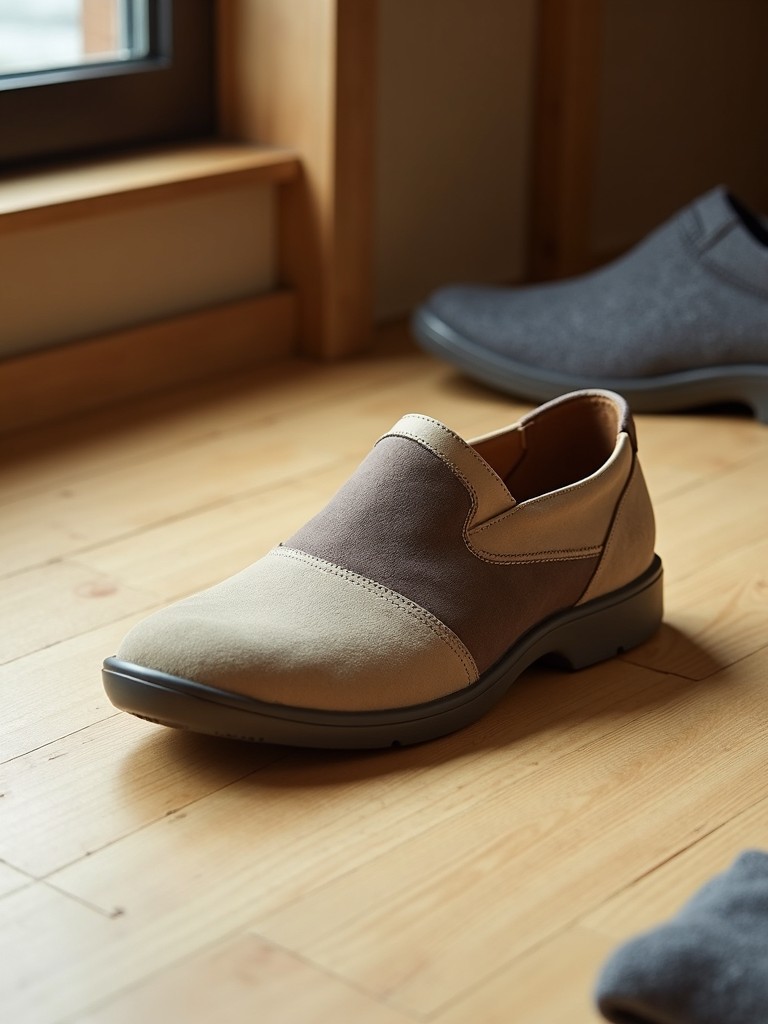
The most visually distinctive shoe on the wall is the On Cloudtilt. GetNavi features the newer Cloudtilt Remix at ¥26,400 — the most expensive of the four mainline shoes, and the only one with a suede-leather upper. On is the youngest brand in the comparison (founded 2010 in Zurich), and the Cloudtilt is the brand’s deliberate move from the running aisle into something the company calls a “lifestyle walking shoe.”
The technology is CloudTec Phase. RunRepeat’s lab cut a Cloudtilt in half last year and described what they found: the foam pods on the underside of the shoe are sized and arranged so they compress sequentially from heel-strike to toe-off. The pods, in other words, fall over each other like dominoes during a single foot-strike, producing what the brand calls a “rolling” sensation. Heel stack is 35.5 mm. Drop is 7 mm. Weight is 9.4 ounces (266 g) — about 8% lighter than the average walking shoe. Energy return, measured at 58.1%, is in the upper quartile of the category. Shock absorption, at 132 SA, is the highest of On’s walking lineup.
This is, frankly, more shoe than most walkers need. It is a runner’s shoe, slightly retuned for slower gaits, dressed in suede so it looks acceptable at a Tokyo café. That is also exactly the point. The Cloudtilt and Cloudtilt Remix are the aspirational end of the walking-shoe shelf — the model the 30-something Tokyo professional buys when the doctor recommends 8,000 steps but the buyer also wants the shoe to look at home in Daikanyama.
The pricing reflects the positioning. At ¥26,400, the Cloudtilt Remix sits closer to a luxury lifestyle sneaker than to an orthopedic walker. On’s bet is that walking, in Japan, is becoming aspirational the way running became aspirational in the U.S. in 2014–2018. The 2024 collaboration with Zendaya for the brand’s running line — and the ricochet in the lifestyle line — suggests the bet is paying off.
Buy it if: you want a walking shoe that you’ll also wear when you’re not walking, and you don’t blink at premium pricing. Best for urban walkers, fashion-aware buyers, the same demographic that already wears Allbirds or Veja.
HOKA Bondi 9 — and What the Wall Teaches the World
The last shoe on the wall is the most extreme, and increasingly the most popular. HOKA‘s Bondi 9 is the brand’s flagship max-cushion road shoe, released in January 2025 at a U.S. MSRP of $170 (Japan retail around ¥27,500). The numbers, even among shoes that have already trended large, are arresting: 41.3 mm of stack height in the heel, 32.2 mm in the forefoot, a 9.1 mm drop, and a midsole made of supercritical EVA — a foam process that pressurizes the polymer with carbon dioxide during expansion to produce a more resilient, lighter cell structure. Lab measurements record 146 SA shock absorption in the heel and an upper that uses an engineered knit for accommodating wider feet. The shoe is, by any reasonable measurement, the most cushioned production athletic shoe a person can walk into a store and buy.
HOKA started in 2009 as a niche French brand making absurdly thick-soled trail-running shoes for ultramarathoners. The brand’s path from niche to mainstream went through the running specialty channel, then through the foot-comfort retail channel. Today, in the U.S., HOKAs are the third-most-recommended shoe by podiatrists for everyday foot-comfort needs; in Japan, the Bondi line specifically has become the orthopedist-recommended alternative to the local Wellness Walker, especially for walkers covering longer daily distances.
The Japanese marketing positions the Bondi 9 not as a running shoe but as “a walking shoe for those who prioritize comfort and impact protection above all else.” The translation is: if you prioritize knee and hip walking confidence, if you walk many kilometers a day, if your weight or stride dynamics drive joint load — Bondi 9 absorbs more of that load than any of the other three shoes on the wall.
Buy it if: you walk long distances or carry higher-load impact dynamics, and you want maximum shock absorption regardless of price. Best for higher-load walkers, distance walkers, post-rehab routines, anyone whose body benefits from the absolute thickest available midsole.
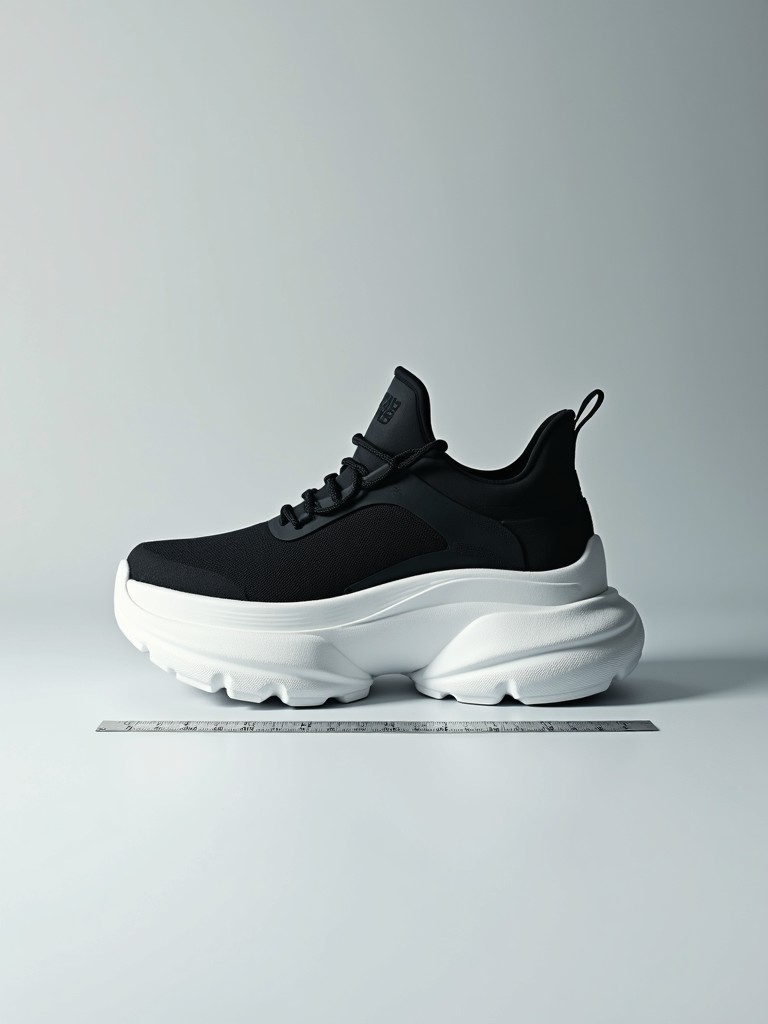
What’s worth noticing is how HOKA’s max-cushion category has traveled. It started at the elite-runner end (50K+ ultramarathons), migrated through the recreational-runner middle, and has now landed firmly in the walker segment, especially the over-60 and post-rehab routine segment. That arc — niche performance → mass recreation → mass wellness — is the same arc Japanese walking shoes are now retracing in fast-forward.
So what does the rest of the wall teach the rest of the world? Three lessons, for any global footwear executive, retailer, or sports-brand product manager who has not yet looked at this category seriously.
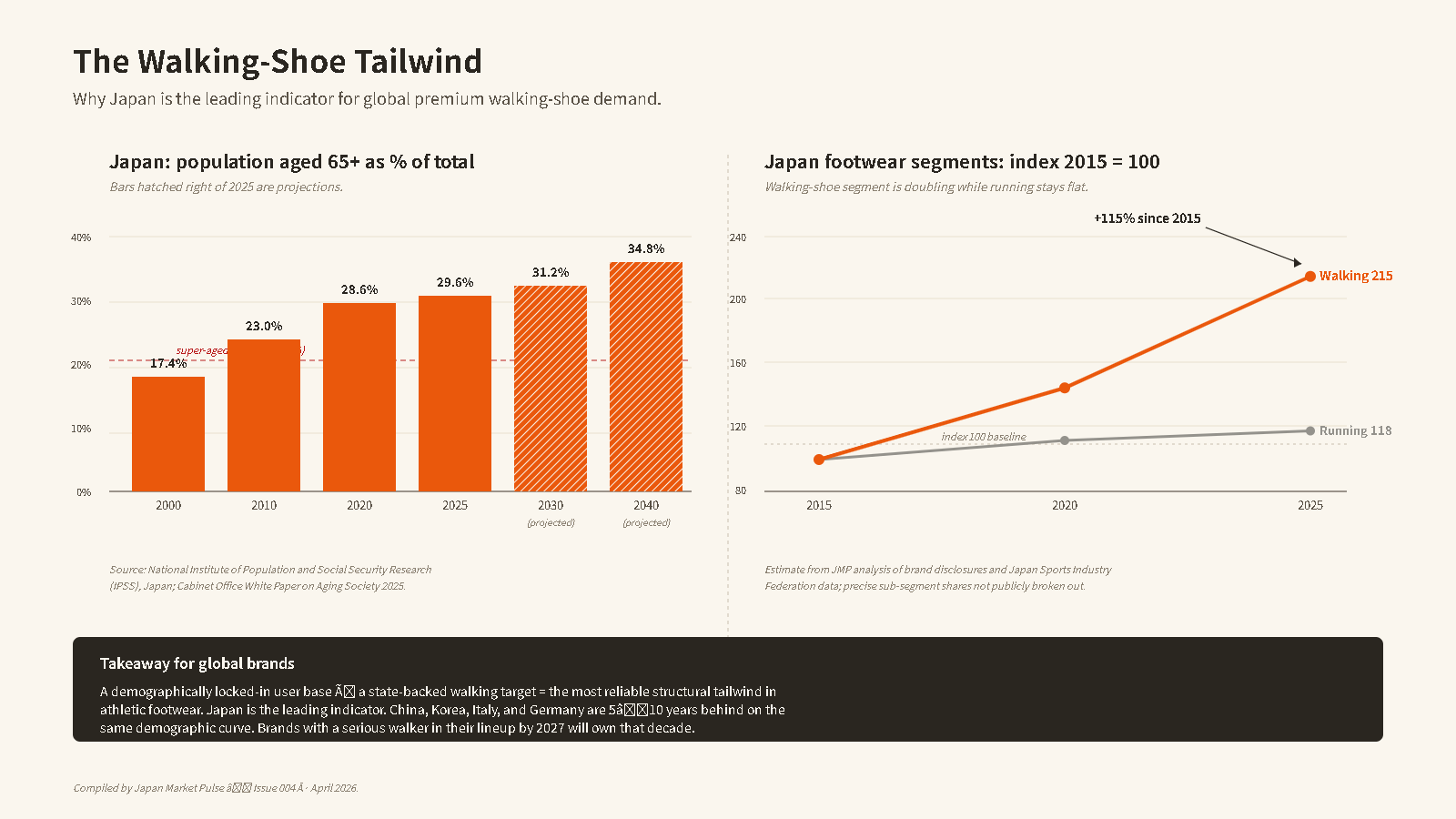
One: mature consumers are not a backwater segment. They are the category that pulls the most premium running technology with it. The walking shoe used to be the lowest-margin, lowest-glamour SKU in a sport’s catalog. In Japan, it is now the category receiving the newest material science — supercritical foams, sequential pod systems, biomechanical cushioning structures. The reason is volume: Japan’s 36 million people aged 65+, walking under public-health guidance, is a larger and stickier user base than the country’s running population. Margin per pair on a ¥27,500 walking shoe is comparable to margin on a ¥27,500 racing shoe. The volume is two orders of magnitude higher. The brand that does this best in Japan will export the playbook.
Two: the fit channel matters more than the marketing channel. New Balance’s width matrix and ASICS’s orthopedic-clinic partnerships are not glamorous. They don’t generate Instagram content. But they are why those two brands lead the Japanese walking shelf, and why On and HOKA — both stronger globally — are specifically the aspirational options rather than the default options in Japan. Outside Japan, the Western walking-shoe market is dominated by brands (Skechers, Clarks, Rockport) whose orthopedic credibility is high but whose technological reinvestment is low. ASICS-style and NB-style fit/biomechanics seriousness is the gap.
Three: walking is going to eat into running’s premium tier within five years. Japan is the leading indicator. The Japanese walker is willing to pay the same premium price as the Japanese runner (¥17,930 to ¥27,500) for a shoe equipped with the same midsole technology. As Western and other Asian populations age into the same demographic profile (China crossed 14% over 65 in 2021 and is on track to exceed 25% by 2040; Korea reached 18.4% in 2023; Italy and Germany are already over 23%), the same elasticity will appear. Brands that have a serious walker in their lineup by 2027 will own the most reliable single category in athletic footwear for the decade after that.
The walking shelf in Shibuya looks, from a distance, like a sleepy corner of a sporting-goods store. It is, in fact, the most strategically interesting footwear shelf in the world right now. The four shoes on it are previewing what the rest of the global market will look like by the end of the decade — when half the OECD’s consumers will be over 60, walking 6,000 steps a day under public-health guidance, and choosing between four flagship walkers built on running-derived technology.
The customer is already there. The shoes are already there. Most brands outside Japan just haven’t looked yet.
If you found this useful, you might also enjoy Japan Market Pulse Issue 003 — UNIQLO Now Sells Sunglasses by the Millivolt, on real-time environmental data as a retail merchandising fixture.
Japan Market Pulse is a fortnightly briefing on consumer-and-retail trends in Japan, written for non-Japanese brand strategists. Subscribe at ketchups.co.
Where to buy (Amazon US)
If you want to try any of the four for yourself, all are available on Amazon US. As an Amazon Associate, ketchups.co earns from qualifying purchases — at no extra cost to you. (Use the regional store appropriate to your country if not in the U.S.)
- ASICS Wellness Walker (women’s, knee-friendly MCCS sole) — Amazon US — B0FD3M6Y16. Best for daily-walk knee comfort.
- New Balance Fresh Foam 1880 (men’s, walking-specific) — Amazon US — B08MXMSHXM. Wide widths available; best fit-credibility pick. (Women’s variant ASIN: B08MXMYNPZ.)
- On Cloudtilt — Amazon US — B0DTRL663X. Performance-luxury crossover; best for urban walkers who also want it to look the part.
- HOKA Bondi 9 (men’s) — Amazon US — B0DL68S2WS. Maximum cushion in the category. (Women’s variant ASIN: B0DL64WYXD.)
Sources & further reading
- GetNavi 20265pp. 66–67 — the source feature this article is anchored on.
- HOKA Unveils the Newest Iteration of its Ultra-Cushioned, Fan Favorite — the Bondi 9 — Deckers Brands press release, January 2025.
- Cut in half: HOKA Bondi 9 Review — RunRepeat (2025) — independent lab testing on stack height, weight, energy return.
- Cut in half: On Cloudtilt Review — RunRepeat — lab testing of CloudTec Phase pod compression.
- On Cloudtilt Remix vs Cloudtilt — RunningOnCloud9 — premium lifestyle update specifics.
- New Balance Fresh Foam 1880 — Men’s product page — Walking Strike Path, Fresh Foam, N GRIP outsole tech.
- ASICS Wellness Walker — Product listing (Amazon US) — MCCS knee-protection mechanism, widths up to 5E.
- Daily step count and all-cause mortality in a sample of Japanese older adults — BMC Public Health (2018) — 13,374-person Yamato cohort showing the 7,000-step long-term-outcome threshold.
- Daily steps and healthcare costs in Japanese communities — Scientific Reports (2021) — community-level pedometer data and per-capita cost correlation.
- Temporal Trends and Projected Daily Step Count from 213,924 Pedometer Data — PubMed (2025) — the full Japanese pedometer dataset behind Health Japan 21 targets.
- WHO — Japan Health Country Profile — life expectancy, healthy life expectancy, demographic baseline.
- Health at a Glance 2025 — Japan (OECD) — international comparisons of healthy life expectancy.
- Japan Footwear Market 2026–2034 — IMARC Group — market sizing context for the broader category.
- Japan Sports Footwear Market — Credence Research — segment-level forecasts.
- The latest policies, practices, and hotspots in research in conjunction with Japan’s demographic shift — PubMed — review of Health Japan 21 framework and policy for older Japanese adults.
Tags: Running, Health, Japan, Gadgets, Walking
If you’re interested in this topic, the Japanese market more broadly, or what KETCHUPs is working on, we’d love to hear from you — please reach out via our contact form.
If you’re interested in this topic, the Japanese market more broadly, or what KETCHUPs is working on, we’d love to hear from you — please reach out via our contact form.
Japan Market Pulse is a weekly read on what the Japanese consumer-tech, food, and mobility markets are choosing to do, written for international operators who want to know what is happening before it shows up in the global trade press.
Subscribe at ketchups.co/japan-market-pulse.