

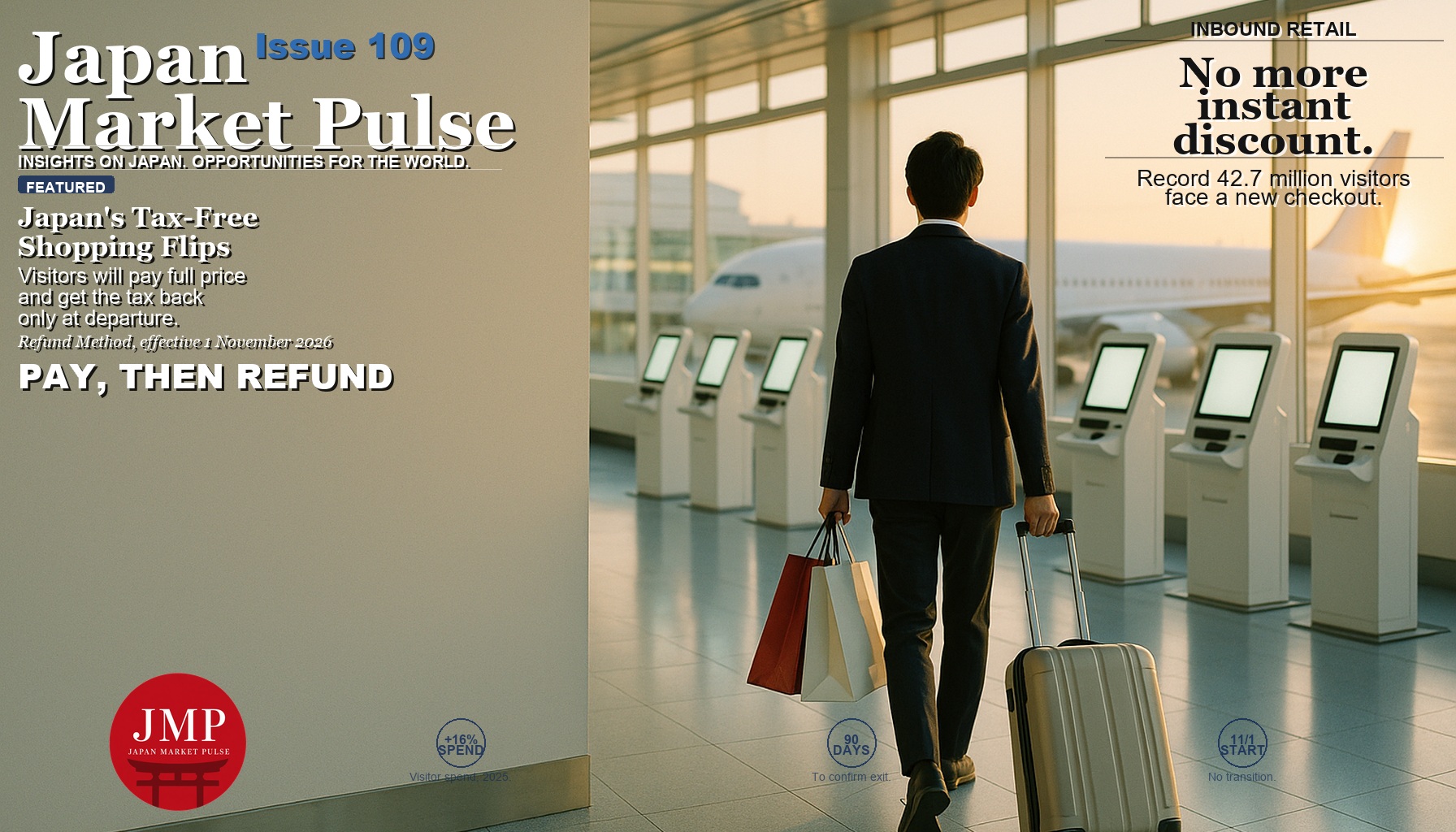
At midnight on 31 October 2026, one of the oldest habits in Japanese retail will quietly expire. For decades, a foreign visitor buying a camera, a handbag or a bag of skincare at a Japanese store could show a passport at the register and walk away having paid no consumption tax at all. From 1 November, that moment at the register disappears. Visitors will pay the full tax-inclusive price, and the tax will be returned only after customs confirms, at the airport or seaport, that the goods are actually leaving the country.
There is no transition period. A qualifying purchase made on 31 October follows the old system. The same purchase made one day later follows the new one.
The timing is striking. In 2025, Japan welcomed a record 42.68 million foreign visitors, up 15.8% on the year before, and those visitors spent a record ¥9,455.9 billion, up 16.4%. The government wants 60 million visitors a year by 2030. Tax-free shopping is an important part of the shopping appeal for many of them, and it is the most visible piece of the tourism pitch at the checkout counter. Changing how it works, in the middle of the boom, is a calculated gamble.
I have spent two decades watching how Japanese stores sell to foreign visitors, and this is the biggest structural change to the experience since the system was widened in 2014. This article walks through what is changing, why the Ministry of Finance wants it, what the numbers say about the market that is about to be rewired, and what it means for anyone who sells to visitors in Japan or plans to.
The Rule That Flips at Midnight on 1 November
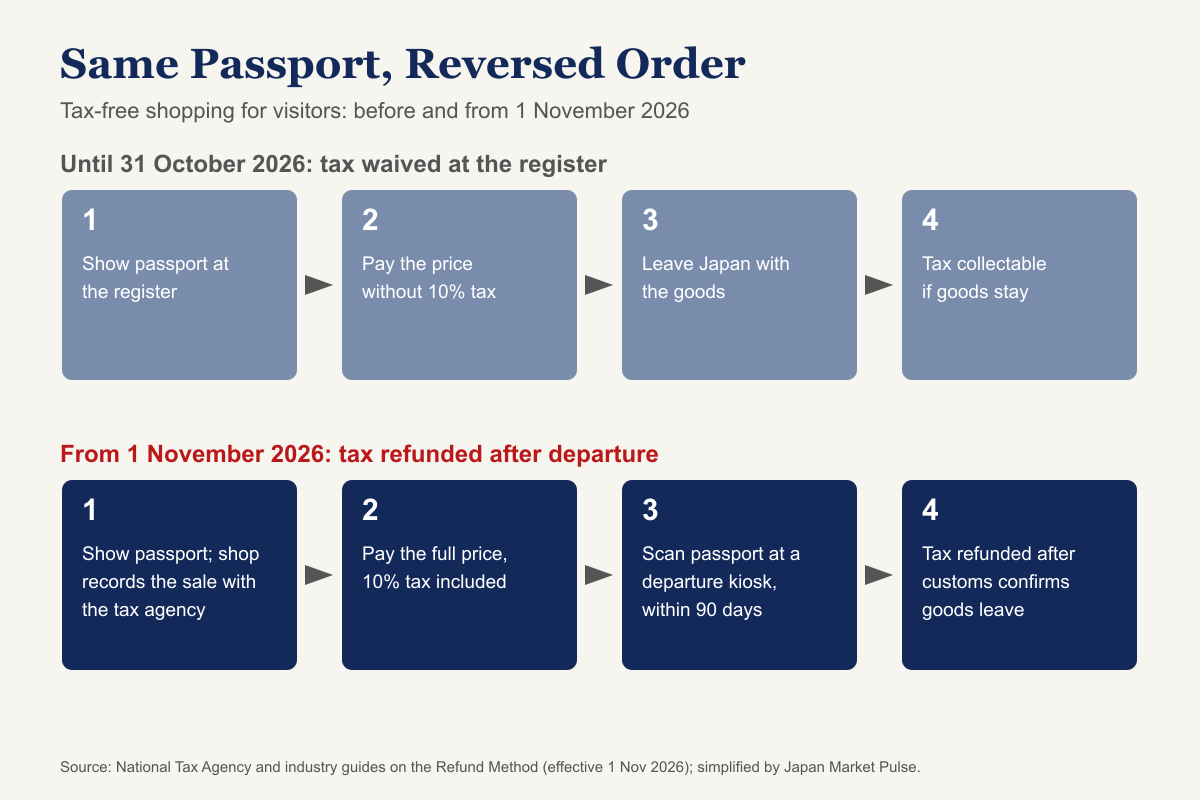
The mechanics of the old system were simple, and that simplicity was the point. A short-term foreign visitor spending at least ¥5,000 before tax at one store on one day could buy goods consumption-tax free. The shop checked the passport, sent the purchase record electronically to the National Tax Agency, and the customer paid the tax-exclusive price. For consumables such as cosmetics, food and medicine, shops sealed the goods in special bags and capped the total at ¥500,000 per person per store per day. General goods such as electronics, watches, bags and clothing had no cap at all.
The new system, which the government calls the Refund Method, reverses the order. The visitor pays the price including the 10% consumption tax. The shop records the sale, including passport details and the goods, in a system run by the National Tax Agency. Then, when the visitor leaves, customs confirms that the goods are being taken out of Japan, and only then is the tax paid back.
Several details of the reform are worth stating precisely, because the first wave of news coverage has blurred them:
– The effective date is 1 November 2026, with no overlap. The date of sale decides which procedure applies. – The ¥5,000 minimum stays. But general goods and consumables are now combined when reaching it, which makes the threshold easier to meet. – The ¥500,000 cap on consumables is abolished, and the sealed-bag requirement disappears with it. – Items priced at ¥1,000,000 or more before tax require detailed records, including serial numbers where they exist. – Customs confirmation must be completed within 90 days. Day one is the day after purchase, so a purchase on 1 November has a deadline of 30 January. Miss it, and there is no exemption and no refund. If a refund has already been paid, it may have to be repaid. – Gold and platinum bullion and coins are excluded.
This is not a simple tightening. In some respects it is a loosening: the visitor who buys more than ¥500,000 of cosmetics in a single store in one day no longer runs into the consumables cap, and the sealed bags that made luggage packing awkward are gone. What changes is the trust model. The old system waived the tax at the counter and relied on customs checks at departure, with the tax collectable afterwards if the goods stayed. The new one holds the money until the goods are verified out of the country.
!Old and new tax-free checkout flow

How the New Refund Method Actually Works
For a visitor, the journey has four steps, and the first one is the only one that feels unchanged.
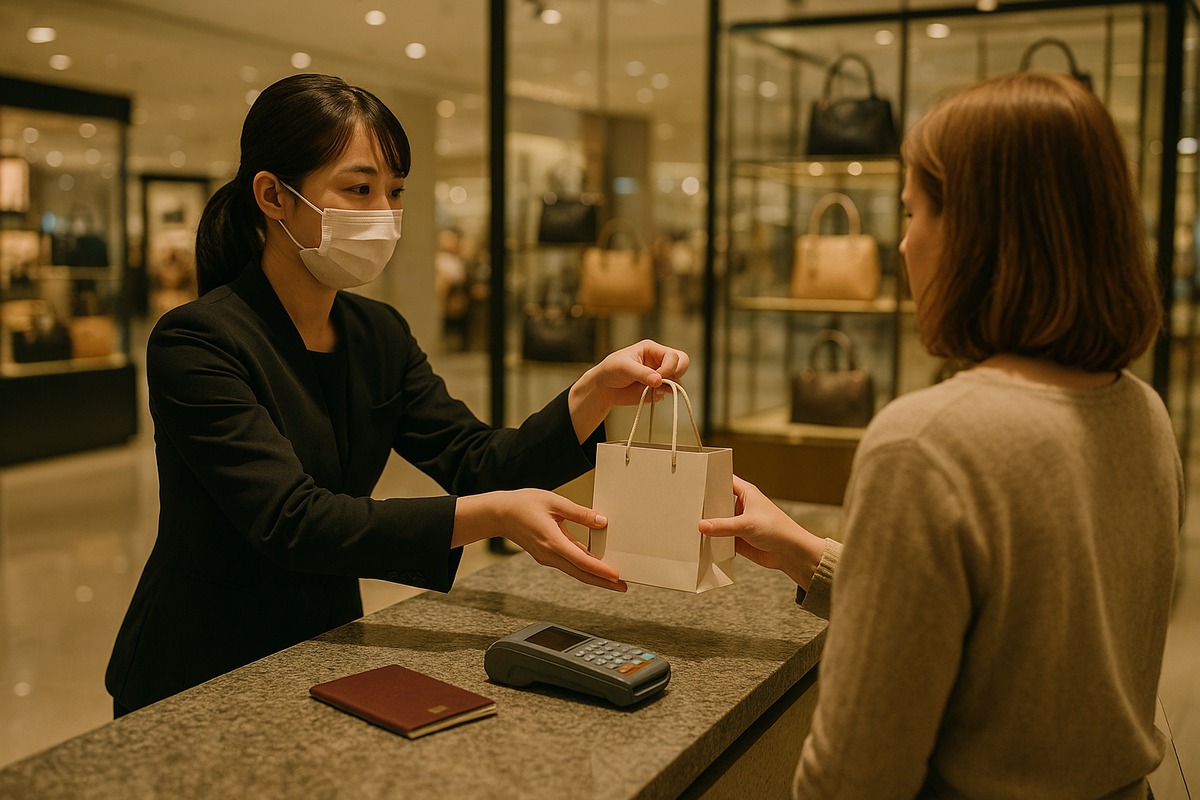
At the shop, the traveller shows a passport, as before, and pays the full price. The shop uploads the purchase record to the tax authority’s system. As under the current electronic system, the record lives in the tax agency’s system and is tied to the passport number; the key change is that the visitor now pays tax-inclusive until customs confirms the export.
On the way to the airport, nothing is required. There is no form to fill in and no booth to visit in the city.
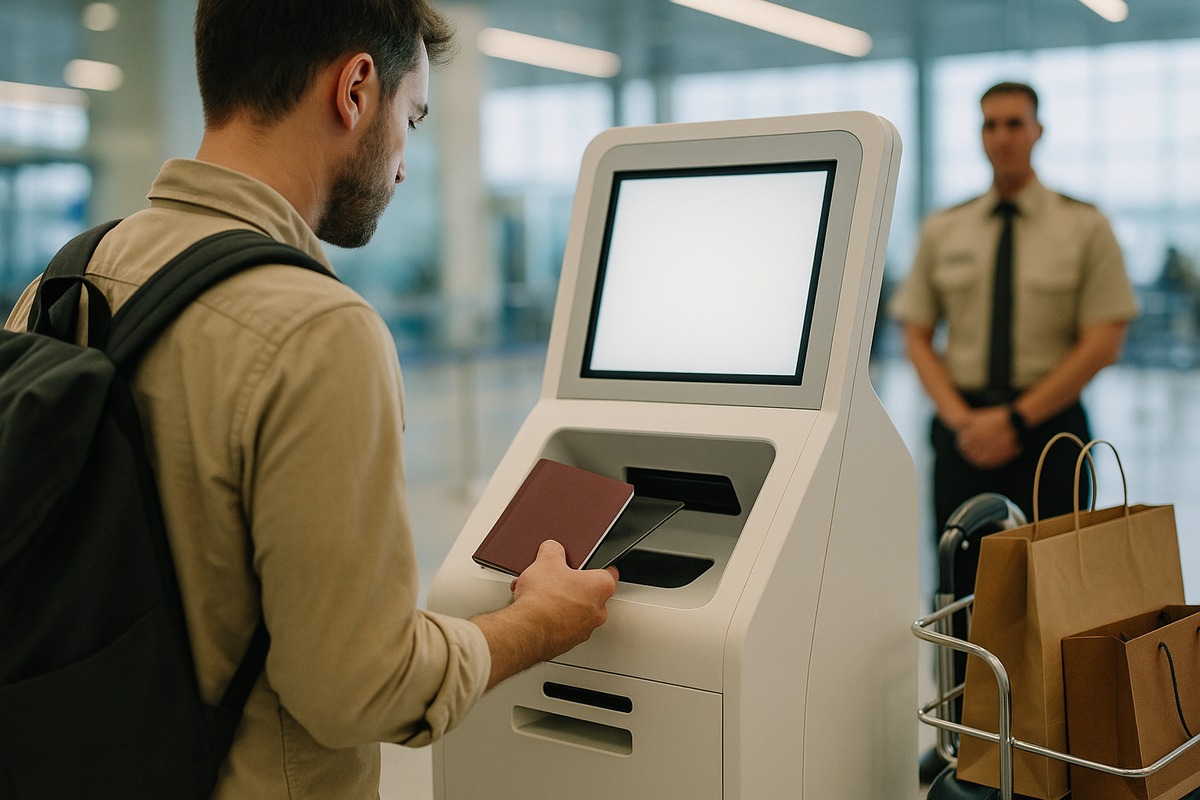
At departure, the traveller scans their passport at a self-service tax-free terminal, typically a kiosk in the departure hall, which pulls up the purchase records and decides automatically whether a customs officer needs to inspect the goods. Confirmation must be completed before checking in any luggage that contains the purchased goods. From 1 November, the Visit Japan Web service can also be used for the departure procedure at seven airports: Narita, Haneda, Kansai, Chubu Centrair, New Chitose, Fukuoka and Naha.
After confirmation, the refund is paid by whatever method the shop or its refund provider supports. Industry guides list cash at the airport or seaport, bank transfer, credit card and app-based transfer. Not every shop will offer every method, and the timing depends on the method: some refunds will be paid in cash on the spot, while others will be credited later. Some travel guides also say refund providers may deduct a handling fee. Whether and how much will be set by each provider rather than by law, so it is worth asking before paying.
One thing that is gone for good is the separate-shipping route for travellers. That was abolished on 31 March 2025. A shop can still ship goods directly overseas for a customer as an export under Article 7 of the Consumption Tax Act, but that sits outside the Refund Method.
!A shopper at a department store tax-free counter

Why Japan Is Doing This: ¥2.1 Billion Uncollected and a ¥140 Billion Apple Problem
If the old system worked for shoppers and shops, why change it? Because for the tax authority it was leaking, and the leaks had names and numbers.
Under the old model, a store sold goods without tax on the strength of the buyer’s promise to export them. If the goods did not leave, the tax became due, but collecting it from a person who had just left the country was close to impossible. In practice, the liability could fall back on the store.
Reporting on audits by customs and the Ministry of Finance gave a sense of the scale. In fiscal 2022, customs authorities aimed to collect about ¥2.2 billion in consumption tax from 366 visitors whose purchases had not met the exemption requirements, and were unable to collect roughly ¥2.1 billion of it, almost all because the buyers had already left the country. In a separate review of 57 visitors who each bought more than ¥100 million of tax-free goods in the same year, only one was found to have actually taken the goods out of Japan. Of the other 56, 55 left without paying the tax that was due, leaving ¥1.85 billion unpaid.
The best-known case was Apple. In 2022, reports said the tax authorities had assessed Apple Japan for around ¥14 billion in back taxes, after concluding that roughly ¥140 billion of tax-free sales had not met the conditions. The authorities suspected the buyers were part of a resale operation: recruiters found foreign visitors, often through social media, who bought iPhones tax-free in Japan, where prices were lower than abroad, and the devices were then resold overseas at a profit. Apple filed an amended return and voluntarily stopped offering tax-free shopping at its stores.
The pattern behind these cases is that the old system had a structural weakness: general goods had no cap, so a single organised buyer could move a large quantity of high-value, easily resold items under the tax-free label. The reform closes the gap not by limiting what can be bought but by moving the verification to the point where evidence exists, the departure gate.
The government’s stated rationale also includes fairness. A tourist who bought a thousand-dollar watch tax-free, kept it in Japan and left without paying was getting an advantage over both residents and honest visitors. The Refund Method makes that much harder.
The Market Being Rewired: ¥9.46 Trillion and a Department Store Paradox
To understand why the change is a gamble, you have to look at the market it applies to.
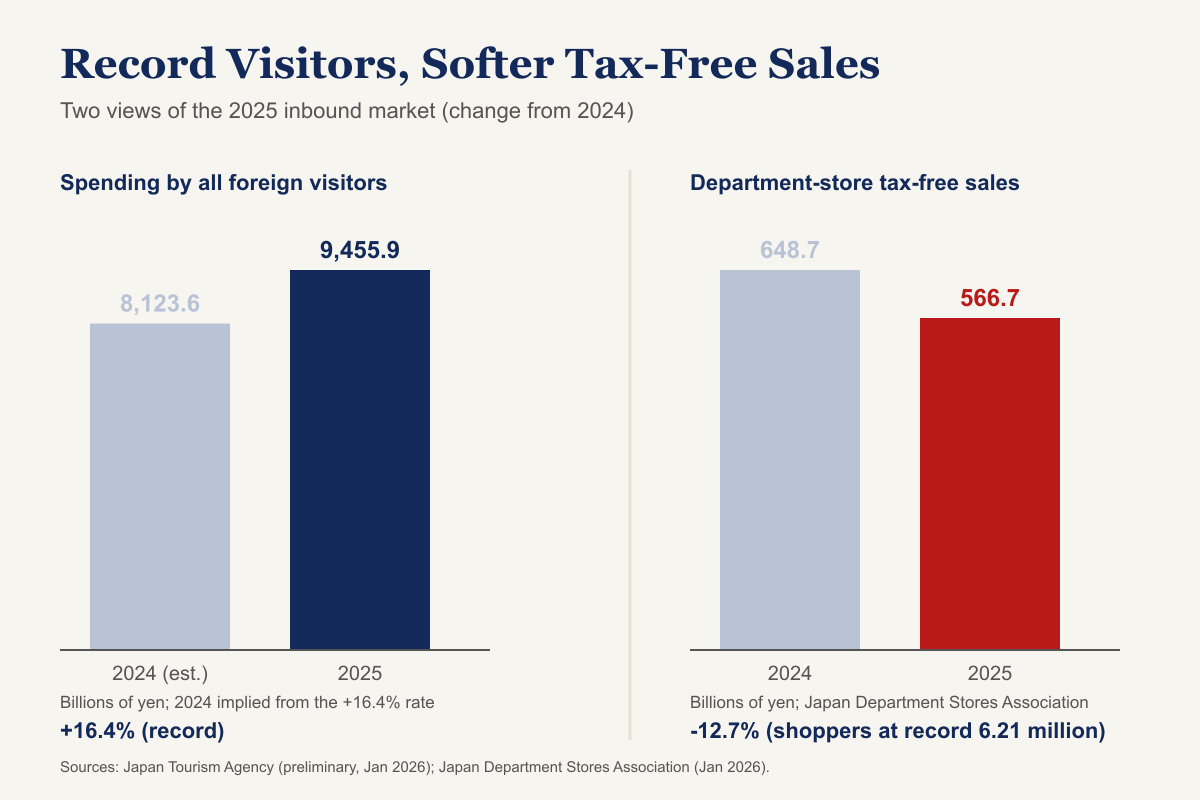
The headline numbers for 2025 were extraordinary. Visitors reached 42,683,600, passing 40 million for the first time. Total spending reached ¥9,455.9 billion. Mainland Chinese visitors were the largest spenders at ¥2,002.6 billion, followed by visitors from Taiwan at ¥1,211 billion.
But the department store figures, which are the cleanest public read on high-end tax-free retail, tell a more complicated story. According to the Japan Department Stores Association, tax-free sales at department stores reached a record ¥648.7 billion in 2024, up 85.9%. In 2025 they fell 12.7% to about ¥566.7 billion, even though the number of foreign shoppers at department stores set a record of more than 6.21 million. Spending per shopper fell as demand shifted toward lower-priced consumables, a stronger yen in parts of the year weakened the pull of luxury goods, and a diplomatic dispute with China in late 2025 cut visits and spending by Chinese tourists by around 40% at department stores in December.
!Visitor spending vs department store tax-free sales

There is a recovery signal as well. In October 2025, department store tax-free sales rose 7.5% to ¥54.6 billion, the first rise after seven months of declines, helped by the weak yen and demand for luxury bags and cosmetics.
So the context for the reform is a market that is growing in headcount, softer in per-head luxury spending, volatile on Chinese demand, and shifting toward lower-ticket consumables. A system change that adds a step of friction lands on top of that mix. The question every retailer is asking is whether the added friction will dent that spending, or whether it is small enough that visitors will not notice.
What Retailers Must Do Now
For shops, the reform is less a cost of compliance than a change of operating model.
Point-of-sale systems must send records to the tax authority. Shops need to record passport details, purchaser and goods at the time of sale and submit them to the National Tax Agency’s management system. Most larger chains are already used to electronic transmission, because electronic submission of tax-free sales records has been part of the old system since 2020, but smaller independent shops will need to check their equipment and software.
Shops choose their refund model. The reform does not prescribe how the money flows back. A shop can work with a refund provider, offer cash at the airport through a partner, or credit a card. This is where competition will happen. The shop that makes the refund fast, visible and fee-free will be the one visitors choose.
Cash flow shifts. The shop used to sell at a tax-exclusive price. Now it collects the tax-inclusive price and the refund is paid out from a different pool. Whether refund providers or shops carry the float, and for how long, becomes a commercial question.
Staff scripts need rewriting. The conversation at the register changes from “please show your passport and sign here” to “you will pay the full price today and receive the tax back at the airport.” Shops that explain this well, in the visitor’s language and with a clear leaflet or QR code, will save themselves complaints and returns.
High-value items need extra recording. For anything priced at ¥1,000,000 or more before tax, a serial number or equivalent must be recorded. For jewellers, watch retailers and luxury houses, this is a new item on the checklist.
The upside for shops is that the old burden, the exposure to uncollectable tax and the packaging of sealed consumables, is lifted.
What Changes for Visitors and What Does Not
The practical experience for a visitor falls into three buckets.
What gets harder. Paying the full price up front is an extra cash burden, especially for big-ticket items. Visitors must also remember to complete the airport procedure and leave time for it. A traveller who arrives at the departure hall twenty minutes before the baggage drop will find the new step stressful.
What gets easier. No sealed bags. No ¥500,000 consumables cap. A combined threshold. The ability to use a kiosk and, from 1 November, a digital departure procedure.
What stays exactly the same. Eligibility is the same: short-term visitors qualify; residents, and foreign nationals with work-related status or stays of six months or more, do not. Japanese citizens who have lived abroad for at least two years can still qualify, and from November 2026 a My Number Card is accepted as proof.
Guides written for tourists will matter more than usual. The most common mistake after a system change like this is a traveller who follows last year’s advice.
Four Risks and Open Questions
It is worth being honest about what is not yet known.
1. The airport bottleneck. Departure halls in Japan already run tight at peak times. If tens of thousands of visitors need to complete a kiosk procedure each day, the design and capacity of those kiosks will decide whether the reform feels smooth or becomes the first image of a visit to Japan’s airports that people post online.
2. The refund experience. A refund that arrives in thirty seconds in cash is a delight. A refund that arrives on a card statement three weeks later, minus a fee, is an irritation. Because the method is left to shops and providers, the experience will be uneven at first.
3. The effect on luxury and electronics. The categories most exposed to the old loophole, high-value electronics and resellable luxury goods, are also those where organised reselling will be hardest to sustain. Some of that demand was never genuine tourist consumption. Retailers in those categories may see a drop that reflects reselling disappearing rather than tourists leaving.
4. The transition itself. With no overlap, there is a real possibility of a rush of purchases in late October, followed by a lull. Retailers should expect distorted year-on-year numbers across October and November.
What This Means If You Sell to Visitors in Japan
For international brands and operators, the practical lessons are specific.
Treat the refund as part of your product. Visitors will remember how the money came back. Partner with a refund provider that offers a fast, low-friction path, and tell customers about it before they pay.
Prepare multilingual explanations. A short printed or QR-based explanation in English, Chinese, Korean and any other major visitor language will matter more than a discount in the first months.
Review your point-of-sale and inventory systems. If you sell high-value items, make sure you can capture serial numbers and send purchase records electronically.
Plan October and November carefully. Expect a pull-forward in late October and a possibly soft early November. Do not read the first weeks as a trend.
Watch the data. The Japan Department Stores Association publishes monthly tax-free figures, and the Japan Tourism Agency publishes quarterly spending estimates. Those will show within a quarter whether the reform changed behaviour.
!A traveller scanning a passport at an airport kiosk

Frequently Asked Questions
Q. When does Japan’s new tax-free refund system start?
A. On 1 November 2026. There is no transition period: the date of sale decides which procedure applies, so a qualifying purchase on 31 October follows the old system and one on 1 November follows the new one.
Q. Do tourists still get a full consumption tax refund?
A. Yes, the tax-equivalent amount is still returned, but only after customs confirms at departure that the goods are leaving Japan. Refund providers or shops may charge handling fees depending on the method, so it is worth checking with the shop before paying.
Q. Is the ¥5,000 minimum purchase changing?
A. No. The minimum of ¥5,000 before tax per store per day stays, but general goods and consumables are now combined when meeting it.
Q. What happens if I miss the 90-day deadline?
A. Customs confirmation must be completed within 90 days of purchase, counting the day after purchase as day one. If you miss it, you receive no exemption and no refund, and any refund already paid may have to be repaid.
Q. Why is Japan changing the system?
A. The government’s stated aim is to stop the resale and diversion of tax-free goods inside Japan and to avoid unpaid tax that is hard to collect from visitors after they leave. In one fiscal year, customs reported being unable to collect roughly ¥2.1 billion of tax from visitors whose purchases did not meet the exemption conditions.
Q. Does this affect Japanese residents or long-term foreign residents?
A. No. Eligibility is unchanged: short-term visitors qualify, while residents and foreign nationals on work-related statuses or with stays of six months or more do not.
Conclusion
For decades, tax-free shopping in Japan was built on a quiet act of trust at the register. The new system replaces that trust with verification at the gate. It is a rational response to documented abuse, and in some respects it is friendlier than the old system, with its sealed bags and consumables cap. But it arrives at a delicate moment: a record tourist year, a softening in luxury spending per visitor, and a volatile Chinese market.
The outcome will not be decided by the law. It will be decided by the kiosks, the refund providers and the staff at the register who have to explain a new routine to someone holding shopping bags and a boarding pass. For retailers, the competitive edge of the next twelve months is not discounting. It is making the refund feel effortless.
Japan is not turning away visitors. It is changing the moment at which it trusts them. How gracefully the shops and the airports handle that moment will shape how the world’s most-watched inbound market looks a year from now.
If you’re interested in this topic, the Japanese market more broadly, or what KETCHUPs is working on, we’d love to hear from you — please reach out via our contact form.
Japan Market Pulse is a weekly read on what the Japanese consumer-tech, food, and mobility markets are choosing to do, written for international operators who want to know what is happening before it shows up in the global trade press.
Subscribe at ketchups.co/japan-market-pulse.