

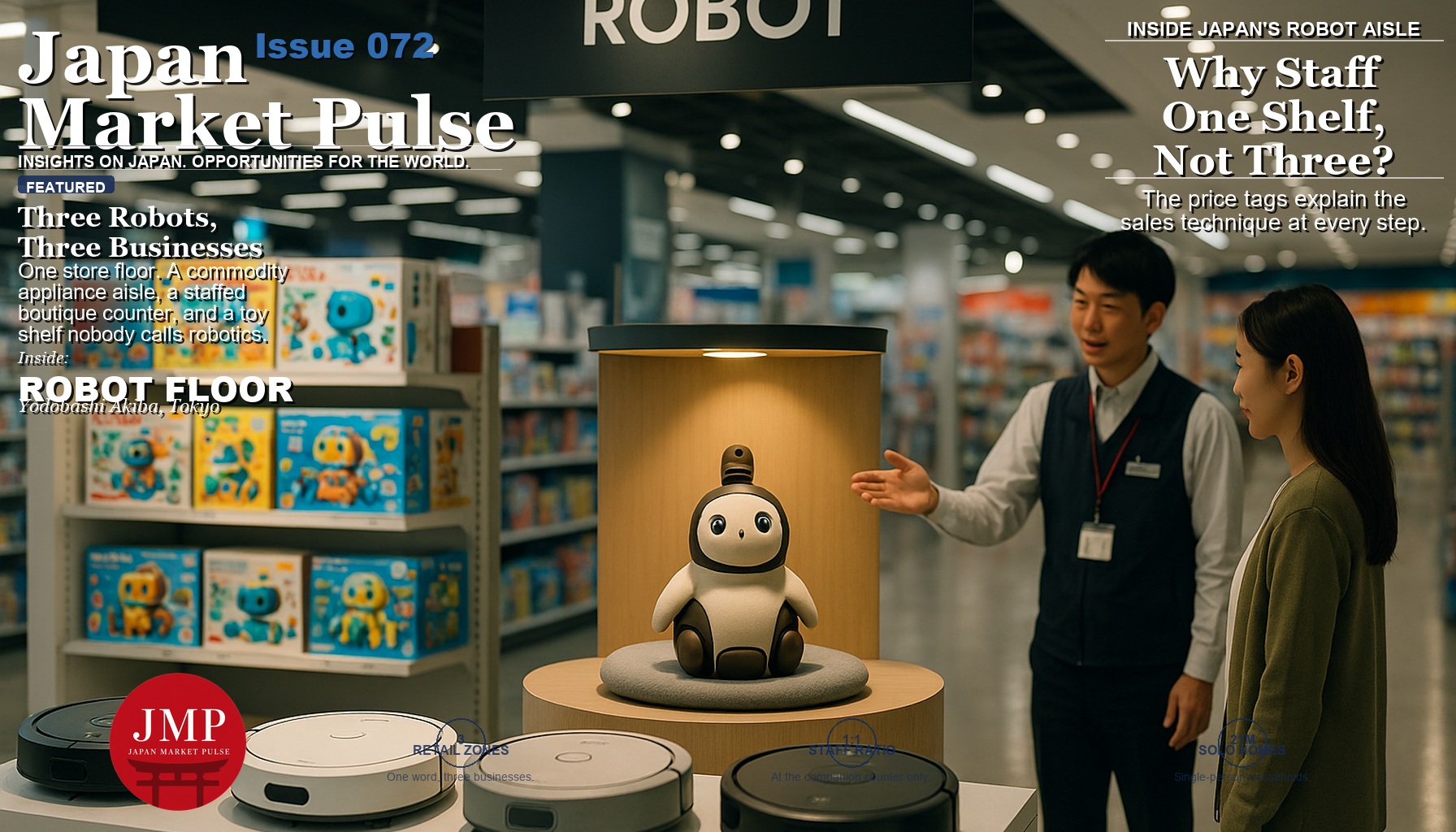
The escalator at Yodobashi Camera’s flagship Akihabara store dumps you, without warning, into a robot. Not a display case with a robot in it — an actual robot, a house-cat-sized machine with a soft, rounded body and two eyes that track your face as you step off the escalator and instinctively slow down. Around it, a small crowd has formed the way a crowd forms around a street performer: not quite touching, not quite looking away either. A staff member is crouched next to a woman in her sixties, walking her through a payment plan on a tablet, speaking in the unhurried, patient register Japanese retail staff use for anything expensive.
I have lived in Japan for twenty years, long enough that very little about this country surprises me on sight anymore. But I still find myself stopping at this particular corner of this particular floor more often than I’d like to admit, because it is one of the only places I know of, anywhere in the world, where “robot” is not a novelty aisle wedged between drones and Bluetooth speakers. It is a department. It has its own floor logic, its own pricing tiers, its own sales technique, and — this is the part that took me a few visits to notice — its own quiet argument about what a robot is actually for.
That argument, and how a handful of Japanese big-box electronics retailers have chosen to resolve it on the sales floor, is the subject of this piece. Not any single robot brand. The store itself — Yodobashi Camera, Bic Camera, and their smaller regional cousins — as a kind of accidental museum of what “robot” means to the Japanese consumer market right now, told through where things are placed, how they are priced, and who is standing in front of them.
The Floor Plan Doesn’t Lie
Retail floor plans are never neutral. Every big-box store on earth puts high-margin, high-attach-rate categories at eye level near the entrance and buries the low-turnover, high-consideration purchases somewhere a salesperson has to walk you to. Japan’s robot floor follows the same logic, and once you notice it, the whole category sorts itself into three distinct businesses wearing one label.
Robot vacuums sit up front, close to the main appliance floor, stacked in rows like any other white good — because that’s functionally what they are now. A few paces further in, the floor changes character: lighting gets warmer, the shelving gives way to something closer to a boutique display, and a single product often gets an entire dedicated corner with its own staff member. That’s the companion-robot zone, and it behaves nothing like an appliance department. Then, usually near the toy and stationery floor rather than anywhere close to “electronics,” sits a much smaller, brighter, more colorful cluster of programming kits and robot toys, priced like birthday presents and largely left to sell themselves.
Three categories, three completely different retail businesses, filed under one word. Walk the floor slowly enough and a store like Yodobashi Akiba is quietly telling you which robots Japan already trusts as appliances, which ones it still sells as relationships, and which ones it treats as toys — and the price tags, sales scripts, and even the lighting confirm the distinction at every step.
The Volume Business at the Door: Robot Vacuums
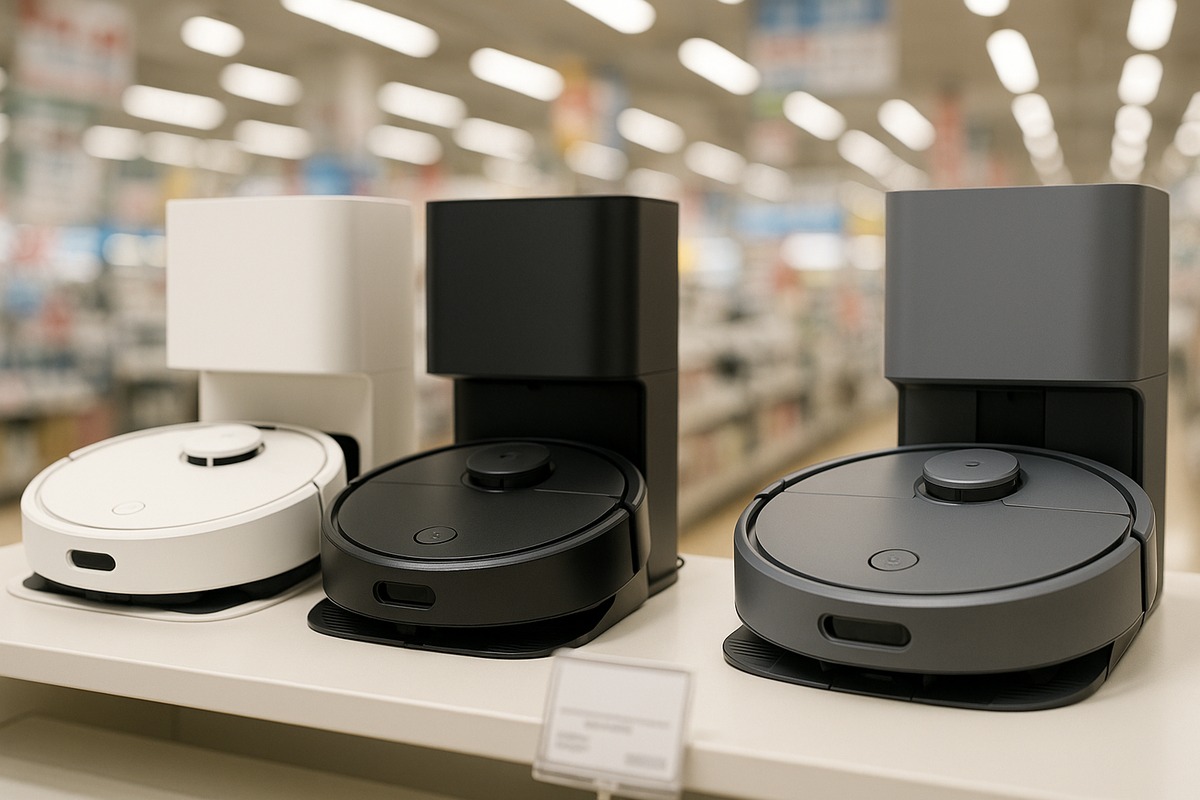
Robot vacuums are the part of this story that has already finished happening, and the sales floor reflects it. iRobot, the American company behind Roomba, operates what it has called its largest brand showcase anywhere inside Yodobashi Akiba: a dedicated demonstration bay with working units running live on different flooring textures, plus a maintenance table where staff pop open dustbins and brush heads to show shoppers exactly what a few weeks of use looks like. That is not how a company treats a novelty category. That is how a company treats a mature appliance business it intends to defend against a crowded field of challengers.
And the field is crowded. Roomba shares floor space with Chinese entrants like Ecovacs and Roborock, plus Panasonic’s homegrown RULO line, all competing on the same axis that vacuum cleaners have always competed on: suction, battery life, how often you have to empty the bin, and price. That last one has become the real battleground. A current entry-level Roomba retails for well under ¥40,000 — cheap enough to be an impulse upgrade rather than a considered purchase — while the flagship models with dual counter-rotating brushes, self-emptying docks that go months between servicing, and lidar-based room mapping climb toward ¥150,000. Between those two points sits nearly every price the Japanese consumer might reasonably pay for “the vacuum does the vacuuming now,” and the shelf is built to walk a customer up that ladder in about ninety seconds, the same way a phone store walks you from the base storage tier to the one with more memory.
What struck me, watching a middle-aged couple compare two models side by side, is how little emotional labor this section asks of either the shopper or the staff. Nobody is being sold on whether to trust a robot vacuum; that argument was won years ago, first by Roomba’s decade-plus head start and then by a wave of cheaper competitors that turned the whole category into a commodity fight. The conversation I overheard was entirely about mop function versus vacuum-only, whether the self-empty bag needs replacing monthly or quarterly, and if the base station would fit the narrow gap next to their refrigerator. It’s appliance shopping, full stop — the robot descriptor has become almost decorative, the way “smart” in front of “TV” stopped meaning anything distinctive a decade ago.
The Slow Sell: Companion Robots Get Their Own Counter
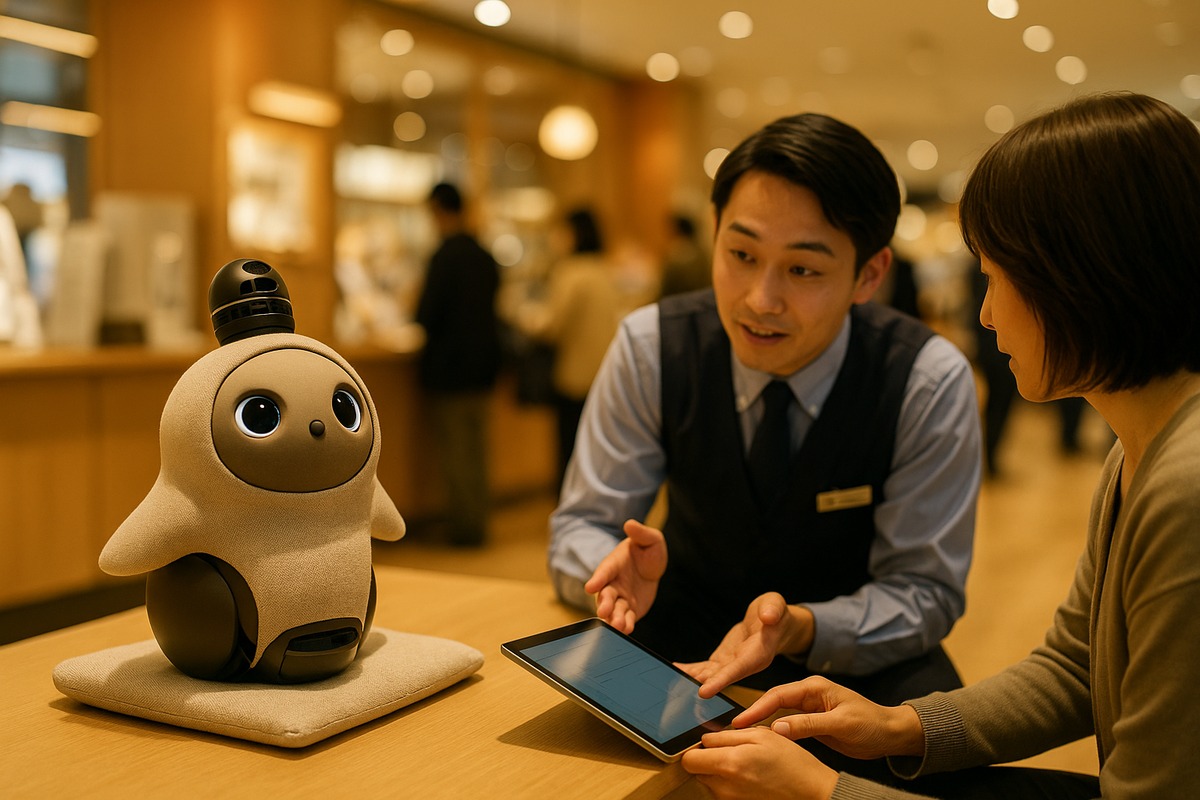
Walk twenty meters further into the same floor and the entire tempo of the store changes. This is where LOVOT lives — the round, big-eyed companion robot from Tokyo startup GROOVE X — and Yodobashi has given it something closer to a boutique concession than a shelf: soft furnishings, a demo unit shoppers are invited to pick up and hold, and a staff member whose entire job, for the ten or fifteen minutes I watched, was answering questions about a single product line rather than comparing five competing SKUs.
The price explains the pacing. A current-generation LOVOT starts north of ¥400,000 before accessories, climbing past ¥500,000 for the newest model, and ownership doesn’t stop at the purchase — a mandatory monthly care plan runs somewhere in the ¥10,000-to-¥20,000 range on top, closer to a phone contract or a pet’s recurring vet-and-food budget than anything else sold on this floor. Sony’s aibo, the other fixture of Japan’s companion-robot upper tier, occupies similar territory: a robot dog priced like a good used car, sold with its own monthly service plan and its own dedicated cloud-connected personality that develops over years of ownership. Nobody buys either one the way they buy a vacuum. What I watched at the LOVOT counter looked less like an electronics sale and more like the way a Japanese department store sells a wedding gift set — unhurried, consultative, built around a life event rather than a spec sheet.
The demographic in front of that counter was wider than I expected walking in. Yes, there was the woman in her sixties I mentioned earlier, and eldercare-adjacent purchases — adult children buying a companion for an aging parent who lives alone — are a real and often-cited slice of this market. But over three separate visits I also watched a couple in their thirties debating LOVOT the way people debate a first pet together, and a solo shopper in a work blazer who spent close to twenty minutes with a demo unit before quietly asking about financing. Japan has more than 21 million single-person households and a median age north of 48; a robot department that treats companionship as a serious, well-funded product category is responding to a market that already exists, not inventing demand out of nothing.
The sales technique matches the stakes. Staff at this counter aren’t reciting specs; they’re managing an emotional decision with a six-figure yen price tag and a recurring bill attached, which means the job looks more like consultative selling in an insurance office than anything from a typical electronics floor. It’s the most labor-intensive square footage in the entire robot department, and the store clearly treats it that way — one product, one dedicated staff member, and as much time as a shopper wants to take.
The Kids’ Aisle Nobody Calls a Robot Aisle
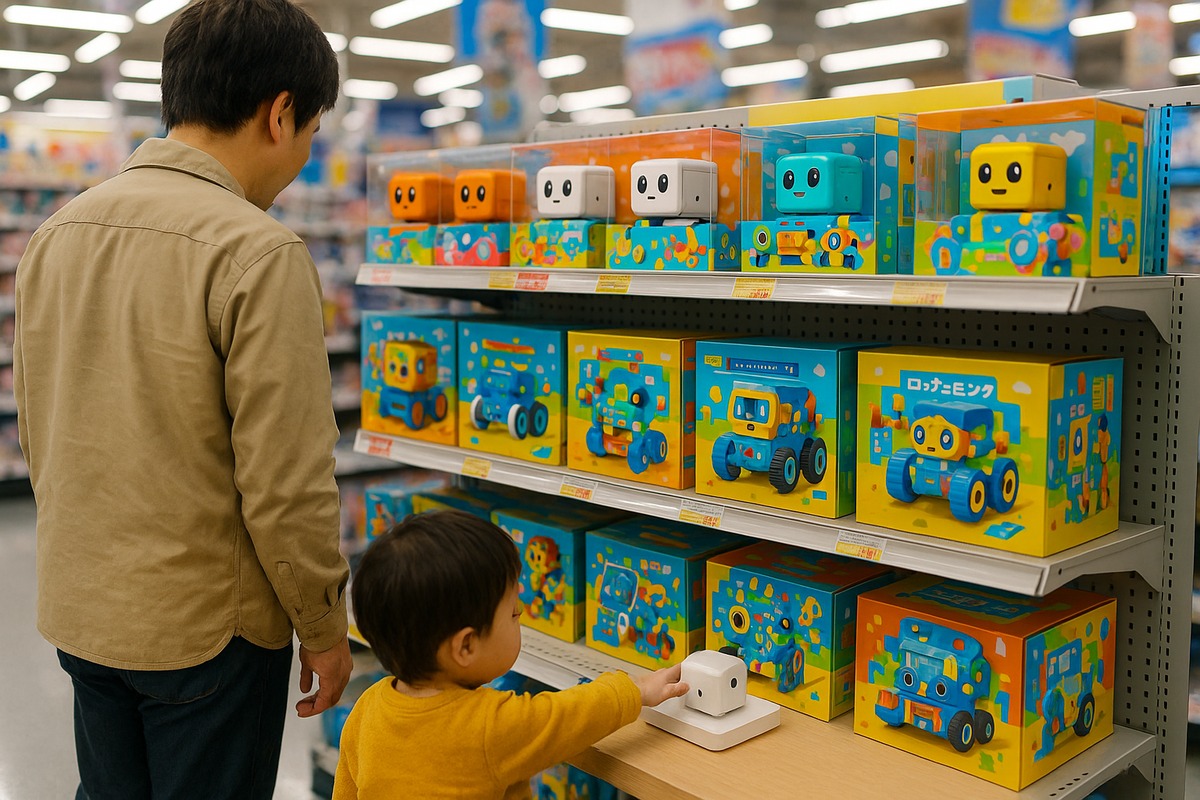
The third category is the easiest to miss, because the stores themselves don’t file it under “robot” the way they do the previous two. Sony’s toio and KOOV — small, cube-based robots and programmable building kits aimed at kids roughly six and up — tend to surface near the toy floor or the stationery and hobby section rather than anywhere close to appliances or the LOVOT counter. The price range makes the logic obvious: toio starter sets and accessories run from under ¥5,000 into the low tens of thousands, and KOOV’s programming kits land somewhere between ¥40,000 and ¥65,000 depending on how many sensors and motors come in the box — closer to a nice board game or a mid-range gaming accessory than a major appliance purchase.
Nobody is staffing this shelf the way LOVOT gets staffed. It’s largely self-service, boxed like any other toy, with the occasional in-store demo table during a school holiday weekend rather than a permanent dedicated attendant. The buyer here is overwhelmingly a parent, often shopping with a child in tow who is more interested in the demo unit than the box art, and the purchase logic is the one every parent recognizes regardless of country: is this going to hold a kid’s attention past the first weekend, and is there some plausible educational justification for the receipt. Japan’s long-running enthusiasm for STEM-adjacent toys and its formal introduction of programming education into the elementary curriculum a few years back have given this shelf a legitimacy that “robot toy” alone wouldn’t carry; parents I watched browsing weren’t debating whether their child needed a toy, they were debating whether this particular toy counted as something closer to a school supply.
It’s worth sitting with how different this feels from the LOVOT counter twenty meters away, because the contrast is the whole point of walking this floor slowly. Same overhead category — robot — completely different unit economics, completely different sales motion, completely different emotional register. One is a considered, financed, relationship-scale purchase sold by a dedicated specialist. The other is an impulse-adjacent toy purchase that a parent decides on in the time it takes a child to ask twice.
What’s Conspicuously Absent: The Robots Behind the Counter
The fourth category worth naming is the one you won’t actually find for sale on this floor at all: the robots the store itself uses. Facing a well-documented staffing shortage across Japanese retail, chains including Yamada have started deploying remotely operated robots — an operator working from elsewhere pilots a screen-equipped unit that can greet shoppers and answer basic questions on the floor — while brands like Dyson have placed video-call terminals directly on the sales floor so a shopper can get an expert product walkthrough without a specialist physically present in that store. Security and patrol robots, the kind that quietly circuit convenience stores and warehouses overnight in other write-ups about Japanese retail automation, are similarly absent here; they’re a business-to-business purchase decided by a facilities manager, not a consumer product with a price tag and a shelf.
That absence is its own small data point. The robots a Japanese retailer sells to you and the robots it quietly uses to run itself are, for now, two entirely separate product categories that don’t share shelf space, staff, or even a sales pitch — a reminder that “service robot” and “consumer robot” remain distinct businesses in Japan, however often the same word covers both in casual conversation.
Reading the Shelf Like a Balance Sheet
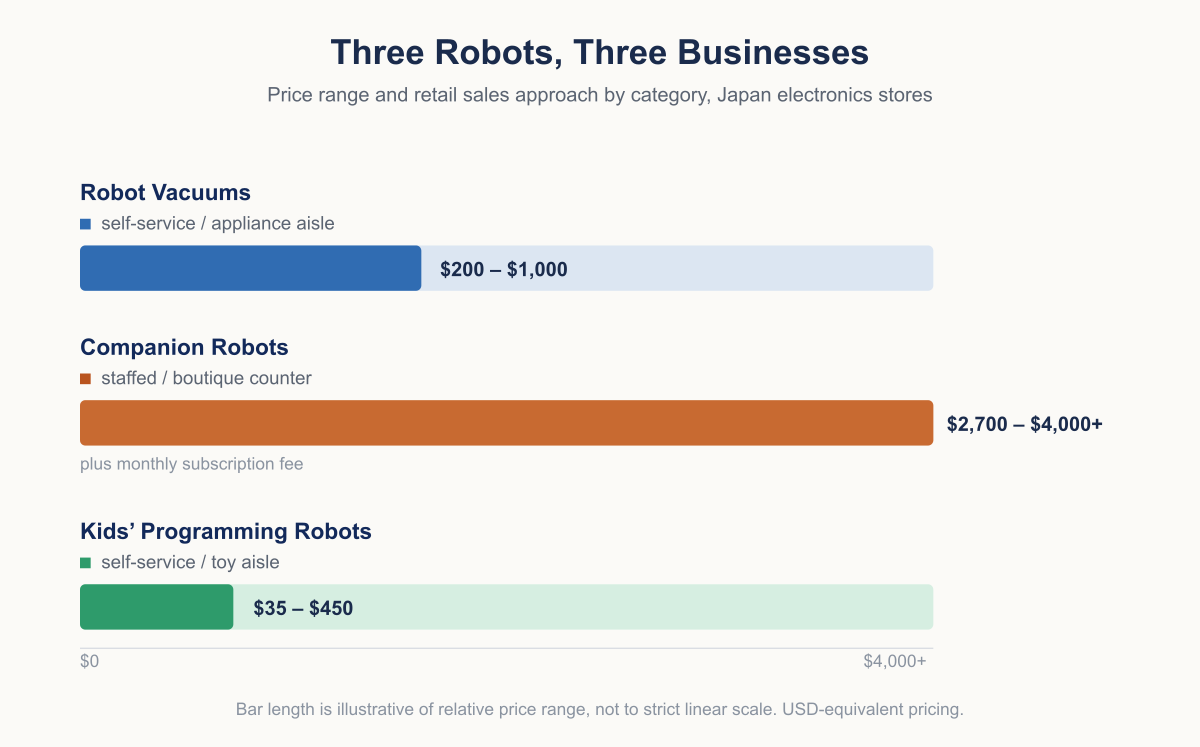
Step back far enough and the whole floor starts to read less like a product category and more like three different bets about where robots are headed, running side by side in the same building. The vacuum aisle is a bet that’s already been settled — a genuinely mature appliance market, thin margins, brand competition fought on suction and self-emptying intervals, sold with zero emotional friction because the argument for owning one stopped needing to be made years ago. The companion-robot counter is the opposite bet, still very much in progress: a small number of expensive, high-touch products sold the way you’d sell a piece of jewelry or a first pet, aimed at a market — aging, urbanizing, increasingly single-person — that Japan happens to have in greater concentration than almost anywhere else on earth, which is as good an explanation as any for why this particular bet is being placed here first. And the kids’ programming-robot shelf is a quieter, lower-stakes wager that today’s ¥40,000 STEM toy buyer is tomorrow’s higher-tier customer, priced to make that bet cheap to place.
What’s genuinely rare, in my experience shopping for electronics in the US and elsewhere, is finding all three bets laid out under one roof, each with its own pricing logic and its own sales technique, rather than scattered across a “smart home” endcap and a toy aisle that never talk to each other. American big-box retailers sell robot vacuums fine — that part of the floor would look familiar to any Best Buy shopper — but the idea of a dedicated, staffed, boutique-style counter for an emotional-companionship product priced like a used car simply doesn’t exist yet in most Western retail formats, because the demand curve that justifies staffing it hasn’t shown up at scale outside Japan. Watching Yodobashi build that counter, staff it properly, and keep expanding it — LOVOT’s footprint inside Yodobashi has grown rather than shrunk since its consumer debut — is a useful early read on which parts of the “everyone will own a robot someday” story are commercially real today, and which parts are still five or ten years of demand-building away, wherever else in the world that demand eventually shows up.
Frequently Asked Questions
Q. Where can I see or buy these robots in person if I’m visiting Japan?
A. Large Yodobashi Camera stores such as Akihabara (Tokyo) and Umeda (Osaka) carry robot-vacuum demos, dedicated LOVOT corners, and kids’ programming kits across the relevant sections rather than on one single floor. Bic Camera’s larger flagship locations carry a similar, if smaller, mix. No appointment is needed for any of the three categories described here.
Q. How much does a robot vacuum cost in Japan compared to a companion robot like LOVOT?
A. A basic robot vacuum from a brand like iRobot Roomba starts well under ¥40,000, with premium self-emptying, dual-brush flagship models like the Roomba Max 705 reaching roughly ¥150,000. LOVOT, by contrast, starts north of ¥400,000 for the hardware alone, plus a mandatory monthly care plan — a difference in kind, not just degree, that maps directly onto how differently each is sold on the floor.
Q. Are Japan’s companion robots, like LOVOT or aibo, available for purchase outside Japan?
A. Mostly not yet. LOVOT remains effectively Japan-only, tied to Japanese-language conversational support and a domestic service network. Sony’s aibo is available in both Japan and the United States, though availability and support remain market-limited. Robot vacuums are the exception — global brands like iRobot, Roborock, and Ecovacs sell nearly identical lineups in Japan and abroad, which is part of why that category already looks and sells like a normal appliance everywhere.
Q. Is buying a kids’ programming robot like toio or KOOV a serious educational purchase or just a toy?
A. Retailers clearly position it as both. Sony’s toio and its KOOV programming kits sit in the toy and hobby sections rather than the electronics floor, priced from under ¥5,000 into the ¥40,000–¥65,000 range, and they benefit from Japan’s formal push to introduce programming concepts in elementary education — enough legitimacy that parents shop them as a defensible middle ground between “toy” and “school supply.”
Q. Why does Japan seem to have a more developed retail category for robots than other countries?
A. A combination of factors: an aging, increasingly single-person-household population that has created real commercial demand for companionship products; a consumer culture with less residual discomfort around anthropomorphized machines; and large-format electronics retailers with the floor space and staffing model to justify a dedicated, high-touch sales counter for a product most other markets would still file under “novelty.”
Conclusion
None of the three robot businesses I watched play out on that Yodobashi floor are hypothetical anymore. The vacuums have already won their argument and settled into the unglamorous rhythm of any mature appliance category. The companion robots are still making their case, one patient, unhurried conversation at a time, to a market that happens to have unusually strong reasons to listen. And the kids’ programming kits are quietly seeding whichever of those two futures — appliance or relationship — today’s ten-year-olds end up buying into as adults. Watching all three get sold, in the same building, on the same afternoon, told me more about where consumer robotics is actually headed than any product announcement has in years.
This article contains affiliate links. If you purchase through these links, we may earn a small commission at no extra cost to you.
If you’re interested in this topic, the Japanese market more broadly, or what KETCHUPs is working on, we’d love to hear from you — please reach out via our contact form.
Japan Market Pulse is a weekly read on what the Japanese consumer-tech, food, and mobility markets are choosing to do, written for international operators who want to know what is happening before it shows up in the global trade press.
Subscribe at ketchups.co/japan-market-pulse.