

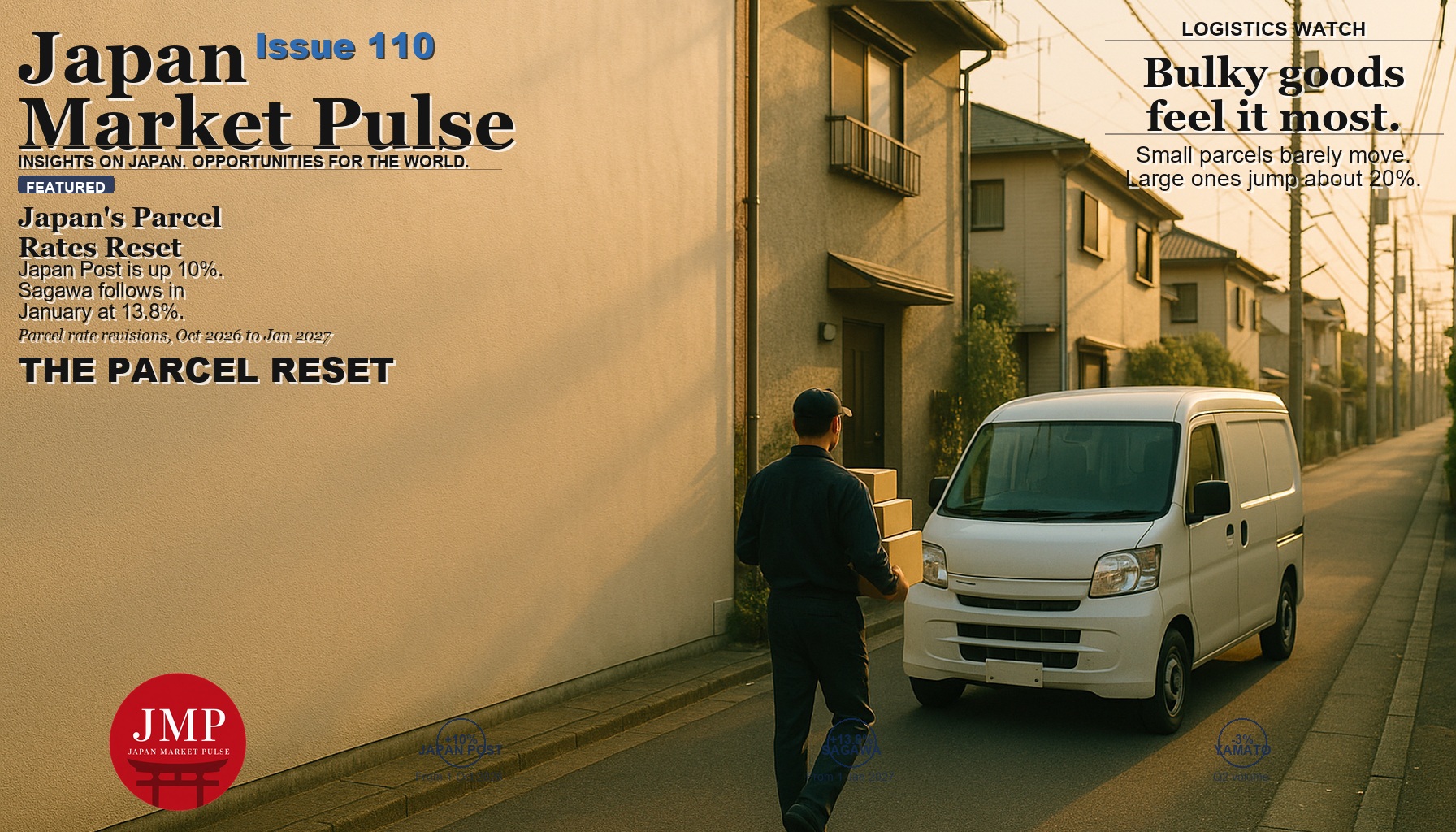
On 1 October 2026, one of the lowest-priced ways to send a box across Japan quietly got more expensive. Japan Post raised the base rates of its Yu-Pack parcel service by about 10% on average and restructured its Yu-Packet small-item service, a notable step for a carrier that is also fighting a shrinking mail business. Two days later, on 2 October, Sagawa Express announced that its own base rates will rise by about 13.8% on average from 1 January 2027, with size-260 parcels on the main Tokyo-Osaka lane rising by about 20% and some size bands rising more.
Put those two notices next to each other and a pattern appears that matters far beyond Japan. Price competition looks less central in these latest revisions. The three big carriers appear to be competing more on who can afford to carry what, and for whom.
For international sellers, brands and marketplaces that ship to Japanese consumers, or that manage fulfilment inside Japan, this is a cost-of-goods story disguised as a logistics story. A few yen per parcel does not sound like much until it is multiplied by every order, every return and every free-shipping threshold in your pricing model.
This article walks through what Japan Post and Sagawa actually changed, which carrier is winning parcels and which is losing them, how Japan’s rate-setting rhythm differs from the American one, and what operators should do about it before the new year.
Two Notices in Three Months
The sequence is worth setting out, because the timing is part of the story.
On 3 July 2026, Japan Post announced a revision of its Yu-Pack and Yu-Packet charges to take effect on 1 October. The stated reasons were rising labour, fuel and materials costs from inflation. The company said it would absorb what it could through productivity gains and pass on the rest.
On 1 October, the new rates took effect. On 2 October, Sagawa Express published its own revision: an average increase of about 13.8% on base parcel rates, effective 1 January 2027, with air-parcel rates rising by a much smaller 2.7% on average. Sagawa cited labour costs, material prices and the cost of paying partner companies enough to keep drivers on the road. It was Sagawa’s first base-rate increase since April 2024.
Yamato Transport, the carrier that created Japan’s door-to-door parcel category and still holds the largest brand name, has not announced a general rate rise this autumn. But it did not stand still. In October 2025 it revised its filed rates for the 120 to 200 size classes and for specialty products such as golf and ski delivery. In February 2026 it told investors it expected operating revenue to come in ¥20 billion below its earlier forecast, citing deliberate restrictions on low-margin parcels and weaker volumes from large corporate customers.
Three carriers, three different tactics, one direction.
What Japan Post Changed on 1 October
The headline number is an average of roughly 10% for Yu-Pack, but the average hides a lot. Japan Post’s Yu-Pack revision varies by parcel size and by distance. According to secondary reports of the rate tables, a parcel sent within one prefecture rose by only about 2%, a parcel up to 120 size crossing prefectural lines rose by about 10%, and some parcels of 140 size and above rose by around 20%. I would treat those bands as indicative rather than official, but the shape is clear: the further and the bigger, the more it hurts.
The packaging that Japan Post sells at the counter also went up. According to the carrier’s own price list, a size-60 box rose from ¥100 to ¥110, a size-80 box from ¥140 to ¥160, a size-100 box from ¥220 to ¥250 and a size-120 box from ¥380 to ¥420. Padded envelopes, wine boxes, golf-bag covers and Yu-Pack bags all rose by roughly 10%. For a small seller who buys boxes at the counter, packaging is no longer a rounding error.
The smaller Yu-Packet service, which is the workhorse for lightweight items like phone cases, cosmetics samples and apparel, changed in a different way. Japan Post abolished the old 1 cm and 2 cm thickness classes and merged them into a single 3 cm standard at ¥360. Before, a parcel under 1 cm cost ¥250 and one under 2 cm cost ¥310.
That is a classic price-architecture move. It simplifies the menu and raises the entry price for the thinnest items by 44% (¥250 to ¥360), while the 3 cm class itself stays at ¥360. A seller shipping a 0.8 cm envelope has just taken a ¥110 hit per parcel. A seller whose items were already close to 3 cm is unaffected.
Rates are based on the acceptance date, not the packing date. Anything handed to Japan Post on or after 1 October pays the new rate, even if the box was sealed in September.
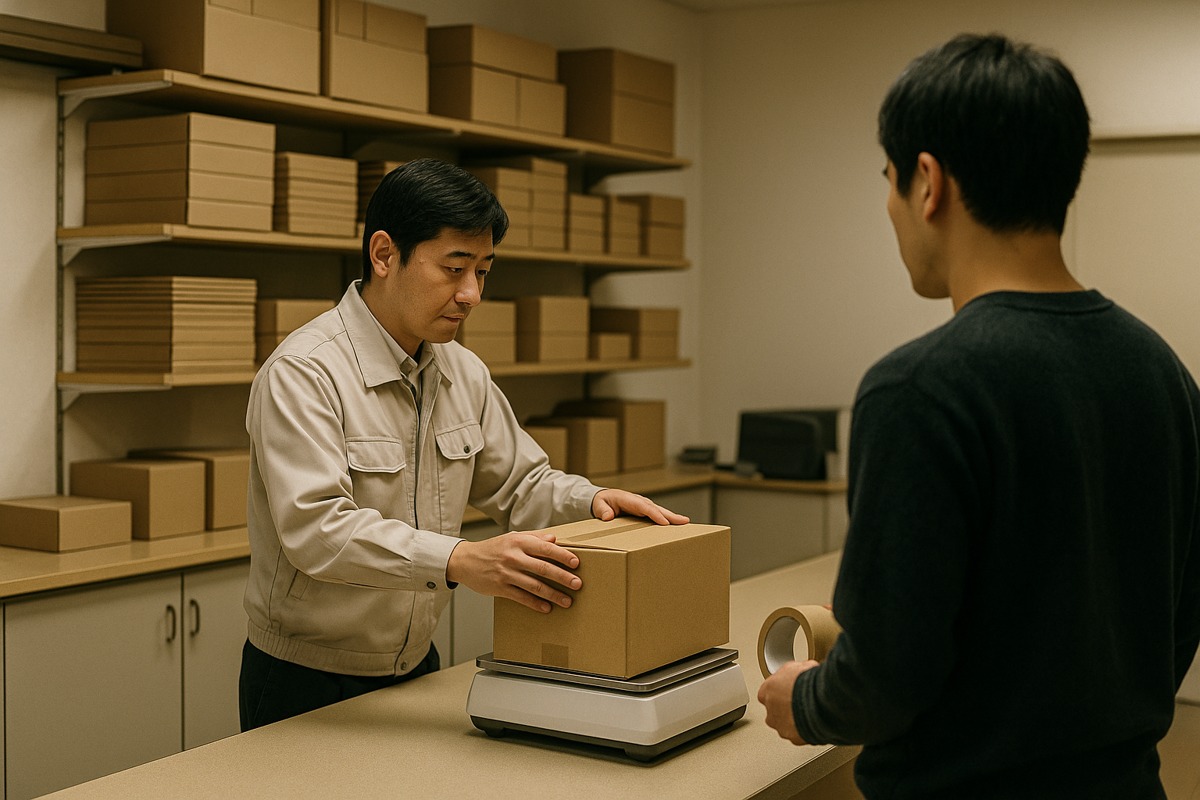
!A clerk weighing a parcel at a neighbourhood post office

Sagawa’s January Move: 13.8% and a Paper Invoice Fee That Doubles
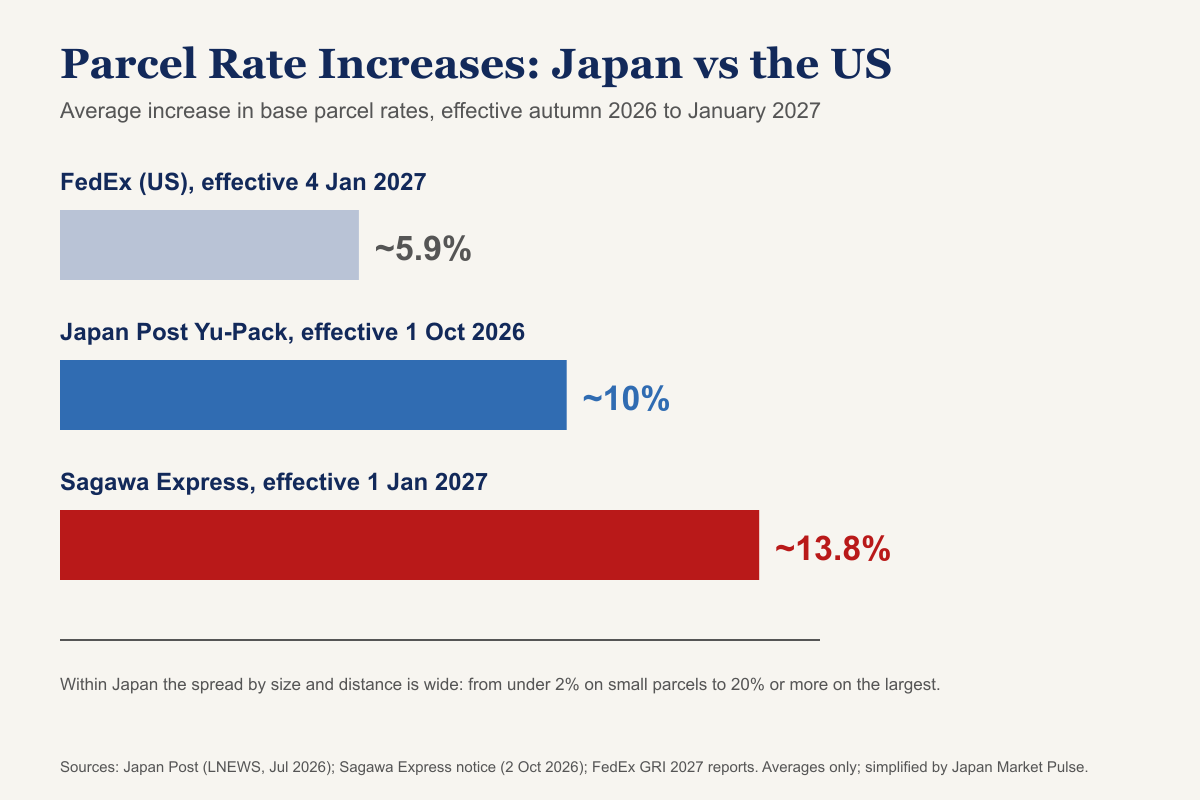
Sagawa’s notice is the more aggressive of the two. The average base-rate increase of about 13.8% is larger than Japan Post’s, and the distribution is steeper.
A size-60 parcel from the Kanto region (Tokyo) to the Kansai region (Osaka) goes from ¥1,040 to ¥1,060, an increase of just ¥20. A size-260 parcel on the same route goes from ¥8,420 to ¥10,100, an increase of roughly 20%. Sagawa’s own Hikyaku Yu-Packet, its mailbox-sized product, is also restructured, with parcels up to 1 cm rising from ¥250 to ¥360 and those up to 2 cm from ¥310 to ¥360, in line with Japan Post.
The line item most likely to be overlooked is the paper invoice fee, which doubles from ¥110 to ¥220 per document. For business customers that still run paper-based delivery accounting, which in Japan is far from rare, that is a direct push toward digital billing.
Notice what the numbers say about strategy. The small-parcel price barely moves. The big-parcel price jumps. Carriers are not trying to scare away the lightweight, high-volume e-commerce flow that fills their trucks. They are re-pricing the heavy, awkward items that cost the most to move, such as furniture, large appliances, bulky sports equipment and multi-box orders.
If you sell furniture, large appliances or oversized goods into Japan, that matters more than the 13.8% headline.
!Rate increases: Japan Post, Sagawa and FedEx

The Volume Map: Who Is Gaining Parcels and Who Is Losing Them
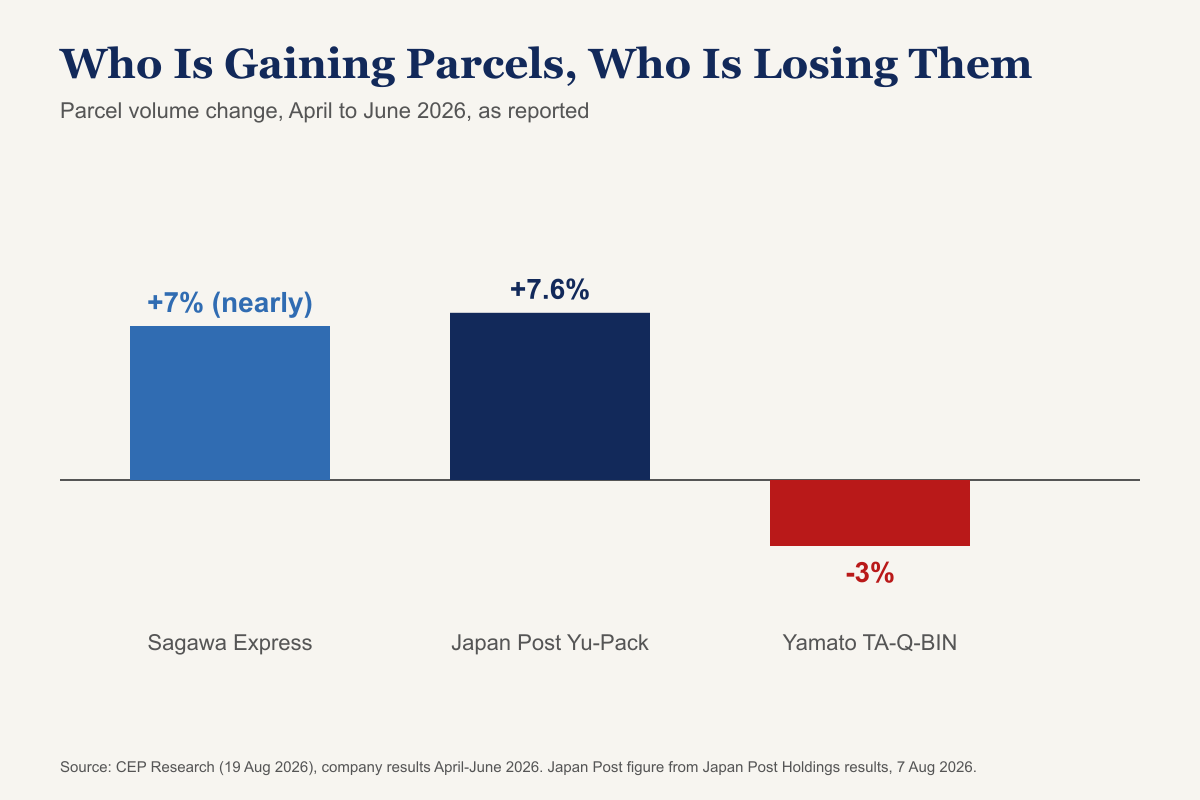
The rate announcements make more sense against the volume data for April to June 2026, as reported by CEP Research and each company’s results. Each figure covers the carrier’s own parcel service, so the definitions are not identical across companies and the numbers are best read as direction rather than a like-for-like league table.
Sagawa’s parcel volumes rose by nearly 7%, which CEP Research attributes in particular to cross-border e-commerce. Japan Post’s own results show Yu-Pack volumes up about 7.6% and Yu-Packet volumes up about 10.7%. Yamato’s core TA-Q-BIN volumes fell by 3%, with a sharp drop in business from large corporate customers.
The profit picture was just as uneven. At SG Holdings, Sagawa’s parent, group revenues and profits increased, but profits in the delivery business fell. At Yamato Holdings, the operating result improved even as parcel volumes shrank. At Japan Post, the parcel business improved, but the postal and domestic logistics division stayed in loss, mainly because mail revenues keep shrinking while delivery-related costs rise.
Read together, those figures describe three very different strategies:
– Yamato is deliberately shedding unprofitable parcels and protecting its margin. Smaller volume with better pricing is the plan, not a failure. – Sagawa is growing volume through cross-border e-commerce but watching its delivery profit slip, which is exactly why it needs a 13.8% increase. – Japan Post has the least pricing power to lose. Mail volumes are in structural decline, so it needs parcels to fill the network, yet it is also raising rates to cover a widening loss.
An operator reading those three positions should reach one conclusion: none of them will cut prices to win your business in the near term.
!Parcel volume change, April to June 2026

Japan Versus the United States: Smaller Annual Steps, Bigger Periodic Resets
The most useful comparison for an international reader is with the United States, where FedEx has announced a 5.9% average general rate increase for 2027, effective 4 January. It is the fourth year in a row that FedEx has used the same 5.9% headline figure. UPS also set 5.9% for 2026.
At first glance Japan looks more expensive: roughly 10% from Japan Post and 13.8% from Sagawa against 5.9% for FedEx. But the rhythm is different, and that is where the real difference lies.
The major US carriers have recently made annual general rate increases, on a calendar everyone can plan around. Historically, Japanese carriers held rates flat for multi-year stretches and then moved in a single step, although Yamato now says it revises its filed rates annually. Yamato’s 2017 increase was its first in 27 years. Sagawa’s increase announced this month will take effect two years and nine months after its previous one. Yamato has said it now revises its filed rates every fiscal year, which suggests the era of long freezes is ending.
Spread over the same period, the cumulative cost curve of a Japanese shipper and an American shipper may look more similar than the headline numbers suggest. I would not push that comparison too far. Japan’s cumulative curve depends on how many steps arrive in the next few years, and carriers in both countries are also adjusting surcharges, size rules and invoice fees that sit outside the headline average.
The practical difference is predictability. On the published list rates of the major US carriers, annual increases have recently been the norm, so a US shipper can budget around 6% a year. A Japanese shipper has to assume that a step of 10% to 14% can arrive with three months of notice and then possibly nothing for two years.
What It Does to Your Unit Economics
Consider an illustrative example, not a forecast. A seller ships a size-60 parcel within the Kanto-to-Kansai corridor, pays ¥1,040 now and ¥1,060 from January: a ¥20 rise, or 1.9%. The same seller packs the item in a ¥100 box that now costs ¥110. The extra cost per order is about ¥30. On a ¥4,000 basket that is less than 1% of revenue.
Now take a seller of a bulky item that ships as a size-260 parcel on the same route. The rate goes from ¥8,420 to ¥10,100, an increase of ¥1,680 per order. If the item sells for ¥30,000, that is 5.6% of revenue on one line item, enough to erase a typical online-retail margin.
The difference between those two sellers is the whole story. Light, small, standard-size goods barely notice. Heavy, awkward goods feel everything.
Three second-order effects are worth planning for:
1. Free-shipping thresholds. Many Japanese marketplaces and brand stores use thresholds of ¥3,000 to ¥5,000. A carrier cost rise of ¥100 to ¥200 across a typical mix pushes the break-even basket value up, and the threshold has to follow. 2. Return cost. Returns pay the same price as outbound shipments. Categories with high return rates, such as apparel and footwear, absorb the increase twice. 3. Size-class discipline. With steeper increases for larger classes, every centimetre of packaging matters. Taking an item from size 100 to size 80 now saves materially more than it did a year ago.
What to Do Now
The following steps are practical and can be done before the January change:
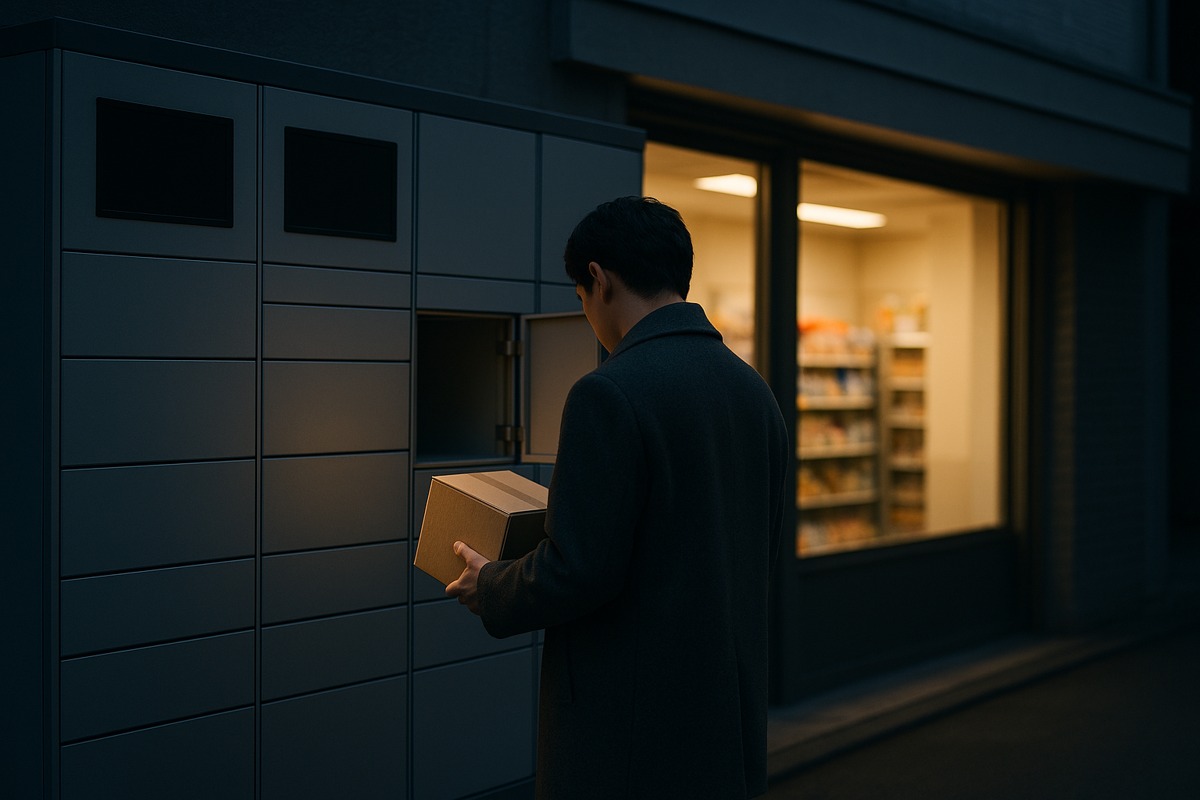
– Rebuild your Japan shipping cost table by size class and by lane. An average increase is useless to you. You need the delta for your own mix of sizes and distances. – Audit your packaging. Measure the tallest, widest and longest dimension of your top 20 SKUs and check whether a smaller class is possible. Moving a parcel down one size is the cheapest saving available. – Re-test Yu-Packet eligibility. If you ship items between 1 cm and 3 cm thick, check whether the single 3 cm class at ¥360 changes your cheapest option. The thinnest items now pay more; items near 3 cm pay the same as before. – Compare carriers on your own parcels. Since Japan Post and Sagawa now differ more in structure than in price, a mixed-carrier strategy may beat a single-carrier contract. Ask for quotes before the January change takes effect. – Use pickup points and lockers. Convenience-store pickup and parcel lockers cut failed-delivery costs. They are also where Japan’s carriers are pushing volume. – Move paper documents to digital billing. At ¥220 per paper invoice, the fee now matters for anyone with a high volume of small deliveries.
!A commuter collecting a parcel from a pickup locker

Four Risks and Open Questions
Will competition return? Yamato’s volume decline and Sagawa’s growth raise the possibility that Yamato will use price or service to win some volume back. Its stated policy so far is the opposite, but a three-percent annual decline is not a position any carrier tolerates forever.
Will the 2024 labour problem return? Overtime caps for truck drivers began in April 2024 and are widely cited as the structural driver of capacity tightness. A second round of rate rises could signal that the capacity problem is not solved.
Will consumers notice? Many Japanese retailers absorb delivery costs inside the price. If carriers keep raising rates, more of them will either introduce delivery fees or raise free-shipping thresholds. Japanese consumers are sensitive to visible shipping charges.
Are the secondary figures right? Size-band increases for Japan Post differ between sources. Use official rate tables for your own calculations.
What This Means If You Sell to Japan
The lesson from these two announcements is not that shipping in Japan is expensive. It is still cheap by international standards, and the service quality is high. The lesson is that long multi-year freezes in domestic parcel rates look to be ending, and that the increases will not be evenly spread.
If you sell light, standard-size goods, treat this as a rounding error and keep your shipping promise. If you sell anything heavy, bulky or multi-box, treat it as a pricing event and rework your cost model before the new year.
The window to act is short. Japan Post’s new rates are already live. Sagawa’s take effect on 1 January 2027, which means shipments accepted by the carrier before 1 January, including most peak-season parcels in November and December, will pay current prices, and shipments accepted from 1 January the new ones. That timing creates a natural moment to reset thresholds, packaging and carrier mix.
Frequently Asked Questions
Q. When did Japan’s parcel rates increase?
A. Japan Post’s Yu-Pack increase took effect on 1 October 2026, averaging about 10%, alongside a restructuring of Yu-Packet thickness classes. Sagawa Express announced on 2 October an average increase of about 13.8%, effective 1 January 2027.
Q. How much does it cost to send a parcel in Japan now?
A. It depends on size and distance. A size-60 parcel from Tokyo to Osaka with Sagawa currently costs ¥1,040 and will cost ¥1,060 from January. A size-260 parcel on the same route rises from ¥8,420 to ¥10,100. Japan Post’s rates are published by size and distance and vary by about 2% to 20% in this revision, according to secondary reports.
Q. Did Yamato raise its prices too?
A. Yamato has not announced a general increase this autumn, but it revised filed rates for size 120 to 200 parcels and specialty services in October 2025 and says it reviews rates every fiscal year. In February 2026 it said it was restricting low-margin parcels.
Q. Is shipping in Japan more expensive than in the United States?
A. In headline percentage terms the recent increases are bigger, about 10% to 13.8% against FedEx’s 5.9%. But the major US carriers have recently raised rates every year while Japanese carriers have tended to move in larger, less frequent steps, so the cumulative difference over several years is smaller than the headline suggests.
Q. What is Yu-Packet and how did it change?
A. Yu-Packet is Japan Post’s low-cost service for small, thin items. From 1 October 2026 the 1 cm and 2 cm thickness classes were merged into one 3 cm class priced at ¥360, so the thinnest items now pay more while items near 3 cm pay the same as before.
Conclusion
For long stretches, Japan’s parcel market ran on a quiet bargain: carriers often held prices for years at a time, shippers held volumes, and a brutally efficient network of drivers, depots and convenience stores absorbed the pressure. The bargain is fraying. Labour is scarcer, mail volumes are shrinking, and the carriers have both the need and the evidence to push prices up.
What is notable is how selectively they are doing it. Light parcels move a little, heavy parcels move a lot, and each carrier is making a different bet about who it wants to carry. That is the behaviour of a market that has stopped racing to the bottom.
The operators who handle it well will not be those who find the cheapest carrier. They will be those who know their cost by size class and lane, design their packaging around the rate card, and decide early whether their customers will see a delivery fee or a higher threshold.
Japan is not becoming an expensive place to ship to. It is becoming a place where shipping has to be planned.
If you’re interested in this topic, the Japanese market more broadly, or what KETCHUPs is working on, we’d love to hear from you — please reach out via our contact form.
Japan Market Pulse is a weekly read on what the Japanese consumer-tech, food, and mobility markets are choosing to do, written for international operators who want to know what is happening before it shows up in the global trade press.
Subscribe at ketchups.co/japan-market-pulse.