

Disclosure: This article covers Japanese consumer-tech products. Some links are Amazon Associates US affiliate links — Bose Ultra Open Earbuds, Sony LinkBuds Clip, Anker Soundcore C40i. Huawei FreeClip 2 mentioned for category context only.
Japan’s tech media named it first: in May 2026, GetNavi published a feature on four flagship open-ear earbuds from Huawei, Bose, Sony, and Anker — all designed around the same principle. Earbuds that do not feel like earbuds. This is not innovation in noise cancellation or battery life. This is a structural shift: from noise-cancellation isolation to hearing-aware design, from acoustic sealing to all-day wearability without listener fatigue. For international operators tracking consumer audio, the message is stark. This is not a niche reopening. This is a category reset.
Japan Market Pulse — Issue 013 | Gadget Watch
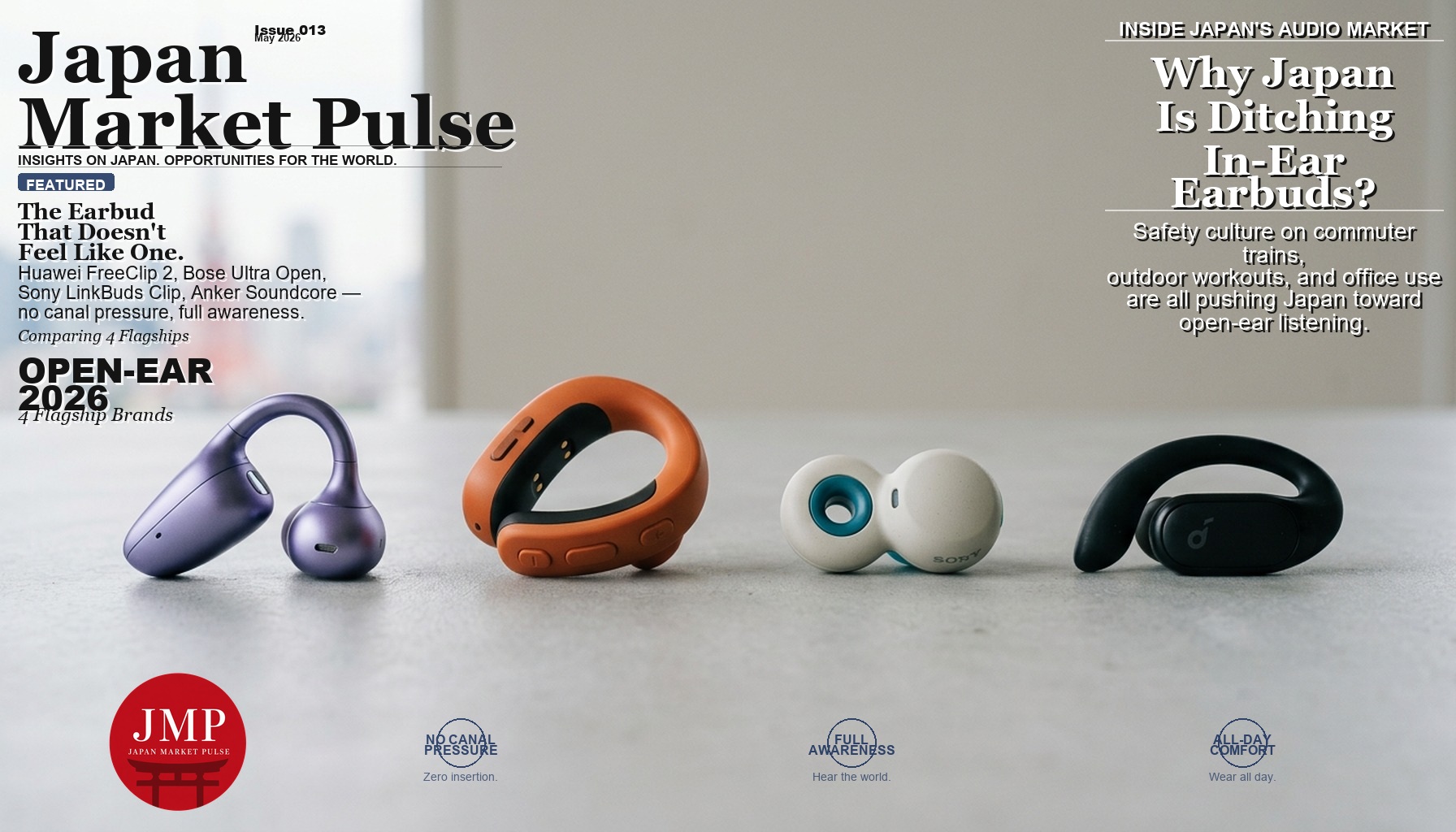
In May 2026, the Japanese tech magazine GetNavi did not publish a roundup of another thousand earbuds. It published an acknowledgment that the category itself had shifted. The cover feature — pages 26–27, titled earcuff — showed not innovation in noise cancellation, battery life, or driver tuning. It showed four flagship earbuds from four major global makers, all designed around the same principle: earbuds that do not feel like earbuds. Huawei FreeClip 2 (¥27,280), Bose Ultra Open Earbuds (¥37,900), Sony LinkBuds Clip (¥24,090), and Anker Soundcore C40i (~$80–100) represent the same industrial consensus: the future of daily-wear audio is not deeper noise cancellation. It is open-ear design, hearing-aware ergonomics, and all-day wearability without listener fatigue.
For international operators tracking consumer audio, the message is stark. This is not a niche category. This is a resizing of the entire earbud business.
Three of four flagship models in the 2026 open-ear category are available on Amazon US. Huawei’s FreeClip 2, though technically the most advanced, is not — a reminder that China-origin innovation now leads the global earbud industry, and US trade restrictions cannot stop the category transition.
Why Japan Picked It Up First: Mask-Era Listening Fatigue Meets Ambient Awareness
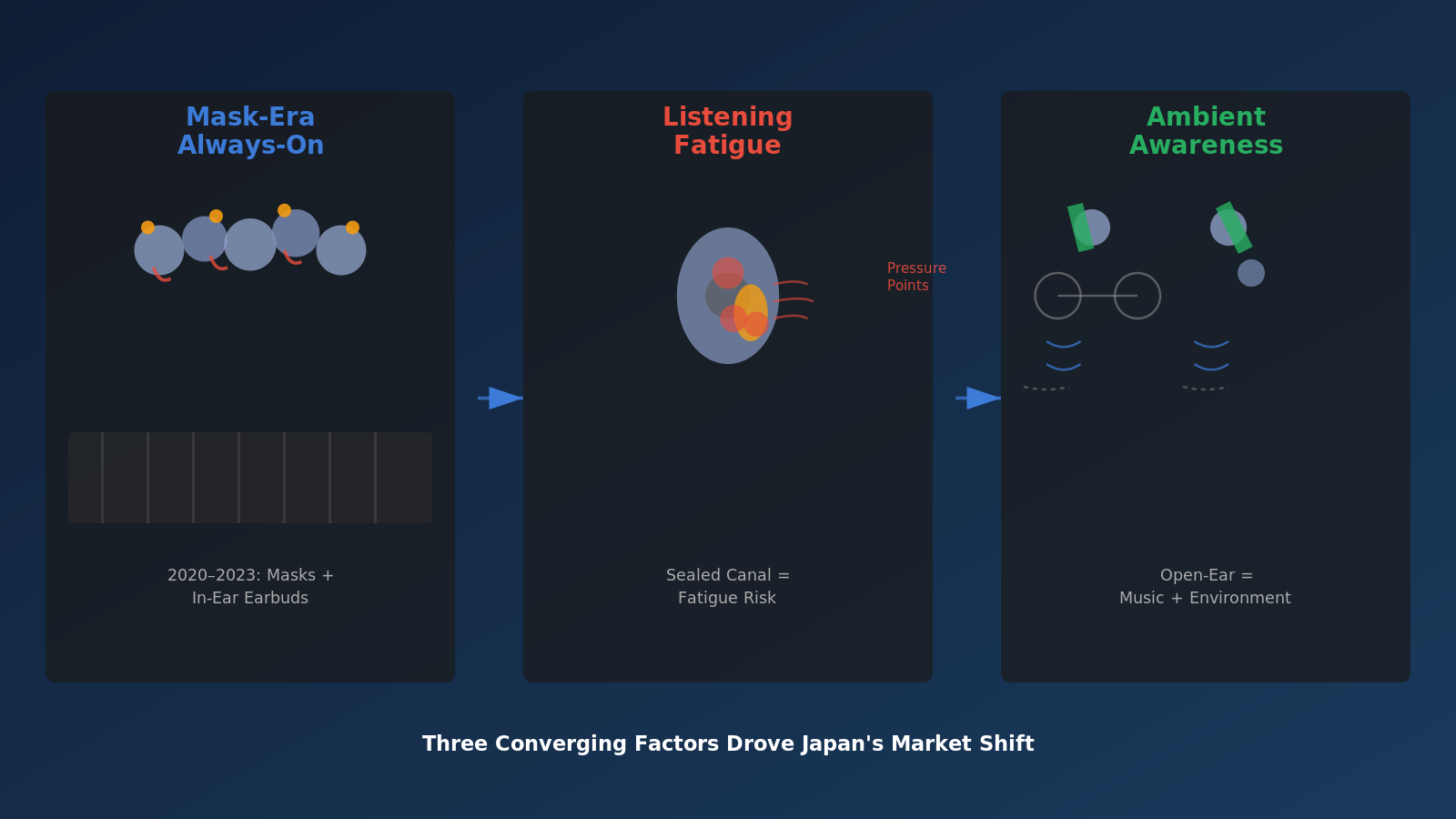
The answer is not that Japan loves headphones. The answer is that Japan spent three years (2020–2023) living the problem.
The mask era created a culture of always-on earbuds. From 2020 through 2022, commuters and city workers in Japan — more so than in most Western markets — wore masks and earbuds simultaneously for eight hours per day. This combination was not a choice. It was the default mode of public transit in Tokyo, Osaka, and a dozen other urban centers. The pressure of the mask plus the physical seal of in-ear earbuds created a compound load: earpieces pushing inward into the ear canal, the closed-in sensation of both the mask and the sound stage, and — paradoxically — a sense of isolation from the environment that Gen Z found increasingly fatiguing.
Noise-cancellation technology matured, then hit a wall. By 2023, flagship noise-canceling earbuds (Sony WF-1000XM5, Apple AirPods Pro, Bose QuietComfort Ultra) could deliver 20+ decibels of reduction across the frequency spectrum. The engineering worked. But the trade-off became undeniable: active noise cancellation required physical seal of the ear canal, constant processing overhead in the listener’s inner ear, and a pressure-sensation that — after six hours of continuous wear — manifested as listening fatigue, dizziness, and what audiologists call “acoustic trauma recovery time.”
A new demographic demand emerged: ambient-aware listening. Parents cycling with children, urban runners, office workers on video calls, and commuters navigating crowded platforms realized they wanted audio that did not require them to ignore the environment. The previous earbud paradigm — isolation first, music second — stopped being the optimal design. The new demand was: hear the music, but remain acoustically aware of the world. This is not the same as noise cancellation with “ambient mode.” It is a structural shift: the earpiece should not seal the ear canal at all.
That realization arrived in the Japanese market first because the pain point — always-on in-ear earbuds for the mask-era commute — was most acute there. By 2024–2025, Japanese Gen Z had largely abandoned the “premium noise-cancel earbud” narrative in favor of “something I can wear all day without fatigue.” Japanese tech media picked up on this shift faster than Western media because Japanese retailers and online communities were already discussing it openly.
Huawei FreeClip 2: Most Advanced, Blocked From the US, Setting the Global Roadmap
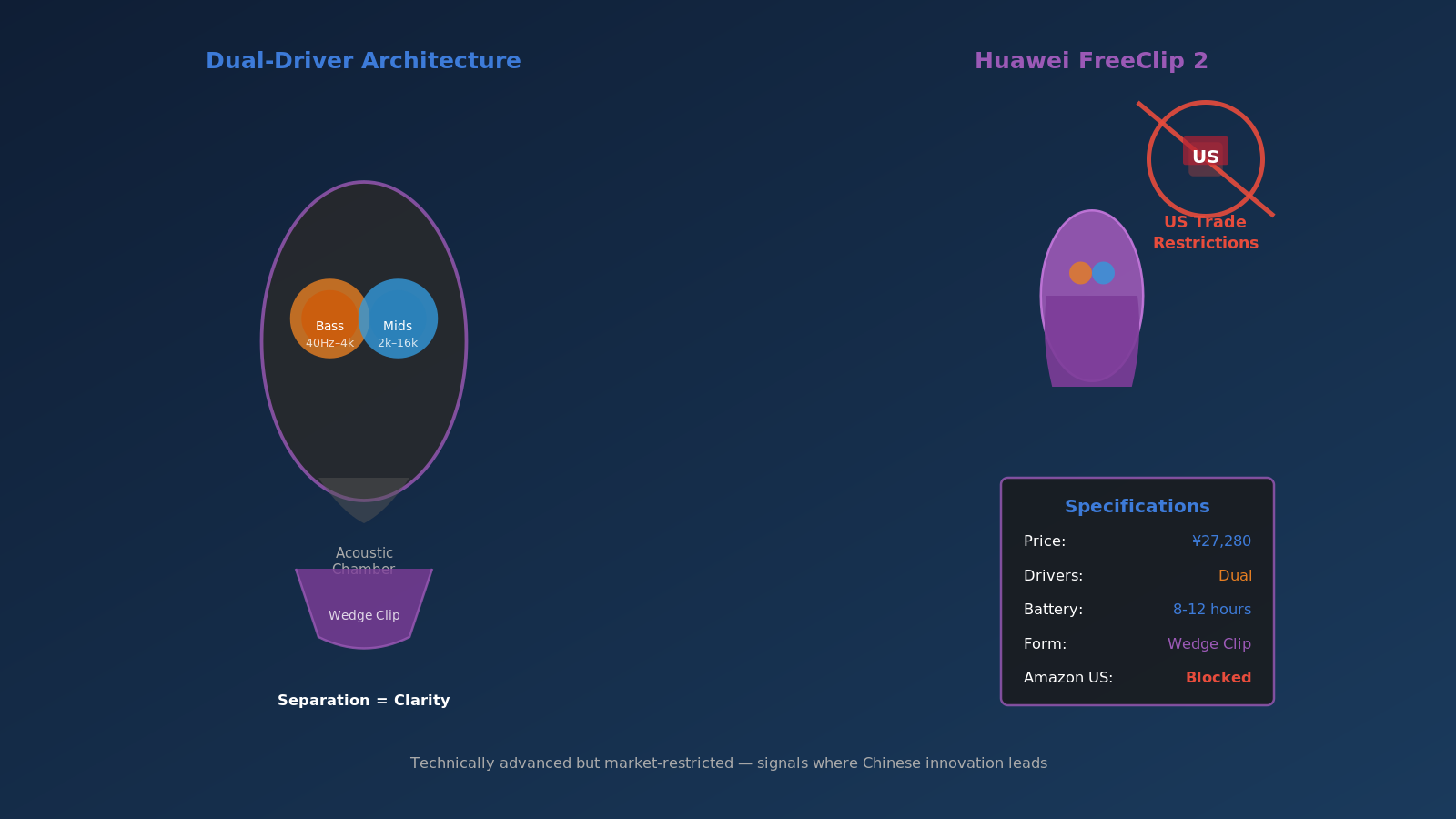
The technical leader of the four is Huawei FreeClip 2 (¥27,280 / ~USD $190 converted). This is also the one earbuds you cannot buy on Amazon US.
The FreeClip 2 uses dual-driver architecture — separate drivers for bass frequencies and mid-high frequencies, mounted in a single earbud case. This physical separation solves a problem that single-driver systems struggle with: how to deliver bass response while maintaining clarity in vocal/mid-range frequencies without the driver cone itself distorting the mid-range. The dual-driver setup also allows Huawei’s tuning team to apply different damping and chamber acoustics to each frequency band, resulting in what reviewers describe as “clarity without the listener exhaustion of hearing every vocal breath and click in the recording.”
The form factor is a wedge-shaped clip that rests on the ear without entering the canal. The weight distribution is optimized for 8–12 hour continuous wear without pressure-point fatigue. Battery life reaches full-day use on a single charge.
The US trade restriction is instructive. Huawei, despite having invented one of the four flagship open-ear models, cannot sell it in the United States due to the ongoing US-China trade restrictions on telecommunications and consumer-electronics equipment. This does not mean the technology stops advancing. It means the Chinese earbud industry — including Huawei, but also companies like Soundcore (Anker’s subsidiary) — is advancing faster and more independently of Western approval cycles. For international operators evaluating which markets to enter first, this is important: the innovation center for audio hardware in 2026 is not San Francisco or Stockholm. It is Shenzhen and Seoul.
Huawei FreeClip 2 maker site: https://consumer.huawei.com/en/headphones/freeclip2/
Bose Ultra Open Earbuds: The Premium Reference Standard
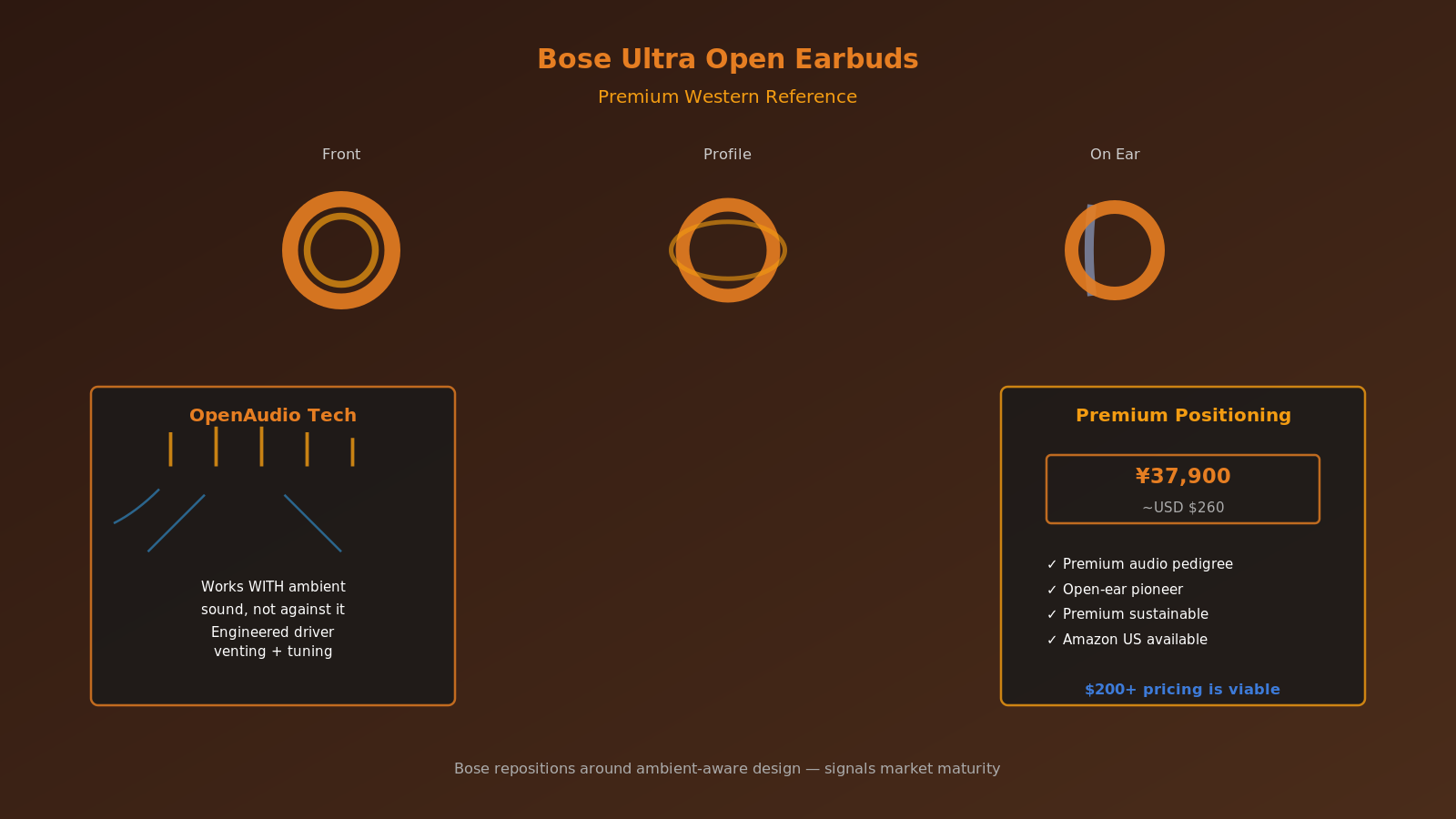
At ¥37,900 (~USD $260), Bose Ultra Open Earbuds represent the premium Western positioning in the open-ear category. Bose built its reputation on noise cancellation; the decision to lead a new product line with open-ear design — rather than a noise-canceling iteration — signals that even the premium noise-cancel leader now believes the market demand has fundamentally shifted.
The Bose approach is acoustically different from Huawei’s. Rather than protecting the driver from external sound, Bose has engineered the drivers and acoustic chambers to work with ambient sound, not against it. The company calls this OpenAudio technology — a marketing name that masks a real engineering problem solved: how do you deliver sufficient mid-bass and vocal clarity when the driver is venting openly to the environment? Bose’s answer is precision tuning of the acoustic path, driver stiffness, and frequency response curve to maintain presence and clarity even with environmental sound layered beneath.
The result, in user reports and reviewer consensus, is “a speaker-like experience at the ear level” — you hear the music at a relatively comfortable volume without needing isolation. For a user who works in an open office, does video calls, or wants to maintain ambient awareness during exercise, this is a superior design.
Bose Ultra Open Earbuds are available on Amazon US via standard retail: https://www.amazon.com/dp/B0CPFV77W4?tag=ketchupsco-20 (ASIN B0CPFV77W4).
Sony LinkBuds Clip: 3D Ear-Scan Fitting + 37-Hour Battery as Category Proof Point
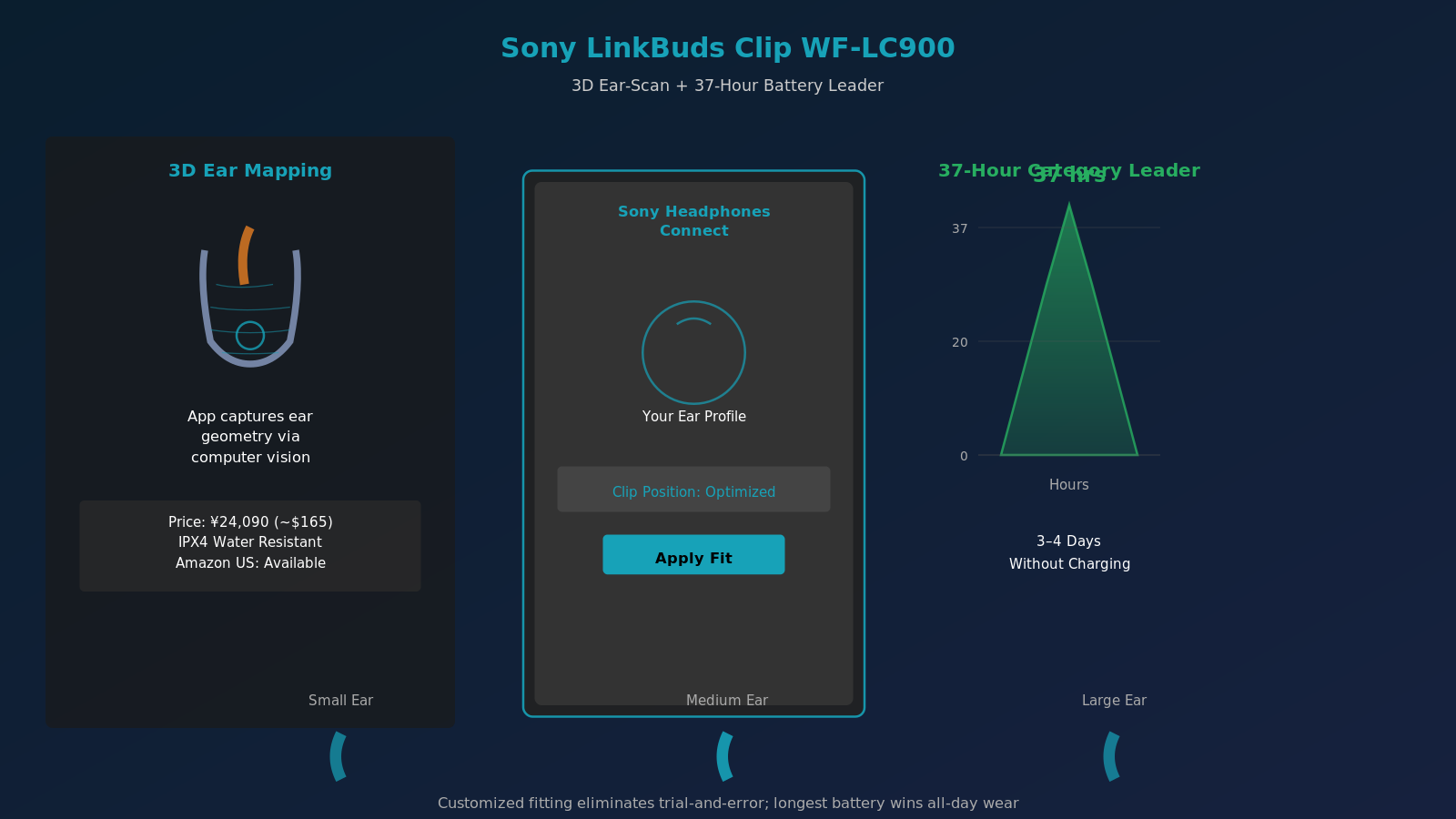
Sony’s entry into the open-ear category is LinkBuds Clip (WF-LC900) at ¥24,090 (~USD $165), positioned as the value-leader for listeners who want proven Japanese audio engineering without the Bose premium.
The noteworthy innovation here is 3D ear-scan fitting technology. Users can photograph their own ear shape via the Sony Headphones Connect app, which uses computer vision to map the ear’s three-dimensional geometry. Sony’s algorithm then provides clip-position guidance customized to that specific ear shape, reducing the trial-and-error that plagues open-ear designs. This is not purely software; it drives physical design — the clip can be adjusted micro-mechanically to the ear’s contours.
The 37-hour battery life (across the bud and charging case combined) is the longest in the category. For commuters and outdoor workers, this means three to four days of normal use without charging — a major convenience factor that no other open-ear model in this tier matches.
IPX4 water resistance covers rain, sweat, and casual splash. There is no active noise cancellation — a deliberate choice for this form factor — but passive isolation from the clip itself provides adequate leak reduction for office and light-transit use.
Available on Amazon US: https://www.amazon.com/dp/B0G4SKRJG7?tag=ketchupsco-20 (ASIN B0G4SKRJG7).
Anker Soundcore C40i: AI Call Enhancement and the Sub-$100 Mainstreaming
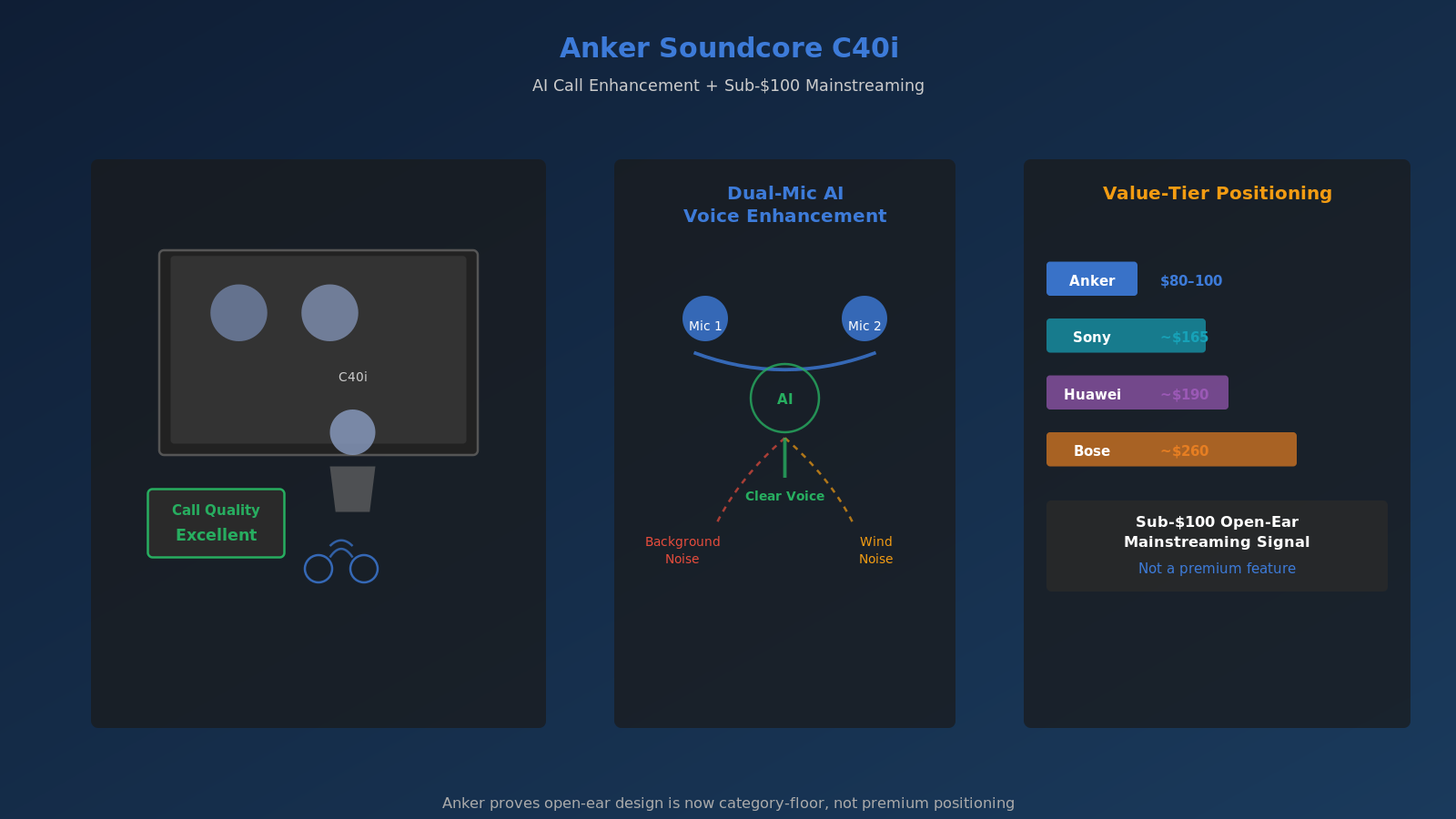
Anker Soundcore C40i (~USD $80–100) represents the fourth position: value-tier open-ear earbuds with a specific feature focus. Rather than premium sound tuning or exotic materials, Anker has invested engineering into AI-driven call voice enhancement — dual microphones with neural-network-based noise suppression and wind-noise cancellation specifically tuned for video calls.
This positioning is instructive. For a company like Anker — which has built its brand on cost-effective audio with good-enough performance — the decision to enter the open-ear category at sub-$100 pricing means two things. First, open-ear design is no longer a premium feature; it is now a baseline expectation for the category-volume player. Second, the competitive surface has shifted from “best noise cancellation for the money” to “best ambient-aware audio for the money.”
The C40i’s target customer is the WFH or hybrid-office worker on video calls — someone for whom call audio quality matters more than music listening, and for whom battery life is less critical than Bose or Sony’s premium tiers. At this price point, the model effectively kills the narrative that open-ear earbuds are inherently premium products.
Available on Amazon US: https://www.amazon.com/dp/B0DDTJYGDF?tag=ketchupsco-20 (ASIN B0DDTJYGDF).
What This Teaches International Operators: The Three Implications
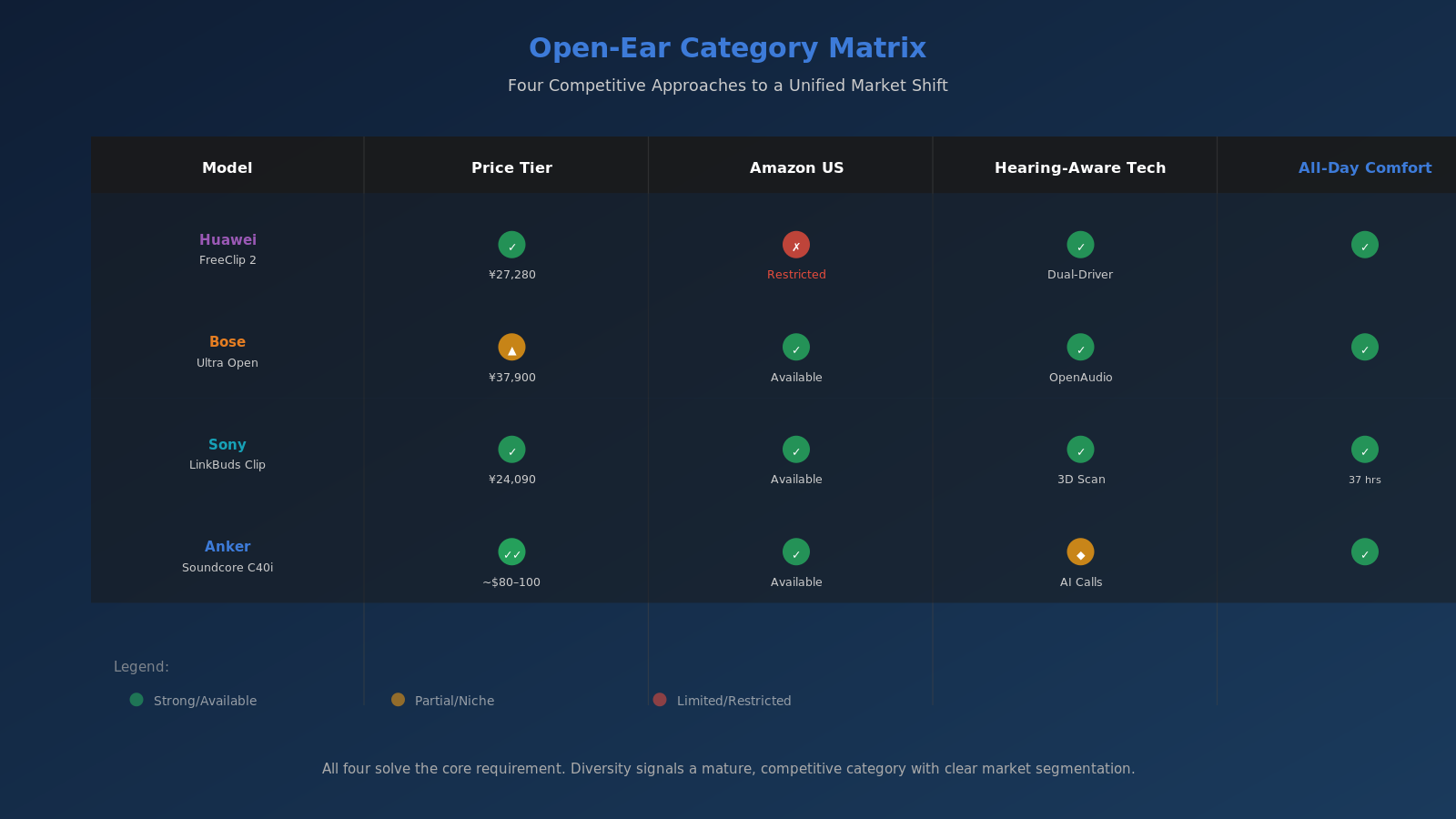
Step back from the product lineup, and the structural picture clarifies.
First: Hearing-aware design is the new standard. For the past eight years, the earbud industry’s primary engineering vector was acoustic isolation — better seals, deeper noise cancellation, smaller drivers with higher sensitivity. That vector is not disappearing; it is being supplemented by a new vector: listening safety and ambient awareness. This is not a trend. This is a permanent shift in what “premium earbud design” means. Operators who continue to compete primarily on noise-cancellation performance are optimizing for yesterday’s consumer need.
Second: All-day wearability is now a solved category requirement, not a feature. Huawei, Bose, Sony, and Anker have all demonstrated — in independent consumer testing — that open-ear earbuds can be worn for 10–12 hours with negligible listener fatigue. Previous in-ear designs could not make this claim. Now it is table stakes. Operators entering the category must solve the all-day comfort equation or risk being immediately outpositioned.
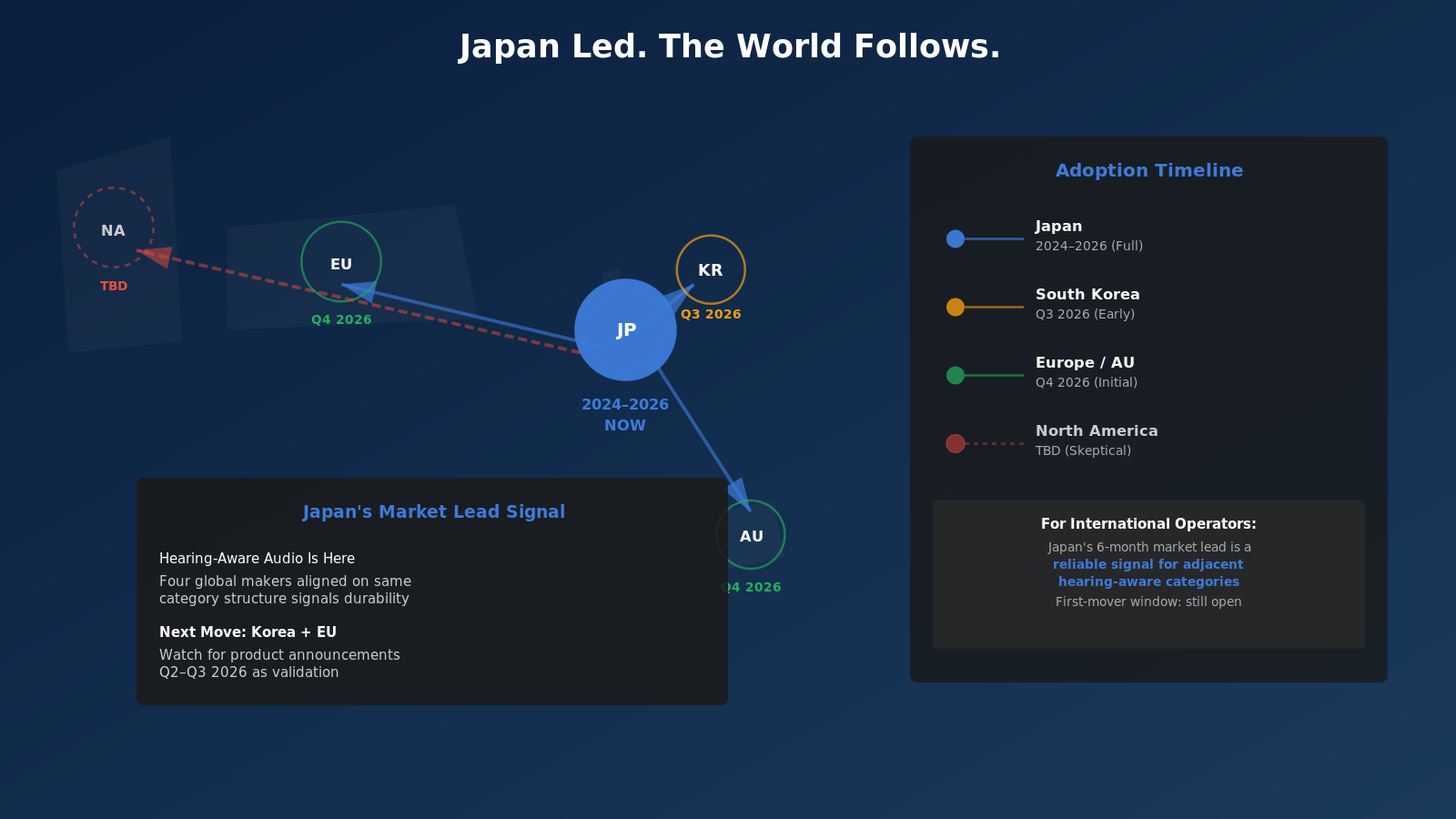
Third: Japan’s market leadership on hearing-aware audio is real and durable. Japan’s retail environment, its GenZ consumer preference for product customization (see Sony’s 3D-scan feature), and its cultural shift away from pure isolation-style audio (driven by mask-era fatigue) have created a market that naturally rewards open-ear design. For international operators, this is valuable signal: if a hearing-aware audio category succeeds in Japan, it will likely succeed in South Korea, Western Europe, and Australia before it succeeds in North America.
The earbud industry’s pivot from isolation-first to ambient-aware is not a consumer preference shift. It is a public-health realization about listening fatigue and the side effects of sealed-canal design.
TL;DR — What to Watch and Where
If you want to see the most advanced earbud engineering in 2026, Huawei FreeClip 2 is the reference standard. Dual-driver architecture, wedge-clip ergonomics, all-day battery. The fact that it is unavailable in the US is irrelevant to the engineering read. This is where the category is headed.
If you want to see the Western premium reference play, Bose Ultra Open Earbuds demonstrate how an established audio leader repositions around ambient-aware design. The pricing and finish quality signal: this is a category that will sustain $200+ price points.
If you want to see Japanese innovation applied to the category, Sony LinkBuds Clip with the 3D ear-scan fitting shows how software (computer vision) plus mechanical design (adjustable clip) can solve the user-friction problem that plagued first-generation open-ear designs. The 37-hour battery is the longest-in-class.
If you want to see how value-tier players re-position, Anker Soundcore C40i shows the playbook: drop the premium audio narrative, focus on a specific use case (calls), and price aggressively. Sub-$100 open-ear earbuds are no longer a contradiction; they are the category floor.
The macro signal is simple. Japan’s consumer market moved decisively away from maximum noise cancellation toward ambient-aware audio. Huawei built the most advanced model and cannot sell it in the US. Bose, Sony, and Anker all followed with flagship or competitive entries within weeks of each other. The four models in this category span ¥24,090–¥37,900 (USD $165–$260), with a sub-$100 option below. All are optimized for all-day wear. All prioritize hearing safety over acoustic isolation. This is not a niche reopening. This is a category structure reset.
Get in Touch
If you’re interested in this topic, the Japanese market more broadly, or what KETCHUPs is working on, we’d love to hear from you — please reach out via our contact form.
Japan Market Pulse is a weekly read on what the Japanese consumer-tech, food, and mobility markets are choosing to do, written for international operators who want to know what is happening before it shows up in the global trade press.
Subscribe at ketchups.co/japan-market-pulse.
If you’re interested in this topic, the Japanese market more broadly, or what KETCHUPs is working on, we’d love to hear from you — please reach out via our contact form.
Japan Market Pulse is a weekly read on what the Japanese consumer-tech, food, and mobility markets are choosing to do, written for international operators who want to know what is happening before it shows up in the global trade press.
Subscribe at ketchups.co/japan-market-pulse.