

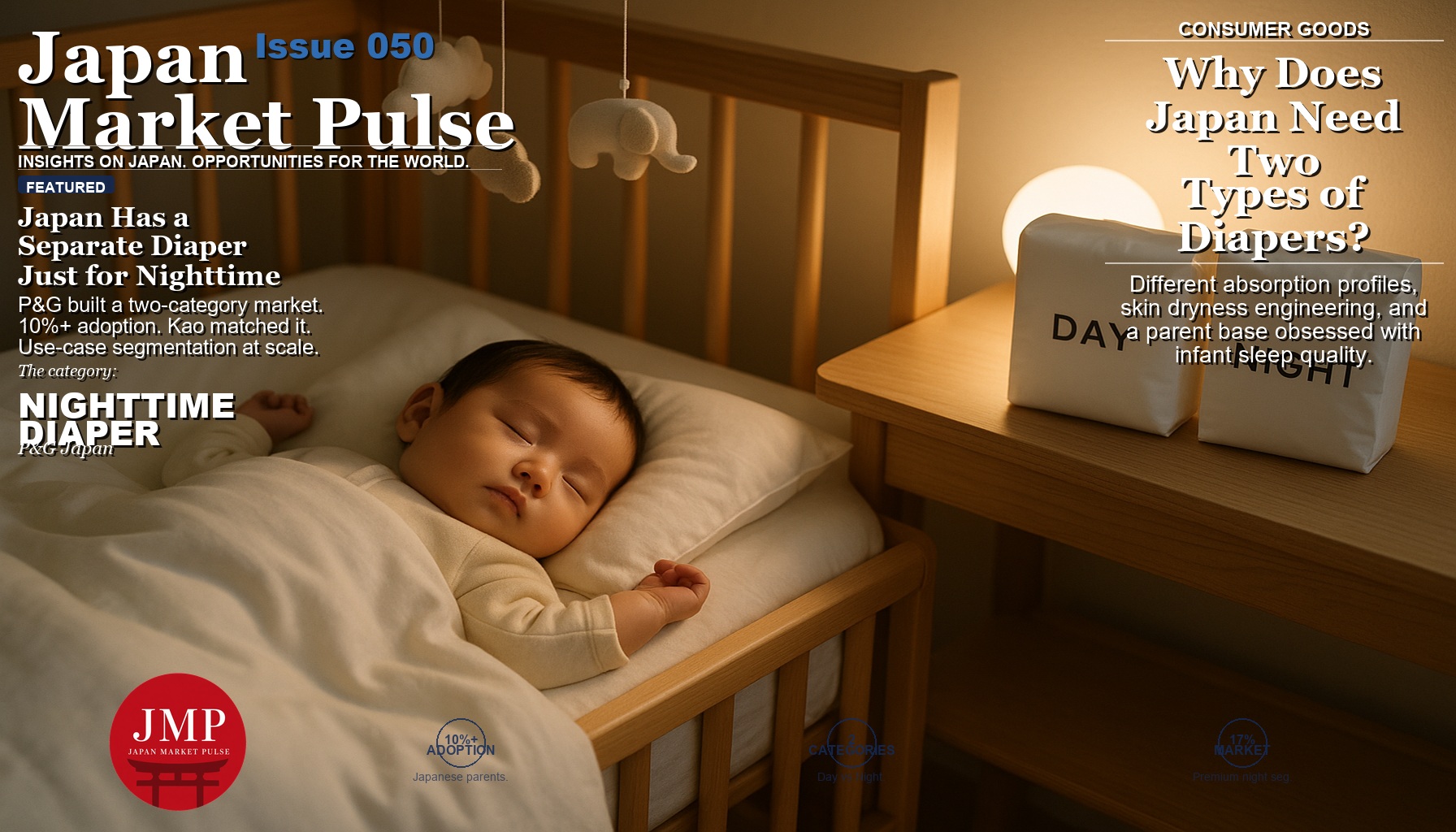
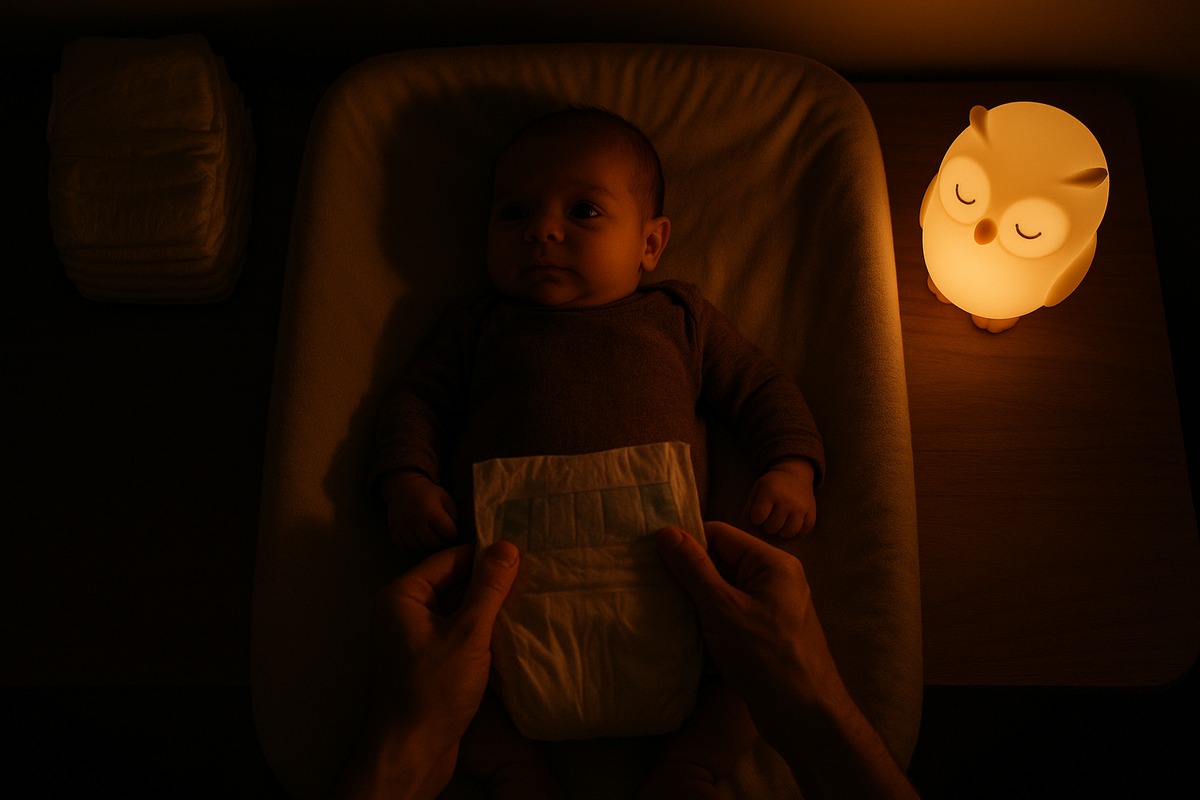
If you ask a first-time parent in the United States about diapers, they will talk about brand loyalty, absorbency, price-per-unit, and whether they use Amazon‘s Subscribe & Save. If you ask a Japanese parent the same question, you will likely hear something additional: whether they use different diapers at night than during the day.
That distinction — daytime diaper versus nighttime diaper, treated as genuinely different products with different performance requirements and different purchase decisions — is not universal. It exists as a serious commercial category primarily in Japan, where the diaper market has undergone a segmentation process that offers a useful case study in how Japanese consumer goods markets develop.
Understanding the nighttime diaper — why it exists, who it serves, and what P&G has done with it — is one of the more revealing exercises you can do if you are trying to understand how Japanese consumer markets work at the level of product development and consumer psychology.
A Market That Takes Infant Sleep Seriously
The starting point for the nighttime diaper story is not diapers. It is Japan‘s relationship with sleep.
Japan has, paradoxically, one of the world‘s most sleep-conscious consumer cultures and one of the most sleep-deprived adult populations. The tension between those two things has generated a substantial industry — sleep technology, sleep supplements, sleep environmental design — that I have written about previously. What is less often discussed is how this sleep consciousness applies to infants, and specifically to the parents of infants.
New parents in Japan — as everywhere — are extremely sleep-deprived. The difference in Japan is that this deprivation occurs within a culture that takes sleep quality seriously enough to have developed detailed vocabulary and commercial products around its optimization. The concern about infant sleep quality is not incidental; it is front of mind for Japanese parents, who are exposed to extensive information about sleep environment, sleep hygiene, feeding schedules, and anything that might affect overnight rest.
In this context, a product that claims to improve infant overnight sleep by eliminating the discomfort that causes nighttime waking is not a marginal product. It is a direct response to one of the central anxieties of new parenthood in Japan. The performance promise — your baby sleeps better, which means you sleep better — connects to something real and immediate.
How P&G Built a Two-Category Market
P&G‘s Pampers line in Japan developed the nighttime segmentation through a multi-year process that involved genuine product differentiation, not just a marketing repositioning of existing product.
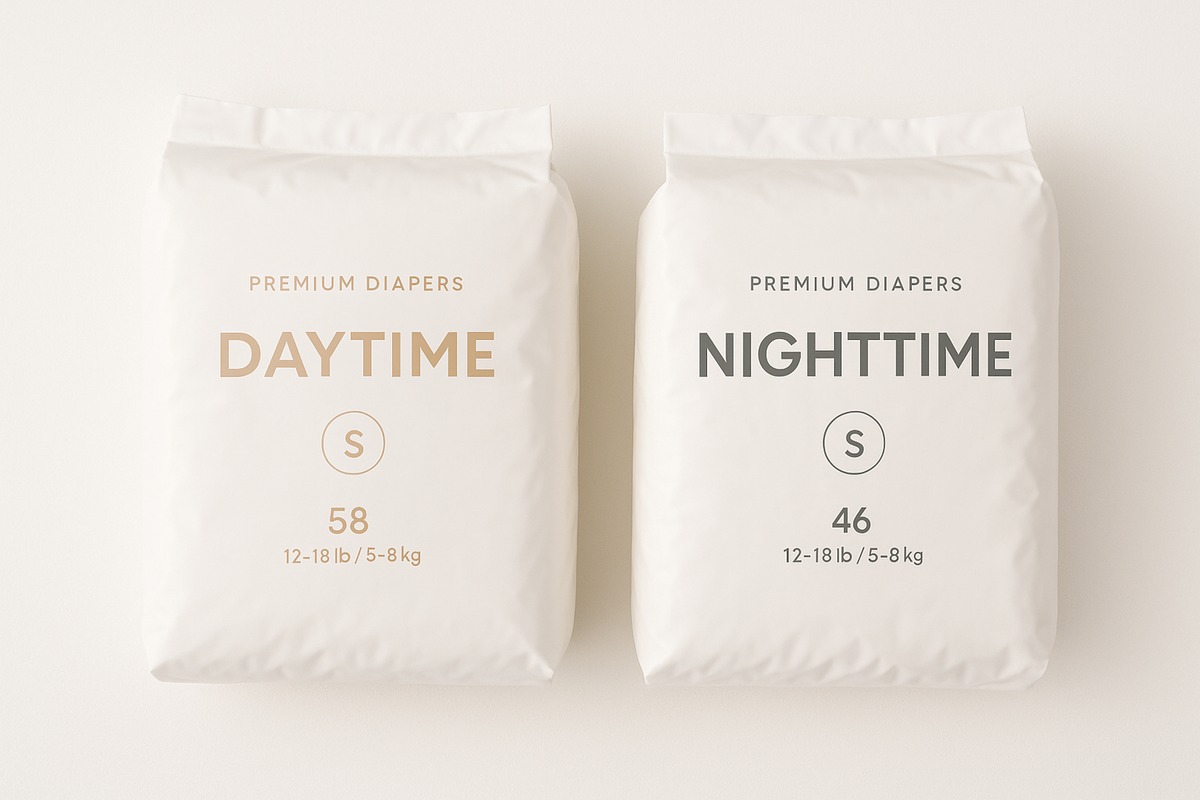
The nighttime diaper differs from its daytime counterpart along several specific axes. Absorption capacity is higher, because the product needs to handle overnight fluid volume without leakage across a longer uninterrupted wear period — the child will not be changed until morning, and the product needs to handle that reliably. The absorption speed profile differs as well: nighttime product is optimized for extended slow absorption rather than rapid-burst performance. Skin dryness — the degree to which absorbed fluid is kept away from the skin surface — is a particular focus, because contact with moisture during extended wear is the primary cause of diaper rash in overnight use.
The breathability engineering in nighttime variants is also different. Reduced external air circulation during overnight use in a covered sleeping environment creates different thermal conditions than daytime use with more activity and variable positioning. Nighttime diapers are engineered to manage this differently.
These are genuine engineering differences, not cosmetic ones. The product that Pampers markets for nighttime use in Japan is not the same product with different packaging. It is a different formulation, developed specifically for the performance profile of overnight use.
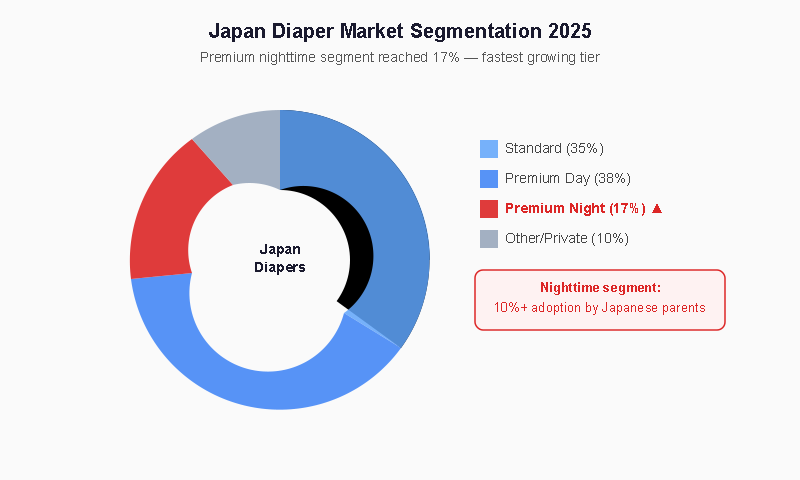
The result has been a significant market outcome: Japanese parents, who have access to both products and clear information about the differences, have adopted the two-product system at rates that justify its continuing investment. P&G has reported that the nighttime segment — which requires an additional purchase decision and an additional line on the household budget — has achieved adoption rates exceeding 10% of the relevant parent population in Japan, a number that in a market of Japan‘s size represents substantial commercial volume.
The Domestic Competition
P&G‘s nighttime segmentation did not occur in a vacuum. The Japanese diaper market is one of the most competitive in the world, with domestic brands — Kao‘s Merries, Unicharm‘s Moony and MamyPoko, Daio Paper‘s GOO.N — holding significant share and matching product innovation at every stage.
Japanese domestic diaper brands are formidable competitors for reasons that are themselves worth studying. They have deep consumer insight in the local market, relationships with maternity wards and pediatricians that create initial brand recommendations, retail relationships that give them shelf presence at every channel that new parents shop, and product development programs that respond to Japanese consumer feedback with shorter cycle times than most international players.
The response to Pampers’ nighttime segmentation from domestic competitors has been competition — matching product, which has validated the category and, in some ways, expanded it by giving parents who prefer domestic brands a nighttime option as well. A category innovation that your competitors copy is evidence that you identified something real.
Merries, in particular, has developed its own nighttime variant and invested in consumer education around the use case. The fact that Kao — one of Japan‘s most sophisticated consumer goods companies, with an extraordinarily strong track record in diaper market development — committed resources to matching the nighttime segment is the strongest possible signal that the segment has genuine commercial validity.
The Consumer Insight Behind the Category
Why do Japanese parents adopt the two-product system at higher rates than parents elsewhere?
Part of the answer is market development — P&G and its competitors have invested in consumer education in Japan that they have not necessarily replicated in other markets. If you see the advertising, read the product comparison material in the maternity sections of Japanese drugstores, or encounter the recommendation from a pediatrician, you know the two-product system exists and why you might use it. Awareness precedes adoption.
But awareness alone does not generate 10%+ adoption. The adoption rate suggests that parents are trying the nighttime product and finding it delivers enough improvement — in their baby‘s sleep, in the absence of overnight leakage, in reduced skin irritation — to justify the additional purchase. The product works well enough to maintain the behavior.
This connects to something broader about Japanese consumer behavior in the parenting category: the willingness to invest in product quality for children, and particularly infants, at rates that exceed what parents spend on themselves. Japanese household expenditure data consistently shows premium spending on infant and child care products relative to adult equivalents. The parenting category is one where value-oriented purchasing instincts are relaxed, and performance-seeking behavior is enabled.
The nighttime diaper sits at the intersection of this premium parenting psychology and a specific and addressable problem — overnight sleep disruption — that parents have strong motivation to solve.
The Drugstore Channel and Recommendation Dynamics
Understanding how the nighttime diaper achieved its adoption in Japan requires understanding the role of the Japanese pharmacy channel in parenting product decisions.
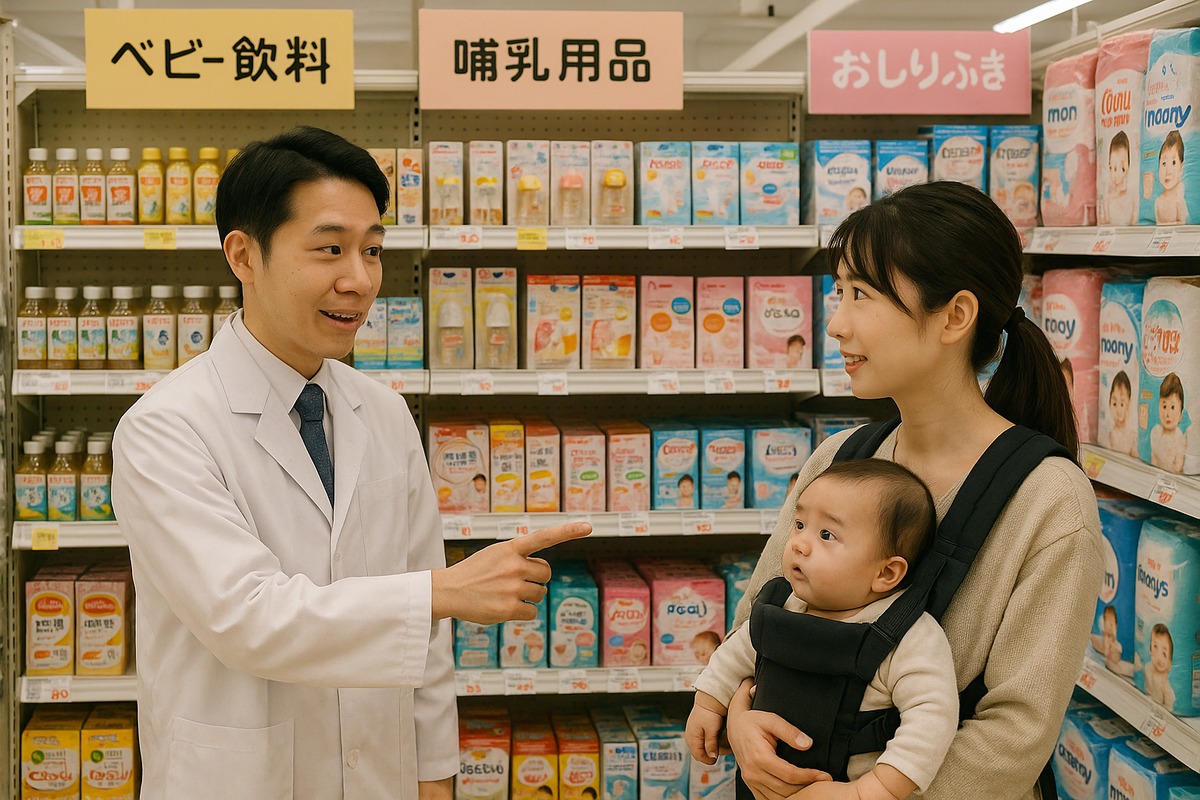
Japanese drugstores — matsukiyo, welcia, tsuruha, and the category leaders — are not just retail venues for parenting products. They are information environments. The staffing in baby care sections includes pharmacists and trained staff who advise parents, the shelf organization provides side-by-side comparison information, and the marketing materials are detailed and product-specific in ways that American mass-market retail does not typically support.
In this environment, a parent who asks "which diaper is best for overnight" gets a specific answer — a specific product recommendation, often with an explanation. The conversion from question to trial to adoption is shorter because the retail environment is designed to support it.
P&G has invested in this channel relationship in ways that support the nighttime segment specifically — in-store demonstration materials, staff education programs, and product sampling that put the nighttime variant directly in the hands of parents who might not otherwise discover it.
What the Nighttime Diaper Tells You About Segmentation Strategy
The commercial story of the nighttime diaper is, at its core, a segmentation strategy executed at a level of specificity that most consumer goods markets do not attempt.
The standard consumer goods segmentation playbook — good, better, best across a linear quality axis — is relatively straightforward. The more sophisticated play, which Japan‘s diaper market demonstrates, is use-case segmentation: identifying that the same core product need (diaper) has meaningfully different performance requirements at different times of day, and creating separate products optimized for each.
Use-case segmentation is more expensive to develop and more complex to market. It requires genuine product differentiation — not just marketing claims — and it requires consumer education to establish the category. But when it works, as it has in Japan‘s diaper market, the results are commercially superior to linear quality segmentation: you get a separate purchase decision, separate purchase frequency, and a consumer who is buying two products instead of one.
Japan is a market where this level of product sophistication has found receptive consumers in categories ranging from skincare (separate products for daytime and nighttime application) to food (seasonally specific packaged goods that exist for a few months only) to beverages (hot and cold variations of the same product marketed differently by season). The diaper category is the parenting sector‘s entry into the same logic.
For international brands in consumer goods, the Japanese market‘s appetite for use-case segmentation is worth taking seriously. The products that Japan‘s consumers will pay premium prices for are not necessarily the most expensive across a single quality axis. They are often the most specifically optimized for the particular situation in which they will be used.
The Numbers That Make the Category Work
To close the loop on commercial reality: in Japan‘s diaper market, which is substantial by volume given birth rates that, while declining, still represent a very large number of infant-years of product consumption, a 10%+ adoption rate of a nighttime-specific product represents real incremental revenue.
The nighttime variant typically carries a modest price premium over standard daytime product — a premium that is justified by the additional material cost and the engineering investment, and that consumers find acceptable given the performance claim. The incremental basket size when parents add the nighttime product to their regular purchase is meaningful.
Beyond Japan, the question that P&G and its competitors are presumably asking is whether the nighttime diaper category can travel. The conditions that made it work in Japan — high sleep consciousness, premium willingness in parenting spending, sophisticated retail channel, and receptivity to use-case segmentation — exist to varying degrees in other high-income markets. South Korea, with similar cultural characteristics and a similarly sophisticated consumer goods environment, would be the obvious next test.
Whether it travels to markets with different cultural orientations toward parenting expenditure and sleep consciousness is a more open question. But as a case study in building a category through genuine product development and use-case clarity, Japan‘s nighttime diaper market is worth the study.
If you’re interested in this topic, the Japanese market more broadly, or what KETCHUPs is working on, we’d love to hear from you — please reach out via our contact form.
Japan Market Pulse is a weekly read on what the Japanese consumer-tech, food, and mobility markets are choosing to do, written for international operators who want to know what is happening before it shows up in the global trade press.
Subscribe at ketchups.co/japan-market-pulse.
Japan Market Pulse is a weekly read on what the Japanese consumer-tech, food, and mobility markets are choosing to do, written for international operators who want to know what is happening before it shows up in the global trade press.
Subscribe at ketchups.co/japan-market-pulse.