


Gifu Prefecture, the real-world setting behind scenes in several hit anime films including “Your Name,” has drawn an estimated 1.03 million pilgrimage visitors specifically seeking out those locations, who collectively spent approximately ¥23 billion — a direct economic effect of roughly ¥16.3 billion, and a total economic effect (including secondary spending) of about ¥25.3 billion once the ripple effects through the local economy are counted. A smaller, earlier case makes the same point at a different scale: the town of Oarai, the setting for the anime “Girls und Panzer,” drew roughly 159,000 pilgrimage visitors in a single year and generated an estimated ¥721 million in direct economic impact for a town that most tourists, foreign or domestic, would have had no reason to visit otherwise.
None of this ran through a traditional marketing budget. Japan’s domestic anime and manga market hit a record ¥1.7222 trillion in 2023, up 17% year-on-year for its third consecutive record year, and the share of inbound foreign tourists specifically visiting anime and film-related locations rose from 4.6% in 2019 to 8.5% by mid-2023 — roughly 566,000 visitors in a single quarter, with 95.4% satisfaction and 13% saying they intend to make another anime-location trip on a future visit. For anyone in tourism marketing, film production, or regional economic development, the mechanism behind these numbers — a form of tourism marketing that costs the destination almost nothing to generate — is worth understanding directly.
How “Pilgrimage” Tourism Actually Works
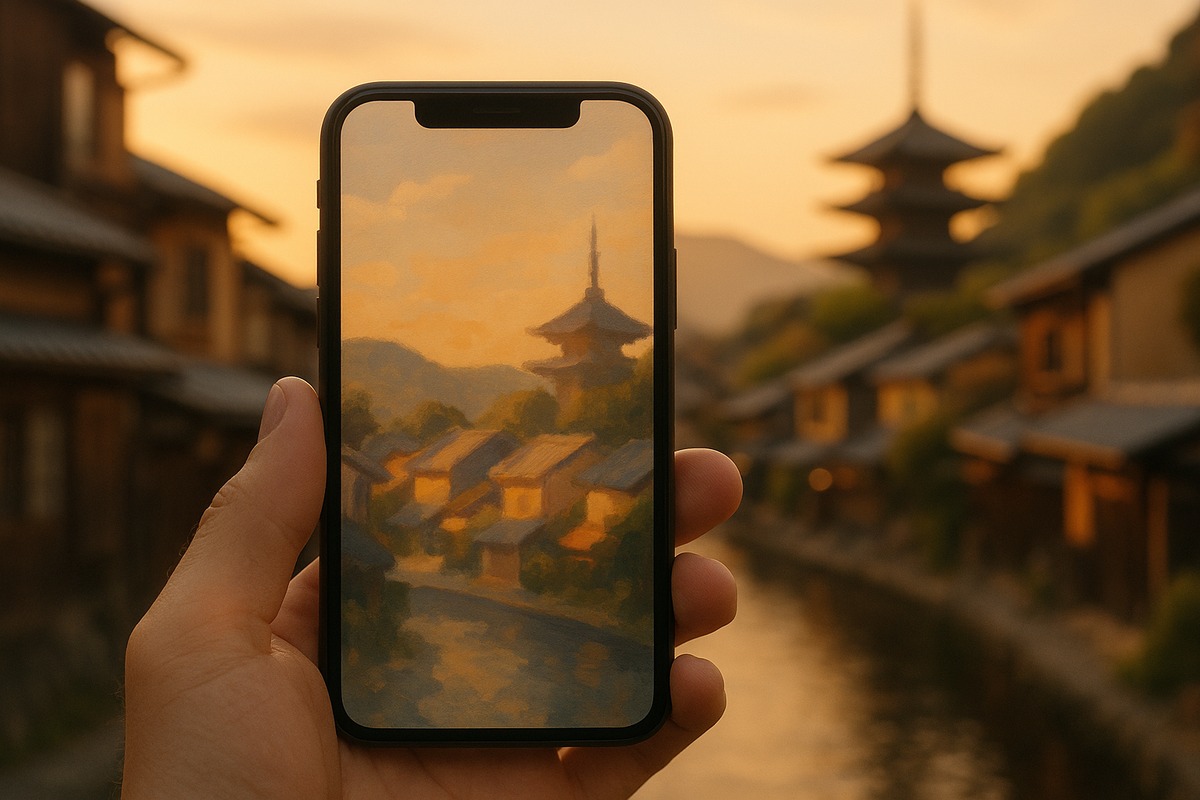
Seichi junrei — literally “sacred site pilgrimage,” borrowed from religious tourism vocabulary and applied to fan culture — describes the practice of anime fans traveling to real-world locations that inspired specific scenes, usually background art rather than named landmarks, and photographing themselves at the exact same angle as the animated frame. Critically, this is almost entirely fan-driven and fan-discovered. Anime background artists frequently base scenery on real towns, train stations, and streets, sometimes without the studio ever formally announcing or promoting the connection. Fans identify the location themselves — often through frame-by-frame comparison shared on social media — and the pilgrimage destination is essentially crowdsourced into existence before any tourism board, city government, or production company does anything at all.
That origin story is the entire reason the economics look the way they do. A location doesn’t need a licensing deal, a location-tourism marketing budget, or a studio partnership to become a pilgrimage site — it only needs to have been used as visual reference for a popular anime and to be identified by the fan community. The “marketing” that drives hundreds of thousands of visitors to a specific train station platform or shrine staircase is fan-generated photo comparisons circulating for free on social media, sustained entirely by fan enthusiasm rather than any paid campaign.
The Numbers at Two Very Different Scales
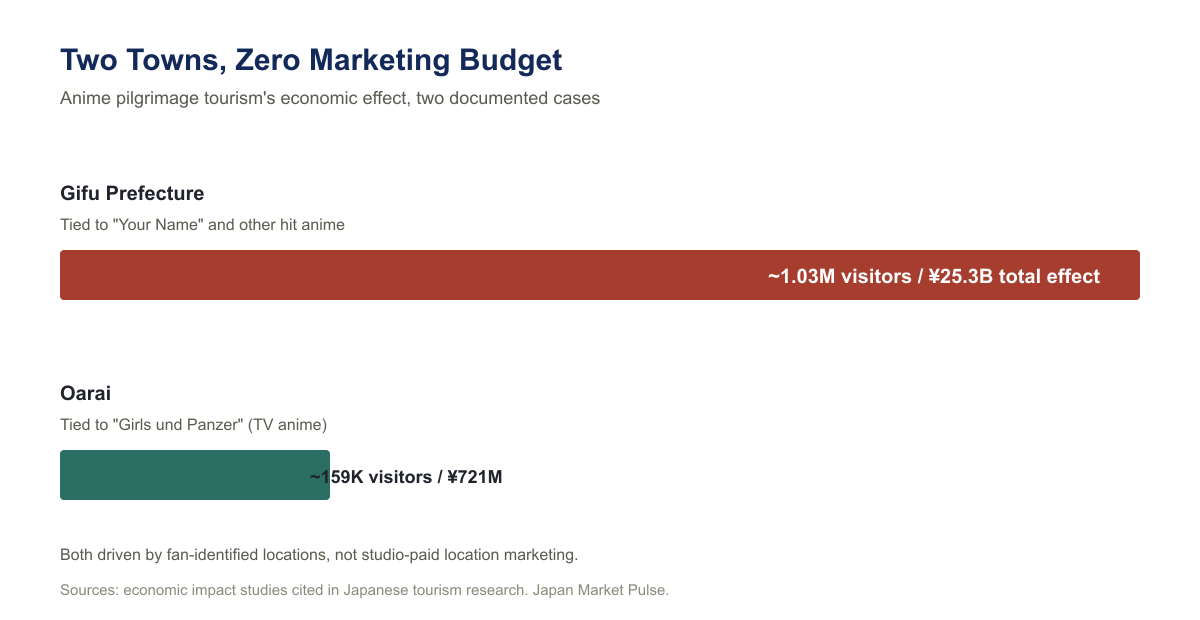
Gifu and Oarai illustrate how this scales from a modest but real regional boost to a genuinely significant tourism economy depending on the anime’s popularity and how well the destination capitalizes on it. Gifu’s roughly 1.03 million pilgrimage visitors and ¥25.3 billion total economic effect reflect the scale a major theatrical anime hit tied to a real, geographically specific region can produce, especially when local government and business actively support the pilgrimage economy once it emerges — official pilgrimage maps, collaboration goods, and location signage that don’t create the phenomenon but do help capture and extend the spending once fans arrive. Oarai’s smaller but still meaningful ¥721 million from roughly 159,000 visitors in a single year shows the same mechanism working at the scale of a single television anime and a specific, much smaller town, proving the model isn’t dependent on blockbuster-scale properties to generate a real, measurable local economic effect.
Zoomed out to the national level, the broader trend context matters: Japan’s anime and manga industry crossed ¥1.7 trillion domestically in 2023, its third consecutive record year, growing 17% in a single year. Pilgrimage tourism is a downstream effect of an industry that is itself compounding rapidly, meaning the pipeline of newly popular anime generating newly identified real-world pilgrimage sites shows no sign of slowing.
Why This Looks Different From Western Film Tourism
Hollywood and streaming platforms do generate location tourism — New Zealand’s Lord of the Rings tourism infrastructure is the best-documented example — but that model typically requires a studio partnership, a location-tourism marketing budget, and often years of formal promotion tying a destination to a production. (Dubrovnik’s Game of Thrones boom, by contrast, grew organically out of fan demand rather than any official HBO partnership — closer to the Japanese pattern than the studio-driven one.) Japan’s anime pilgrimage phenomenon runs on close to the opposite economics: the location tourism effect exists whether or not the studio, the tourism board, or the local government does anything at all, because the identification and promotion of the site happens entirely inside fan communities, for free, as an act of enthusiasm rather than commerce.
That distinction matters enormously for smaller regions and towns that would never attract a major studio location deal. Oarai didn’t need Lord of the Rings-scale production infrastructure or a New Zealand Tourism Board budget to draw 159,000 pilgrimage visitors — it needed to be drawn accurately as background art in a moderately popular television anime, and to have fans notice. That’s a fundamentally lower bar than the deal-making required for Western studio-driven film tourism, and it means the phenomenon can create real economic upside for towns and regions with no existing tourism infrastructure or marketing budget at all.
What International Operators Should Take From This
For tourism boards, regional economic development agencies, and even production companies outside Japan, the seichi junrei phenomenon suggests a genuinely low-cost path to location-driven tourism that doesn’t depend on winning a marquee studio production deal. A region doesn’t need to be the setting of a blockbuster — it needs to be recognizable enough as itself in animated or stylized visual media that a fan community can identify and rally around it, and then needs to be ready to capture that attention once it happens rather than treating it as background noise. The lightest-touch, highest-leverage move available to almost any region is simply monitoring whether it’s already been used as visual reference in popular anime or other stylized media, and if so, engaging with the fan community that’s already doing the promotional work for free rather than waiting for a formal studio partnership that may never materialize.
The deeper structural lesson is about where marketing cost actually goes in a fan-driven tourism model versus a studio-driven one. Western film tourism spends heavily on the deal and the promotional tie-in; Japan’s anime pilgrimage tourism spends almost nothing on either, because the enthusiasm and the promotion are generated organically by an audience that wants to do it. Any operator sitting on a location that might already be quietly famous inside a fan community — without anyone in tourism or economic development having noticed yet — is sitting on upside that costs almost nothing to capture, provided someone is paying attention.
Frequently Asked Questions
Q. How much tourism revenue has anime pilgrimage generated in Japan?
A. Gifu Prefecture, tied to locations in “Your Name” and other hit anime, drew an estimated 1.03 million pilgrimage visitors and generated approximately ¥25.3 billion in total economic effect. Oarai, the setting for “Girls und Panzer,” drew about 159,000 visitors and generated roughly ¥721 million in a single year.
Q. How is an anime pilgrimage site identified?
A. Almost entirely by fans, who compare real-world locations to anime background art frame-by-frame and share the matches on social media — often without any formal confirmation or promotion from the anime’s studio.
Q. How does this differ from Western film tourism, like Lord of the Rings tourism in New Zealand?
A. Western film tourism typically requires a studio partnership and a dedicated marketing budget tied to the production. Japan’s anime pilgrimage tourism generates location awareness almost entirely through free, fan-driven social media activity, with no studio deal required.
Q. What share of inbound tourists to Japan visit anime-related locations?
A. The share of inbound foreign tourists visiting film or anime-related sites rose from 4.6% in 2019 to 8.5% by mid-2023, with satisfaction among those visitors measured at 95.4%.
If you’re interested in this topic, the Japanese market more broadly, or what KETCHUPs is working on, we’d love to hear from you — please reach out via our contact form.
Japan Market Pulse is a weekly read on what the Japanese consumer-tech, food, and mobility markets are choosing to do, written for international operators who want to know what is happening before it shows up in the global trade press.
Subscribe at ketchups.co/japan-market-pulse.