


On 30 September 2026, the Tokyo District Court dismissed a lawsuit brought by Kenjiro Tsuda, one of the most recognisable voices in Japanese animation, against the operator of TikTok. On the same afternoon, in the same judgment, it did something no Japanese court had done before: it said that a human voice can be protected by the right of publicity in the same way as a person’s face.
Those two facts sound contradictory. They are not. Tsuda asked the court to order the removal of videos narrated by an AI voice that he said had been cloned from his own. By the time the judge ruled, the anonymous account that posted them had already been deleted, so there was nothing left to remove. The claim failed on a technicality. The principle survived, and the principle is what matters.
I have spent a long time watching foreign companies misread Japan’s rules on intellectual property. The usual mistake is to assume the country is permissive because one famous provision of its copyright law gives AI developers unusually broad room to train models on copyrighted material. That assumption was always incomplete. After this ruling, and after a 143-page government report published fifty-four days earlier, it is now actively dangerous for anyone who uses synthetic voices in advertising, customer service, games, dubbing or social media in Japan.
This is the long version of why. It covers what actually happened in the case, how a 2012 dispute over a pop duo’s dance moves became the legal foundation for AI voice protection, how Japan’s approach compares with the United States, China and Europe, why voice carries more commercial weight in Japan than in almost any other market, and what an international operator should change in its playbook this quarter.
188 Videos, 200,000 Followers and a Baritone Everyone Recognised
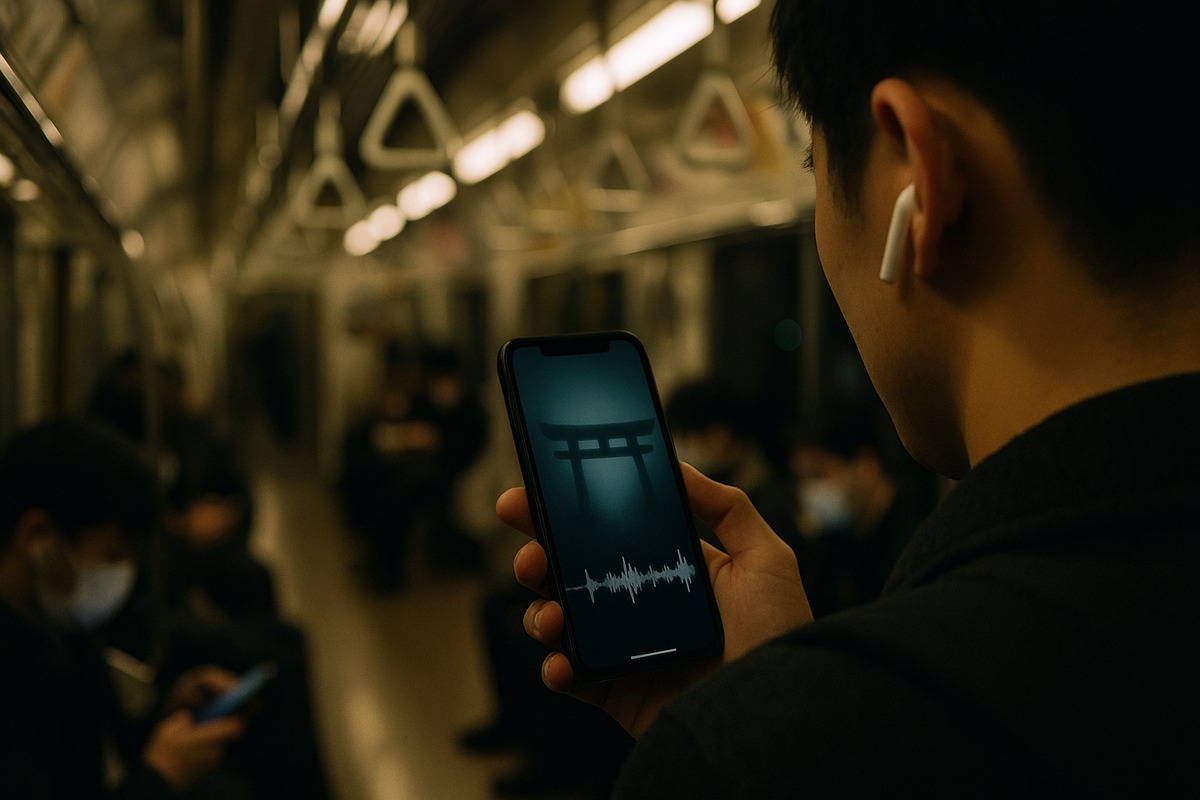
Start with the plaintiff. Kenjiro Tsuda is a veteran voice actor, or seiyuu, with a deep, slightly rough baritone that Japanese audiences know from dozens of roles, including Kento Nanami in Jujutsu Kaisen and Seto Kaiba in Yu-Gi-Oh!. In Japan, a voice like that is not background talent. It is a brand. Fans buy event tickets, radio-show recordings and drama CDs specifically to hear it.
According to his lawsuit, filed in Tokyo in November 2025, an unidentified person ran a TikTok account that posted at least 188 videos between July 2024 and September 2025. The videos told urban legends, myths and conspiracy stories, the kind of late-night, slightly eerie content that does well on short-video feeds. Every one was narrated by an AI-generated voice that, Tsuda argued, was a clone of his. The account used character imagery from Jujutsu Kaisen, the series in which he plays one of the most popular roles. It reportedly built an audience of more than 200,000 followers, and viewers often assumed that Tsuda himself was the narrator, or that someone was cloning him.
The money was not trivial. According to figures the account holder posted on a separate website, the videos were earning an estimated 500,000 to 750,000 yen a month, roughly $3,000 to $5,000 at recent exchange rates. For a faceless account that never paid a performer, never booked a studio and never signed a contract, that is a very good small business.
TikTok’s defence was straightforward. Its side argued that the narration used a “generic male voice” that would not be mistaken for Tsuda’s, and pointed out that the uploader had explained elsewhere that the voice came from an AI model trained on the voice of a friend. Tsuda was not suing the anonymous creator directly, whose identity he did not know; he was asking the platform to take the videos down.
Then, during the proceedings, the account and its videos disappeared. Tsuda’s side said the operator deleted them around May 2026. That deletion is why the case ended the way it did.
Japanese reporting described Tsuda as the first voice actor in the country to take a major platform to court over alleged AI voice cloning. That is part of why the industry followed it so closely. The Japan Actors Union, the performers’ organisation that has campaigned on generative AI for two years, framed the stakes in terms of labour rather than technology: an actor’s voice, its executive director Yuko Sasaki said, is “the result of years of rigorous training.”
Why Losing Was Winning: The Two Messages in One Judgment
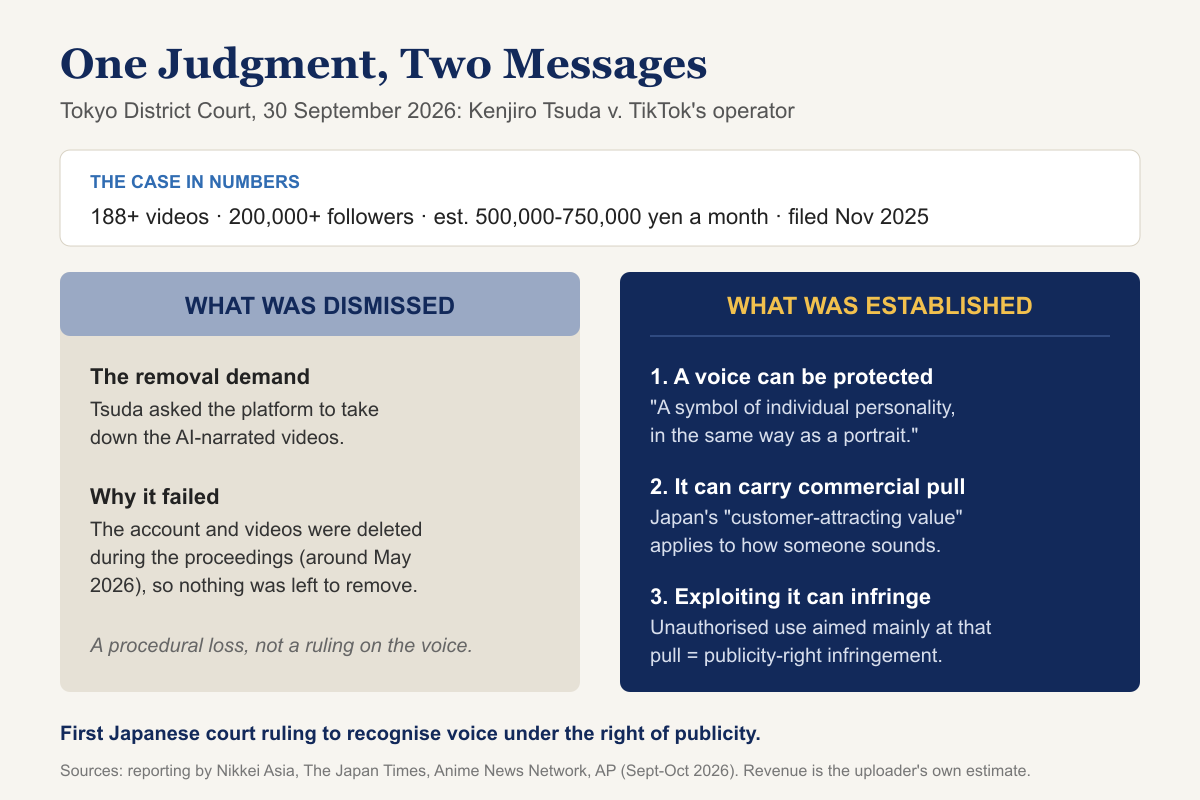
A court in Japan, like a court almost anywhere, only decides the claim in front of it. The claim in front of the Tokyo District Court was a demand that TikTok’s operator remove specific videos. Those videos no longer existed, so the court found there was no remaining obligation to remove anything, and it dismissed the demand.
If the judgment had stopped there, it would have been a footnote. It did not stop there. In reaching its conclusion, the court set out how it would have analysed the voice itself, and that reasoning is now the clearest statement any Japanese court has made on the question.
The court said that a voice can be “a symbol of individual personality in the same way as a portrait.” It said a voice can have customer-attracting value — the legal phrase in Japan for the commercial pull of a famous person’s identity. And it said that using a voice without permission, where the use is aimed primarily at exploiting that commercial pull, can constitute an infringement of the right of publicity. This was a statement of the general rule for performers’ voices. The court did not decide whether the narration in these videos was in fact Tsuda’s voice, whether these particular videos infringed, or whether TikTok bore any liability — the deletion made those questions moot.
For international readers, three things about this are worth noticing.
First, the protected thing is the voice, not a recording. Copyright protects a specific recorded performance. It does not protect the characteristics of how someone sounds. An AI model that generates new speech in a familiar timbre does not copy any recording, which is why copyright has been a weak tool against voice clones in almost every jurisdiction. Publicity rights do not have that gap.
Second, the test is about exploitation of commercial value, not about technical similarity scores. The question is not “does this waveform match that waveform.” The question is whether the use is designed to borrow the draw of a specific, identifiable person. An account that narrates ghost stories in a voice audiences associate with a famous actor, next to imagery from the anime that made him famous, is the textbook fact pattern.
Third, the platform was the defendant. The case did not establish platform liability, because it never had to. But a famous performer was able to bring a removal claim against a global platform in a Japanese court and obtain a reasoned judgment setting out, in general terms, how voice protection works — even though the court never ruled on the specific videos. That procedural path is now visible to every other performer, agency and estate in the country.
From Pink Lady to Pixels: The 14-Year Road to Voice Protection
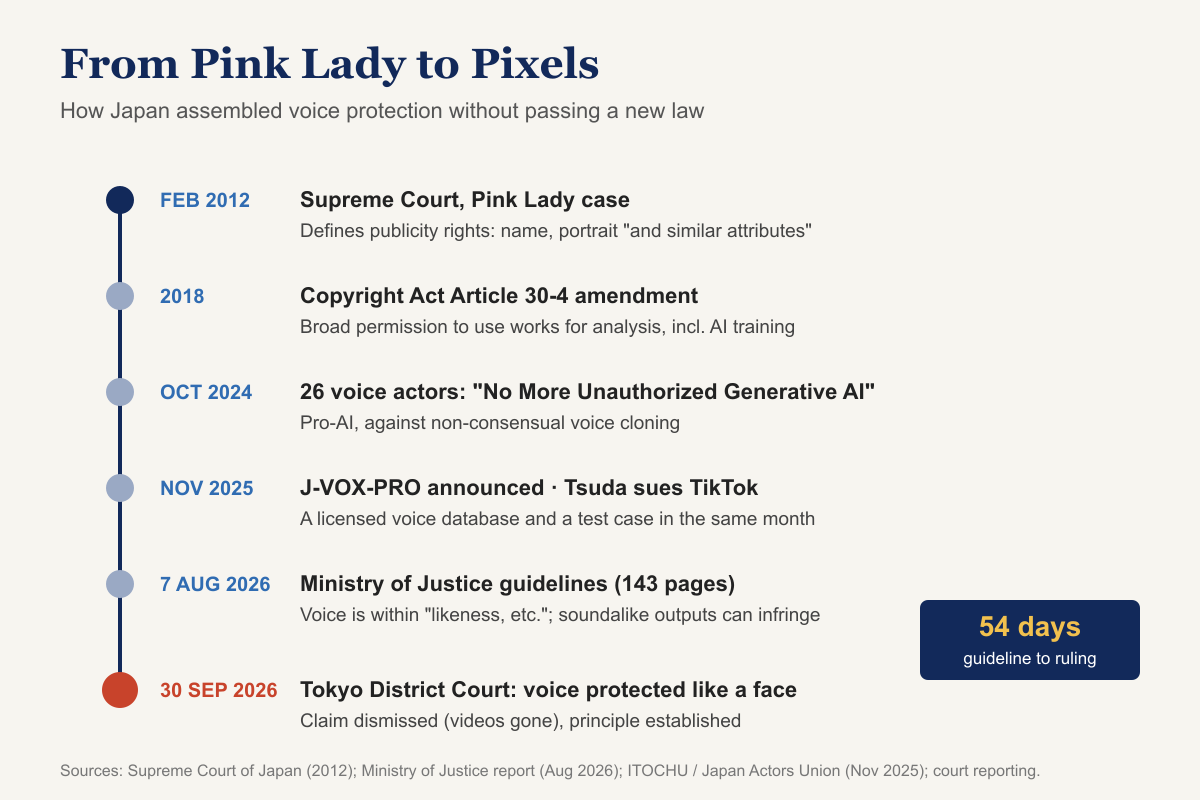
Japan has no statute called a “right of publicity.” The right exists because courts built it, and the foundation stone was laid on 2 February 2012 by the Supreme Court in a case brought by Pink Lady, the hugely popular 1970s pop duo.
The facts were almost comically low-tech. A weekly magazine ran a diet feature that used photographs of the duo to illustrate exercises based on their famous dance routines. The two singers sued, arguing that their images had been used without permission. They lost — the court found the photos were a small part of an article about dieting, not an exploitation of their fame — but in rejecting the claim, the Supreme Court defined the right that has governed every celebrity-likeness dispute in Japan since.
The court said that a person’s name, portrait and similar attributes can have customer-attracting power, and that the exclusive right to exploit that power is protected as part of personality rights. Infringement occurs when the likeness is used mainly for the purpose of exploiting that power. It then gave three typical examples: using the likeness itself as an object of appreciation, such as selling photographs or posters; attaching it to goods to differentiate them, such as character merchandise; and using it to advertise goods.
Notice the phrase “name, portrait and similar attributes.” For fourteen years, lawyers argued about whether “similar attributes” included voice. Most assumed it probably did. Nobody had a judgment that said so.
Meanwhile, the technology moved. Consumer voice-cloning tools that once needed hours of studio-quality recordings began producing convincing results from minutes of audio. Japanese social platforms filled with “AI covers” of famous singers and AI voice models labelled with the names of popular seiyuu, distributed without permission. In October 2024, twenty-six of the country’s best-known voice actors, including Koichi Yamadera, Ryusei Nakao, Yuki Kaji and Romi Park, launched a campaign called “No More Unauthorized Generative AI.” It explicitly did not oppose AI. It opposed AI trained on their voices without consent.
In November 2025, the Japan Actors Union, the trading house ITOCHU and its systems subsidiary ITOCHU Techno-Solutions announced a licensed alternative: a professional voice database, provisionally named J-VOX-PRO, designed to store performers’ voices securely and license them for agreed purposes. The same month, Tsuda filed suit.
In August 2026, the Ministry of Justice published its report. On 30 September, the Tokyo District Court ruled. The sequence matters because it shows that Japan’s answer to AI voice cloning did not arrive suddenly. It was assembled from a 2012 precedent, an industry campaign, a commercial licensing model, a government interpretive guideline and finally a court ruling — each one making the next one easier.
The Rulebook Arrived 54 Days Before the Ruling
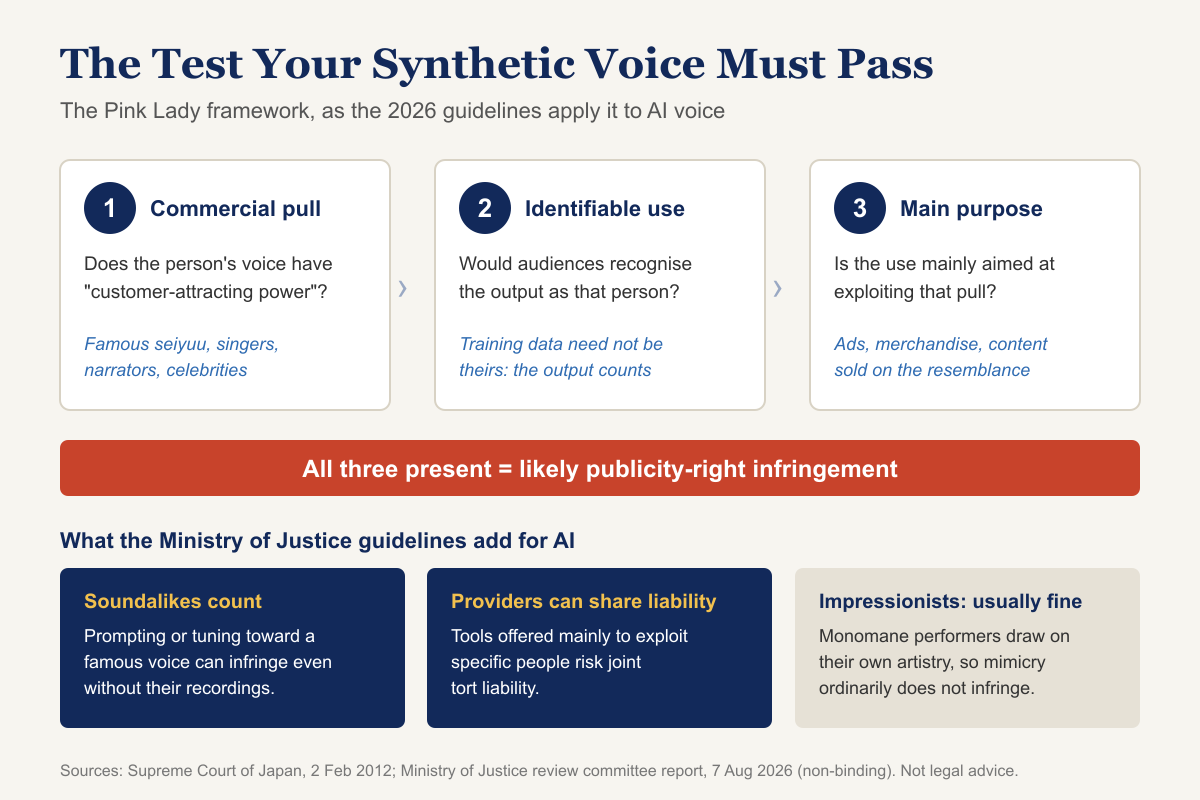
On 7 August 2026, a review committee established under the Ministry of Justice published a final report on civil liability for the unauthorised use of people’s likenesses and voices. Its subtitle describes it as interpretive guidelines on infringement of publicity rights by generative AI. It runs to 143 pages, and it is organised around seven hypothetical cases: an actor’s likeness used in AI video, a singer’s or voice actor’s voice used in AI audio, sexual deepfakes, non-commercial posting, licensing arrangements and the likenesses of people who have died, among others.
It is important to be precise about what this document is. It is not a statute, not a regulation and not binding on any court. It is a study group’s reading of existing law. But it is the most detailed public statement the Japanese state has made on the topic, and the Tokyo District Court’s reasoning fifty-four days later lines up with it closely.
Four conclusions in the report are directly relevant to businesses.
The first is the headline: a voice falls within the “likeness, etc.” protected by publicity rights. The report reasons that voice is identifying information about a person and therefore part of the personality interest the right protects. The Pink Lady three-part test — customer-attracting power, use of the identifiable likeness, and a use mainly aimed at exploiting that power — applies to voice as it does to faces.
The second is the one that should worry marketing teams. The report says infringement can occur when an output resembling a person’s likeness is produced, through prompt adjustment or otherwise, and exploits that person’s customer-attracting power, even if the person’s actual data was never used. In plain terms, “we trained on a friend’s voice” or “we generated it from scratch” is not a complete defence if the result is designed to sound like someone famous and is used to cash in on that resemblance.
The third concerns AI providers. The report says a generative AI provider can face joint tort liability where it contributes to infringement, particularly where it offers an AI tool mainly for the purpose of exploiting the customer-attracting power of specific individuals. A general-purpose voice engine is not automatically liable. A product marketed as “make your video sound like this star” is a different matter.
The fourth is a carve-out that reflects Japanese culture. Impersonation and voice mimicry by human performers — the country has a long tradition of comic impressionists, known as monomane — ordinarily do not infringe, because the impersonator attracts an audience through their own artistry rather than by exploiting someone else’s draw. The line the report draws is between performing an imitation and deploying a substitute.
The committee also left something unresolved: it was divided on whether publicity rights can be assigned to another party, and said it would watch future court decisions. That question matters enormously for licensing, and it is still open.
An AI-Training Paradise That Now Guards the Output
Many international technology companies still describe Japan as an “AI training paradise.” The phrase refers to Article 30-4 of the Copyright Act, introduced in a 2018 amendment, which broadly permits the use of copyrighted works for information analysis, including machine-learning training, where the purpose is not to enjoy the expressive content of the work — subject to an exception where the use would unreasonably prejudice the copyright holder’s interests. Compared with the litigation-heavy environment in the United States, Japan looks wide open at the input stage.
The voice ruling shows why that reading was always half the picture. Japan’s system is unusually permissive about what goes into a model and increasingly strict about what comes out of it and how that output is used commercially. Copyright law governs the training. Personality and publicity rights govern the face or voice that appears in the finished advertisement, game character or social video. The two bodies of law are separate, and a green light under one says nothing about the other.
This is not a contradiction. It is a fairly coherent policy position. Japan wants domestic and foreign AI developers to build models on Japanese-language data, because it does not want to be dependent on systems trained elsewhere. It also has an entertainment economy that depends on the commercial value of specific, recognisable human performers. Permissive training plus protected identity is how a country tries to have both.
For operators, the practical consequence is that the compliance question moves downstream. Your legal team can no longer clear a synthetic-voice campaign in Japan by asking whether the model was trained lawfully. It has to ask whether the output sounds like an identifiable person, whether that person’s voice has commercial pull, and whether the campaign benefits from the resemblance.
There is also a reputational layer that the law does not capture. Japanese consumers, and particularly anime and game fans, notice voices with extraordinary precision. A soundalike that a court might find too generic to infringe can still be identified, screenshotted and criticised on social media within hours. In a market where brand trust is slow to build and quick to lose, “probably legal” is a low bar.
America’s Patchwork, China’s Damages, Japan’s Precedent
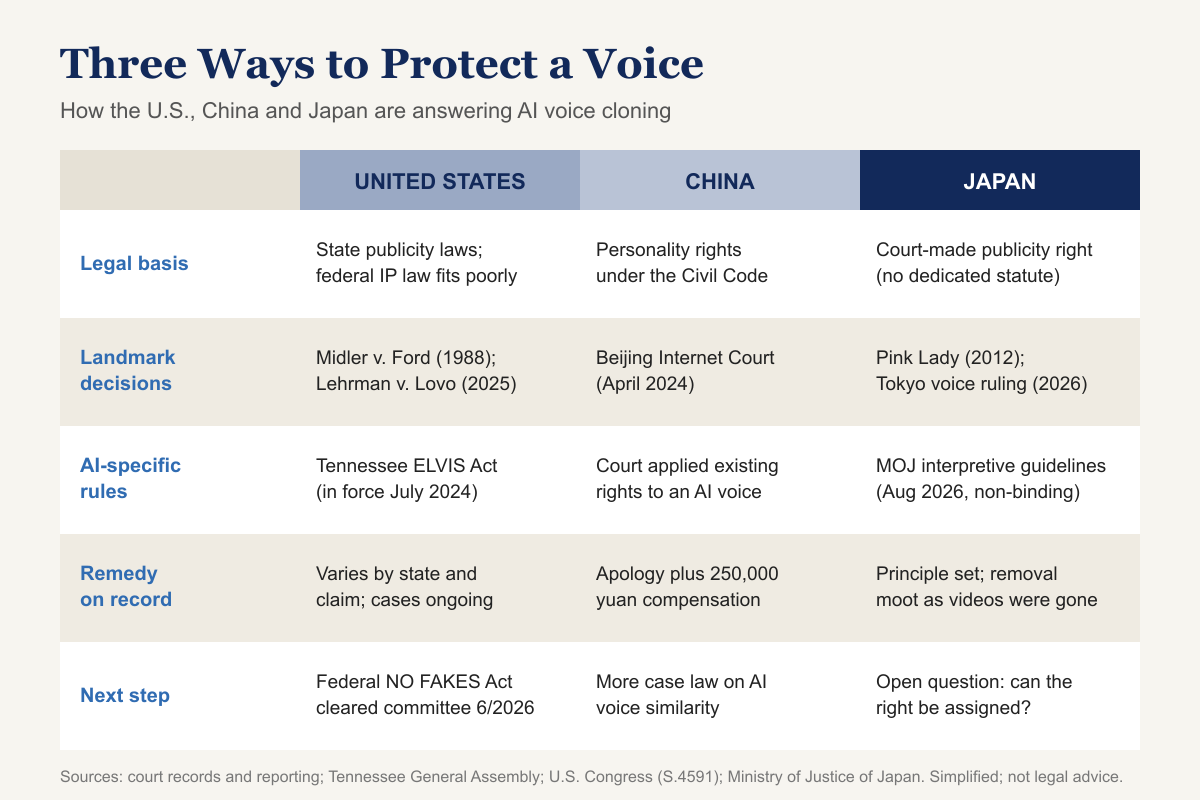
Japan is not alone in moving on this issue, and it is not first. What makes its position distinctive is the route it took.
The United States has the longest history. In 1988, in Midler v. Ford Motor Co., a federal appeals court held that deliberately imitating a famous singer’s distinctive voice to sell a product could be actionable, after Ford’s advertising agency hired a backup singer to sound like Bette Midler when Midler herself declined. But American publicity rights are state law, and they vary widely.
Tennessee moved first on AI specifically. Its ELVIS Act — the Ensuring Likeness, Voice, and Image Security Act — was signed on 21 March 2024 and took effect on 1 July 2024, adding voice explicitly to the state’s protections and targeting AI-generated imitation. In May 2024, OpenAI paused one of the voices in ChatGPT after the actor Scarlett Johansson objected that it sounded strikingly like hers, a dispute that played out in public rather than in court. In July 2025, in Lehrman v. Lovo, a federal court in Manhattan dismissed two voice actors’ federal trademark claims and most of their copyright claims against an AI voice company, but allowed claims under New York’s right of publicity statute and consumer protection law to proceed. The pattern is consistent: federal intellectual property law struggles with voice clones, while state publicity law does the work.
A federal fix is still pending. The NO FAKES Act of 2026, which would create a federal right to control digital replicas of a person’s voice and visual likeness, was advanced unanimously by the Senate Judiciary Committee on 18 June 2026. As of this writing, neither chamber of Congress has passed it.
China moved by court ruling. In April 2024, the Beijing Internet Court decided what it described as the country’s first case on AI-generated voice and personality rights. A voice performer’s recordings had been used to build an AI voice product that was then sold commercially. The court held that a voice identifiable by its characteristics is protected under personality rights, that the protection extends to an AI-generated voice that the public would associate with the person, and ordered compensation of 250,000 yuan.
Japan, by contrast, built its answer in layers: an old Supreme Court framework, a non-binding but detailed government guideline, and a lower-court ruling that applied the framework to voice. There is no new statute and no damages award. That makes the Japanese position less dramatic than China’s and less fragmented than America’s — and, for businesses, arguably more predictable, because the test was published before the ruling and the ruling followed the test.
Why a Voice Is Worth More in Japan Than Almost Anywhere
To understand why this ruling matters commercially, you have to understand the economic position of the voice in Japanese entertainment.
According to the Association of Japanese Animations, Japan’s anime industry reached a record 3.84 trillion yen in market value in 2024, about $25 billion. For the second year running, more of that money came from outside Japan than from inside it: about 2.17 trillion yen overseas against about 1.67 trillion yen domestically. Anime is one of the country’s most successful cultural exports, and the voice cast is a core part of the product, not an interchangeable component.
In much of the Western animation business, voice actors are well paid but largely invisible to the general public, with the exception of celebrity casting. In Japan, seiyuu are stars in their own right. They headline live events, release music, host radio programmes, appear in commercials and attract fan communities that follow them across roles. When a major voice actor is cast in a new series, it is news. When one leaves a long-running role, it is bigger news.
This is the “customer-attracting power” the Pink Lady test is looking for, and it is unusually concentrated in voice. A Japanese fan can often identify a leading seiyuu from a single line of dialogue. That is exactly why a cloned voice is so commercially useful to a faceless account — and exactly why the law now treats its unauthorised use as exploitation.
The same dynamic extends far beyond anime. Japanese television advertising, train-station announcements, game characters, navigation systems, theme-park attractions and corporate explainer videos all lean heavily on professional voice talent. Brands entering Japan often underestimate how much of their local identity will be carried by a voice, and how strongly audiences react when that voice feels wrong, cheap or borrowed.
There is a strategic risk here for global companies that have standardised on AI voice for localisation. A synthetic Japanese narrator that sounds neutral to a team in London or San Francisco may sound, to a Japanese ear, very much like a specific, famous person. Nobody on the global team will hear it. Your Japanese customers will.
The Consent Economy: Japan Is Building a Licensed Market for Voices
The most interesting part of Japan’s response is not the prohibition. It is the attempt to build a legitimate market alongside it.
The J-VOX-PRO initiative announced in November 2025 by the Japan Actors Union, ITOCHU and ITOCHU Techno-Solutions is designed as a voice database for professional performers. The partners said they aimed to collect voice data from thousands of performers, store it securely, and make it available to companies that pay set fees and use the data only for agreed purposes, with fees and conditions determined after consultation with the performer or their agency. The system was described as including matching functions between performers and potential users, along with digital watermarking and voiceprint recognition to detect unauthorised use. The announced use cases were deliberately unglamorous: education, healthcare and tourism.
That design tells you how the Japanese industry wants this to work. Performers are not trying to stop synthetic voice. They are trying to make sure that synthetic voice is licensed, traceable and paid for, with the performer’s agency in the loop. The model resembles Japan’s existing approach to character licensing, which is one of the most sophisticated and lucrative in the world: tight control over who can use a property, for what, and on what terms.
For international companies, this changes the decision. The question is no longer “can we use AI voice in Japan?” The answer to that is plainly yes. The question is “whose voice, licensed how?” There is now a growing set of legitimate answers: licensed databases, direct contracts with performers and their agencies, and synthetic voices built from consenting talent with clear documentation. The illegitimate answer — a soundalike of someone famous generated from an unknown model — has become measurably riskier in both legal and reputational terms.
There is a cost argument too. Licensed synthetic voice will cost more than an anonymous clone. It will almost certainly cost less than a takedown campaign, a recall of advertising assets, a lawsuit, or a social-media backlash led by a performer with hundreds of thousands of loyal fans.
What This Means If You Sell in Japan: Seven Rules for Synthetic Voices
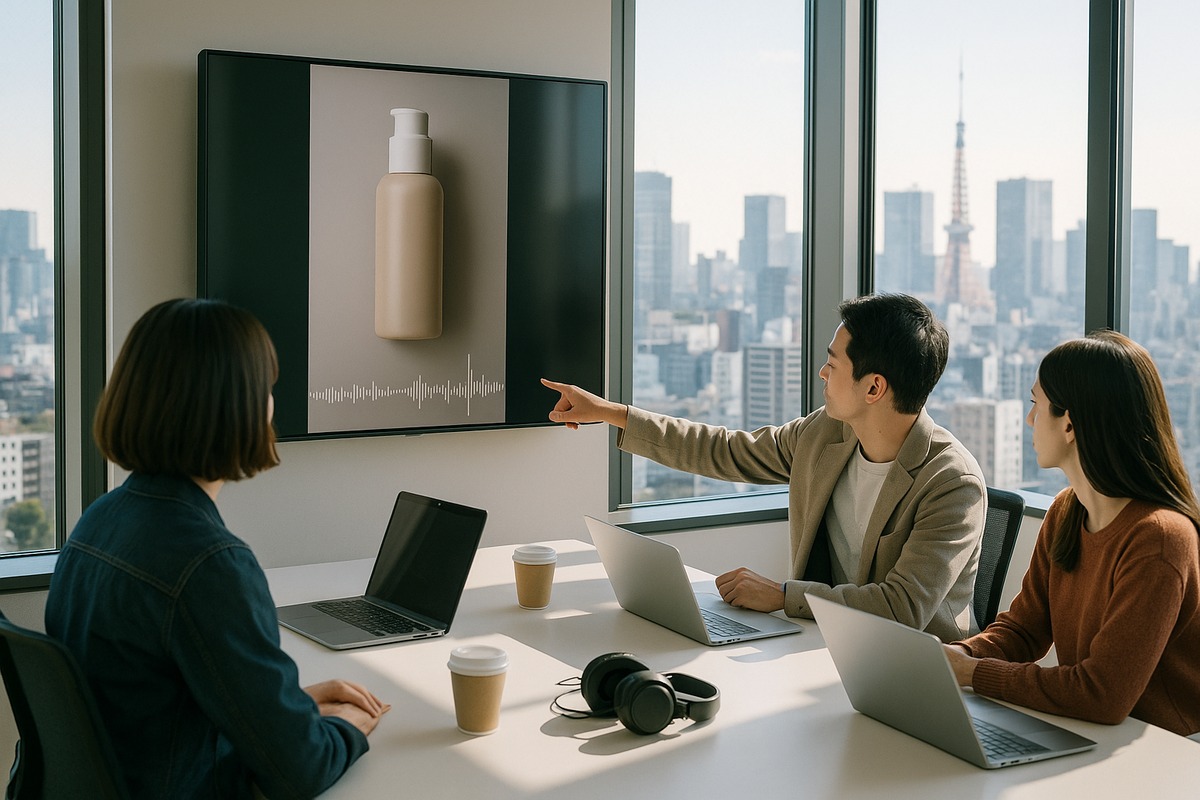
None of the following is legal advice, and any business with real exposure should talk to Japanese counsel. But these are the operating rules I would put in front of any brand, agency or platform using synthetic voice in Japan from this quarter.
1. Audit what you already have. Collect every Japanese-language synthetic voice currently live in your advertising, apps, games, customer service lines and social channels. For each one, record the provider, the model, the source of training audio and the contract terms. If you cannot answer those questions, that asset is a risk.
2. Test for resemblance with Japanese ears. Do not rely on global teams or automated similarity tools. Play each voice to a panel of native Japanese speakers who consume anime, games and television, and ask a simple question: does this sound like anyone? If the answer is a name, change the voice.
3. Never prompt for a person. Ban internal briefs and prompts that reference a real performer — “make it sound like” or “in the style of” a named voice actor. Under the Ministry of Justice guidelines, the route to a soundalike does not save you if the output exploits a famous person’s draw. A documented policy against prompting for real people is also the best evidence that a resemblance was accidental.
4. Keep a consent chain for every voice. For any synthetic voice built on a real human, keep written evidence that the person agreed to synthetic use, for which purposes, in which markets and for how long. Japanese talent agencies are used to precise usage terms; expect them to apply the same discipline to AI.
5. Use licensed sources where you can. Licensed databases and direct performer agreements cost more, but they create a clean record. In a market where the Japan Actors Union is building the infrastructure for licensed voice, using it is also a visible signal of good faith.
6. Treat platforms as part of the risk. If you run a platform or marketplace that lets users generate or upload voice content, the Tsuda case shows that performers will bring removal claims to you. Build a fast, documented takedown process for Japanese voice complaints, and avoid any feature or marketing that invites users to imitate named individuals — the Ministry of Justice report points to exactly that as a route to joint liability.
7. Label synthetic voices clearly. Japanese law does not yet impose a general disclosure duty for AI voices in advertising. Disclose anyway. A short, visible note that a voice is AI-generated and licensed from a consenting performer costs almost nothing and removes much of the suspicion that fuels online backlash.
These rules are not exotic. Most of them are what a well-run global brand already does with photography, music and celebrity endorsements in Japan. The change is that voice now belongs on the same checklist.
Frequently Asked Questions
Q. Did Kenjiro Tsuda win his lawsuit against TikTok?
A. No. The Tokyo District Court dismissed his demand on 30 September 2026 because the account and videos he wanted removed had already been deleted during the proceedings, so there was nothing left to order removed. However, in the same judgment, the court recognised that a voice can be protected by the right of publicity, the first such ruling in Japan. That principle is why the case is regarded as a landmark despite the dismissal.
Q. Is it illegal to use an AI voice that sounds like a celebrity in Japan?
A. It can be. Under the reasoning of the ruling and the Ministry of Justice’s August 2026 guidelines, using a voice that is identifiable as a specific person, where that person’s voice has commercial pull and the use is mainly aimed at exploiting it, can infringe publicity rights — even if the AI was not trained on that person’s recordings. A generic synthetic voice that does not resemble any identifiable person falls outside this publicity-rights framework, although contract, copyright and other issues still need separate review. Specific cases need advice from Japanese counsel.
Q. Doesn’t Japan’s copyright law allow AI training on almost any material?
A. Article 30-4 of the Copyright Act broadly permits the use of works for information analysis, including AI training, where the purpose is not to enjoy the expressive content, with an exception where the use would unreasonably prejudice the copyright holder’s interests. But that provision governs copyright at the training stage. Publicity and personality rights govern how a person’s likeness or voice is used in outputs, and they are a separate body of law. Lawful training does not make a commercial soundalike lawful.
Q. How does Japan’s approach compare with the United States?
A. In the United States, voice protection relies mainly on state publicity laws, such as Tennessee’s ELVIS Act and New York’s right of publicity statute, while a federal NO FAKES Act was advanced by the Senate Judiciary Committee in June 2026 but has not passed either chamber. Japan has no dedicated statute; instead it applies a 2012 Supreme Court framework, now reinforced by detailed government guidelines and the September 2026 ruling. The result is a single national test rather than a state-by-state patchwork.
Q. Can companies license Japanese voice actors’ voices for AI legitimately?
A. Yes. The most direct route is a contract with the performer or their agency that specifies synthetic use, purpose, territory and duration. The Japan Actors Union, ITOCHU and ITOCHU Techno-Solutions have also announced a professional voice database, provisionally named J-VOX-PRO, designed to license performers’ voices for agreed purposes with set fees and protections such as watermarking.
Conclusion
The easy headline from Tokyo is that a famous voice actor lost his case against TikTok. That headline is accurate and almost entirely beside the point.
What happened on 30 September is that Japan finished assembling a rule. A 2012 Supreme Court decision about a pop duo’s photographs supplied the framework. A 2024 campaign by twenty-six voice actors supplied the public pressure. A 2025 licensing initiative supplied the commercial alternative. A 143-page government guideline in August 2026 supplied the detailed analysis. And a district court ruling fifty-four days later confirmed, in a real case against a real platform, that a voice with commercial pull can be protected the way a face is.
For international operators, the lesson is not that Japan has turned against AI. It has not. It remains one of the most permissive major markets in the world for training models. The lesson is that Japan has drawn a sharp line between building with AI and borrowing someone’s identity through it — and that the line runs straight through the voices in your advertising, your apps and your localised content.
Companies that treat Japanese voices the way they already treat Japanese faces, characters and music — licensed, documented and respected — will find this ruling barely changes their business. Companies that assumed a synthetic soundalike was free will find that, in Japan, it never really was.
—
If you’re interested in this topic, the Japanese market more broadly, or what KETCHUPs is working on, we’d love to hear from you — please reach out via our contact form.
Japan Market Pulse is a weekly read on what the Japanese consumer-tech, food, and mobility markets are choosing to do, written for international operators who want to know what is happening before it shows up in the global trade press.
Subscribe at ketchups.co/japan-market-pulse.