

Disclosure: This article is published by KETCHUPs, a Tokyo-based trading and brand-development firm. We do not currently hold a wholesale agreement with Q-Lia, Sanrio, Sunstar Stationery, or any other manufacturer named below; everything in this piece is editorial. Some product links may be affiliate links.
A ¥500 sheet of puffy stickers from a small Osaka stationery company has, in eighteen months, sold over fifteen million units, drawn lottery-only crowds at Kiddyland, generated a counterfeit market on Mercari, and turned 35-year-old women into the most ferocious collector demographic in Japan’s stationery channel. The product is called Bonbon Drop Seal. Here is what is actually happening, and why it matters to anyone who imports, distributes, or curates Japanese consumer goods abroad.
Japan Market Pulse — Issue 012 | Consumer Trends Watch
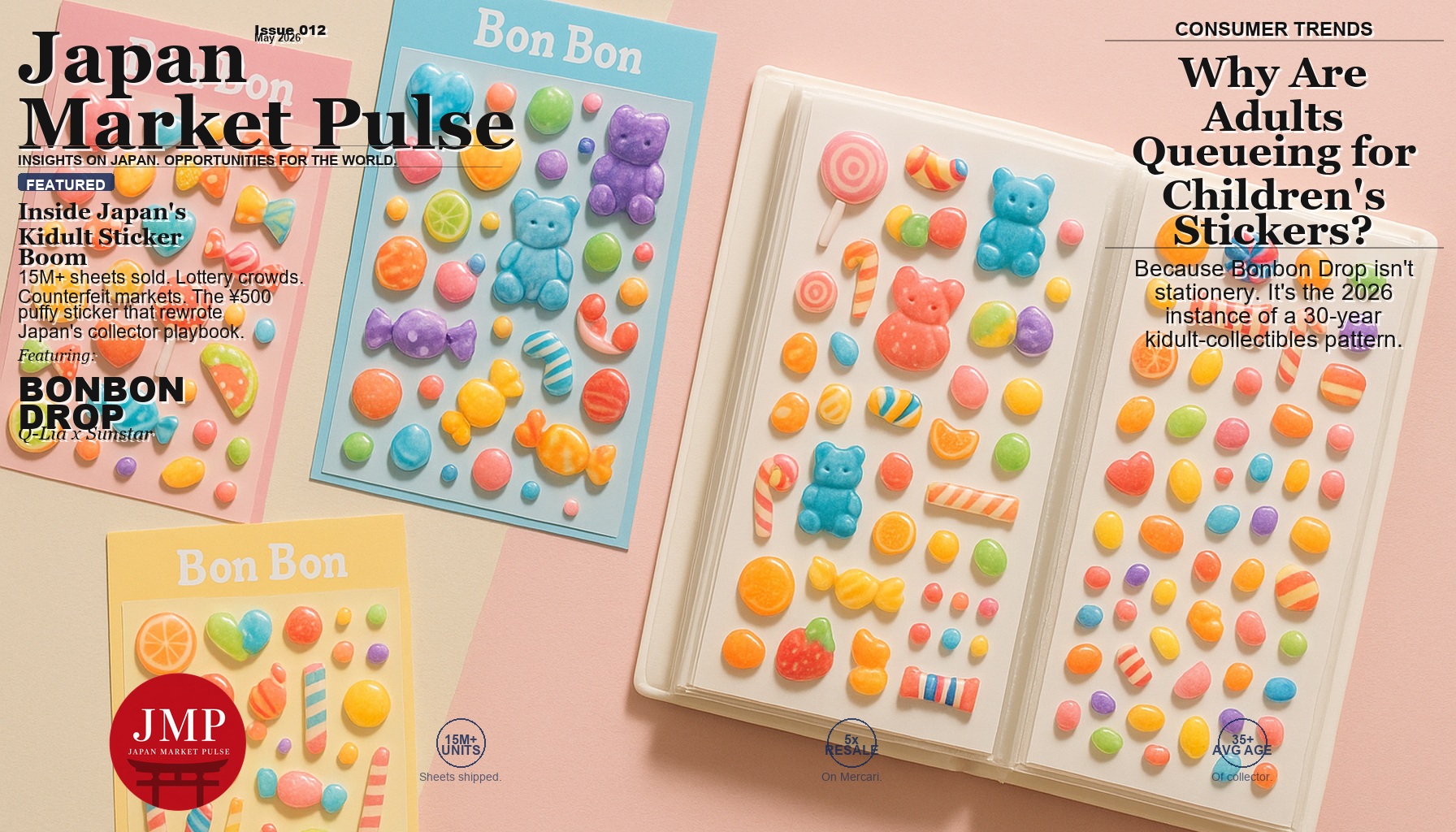
There is a particular kind of Japanese consumer story that the international press tends to handle badly. It is the story of an object that is — on the face of it — for children, that has somehow become an obsession for adults, and that makes complete economic sense in Japan and looks bewildering everywhere else. Tamagotchi was that story in 1996. Pokémon Cards were that story in 1999, again in 2021, and arguably are that story still. Sonny Angel mini-figures were that story in 2023. Capsule-toy gachapon, in their adult-targeted form, have been that story for most of the last decade. The pattern is so consistent that it has begun, in the Japanese consumer-research literature, to acquire a name — kidult — and a measurable market footprint.
In spring 2026, the story is Bonbon Drop Seal — a line of three-dimensional, glossy, candy-like puffy stickers manufactured in Osaka, originally pitched at primary-school girls aged 5 to 12, that has become the most explosive adult-female-collector phenomenon in Japanese stationery in twenty years.
What a Bonbon Drop Actually Is
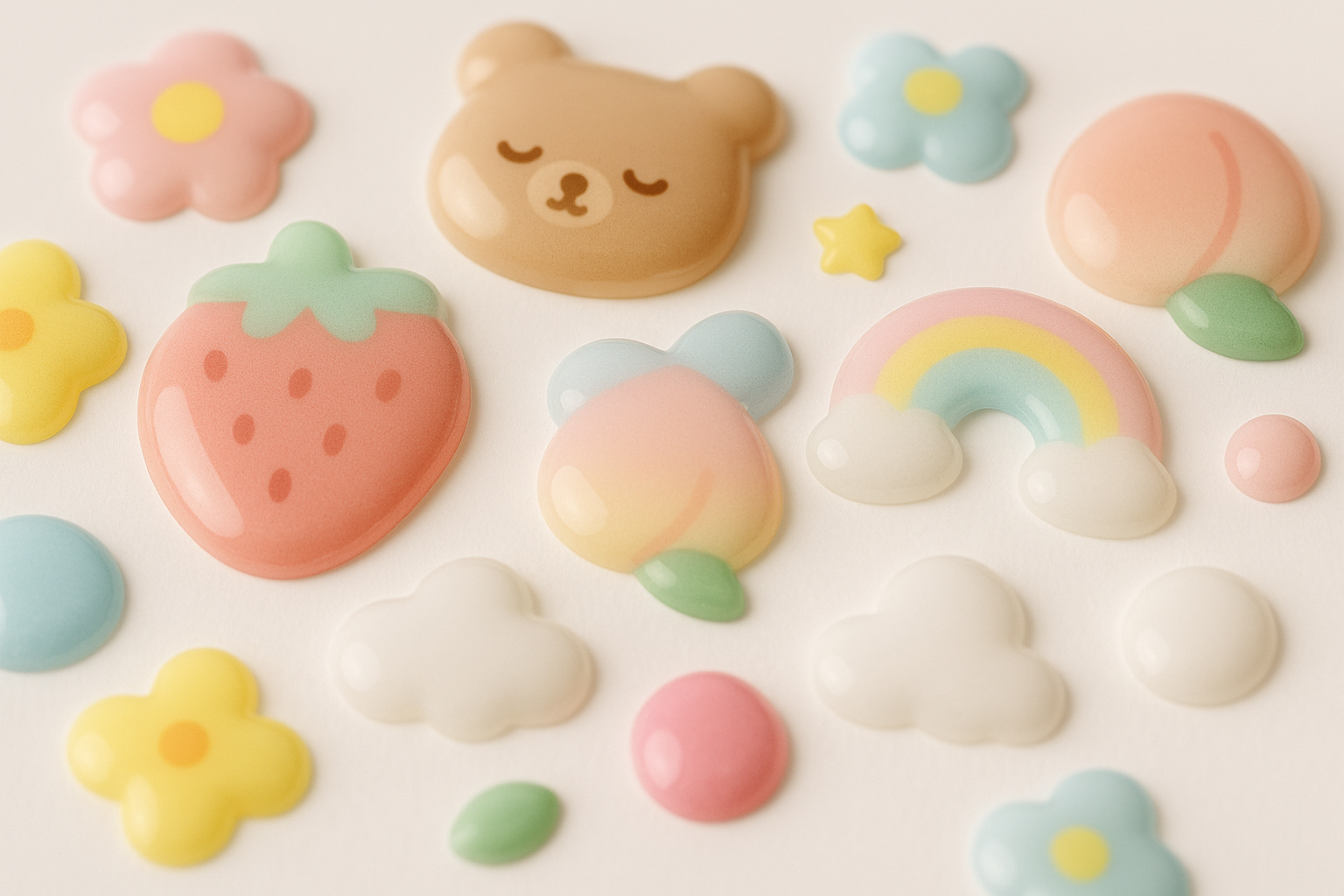
Bonbon Drop Seal is a product of Q-Lia , a small Osaka kawaii-stationery house founded in 1985 and known, prior to 2024, for diary covers and mid-shelf fancy notebooks. The product was designed by Q-Lia’s in-house designer Nao Yamazaki and is produced in partnership with Sunstar Stationery, the long-established Japanese stationery group.
The physical object is the point. A Bonbon Drop sticker is not a flat decal. It is a thick, domed, transparent PVC droplet — typically 8 to 15 millimeters across — with the printed character or motif sealed underneath a glossy resin shell. To the eye it looks like a piece of artisan candy. To the finger it has a distinct, slightly springy resistance — the “” (puku-puku) sensation that gives the entire product category its Japanese name. A single sheet contains 15–25 drops and retails at ¥500 (about USD $3.30) tax included. The January 2026 Sanrio collaboration mini-line retails at ¥550 (USD $3.65). A dedicated transparent collector binder retails at ¥990 (USD $6.60).
As of February 2026, more than fifteen million sheets have shipped, with Q-Lia scaling production capacity by an estimated factor of three hundred since late 2024. Loft and Hands have suspended in-store sales at various branches because the lines were impossible to manage. Don Quijote has implemented per-customer purchase limits. Kiddyland Shinjuku switched the January Sanrio-collaboration release to a lottery-only model. Mercari resale prices run three to five times retail, and the official @bonbon_drop X account issues counterfeit warnings on a near-monthly basis.
The Heisei Girl Phenomenon
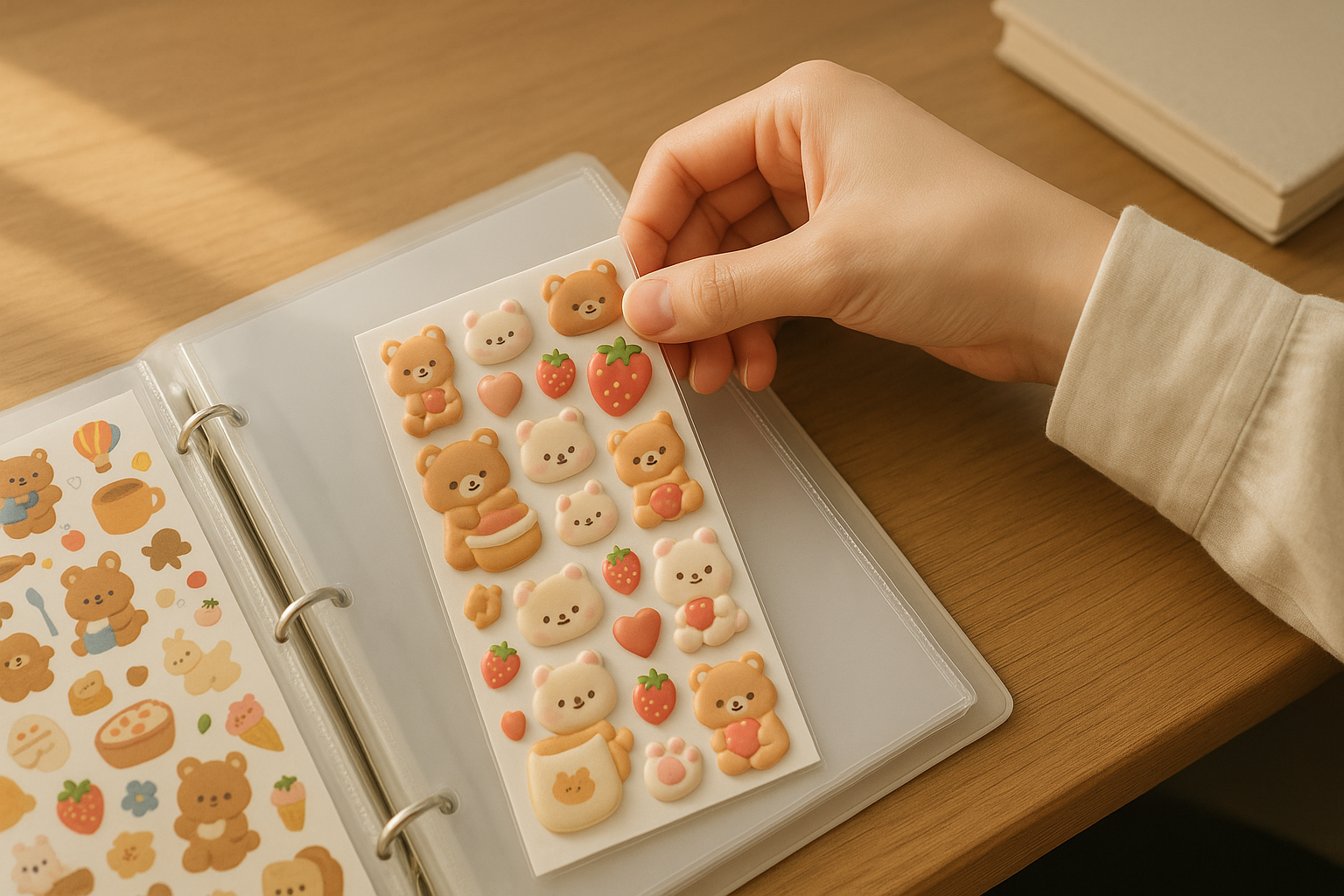
The headline answer — confirmed by reporting in Japan Today, Nikkei Asia, The Japan Times, and Toyo Keizai Online — is that the dominant Bonbon Drop demographic is women in their late twenties through late thirties. The Japanese term for the cohort is Heisei joji — “Heisei girls,” meaning the millennial sub-cohort whose elementary-school years fell between roughly 1995 and 2010. The phrase was selected as one of the thirty buzzwords that defined Japan in 2025 by Gendai Yougo no Kiso Chishiki.
“What started as mothers buying stickers for their daughters quickly evolved into mothers buying for themselves. The phenomenon of parent-child sticker activities — has become one of the genuine drivers of the boom.”
A Japanese woman who is now 33 was, in 2003, an eight-year-old fourth-grader. In 2003, sticker-trading was the dominant social-currency play in Japanese elementary-school girl culture. Stickers from Sanrio, San-X, Camio, and Crux circulated through hand-to-hand exchanges, stored in dedicated transparent-pocket sticker albums, and functioned as a micro-economy. That mechanic disappeared between roughly 2010 and 2022, displaced by smartphone-mediated social play. Bonbon Drop has brought it back — and the people most viscerally responsive to the return are not the present-day eight-year-olds but the women who were eight years old in the Heisei era.
A 2026 Nifty Kids survey found that 70.2% of 2,484 respondents reported actively collecting stickers. Japan’s adult-buyer-of-children’s-products population is now estimated at 5.35 million people, with average annual spend of ¥14,574 (USD $96), totaling roughly a ¥78 billion (USD $520 million) market. 48.6% of those kidult buyers report nostalgia as their primary purchase driver.
Mother-and-Daughter Sticker Activity
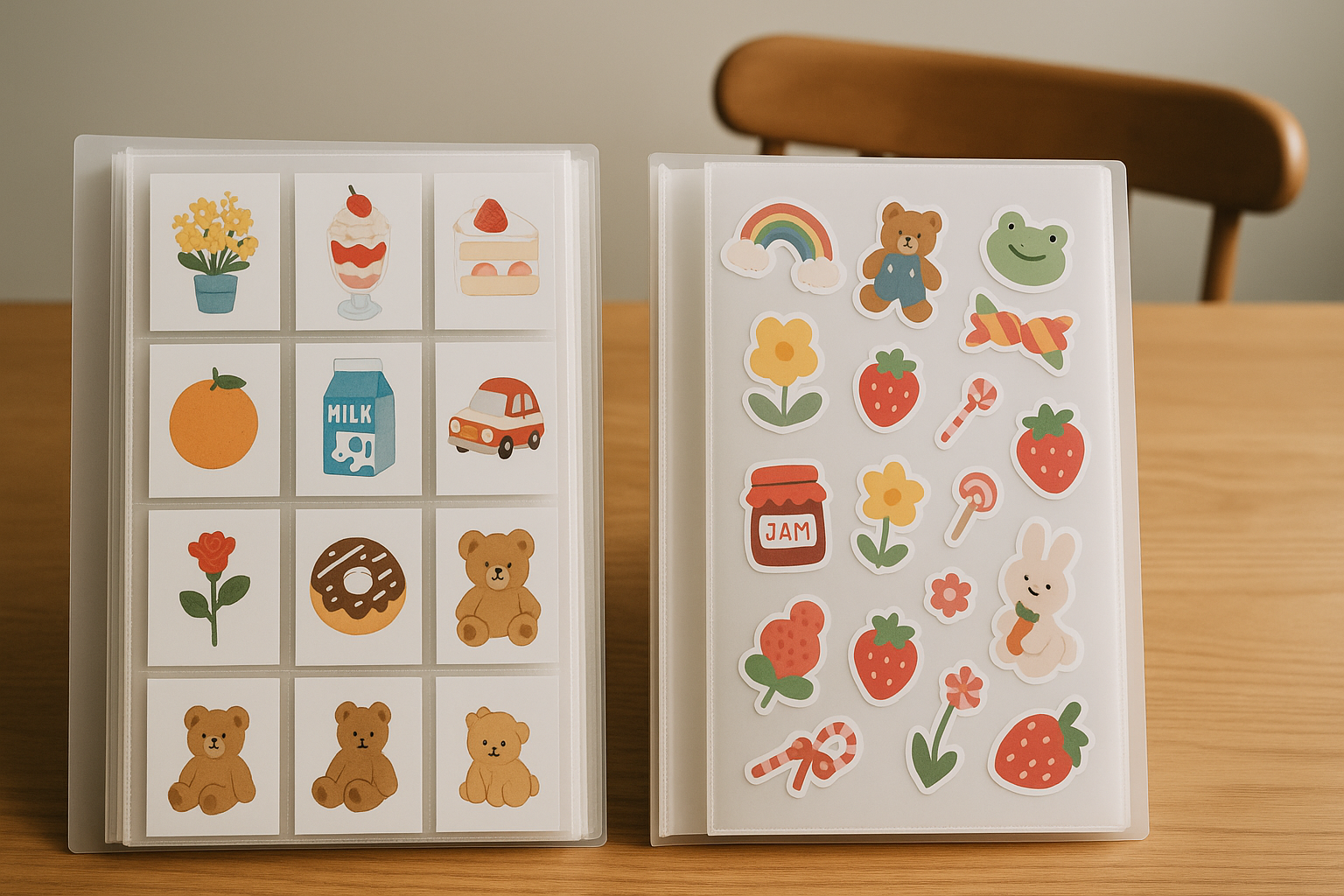
The intergenerational mechanic is what distinguishes Bonbon Drop from a pure nostalgia play and is what makes the boom culturally durable rather than a six-month spike.
A typical Bonbon Drop household, as documented in TV coverage by Kantele News, Mezamashi Media, and TOS Online, looks like this: a mother in her early thirties, who collected stickers herself in 2002, takes her seven-year-old daughter to Loft on a Saturday, waits in line, buys two sheets each — one for the mother’s binder, one for the daughter’s — then sits at the kitchen table arranging them into transparent-pocket albums. The result is photographed and posted to TikTok or Instagram with hashtags like # (“housewife’s sticker album”) or # (“Heisei girl”), the latter of which has accumulated tens of millions of views across Japanese-language TikTok in the eighteen months to spring 2026.
What is genuinely new is the three-axis overlap of (1) collection — the variety, the rarity, the trading; (2) tactile object — the puku-puku 3D resin, the binder, the kitchen-table session; and (3) nostalgia — the Heisei retro through-line. Western collectibles markets tend to weight axis 1 hard and axes 2 and 3 lightly. The Japanese adult-sticker market in 2026 weights all three roughly equally.
The Channel Map
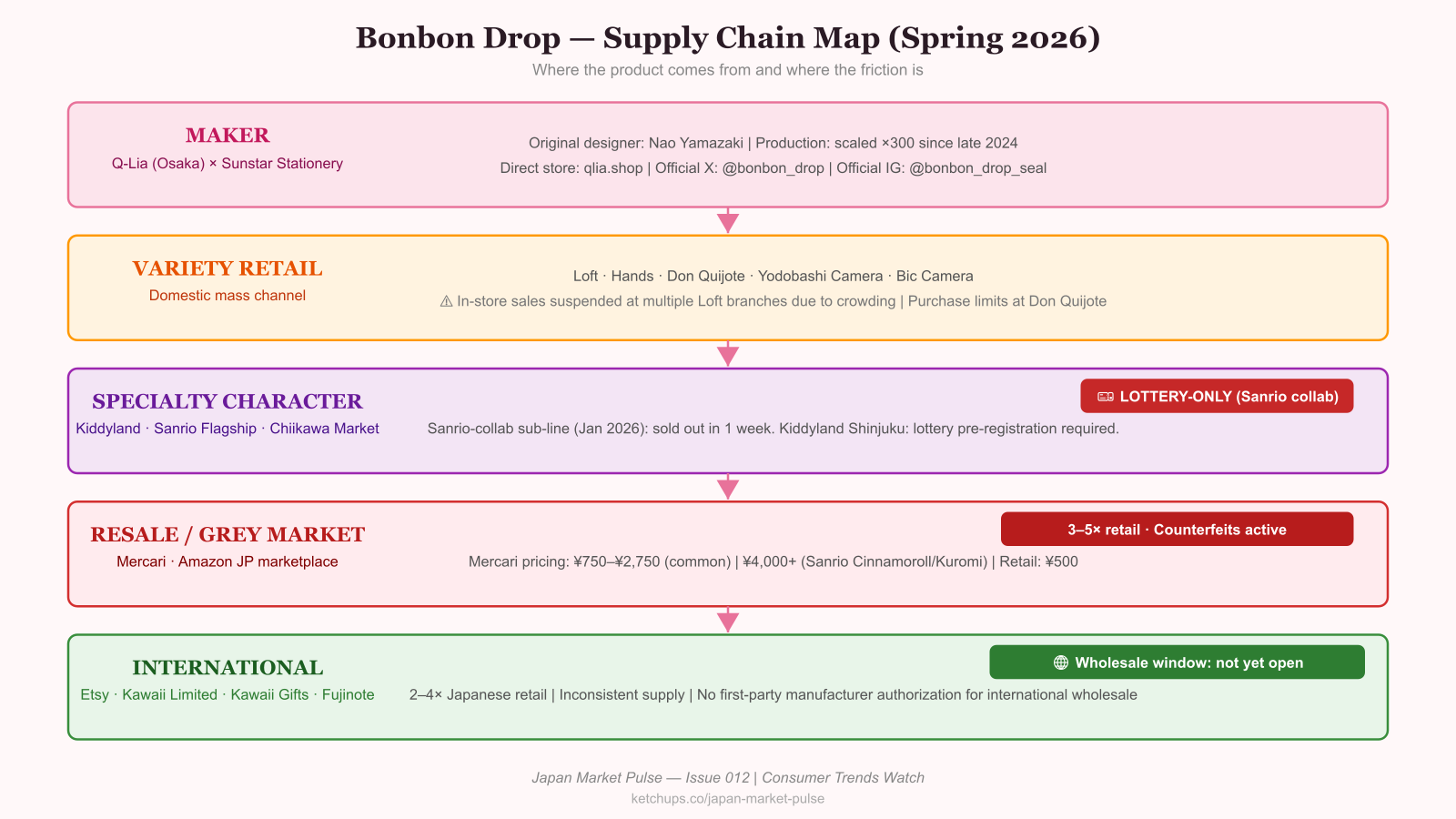
Primary maker channel. Q-Lia operates a direct online store at qlia.shop and runs the official Bonbon Drop Instagram and X accounts. These are the canonical sources. Production is by Sunstar Stationery, with the Q-Lia distribution partnership.
Domestic Japanese variety-retail channel. The product reaches the consumer through Loft, Hands, Don Quijote, Kiddyland, Yodobashi Camera, Bic Camera, and the long tail of Japanese stationery and variety shops. Some Loft branches expanded their sticker section from two retail bays to nine, with Bonbon Drop the dominant SKU, before subsequently restricting in-store sales due to crowding.
International channel. Bonbon Drop is not, in spring 2026, in any meaningful native distribution outside Japan. Etsy, Kawaii Limited, Kawaii Gifts, Kawaii Depot, Fujinote, and a long tail of small Japan-import shops carry the product, often at 2x to 4x Japanese retail, with inconsistent supply. There is no fully cleared, volume-priced international wholesale channel. This is a real and quantifiable opportunity.
The Other Players — Crux, Camio, Sanrio Direct
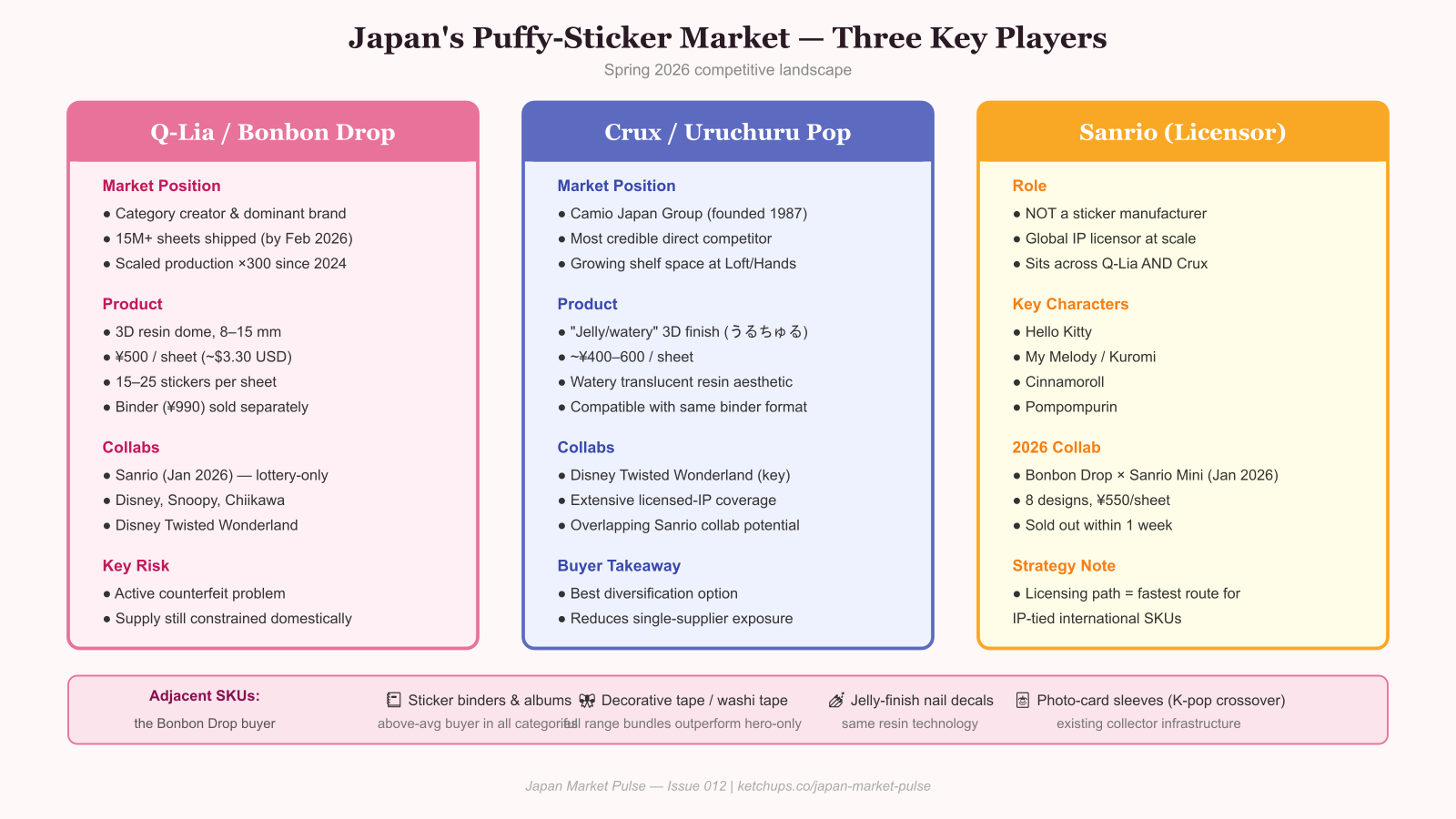
The broader puffy-sticker category is bigger than the single Q-Lia line. The two adjacent suppliers that matter are Crux and Camio Japan . Crux is best known for the Uruchuru Pop Seal (POP SEAL) line — a watery, jelly-like 3D sticker concept that competes head-on with Bonbon Drop on tactile feel and visual appeal, with extensive Disney Twisted Wonderland and other licensed-IP collaboration coverage.
Sanrio, the global IP house, is not itself a sticker manufacturer at this scale. Sanrio’s role is as a licensor: the Bonbon Drop × Sanrio Mini collaboration of January 2026 is a Sanrio-licensed sub-line produced under the Q-Lia / Sunstar partnership. For the wholesale buyer, the practical takeaway is that the category is multi-supplier but brand-loyal at the consumer level.
What This Tells Operators
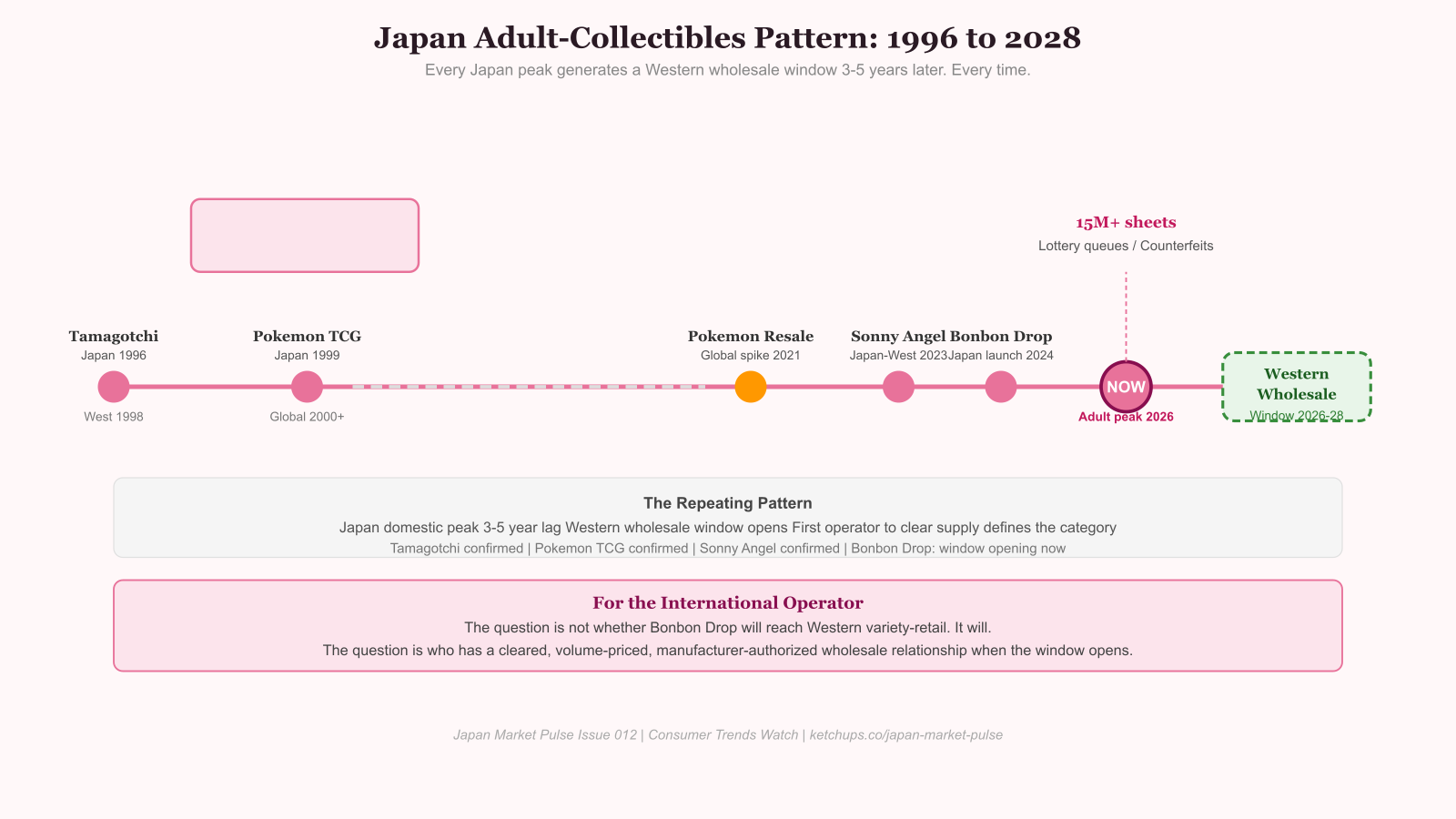
Japan’s consumer market has always been uncommonly receptive to adult-targeted nostalgia objects. The Tamagotchi-revivals, the Pokémon-25th-anniversary spike, the Sonny Angel mini-figure boom — these are all instances of the same underlying mechanic, in which an object originally aimed at a younger audience returns, twenty to thirty years later, as an adult collectible with a coherent emotional narrative attached.
Bonbon Drop is the 2026 instance. The specific shape of it — stickers as a tactile, collectible, intergenerational object that adult women buy alongside their daughters — is novel. The underlying mechanic is not. And the underlying mechanic has, in every previous instance, eventually become globally exportable, usually three to five years after the Japanese domestic peak.
For the international wholesale operator, the implication is direct: the question is not whether Bonbon Drop and the broader Japanese adult-puffy-sticker category will move into Western variety-retail and stationery channels. The question is who is positioned to handle the supply. The first cleared, volume-priced, manufacturer-authorized wholesale relationship into a Western variety-shop chain — Urban Outfitters’ stationery section, Indigo’s Chapters trend wall, the European papeterie boutique cluster — will, on the strength of the precedent set by Sonny Angel and Smiski, do meaningful volume.
The Japanese maker side of the conversation is, at this writing, focused almost entirely on managing domestic shortage. That window will close. When it does, the operators who already have the licensing relationships will get the first call.
Practical Note for English-Speaking Buyers
If you are buying Bonbon Drop today as a small-volume reseller: the cleanest sources are the official Q-Lia online store (qlia.shop, ships internationally to a limited list of countries) and the small-batch Japan-import retailers (Kawaii Limited, Kawaii Gifts, Fujinote) which carry the product at 2x to 4x Japanese retail. Avoid Mercari and Amazon US marketplace listings unless you are prepared to authenticate against counterfeit risk.
If you are buying for genuine wholesale: Q-Lia direct, and the Sunstar Stationery partner contact, are the canonical entry points. International wholesale is not the manufacturer’s current operational priority — but the licensing-cleared path through Sanrio collaborations may, in some cases, be the fastest formal route for IP-tied SKUs.
If you’re interested in this topic, the Japanese market more broadly, or what KETCHUPs is working on, we’d love to hear from you — please reach out via our contact form.
Japan Market Pulse is a weekly read on what the Japanese consumer-tech, lifestyle, and adult-collectibles markets are choosing to do, written for international operators who want to know what is happening before it shows up in the global trade press.
Subscribe at ketchups.co/japan-market-pulse.
If you’re interested in this topic, the Japanese market more broadly, or what KETCHUPs is working on, we’d love to hear from you — please reach out via our contact form.
Japan Market Pulse is a weekly read on what the Japanese consumer-tech, food, and mobility markets are choosing to do, written for international operators who want to know what is happening before it shows up in the global trade press.
Subscribe at ketchups.co/japan-market-pulse.