

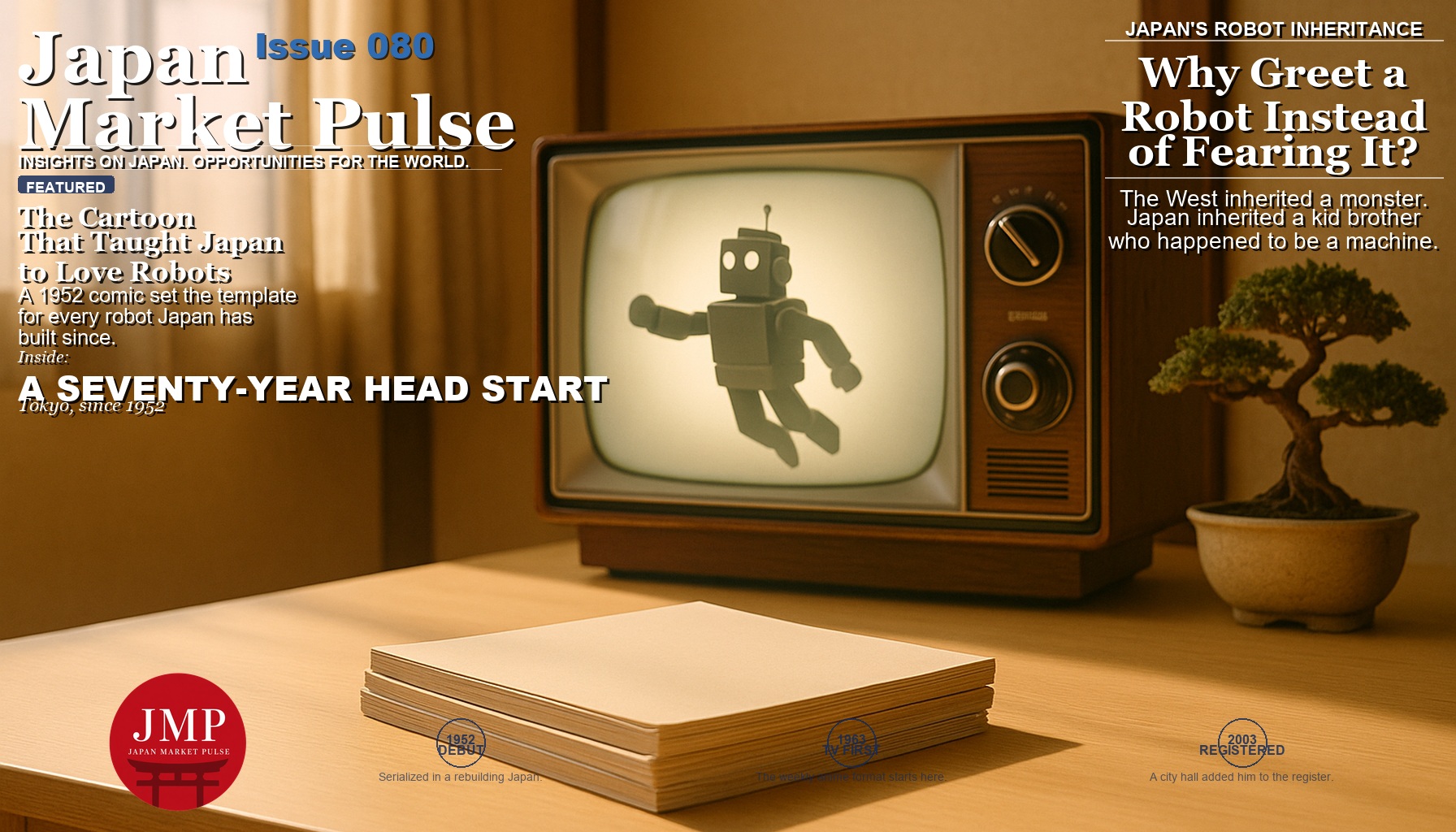
Ask an American engineer what a robot looks like and, somewhere in the back of their mind, there is a T-800 walking out of a fire. Ask a Japanese engineer the same question and there is a good chance a wide-eyed boy with a red rocket-boot flying pose shows up instead. That single difference in the mental picture — menace versus mascot — is not a coincidence of national temperament. It was, to an unusually literal degree, manufactured. One comic strip, drawn by a former medical student in the early 1950s, became one of the most important cultural forces shaping how an entire country feels about machines — arguably more so than any government white paper, engineering curriculum, or corporate marketing budget that came after it. Japan did not simply grow up more comfortable with robots than the West. It grew up on a specific robot, and that robot has been quietly running the show ever since — for better and, as this piece will get into, sometimes for worse.
The character is Tetsuwan Atomu, known internationally as Astro Boy, and if you have spent any time in Japan you have absorbed his influence without necessarily clocking the source. It is there in the way department store greeters bow to a Pepper robot instead of recoiling from it. It is there in the way a Roomba gets a pet name instead of a raised eyebrow. It is there, most tellingly, in the way Japanese robotics engineers talk about their own work — not as a defense against an uncertain future, but as an unfinished promise made to a child seven decades ago.
A Manga Born From a Ruined City

Osamu Tezuka began serializing the story in a boys’ magazine in the early 1950s, in a Japan that was, in very literal terms, rebuilding itself from rubble. Tezuka had trained as a physician before turning fully to comics, and that scientific bent shows up everywhere in the strip: robots with computerized brains, atomic power plants, a boy built by a grieving scientist to replace a dead son. The premise is darker than the cheerful character design suggests. Astro Boy is, at his origin, a substitute — a machine built to fill a human-shaped hole — and he is initially rejected by the very father figure who created him for not growing up, for staying a machine. It is only when a second scientist, the kindly and disheveled Professor Ochanomizu, takes him in and treats him as a person rather than a product that Astro Boy becomes the hero generations of readers fell in love with.
That origin story matters more than most retrospectives give it credit for, because it set the emotional template for every robot character Japan produced afterward: the robot as an orphaned, misunderstood, fundamentally good-hearted member of the family, not a servant and not a threat. Tezuka was writing for a country that had just watched technology do something almost unimaginably destructive, and instead of leaning into that trauma, he wrote a story about a machine that chooses to protect people anyway. It is hard to overstate how unusual that framing was for the era, and how deliberately optimistic it reads in hindsight. Japan’s most influential piece of robot fiction was not a cautionary tale. It was a reconciliation.
Prime-Time, Then Prime Time Everywhere
A decade after the manga began, the story made the jump to television, and this is the point where “influential comic” turns into “cultural infrastructure.” The 1963 broadcast is widely regarded as Japan’s first serialized, weekly, half-hour animated television series in the format that would come to define the entire anime industry — cost-cut, limited-animation techniques and all, developed largely because Tezuka’s studio needed a production method that could actually hit a weekly broadcast deadline on a shoestring budget. Those production shortcuts, born out of financial necessity, became the technical grammar of an entire medium.
Just as important for this story: the series was quickly picked up for broadcast in the United States under the Astro Boy title, making it one of the first Japanese animated properties American children grew up watching, often with no idea it had originated in Japan at all. A generation of Japanese children was raised with a friendly robot as a genuine evening-television fixture, appearing on toys, lunchboxes, and stationery with the same ubiquity an American kid of the same era might associate with a baseball star. A robot was not a novelty in Japanese households. He was, functionally, a neighbor.
The Day a City Hall Put a Cartoon Robot on the Resident Register
Tezuka gave his character a specific, fictional birth date: April 7, 2003. He likely never expected the calendar to actually reach that date within his own lifetime or the franchise’s cultural relevance — he died in 1989 — but when 2003 arrived, Japan treated the anniversary as something closer to a national event than a marketing tie-in. A new television series launched to coincide with the date. Commemorative displays went up in department stores. And in Niiza, the city outside Tokyo where Tezuka’s production studio is based, the municipal government did something few civic bureaucracies anywhere would consider doing for a fictional robot: it issued Astro Boy a special resident registration certificate, listing the studio’s real address as his home and naming Professor Ochanomizu, his fictional guardian, as head of household. It is a registry entry, not an immigration document — the point was symbolic municipal recognition, not legal status.
It is a small, almost whimsical bureaucratic gesture, and it is also one of the clearest pieces of evidence available for how thoroughly the character had been absorbed into Japan’s sense of itself. A government office did not do this as a joke aimed at children. It did it because treating Astro Boy as a quasi-citizen was, by 2003, a completely legible cultural statement — the kind of gesture that requires decades of prior buy-in to land as charming rather than absurd. A year later, the character was formally inducted into the Robot Hall of Fame, a hall that explicitly honors both real working machines and the fictional robots that inspired them — Astro Boy entered in the same class of fictional inductees as C-3PO and Robby the Robot. Astro Boy had, in every sense that mattered culturally, stopped being fiction and started being infrastructure.
When Engineers Started Building Toward a Cartoon
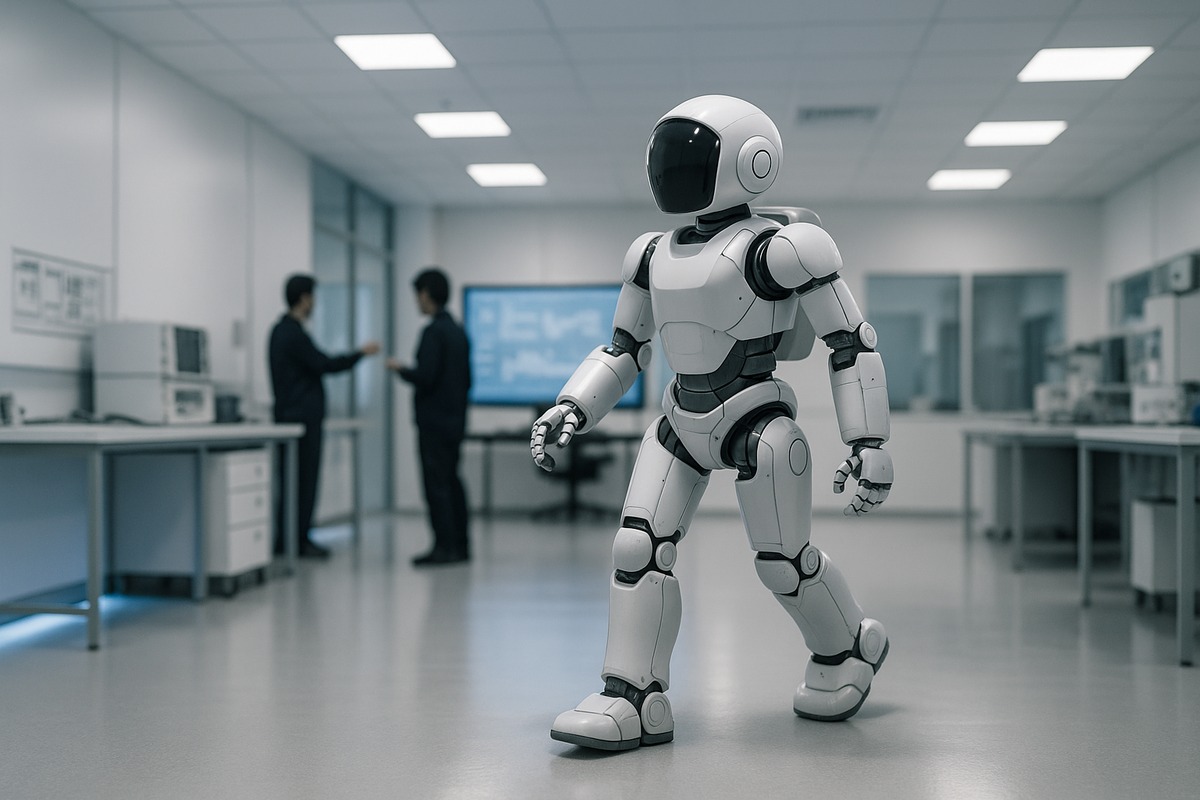
This is where the story stops being purely about nostalgia and starts being about industrial policy, because Japan’s robotics establishment did not just enjoy Astro Boy from a distance. It set out to build him.
Japanese researchers and engineers have referenced the character for decades as something closer to a design brief than a bedtime story. The most frequently repeated version of this comes from Honda’s humanoid robotics program, the project that eventually produced ASIMO — for years the most recognizable walking, human-shaped robot on Earth. According to accounts from people close to the program, the engineer who led the effort was told directly by his superiors, in essence, to go build Astro Boy: a friendly, human-scaled machine that could exist comfortably alongside people rather than behind safety cages in a factory. That instruction is not a metaphor cooked up after the fact for a press release. It reflects how literally Japan’s engineering culture treated the character as an actual technical target — a benchmark for what a robot should look like, move like, and mean to the person standing next to it.
The same reference point shows up again and again across Japan’s broader robotics push: government and industry narratives about friendly, human-centered machines tend to echo the character even when they do not name him, and domestic media frames new robot launches the same way. When Japanese officials and industry groups talk about the country’s ambitions in robotics — as a growth industry, as an answer to an aging and shrinking workforce, as a source of soft power — Astro Boy is never far from the pitch, explicitly or implicitly. It functions as shorthand for a very specific promise: robots that live with people, help people, and are loved by people, rather than robots that merely replace people. That promise has shaped public narratives around research funding and consumer expectations for what a “good” robot is supposed to feel like, decades after the character first appeared in print.
Why the West Got a Monster and Japan Got a Kid Brother
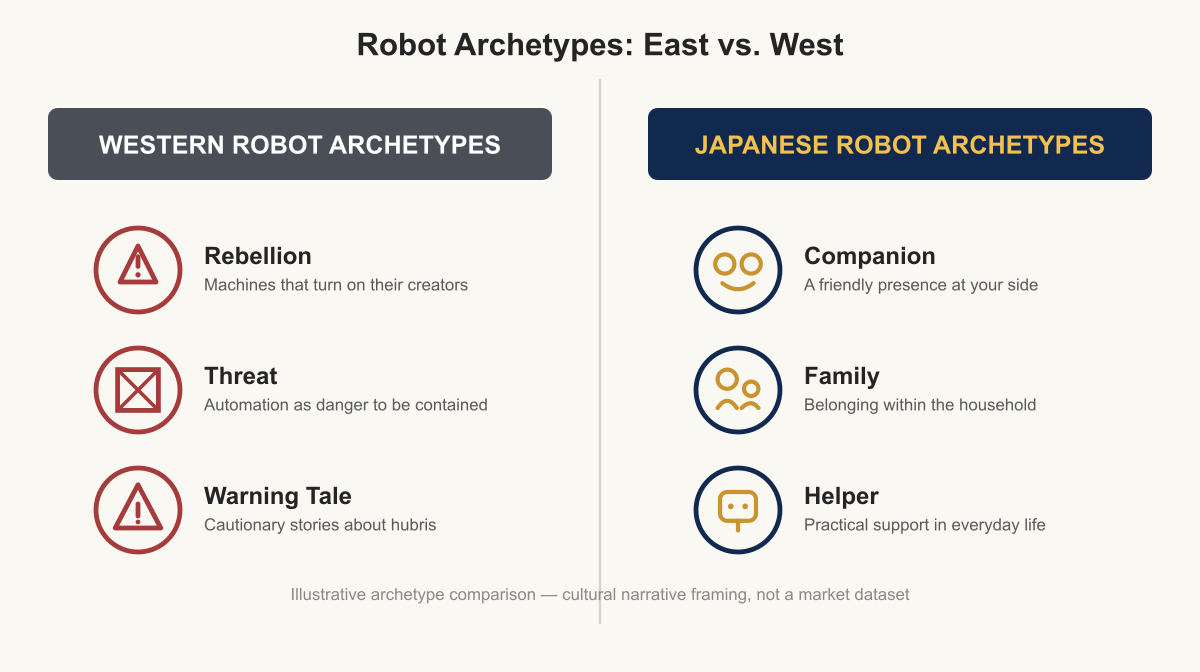
None of this makes sense without putting it next to what was happening on the other side of the Pacific at roughly the same time. One of the most powerful strands of twentieth-century Western science fiction built its robots around the idea of rebellion — the created thing turning on its creator. Isaac Asimov, writing in the same postwar decades as Tezuka, gave this anxiety a name that stuck: the Frankenstein complex, the deep-seated fear that anything we build in our own image will eventually resent us for it and come for us in the night. Asimov’s own Three Laws of Robotics were explicitly designed as a literary antidote to that fear, but the fear itself proved far more durable in Western pop culture than any fictional safeguard. It runs through a long line of artificial beings, from Frankenstein’s monster to HAL 9000 and eventually to a chrome skeleton hunting a woman named Sarah Connor through 1980s Los Angeles. The Western robot, across a century of storytelling, is very often a mirror held up to human hubris, and the moral of the story is almost always that we should not have built it.
Japan’s most famous roboticist-turned-philosopher, Masahiro Mori, gave the culture its own equally influential concept in 1970: the uncanny valley, the observation that a robot’s likability rises as it becomes more humanlike, right up until it becomes too humanlike, at which point likability collapses into revulsion. It is worth sitting with the fact that Mori’s insight and Astro Boy’s popularity are not contradictory — they are complementary halves of the same cultural instinct. Astro Boy is drawn recognizably as a machine, not a flawless human simulacrum: the spiky hair reads as a hairstyle and a design cue at once, the boots are visibly rocket boots, the humanity is emotional rather than skin-deep. He sits comfortably on the safe side of Mori’s valley, lovable specifically because he never pretends to be something he is not. Japan’s dominant cultural template for a good robot was never “a machine indistinguishable from a person.” It was “a machine that is honestly, openly a machine, and chooses to care about people anyway.” That is a much easier character to welcome into your living room than a monster built from spare human parts, and it is a much easier product category for a consumer electronics company to build a business around.
The Blessing’s Quieter Twin
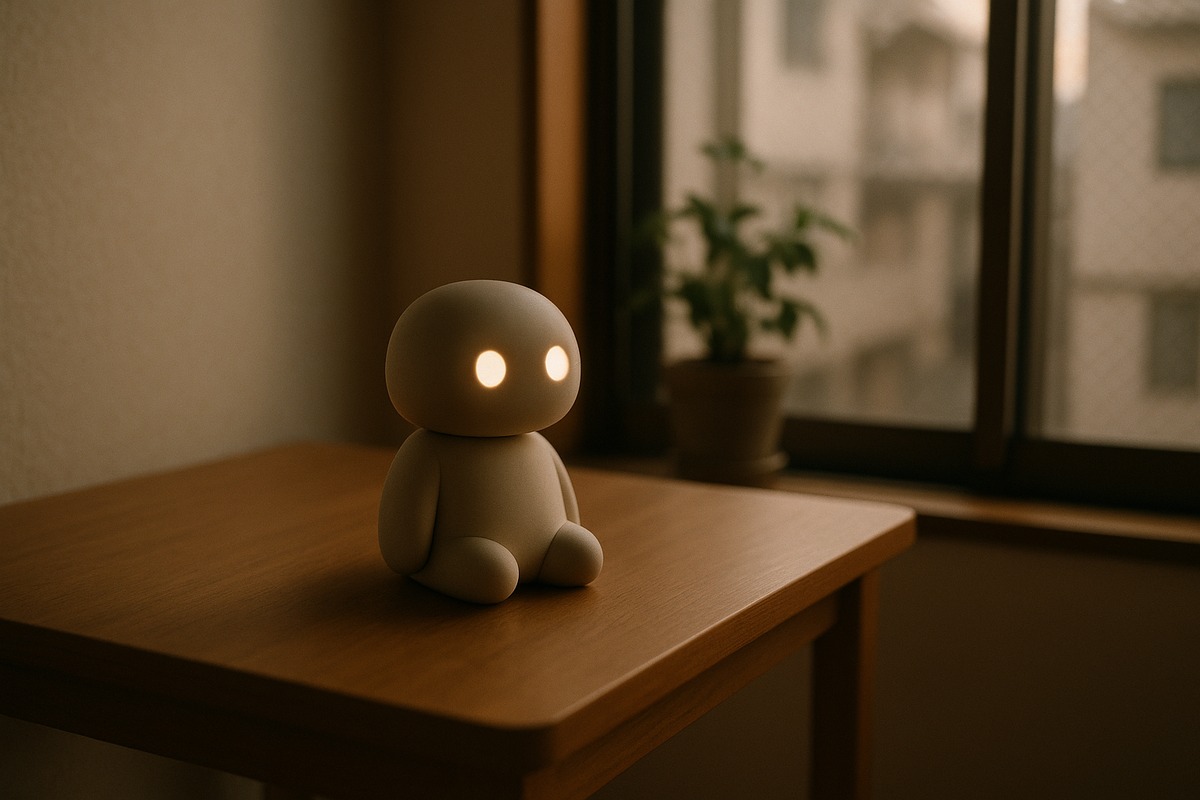
Here is the part of the story that tends to get left out of the retrospectives, and it is the part worth sitting with the longest. Astro Boy did not just make Japan comfortable with robots. He set a standard for what a robot should be able to do and feel, and that standard has been almost impossible for the actual robotics industry to live up to.
Astro Boy, in the fiction, has something close to genuine emotion, ethical reasoning, superhuman strength, flight, and a hundred thousand horsepower packed into the body of a child. Real robots, seventy years later, still struggle with reliably folding laundry. Every commercially available companion or service robot that has launched in Japan since — and there have been dozens, from conversational tabletop devices to therapeutic robotic seals used in eldercare facilities to household humanoids — has been measured, fairly or not, against a fictional seven-decades-old benchmark that promised something categorically more than any of them can deliver. Developers I have spoken with over the years, off the record more often than on it, describe a specific and recurring frustration: consumers arrive at a robot showroom with Astro Boy-shaped expectations and leave a little disappointed that the machine in front of them cannot hold a real conversation, cannot understand context, cannot love them back in any way that isn’t a carefully engineered illusion. The gap between the promise and the product is not a Japan-specific problem — every country’s robotics industry deals with a hype-versus-reality gap — but Japan is unusual in how emotionally specific and how old that gap is. It is not disappointment in a marketing claim from last year’s product launch. It is disappointment against a cultural icon from before most of the engineers building today’s robots were born.
There is a real cost to this. Japanese robotics companies have, at times, been pushed toward promising more warmth, more personality, and more companionship than the underlying technology can honestly support, because the market’s baseline expectation was set by a boy who could fly and feel heartbreak. Government-backed robotics initiatives aimed at eldercare and labor-shortage solutions have occasionally run into a similar wall: the practical, useful robot — a mechanical lifting aid, a monitoring sensor, a simple conversational companion for isolated seniors — can feel like a letdown next to the idea of Astro Boy that several generations of Japanese consumers were raised on. The curse and the blessing are, quite literally, the same cultural inheritance. The warmth that makes Japanese consumers willing to welcome an imperfect robot into a nursing home or a hotel lobby is inseparable from the impossibly high bar that same warmth quietly sets for every robot that follows.
What This Looks Like From the Ground
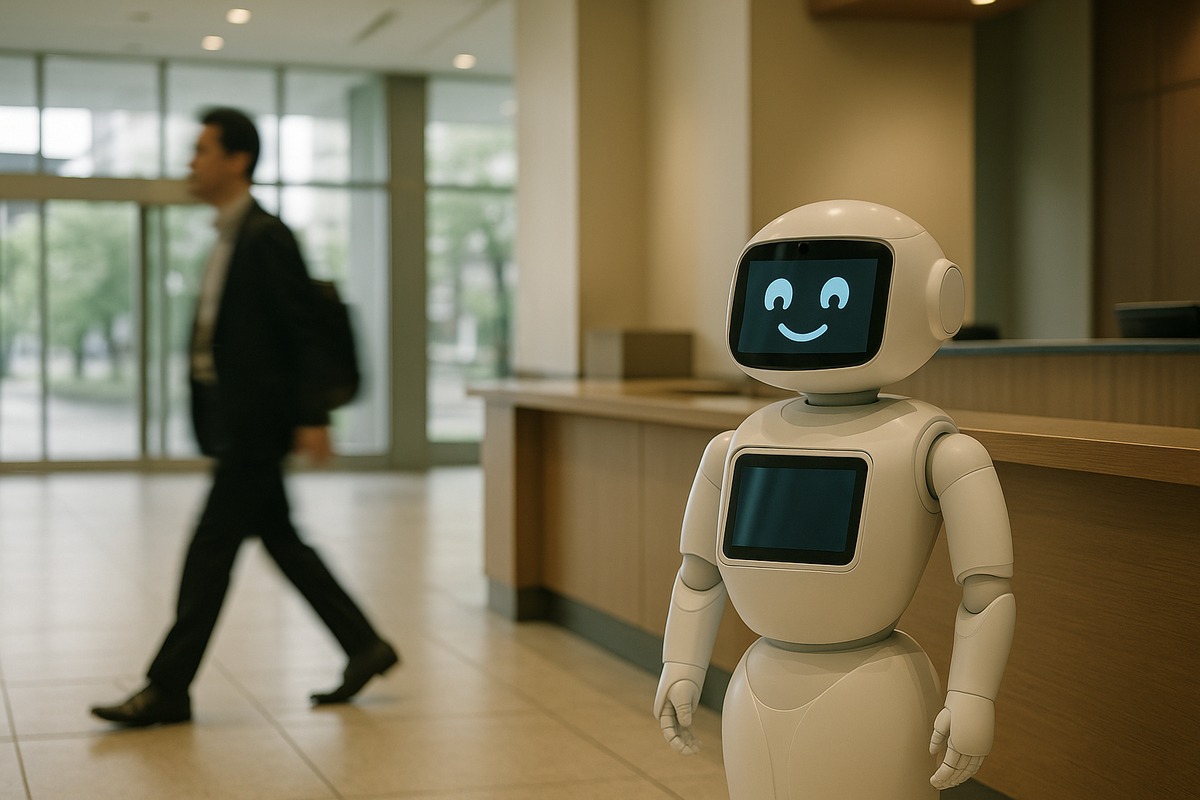
I have lived in Japan for two decades now, long enough that I stopped noticing how strange it is to watch small children wave at a guide robot in a train station the way an American kid might wave at a mascot at a ballgame. It only strikes me again when I describe it to friends back home. I mentioned once, in an email to a friend in the Midwest, that a hotel I was staying at had a robot at the front desk that checked me in, and the reply I got back was some version of “doesn’t that freak you out?” It genuinely had not occurred to me that it should. That gap in reaction is, I think, the most honest evidence there is for everything above. It is not that Japanese consumers are more technologically advanced or more credulous than American ones. It is that they were handed a different founding story about what a robot is for, decades before either of us was born, and that story is still doing quiet work in how a robot gets received at street level — in a showroom, in a lobby, in a nursing home hallway — long after most people have forgotten where the feeling came from.
For anyone building or selling technology into this market, that inherited comfort is a genuine commercial asset, and it is worth understanding precisely, rather than treating it as a vague stereotype about “Japan loving robots.” Japanese consumers are not uncritical. They are primed to give a well-designed, honestly-framed robot the benefit of the doubt in a way few other major markets are — and just as quickly primed to feel let down by a product that oversells its own warmth. Astro Boy opened the door. He also set the bar on the other side of it.
Frequently Asked Questions
Q. Why did Astro Boy become so influential in Japan specifically, rather than just being a popular cartoon?
A. Timing and framing both mattered. The character launched in the early 1950s, when Japan was rebuilding after the war and looking for optimistic stories about what science and technology could do next. Astro Boy offered a robot that was fundamentally good-hearted rather than threatening, at exactly the moment the country needed a hopeful vision of its own technological future. That story then reached an entire generation simultaneously through one of the first weekly animated television series in the country, which gave it a level of cultural saturation a comic alone could not have achieved.
Q. Is Astro Boy actually connected to real robots being built in Japan today, or is this mostly nostalgia?
A. It is a genuine, ongoing reference point rather than pure nostalgia. Engineers involved in Honda’s humanoid robotics program, which produced ASIMO, have described being told to essentially build a real version of the character. Japanese robotics strategy, industry messaging, and product design have continued to lean on the same idea of a friendly, human-scaled, approachable machine that the character established decades earlier.
Q. What is the “curse” side of this story, in simple terms?
A. Astro Boy set expectations — genuine emotion, near-human intelligence, effortless companionship — that no real robot has come close to matching. Japanese consumers and, at times, government-backed robotics programs have measured actual products against that fictional standard, which has occasionally pushed companies to oversell warmth and personality that current technology cannot really deliver, and has left real, useful robots looking underwhelming next to a seventy-year-old cartoon promise.
Q. Can I still watch the original Astro Boy series today?
A. Versions of the manga and multiple television adaptations have been released internationally over the decades, including English-subtitled and dubbed editions, and English translations of Tezuka’s original manga volumes are widely available through major retailers, including on Amazon.
Q. Does this cultural comfort with robots actually translate into Japan buying more consumer robots than other countries?
A. It shows up more in willingness to adopt than in raw household penetration numbers, which vary by product category and price. Where the cultural comfort clearly matters is in first-touch acceptance — many Japanese consumers appear more likely to approach an unfamiliar robot in a hotel, store, or care facility with curiosity rather than suspicion, which lowers the barrier for a new robotics product to get its first real-world trial in the Japanese market.
This article contains affiliate links. If you purchase through these links, we may earn a small commission at no extra cost to you.
Conclusion
Seventy-odd years after a former medical student started drawing a robot boy for a wartime-scarred readership, the character is still doing more work in Japan’s relationship with technology than almost any policy document written since. He gave the country a template for treating machines as members of the household rather than threats to it, and that template is real, measurable, and commercially useful for anyone trying to sell hardware into this market today. He also gave the country an impossible promise it has been quietly chasing ever since — a robot that feels, flies, and loves you back — and every real product launched in the decades since has had to live in that shadow, for better and for worse. The blessing and the curse were never separate stories. They were always the same one.
If you’re interested in this topic, the Japanese market more broadly, or what KETCHUPs is working on, we’d love to hear from you — please reach out via our contact form.
Japan Market Pulse is a weekly read on what the Japanese consumer-tech, food, and mobility markets are choosing to do, written for international operators who want to know what is happening before it shows up in the global trade press.
Subscribe at ketchups.co/japan-market-pulse.