

Disclosure: As an Amazon Associate, I earn from qualifying purchases. Some links in this article are affiliate links.
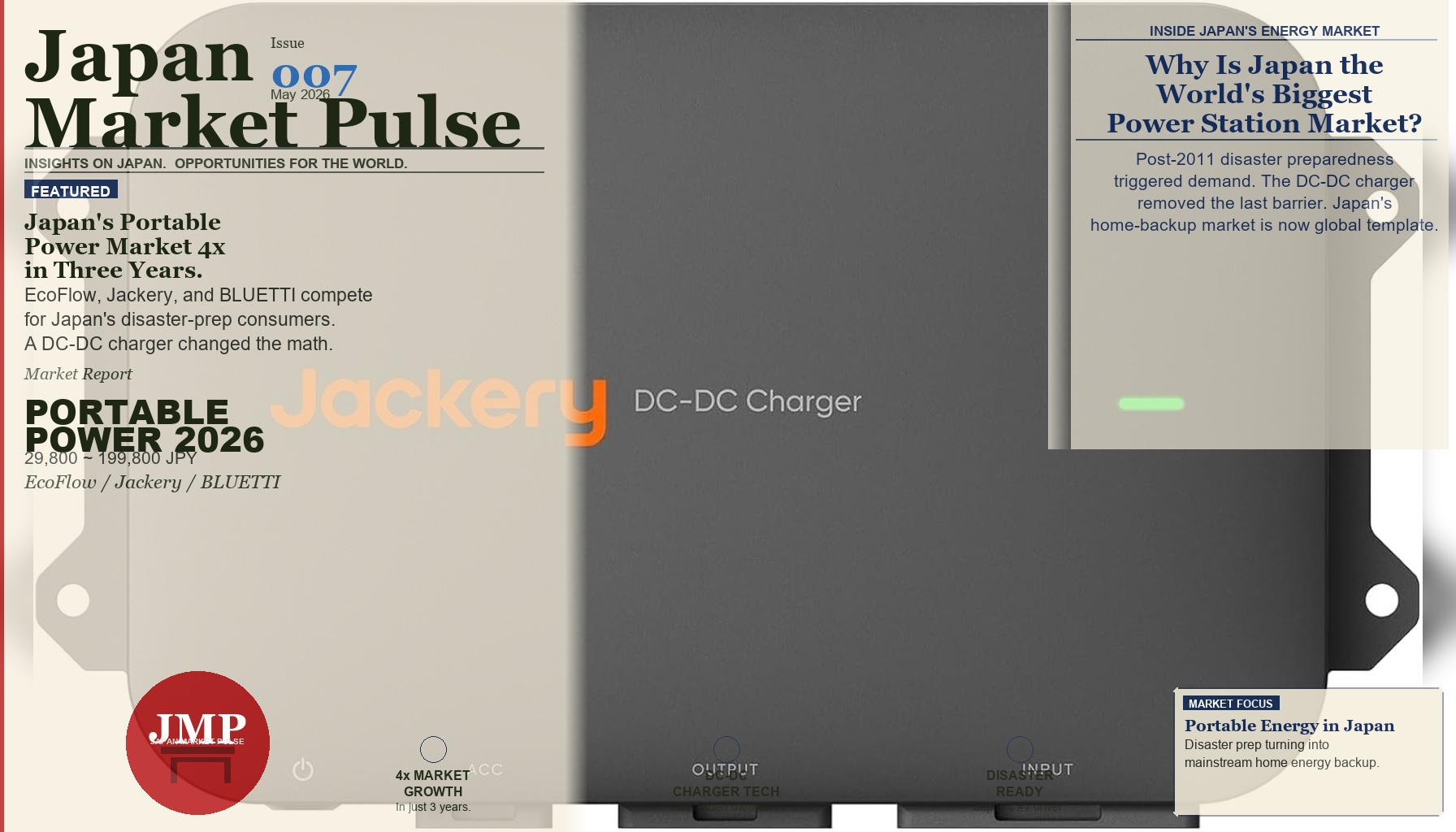
Three brands launched alternator chargers in eighteen months. Here’s how they sort out — and why kei-vans are the test market.
Japan Market Pulse — Issue 007 | Outdoor Tech
It is a Friday evening in late April 2026 in a coin-parking lot fifty meters from the Yokohama-Yokosuka Expressway, and a forty-something man in a fleece is wiring a small gray box to the cigarette socket of a Suzuki Every Wagon. The box is the size of a hardback novel and weighs about as much as a paperback Bible. Inside it, an isolated DC-DC converter is doing something that, until about eighteen months ago, was not really possible from a parked Japanese kei-van.
He pulls the engine into idle. A green LED on the box turns on. A second cable runs to the back of the van and into the input port of a 1-kWh portable power station — a slab-sized lithium-iron-phosphate (LFP) battery that, in 2021, would have been a curiosity in a niche outdoor catalog and that is now stocked at his neighborhood Yamada Denki between the rice cookers and the hair dryers.
He glances at the power station’s screen. The input number reads 620 W.
The number is the entire competitive event of the past two years in Japanese mobile-power retail, and it has just rendered the previous decade of car-charging hardware obsolete. A cigarette-socket charger that I bought from the same store in 2022 — the kind with a thin coiled wire and a cooling fin barely larger than a postage stamp — pushed maybe 120 watts, peaking at 96 W under load. To fill the 1024 Wh battery in the back of his van that machine would have taken the entire two-and-a-half-hour drive from his apartment in Kawasaki, plus another forty minutes idling once he arrived. The new box, by contrast, will fill the same battery during the drive itself, with margin to spare.
Multiply that across the Japanese consumer portable power-station market, which by GetNavi’s tracking has grown from roughly 155,000 units sold to households in 2021 to 597,000 in 2024 — a four-times expansion in three years. Multiply it again across the half-dozen lifestyle subcultures that already had an obvious use case for “fill the battery while driving” and were silently irritated by how slow the previous answer was. What you get is a market opening that three Chinese-headquartered brands — EcoFlow, Jackery, and BLUETTI — all walked through within the same eighteen-month window, with three different bets, in front of the most demanding car-camp culture in the world. This is the story of that fight.
The Math Problem That Cigarette Sockets Could Never Solve
 The math that made cigarette-socket charging obsolete. Same battery, two paths, one is six to seven times faster.
To understand why “alternator charger” is having a moment in Japan, it helps to look hard at what it is replacing.
The standard Japanese 12 V automotive electrical system, like its American and European cousins, hands the cigarette socket somewhere between 120 and 180 W of useful power before the socket’s fuse — typically rated at 10 A or 15 A — gets nervous. In practice, almost no aftermarket charger pushes the socket above 120 W continuously, because the cumulative wire run, the spring-loaded contacts, and the original automaker’s wiring assumptions were never designed for a cigarette user, let alone a 2024 portable power station drawing the equivalent of a microwave oven through a fast-food-soda-cup-sized plug.
That ceiling is a hard physical fact. To raise it, you cannot upgrade the cigarette socket. You have to bypass it. That means a cable from the alternator output itself — or, more often in newer installations, from the auxiliary 12 V battery in the vehicle — directly to a small, isolated DC-DC converter that handles current in the 30 A to 80 A range. Run an 80 A line through the right gauge of cable and you have a path that can carry roughly 1,000 W continuously while keeping voltage stable.
That is what the new product category does. It is a DC-to-DC isolated converter, packaged with circuit protection, voltage matching for both 12 V and 24 V vehicle architectures, and a friendly enclosure that a non-installer can mount under a passenger seat or behind a center console. The complete unit costs between $269 and $549 in the U.S. The Japanese list prices, distributed through Amazon Japan and the well-organized Japanese outdoor-power retailer SK Hompo (SK), run from ¥35,000 to ¥120,000, depending on the wattage class.
What this hardware does for the user is mathematically simple and culturally enormous. A 1024 Wh battery — the volume class that has become the default Japanese household choice for blackout backup and car-camping — fills in roughly 75 minutes at 800 W, versus roughly 8 hours and 30 minutes through the cigarette socket of a small kei-van at 120 W. For an audience that drives an average of about 90 minutes to most realistic Japanese car-camp destinations, the new category does not just speed up charging. It collapses an overnight problem into a single drive. And once that collapses, the entire economics of the rest of the trip changes too.
Why Three Chinese Brands All Showed Up in 2024
Three companies do not arrive at the same product category in the same year by accident. EcoFlow (founded 2017, headquartered in Shenzhen, IPO-track), Jackery (founded 2012, originally in Fremont, now Shenzhen-headquartered), and BLUETTI — the consumer brand of PowerOak, founded in 2009 in Shenzhen — have spent the last five years quietly engineering one of the more underreported product-category waves of the post-COVID era: the household lithium-iron-phosphate portable power station, which is a battery the size of a small cooler that turns into a kitchen appliance during a typhoon.
The economics of the cell side of that business are well-rehearsed. Chinese CATL and EVE Energy dominate global LFP cell supply. The cell is the biggest line item in a portable power station’s bill of materials. So firms that can negotiate aggressively with CATL or EVE — and that have direct access to Shenzhen’s industrial ecosystem for the inverters, BMS controllers, and cooling subsystems that wrap the cell — have a structural cost advantage that European and Japanese consumer-electronics incumbents (Anker, the relevant Panasonic and Sony divisions, the BLUETTI-equivalent boutique Western brands) can only partially match.
What is interesting is what happened after these three brands won the household power-station segment. They are now competing against each other in a smaller, denser, more demanding sub-segment: the buyers who actually take their power stations into a vehicle, the ones who are not just stockpiling for a typhoon but using the box every weekend.
That sub-segment in Japan is sharper than the one in North America. There are three reasons.
First, the Japanese kei-van ecosystem — the boxy 660-cc commercial-class vehicles that account for nearly 40% of the new domestic market — is, in 2026, the most car-campable platform in the developed world. A Suzuki Every Wagon, a Honda N-VAN, a Daihatsu Atrai, or a Nissan NV100 has a cargo area roughly the dimensions of a single-bed mattress, runs on a 12 V architecture identical to a passenger car, parks in any urban Japanese coin lot, and crucially is now available in EV trims that come from the factory with the auxiliary-battery wiring this hardware category needs. (Hideyuki’s note: the GetNavi 20265 P7 trio of kei-EVs — Suzuki Every EV, Honda N-VAN e:, and Daihatsu Hijet Cargo e: — are not coincidentally arriving in the same year as the alternator-charger category. The two product lines were timed for each other.)
Second, Japan’s **car-camp culture (, shachū-haku) is not a hobbyist subculture. It is a post-COVID mass-market consumer category** with its own magazines (Carsmile, Auto Camper), its own coordinated YouTube ecosystem (the prolific Japanese “Vanlife” niche, much of it shot in unmodified kei-vans), and its own seasonal infrastructure of paid car-camp parks that rent power outlets — and now, increasingly, do not need to. The category exists at scale. It buys hardware accordingly.
Third, earthquake culture. The household power station as a “winter blackout backup” is not a marketing fiction in Japan. After the 2024 Noto Peninsula earthquake on January 1, the relief operation included multiple high-profile deployments of Jackery and EcoFlow units to community centers and isolated homes. That visibility, combined with the Japanese Ministry of Internal Affairs’ standing recommendation that households keep a 72-hour energy reserve, has put the portable power station into the same emotional category as a fire extinguisher or a shake-charged radio. The alternator charger is what turns that fire-extinguisher into something you actually use, every weekend, instead of letting it sit and self-discharge in a garage.
Three companies looking at the same Japanese market, from the same Shenzhen industrial base, with overlapping cell supply chains, naturally produced three almost-simultaneous answers.
EcoFlow’s Ecosystem Bet — 800W Alternator Charger 1
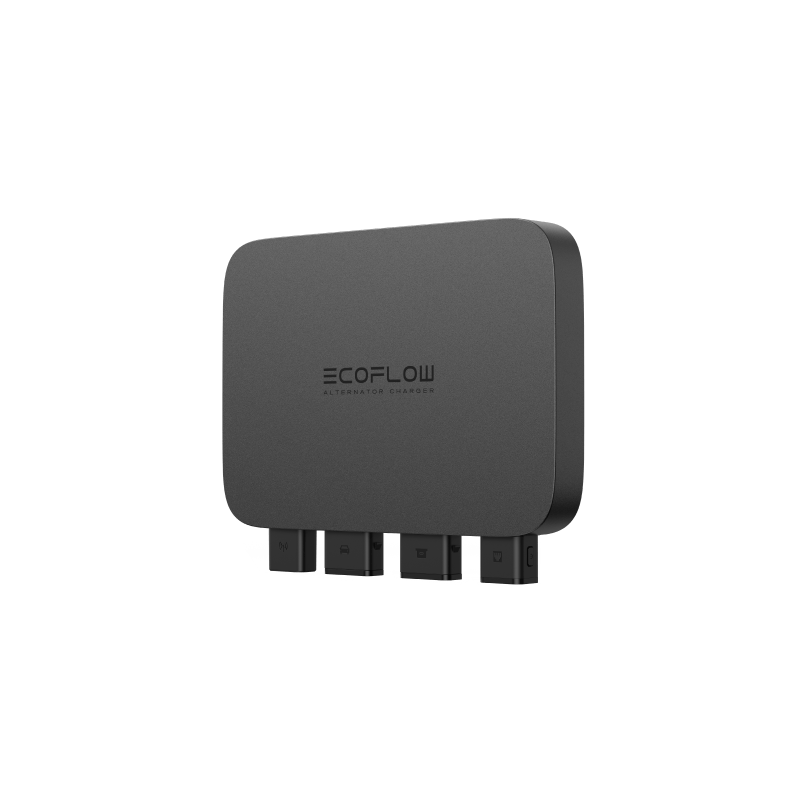 EcoFlow’s 800W Alternator Charger 1 — the ecosystem-bound option. Native handshaking with the DELTA family, app monitoring, premium pricing.
EcoFlow’s entry, the 800W Alternator Charger 1 (USD around $399 at U.S. retail; in Japan, the higher-spec Alternator Charger Plus 1000 ships at ¥69,300), is the most aggressively positioned of the three. It is also the most ecosystem-bound: the unit is engineered to talk natively, over a single integrated cable and a Bluetooth handshake, to EcoFlow’s existing DELTA and RIVER series of household power stations. Set up an EcoFlow stack, and the alternator charger becomes a peripheral the way a printer becomes a peripheral. The mobile app sees the charger’s input voltage, the engine RPM contribution, the battery’s input and state-of-charge curves, all in one screen.
That integration buys you something concrete. EcoFlow units, when paired natively, support the company’s proprietary “X-Stream” rapid input, which on the latest DELTA-series machines lets the system pull above the alternator charger’s nominal 800 W if the vehicle’s electrical system can sustain a brief spike. The advertised number is “1 kWh in roughly 1.3 hours” — which is the marketing way of saying that on a standard Tokyo-to-Hakone weekend drive, the box handles the charging entirely while you handle the driving. The ASIN B0DSBZVPS6 is the U.S. shipping SKU.
The trade-off is the same trade-off Apple owners have known for fifteen years. The system is excellent if you stay inside the EcoFlow stack. Pair the charger with a non-EcoFlow battery and you are running a standard isolated DC-DC converter — still useful, still 6× to 8× faster than a cigarette-socket setup, but without the smart-handshaking that justifies the premium. EcoFlow knows this and prices accordingly. The premium is the lock-in tax.
What this means in Japan: EcoFlow’s positioning is the high-margin, brand-loyal end of the kei-van car-camp segment. The user who has already bought into a DELTA 2 or DELTA 3 — and there are now several hundred thousand of them in Japanese homes — gets a peripheral that “just works.” The user shopping a la carte is more likely to look at one of the next two.
Jackery’s Boring-Reliable Play — 600W DC-DC
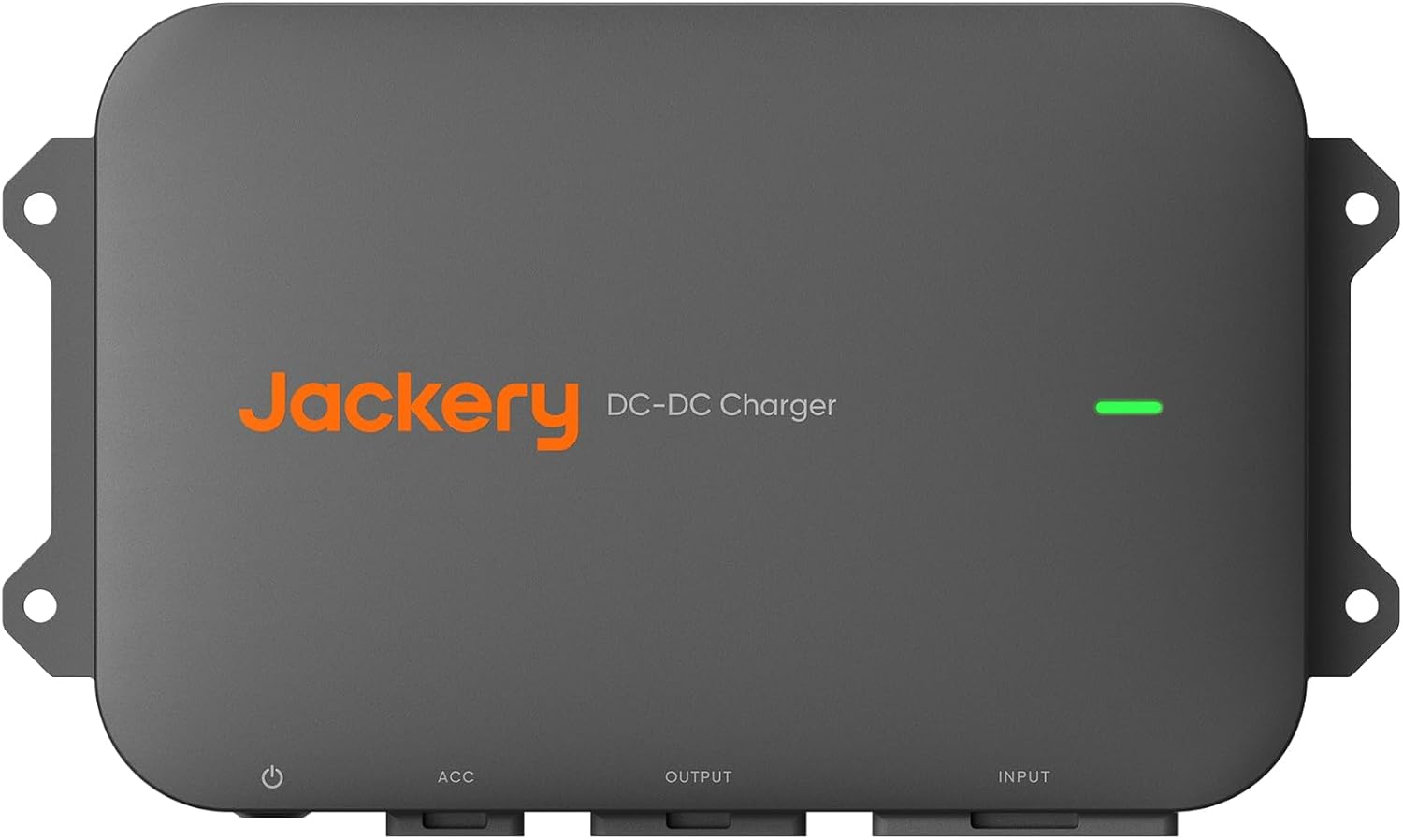 Jackery’s 600W DC-DC Alternator Charger — the boring-reliable option. No app, no Bluetooth, fits 90 percent of the cars on the road including Japanese hybrids.
If EcoFlow’s pitch is “join the system,” Jackery’s is the opposite: “fits 90 percent of the cars on the road, including the ones you don’t think about.” The 600W DC-DC Alternator Charger (US ASIN B0GTYGKRYP, Japanese MSRP ¥39,000) is, by intent, the most boring-looking unit in the trio. It is a flat black box with a single pair of input terminals, a single pair of output terminals, an RJ45-style data port, and a status LED. There is no app. There is no Bluetooth. There is no “ecosystem.”
What there is, is vehicle compatibility breadth that is meaningfully wider than the competition’s. Jackery’s marketing claim is that the unit operates correctly on input voltages between 11.8 V and 32 V, which is the technical way of saying it works on almost all 12 V vehicles, almost all 24 V commercial vans and trucks, and (importantly) the auxiliary-battery output of most Japanese hybrids. That last category matters more than American observers tend to notice. The Japanese fleet of Toyota Prius, Toyota Aqua, Honda Insight, and the Suzuki Solio class — the cars that, in aggregate, dominate the Japanese mid-life household — uses an architecture where a naïve cigarette-socket attachment to a high-current load can confuse the engine-stop cycle. Jackery’s box is engineered around that.
The unit’s nominal output is 600 W, which is the lowest of the three flagship products in this story. That is a deliberate choice. Six hundred watts is the sustained output that a stock Japanese kei-van’s auxiliary wiring will tolerate without an aftermarket cable upgrade — meaning a Jackery customer can install the unit in a Suzuki Every Wagon, with no rewiring, no thicker cable run, and no stop at an automotive electrical specialist. The trade is that filling a 1024 Wh battery on a Jackery system takes about 1 hour 40 minutes, versus the EcoFlow’s roughly 75 minutes — a difference that, on a real Japanese drive, is rarely visible.
What Jackery has bet on is not specifications. It is the assumption that the median Japanese car-camp buyer is not interested in pairing devices over Bluetooth and would rather not download an app. That buyer — a fifty-year-old salaryman who finally bought a Suzuki Every Wagon during his late-2024 work-from-home pivot — is exactly the buyer who reads the GetNavi feature carefully, walks into a SK Hompo store on a Sunday, and asks the salesperson which one is the simplest. The salesperson, in 2026, increasingly says Jackery.
BLUETTI’s Compatibility Door — Charger 1 (560W)
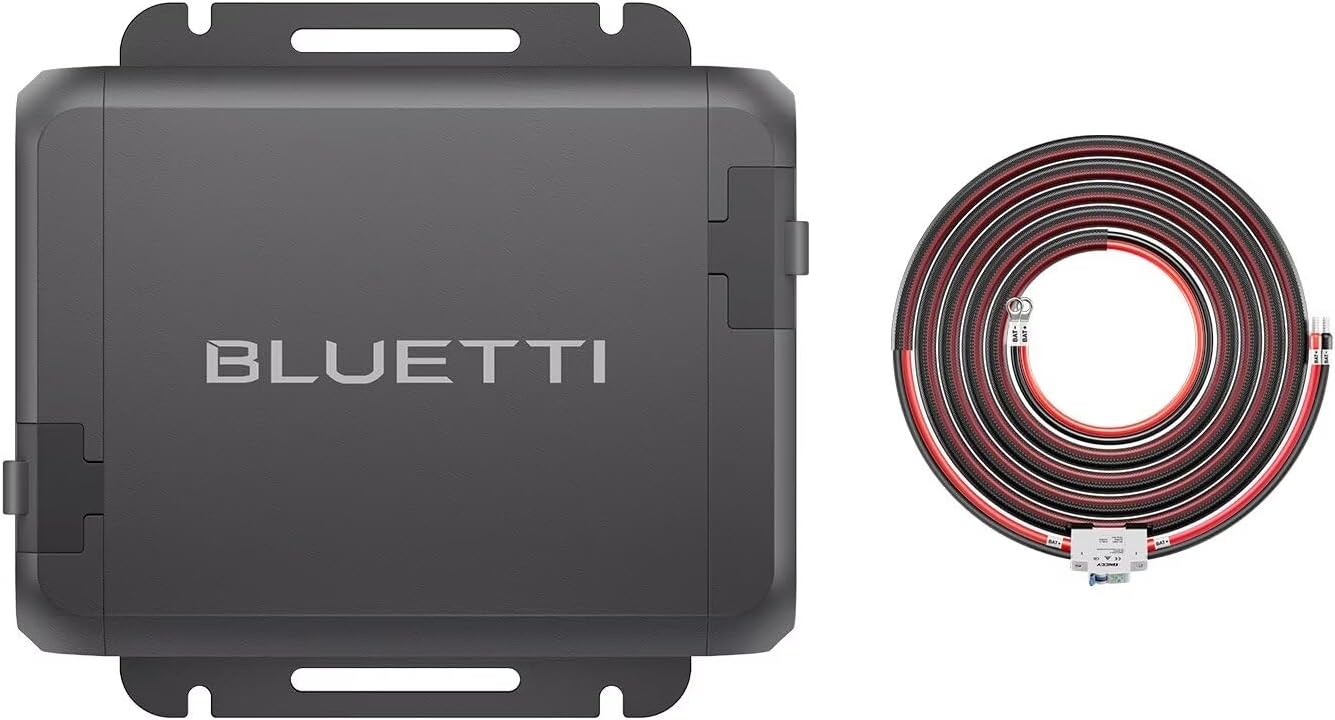 BLUETTI’s Charger 1 (560W) — the universal accessory. Compatible with 95% of major-brand power stations on the market.
BLUETTI’s answer is the most strategic of the three, and arguably the most interesting. The Charger 1 (560W) unit (US ASIN B0DGXYPMQ4, priced at $269 retail) is the cheapest of the trio at roughly two-thirds the EcoFlow’s price. Its specifications are also the most modest: 560 W nominal output, 12 V vehicle architecture only, no fancy app integration. On the surface, it looks like the budget option.
Look at the marketing copy more carefully and a different story emerges. BLUETTI’s selling point is “compatible with 95% of solar generators on the market” — not just BLUETTI’s own AC180, AC200L, AC300, and Elite line, but also (critically) Jackery, EcoFlow, Anker SOLIX, Goal Zero, and the cluster of smaller Chinese-brand power stations that have flooded the global market over the past three years. BLUETTI is, in a way no Western incumbent has tried in this segment, deliberately playing the role of the universal accessory. If you already own any major brand of portable power station — and after four years of category growth, hundreds of thousands of Japanese households now do — BLUETTI’s bet is that you will buy a Charger 1 to feed it during your next car-camp trip, regardless of whether you ever buy a BLUETTI battery.
The mechanical implementation is conceptually simple: the Charger 1 ships with a multi-tip output cable that physically mates with the input ports of the major power-station families. Software-wise, the unit speaks to the host battery as an “AC adapter equivalent” rather than over any proprietary handshake. There is no Bluetooth. There is no firmware update story. There is just a small box that takes 12 V from a vehicle and outputs the right voltage and current to fill any modern lithium-iron-phosphate household power station at roughly six times the speed of a cigarette socket.
In the Japanese context, this strategy reads especially well. The Japanese household has, in many cases, an EcoFlow DELTA bought during the post-Noto-earthquake retail spike of January–March 2024, alongside a Jackery 1000 Plus bought during the COVID-era 2021 typhoon-prep wave. BLUETTI is offering a single accessory that quietly works with both. In a market where buyers are not loyal to the same brand across replacement cycles, “compatible with everything” is a real value proposition, not just a marketing line.
What Japan’s Car-Camp Culture Does With This Hardware
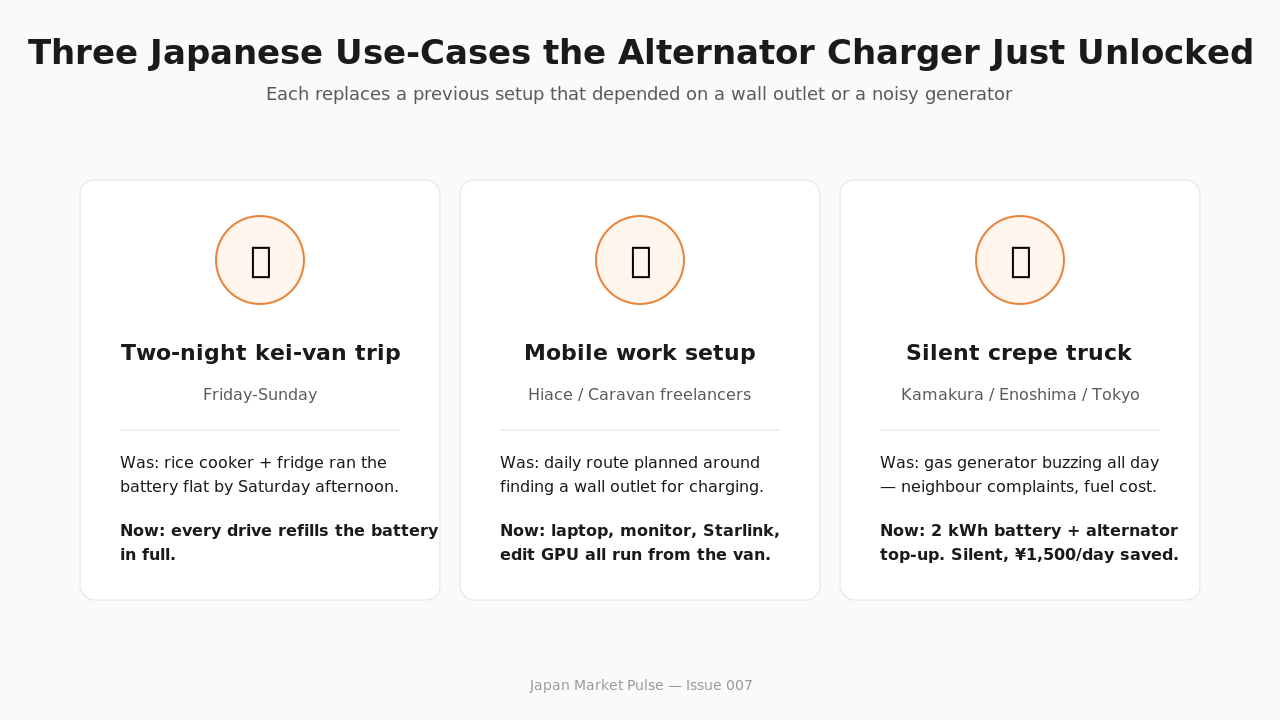 Three Japanese use cases the alternator-charger generation has just made viable, each replacing a previous setup that depended on a wall outlet or a noisy generator.
Specifications are only half the story. The other half is what the audience does with the gear once it gets home from the store.
The dominant Japanese use case is, predictably, the 2-night, 3-day kei-van trip — Friday night drive, Saturday-Sunday at a coin-parking lot or paid car-camp, Sunday-evening drive home. That trip historically runs into one bottleneck: the rear power station, which the user wants to run a small rice cooker (¥7,000 Tiger or Zojirushi single-cup model, 200 W), a portable refrigerator (45 W typical), a fan or kotatsu-style heater pad, and a small TV or projector, drains over the weekend faster than it can be recharged at any reasonable Japanese campsite outlet. The alternator charger collapses that bottleneck. Saturday morning’s drive to the trailhead is enough to fill the battery completely. Sunday’s drive home is enough to fill it again, ready for the next weekend.
The second use case is the small mobile work setup. Japanese remote-work patterns post-2023 have produced a small but stable population of mobile freelancers and YouTubers working out of converted Hiace and Caravan vans. For these users, the daily question is not “will my battery hold for the weekend” but “can I charge my battery during my drive between locations such that I never have to plug into a wall.” The answer, with the new generation of alternator chargers, is yes. The implication is that a self-contained mobile workstation, capable of running a laptop, two monitors, a Starlink terminal, and a small video-editing GPU rig, no longer needs to map its day around the location of an electrical outlet. That is a meaningful shift in the addressable lifestyle.
The third — and I think most underdiscussed — use case is the small Japanese outdoor-vendor economy. The crepe trucks, the kakigori trucks, the espresso-machine-equipped Daihatsu Hijet vendors that line the shopping districts of Kamakura, Enoshima, and central Tokyo on weekends. These businesses have, for two decades, run on either a noisy gasoline generator or an extension cord begged from a sympathetic shopkeeper. The 2026 alternator-charger generation makes a different setup viable: drive to the location with a fully-charged 2 kWh power station in the back, then top it up at the next driving leg. The economic difference is small — maybe ¥1,500 of electricity-and-fuel saved per day — but the noise difference is enormous. The “silent crepe truck” is now a real thing.
What the Japanese Magazine Coverage Got Right (and What It Missed)
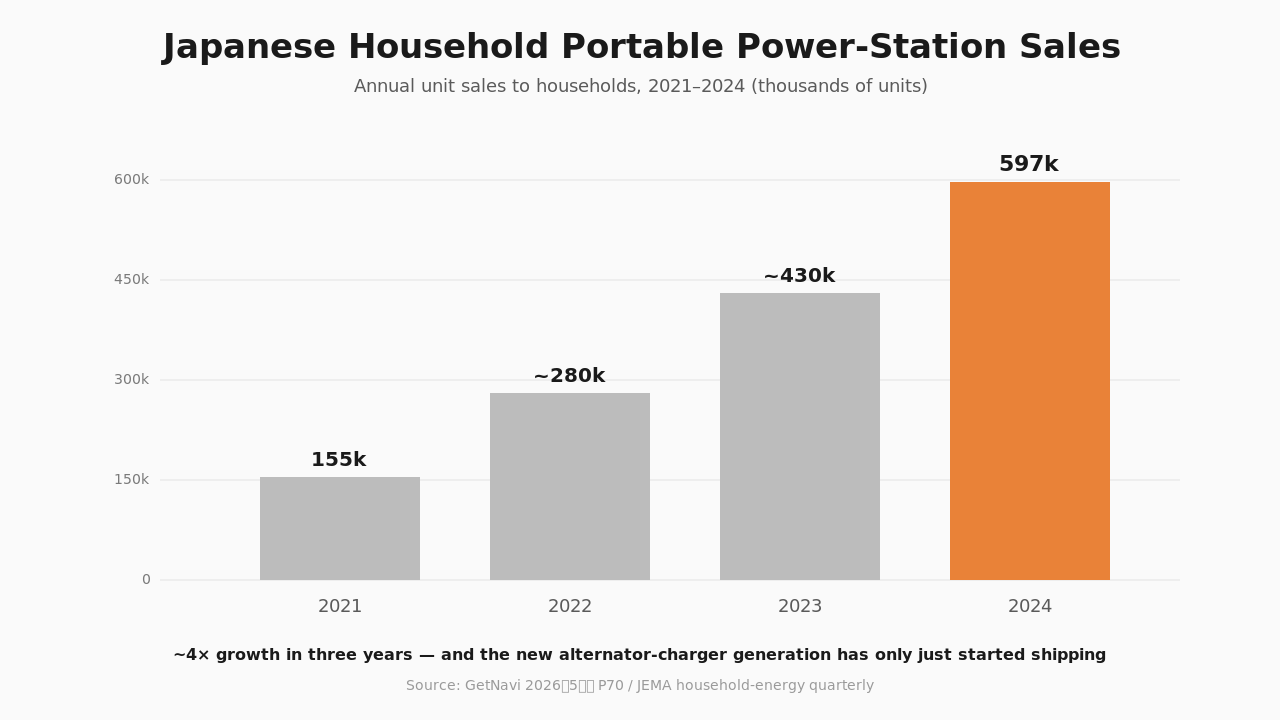 Roughly 4× growth in three years. The category was already large before the alternator charger arrived. The new hardware is what unlocks the next leg.
GetNavi’s coverage of the alternator-charger category, in its May 2026 issue, is unusually accurate by the standards of Japanese consumer-magazine product comparisons. The chart on page 70 — showing the roughly 4× growth in household portable power-station sales between 2021 and 2024 — is the right data, sourced from the JEMA (Japan Electrical Manufacturers’ Association) household-energy quarterly. The selection of three brands (EcoFlow, Jackery, BLUETTI) reflects who actually ships in volume into the Japanese channel. The price points listed are approximately correct.
What the magazine coverage misses is the second-order effect: this category, more than any of its predecessors in the portable-power space, is going to change which vehicles Japanese consumers buy. The reason is straightforward. If you are a 2026 Japanese household considering a kei-van purchase, the question of “is the auxiliary battery accessible and does the vehicle’s wiring tolerate an 80 A continuous draw” has just become a real purchase consideration — in a way that, three years ago, only a handful of vanlife converters would have asked. The kei-EV models from Suzuki, Honda, and Daihatsu are positioned, in part, around this exact new use case. Toyota and Nissan have noticed. The half-dozen other automotive infrastructure decisions — wiring loom rating, alternator output spec, secondary battery accessibility — that car designers used to optimize for cost are about to be re-optimized for what is, in net, a roughly ¥80 billion consumer accessory market.
For the international reader: this is the part of the Japanese tech story that does not show up in CES coverage. It is not a phone, not a TV, not a household robot. It is a small DC-DC converter, in a kei-van, in a coin-parking lot in Yokohama on a Friday evening, doing the same thing thousands of similar boxes are doing in Hokkaido and Shikoku and northern Kyushu, redrawing the line between “weekend trip” and “daily life.”
The three Chinese brands fighting for that line — and they are unambiguously fighting — are competing on a clean field, in a country whose buyers are uniquely qualified to judge them. That is the kind of competitive event that, in retrospect, defines a category for a decade.
TL;DR — Which One Do You Buy
Pick EcoFlow’s 800W Alternator Charger 1 (B0DSBZVPS6) if you already own an EcoFlow DELTA-series battery and want native handshaking, app monitoring, and the highest sustained output of the three.
Pick Jackery’s 600W DC-DC Alternator Charger (B0GTYGKRYP) if you want the simplest possible install, the broadest vehicle compatibility (especially Japanese hybrids), and a unit that does not assume you want to download an app.
Pick BLUETTI’s Charger 1 (560W) (B0DGXYPMQ4) if you already own a non-BLUETTI power station — Jackery, EcoFlow, Anker SOLIX, Goal Zero, anything — and want the universal accessory that fills any of them at six times cigarette-socket speed.
All three are real products, all three ship in volume in both the U.S. and Japan, and all three are about to change how a million Japanese households spend their weekends.
Subscribe at ketchups.co/japan-market-pulse.
If you’re interested in this topic, the Japanese market more broadly, or what KETCHUPs is working on, we’d love to hear from you — please reach out via our contact form.
If you’re interested in this topic, the Japanese market more broadly, or what KETCHUPs is working on, we’d love to hear from you — please reach out via our contact form.
Japan Market Pulse is a weekly read on what the Japanese consumer-tech, food, and mobility markets are choosing to do, written for international operators who want to know what is happening before it shows up in the global trade press.
Subscribe at ketchups.co/japan-market-pulse.