

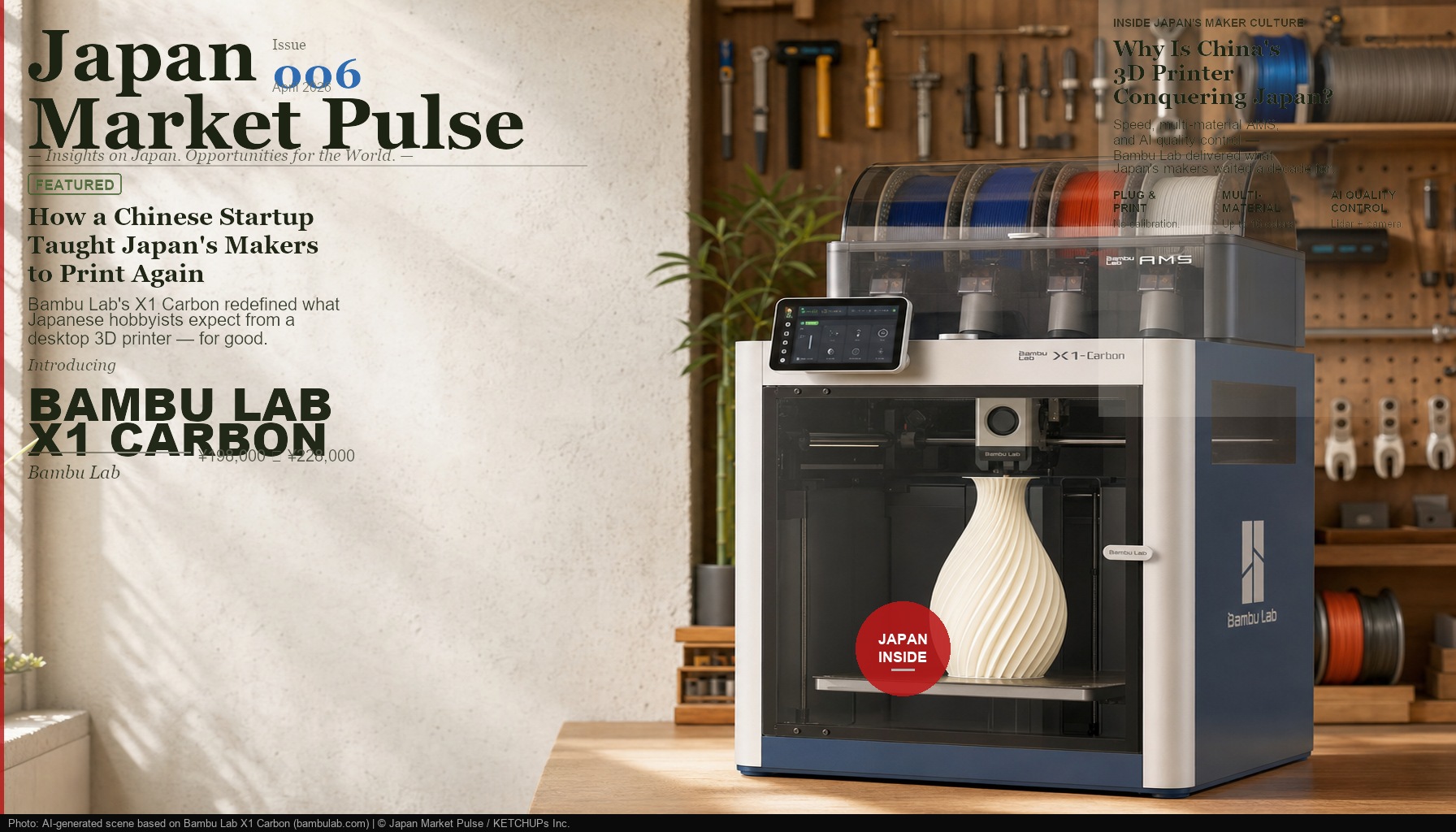
 Akihabara, April 2026: in a small FabLab where five years ago Creality Ender-3s went to die, six matte-black enclosed printers now run in parallel.
The desktop 3D printer used to be the great unfulfilled promise of Japanese hobbyist manufacturing — a finicky, weekend-eating box that made people feel stupid. In two years, Bambu Lab turned it into an appliance. Creality and Flashforge are now reshaping themselves around the new shape of the market. Here is what changed, why it matters, and what it means for the country that quietly invented the Maker movement’s Asian heartland.
Walk into a small FabLab in Akihabara on a Tuesday evening in April 2026. Ten desktop 3D printers are running. Nine of them are matte-black enclosed boxes with a small white logo on the front: Bambu Lab. The tenth — a tower-style Creality K2 Plus, conspicuously larger than the others — is printing a 30 cm aquarium filter housing in matte gray PETG, beside a Flashforge Adventurer 5M quietly extruding a school-project pencil holder.
Five years ago, this room would have looked completely different. There would have been Creality Ender-3s and Prusa i3 MK3S+ kits in various states of assembly. At least three of them would have been broken. The bed of one would be visibly warped. Someone would be earnestly explaining to a newcomer that you really do need to “tune your e-steps” before printing anything important. The newcomer would nod, go home, and never come back.
That FabLab does not exist anymore. Or rather, the cultural object that kept it small — the unspoken rule that 3D printing was a hobby for people who enjoyed fixing 3D printers more than printing things — has been quietly eaten over the last twenty-four months by a single company.
In 2023 a four-year-old Shenzhen startup called Bambu Lab launched the X1 Carbon. In 2024 it launched the P1S, a $499 enclosed printer that reviewers and YouTube tear-down channels could find essentially nothing wrong with. In late 2025 it launched the P2S, an iterative upgrade. In Q3 2025, by the count of the market intelligence firm CONTEXT, Bambu Lab passed Creality — the long-time volume king — to become the world’s top-selling brand of entry-level desktop 3D printers. By the end of March 2026, Bambu had quietly discontinued the X1 Carbon and X1E and started shipping their successor, the X2D. The whole thing took about three years.
The Bambu Lab story is, on the surface, a simple competitive-disruption case study: a well-funded newcomer, backed by Temasek, IDG Capital, and Tencent, vertically integrated its hardware and software, fixed the user experience, and ate the incumbents’ lunch. That story is true. It is also the least interesting thing about what is currently happening.
The more interesting thing is what the new product category is doing inside Japan — a country whose hobbyist Maker movement has, for fifteen years, sat awkwardly between three things it loved (FabLab, Wonder Festival, garage-kit culture) and one thing it could never make work (the desktop FDM 3D printer). For the first time, the third leg of that stool is steady. And what’s happening on top of it — figurines, replacement parts for discontinued cameras, aquarium fittings, N-gauge train scenery, custom Joy-Con grips, dental-aligner trays for the family dog — is starting to look like a quiet renaissance.
This is a story about three printers, three companies, and one country that paid attention late and is now catching up fast.
The State of Play, Mid-2026
Let’s start with the leaderboard, because the leaderboard has changed more in two years than in the previous ten.
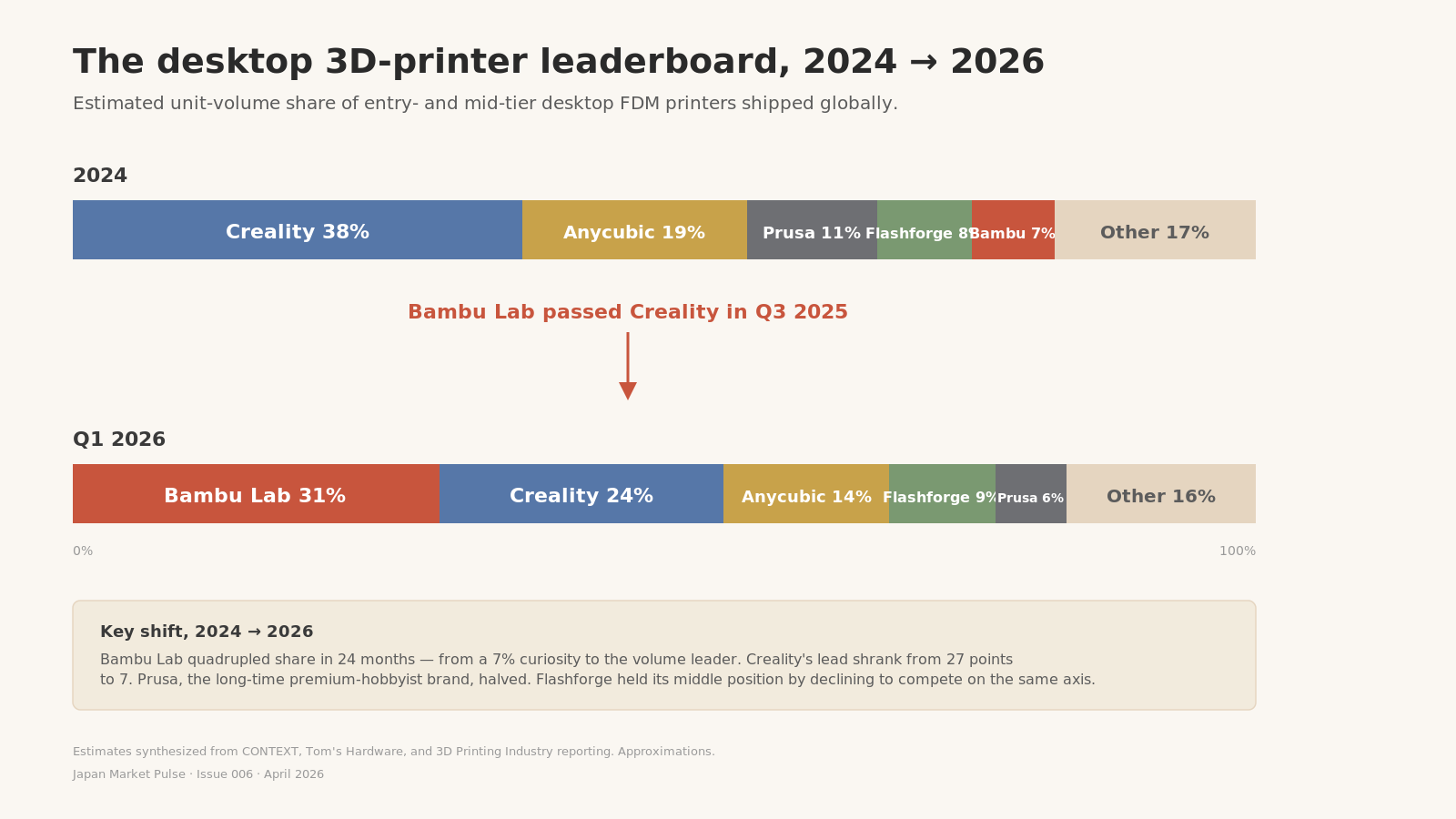 In two years, Bambu Lab went from a curiosity to the volume leader of entry-tier desktop 3D printers globally. Creality remains second, Flashforge holds the middle, Prusa loses share.
By unit volume of entry- and mid-level desktop FDM printers shipped globally — the segment that covers everything from a college student’s first machine to a small workshop’s daily driver — the order at the start of 2026 is roughly: Bambu Lab, Creality, Anycubic, Flashforge, Prusa. Two years ago it was: Creality, Anycubic, Prusa, Flashforge, with Bambu Lab a curiosity. Bambu didn’t move up the leaderboard. It picked it up and shook it.
The current 2026 lineup looks like this. Bambu Lab P1S at $399 (or $549 in the “Combo” bundle that includes the four-spool Automatic Material System) is the entry point. Bambu Lab P2S, launched in November 2025, sits at $549 standalone and $799 with AMS 2 Pro. The flagship is now the X2D, which replaced the X1 Carbon when production ceased on March 31, 2026 — Bambu has promised spare parts for the X1 family through 2031, but the focus is unambiguously forward.
Creality’s frontline answer is the K2 Plus, a CoreXY-style printer with a 350 × 350 × 350 mm build volume — the largest in its price class — and a 350°C maximum nozzle temperature, sold as a multicolor “Combo” bundle for $1,499. It is positioned squarely against the Bambu X1 Carbon’s old territory: serious hobbyists and small workshops who want to print engineering plastics and large parts in one go. Below it sit the K1, K1C, and K1 SE, all of which were Creality’s competitive response to the original P1S in 2023–2024.
Flashforge — historically a workhorse brand for educators, dentists, and small businesses, and one of the older Chinese 3D-printer companies — has anchored its consumer line on the Adventurer 5M and Adventurer 5M Pro. The base 5M lists at around $349, the Pro at $419. Both are 220 × 220 × 250 mm build volume, ship 95% pre-assembled, run a 600 mm/s maximum print speed (in line with the rest of the modern segment), and have a 4.3-inch color touchscreen that works out of the box. Flashforge has, very deliberately, declined to chase the high end and has built a stable middle.
Three printers, three strategies. The first sells you an experience and a walled garden. The second sells you specifications and a price point. The third sells you reliability and the absence of decisions. Each, in the Japanese context, has found a different audience.
Why Bambu Lab Won — And Why Japan Noticed Late
The technical innovations Bambu Lab brought to the desktop FDM category in 2023 are by now well-rehearsed in the YouTube reviewer canon: a CoreXY motion system that allows higher accelerations than the bedslinger architectures Creality had standardized; an enclosed chamber that finally made ABS, ASA, and carbon-fiber-filled materials practical at home; an integrated camera and a “spaghetti detection” first-pass failure check; an Automatic Material System (AMS) that lets a printer keep four spools wet and switch colors mid-print; and, crucially, a slicer (Bambu Studio) and an online model library (MakerWorld) that the same company controls top to bottom.
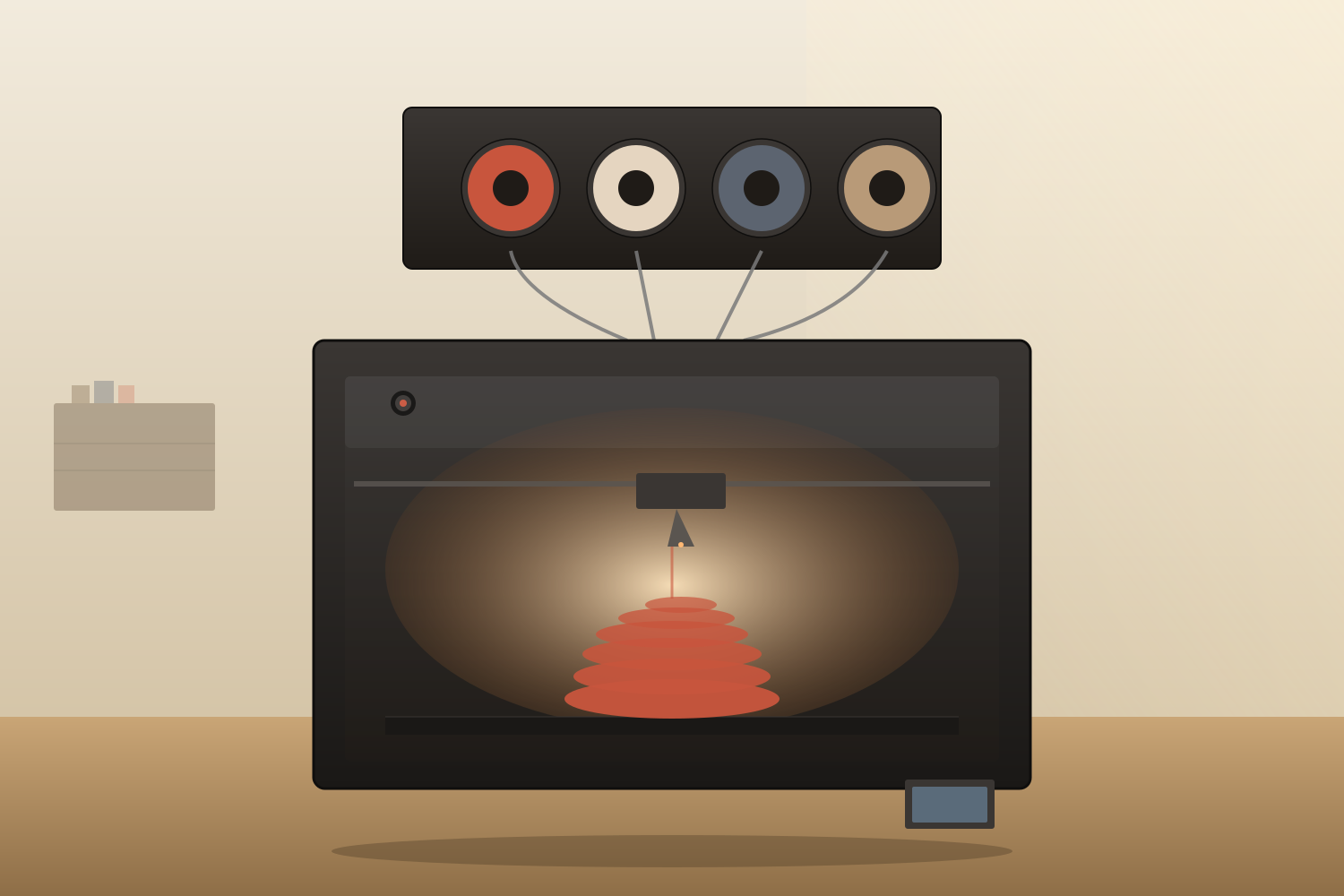 The architectural innovation that defined the category: an enclosed CoreXY chamber, an AMS-style multi-color feeder, and an integrated camera — all of it controlled by a single first-party slicer.
What that integration produced was not a faster printer or a cheaper printer. It was a printer where the median time from unboxing to first successful print fell from a community-estimated 20–40 hours to under 90 minutes. That single number is the entire competitive event. In any consumer hardware category, when the time-to-first-successful-use collapses by an order of magnitude, the existing buyer base does not migrate gradually. It tips.
Japan tipped late. There are three reasons, all of them structural.
The first is the chronic Japanese consumer-electronics aversion to personal importing — call it the “PSE wall.” Japan’s electrical-appliance safety law (, denki yōhin anzen-hō, abbreviated PSE) requires the PSE mark on most powered devices sold domestically; private importers can run their own machines but cannot resell them, and many buyers simply will not put a non-PSE-marked device on a circuit they share with a Japanese-spec home. Until Bambu Lab established formal Amazon.co.jp distribution in late 2024, the only way to get a P1S in Japan was a personal import, with all the warranty, voltage-conversion, and resale headaches that implies.
The second is the incumbency of Prusa Research — the Czech firm whose Mk3S+ and Mk4 had become the de-facto reference printer in the Japanese FabLab and university-engineering communities through 2022. Prusa’s open-hardware philosophy mapped neatly onto the Japanese FabLab Charter, and Prusa machines, despite being four to ten times the price of an Ender-3, dominated the kind of institutional purchases that drove Japanese 3D-printing public visibility. Bambu’s closed ecosystem — its slicer, its model store, its account-linked devices — sat in awkward tension with that institutional taste, even after the price gap collapsed.
The third is more ambient: the language layer. Bambu Lab’s Japanese-language manuals, Japanese-language firmware, and Japanese customer support did not arrive together with the hardware. They arrived in stages between mid-2024 and mid-2025. For a country where the typical buyer of a hobby tool will read every manual cover to cover before plugging in the machine, that ordering matters more than American observers tend to notice.
The dam broke around mid-2025. By that point, Amazon Japan’s listings showed Bambu Lab P1S Combo bundles in stock at roughly ¥80,000–¥150,000 depending on the configuration. Within six months, the Japanese 3D-printing community on X (formerly Twitter) and Discord had filled with a recognizable post format: a photograph of an old Ender-3 going to a recycler, a photograph of a new Bambu Lab P1S beside it, and a caption along the lines of 「」 — “I got my weekends back.”
That joke is the entire competitive event, restated.
The Creality Counter-Attack: K2 Plus and the “We’re Not Dead” Play
It is a mistake to write Creality’s obituary. The company is bigger than Bambu — it employs more people, ships more SKUs, and has an unmatched after-sales footprint in the price-sensitive entry segment. What it has lost is not market presence but narrative gravity. The Maker community no longer assumes that the cheapest sensible printer is a Creality. That assumption took a decade to build and three years to dismantle.
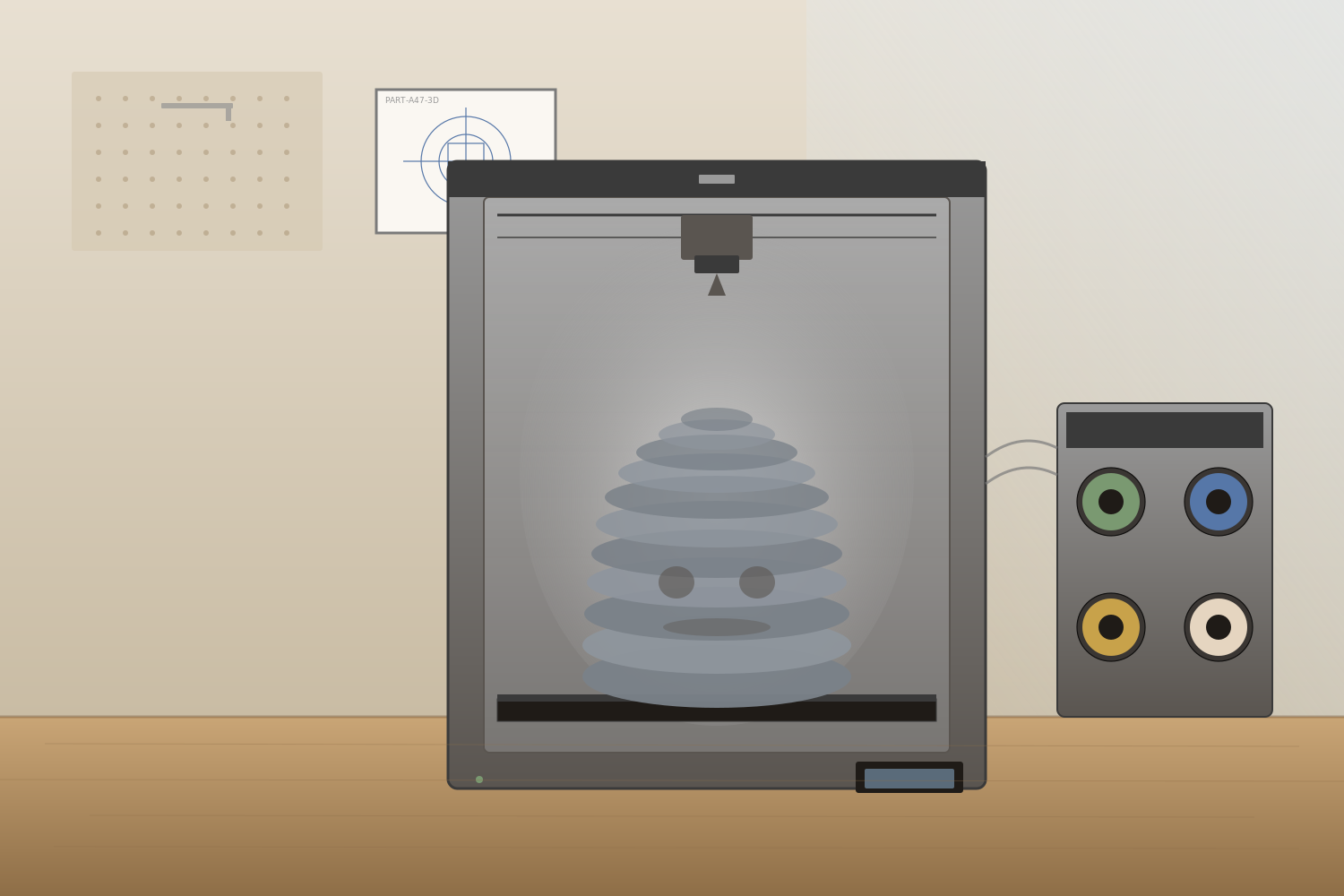 The Creality K2 Plus’s 350-mm-cubed build volume is the spec line that defines its market position — bigger than anything in Bambu Lab’s current consumer lineup, at $1,499 for the Combo.
The K2 Plus, launched in late 2024 and refined through 2025, is Creality’s most coherent counter-offensive yet. The architectural decisions are easy to read. Build volume: 350 mm cubed, larger than Bambu’s X1 Carbon (256 mm cubed) and far larger than the P1S (256 mm cubed). Multicolor system: the Creality Filament System (CFS), a four-spool external box conceptually equivalent to Bambu’s AMS but mechanically simpler, cheaper, and somewhat less polished in its filament-tracking. Nozzle: a 350°C hotend out of the box, capable of printing engineering plastics that the entry-level Bambu machines cannot. Software: a refactored Creality Print slicer that has narrowed but not closed the gap with Bambu Studio.
The K2 Plus Combo retails at $1,499 in the U.S. and at roughly ¥220,000–¥260,000 in Japanese distribution channels through SK and similar reseller networks. That is meaningfully cheaper than the Bambu Lab X1 Carbon’s old MSRP and, more importantly, comes with a build volume the Bambu lineup at its current organization simply does not offer.
Where Creality is losing the argument is not the spec sheet. It is the texture of daily ownership. Bambu Studio’s model-import flow, its friend-list-sized social layer through MakerWorld, its print-history dashboard, the way the company’s firmware updates land — all of these continue to outpace what Creality can ship through its own slicer. The K2 Plus is a better printer than its reviews give it credit for. It is also a printer that asks more of its user than the Bambu equivalents do, and the marginal user in 2026 is unwilling to be asked.
In Japan, Creality has one structural advantage Bambu does not: a longer-established physical reseller network. The Tokyo and Osaka 3D-printing scene has had Creality products on shelves at hands-on retailers since 2018 — at SK, at 3D events, in the small-shop tier of Akihabara that sells modular electronics next to single-board computers. Bambu’s distribution remains primarily Amazon-and-direct. For a Japanese buyer who wants to see the printer running before buying it, Creality is, for now, an easier target. Whether that physical-channel advantage holds depends on how aggressively Bambu pursues showroom and retail relationships through 2026 and 2027.
Flashforge’s Quiet Middle Path: Adventurer 5M
If Bambu is the disruptor and Creality is the volume incumbent, Flashforge is the company that has chosen, with notable discipline, to stop trying to be either. The company was founded in 2011 in Jinhua and has been one of the more adult-feeling Chinese 3D-printer brands for a decade — the kind of company whose marketing prefers technical specs to lifestyle photography, and whose customer-service operation is bigger than its R&D is famous.
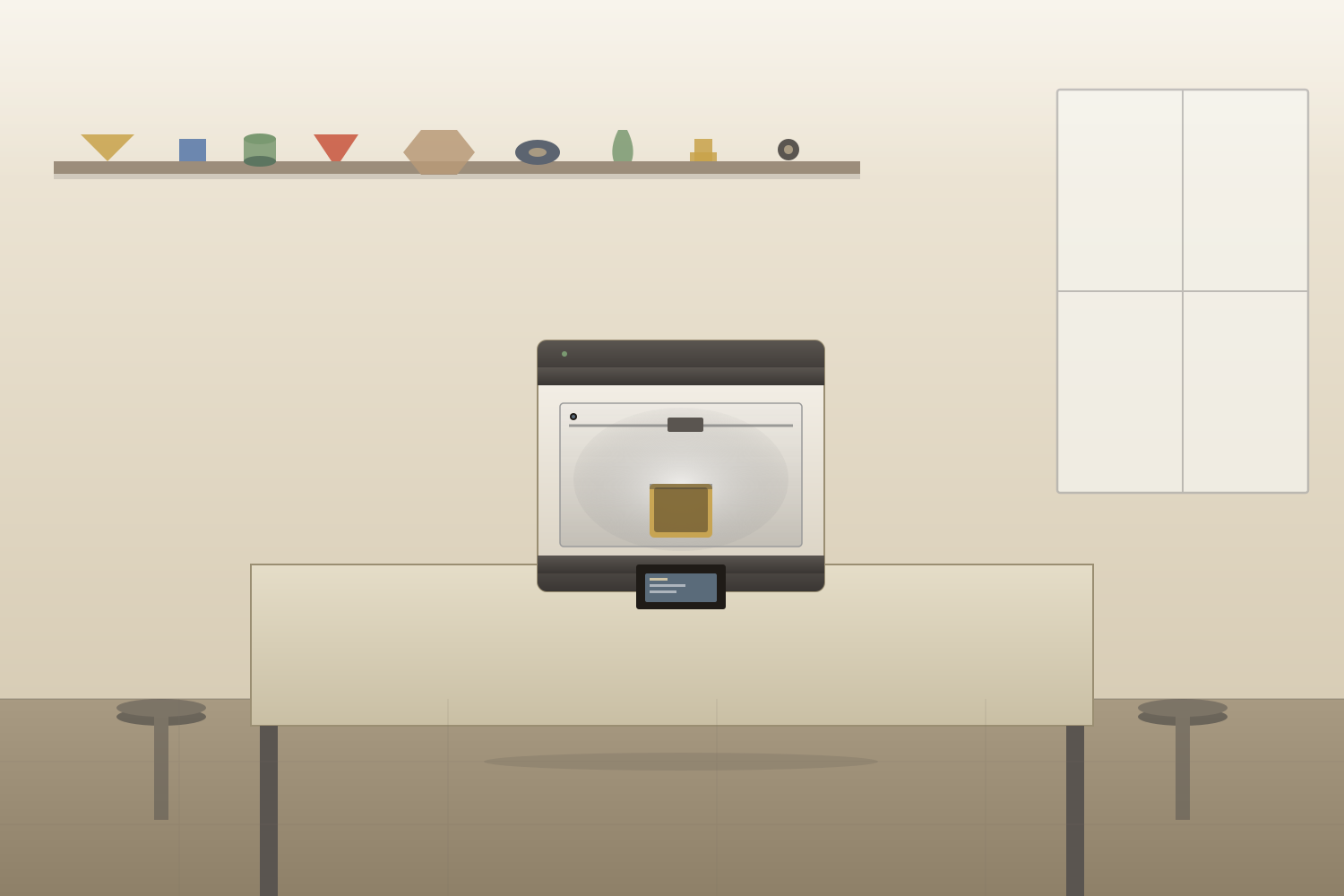 Flashforge’s strategy was, basically, not to fight Bambu on Bambu’s ground. The result: a near-monopoly position in Japanese school and corporate-procurement channels.
The Adventurer 5M product line is what that discipline looks like in 2026. The base unit is 220 × 220 × 250 mm, ships 95% pre-assembled, runs a 600 mm/s advertised maximum speed (lower in practice on calibration-sensitive geometry), and is fully enclosed with HEPA filtration at the top. The Pro variant adds an upgraded extruder, a chamber sensor, an upgraded camera, and a slightly wider material profile. The 5M lists at around $349, the Pro at $419. In Japan they sit at roughly ¥58,000–¥75,000 through the long-established Apple Tree Japanese distributor for Flashforge, with full domestic warranty service and an honest-to-god Japanese-language manual that was written, not auto-translated.
Flashforge’s strategic answer to Bambu is, basically, not to fight on Bambu’s ground. They are not competing for the cult-of-MakerWorld user. They are not competing for the engineering-plastic prosumer. They are competing for the school technology-class teacher, the corporate prototype shop with two engineers and one non-engineer, the dental clinic, the architectural model maker, and the parents buying their teenager a first machine. In every one of those contexts, the relevant questions are not “how fast can it print TPU?” but “will it work next Tuesday?” and “who do I call when it doesn’t?”
This is a meaningful market. Japanese junior high schools and technical high schools added 3D-printing curriculum requirements in successive waves between 2022 and 2025. The procurement reality of those institutions is that they need a small number of printers each, that the printers will be operated by non-experts, that the machines must be safe in a classroom (enclosed, HEPA-filtered), and that the school’s procurement department needs a Japanese-domiciled vendor with a service contract. Flashforge fits that template. Bambu, today, does not. Creality, today, only partially does.
The result is a pattern visible to anyone who walks Japanese trade shows: Bambu dominates the hobbyist booths, Creality dominates the consumer-tech retail booths, and Flashforge dominates the education and corporate-procurement booths. Each of the three companies has settled, perhaps without entirely intending to, into a different cultural slice of the same total addressable market.
What Japanese Makers Actually Do With These
It is one thing to write about market share. It is another to look at the things the printers are actually being used for, because the things being used for are how a market category outgrows being a market category and starts being part of a culture.
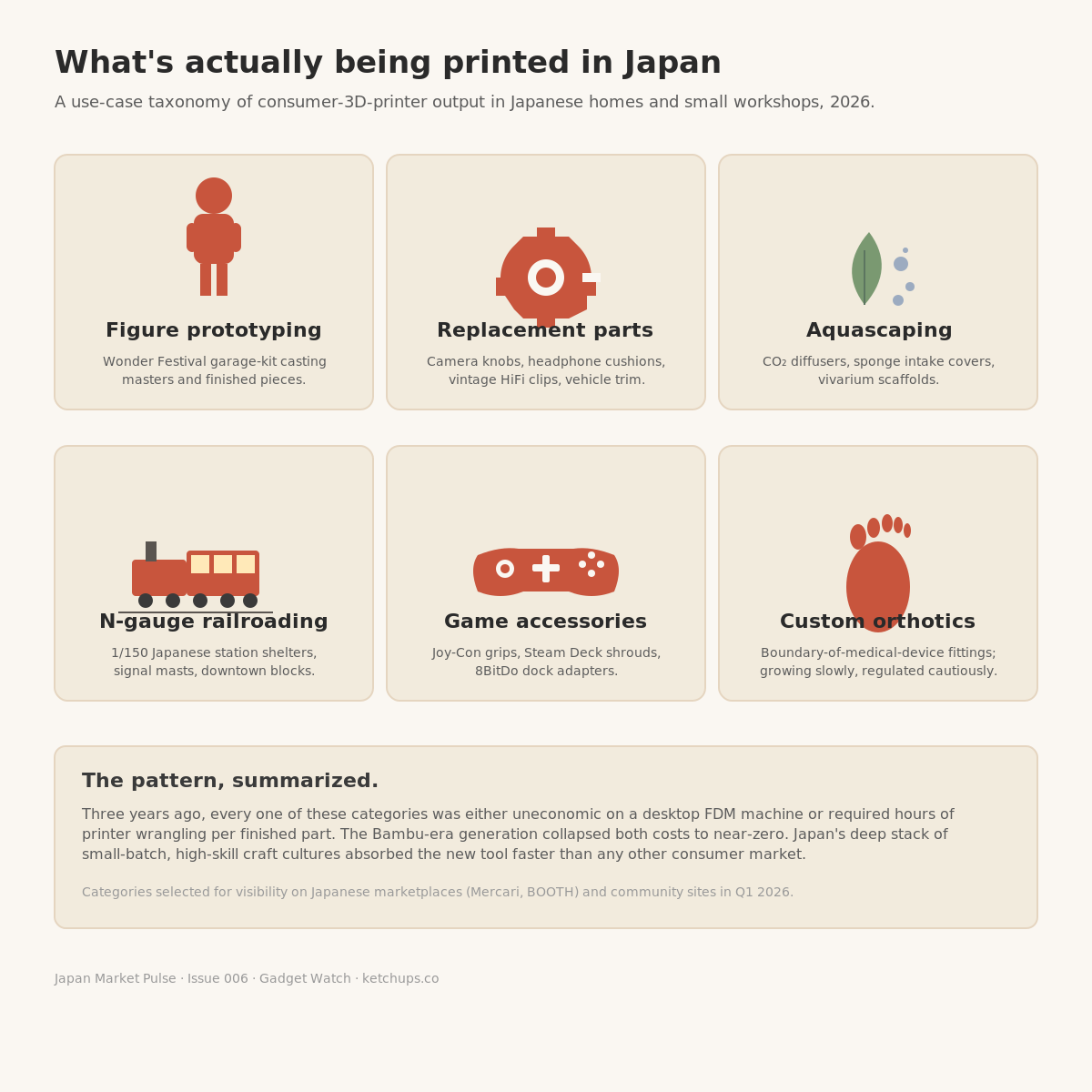 Six representative use-case categories where Japanese hobbyists and small operators are currently using their consumer 3D printers in ways that, three years ago, were either uneconomic or not technically feasible.
The largest and most visible Japanese application — the one that draws photo-essays and YouTube documentaries — is figure prototyping. Wonder Festival, the twice-yearly Makuhari Messe garage-kit convention, has for two decades been the public face of Japanese small-batch sculpture. Through about 2023, Wonder Festival exhibitors mostly sculpted in clay or polymer and used external service bureaus for SLA prints when they needed a casting master. By Wonder Festival Winter 2026 — held in early February — the floor was visibly different: a substantial fraction of stalls were displaying in-house Bambu Lab P1S or X1 Carbon prints as either the casting master or the finished selling product, with the printer’s manufacturer occasionally listed in the booth notes the way one would once have listed the dental wax used for the original sculpt.
Outside the figure scene, the use cases get more domestic and, in many ways, more interesting.
Replacement parts for orphaned consumer goods. A whole sub-economy on Japanese marketplaces — particularly Mercari and BOOTH — has emerged around printing parts for cameras, headphones, vintage HiFi gear, kitchen appliances, and bicycles for which the original manufacturer’s spare-parts pipeline has dried up. AirPods Max ear-cushion adapters for non-Apple replacement pads. Replacement film-rewind knobs for 1980s Pentax bodies. Plastic clips for the headlight assemblies of mid-1990s minivans. The unit economics are tight — most parts sell for ¥800–¥3,000 — but the gross margin is high enough that a hobbyist with a P1S and a small shelf can earn ¥30,000–¥80,000 a month from a niche of two hundred customers.
Aquarium and bonsai infrastructure. The Japanese aquascaping community — internationally famous for its Takashi Amano-school iwagumi aquariums — has rapidly absorbed the desktop 3D printer as a fixture-design tool. CO₂ diffusers, sponge-filter intake covers, stem-plant anchor weights, moss-frame skeletons for vivariums: all of these are now small-batch printed at home in PETG (aquarium-safe in the relevant geometries) and traded through community sites.
Model railroading and dioramas. Japan’s enormously deep N-gauge culture, anchored around makers like Tomytec and Greenmax, has historically required either expensive injection-molded scenery or very fiddly resin casting at home for custom buildings. The Bambu/Creality generation prints scratch-built Japanese station shelters, signal masts, telegraph-pole sets, and entire downtown blocks at 1/150 scale, with surface detail that — at the resolutions modern FDM achieves with 0.2 mm nozzles — is approaching the quality bar of mass-production tooling.
Game accessories. Reinforcement frames for Switch Pro Joy-Con drift fixes, Steam Deck cooling shrouds, 8BitDo dock adapters, and a small but vibrant Japanese sub-community printing right-handed-only ergonomic shells for various legacy gamepads. None of this is large in absolute terms; collectively, it is the connective tissue of a Maker scene that is once again confident it can make things on a Tuesday evening.
This is what a working consumer 3D-printing market looks like. Not a flagship use case, but a thousand small ones.
What This Means for Japanese Small Manufacturing
It would be tempting, given Japan’s cultural memory of the 1980s factory automation revolution, to draw a straight line from “the Bambu Lab P1S is in every hobbyist workshop” to “Japan is about to industrially leapfrog through desktop 3D printing.” That line is wrong, and worth being careful about.
 Akihabara, after closing. The desktop 3D printer has finally become the Maker tool the country’s workshops were waiting for.
Desktop FDM, even at the 2026 state of the art, is not industrial manufacturing. The machines are too slow per part for anything but single-digit-thousand-unit runs. The materials are limited to a roughly familiar set of thermoplastics — PLA, PETG, ABS, ASA, PA, PC, and their carbon-and-glass-filled variants — with a slowly expanding fringe of high-temperature engineering polymers. The dimensional repeatability is good but not great by injection-molding standards. The surface finish requires post-processing for any cosmetic application. And the end-of-life material flows — the spools, the failed prints, the support waste — are non-trivial environmental footnotes that Japan’s single-stream recycling system does not handle well.
What the new generation of desktop 3D printers does change, more subtly, is the economics of the prototyping step in small-batch Japanese manufacturing. A small machine shop in Ota Ward that designs, say, a custom hose fitting for an industrial customer used to face a clear gate: build a three-step injection-mold tool for ¥800,000, or pay an external service bureau ¥8,000 per part for fifty SLA prototypes before committing to the tool. Now there is a third option, and increasingly it is the default option — print twenty iterations at home for under ¥4,000 in PETG, then go straight to the production tool with a design that has already been physically iterated. The cost difference is not enormous on a per-shop basis. On a per-decade-per-Japan basis it is meaningful.
The longer-term effect, if it lands, is on the mass-customization end of the existing Japanese small-manufacturing economy. Bicycle frames with made-to-fit plastic fittings. Kitchen appliances with regional or seasonal custom trim. Replacement automotive interior parts for the long tail of cars that the major OEMs no longer support. Custom orthotics and dental aligners at the boundary of medical devices. Children’s toys. Any product category where the marginal cost of customization used to be the cost of the tool, and the tool is now an open-source slicer.
Japan does not need a new factory revolution. Japan has plenty of factories. What it has been missing for two decades is the layer of cheap, reliable, individually owned production capacity that lets a person with an idea on Saturday evening have a physical prototype on Sunday afternoon. That layer used to exist in this country — it lived in Akihabara’s parts shops in the 1980s, and it lived in the Tokyu Hands woodshop and the local hobby store through the 1990s. The desktop 3D printer is, on the evidence of the past two years, the first technology in twenty years that puts that layer back into private homes at scale.
That is what is happening in the FabLab in Akihabara on a Tuesday evening. Nine matte-black boxes, all running, all printing something — most of it small, most of it weird, most of it not commercially significant. But all of it being made by people who, three years ago, could not have done the making.
The Chinese company that quietly made this happen probably has not, even now, fully grasped what it has unlocked outside its own borders. What Bambu Lab built, in the end, was not a 3D printer. It was a tool that made one of the world’s most patient and capable Maker cultures stop apologizing for not making things. The rest will follow.
If you found this useful, you might also enjoy Japan Market Pulse Issue 005 — “Japan Just Invented a Toilet That Scans Your Poop”, on Japan’s quiet leadership in ambient health monitoring.
Japan Market Pulse is a fortnightly briefing on consumer-and-retail trends in Japan, written for non-Japanese brand strategists. Subscribe at ketchups.co.
Try one of these printers (Amazon US — affiliate links)
If you want to try one of the printers discussed in this piece, here are the three main starting points. As an Amazon Associate, ketchups.co earns from qualifying purchases — at no extra cost to you.
- Bambu Lab P1S Combo — the recommended entry point for a serious hobbyist who wants Bambu’s full ecosystem (printer + AMS multi-color system) on day one. → Buy on Amazon US
- Creality K2 Plus Combo — for the maker who needs a 350 mm cubed build volume and is willing to do a bit more software wrangling for the extra real estate. → Buy on Amazon US
- Flashforge Adventurer 5M Pro — for the educator, the gift-buyer, and the user who values a printer that stays out of the way over the latest spec. → Buy on Amazon US
Sources & further reading
- 3D Printing Industry — Bambu Lab Discontinues the X1 Series After Four Years on the Market — March 2026 production-end announcement and X2D successor introduction.
- Tom’s Hardware — Bambu Lab overtakes Creality as the world’s top-selling budget 3D printer brand — CONTEXT data on the Q3 2025 leadership change.
- Bambu Lab US Store — P1S product page — current pricing for the P1S and P1S Combo.
- Bambu Lab US Store — P2S product page — pricing for the P2S, AMS 2 Pro, and Combo bundles.
- PrintPal — Which Bambu Lab Printer Is Right for You? A 2026 Buyer’s Guide — full 2026 lineup overview.
- Matter Manifest — Creality K2 Plus vs Flashforge Adventurer 5M Pro — head-to-head spec comparison used for the chart in this piece.
- 3DWithUs — Best Budget FDM 3D Printers 2026: Tested — independent buyer-side ranking of the current consumer field.
- Bambu Lab — A farewell to P1P — official end-of-manufacturing announcement for the P1P, February 2026.
- Precedence Research — Japan 3D Printing Market Size to Hit USD 3,054.40 Million by 2035 — sizing of the Japanese market for context.
- Fortune Business Insights — Japan 3D Printing Market Size, Share, Forecast, 2034 — secondary market-size source.
Source magazine: GetNavi 20265A003 「3D」 (the 3D printer warring-states era).
If you’re interested in this topic, the Japanese market more broadly, or what KETCHUPs is working on, we’d love to hear from you — please reach out via our contact form.
If you’re interested in this topic, the Japanese market more broadly, or what KETCHUPs is working on, we’d love to hear from you — please reach out via our contact form.
Japan Market Pulse is a weekly read on what the Japanese consumer-tech, food, and mobility markets are choosing to do, written for international operators who want to know what is happening before it shows up in the global trade press.
Subscribe at ketchups.co/japan-market-pulse.