

Japan’s quiet bet that real-time environmental data is retail’s next layer.
Japan Market Pulse — Issue 003 | Retail Watch

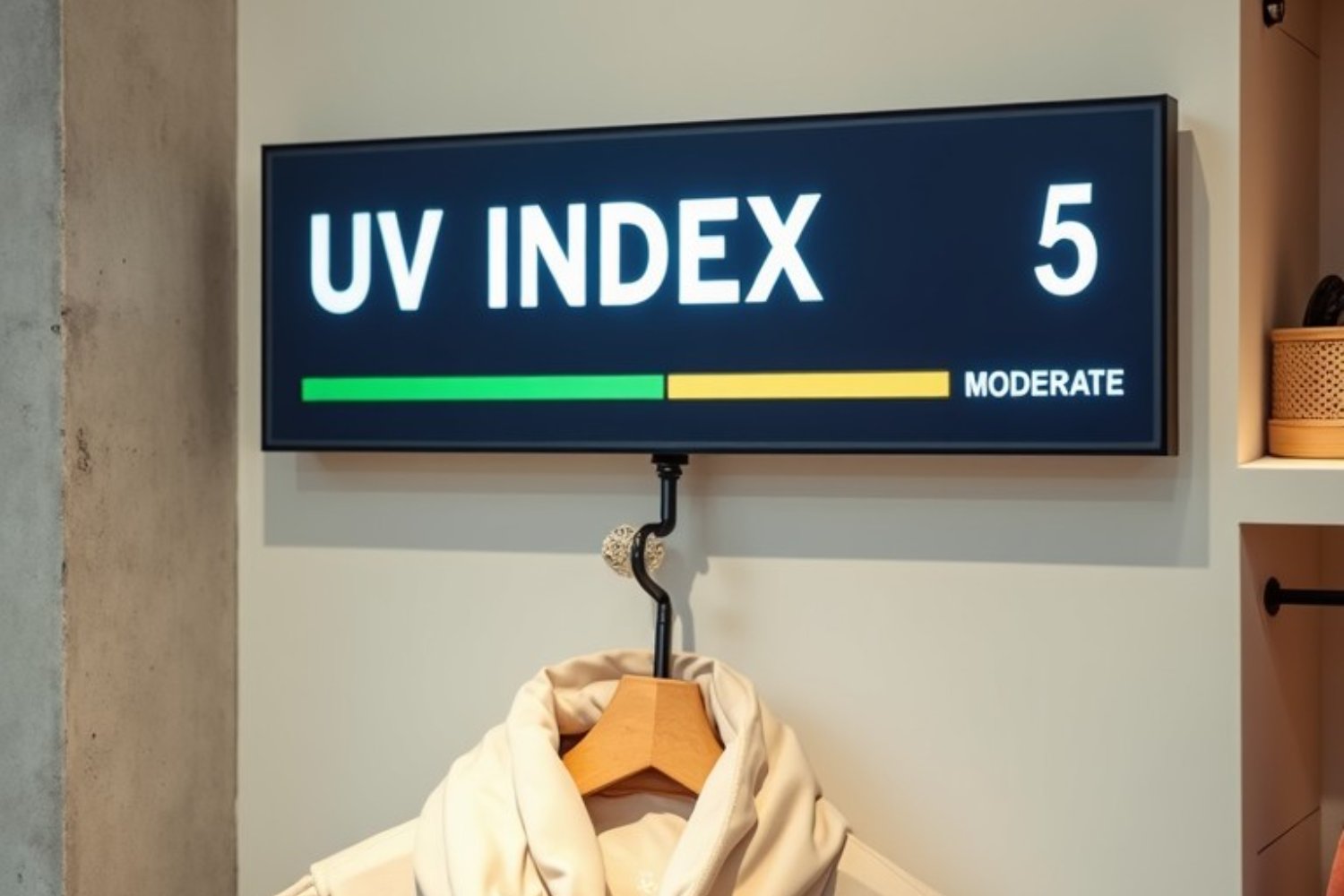
Walk into a UNIQLO in Tokyo this April and, somewhere near the entrance — between the wall of UV-cut parkas and a small table of new sunglasses — a screen will tell you exactly how dangerous the sun is right now. It will read “UV: very high — index 8” at lunchtime. By 4 p.m., the same screen will say “index 5, moderate.” The number is pulled live from the Japan Meteorological Agency, the same dataset weather forecasters use, and it updates throughout the day.
The product on the rack underneath does not change. But the interpretation of that product changes by the hour.
This is what was reported in the Nikkei MJ on April 20, 2026 — UNIQLO has begun displaying real-time ultraviolet readings inside selected stores in Ikebukuro, Umeda, and JR Nagoya, with plans to expand to roughly five stores per prefecture by the end of summer. The framing in the press was modest: it’s a sales-promotion device for UV-protection clothing. The framing inside the store is also modest. There is no banner. There is no “limited time only.” There is just a number, glowing softly, telling the truth about the air outside.
Modesty is what makes it interesting. UNIQLO has done something quietly radical: it has installed a piece of public infrastructure inside its own private retail floor and turned it into a merchandising fixture. The store now knows the weather. And once a store knows the weather, the entire logic of seasonal merchandising starts to look obsolete.
The Display Itself
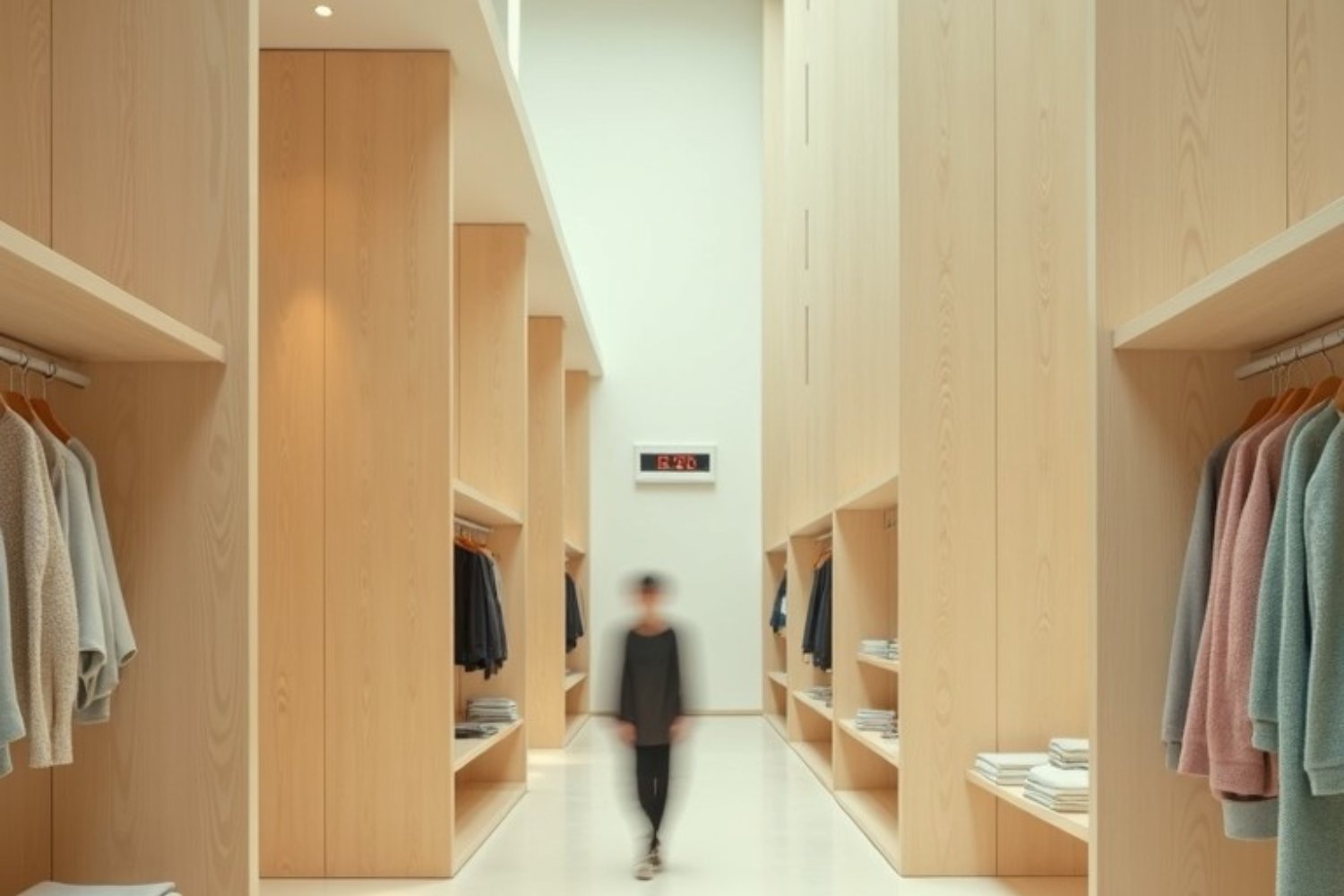
Physically, the device is unspectacular. A horizontal LED panel, mounted at adult-eye height, shows a single line of large numerals — the current UV index — alongside a small color band running from green (“low”) through yellow, orange, red, and violet (“extreme”). A second line gives a verbal label and a brief recommended action (“wear UV-protection clothing”, “wear sunglasses and a hat”). The data refreshes every few minutes, drawn from the JMA feed for the prefecture the store sits in.
What makes the device significant is not the hardware. It is the placement.
The screen is positioned directly above the UV-protection apparel area — the parkas, the long-sleeve tees, the sunglasses by Clare Waight Keller, the wide-brim hats, the UV-cut umbrellas. The customer does not see “weather data” and “products” as separate things. They see a single integrated display: the air outside is at risk-level 8, and these are the items in this store designed for risk-level 8.
Retailers have been arranging products by season for two centuries. Spring goes out in February. Summer comes in April. Autumn lands in August. The calendar drives the floor plan. UNIQLO has just severed that link. The floor responds, instead, to the actual sky on the actual day.
The display does not generate demand. It exposes demand that the customer already feels but has not yet articulated. That is a different kind of merchandising entirely.
Why Now
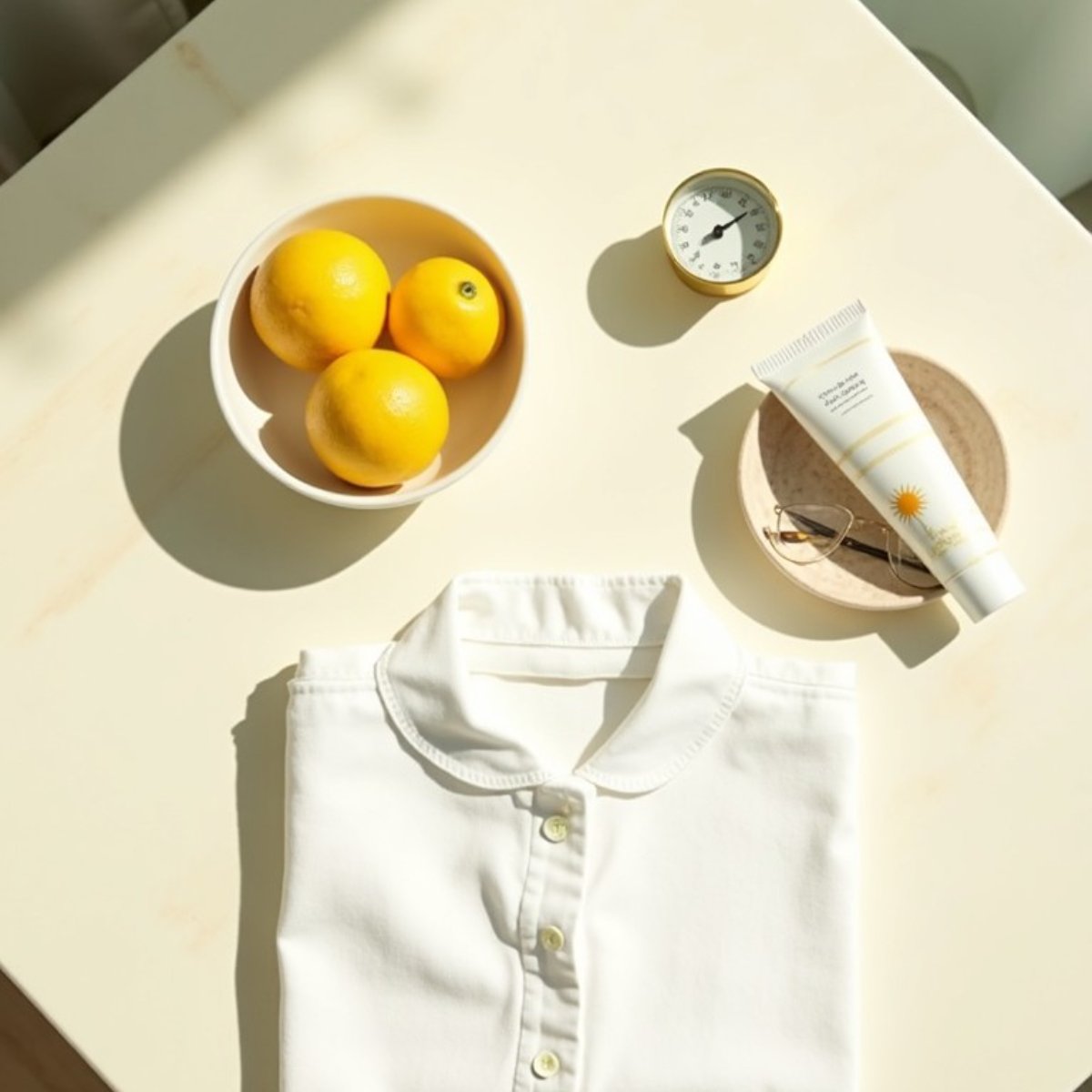
The reason this experiment is happening in 2026, and not five years ago, is that the underlying environment has shifted in a measurable way.
Japan’s solar UV radiation has been rising. Long-term monitoring at the Japan Meteorological Agency’s Tsukuba station shows a statistically significant increase of approximately 33.0 kJ/m² per decade in erythemal UV — at 99% confidence level. Less air pollution, paradoxically, means more UV reaching the skin.
The on-the-ground numbers are dramatic. In June, central Tokyo regularly hits a UV index of 11 — the “extreme” category, where unprotected skin can begin to damage in roughly ten minutes. UV exposure that used to be confined to the high-summer window of June through August now starts measurably in March and persists into late September. A category that used to be a three-month spike is becoming a seven-month plateau.
The Japanese sun-care market reflects this. Industry data put the country at roughly $828 million in sun-care product sales in 2024, projected to reach $1.36 billion by 2033 — a CAGR of around 5.7%. Asia-Pacific now accounts for about 22% of global sun-protection revenue.
What UNIQLO is doing is not reading a research report. It is taking a real-time slice of the same atmospheric data the research reports are based on, and putting that slice next to the product. The customer doesn’t have to take the trend on faith. The customer can see it, every visit, in glowing LEDs.
The Curve and the Category
The data tells a tidy story. Two curves, one diverging from itself, one tracking upward in lockstep.
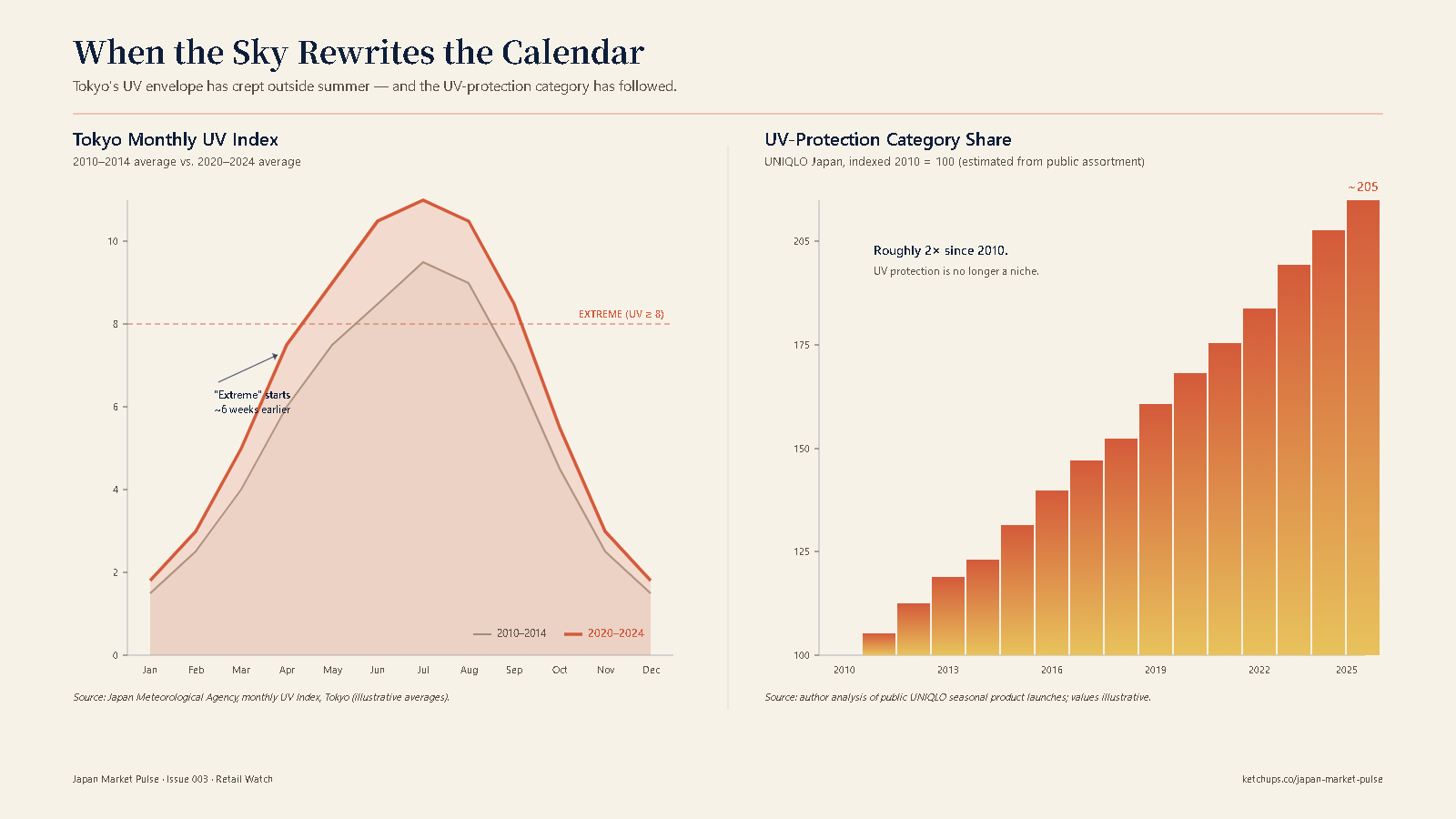
The left side of the chart shows monthly UV index readings for central Tokyo, comparing a five-year average from 2010–2014 against the equivalent average from 2020–2024. The “extreme” band — UV ≥ 8 — used to occupy the months of June, July, and August. By the latest five-year window, that band has grown to span late April through early October. The growing season for sun damage is now nearly half the calendar.
The right side of the chart shows UNIQLO’s UV-protection apparel category as a share of total spring-summer merchandise displayed in Japan stores, a proxy estimated from the company’s seasonal product launches. That share has roughly doubled over the same fifteen years.
Read together, the two curves are an answer to the question, “why now?” UNIQLO is not pioneering a behavior. It is acknowledging, on its sales floor, a behavior that the customer has already adopted — and then making it slightly easier to act on.
This is, in a quiet way, also a climate story. The merchandising calendar is one of the small, mundane things that climate change is rewriting. Apparel companies that wait for the calendar to be officially rewritten will be late.
The Global Design Layer
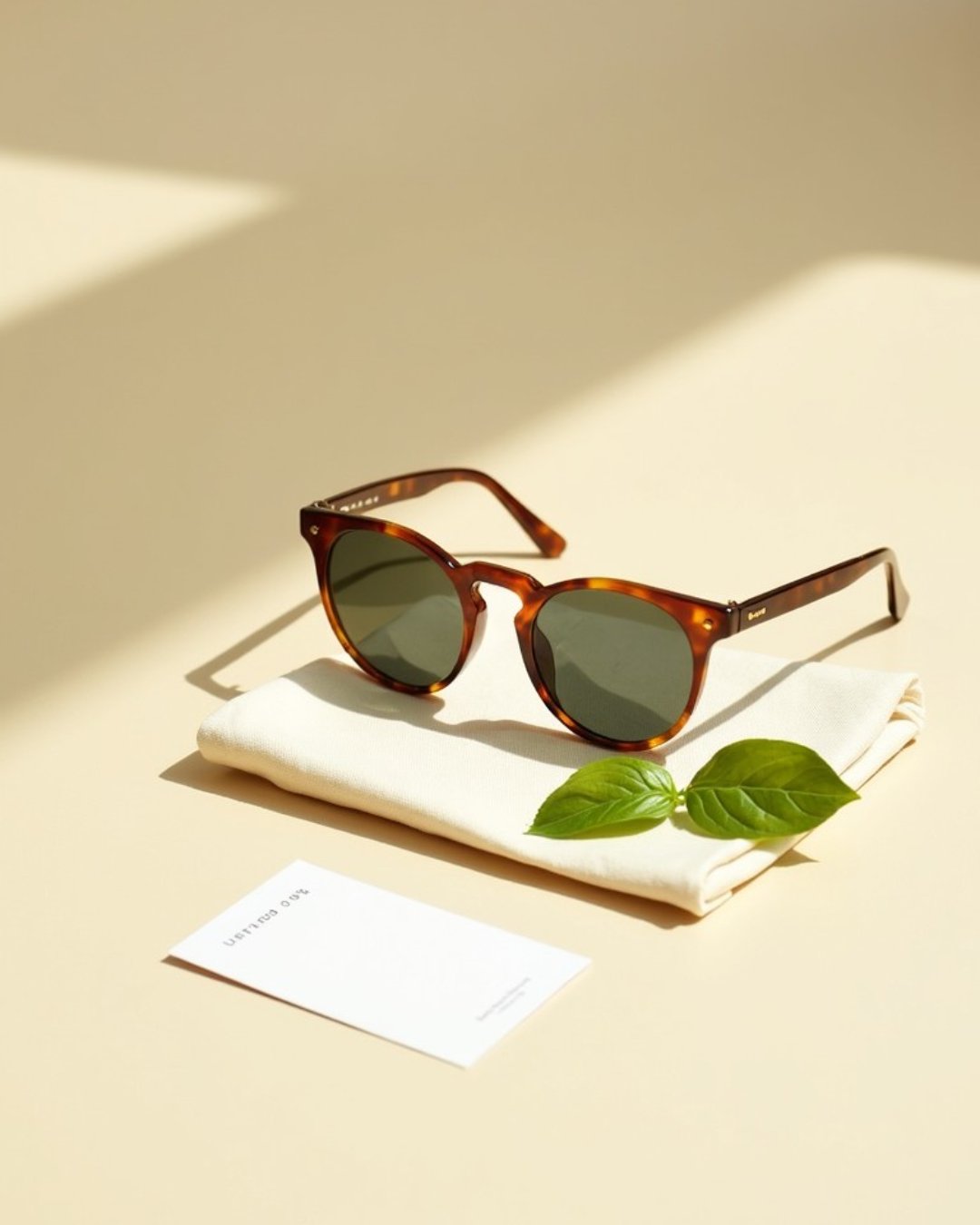
Above the live display, on the table closest to the entrance, sits a small range of sunglasses. They are the new accessories from UNIQLO: C, the Spring/Summer 2026 collection by Clare Waight Keller — the British designer formerly of Givenchy, internationally recognized for, among other things, designing Meghan Markle’s wedding dress.
The sunglasses are the first eyewear UNIQLO has launched under the : C sub-line. They feature UV400 lenses — meaning they block 99% of ultraviolet radiation up to 400 nanometers — with a 25% blue-light reduction baked in, and a subset of the “Active” styles add polarized lenses to cut glare. They start at roughly £24.90 in the UK. The collection’s title is “Refined for the Everyday.“
The juxtaposition is the entire point. The local data is JMA — public, austere, scientific. The global design is Waight Keller — globally credible, fashion-magazine adjacent, accessible. UNIQLO has spent fifteen years getting good at this exact assembly: take a functional premise (sun damage is real, daily, and rising), wrap it in a technological layer (real-time UV display), and dress it in a globally fluent aesthetic (Waight Keller’s restraint), and price it like an ordinary object.
Each layer reinforces the others. The data without the design feels like a public-health poster. The design without the data feels like another fashion-collaboration drop. Together, they look — and operate — like a complete proposition: here is what’s outside, here is what to wear in response, here is the version of that wear which won’t embarrass you in any global city.
There is a deeper point here about Japanese retail’s particular skill. Japanese mass-market brands have, over the last two decades, become unusually good at synthesizing functional, technological, and aesthetic layers into a single product object. MUJI does it with everyday goods. Uniqlo does it with apparel. Daiso does it with stationery. Toyota has done it with cars for half a century.
Quiet Retail, Now With Sensors
If the UV display feels familiar to anyone who has been watching global retail innovation, it should. The genre — letting environmental or biometric data condition the in-store experience — has been quietly developing for a decade.
Sephora built Color IQ in 2012, a handheld device that scans a customer’s skin tone and recommends matched foundation. The data is the customer’s own face. The output is a routed product recommendation. Sephora has since added an Innovation Lab and beacons that personalize promotions to the shopper’s location inside the store.
IKEA runs Planning Studio stores — small urban formats with almost no on-site stock — where a customer collaborates with an in-store designer on 3D plans of their actual apartment, using real measurements. The store is not selling furniture. It is selling a designed answer to the customer’s specific space.
Nordstrom invested heavily in interactive fitting rooms, with mirrors that pull up Instagram reviews and stock-availability data for the exact item being tried on. Approximately 30% of Nordstrom’s capital budget has gone into technology in recent years, much of it directed at this kind of in-store ambient layer.
What none of these has done — until UNIQLO — is bring real-time external environmental data onto the sales floor as a merchandising fixture. Sephora’s data is the customer. IKEA’s data is the apartment. Nordstrom’s data is social proof. UNIQLO’s data is the sky.
That is a meaningful new direction. It is the moment when retail goes from “the store knows you” to “the store knows the world you just walked in from.” The two are linked but distinct. Personalization assumes a database of past behavior. Ambient retail assumes a sensor in the present.
The strategic case for ambient over personalized is unsexy but solid. Personalization data needs years of consent-aware accumulation, faces growing privacy headwinds, and tends to be brittle. Ambient sensor data is public, uncontroversial, and immediately actionable. UNIQLO doesn’t need to know the shopper. It needs to know the air the shopper just stepped out of. That is a much smaller ask, with much larger reach.
A Pattern Any Retailer Can Lift
The UNIQLO UV display is a specific implementation of a general pattern that any physical retailer can copy. The pattern has four loops.
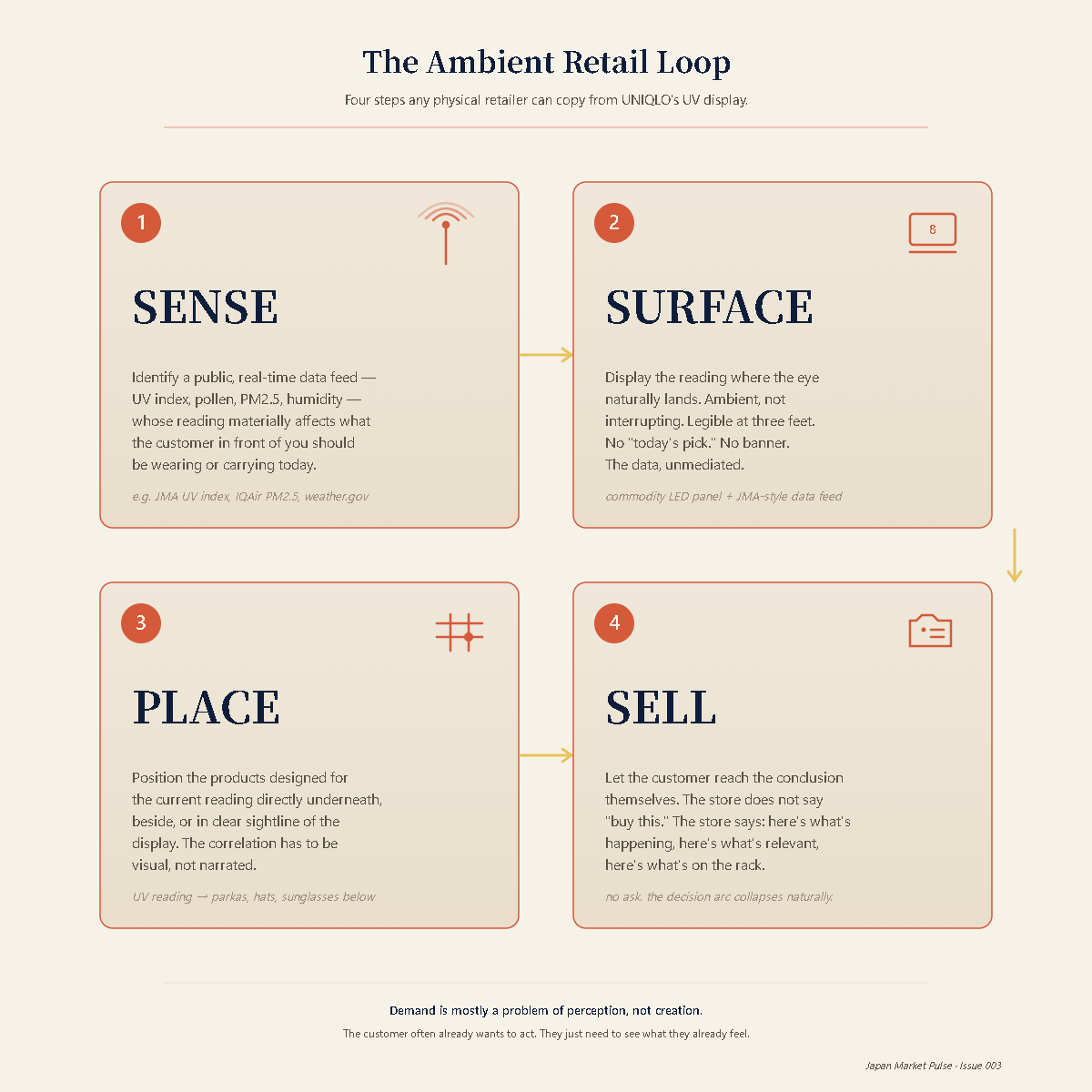
Sense. Identify a public, real-time data source whose reading materially affects what the customer in front of you should be wearing, eating, breathing, or carrying. UV index is one. Air quality (PM2.5) is another. Pollen count is a third. Outdoor temperature, humidity, particulate ozone, even local Strava activity heat-maps — all are publicly available.
Surface. Display the reading where the customer’s eye naturally lands when they enter the relevant product zone. The fixture has to be ambient — not interrupting, not requiring a tap or a scan — and it has to be legible at three feet.
Place. Position the products designed for the current reading directly underneath, beside, or in clear sightline of the display. The correlation has to be visual, not narrated. Words like “today’s pick” undermine the signal — they make the customer suspect a sales tactic.
Sell. Let the customer reach the conclusion themselves. The store does not say “buy this.” The store says: here is what’s happening, here is what’s relevant, here is what’s on the rack. The decision arc collapses naturally. There is no ask.
The four-loop pattern is transferable across categories. A pharmacy chain can do it with pollen and antihistamines. A grocery chain can do it with humidity and shelf-stable bread. A coffee chain can do it with morning temperature drop and seasonal hot drinks. None of these is a futuristic technology project. They are all instances of the same insight: demand is mostly a problem of perception, not creation.
What UNIQLO has done is the cleanest, quietest demonstration of that insight on a Japanese sales floor in years. The display is small. The implementation is unflashy. The implication is enormous.
What This Teaches Anyone Outside Japan
UNIQLO operates roughly 2,543 stores worldwide, including 794 in Japan and 1,002 in Greater China — the rest spread across the United States, Europe, and Southeast Asia. Fast Retailing, the parent, posted first-half FY2026 revenue of ¥2.06 trillion, up 14.8% year on year, after a year in which Tadashi Yanai, the founder, reaffirmed a long-term goal of ¥10 trillion in annual sales. Whatever UNIQLO pilots in Tokyo this spring is likely to land in stores from Singapore to Manchester to São Paulo within an eighteen-month window.
The UV display is small enough, and modular enough, to travel. The hardware is commodity LED. The data feed swaps regional weather agencies for the JMA. The product assortment underneath localizes to the climate. There is no reason a UNIQLO in Madrid couldn’t display the Spanish Met Office’s UV reading by July 2027.
For non-Japanese retailers and brand strategists watching from outside, three things are worth noting.
Japan keeps producing the next generation of retail playbooks. Convenience-store food culture, conveyor-belt sushi, capsule hotels, the mu-aesthetic of MUJI, the pricing-architecture of Daiso, the bespoke configurator culture of Toyota — most of these were Japanese before they were global. Quiet ambient retail, with environmental data as a fixture, looks like the next addition to that list.
Climate is rewriting the merchandising calendar. What used to be a stable seasonal rhythm is now a noisy, drifting curve. Retailers that anchor to the calendar will be misaligned by weeks at a time. Retailers that anchor to today’s actual data will be aligned daily. The cost of acquiring and displaying that data has fallen close to zero. The strategic cost of not doing it is rising.
Quiet wins over loud. UNIQLO’s UV display is the antithesis of most “retail innovation” coverage in the trade press, which tends to feature large gestural projects — robot baristas, holographic mannequins, AI fitting-room mirrors that don’t work. The UV display is one screen, one data feed, one product zone. Cost: low. Cognitive load on the customer: zero. Effect on conversion: probably meaningful, especially over the long upward UV curve.
The screen wins because the customer wins. And the customer wins because, for once, the store is treating them like an adult — not pushing, not narrating, not optimizing, just exposing the relevant fact and trusting them with it.
That kind of retailing is rare. It is also, in the end, the only kind that will scale once the loud kind has exhausted itself.
If you found this useful, you might also enjoy Japan Market Pulse Issue 002 — “Bentley Hired Anthropologists to Understand Japan’s Ultra-Rich”, on the rise of customer ethnography in luxury retail.
Japan Market Pulse is a fortnightly briefing on consumer-and-retail trends in Japan, written for non-Japanese brand strategists. Subscribe at ketchups.co.
Sources & further reading
- Japan Meteorological Agency — UV Index — the public dataset UNIQLO is using inside its stores.
- Long-term Trend of Solar UV Radiation — JMA — Tsukuba’s +33.0 kJ/m² per decade trend.
- UNIQLO: C Spring/Summer 2026 — New York Style Guide — Clare Waight Keller’s collection notes.
- UNIQLO unveils UNIQLO: C Spring/Summer 2026 — Alvinology — sunglasses and accessories detail.
- Fast Retailing — Results Summary (FY2026 H1) — store count and revenue.
- Fast Retailing shares soar after Uniqlo lifts profit forecast — CNBC — H1 FY2026 numbers.
- Japan Sun Care Products Market — IMARC — $828M (2024) → $1.36B (2033), 5.69% CAGR.
- Sun Protection — Japan Statista Market Forecast — sub-segment growth detail.
- 25 top uses of the Internet of Things in retail — Insider Trends — Sephora, IKEA, Nordstrom precedents.
- 13 Retail Companies Using Data to Revolutionize Shopping Experiences — SmartData Collective — Color IQ and beacon detail.
- The influence of climate change on skin cancer incidence — PMC review — biological context for the UV trend.
- Global assessment of surface UV radiation and melanoma incidence 1990-2021 — Nature Sci Reports — global UV dose evidence.
- UPF Sun Protective Clothing Market — Business Research Insights — apparel-side sizing.
- Five in a row: Uniqlo eyes another record profit — Inside Retail Asia — multi-year context for Fast Retailing.
Tags: Retail, Japan, Data Visualization, UNIQLO, Retail UX, Climate, Merchandising
If you’re interested in this topic, the Japanese market more broadly, or what KETCHUPs is working on, we’d love to hear from you — please reach out via our contact form.
If you’re interested in this topic, the Japanese market more broadly, or what KETCHUPs is working on, we’d love to hear from you — please reach out via our contact form.
Japan Market Pulse is a weekly read on what the Japanese consumer-tech, food, and mobility markets are choosing to do, written for international operators who want to know what is happening before it shows up in the global trade press.
Subscribe at ketchups.co/japan-market-pulse.