

Both statements are true at the same time, and the gap between them is the most useful thing a foreign food or retail brand can study about Japan right now. Inside the ¥1,000 wall, the “ramen conglomerate” and the Seattle chain that Yoshinoya just bought.
If you wanted a single bowl that explains the Japanese consumer economy in 2026, you could do worse than a bowl of ramen. It is cheap, universal and emotionally loaded. It is also priced almost exactly where it was a decade ago in the minds of customers, even though almost everything that goes into it has become more expensive. Wheat, pork, nori, bamboo shoots, gas, electricity, rent and wages have all moved up. The sticker price in the window has moved far less, because a whole country has an unspoken belief that a standard bowl should cost about ¥1,000.
That tension produced two headlines in the same month of 2026, and they look as if they cannot both be right. On July 1, the research arm of Teikoku Databank reported that Japan’s ramen shop market reached an estimated ¥885.5 billion in fiscal 2025, the highest since its series began in 2010, and that it could pass ¥1 trillion as early as fiscal 2027. One day later, on July 2, Tokyo Shoko Research reported that 36 ramen shops went bankrupt in the first half of 2026, up 44.4% on the year and the highest first-half total since its comparable records start in 2009.
A record market and a record first-half bankruptcy count. I have spent a good part of the last few weeks reading the underlying reports, and the contradiction turns out to be the story. This is not a market that is dying. It is a market that is sorting itself, quickly and brutally, into winners with scale and survivors without it, and into price tiers that have stopped behaving like one market.
For international operators, this is not a niche food story. The same forces are hitting every Japanese business that sells a low-priced daily purchase to a customer who refuses to be charged more. Understanding how ramen is responding is a preview of what convenience stores, family restaurants, coffee chains and even consumer-goods brands are about to face. It also contains a surprising export angle, because the Japanese company that wants to become the world’s biggest ramen seller by servings has just bought a chain in Seattle.
Here is what the numbers actually say, who is winning, who is losing and what to take from it.
The Paradox: A ¥885.5 Billion Market With Half the Profit
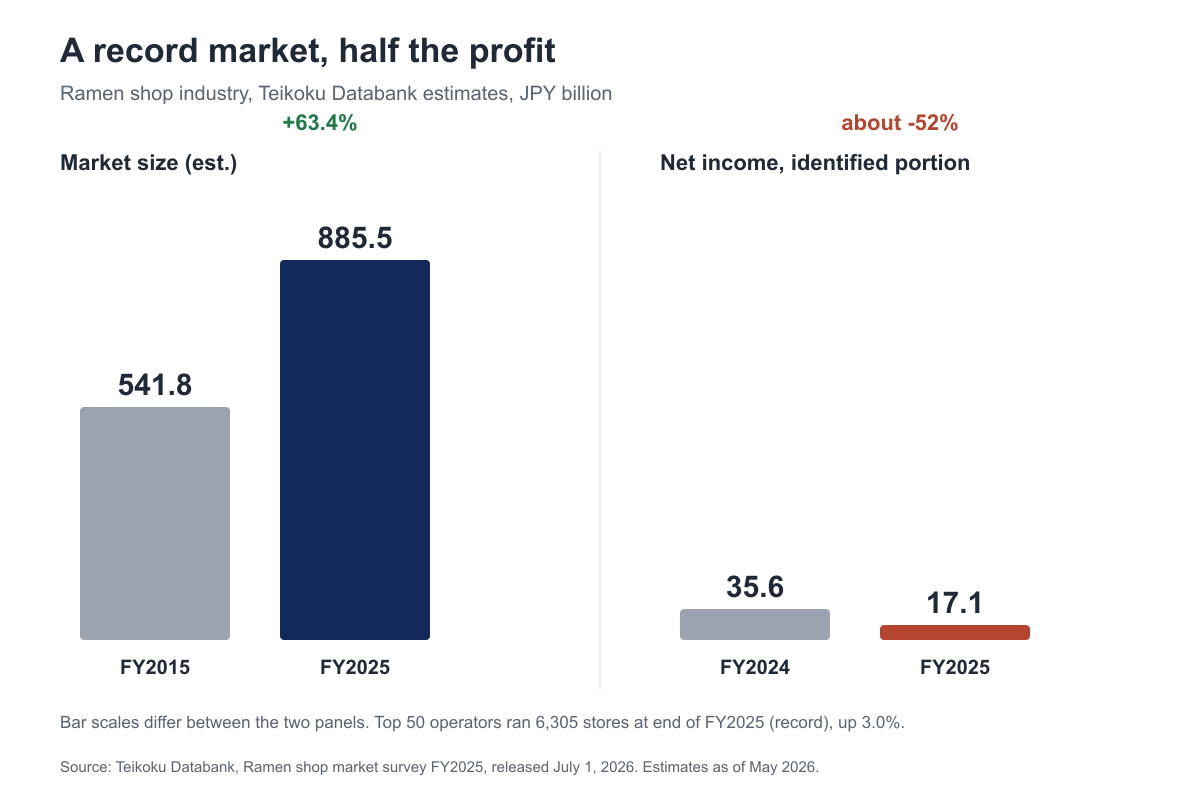
Start with the good news, because there is a lot of it. In its July 1 release, Teikoku Databank estimated the ramen shop market at ¥885.5 billion for fiscal 2025. That is a record for the series, up 63.4% from the ¥541.8 billion it estimated for fiscal 2015. Its survey covers chain ramen shops, regional ramen shops and Chinese restaurants whose main product is ramen. It excludes operators that only franchise.
The industry is also physically bigger than it has ever been. Teikoku counts the main chains of the top 50 ramen operators at 6,305 stores at the end of fiscal 2025, a record, against 6,122 a year earlier. That is 183 net new stores, or 3.0% growth. Expansion is concentrated in tourist areas, station fronts and downtown districts, while suburban roadside competition has become more intense and slowed the pace.
Now the other half of the picture. The same release estimates the net income of the identified portion of the industry at ¥17.1 billion in fiscal 2025, compared with ¥35.6 billion in fiscal 2024. Profit roughly halved while the market hit a record. Put differently, Japan ate more ramen in more places, and the industry earned about half as much from it.
The breakdown by shop is just as telling. In fiscal 2025, 38.8% of surveyed operators reported higher sales, down from a peak of 56.3% in fiscal 2023 and below 40% for the first time in four years. Some 47.2% reported flat sales, the highest share in 20 years. Another 14.0% reported lower sales, up for a second consecutive year. On profit, 38.5% of shops reported an increase, still the largest group, but 34.8% reported a decline, a sharp rise from a year earlier.
Read those together. The average experience of a ramen operator in Japan right now is not boom and not bust. It is a squeeze: sales roughly flat, costs up, margin disappearing. A record top line is being produced by a growing number of stores, a growing number of tourists and moderately higher prices, and almost none of it is reaching the owner’s bank account.
One caveat on definitions, because Japanese industry reports are not always consistent. Teikoku’s market figure is an estimate built from its company databases and external information as of May 2026. It is a useful trend line, not an audited number.
Two Scorecards, Two Stories: Why Tokyo Shoko Research and Teikoku Databank Disagree
Anyone who tries to follow ramen bankruptcies in English quickly runs into numbers that look contradictory. One source says the number fell in 2025 and another says it hit a first-half record in 2026. Neither source is wrong. They are measuring different things, and it matters which one you are looking at.
Tokyo Shoko Research, usually shortened to TSR, and Teikoku Databank, usually shortened to TDB, are the two big credit-research companies in Japan. Each keeps its own database and applies its own filters. Both count only formal, court-involved bankruptcies of operators with liabilities of at least ¥10 million. Neither counts the much larger number of shops that simply shut the door, which is how most small ramen shops end.
Here are the figures as each firm reports them.
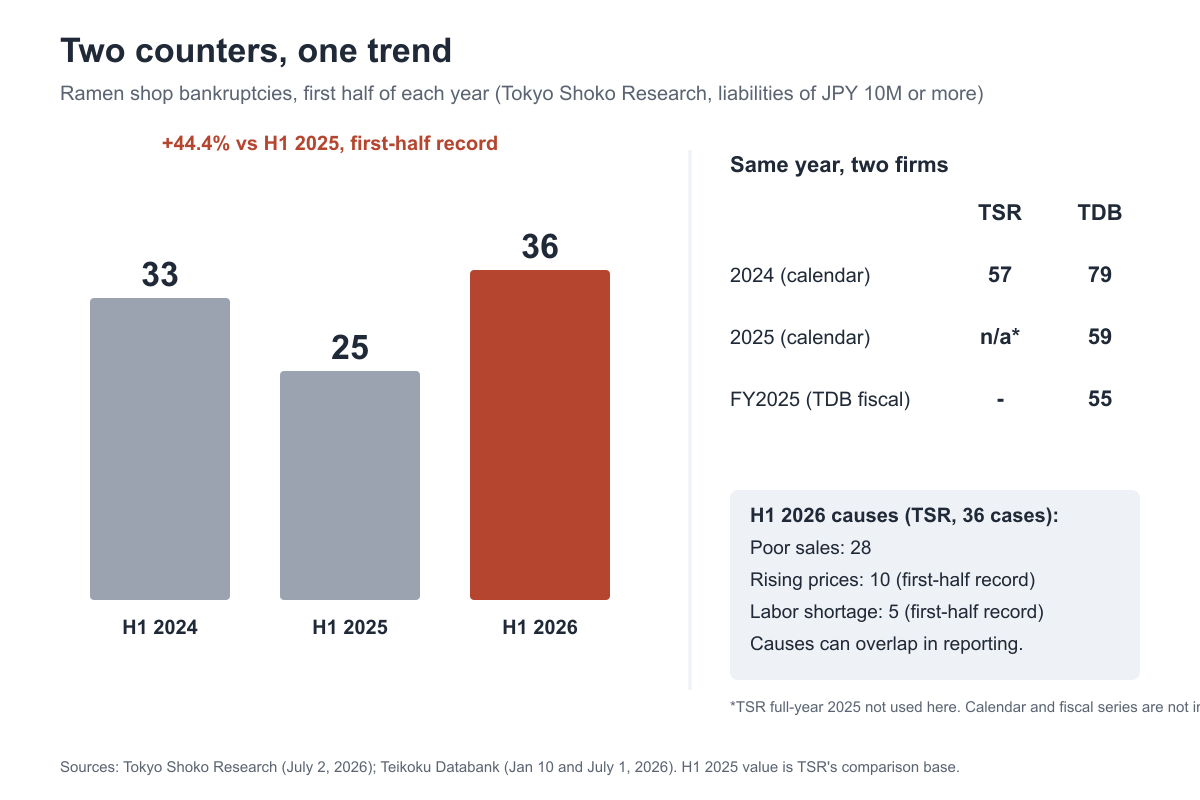
TDB reported that 79 ramen shop operators went bankrupt in calendar 2024, the highest annual figure on record, and 59 in calendar 2025. That is a decline of 25.3%, the first year-on-year drop in four years. In its separate fiscal-year market report, TDB gave 55 bankruptcies for fiscal 2025, down two years in a row from a peak of 75 in fiscal 2023. The calendar-year and fiscal-year series are not interchangeable, so I will keep them apart.
TSR, in its July 2 report, counted 36 ramen shop bankruptcies in the first six months of 2026. That compares with 33 in the first half of 2024 and about 25 in the first half of 2025.
So the sequence looks like this. 2024 was a record year on TDB’s calendar-year count, and TDB’s 2025 figure fell, which is why it headlined a decline. The two firms’ full-year series differ, so I would not stretch that relief too far. Then the first half of 2026 broke the previous first-half record again on TSR’s method. The two stories are the same story at different moments.
What drove the reversal? TSR’s breakdown for the first half of 2026 is specific. Of the 36 cases, 28 cited “poor sales” as the main cause, which is about 78% of the total. Ten were classed as “rising prices” bankruptcies, up 66.6% and a first-half record. Five were classed as “labor shortage” bankruptcies, up 25%, also a first-half record. TSR pointed to a weaker yen and tensions in the Middle East, which have pushed up energy and utility costs, as the new pressure on top of the ingredient inflation seen in 2024 and 2025.
A consultant quoted in Japanese business press, Makoto Sugita, gave a blunt reading that I find persuasive. In his view the decline in 2025 owed more to external conditions easing for a while than to structural improvement, and the sector remains dependent on things it cannot control, such as exchange rates and geopolitics. TDB’s own cautious language points the same way: it suggested that bankruptcies of distinctive but struggling shops might fall as larger companies absorb them, which it called a possibility, not a certainty.
The wider restaurant sector is not much better. TSR counted 509 restaurant bankruptcies in the first half of 2026, up 5.3%. Ramen is not an outlier. It is an unusually clear case of a problem that exists across the whole low-ticket food service business.
Inside the Bowl: Ingredient Costs Are 41% Above Where They Were in 2020
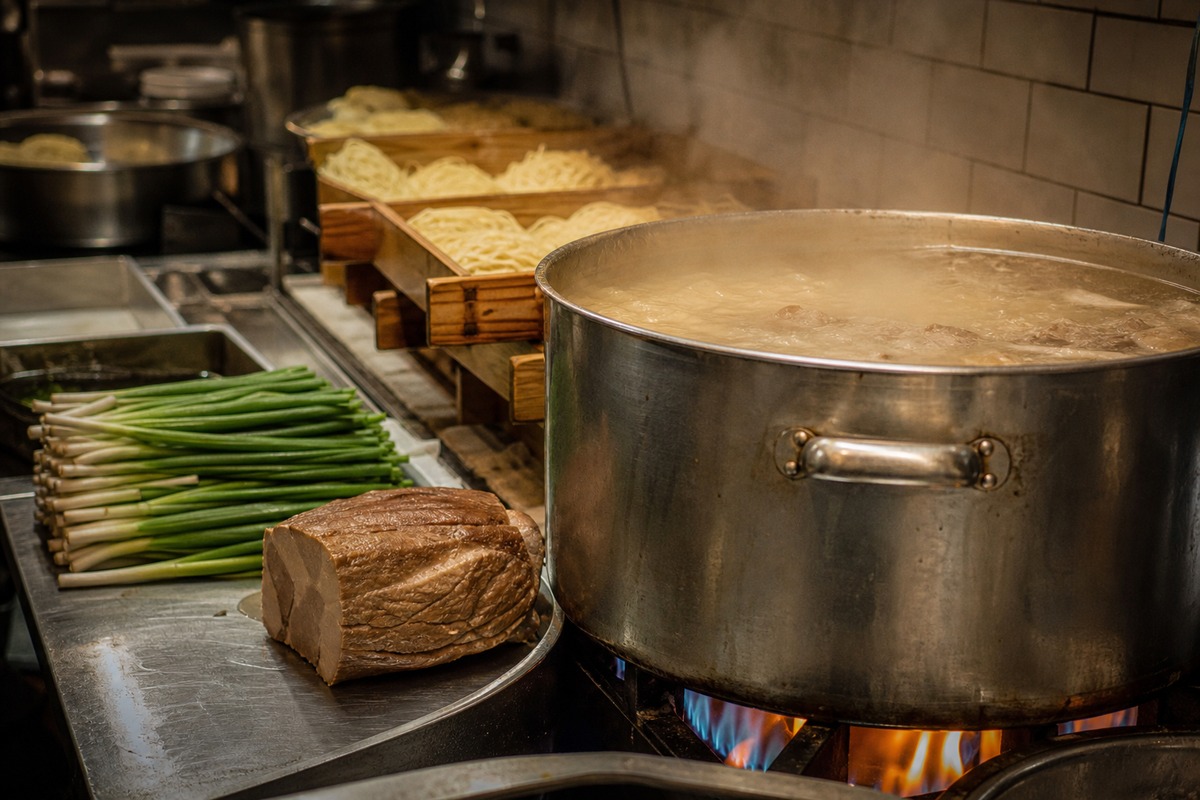
To see why a growing market can still kill small shops, you have to look at the unit economics. TDB publishes what it calls a “ramen cost index,” which tracks the combined cost of ingredients for a standard tonkotsu ramen, using prices in Tokyo’s 23 wards. With the 2020 average set at 100, the index reached 141 in 2025.
That means the raw materials for a bowl of ramen cost about 41% more than they did five years earlier. The raw materials are not exotic. Pork bones and back fat for the soup, wheat for the noodles, dried seaweed, bamboo-shoot menma, vegetables and cooking oil. TDB’s analysis says wheat, vegetables and oils remain at high levels and that labor costs are also rising. The fuel and electricity needed to simmer broth for many hours add another layer, and the Middle East situation has pushed that layer up again in 2026.
Now put those numbers beside the price. In most of Japan, a basic bowl has remained in the neighborhood of ¥800 to ¥1,000 for years. A shop that raises its standard bowl by ¥100 has raised the price by roughly 10% on a headline that customers watch closely. A shop that does not raise it eats the cost. Neither choice is comfortable, and owners are acutely aware that a customer who feels cheated will simply walk to the next shop, or to a convenience store, where instant noodles and frozen ramen are an easy substitute.
TSR’s analysts make a structural point that I have not seen in English coverage. Ramen is unusually exposed because spend per customer is capped. An izakaya or a family restaurant can raise average spend by selling drinks or side dishes, which are high-margin. A ramen shop sells one bowl, plus a topping and perhaps a side of gyoza or rice. There is only so much more you can extract from a single visit, which makes the headline price extremely powerful and extremely sticky.
Labor adds to the pressure. TSR’s data shows five labor-shortage bankruptcies in the first half of 2026 alone, a first-half record. Many ramen shops are run by one or two people who work extraordinary hours. When a key cook leaves, retires or falls ill, there is often no one to replace them, and the shop simply stops. The formal bankruptcy count does not capture those closures at all.
Here is my own read on what the cost index implies. The industry can survive 41% higher input costs only if one of three things happens. Prices rise by a similar amount, which customers resist. Volume rises enough to spread fixed costs, which is what chains do. Or costs are cut through process redesign, which is what the efficiency playbook later in this piece is about. The shops that cannot do any of the three are the ones in the bankruptcy tables.
The ¥1,000 Wall and the Three-Tier Market
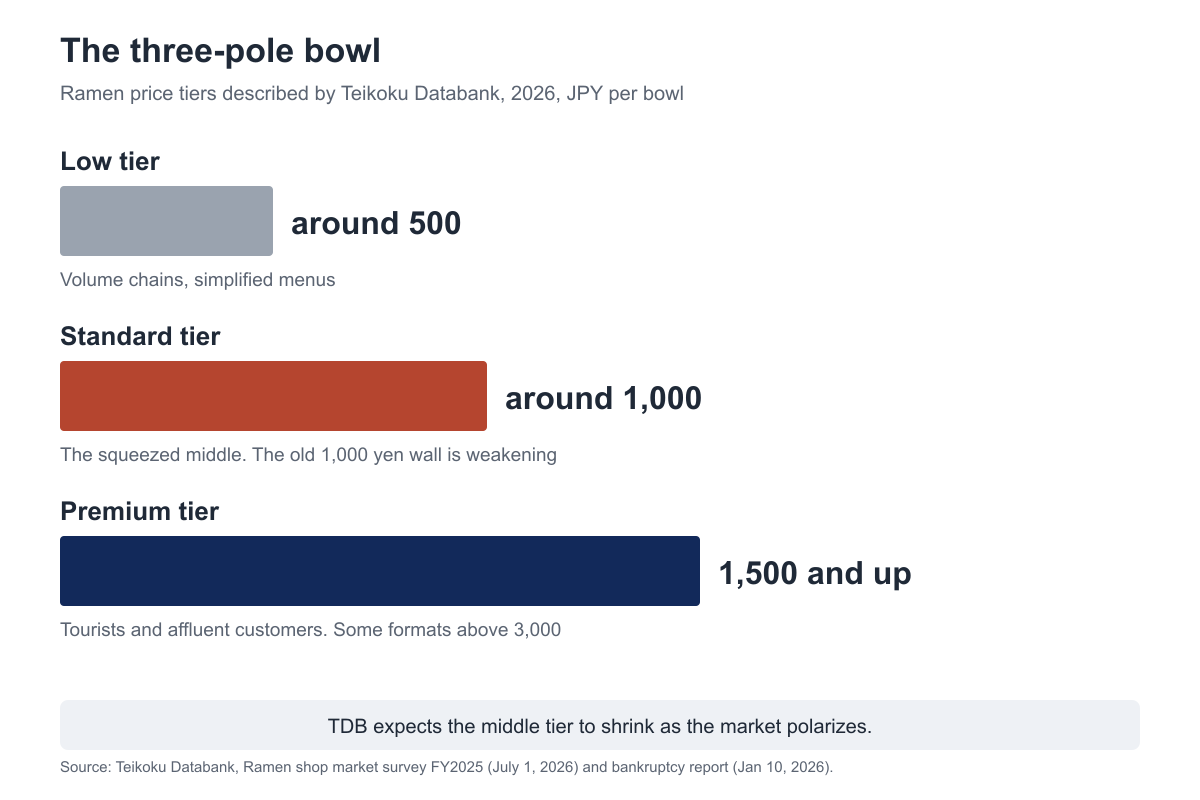
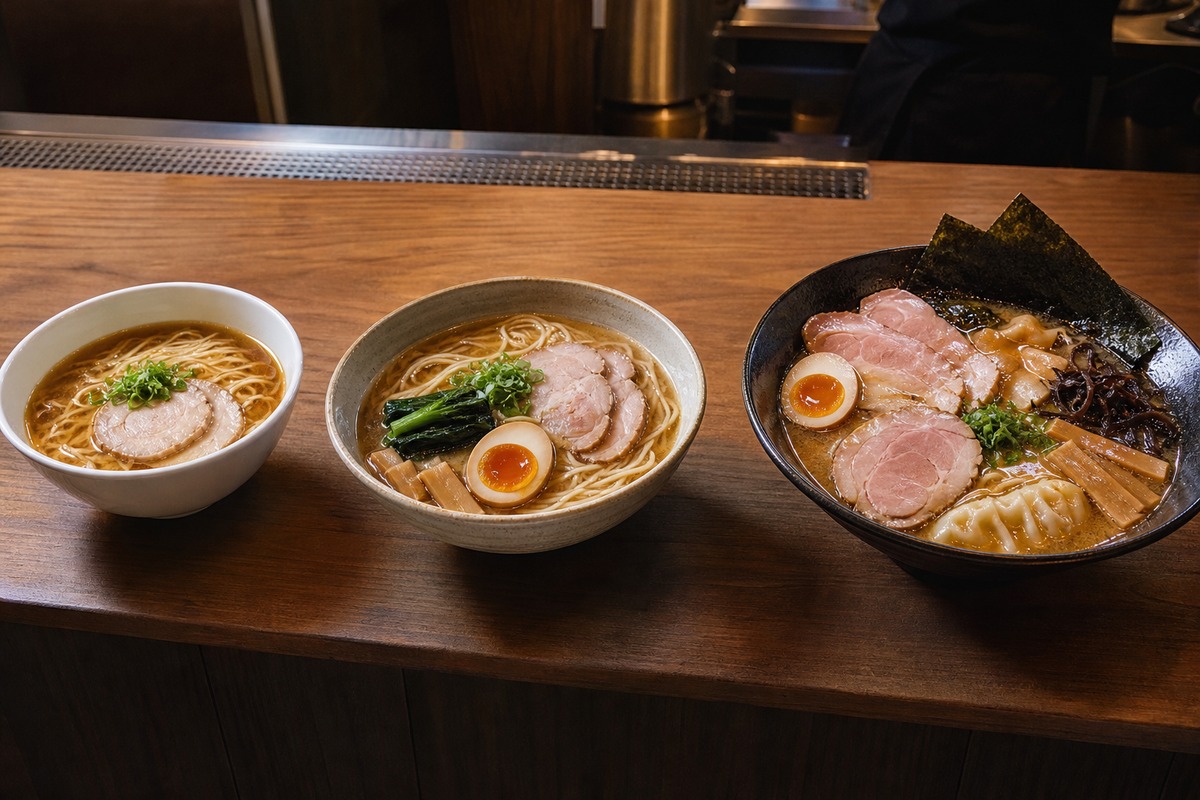
Teikoku Databank’s July report introduces a phrase I expect to keep seeing: “polarization” of price strategy, or more literally, a three-pole market. The old assumption was that ramen has one price, around ¥1,000, and a slow drift above it is tolerated only reluctantly. The new picture has three poles.
At the bottom is the ¥500 tier. These are very cheap bowls, usually at large chains or operators that have rebuilt their cost structure around volume and simplified menus. TDB describes this tier as around ¥500 per bowl.
In the middle is the traditional ¥1,000 tier. This is the standard bowl, the one the typical shop has been selling for a decade, and the one under the most stress. TDB’s report describes the old psychological ceiling of ¥1,000 as weakening, but it also warns of a trap. If a mid-priced shop raises its price without adding visible value, customers may conclude that it is neither cheap nor special. Some will trade down to the ¥500 chains. Others will trade up to premium shops where the higher price seems justified. The report expects the middle tier to shrink as the market continues to polarize.
At the top is the premium tier, ¥1,500 and above, aimed at inbound tourists and wealthier customers. TDB’s January report also noted premium formats priced above ¥3,000 per bowl, built on better ingredients, a story and a higher-quality experience. These shops do not compete on price at all. They compete on being a destination.
The consequence is stark and it is not unique to ramen. In a polarizing market, the middle is the dangerous place. A shop at ¥1,000 has no scale advantage over the ¥500 chain and no experience advantage over the ¥3,000 destination. It is exposed to every cost increase and it is not allowed to pass them on.
I think this matters for international brands because it describes what is happening to Japanese consumer pricing generally. Japanese shoppers have become more willing to accept price increases in some places. TDB itself noted that consumers have become more accepting of price rises. But acceptance is selective. It is granted to products that clearly justify it, such as premium or experiential ones, and withheld from products that simply cost more. A foreign brand arriving with a middle price and a middle story will meet the same squeeze.
There is one more nuance. The wall is weakening, not broken. A ¥1,000 bowl still anchors expectations, and the shops that raise prices fastest are in tourist districts and station areas, where footfall is high and international visitors do not carry the same price memory.
Who Is Actually Closing: Small Shops, Small Debts, Few Successors
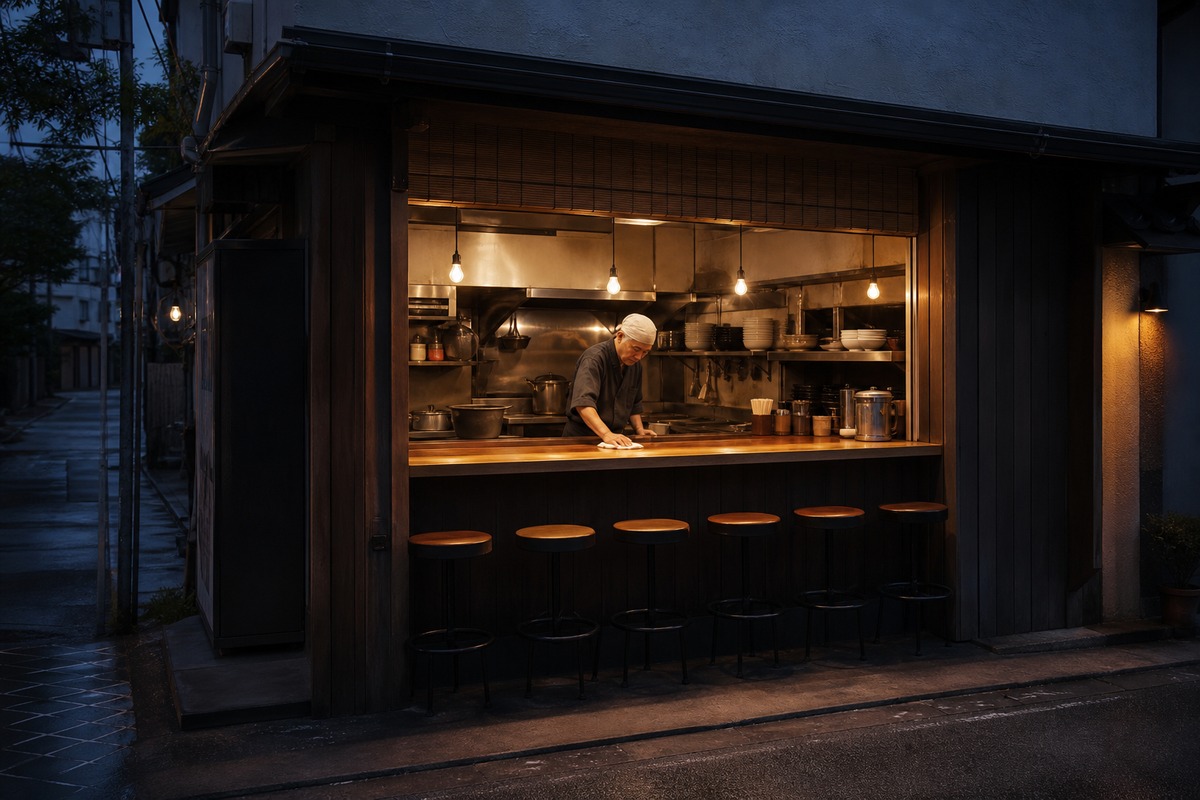
If you imagine the typical ramen bankruptcy as a famous shop that overreached, the data corrects that image. It is mostly small and quiet.
In TSR’s first-half 2026 data, 31 of the 36 bankruptcies, or 86.1%, involved liabilities of under ¥100 million. Average liabilities per case were about ¥41 million, down from about ¥66 million a year earlier, roughly 40% smaller. Companies with capital of under ¥5 million made up 77.7% of cases, and there were no bankruptcies among companies with capital of ¥50 million or more. TDB’s calendar-2025 data shows a similar structure: 42.3% of cases involved capital under ¥1 million, and about 80% of its fiscal-2025 cases were small operators with capital under ¥10 million, including individual shops.
By region, TSR counted 13 cases in the Kanto area, 10 in Kinki and 6 in Tohoku. That is a spread rather than a Tokyo story. Ramen shops are failing everywhere because the cost structure is national.
This small scale has several implications. First, the reported bankruptcies understate the real churn. TDB says explicitly that its counts exclude shops that closed without legal proceedings, including many individual shops, so the real number of exits is probably higher. Second, the damage is not evenly spread. A ¥41 million failure is a personal tragedy for the owner but it does not move the macro numbers. It does, however, remove a shop from a neighborhood.
Third, and most importantly, many of these shops are not failing because the ramen is bad. TDB describes shortage of successors as a major factor for small shops: an owner reaches retirement age and no one wants to take over a business with thin margins, long hours and rising bills. TSR adds that repayments on pandemic-era zero-interest loans, the so-called zero-zero loans, are still a burden. When an owner has been carrying debt since 2020 and costs have risen 41% since then, the margin for error is gone.
This is the pool from which the next phase of consolidation is drawn. Shops with good products and tired owners are exactly what a chain or an investment fund wants to buy.
The Efficiency Playbook: Ticket Machines, Central Kitchens and Soupless Noodles
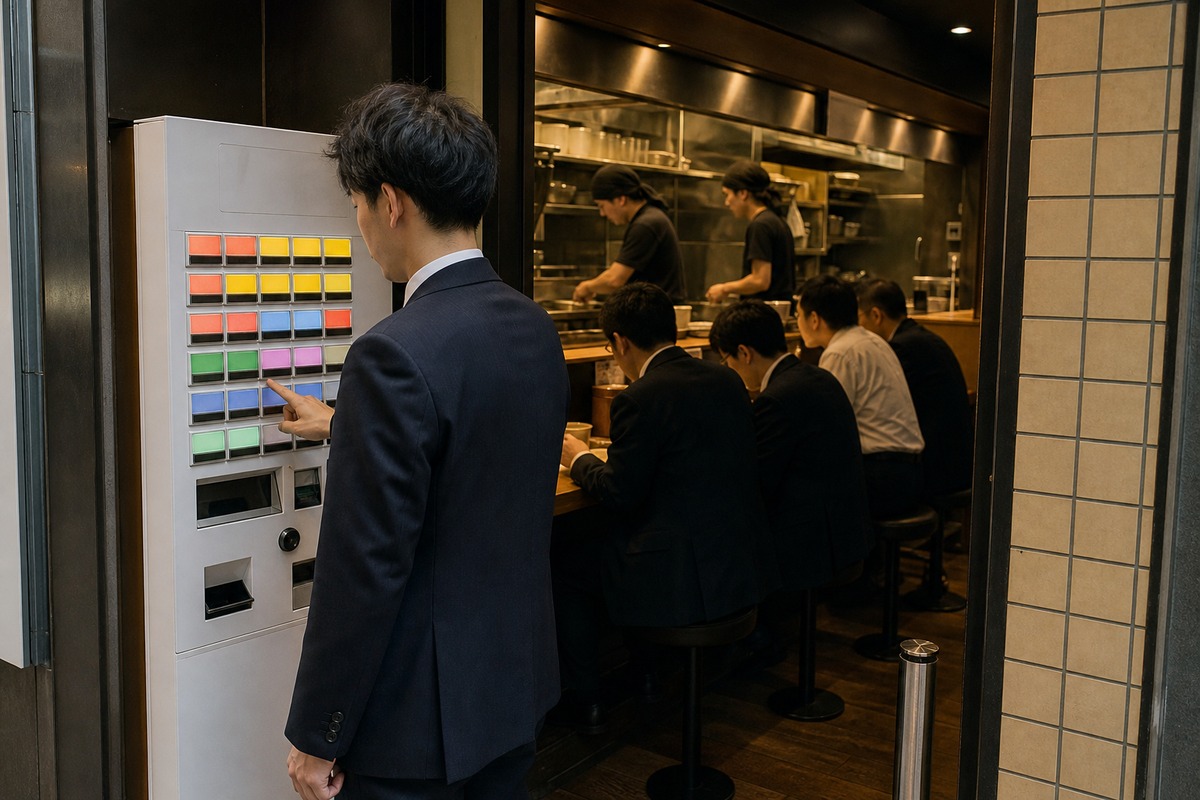
If the reports have a hopeful theme, it is that the survivors are changing how they work. TDB’s January analysis describes the shift as moving from “craft competition” to “efficiency management,” and it lists what that looks like in practice. The list is worth reading as a set of operating ideas that apply well beyond ramen.
Cashless ticket machines are first. The customer pays at a machine by the door and hands a ticket to the cook. This removes a cashier, reduces errors, speeds turnover and makes the menu easier to price consistently. Tablet and chat-based ordering extend the same idea inside the shop.
Central kitchens come next. Instead of every shop boiling bones for 12 hours, a central facility produces the soup base, the chashu pork and other semi-finished components, and shops finish and serve them. This lowers labor skill requirements, stabilizes quality and spreads fixed costs, though it also changes what customers think they are buying.
Third is the rise of soupless formats. TDB highlights “abura-soba,” a style of ramen served with oil and sauce at the bottom of the bowl and no broth. Skipping the soup removes the most expensive and labor-intensive part of the operation: hours of simmering, large volumes of ingredients and fuel. The product can be priced competitively and made in minutes.
Fourth is a deliberate focus on profit rather than volume. TDB describes shops designed so that they can make a profit even with fewer customers, through smaller menus, tighter hours and premium positioning.
Fifth is supply-chain management and digital tools: group purchasing, inventory tracking and data on which toppings and add-ons actually earn money.
None of this is glamorous, and some of it will offend purists. But it is exactly the kind of redesign that a business under cost pressure must do. What strikes me is how close this is to the logic that reshaped Japanese convenience stores and family restaurants earlier. Standardize the back end, protect the part the customer can see, and use technology to reduce the number of skilled hands needed per bowl.
For a foreign brand, there is a useful lesson in what is not on the list. Nobody is solving the problem by asking the Japanese customer to pay much more for the same thing. The adjustments are on the supply side, and the price conversation is reserved for formats that visibly offer something different.
The Ramen Conglomerate: When Chains and Funds Buy the Counter
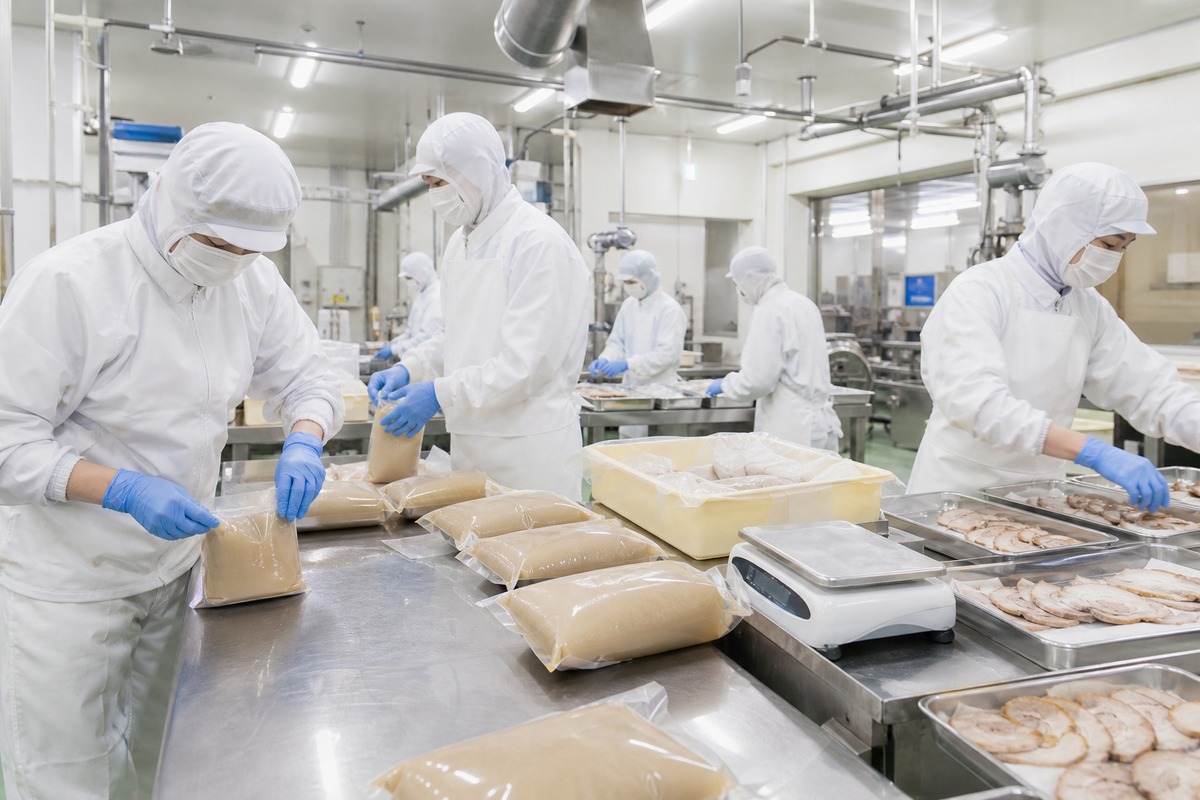
The most interesting phrase in the January TDB release is one that sounds like a joke: the “ramen conglomerate.” TDB uses it to describe a model it expects to take hold in 2026, in which shops that focus on flavor partner with, or are absorbed into, central companies that handle scale and efficiency.
The logic is straightforward. A small shop has a strong product and weak management tools. A larger operator has procurement power, systems, financing and recruitment, but needs distinctive brands. Combining them lets the small shop keep its identity while the group handles purchasing, back-office work and digital tools. TDB describes ramen majors, restaurant chains and investment funds as acquiring or merging with small shops facing succession problems and rising costs. The July report adds that non-noodle restaurant companies are also entering the ramen market and that smaller chains are joining larger restaurant groups or regional chains to share sourcing and marketing.
It is worth being careful about what this means. For a customer, it may be invisible: the sign outside the shop looks the same. For the economy, it means the industry is changing from a long tail of independent artisans into something more like a layered structure, where independent brands operate on top of shared infrastructure. In that structure, the ramen “craft” does not disappear, but the owner who does everything, from boiling bones to doing the taxes, becomes rarer.
TDB’s forecast follows from that. It suggests bankruptcies of distinctive shops could continue to decline as groups acquire them. That is not an unqualified positive. A shop that is acquired is not a shop that went bankrupt, but it may still be a shop that no longer belongs to its founder. In effect the bankruptcy count may be falling for the wrong reason: the failures are being converted into acquisitions, which do not appear in the failure tables.
This is a familiar pattern in retail and food service. When margins compress, the number of independent operators shrinks, the chains grow and the surviving independents either specialize or join a group. Ramen is now moving in the same direction. Foreign investors and operators looking for entry points into Japanese food service should pay attention, because this is where acquirable brands with real customer loyalty are coming to market.
The Export Route: Yoshinoya Buys Into American Ramen
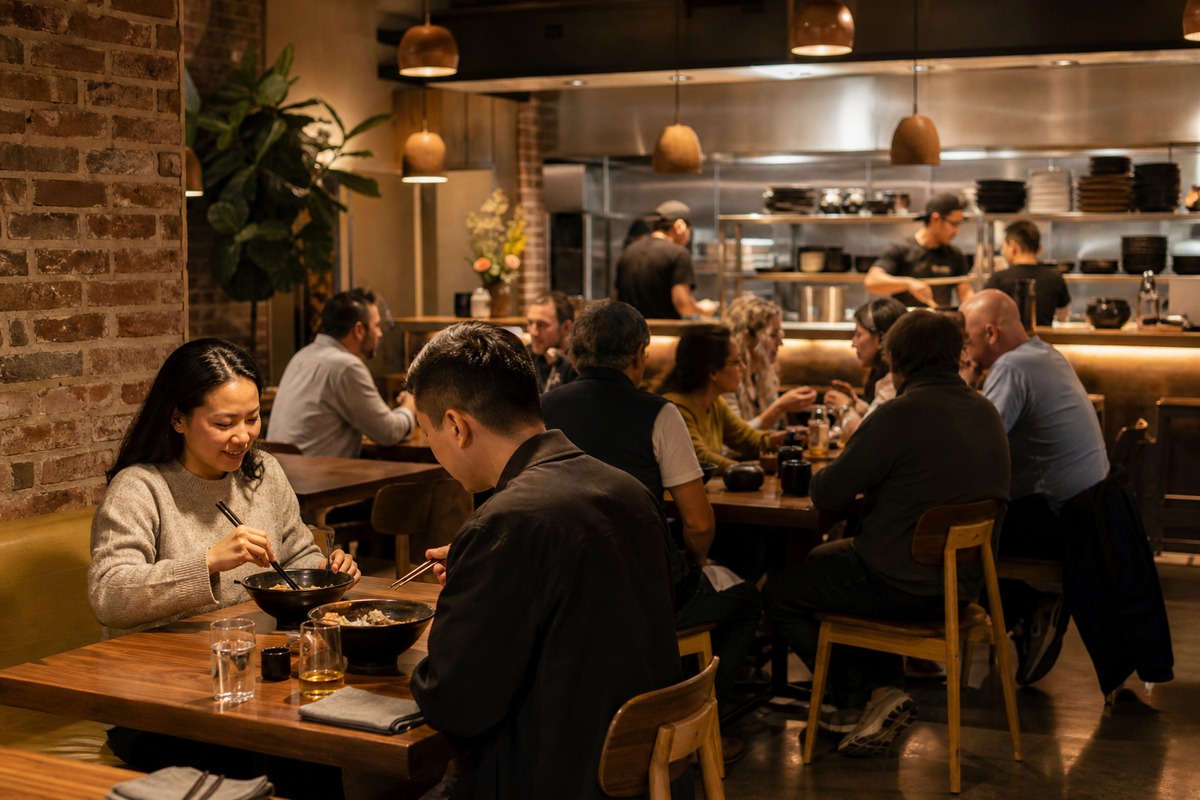
Which brings us to the surprising twist. If the domestic market is a squeeze, where does a large Japanese operator go to find growth? The answer, increasingly, is abroad, and the clearest recent example is a deal in Seattle.
In July 2026, Yoshinoya Holdings, best known in Japan and overseas for beef bowls, announced that it would acquire a 70% interest in Kizuki International LLC, the parent of Kizuki Ramen & Izakaya, through its US subsidiary. Trade press reported the deal at $28.7 million, with part of the price, about $7.5 million, paid in Yoshinoya shares and the rest in cash, plus earn-out payments tied to Kizuki’s performance through 2029. Later reports said the acquisition was completed on September 1, 2026.
Kizuki is not a Japanese chain exported abroad. Its first restaurant opened in Bellevue, Washington, in 2012 under Brandon Ting, a Taiwanese-American restaurateur, and the operating company, Kizuki International LLC, is described in Yoshinoya’s materials as established in Seattle in 2016. The chain now has 17 locations concentrated on the West Coast and in Texas, with production facilities in Seattle, Texas and San Francisco. Trade press reported 2025 revenue of about $37.2 million and operating income of about $1.9 million, after an operating loss in 2022 and steady improvement since. Ting remains chief executive and the brand stays as it is. A simple division of revenue by locations gives roughly $2.2 million per store, though that ignores part-year openings and the production sites, so treat it as an indicator only.
The strategic statement matters more than the price. Yoshinoya has said it wants to become the world’s largest ramen provider by servings by fiscal 2034, positioning ramen as a third pillar alongside beef bowls and udon. Its president, Tetsuya Naruse, described the United States as a strategically vital market. The company already operates about 100 US units of its own and roughly 2,000 outlets worldwide, mostly in Asia, and owns a ramen manufacturing business that supplies noodles and soup in Japan and abroad.
Three points are worth drawing out. First, the buyer is not buying a Japanese brand to export. It is buying an American operator with a working local model, which tells you what an experienced Japanese chain thinks is easier: acquiring local fluency rather than transplanting a domestic format. Second, the deal structure, a 70% stake with the founder staying on and earn-outs lasting until 2029, is the same pattern as the domestic ramen conglomerate, applied overseas. Third, the economics are different. Overseas, a bowl of ramen can be sold at a price that would be unthinkable in Tokyo, because the ¥1,000 wall does not exist in Seattle. The same product that is stuck in a price-war at home can be a premium meal elsewhere.
That last point is probably the most important structural reason why Japanese food companies are pushing outward. Other Japanese ramen businesses are also expanding abroad. Smaller chains such as Ichibanken in Nagoya have announced overseas plans, and TDB’s July report notes that chain operators are growing at home and abroad. The reasons are domestic: higher costs, a flat customer base and a tiering of prices that rewards scale. The destination is any market where Japanese food enjoys a premium and the local operator knows the real estate, labor and customer.
What Operators Should Take From This
Here are the lessons I would pull out for anyone selling food, retail or a consumer product into Japan, or competing with Japanese brands elsewhere.
Price memory is stronger than inflation. Japanese consumers have lived through decades of flat prices, and a number like ¥1,000 acts as a mental anchor. You cannot assume that a product’s cost increase will carry over to its price. Plan to pass on costs only where your product clearly changes category, such as a premium, an experience or a convenience that did not exist before.
Avoid the middle. The ramen market is dividing into cheap, standard and premium, and the standard tier is the one under pressure. If your product has no scale advantage and no story, you will be squeezed from both sides. This applies to a foreign snack, a cosmetic or a gadget as much as to a bowl of noodles.
Read bankruptcy data with the right lens. A record bankruptcy count does not mean a market is collapsing, and a falling count does not mean it is healthy. Check who is failing, what size they are and whether consolidation is hiding failures. The ramen data shows tiny, undercapitalized operators failing while a larger market grows around them.
Look for acquisition opportunities in the wreckage. Good brands with tired owners and thin successors are the supply side of the next consolidation wave. For foreign investors and operators who are patient, partnering with Japanese owners who need scale can be easier and cheaper than building from scratch.
Redesign the operation before you redesign the product. The survivors are adopting ticket machines, central kitchens and simpler formats. They are not asking customers to accept a worse product, but they are changing the way the product is made. If your Japan plan assumes a Tokyo-style craft operation at scale, test the labor model first.
Consider the reverse route too. The same forces that squeeze ramen at home make overseas markets more attractive to Japanese operators. If you run a food business outside Japan, expect more Japanese capital, brands and operating know-how to arrive, sometimes as partners and sometimes as buyers.
Finally, treat reports with care. Different firms count different things, and market-size estimates are not audited. Where I have used a figure in this piece, I have tried to say which source it comes from and what it excludes.
Frequently Asked Questions
Q. How big is the ramen shop market in Japan?
A. Teikoku Databank estimated the market at ¥885.5 billion for fiscal 2025, a record for its series, which began in 2010. That is up 63.4% from ¥541.8 billion in fiscal 2015. The company says the market could reach ¥1 trillion as early as fiscal 2027 if the current pace continues.
Q. How many ramen shops went bankrupt in Japan in 2026?
A. Tokyo Shoko Research counted 36 ramen shop bankruptcies in the first half of 2026, up 44.4% from a year earlier and the highest first-half total since its records begin in 2009. These are formal bankruptcies with liabilities of at least ¥10 million. Full-year 2026 figures were not available at the time of writing.
Q. Why do Tokyo Shoko Research and Teikoku Databank report different numbers?
A. They keep separate databases and use different methods and reporting periods. For example, Teikoku counted 79 ramen operators in calendar 2024 and 59 in calendar 2025, while Tokyo Shoko Research’s headline figure is a first-half count. Teikoku also publishes calendar-year and fiscal-year series, which differ again. Both count only formal bankruptcies, so they miss the many shops that simply close.
Q. How much has the cost of making ramen risen?
A. Teikoku Databank’s ramen cost index, based on a tonkotsu bowl in Tokyo’s 23 wards with the 2020 average set at 100, reached 141 in 2025. That is a rise of about 41% in raw material costs over five years, with labor and utility costs also higher.
Q. What does a bowl of ramen cost in Japan?
A. Teikoku Databank describes three price bands: around ¥500 at the low end, around ¥1,000 for the standard bowl, and ¥1,500 or more for premium shops aimed at tourists and affluent customers. Some premium formats go above ¥3,000. The traditional ¥1,000 ceiling is weakening but still shapes customer expectations.
Q. Why did Yoshinoya buy a ramen chain in the United States?
A. Yoshinoya Holdings agreed to buy 70% of Seattle-based Kizuki Ramen & Izakaya in a deal reported at $28.7 million. The company says it wants to become the world’s largest ramen provider by servings by fiscal 2034 and calls the US a strategically vital market. The deal also lets it acquire a local operator with a working model instead of exporting a Japanese format.
Conclusion
The headline contradiction, a record market with a record first-half bankruptcy count, dissolves once you stop treating ramen as one market. It is a growing, polarizing and consolidating industry in which the cost of a bowl has risen faster than the price customers will tolerate, and in which the businesses with scale, systems and a clear position are pulling away from those without.
For the customer, the result is probably a better-run industry with fewer lone artisans. For the foreign observer, it is a compact case study in how Japanese consumers behave when costs rise: they resist headline prices, accept premium positioning where it is earned, and reward whoever can make an ordinary product more efficiently. The brands that learn to read those signals will find that Japan is still a very large and very profitable market. The ones that arrive in the middle, with a middle price and a middle story, will find that it is the most crowded place to stand.
If you’re interested in this topic, the Japanese market more broadly, or what KETCHUPs is working on, we’d love to hear from you — please reach out via our contact form.
Japan Market Pulse is a weekly read on what the Japanese consumer-tech, food, and mobility markets are choosing to do, written for international operators who want to know what is happening before it shows up in the global trade press.
Subscribe at ketchups.co/japan-market-pulse.