

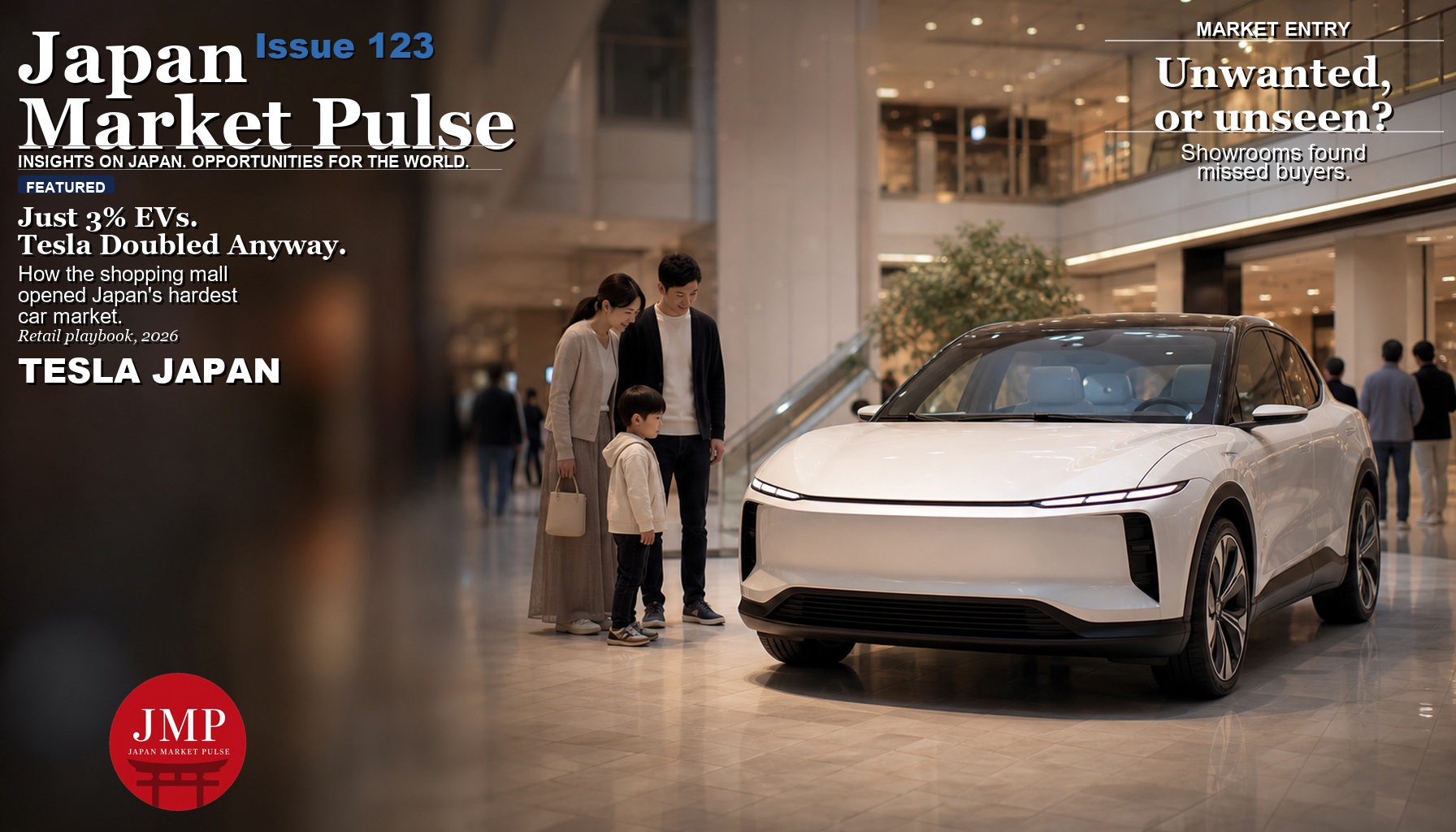
Tesla’s global deliveries fell 2.1% last quarter. In Japan, the category that is mostly Tesla jumped from 3,471 registrations to 8,014 in the same period. The surge is happening in one of the slowest EV markets in the developed world, and the playbook looks less like Silicon Valley than like a very patient Japanese retailer.
If you wanted to design the worst possible market for Tesla, you would come up with something close to Japan. It is the home of the hybrid, the home of Toyota, and a country where drivers have spent a quarter of a century being told, correctly, that a Prius is a sensible answer to almost every question. In 2025, Japan sold about 3.8 million vehicles, and only about 60,677 of them were battery-electric. Foreign brands have historically meant something specific here: a Mercedes-Benz or a BMW, bought from a polished dealership by someone who wanted to be seen owning one.
And yet Japan has become one of the most interesting Tesla stories anywhere. By industry estimates, the company delivered roughly 10,600 vehicles in Japan in 2025, close to double the year before. It then sold an estimated 12,000 in the first six months of 2026 alone. In June, it registered an estimated 4,000 cars in a single month, a record. The Model Y was the best-selling foreign-brand vehicle in the country for the first half of 2026, counting gasoline cars as well as electric ones, according to figures based on JATO Dynamics data.
I have lived in Japan long enough to be skeptical of any foreign brand’s “Japan breakthrough” story. Most of them turn out to be a good quarter, a weak yen and a press release. This one is different, partly because the numbers are large, but mostly because of how Tesla got them. It stopped behaving like an American internet company and started behaving like a Japanese retailer. It also picked up an enormous policy tailwind, which is about to get weaker.
Here is what happened, what actually drove it, and what anyone trying to sell an unfamiliar product to Japanese consumers should take from it.
The Numbers: A Category Tesla Dominates Just Went From 3,471 to 8,014
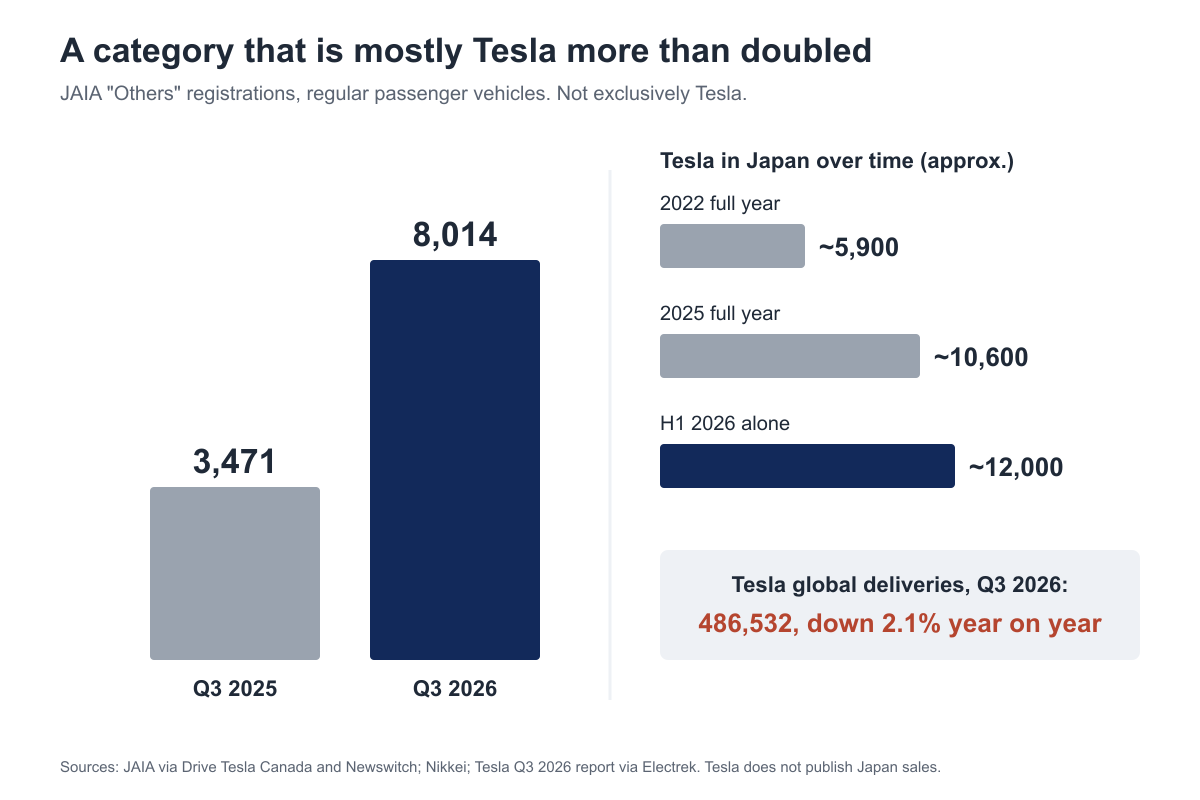
One caveat first, because it matters. Tesla does not publish sales figures for Japan. The Japan Automobile Importers Association, known as JAIA, reports Tesla inside a line called “Others,” which is not exclusively Tesla but which Japanese trade press describes as mostly Tesla. Every figure below that comes from that line should be read with that in mind.
With that said, the trend is hard to miss. For the third quarter of 2026, the “Others” category recorded 8,014 regular passenger vehicle registrations, up from 3,471 in the same quarter a year earlier. That is about 2.3 times the prior-year figure. In September alone it posted 3,348 registrations against 1,471 a year earlier, which placed it second among foreign automakers, behind Mercedes-Benz at 5,983 and ahead of Volkswagen at 3,078.
Stretch the window and the picture stays the same. For the April to September half of Japan’s fiscal year, “Others” reached 15,072 registrations, about 2.5 times the previous year. Through the first nine months of the calendar year, the category passed 20,000, nearly double the 2025 total. For scale, Tesla’s previous high-water mark in Japan, set in 2022, was about 5,900 cars.
Now set that against the rest of the import market. Total foreign-brand registrations for the April to September half came to 121,346, up just 0.7%. The top five foreign brands in that period were all German, and all five sold fewer cars than a year before. Electric vehicles reached 23,022 units, up 38.5%, for a 19.0% share of imports. That share is a first-half record, and JAIA’s “Others” line is widely credited as the reason for it.
The contrast with Tesla’s global picture is the part that should get an international operator’s attention. Worldwide, Tesla delivered 486,532 vehicles in the third quarter of 2026, down 2.1% from a year earlier, even though the result beat analyst expectations. Japan is still a small market for the company, and it will not rescue a global number on its own. But it is rare to see a mature brand growing at this rate in a country where almost nobody had asked for its product.
The Market Nobody Expected: Why Japan Was the Hard Case
To appreciate the result, you have to appreciate the starting point. Japan is routinely described as one of the slowest major markets in the world to adopt fully electric cars. Electric vehicles reached a record share in the first half of 2026, but that record was only about 3% of passenger car sales, on 59,337 units.
That 3% is itself a sharp improvement. It was more than double the prior year’s first-half volume, driven by new models and larger subsidies. Toyota’s upgraded bZ4X was the country’s best-selling EV over that stretch at 13,777 units, while Nissan’s redesigned LEAF reached 10,012. Tesla’s estimated 12,000 put it first among foreign manufacturers. In other words, Tesla is not competing in a vacuum. Domestic automakers are finally showing up with credible products, and the category is growing because of them as well.
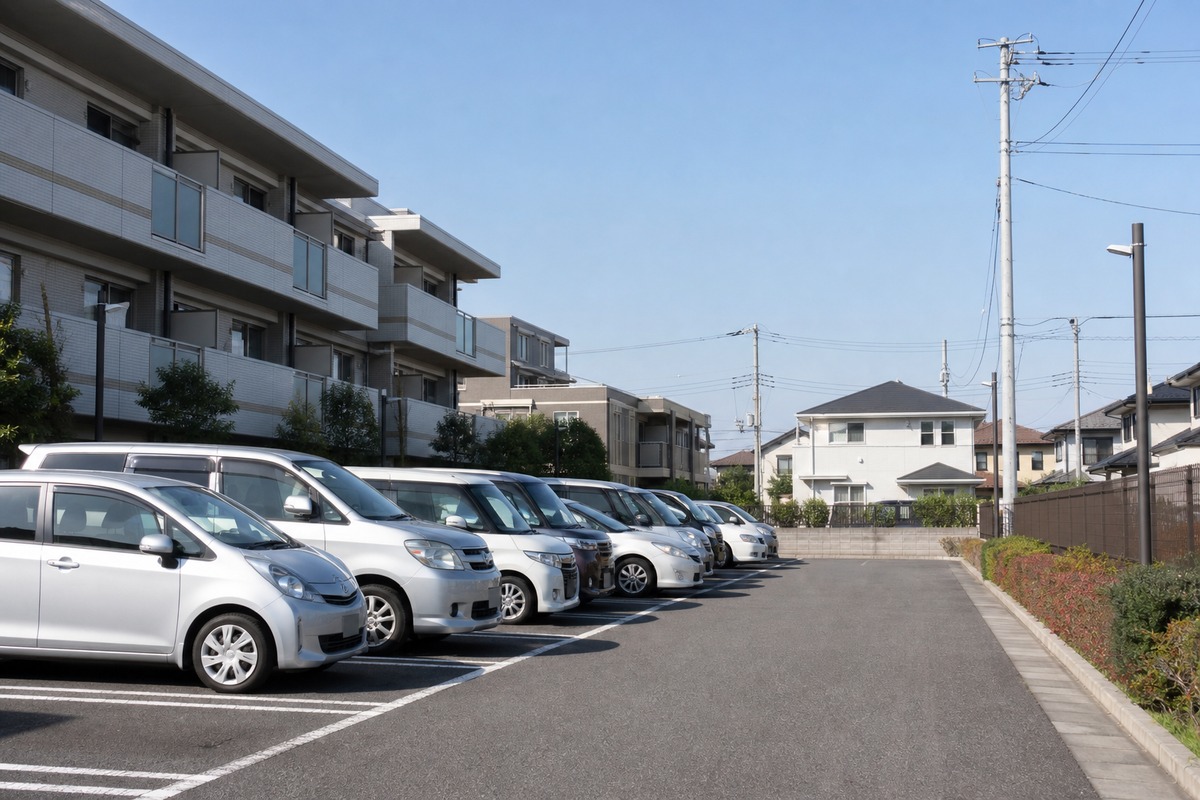
Even so, the cultural headwinds are real. Japanese buyers have a highly developed, and quite rational, attachment to hybrids. A hybrid does not need a charger, and many Japanese households live in apartment buildings where installing one is a negotiation with a building association. Hybrids also have a long record of reliability that buyers trust. The usual consumer objection here is not ideological. It is practical: what problem does this solve for me, and what new problem does it create?
That is where most foreign EV pitches have gone wrong. They lead with the car. Tesla in Japan had a more basic problem, which its country manager has been candid about. Richi Hashimoto, hired in September 2024, said the company “first had to introduce people to Tesla” because brand awareness was low. In the United States, Tesla is a political and cultural argument that everybody already has an opinion on. In Japan, a very large share of potential customers simply had not thought about it at all.
That turned out to be a strange kind of advantage. It meant there was no reputation to repair, only a first impression to make.
From Web Orders to the Food Court: The Mall Strategy
Tesla’s global identity rests on the idea that you do not need a dealership. You configure the car on a website, pay online, and pick it up. Before Hashimoto arrived, that was largely the model in Japan too, and it was producing sales in the single-digit thousands.
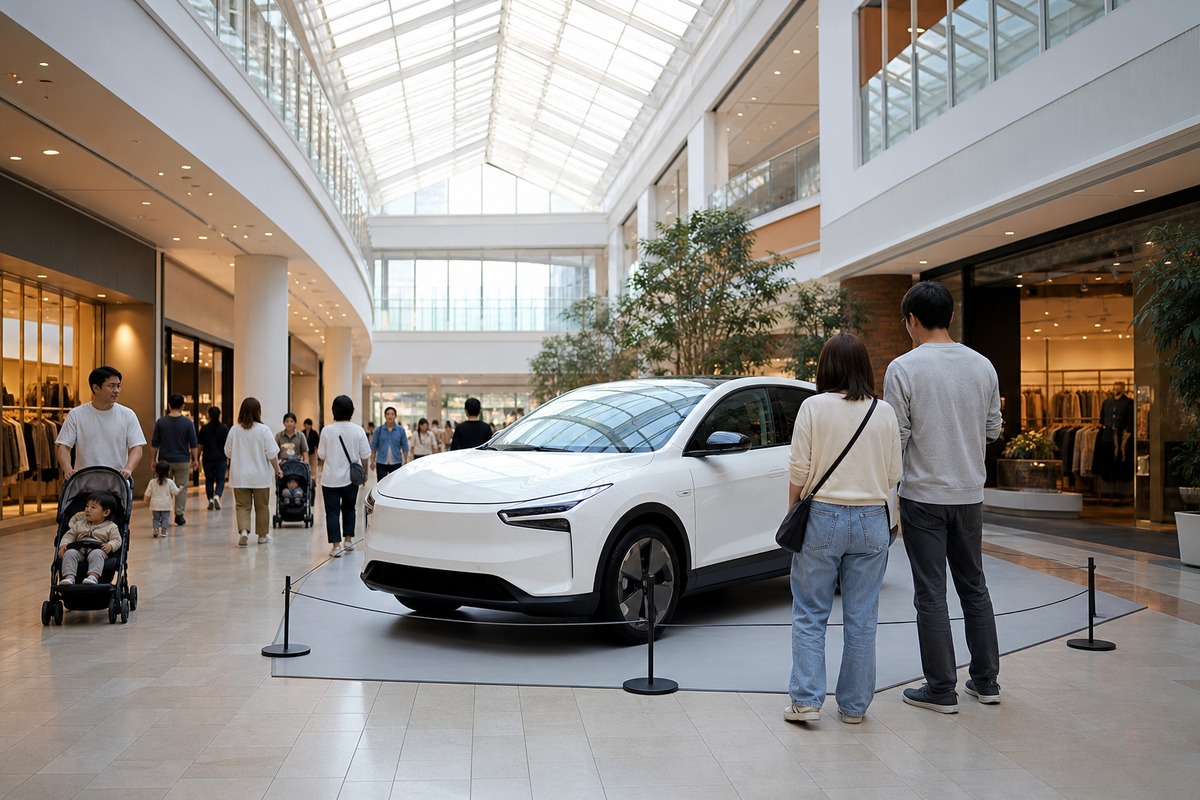
Under Hashimoto, Tesla moved toward something much more physical. It opened 16 new permanent showrooms in 2025, and all 16 were in high-traffic shopping centers, with test drives run from the parking lots. By the end of that year it had 29 locations. By April 2026 that had grown to 35 stores and 14 service centers, and recent reporting puts the count of retail and experience locations at more than 40.
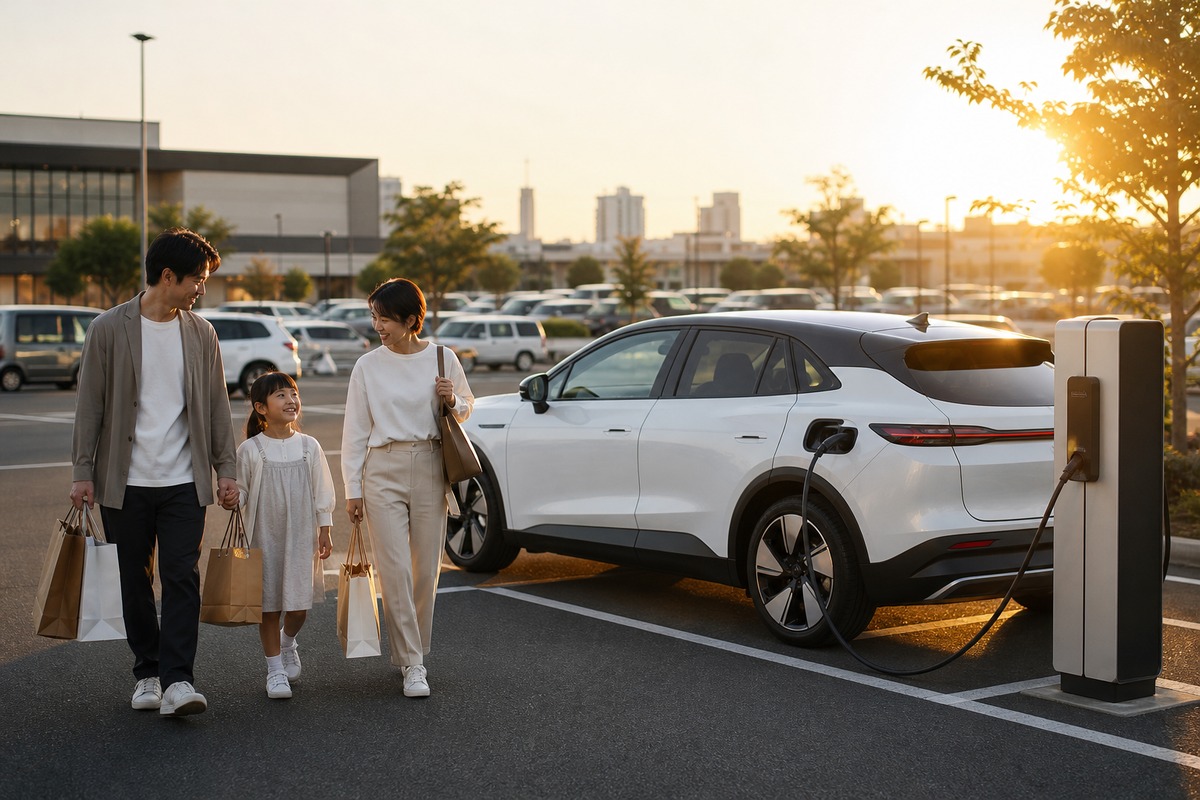
Anyone who has spent a weekend in suburban Japan will understand why this works. The large shopping center is one of the country’s real public squares. Families drive there on Saturday because it has parking, a supermarket, a cinema, a children’s play area and air conditioning. Nobody goes to a car dealership by accident, and a Japanese dealership visit is a slightly formal event, with a greeting at the door and a cup of tea and a sales representative who will remember your name. Walking past a car on your way to the food court carries no such weight. You can touch the screen, ask a question, and leave without embarrassment.
For a low-awareness product, that lack of friction is the whole game. A dealership can only sell to people who have already decided they might want your brand. A mall can reach the much larger group who have never considered it. It also solves a very Japanese version of the trial problem. Consumers here are famously careful, and they tend to want to see and touch a product before committing to it. The parking-lot test drive answers the question “what does it feel like?” before the customer has been asked to invest anything.
Tesla has not given up its direct model, and this is the clever part. There are still no franchised dealers and no haggling. The company sells through its own showrooms at a fixed price, and purchases and contracts are handled online. Cars are collected from separate delivery centers or shipped to a home address. So the mall takes care of discovery, while the transaction stays exactly where Tesla wants it. That split lets the showroom stay small and cheap relative to a full dealership, because it is not asked to do everything.
366 Cars Per Store: How the Math Beat the Germans
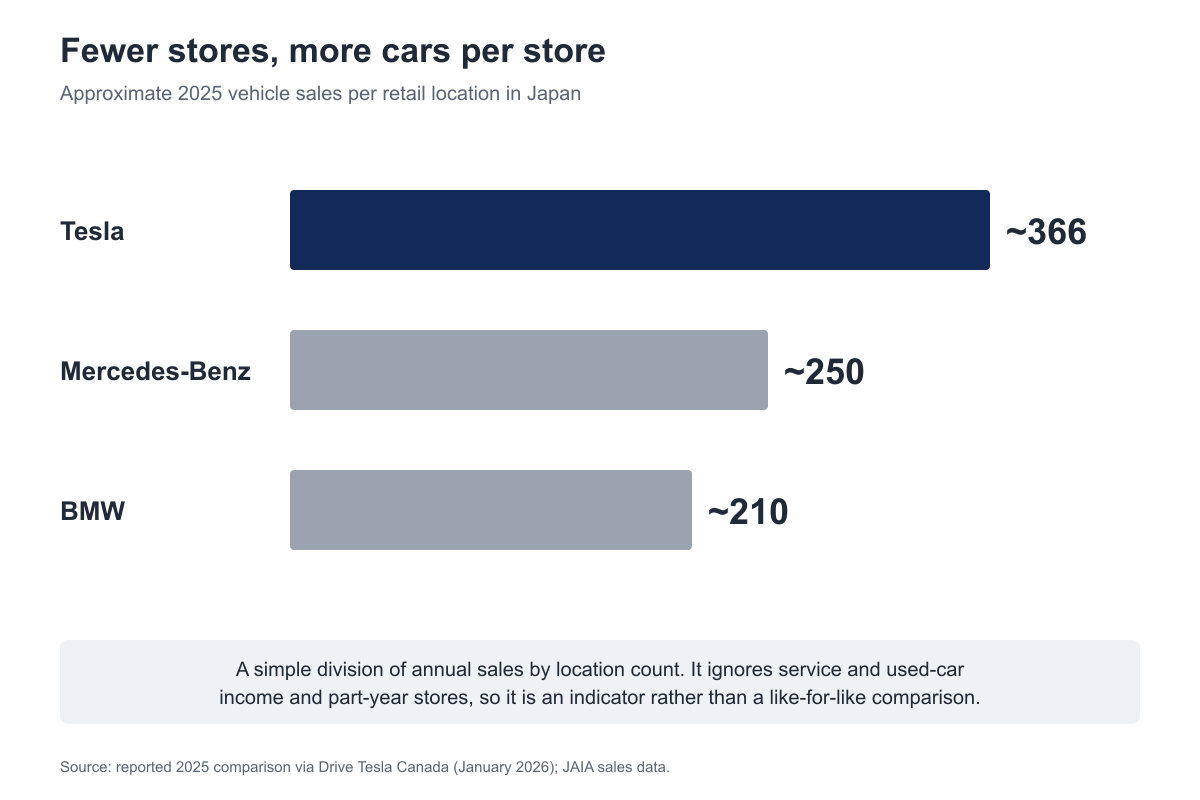
The clearest evidence that this is more than a marketing story is sales productivity. One widely cited comparison for 2025 put Tesla at about 366 vehicles per store in Japan, against about 250 for Mercedes-Benz and about 210 for BMW. That is a simple division of annual sales by location count, and it comes with obvious limits. Tesla’s network was young and small, a few locations were open for only part of the year, and these are not like-for-like businesses. A Mercedes-Benz dealer also earns a great deal from service and used cars, which this calculation ignores.
Still, the direction is striking. A brand that barely registered with Japanese consumers a few years ago was outselling the country’s most established import dealers on a per-location basis, from units inside shopping centers.
The ambition has grown to match. In April, Hashimoto told Reuters: “We want to aim to become the number one imported car brand, possibly as early as next year.” That is a real stretch. Mercedes-Benz sold nearly 51,000 vehicles in Japan in 2025 and has held the top spot for years. But at the current pace the gap has narrowed considerably, and the category that contains Tesla has already been running second in individual months.
The German brands are not collapsing, and it would be a mistake to say so. They still sell far more cars here, and they carry a kind of status that Tesla does not yet have in Japan. What has changed is that they are shrinking slightly in a flat import market while a new entrant takes nearly all the growth. In a market where the rankings of foreign brands have been stable for decades, that alone is news.
Retraining the Sales Floor: The Unglamorous Part of the Story
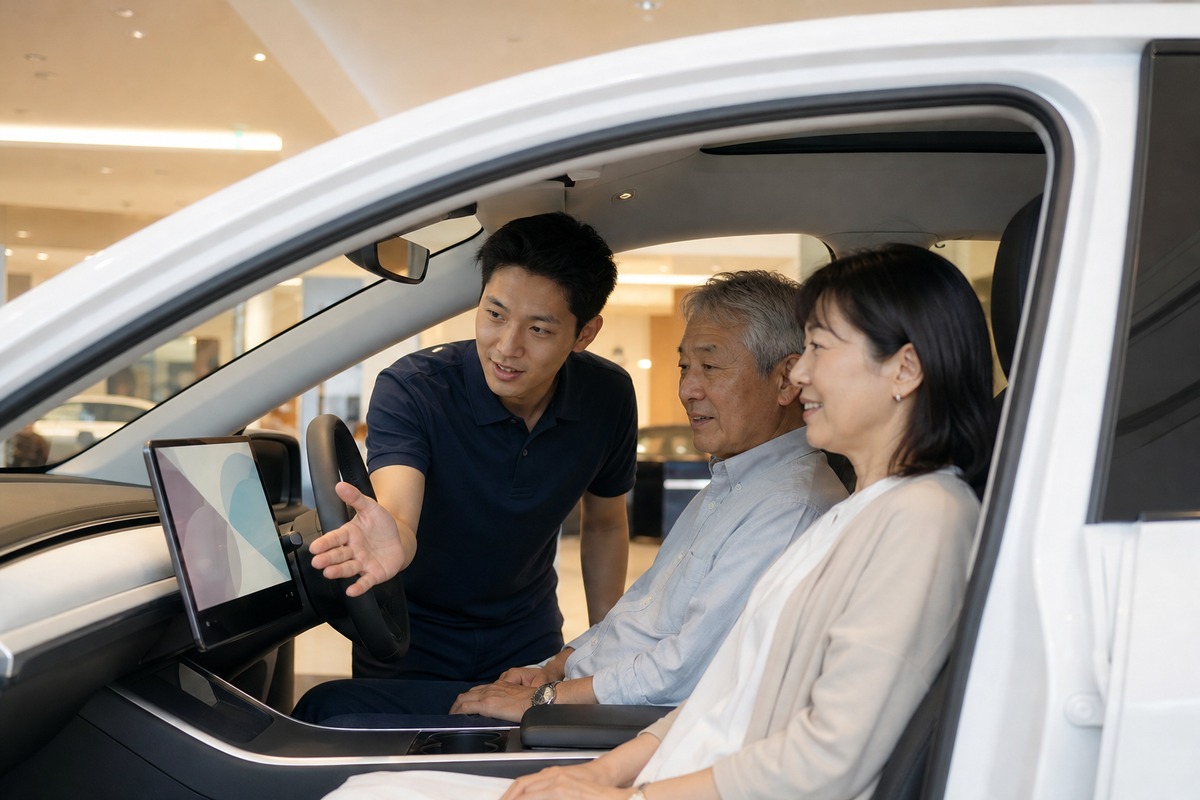
The showroom locations get the headlines, but the part of this story I find most instructive is the staffing.
When Hashimoto arrived, reporting based on his remarks to Nikkei said only about 10% of Tesla’s Japan sales staff met the company’s own standards for product knowledge. He retrained the entire sales force in about three months. Later, as the network expanded quickly, about 70% of sales advisers had been in their roles for under six months, which made training speed a core operating issue. Reuters reported that training has shortened the time it takes new hires to make their first sale.
This matters because of what Japanese customers expect. Service standards here are unusually high and quite specific. A customer asking about charging at an apartment building, or about how the car handles a narrow residential street, expects a precise and patient answer rather than enthusiasm. A brand built on the premise that the product sells itself can get away with less of this in some markets. It cannot get away with it in Japan, particularly with a product that the customer has never seriously considered.
Hashimoto also said something that I wish more foreign executives entering Japan would write down: “Simply increasing stores to sell cars doesn’t make customers buy.” By mid-2026 he was reportedly saying that the priority this year is the quality of each individual store and the customer experience, rather than rapid growth in the retail footprint. For a company whose public image is about scale and speed, that is an unusually Japanese statement of priorities.
The Tailwind: A ¥5.6 Million Car for About ¥3.6 Million
It would be dishonest to tell this story as if it were only about retail excellence. Tesla has also been helped by a very large amount of public money.
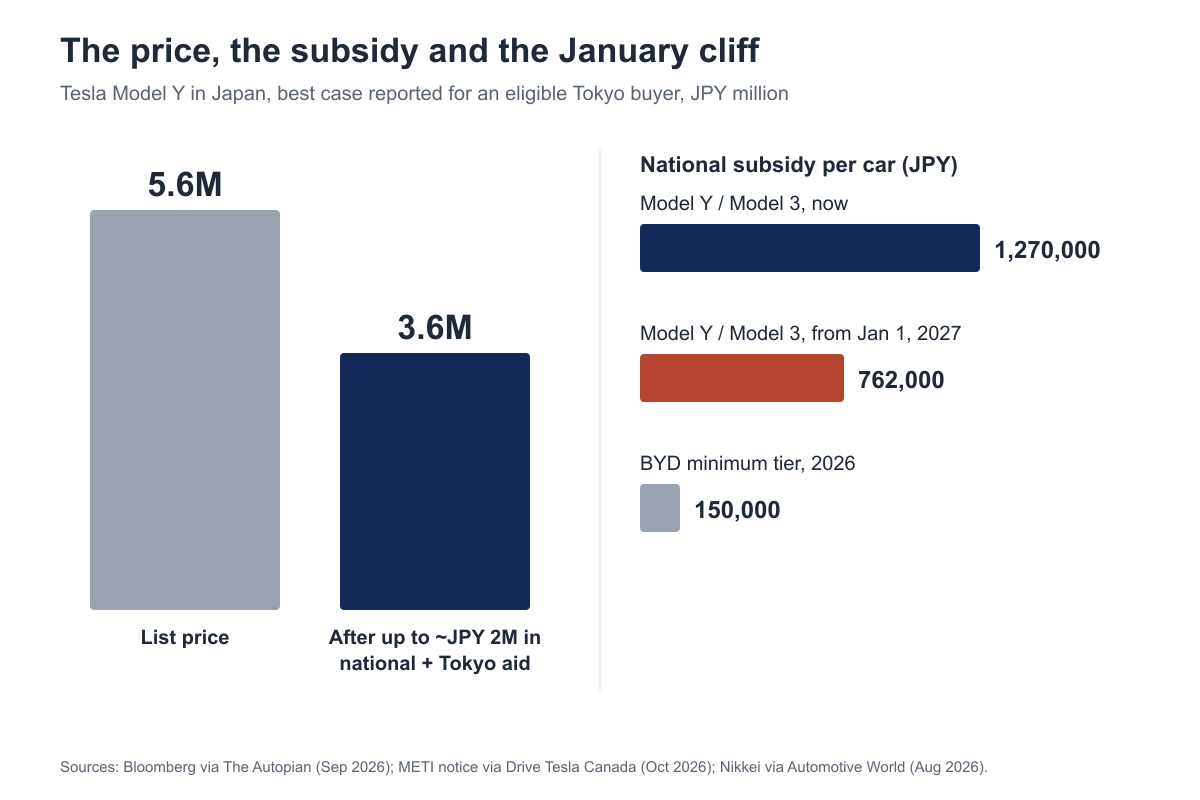
Japan’s national Clean Energy Vehicle subsidy has given the Model 3 and Model Y ¥1.27 million per car, close to the top tier. Tokyo confirmed its own municipal program in June, with Nikkei reporting support of up to ¥1.3 million for eligible EVs. According to Bloomberg figures cited by The Autopian, up to about ¥2 million in combined national and city subsidies could bring a Model Y with a list price of ¥5.6 million down to about ¥3.6 million for an eligible Tokyo buyer, roughly $22,889 at recent exchange rates. That is an extraordinary price for the car, compared with about $39,344 in China and more than $36,000 in California after state incentives. That figure is a best case, not the typical buyer’s experience, and it depends on where you live and which program applies, but the headline number has done plenty of marketing by itself.
Then there is the fine print of how the money is distributed. Japan sets subsidy amounts with a scoring system that evaluates each automaker’s efforts, not just the car. After the scheme was restructured this year, Nikkei reported that the Model Y and Model 3 stayed near the maximum tier, while BYD’s allocation was cut to a minimum of ¥150,000. That is a gap of more than ¥1 million, and it is a big part of the competitive story. BYD’s passenger car registrations in Japan fell 13.3% to 2,043 in the April to September half, even as Tesla surged and the overall EV segment grew.
Tesla also ran a campaign offering three years of free Supercharger use for Model Y and Model 3 cars bought and delivered within a set window. Hashimoto himself credited that promotion for a concentration of orders and deliveries around the end of June, which helps to explain that record month. Removing the fear of charging costs is a strong message in a market where charging is the leading objection.
So the honest accounting is that the mall strategy created awareness and trust, and then subsidies and promotions closed the sale. The retail work deserves credit for the fact that buyers were in the room when the price dropped. The price drop deserves credit for the size of the spike.
The Next Test: Delivery Strain and the January Subsidy Cut
Now the easy part may be ending, and there are two pressures to watch.
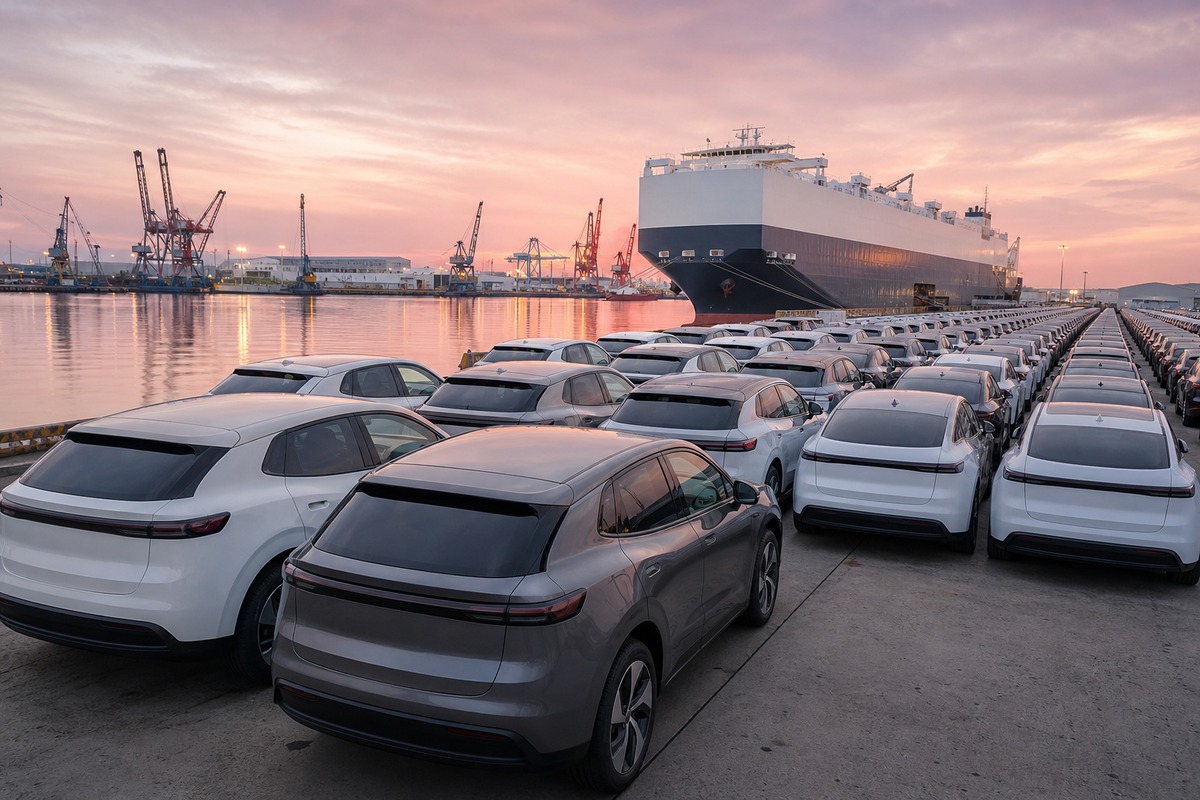
The first is operational. Demand in the first half of the year ran ahead of what Tesla’s Japan infrastructure could comfortably handle. Some customers reportedly saw last-minute changes to delivery dates and pickup locations, and some June handovers slipped into July. That is a serious risk in Japan, where a broken delivery promise can do more damage to a brand than a high price. Tesla is responding on several fronts. It is expanding its delivery network by 60% in 2026, from seven locations to 11. Since July, it has added Mikawa Port in Aichi Prefecture alongside Daikoku Wharf in Yokohama, roughly doubling annual import capacity to about 48,000 vehicles. It has also introduced an AI agent into the delivery process. Those are the right kinds of investments, and whether they have fixed the customer experience is still an open question.
The second pressure is policy, and it has a date on it. According to a notice from Japan’s Ministry of Economy, Trade and Industry, as reported in late October, national subsidies will be cut by about 40% for vehicles newly registered on or after January 1, 2027, because the budget is expected to run out before the program’s final deadline. For the Model 3 and Model Y, that means a drop from ¥1.27 million to ¥762,000.
That has two consequences. In the short term, expect a rush of registrations in November and December, which may produce another record and another delivery squeeze. In the longer term, the first quarter of 2027 will be the first honest test of how much of this demand is about the brand and how much was about the subsidy. If Tesla’s Japanese volumes hold up with ¥508,000 less public money per car, Hashimoto’s number-one ambition becomes much more believable. If they fall sharply, we will have learned something important about how durable a subsidy-supported surge can be.
What Operators Should Take From This
You do not have to sell cars to find this useful. A few lessons travel well to any company trying to bring an unfamiliar product into Japan.
Go where your customers already are. In a low-awareness category, your first job is not persuasion but simple exposure. Japanese shoppers will often be willing to look at a new product if looking costs them nothing socially. Choosing a location where people feel no pressure may be worth more than a prestigious address.
Separate discovery from the transaction. Tesla kept its direct, fixed-price model while giving up the idea that everything had to begin on a website. Plenty of foreign brands treat “our global model” as all-or-nothing. In practice, you can often localize the first meeting while keeping the business model that makes your economics work.
Treat staff knowledge as a product feature. A retraining program is not a glamorous line in a strategy deck, yet it may have done as much work here as the real estate. When a Japanese customer asks a specific question, a vague answer is usually the end of the conversation.
Read the policy details, not just the headlines. The ¥1 million-plus subsidy gap between Tesla and BYD did not come from the cars alone. It came from how a scoring system evaluates makers. Anyone relying on Japanese incentives needs to understand how those criteria are built and how quickly they can change.
Plan for your own success. Japanese consumers tend to forgive a higher price more readily than a missed promise. If a promotion is going to pull demand into a single month, the delivery operation has to be ready before the campaign starts, not after.
Finally, do not mistake a tailwind for a moat. My own read is that Tesla has built something real in Japan, but that the current numbers overstate it. The January subsidy cut is the experiment that will tell us by how much.
Frequently Asked Questions
Q. How many cars does Tesla sell in Japan?
A. Tesla does not publish Japan sales. Estimates based on industry data put its deliveries at roughly 10,600 vehicles in 2025 and about 12,000 in the first half of 2026 alone. JAIA reports Tesla within its “Others” category, which passed 20,000 registrations in the first nine months of 2026. That category is mostly, but not exclusively, Tesla.
Q. How much does a Tesla Model Y cost in Japan?
A. Reports cite a list price of about ¥5.6 million for the version discussed in recent coverage. With up to about ¥2 million in combined national and Tokyo subsidies, an eligible Tokyo buyer could pay about ¥3.6 million, or under $23,000 at recent exchange rates. The national subsidy for the car is scheduled to fall from ¥1.27 million to ¥762,000 for vehicles registered from January 1, 2027.
Q. Why are EVs so uncommon in Japan?
A. Japan has a very strong hybrid market led by Toyota, and many buyers see hybrids as a practical answer that does not require a charger. Many households also live in apartment buildings, where installing home charging can be difficult. EVs reached a record share of only about 3% of passenger car sales in the first half of 2026, though that share is now growing quickly.
Q. Is Tesla bigger than Mercedes-Benz in Japan?
A. Not on a full-year basis. Mercedes-Benz sold nearly 51,000 vehicles in Japan in 2025 and remains the leading foreign brand, with 5,983 registrations in September 2026 against 3,348 for the “Others” category. Tesla’s country manager has said the company aims to become the top imported brand, possibly as early as 2027.
Conclusion
The most useful thing about Tesla’s Japan story is how little of it depends on being Tesla. The company took a market that seemed closed, noticed that the barrier was familiarity rather than hostility, and moved its product into the places where ordinary families spend their Saturdays. It then invested in the slow work of making sure its people could answer questions properly. Generous subsidies did the rest.
January will show how much of that momentum belongs to the strategy and how much belongs to the government’s budget. Either way, the lesson for international operators is clear enough. In Japan, the distance between “nobody here wants this” and “nobody here has really seen this” can be surprisingly short. Sometimes it is about the length of a walk from the parking lot to the food court.
If you’re interested in this topic, the Japanese market more broadly, or what KETCHUPs is working on, we’d love to hear from you — please reach out via our contact form.
Japan Market Pulse is a weekly read on what the Japanese consumer-tech, food, and mobility markets are choosing to do, written for international operators who want to know what is happening before it shows up in the global trade press.
Subscribe at ketchups.co/japan-market-pulse.