

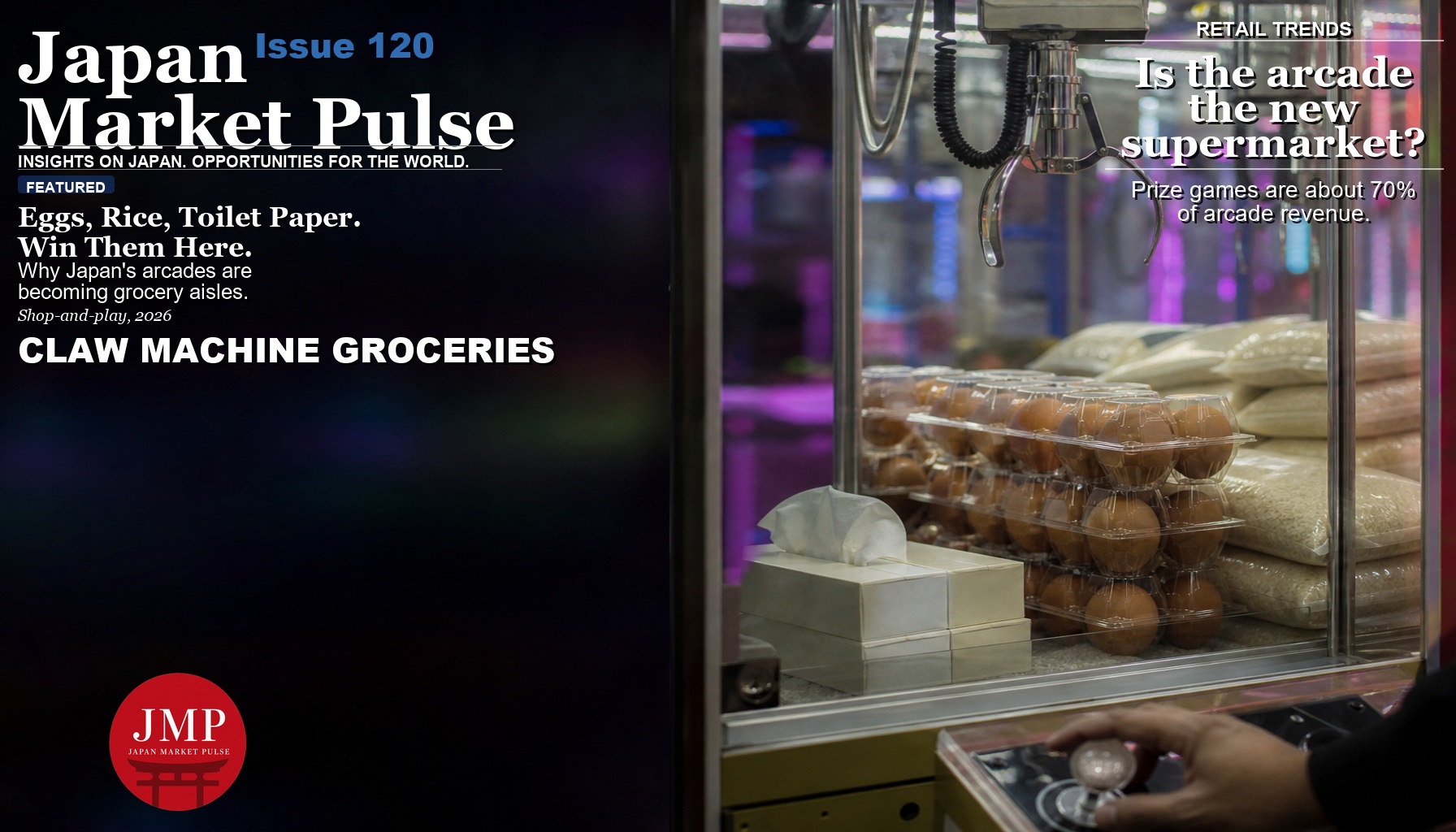
As rising prices squeeze household budgets, the 100-yen claw machine is turning into a household-budget tool. One operator says its household-goods sales rose 2.6-fold in two years, and Aeon’s amusement arm plans about 60 grocery-prize spaces by 2030. Here is what “shop-and-play” tells us about the Japanese consumer, and what retailers abroad can borrow from it.
Picture a Saturday afternoon on the outskirts of Kawasaki. A family walks past a row of glowing machines. Where the plush toys and anime figures used to sit, the glass cases are packed with cartons of eggs, bags of rice, laundry detergent and multipacks of toilet paper. A 25-year-old housewife drops in a 100-yen coin, misses once, tries again, and walks away with a pack of toilet paper. She describes the result, in effect, as a discount if you are a little bit lucky.
This is not a novelty stunt in one quirky shop. According to an AFP report published on 23 October 2026, large arcades on the edge of Japan’s big cities are deliberately stocking claw machines with groceries and household staples, and the operators describe the result as “shop-and-play destinations.” One chain says its household-product sales have grown 2.6 times in two years. A subsidiary of Japan’s biggest retail group says it opened its first food-and-daily-goods prize area for mothers a year ago, runs seven of them today, and is aiming for roughly 60 by 2030.
For anyone who sells to Japanese households, that is a striking signal. The country’s arcade business, once a story of video games and anime merchandise, is quietly being reshaped by something much more ordinary: the weekly grocery bill. This article walks through the numbers, the two operators leading the shift, the consumer psychology behind it, and what it means for brands and retailers that want to understand where Japanese spending is heading next.
Eggs, Rice and Toilet Paper: The Arcade Gets a New Prize Shelf
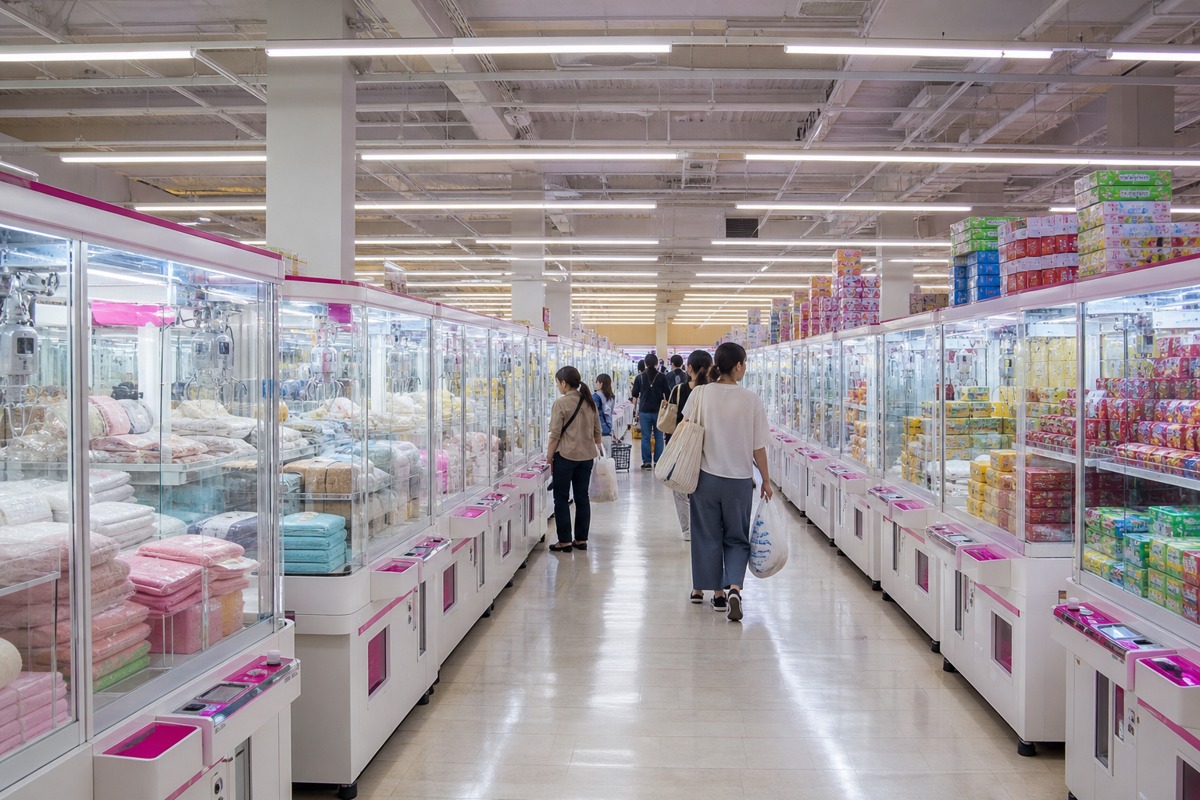
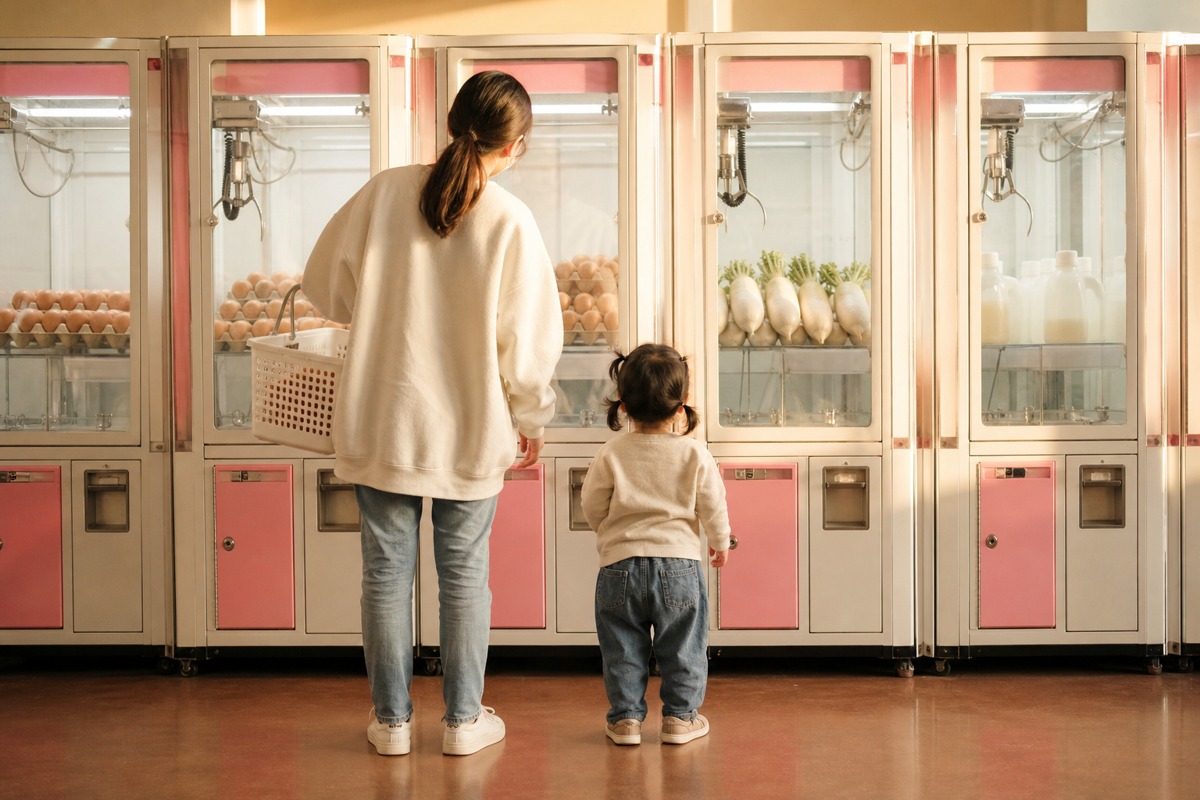
Start with what has changed on the machines themselves. The classic Japanese claw machine, the “crane game,” built its fortunes on character goods: plush toys, figures, snacks and small collectibles tied to popular franchises. That model has not disappeared. But in a growing number of large suburban halls, the prize shelf now looks like a corner of a discount supermarket. Soda cases, boxes of sweets, premium eggs, rolls of toilet paper and bottles of detergent are all in play.
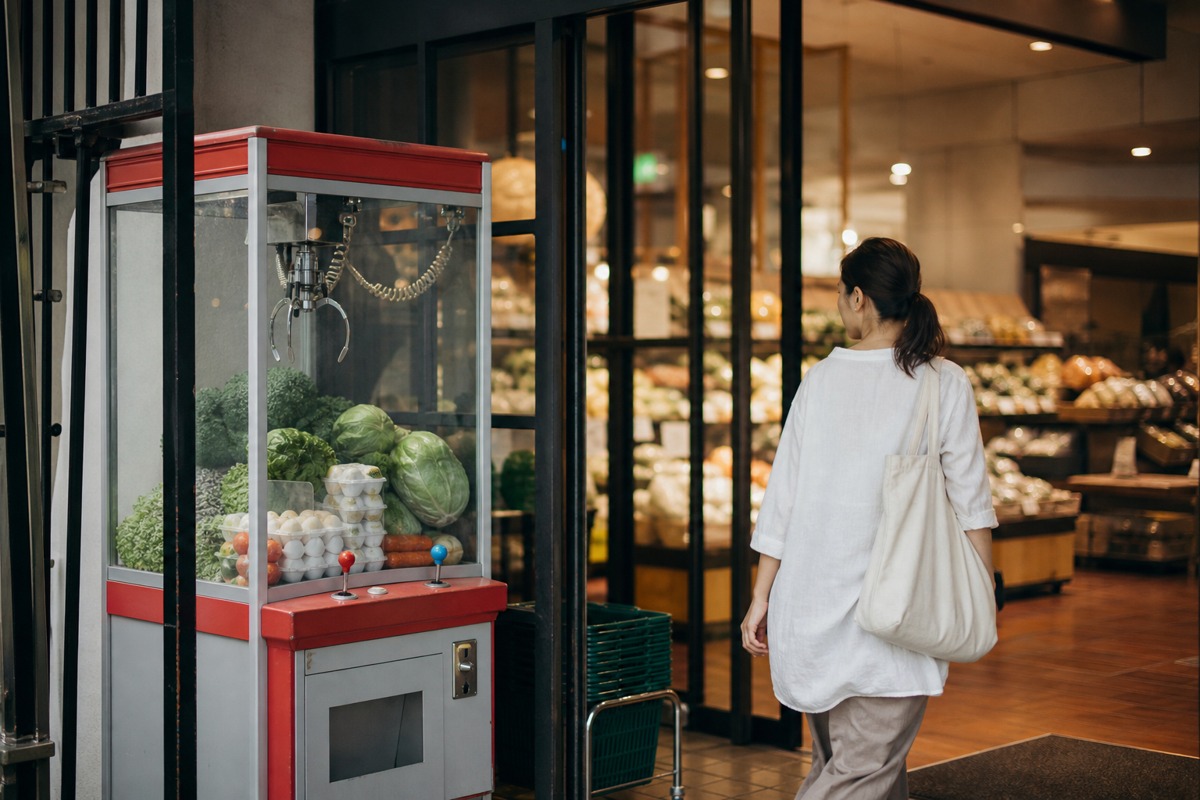
The AFP report describes machines stocked with eggs, rice, laundry detergent and toilet paper at arcades on the outskirts of major cities. Aeon Fantasy, the amusements arm of the Aeon retail group, lists prizes at its newer crane-game specialty stores that include daily goods, food and beverages alongside the usual characters. Its press materials for new openings in 2026 describe stores with prizes ranging from character plush toys and figures to household goods, food and drinks. Regional operators are following: from 5 June 2026, an arcade in the BiVi Shin-Sapporo shopping complex began offering machines stocked with seasonal vegetables and eggs.
The point is not that these machines are generous. A claw machine is a game of skill and chance, and operators price it to make money. The point is that the prize has changed from something you want to something you need. That shift reframes the whole activity. Playing becomes a small gamble with a practical upside, a way to win a pack of toilet paper rather than a toy you will put on a shelf.
A ¥417.7 Billion Business Built on 100-Yen Plays
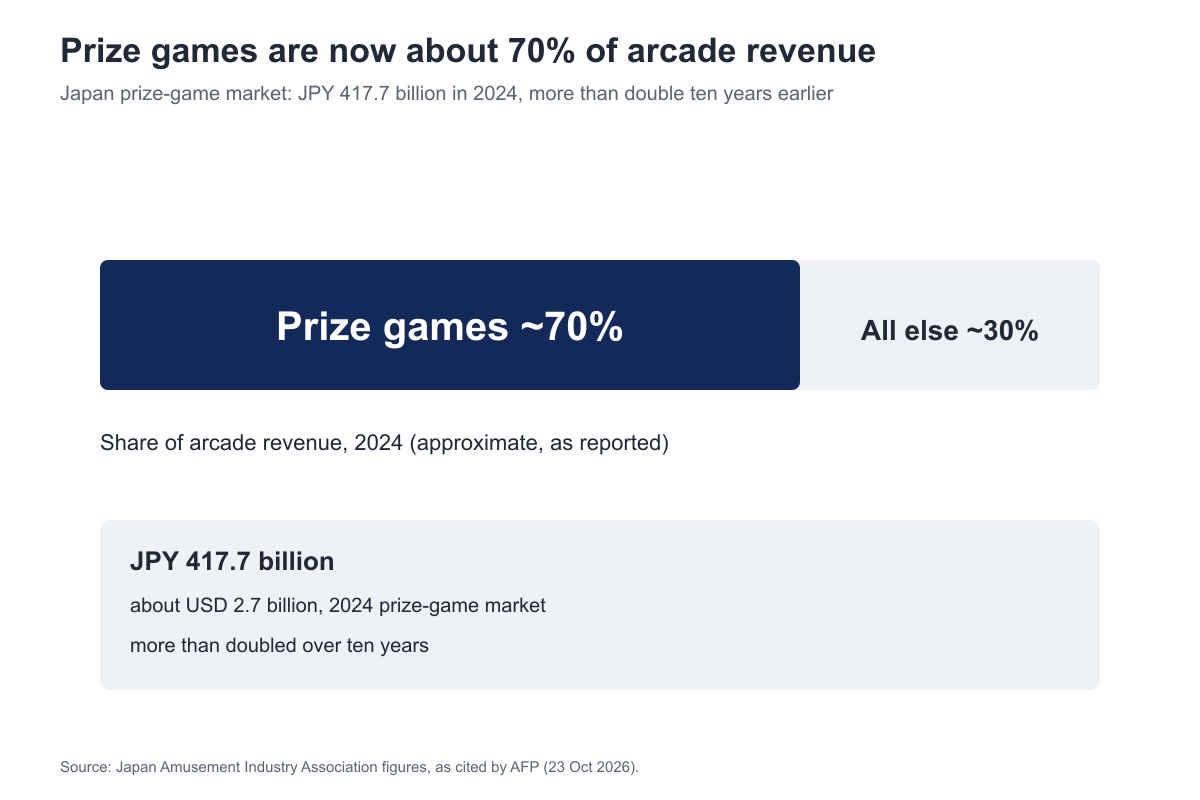
To see why operators are pushing this hard, you need to understand how large the prize-game business has become. Per the Japan Amusement Industry Association figures cited by AFP, the country’s prize-game market more than doubled over ten years to ¥417.7 billion (about US$2.7 billion) in 2024. It now accounts for nearly 70% of all arcade revenue.
That second number matters as much as the first. Prize games are no longer one attraction among many in the Japanese amusement hall; they are the business. Video games, medal pushers and token machines have been squeezed into the remaining thirty percent or so. When a single category supplies close to seven yen of every ten earned, every operator’s strategy comes down to the same question: how do we get more people to put a 100-yen coin into a claw machine, and how do we get them to do it more often?
Characters and collectibles are one answer. Households are the other. A character plush appeals to a fan; a carton of eggs appeals to everyone who has a kitchen. Groceries and daily goods vastly widen the pool of people with a reason to come in, and, just as importantly, a reason to come in regularly. Where a fan might visit when a new series launches, a family might drop by every week, because the fridge empties every week.
Benex: When the Arcade Starts to Look Like Costco
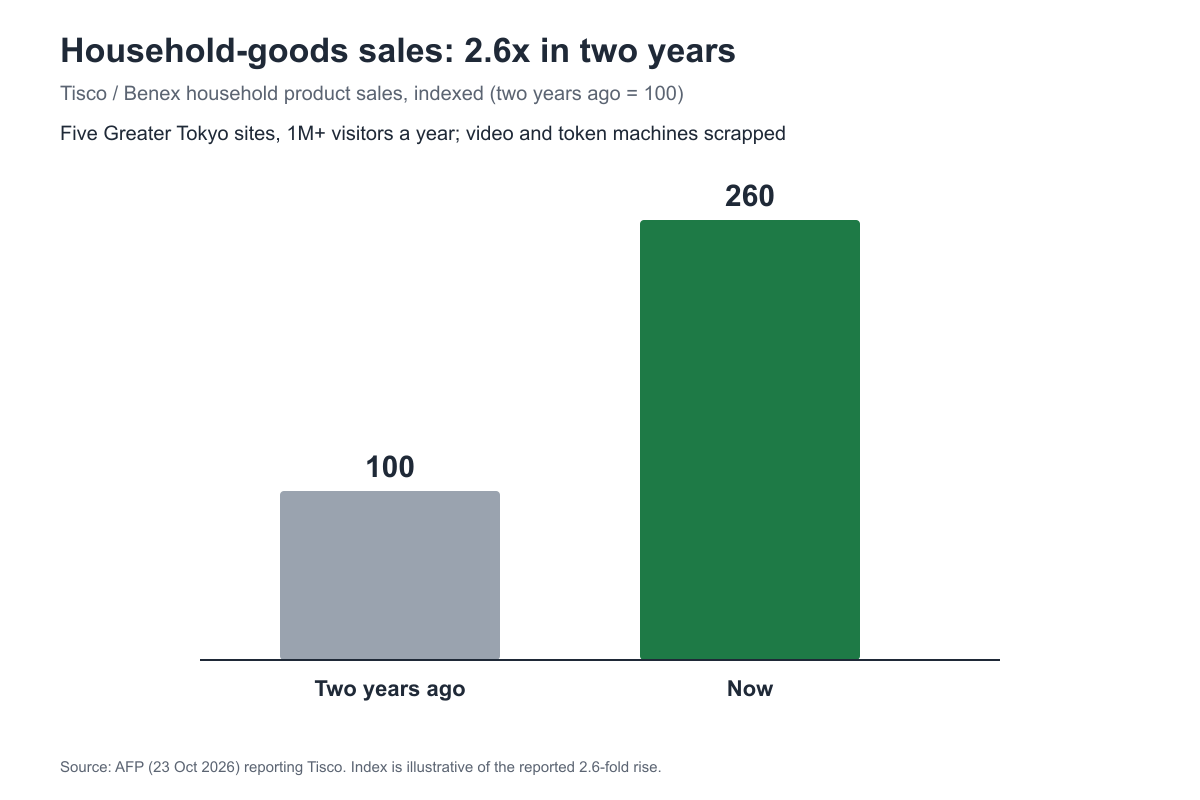
The clearest example in the AFP report is Benex, a large arcade in Kawasaki run by Tisco, a specialist chain. Benex is a hall of hundreds of machines filled with soda, sweets and detergent. Tisco operates five locations in Greater Tokyo and says it draws more than one million visitors a year. Last year it made a decision that tells you how far the model has gone: it scrapped its video games and token machines altogether to concentrate on claw machines. The company says its household-product sales have risen 2.6-fold over the past two years.
Tisco compares its approach to big-box retailers such as Costco or IKEA. These are large stores on the outskirts of cities, where land is cheaper and customers arrive by car and tend to spend more per visit. In other words, the arcade is competing on the same logic as a warehouse club: a destination trip, a big parking lot, a large floor and a reason to stay for hours.
A Benex-style hall also has a built-in answer to one of the weaknesses of conventional retail. It is entertainment, so the time spent there does not feel like a chore. One regular quoted by AFP, a 56-year-old sushi restaurant employee, said she spends two to three hours at a time playing and has won trophies worth nearly ¥8,000. She now buys her snacks at the arcade instead of the convenience store. Another visitor, 49, won two boxes of premium eggs that she said were cheaper than the supermarket’s, adding that she treats herself a little.
Notice what is happening in those quotes. The customers are not describing a gambling session. They are describing a shopping trip with a game attached, and the “savings” are partly real and partly emotional.
Aeon Fantasy: From One Mothers’ Corner to About 60 Spaces
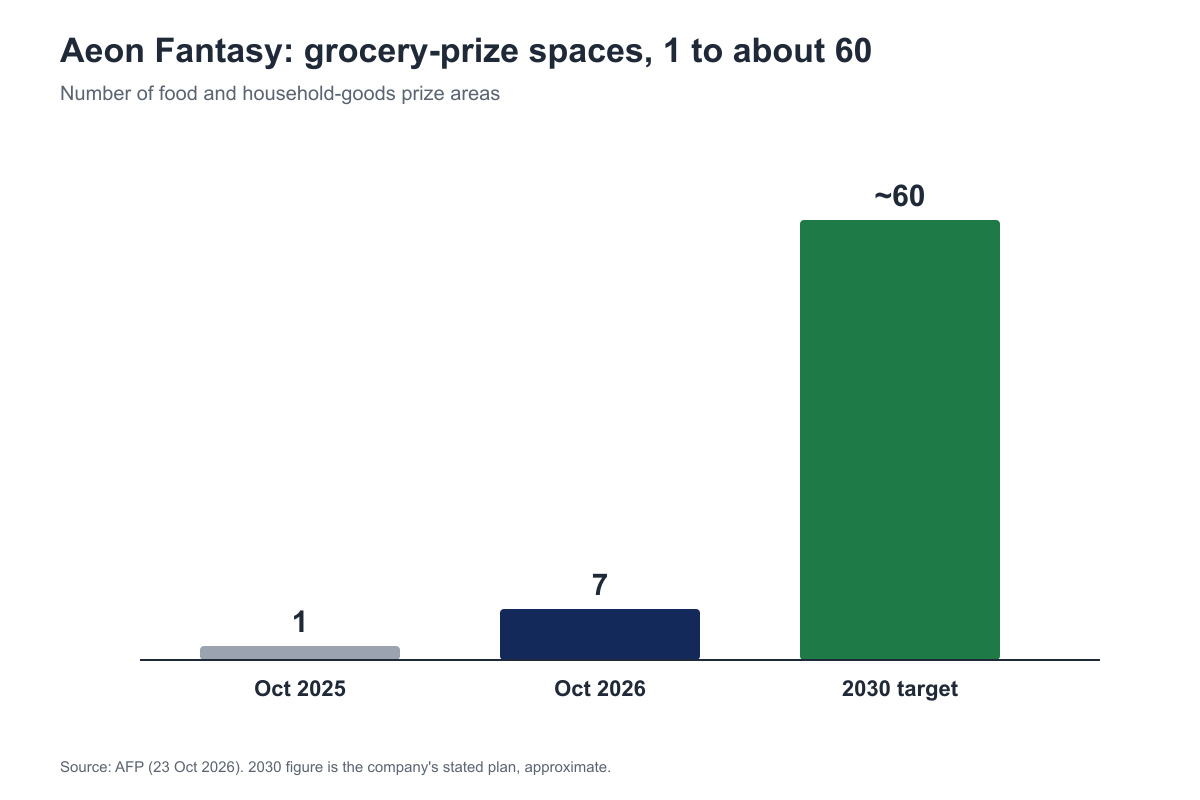
The second case is Aeon Fantasy, the amusement subsidiary of Aeon Group, Japan’s largest retail group. According to the AFP report, the company opened its first food and household-goods prize area designed for mothers in October 2025. It now operates seven such spaces and plans to expand to about 60 by 2030. That is roughly an eight-fold increase in four years.
Aeon Fantasy is also notable for its scale and its siting. The company says it runs more than 1,290 amusement and playground locations across nine countries and regions as of August 2026. A good share of its Japanese halls sit inside Aeon malls and shopping centers, which means a visit to the arcade can sit naturally alongside a visit to the supermarket on the same site. The AFP report quotes an observation that shoppers who win vegetables at the machines sometimes walk next door and buy groceries at the supermarket, a reminder that games and groceries can feed each other rather than compete.
The company’s newer standalone format is a crane-game specialty store called “Crane Yokocho Kiwami.” Its recent openings include a store in Kagamiishi, Fukushima, on 29 July 2026, a large store of roughly 1,100 square meters, and another in Kasugai, Aichi, on 7 October 2026, its seventh in Japan. The stores run cashless through a LINE mini-app, offer a pay-as-you-go or prepaid mode, and give one point for every 100 yen spent. Miniature crane machines start at just 10 yen per play. The format is built around a simple idea: make it cheap to try, make the points visible, and keep the prize shelf varied enough that a parent and a child can both find something worth playing for.
Two details deserve emphasis. First, the “mother” framing is explicit. This is a targeted attempt to win the household’s main shopper, not teenage anime fans. Second, the integration with LINE and a points system is classic Japanese retail loyalty design, applied to a medium that used to run on loose coins.
Why Households Are Playing: Five Years of Shrinking Grocery Budgets
Why is this happening now? The simple answer is inflation. Rising prices have squeezed household purchasing power in recent years, and AFP notes that inflation has recently hovered near the Bank of Japan’s 2% target, a shock in a country used to decades of stagnant or falling prices. The longer answer is that households have already been cutting back for a long time.
Naoko Kuga, a researcher at NLI Research Institute, told AFP that spending on food and everyday products has fallen for five years as households tighten their budgets. Retailers, she said, are looking for ways to make buying fun in order to ease shoppers’ guilt about spending. The claw machine is a neat fit. A parent who feels uneasy about a premium egg carton at the supermarket may feel entirely different about winning one. Another analyst quoted in the report, Teruaki Tsuchiya of Tisco, says parents are increasingly choosing the most cost-effective entertainment for their children, and the new format lets a family combine the outing and the shopping.
There is a second force at work. Kuga pointed out that stores have to find new reasons to draw customers who increasingly buy everyday household goods through Amazon subscriptions. If a roll of toilet paper arrives automatically every month, there is no reason to go to a store for it. A physical retailer therefore needs a new kind of pull, and “play” is one candidate. She expects the trend to outlast the current period of inflation, and she predicts more retailers will launch similar initiatives, including claw machines.
This is where I find the story more interesting than a quirky news item. Japan has long been the home of experiential retail: cat cafes, themed restaurants, vending machines that sell everything. What is new here is that experience is being used to defend the most boring part of retail, the replenishment of staples, from the pull of e-commerce and subscriptions.
The Honest Math: A Discount If You Are a Little Bit Lucky
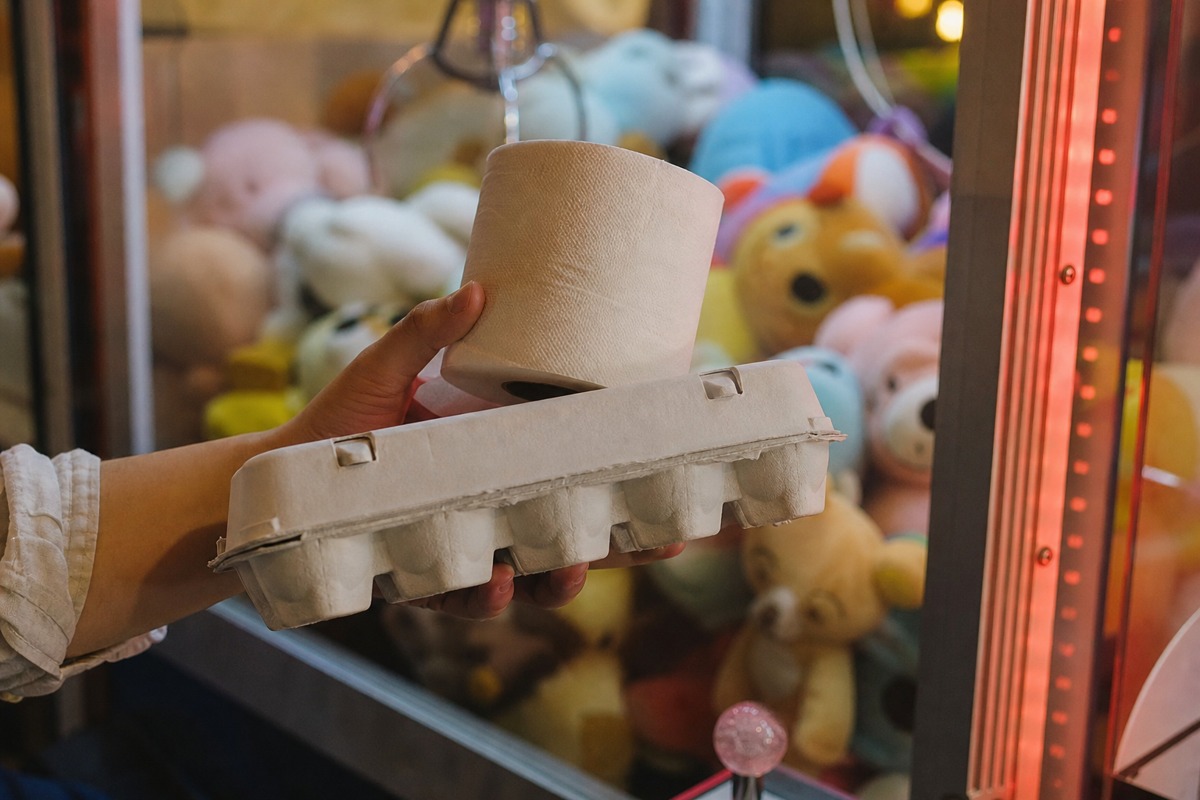
It is worth being clear-eyed about the economics, because the marketing and the reality are not the same thing. The AFP report gives only a few data points: one visitor won toilet paper after two plays at 100 yen each, effectively paying ¥200 for a pack. Another won two cartons of premium eggs. These are the wins that get told. The losses, naturally, do not make it into the story.
A claw machine is a commercial product: the operator has to earn more in revenue than the prizes cost, and household goods are no exception. I could not verify typical payout rates for grocery-prize machines, and the operators do not publish them, so I will not attach a number to the odds. What the reports show is simply that customers experience the outcome as a discount when they win, as entertainment when they do not, and that enough of them keep coming back to make the format worth expanding.
That framing matters for brands. A packaged-goods company whose product appears as a prize is not selling at a discount; it is typically supplying the operator through prize procurement, and the consumer’s experience of “winning” it carries a halo of delight that a promotional price cannot. It is a rare kind of trade placement where the end customer sees the product as a prize, not a purchase.
What International Operators Should Take From This
If you sell consumer goods, run a retail chain or build a loyalty program, the claw-machine grocery aisle offers several practical lessons.
Treat the shopper’s guilt as a design problem. Japanese households are cutting back on routine spending, and the reports suggest they respond well to formats that turn a necessary purchase into a small treat. A discount is a rational appeal; a game is an emotional one. Think about what the equivalent is in your category: a lottery, a collectible, a reveal.
Entertainment can defend replenishment. If your category is being pulled into subscriptions, ask what a physical store can offer that a subscription cannot. Aeon Fantasy and Tisco have effectively answered with “play.” Yours may be different, but the question is the same.
Destination formats still work, if they have a clear reason to exist. Tisco’s Costco comparison is instructive. A large store in a cheap-land location, built around a repeatable ritual, can draw visitors for hours. Bring a car, bring the family, buy a few things, play a little. Smaller, more convenient formats cannot offer that.
Mind the loyalty layer. Aeon Fantasy’s use of a LINE mini-app, with points on every 100 yen, shows how Japanese retail ties even coin-operated entertainment to a data and rewards system. If you are entering Japan, expect that customers will want a points program, and expect that your competitors have one.
Watch the grocery-to-game traffic loop. The report notes that some winners shop next door afterward. For a brand that sells on the shelf, a prize placement may work as a sampling channel that sends customers back to the supermarket.
Frequently Asked Questions
Q. Are Japanese arcades really giving away groceries?
A. Yes, as prizes in claw machines, not as free handouts. AFP reported on 23 October 2026 that large arcades on the outskirts of major Japanese cities are stocking machines with eggs, rice, laundry detergent and toilet paper. Customers pay per play, often 100 yen, and win only some of the time.
Q. How big is Japan’s prize-game market?
A. According to the Japan Amusement Industry Association figures cited by AFP, it more than doubled in ten years to ¥417.7 billion (about US$2.7 billion) in 2024, and now accounts for nearly 70% of arcade revenue.
Q. Which companies are behind the shift?
A. Two operators lead the AFP report. Tisco, which runs the Benex arcade in Kawasaki and five locations in Greater Tokyo, says its household-product sales rose 2.6-fold in two years. Aeon Fantasy, part of the Aeon retail group, says it runs seven food and household-goods prize areas and plans about 60 by 2030.
Q. Why is this happening now?
A. Rising prices have squeezed household budgets in recent years, and NLI Research Institute’s Naoko Kuga says household spending on food and everyday products has fallen for five years. Retailers are looking for ways to make buying fun, and to give customers a reason to visit stores as everyday goods move to subscription delivery.
Q. Is a grocery claw machine actually cheaper than a supermarket?
A. Not reliably. The reports show customers who won items for a few hundred yen, but operators do not publish payout rates, and a player who misses repeatedly can easily spend more than the item costs. It works best as entertainment with a practical bonus.
Conclusion
A few years ago, the idea that a Japanese arcade would compete with the supermarket for the household’s weekly shop would have sounded like a joke. Today, a Kawasaki hall that dropped its video games to focus on claw machines says its household-goods sales have risen 2.6 times in two years, and the amusements arm of Japan’s largest retail group is planning to multiply its grocery-prize spaces roughly eight-fold by 2030.
The common thread is not that arcades have become cheaper than shops. It is that Japanese households, squeezed for years by prices that rise faster than pay, respond to formats that turn necessity into play. The claw machine does that in a coin-sized transaction. Whether the trend lasts as long as the analyst predicts, it already says something useful about the Japanese consumer: a shopper who is careful with money still wants a little delight, and will pay for the chance of it.
For international brands and retailers, the lesson is to look at the unlikely places where Japanese consumers spend time and money. The next shift in how households buy staples may not start in a supermarket at all.
If you’re interested in this topic, the Japanese market more broadly, or what KETCHUPs is working on, we’d love to hear from you — please reach out via our contact form.
Japan Market Pulse is a weekly read on what the Japanese consumer-tech, food, and mobility markets are choosing to do, written for international operators who want to know what is happening before it shows up in the global trade press.
Subscribe at ketchups.co/japan-market-pulse.