

In January 2026, a 5-kilogram bag of rice at a Japanese supermarket cost an average of ¥4,416. By mid-September, the same bag cost ¥2,971, the first time the national average had dipped below ¥3,000 since September 2024. A week later, it was ¥2,934, about US$18.70, according to Japan’s agriculture ministry.
For shoppers, that is welcome relief. For the farmers who grow the rice, it is something closer to an emergency. In some regions, the price a cooperative pays a farmer for 60 kilograms of unprocessed rice has fallen by about half in a single year. A farmer in Chiba told the Japan News that his cooperative now pays under ¥15,000 per 60 kg, compared with ¥30,000 last year. On the day he took office, the new agriculture minister, Kazuo Yana, called the situation “extremely difficult and simply unacceptable for farmers trying to stay in business.”
Two years ago, Japan could not keep rice on the shelves. Today it has too much of it. This article looks at how a country swung from a staple-food shortage to a glut in about two years, why the official forecasts missed the turn, what the government is doing about it, and what the episode tells international food, retail and agricultural companies about how Japan’s protected rice market really works.
How Far Prices Have Fallen
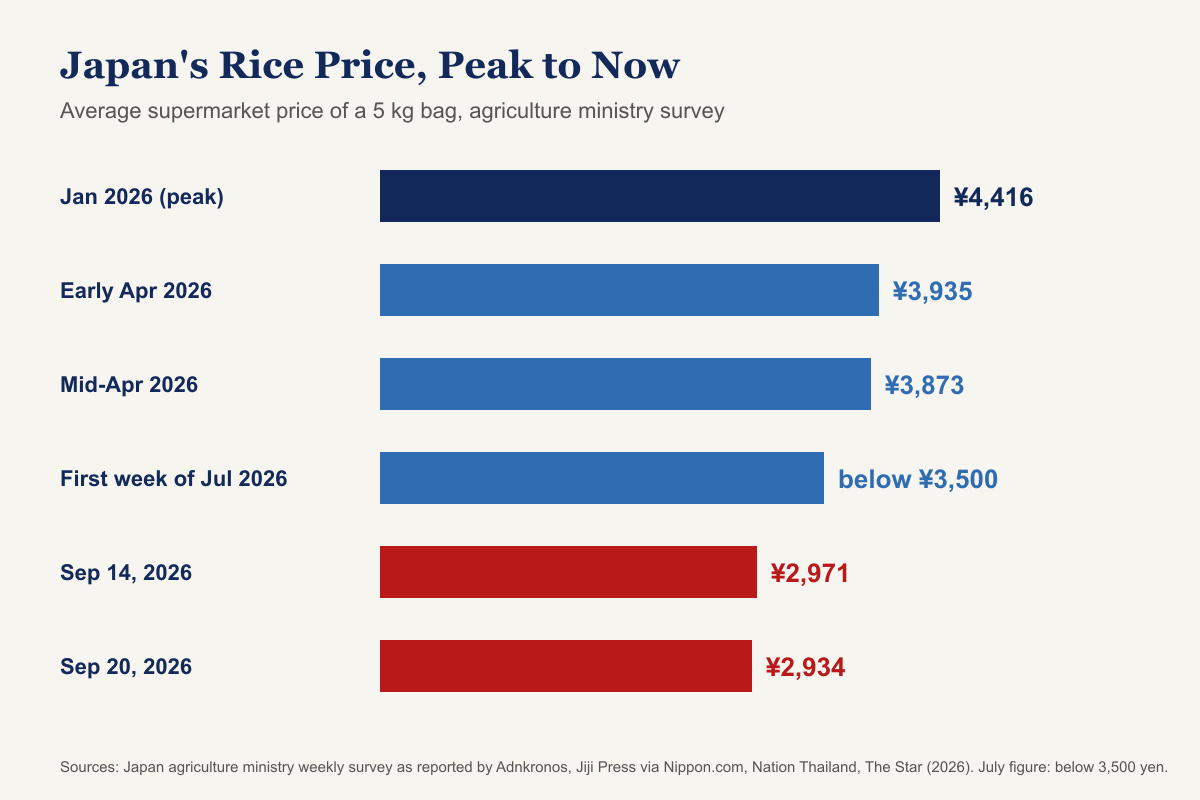
The ministry’s weekly survey tracks the average price of a 5 kg bag at roughly 1,000 supermarkets. It is the closest thing Japan has to a national rice price, and it has become a closely watched number since the shortage that began in the summer of 2024, known in Japan as the Reiwa-era rice crisis.
The path since the peak is clear in the reports. The average stood at ¥4,416 in January 2026. By late March it had slipped below ¥4,000 for the first time in seven months, and one weekly report put it at ¥3,873 per 5 kg in mid-April. In the first week of July, according to Jiji Press, it fell below ¥3,500 for the first time in about a year and a half. By September 14 it was ¥2,971, down ¥32 from the previous week, and the ministry’s latest reading cited in late September was ¥2,934 as of September 20.
The decline is broad. Branded rice, which accounts for about 85% of sales volume, averaged ¥2,988 per 5 kg in the mid-September survey, down ¥35 on the week. Blended rice averaged ¥2,866, down ¥34. In total, the average bag is now roughly one third cheaper than it was at the peak.
Convenience stores have followed. Three of Japan’s major convenience store chains have cut prices on their rice balls, a move covered in our earlier piece on the onigiri price cuts. The falling cost of the main ingredient is part of the reason.
From Shortage to Glut
The reversal is stark when set against what came before. In 2023, an unusually hot summer damaged rice quality and cut milling yields, one factor behind supply worries. Restaurant demand was recovering after the pandemic, and in 2024 a government earthquake warning prompted households to stockpile. Shelves emptied, prices climbed, and the government released rice from its emergency reserves for the first time to respond to the distribution bottlenecks and price spike. Reports say it sold about 590,000 metric tons, roughly one month of national consumption.
Several things then happened at once. The 2025 harvest exceeded demand. At the same time, consumption was falling, as higher prices pushed households toward other staples, eating habits kept changing and the population continued to age. The result, according to the ministry, was that private-sector rice stocks climbed to a record 2.43 million tons at the end of June 2026. The ministry’s projection for 2026 output is about 7.32 million tons, against estimated demand of between 6.93 and 7.11 million tons.
That is a surplus of several hundred thousand tons in a crop that Japan grows largely for itself. In a market where imports are restricted and the state shapes supply through its demand outlook and policy incentives, a surplus of that size is felt quickly in the price.
What Farmers Are Being Paid
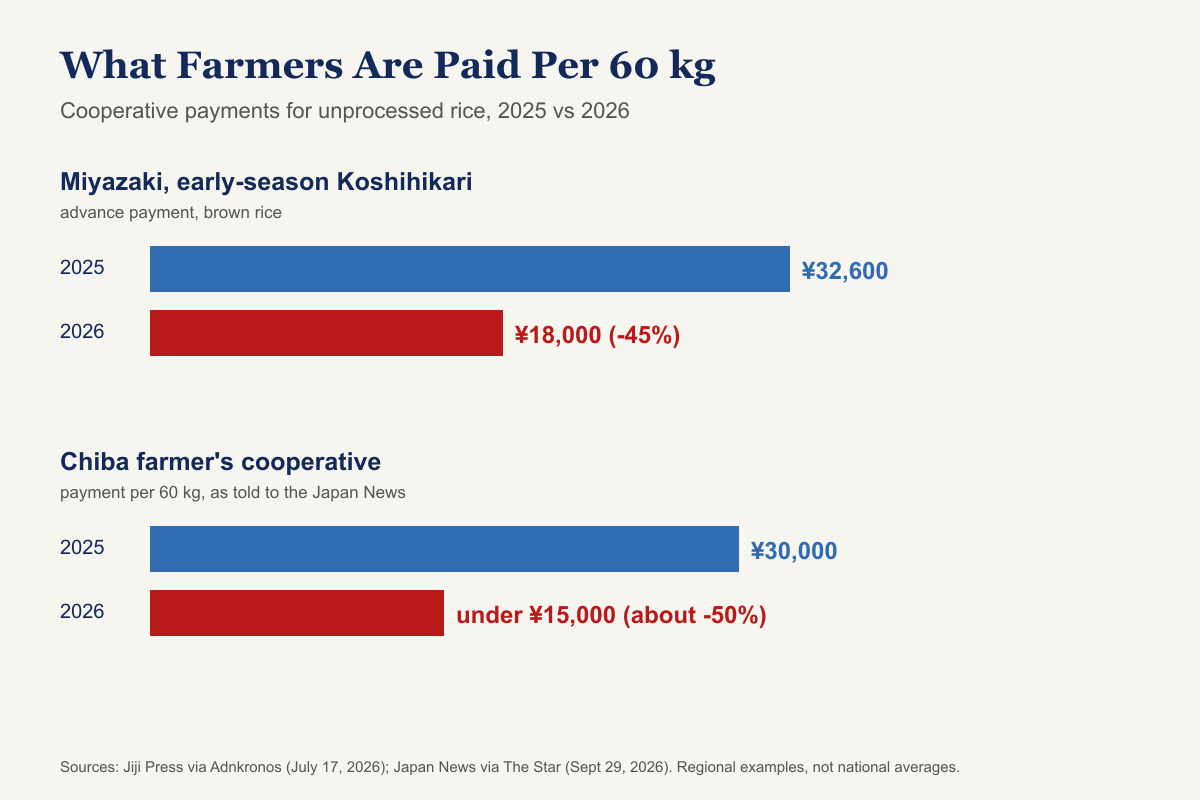
Retail prices tell only half the story. The harder number is the price farmers receive, because it determines whether growing rice pays.
Advance payments, the amounts agricultural cooperatives pay farmers when they collect the harvest, are the first sign. In July, Jiji Press reported that the cooperative federation in Kagoshima had suggested early-season purchase prices about 20% below the previous year. In Miyazaki, advance payments for early-season Koshihikari were set at ¥18,000 per 60 kg of brown rice, down 45% from ¥32,600 in 2025.
The wholesale market tells a similar story. Unmilled rice from the 2025 harvest sold to wholesalers in August averaged ¥31,556 per 60 kg, down ¥930 from July, the first month-on-month fall in two months. And in Chiba, Hiroshi Asano, 59, who farms 38 hectares, told the Japan News that the Japan Agricultural Cooperatives (JA) would pay him under ¥15,000 per 60 kg this year, compared with ¥30,000 last year. He expects to lose money. He would like to see a government price floor of about ¥20,000 per 60 kg.
Asano’s situation illustrates a divide inside the sector. He has diversified, growing organic rice and processing and packaging it himself so that he can sell to local rice shops and individual customers. Smaller farmers cannot afford the equipment and must accept the cooperative’s price. “I’ve been hearing about quite a few people who plan to give up this year,” he said. “But if it were just me, I might have given up already.”
Why the Forecast Missed
A central question is why the glut caught the system off guard. Part of the answer lies in demand forecasting. According to reporting based on the ministry’s own account, last year’s harvest exceeded demand because official forecasts underestimated how far consumption would fall. The ministry has since updated its forecasting model to take account of population shifts, inbound tourism and milling yields.
There is also a data problem. Japan’s rice supply chain has long been opaque, and during the shortage neither officials nor the public had a clear picture of how much rice was sitting in private warehouses. A newly revised food law now requires larger food processors and food service businesses to report their inventory and sales data, an attempt to close that gap.
None of this means the earlier shortage was imaginary. Demand did spike, supply was tight, and the government stockpile did run down. But the response to the shortage, including the release of 590,000 tons from reserves, is now criticised by some farmers as excessive. Asano put it bluntly in his interview, saying that Koizumi, the minister at the time of the release, did not need to release that much stockpiled rice. That view is contested, and the ministry has not endorsed it, but it shows how the political argument has moved.
The Government’s Dilemma
Having drained its emergency reserves during the shortage, the government now has to decide how to refill them without making the glut worse.
The numbers are lopsided. The appropriate stockpile level is about 1 million tons. After the releases, the reserves had dropped to about 320,000 tons by July, according to Jiji Press. The ministry has since announced plans to buy back about 210,000 tons to replenish them.
The buyback has been politically fraught. In June, the then agriculture minister, Norikazu Suzuki, proposed buying back released rice, but the prime minister’s office reportedly opposed the idea because of the effect on people’s daily lives, while some ministry officials worried that buying before the harvest might cause new shortages. A group of ruling-party lawmakers who promote rice farming then submitted an emergency resolution calling for prompt purchases, and the head of JA-Zenchu, the national farm cooperative union, said the stockpile should be restored quickly.
Not everyone expects the buyback to turn prices around. Kimio Inagaki of Mitsubishi Research Institute told the Japan News that he expects prices to keep falling even if the reserves are replaced. Kunio Nishikawa of Nihon University expects falling prices to continue next year. He suggested direct farm subsidies as one answer, while noting that they could be politically difficult.
That difficulty is central. For decades, Japan’s rice policy has used supply guidance and import restrictions to protect farmers and food security. The shortage showed the cost of that system to consumers. The glut is now showing its cost to producers. Policymakers are being pulled in both directions in the space of two years.
A Shrinking Farm Sector
Behind the price cycle sits a structural problem that no buyback can solve. According to the ministry, the number of farmers in Japan has fallen from 2.4 million in 2000 to roughly 1 million or fewer today, depending on how farmers are counted. About 70% of people whose main occupation is farming are over 65. Rising machinery costs and record recent rainfall have added to the pressure on those who remain.
This is why the current price drop is so worrying to the industry. A low price in a sector with young, well-capitalised farmers might simply push out the weakest producers. In a sector with an ageing workforce, it can push out farmers who were already close to retirement and have no successors. Reports of farmers planning to quit this year suggest that some are already making that decision.
It also helps explain why the ministry’s latest forecasts matter. If production is expected to stay above demand, the pressure on prices will continue. If farmers leave in large numbers, supply could tighten again in a few years, and the cycle could swing back. Japan has just lived through that kind of swing in the opposite direction.
What the Swing Means for Consumers and Retailers
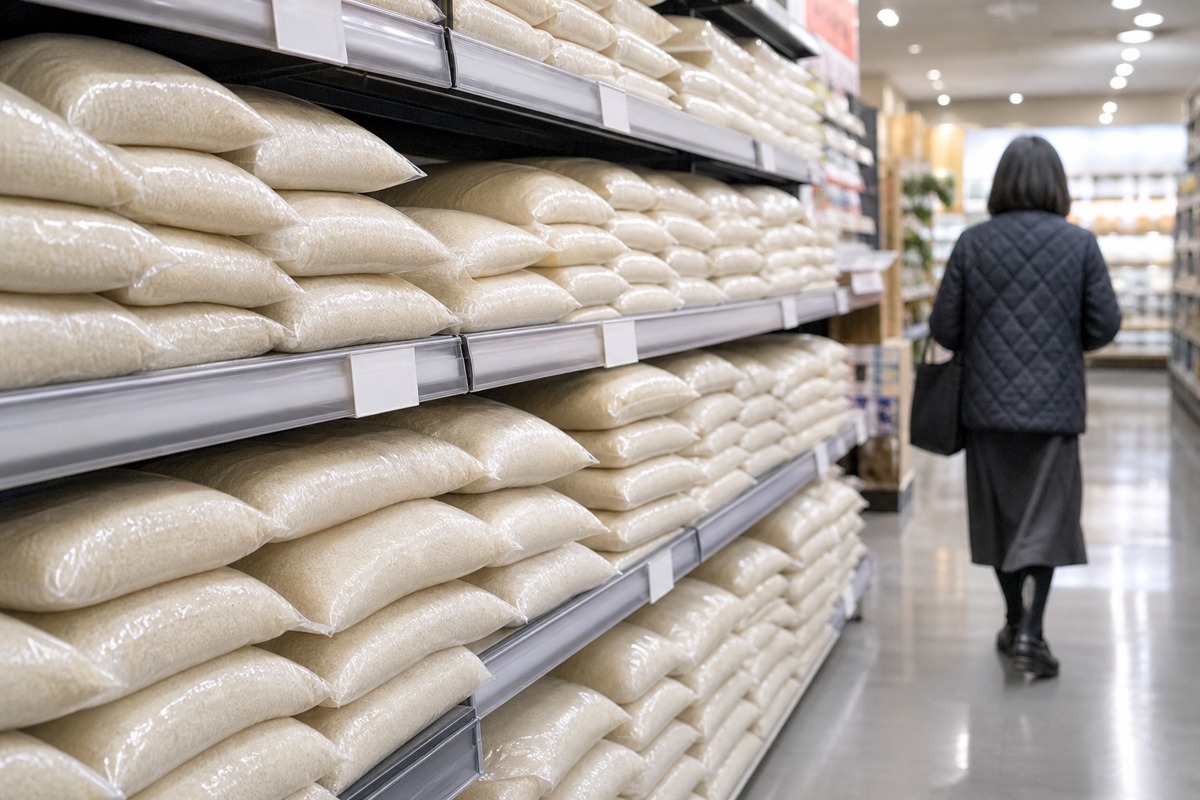
For households, falling rice prices are one of the few areas of the grocery bill moving in the right direction. Japan’s food and beverage makers are raising prices on thousands of items; Teikoku Databank counted 3,153 items scheduled to rise in October alone, after 4,965 in September. Rice is one of the few staples going the other way.
For retailers and food-service operators, the effect is two-sided. Lower rice costs help restaurants, bento makers and convenience stores, which are among the biggest buyers. That is likely one background factor in the rice-ball price cuts. But retailers also face a more volatile commodity than they expected. Operators with fixed-price supply contracts struck during the shortage may find themselves paying above the market, while those with flexible terms benefit.
For rice sellers, the picture depends on position. Large brands with strong consumer recognition and a clear story may find it easier to hold price than blended or unbranded rice. The ministry’s data shows the same pattern in the decline itself, with branded rice only slightly more expensive than blended rice, so the gap between them is narrow.
What International Operators Should Take From This
Rice is Japan’s most politically sensitive food, but the lessons reach well beyond it.
Protected markets swing hard. Japan’s rice system combines supply guidance, import restrictions and a cooperative-dominated distribution chain. That structure dampens some risks but amplifies others. Prices can move sharply when supply and demand are mismatched, because there is little international arbitrage to smooth the swing. Companies that buy Japanese agricultural inputs should plan for volatility, not stability.
Inventory data matters. The new reporting requirements for processors and food service businesses show that regulators now want better visibility into private stocks. Companies that handle rice above the reporting thresholds should expect more reporting obligations and be ready to provide data.
Consumer relief is not guaranteed to last. Analysts quoted in September expect rice prices to keep falling. But if farmers leave the sector in large numbers, supply could tighten in a few years. Anyone building a product or contract around today’s rice price should model both directions.
Value-added positions are more resilient. Hiroshi Asano’s strategy of processing, packaging and selling directly is the same pattern seen across Japanese food. Producers who control a brand or a customer relationship are less exposed to commodity prices than those who sell into the cooperative. International companies looking for Japanese partners in agriculture or food should look at which producers have already made that shift.
Export is not a simple answer. Policymakers have long talked about exporting Japanese rice to absorb surplus, and the idea resurfaces whenever stocks pile up. But our sources do not report any change in export policy as part of the current response, and export volumes are small relative to the surplus. It would be speculative to treat exports as a near-term solution.
What to Watch Next
The weekly ministry survey. The supermarket price is published on Fridays. Watch whether the decline continues below ¥2,900 and whether the pace of the weekly drops slows.
Advance payments for the main crop. The early-season cuts in Kagoshima and Miyazaki were the first signal. The payments for later-harvest regions will show whether the 40% to 50% falls spread.
The buyback. The planned 210,000 tons is well short of the 1 million-ton target. Whether the government buys more, and how fast, will affect both prices and political pressure from the farm lobby.
Support for farmers. The idea of a price floor or direct payments has been raised but not adopted. If the government moves in that direction, it would mark a shift in rice policy.
Next year’s planting. The ministry’s output projection of 7.32 million tons against demand of 6.93 to 7.11 million tons suggests that farmers may be pushed to plant less. How they respond will shape the 2027 crop.
Frequently Asked Questions
Q. How much has Japan’s rice price fallen in 2026?
A. According to Japan’s agriculture ministry, the average supermarket price of a 5 kg bag fell from a peak of ¥4,416 in January 2026 to ¥2,971 in mid-September, the first time below ¥3,000 since September 2024. A report cited in late September put it at ¥2,934 as of September 20.
Q. Why did Japan’s rice price rise so sharply in the first place?
A. A hot summer in 2023 hurt rice quality and milling yields, restaurant demand rebounded after the pandemic and an earthquake warning prompted stockpiling in 2024. Together they triggered a shortage, known as the Reiwa-era rice crisis.
Q. Why are prices falling now?
A. Last year’s harvest exceeded demand, partly because official forecasts underestimated how far consumption would fall. Private-sector stocks reached a record 2.43 million tons at the end of June, and government stockpile releases added supply.
Q. How much are farmers being paid?
A. Prices vary by region and cooperative. In Miyazaki, advance payments for early-season Koshihikari were set at ¥18,000 per 60 kg of brown rice, down 45% from ¥32,600 in 2025. A Chiba farmer reported being offered under ¥15,000 per 60 kg, compared with ¥30,000 last year.
Q. What is the government doing?
A. The agriculture ministry plans to buy back about 210,000 tons of rice to replenish emergency reserves, which fell to about 320,000 tons from a target of about 1 million tons. It has also updated its demand forecasting model and introduced inventory reporting requirements for food processors and food service businesses.
Q. Will rice prices keep falling?
A. Two analysts quoted in the Japan News expect further declines, even after the reserves are replenished. Forecasts of this kind are uncertain, and a decline in the number of farmers could tighten supply over time.
Q. What does this mean for foreign companies?
A. Japan’s protected rice market can swing sharply between shortage and glut. Companies that buy or sell rice-based products in Japan should plan for price volatility, expect more inventory reporting and look for producers with brand and processing capabilities.
Conclusion
Japan’s rice price has fallen by about a third from its peak in nine months. For consumers, it is the end of an unusually painful stretch at the supermarket. For farmers, it is the start of a different kind of squeeze, with prices paid at the farm gate falling faster than prices on the shelf.
The deeper lesson is that Japan’s rice market is not simply a story about one staple. It is a case study in how a tightly managed system responds when forecasts are wrong, stocks are opaque and the workforce behind it is ageing. The shortage of 2024 and the glut of 2026 came from the same structure. Companies that sell to, buy from or invest in Japanese food should treat both as part of one cycle, and plan for the next turn.
If you’re interested in this topic, the Japanese market more broadly, or what KETCHUPs is working on, we’d love to hear from you — please reach out via our contact form.
Japan Market Pulse is a weekly read on what the Japanese consumer-tech, food, and mobility markets are choosing to do, written for international operators who want to know what is happening before it shows up in the global trade press.
Subscribe at ketchups.co/japan-market-pulse.