

On Wednesday, October 7, 2026, investigators from the Japan Fair Trade Commission (JFTC) walked into the offices of Asahi Breweries, Kirin Brewery, Sapporo Breweries and Suntory Spirits. These four companies together control more than 90% of Japan’s beer market. The regulator opened compulsory investigations into all of them on suspicion of violating the Antimonopoly Act, according to reports by the Japan Times, Bloomberg and ABC News.
The suspicion is simple to state and serious in its implications. Investigators believe the brewers may have coordinated when and by how much they raised prices for beer, low-malt beer (happoshu) and other beer-like drinks over several years. All four companies confirmed the inspections and said they would cooperate. None of them has been charged, and no finding has been made.
For international readers, the names are familiar. Asahi Super Dry is sold across Europe and Australia, Kirin Ichiban and Sapporo are brewed abroad, and Suntory is a global spirits group. But the story is less about the brands than about the market they share. Japan’s beer business is highly concentrated, with four sellers holding more than 90% of the market, it has raised prices in near lockstep twice in four years, and it has just been handed a tax cut. This article looks at what the investigation is about, why a four-player market is a natural place for regulators to look, and what it means for international companies that compete in, or sell into, concentrated Japanese categories.
What Happened on October 7
The JFTC’s action was a compulsory investigation, which is a step beyond an ordinary administrative inspection. Under this procedure, officials can enter premises, search them and seize evidence under warrants issued by a court. Reports say the commission is considering whether to file a criminal complaint with prosecutors if it finds that the law was broken. According to NHK, as cited by Nippon.com, it is the commission’s first compulsory criminal investigation into suspected price-fixing in the food and beverage sector.
The alleged mechanism, as reported by the Japan Times, is old-fashioned. The four brewers are members of the Brewers Association of Japan, which holds regular monthly meetings. Sales staff from each company allegedly met separately after those meetings to align the prices they charged to wholesalers. Reports say the coordination covered price increases calculated per litre and by container type.
The four companies’ public responses were brief. Each confirmed the investigation and said it would cooperate. Suntory said it was undergoing an on-site inspection over suspected breaches of the Antimonopoly Act relating to its alcohol trading. Asahi’s Australian business said the investigation concerned Asahi Breweries in Japan and was unrelated to its Australian operations.
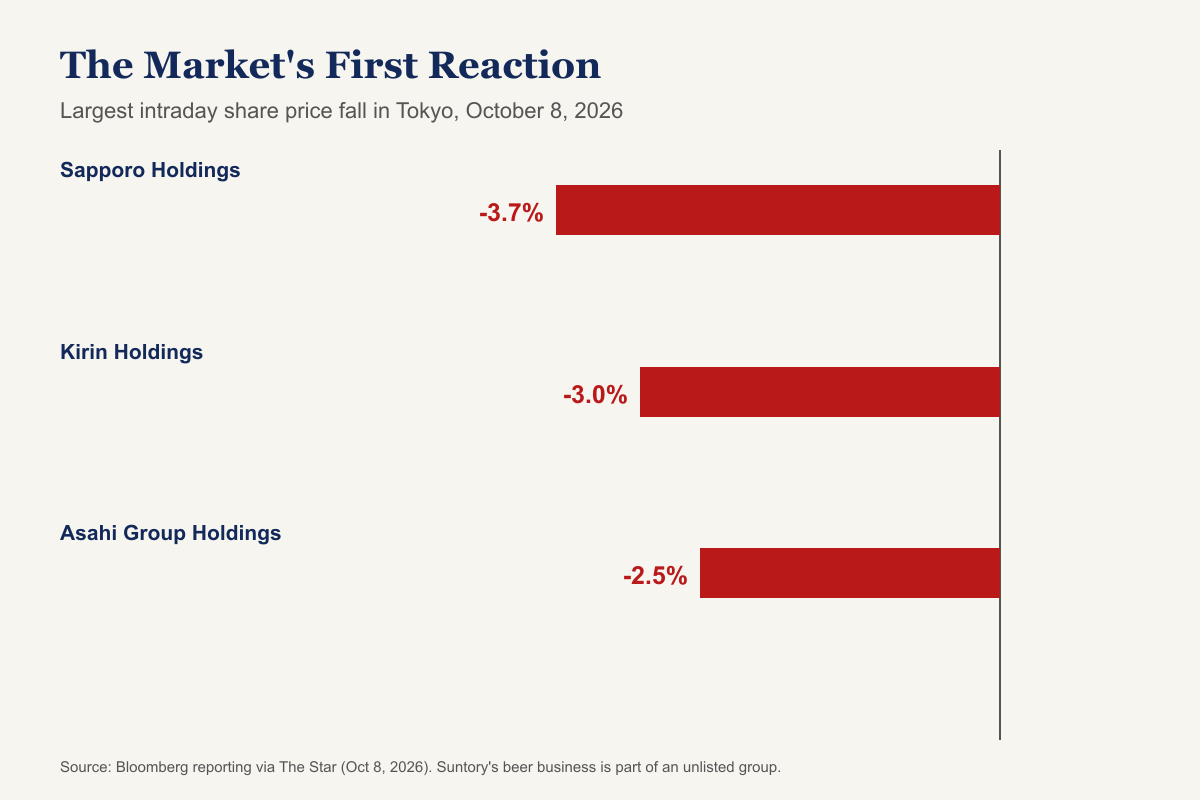
Markets reacted, but modestly. In Tokyo trading on October 8, shares of Sapporo fell as much as 3.7%, Kirin Holdings as much as 3% and Asahi Group Holdings as much as 2.5%, according to reporting carried by The Star. Suntory’s beer business sits inside an unlisted group, so there was no equivalent share move.
It is important to be precise about where things stand. A raid is the start of an investigation, not its conclusion. The companies have not been charged, the commission has not published findings, and similar investigations in Japan can take a long time to resolve. Everything that follows should be read in that light.
Four Companies, More Than 90% of the Market
The reason this investigation matters so much is the structure of the market.
Japan’s beer market is dominated by four companies, which together hold more than 90% of it. The combined domestic market for beer and low-malt beer was worth about ¥1.61 trillion (about $10.1 billion) in 2024, according to National Tax Agency data cited by the Japan Times. That is a large, mature, slowly shrinking market with very few sellers.
Compare that with the United States, where a handful of large groups also lead the market but thousands of independent craft breweries compete for shelf space and taps. Or with Europe, where national champions sit beside strong regional and imported brands. In Japan, a shopper standing in front of a convenience store fridge is choosing, for the most part, between the products of four companies.
Concentration on its own is not illegal. Many markets in Japan, from instant noodles to soft drinks to beer, are led by a few large players because of scale economies in production, distribution and advertising. Japanese convenience stores and supermarkets also prefer to deal with suppliers who can deliver a full range nationwide, which favours large brewers.
But concentration does change the incentives. When four companies face the same cost pressures, sell through the same wholesalers and retailers, and watch each other’s moves closely, prices tend to move together even without any agreement. Economists call this conscious parallelism, and in most legal systems it is lawful. What competition law prohibits is an agreement or understanding among competitors to fix prices, including the timing and size of increases. The JFTC’s job is to find out which of these two things happened in Japan’s beer market.
Two Price Hikes, Same Timing
The investigation focuses on how the brewers raised prices over several years. Two rounds stand out.
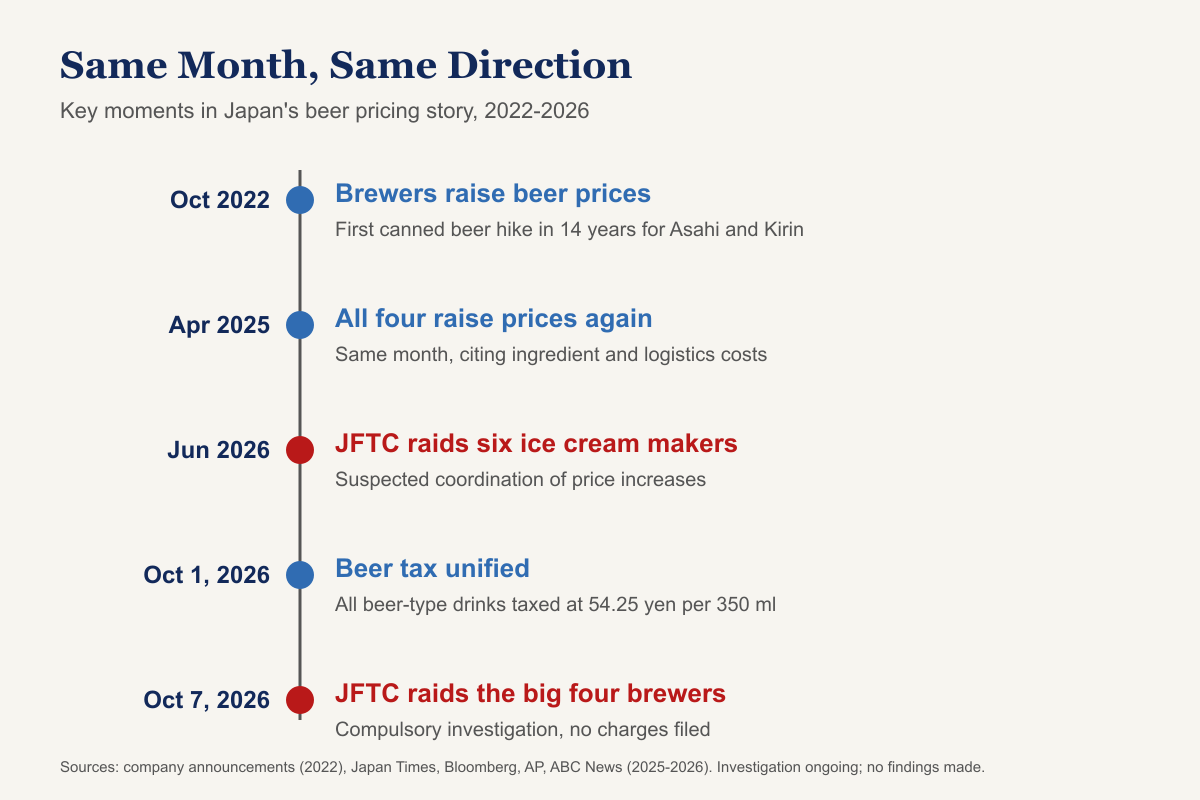
In October 2022, the major brewers raised prices on beer and related drinks, citing higher costs for raw materials such as barley, aluminium for cans and energy, and for logistics. For Asahi and Kirin, it was the first price increase for canned beer for home use in 14 years. Retail prices for beer were expected to rise by roughly 6% to 10%, depending on the product, according to company announcements reported at the time.
In April 2025, the four brewers again raised prices, and again they did so in the same month. In both rounds, each company attributed its increase to higher ingredient and logistics costs.
Viewed from outside, this pattern is open to two readings. The first is that four companies facing the same commodity inflation, the same yen and the same logistics crunch independently concluded that they had to raise prices, and that each moved when the others did because nobody wanted to be the only expensive beer on the shelf for long. The second is that they agreed in advance on how much and when. The first is legal. The second is a cartel.
Japan’s retail environment makes the timing question especially sensitive. Japanese retailers generally prefer suppliers to announce price changes well in advance and to implement them on fixed dates, often the first day of a month or quarter. That alone makes simultaneous price changes more likely. It is also why regulators look closely at what happens before the announcements, at who talked to whom and about what, rather than at the price changes themselves.
Why This Is Happening Now
The timing of the raid is notable for three reasons.
First, the JFTC has become more active in consumer goods. In June 2026, it raided six ice cream makers, including Meiji, Morinaga Milk Industry, Morinaga & Co., Lotte, Ezaki Glico and Akagi Nyugyo, on suspicion of price fixing. According to the Associated Press, top managers at those companies were suspected of being in contact over several years to coordinate price increases, such as raising prices by ¥10, and the timing of those increases. The beer raid follows the same pattern: a concentrated category, several years of price rises, and a suspicion that rises were coordinated rather than independent.
Second, Japan is in its longest period of sustained price increases in decades. After years of near-zero inflation, food and drink companies have raised prices repeatedly since 2022. Consumers have accepted many of these increases, but political and regulatory attention to whether price rises are justified has grown. A competition investigation is one way for the state to show that it is watching.
Third, the beer market has just been reshaped by tax. On October 1, 2026, the final stage of Japan’s liquor tax reform took effect. Beer, happoshu and new-genre beer are now all taxed at ¥54.25 per 350 ml can. For real beer, that is a tax cut. For the cheaper beer-like drinks that brewers created to exploit the old tax gaps, it is a tax increase. The reform was designed to end decades of tax-driven product engineering and was expected to boost demand for real beer. Brewers have been shifting their portfolios toward higher-margin beer products in response.
That combination makes pricing behaviour in the beer market more visible than usual. When taxes change, every brewer must decide how much of the change to pass on and when. If those decisions look coordinated, the investigation will make them harder to defend.
What This Means for the Brewers
For Asahi, Kirin, Sapporo and Suntory, the immediate impact is reputational and managerial rather than financial. A compulsory investigation consumes management time, involves the seizure of documents and emails, and places every pricing decision under scrutiny.
If the commission finds a breach, the consequences can include administrative surcharges, orders to change business practices and, in serious cases, criminal complaints against companies and individuals. Reports so far have not specified any penalty amounts, and it would be speculative to estimate them.
There are also operational effects. While the investigation continues, the brewers are likely to be cautious about any communication that could look like coordination, including through industry associations. Industry bodies in Japan play a large role in sharing information, lobbying on tax and regulation, and running joint campaigns on topics such as responsible drinking and recycling. Their meetings will now be watched more closely, and companies will likely add compliance controls around them.
Pricing itself may change. Brewers that previously moved prices on the same date as competitors may now want to show independence, by choosing different timing, different increases or different product mixes. In the short term, that could make the market slightly more competitive for consumers. In the longer term, it could push brewers to compete more on product, premiumisation and marketing than on price.
What International Operators Should Take From This
Most readers of this newsletter are not brewers. But the beer investigation carries lessons for any international company that sells into, partners with or competes against concentrated Japanese categories.
1. Concentrated categories are common in Japan, and they are now under a brighter light. Beer, ice cream, instant noodles, soft drinks, confectionery and many household goods are led by a few large domestic players. For a foreign brand, this means entering a market where incumbents are well known to each other, to retailers and to regulators. The JFTC’s recent actions suggest that regulators are more willing to examine how prices are set in these categories. That can create openings for challengers, because retailers and consumers become more receptive to alternatives when incumbents are under scrutiny.
2. Industry associations are not a safe space. Many international companies join Japanese industry associations to gain information and influence. That is legitimate and often useful. But the beer case shows how conversations around association meetings can become the focus of an investigation. Foreign companies operating in Japan should apply the same competition compliance standards they use in the US or Europe: no discussions with competitors about prices, margins, timing of price changes or customer allocation, even informally after the formal meeting has ended.
3. Price increase timing in Japan is a compliance issue as well as a commercial one. Because Japanese retailers expect advance notice and fixed implementation dates, suppliers often announce price changes months ahead. That transparency can make it easy to see what competitors are planning. Companies should document how they set their own prices and dates independently, using their own cost data, so they can show that any parallel movement was not agreed.
4. Imported and craft products have a narrative opportunity. When a category’s leaders are under investigation for coordinated price increases, consumers and retailers may pay more attention to value and to alternatives. International brewers, craft producers and imported beverage brands can position themselves around transparency, quality and fair pricing. This should be done carefully. Commenting directly on an ongoing investigation is risky, but emphasising independent pricing and product value is not.
5. Tax and regulation are shaping Japanese categories as much as consumer taste. The beer market’s structure was heavily influenced by tax, which encouraged brewers to create happoshu and new-genre products. The October 2026 tax unification removes that distortion. Combined with the competition investigation, it means the rules of the beer market are changing on two fronts at once. Foreign companies should track regulatory changes in their Japanese categories as closely as they track consumer trends.
Japan Compared With the US and Europe
Price-fixing investigations in beer are not unique to Japan. Competition authorities in Europe have investigated and fined brewers in several countries over the years, and in the US, competition concerns in beer have usually focused on mergers and distribution rather than on price cartels among brewers. The details and outcomes vary by country and case, and readers should look at specific decisions rather than generalising.
What stands out in Japan’s case is the combination of very high concentration, regular industry association meetings after which, according to reports, sales staff are suspected of meeting, and a retail calendar in which price changes tend to cluster on fixed dates. In that environment, the line between lawful parallel behaviour and unlawful coordination can be harder to see from the outside, which is precisely why investigators want to look at internal documents.
For international readers, it is also worth noting what this case is not. It is not a sign that Japanese consumer markets are closed or rigged. Japan’s beer market has seen intense competition in product development, from dry beers in the 1980s to the explosion of happoshu and new-genre drinks in the 2000s and the current push into premium and craft-style products. The question the JFTC is asking is narrower: whether, on price, the four leading companies competed or cooperated.
What to Watch Next
Several developments will show where this case is heading.
Whether the JFTC files a criminal complaint. Reports say the commission is considering filing criminal complaints with prosecutors. If it does, the case will move into the criminal justice system, and the companies and individuals involved could face prosecution. If it does not, the case may instead result in administrative measures.
How the brewers handle their next price changes. The October 2026 tax change and continuing cost pressure mean that pricing decisions will keep coming. Watch whether the four companies continue to move on the same dates or start to diverge.
Changes at the Brewers Association of Japan. Any announcements about governance, meeting rules or compliance controls would suggest that the industry is preparing for tougher scrutiny.
Retailer reactions. Japanese supermarkets and convenience store chains have significant bargaining power. If they push back on future price increases or give more space to private label and imported beer, it would change the competitive balance.
Other categories. After ice cream in June and beer in October, it is reasonable to ask which concentrated food and beverage categories could come next. The JFTC has not said, and it would be speculative to name any. But international companies in concentrated Japanese categories should assume that regulators are paying attention.
Frequently Asked Questions
Q. Which Japanese beer companies were raided in October 2026?
A. The Japan Fair Trade Commission opened compulsory investigations into Asahi Breweries, Kirin Brewery, Sapporo Breweries and Suntory Spirits on October 7, 2026, on suspicion of violating the Antimonopoly Act.
Q. What are the brewers suspected of?
A. The commission suspects that the four companies coordinated the timing and size of price increases for beer, happoshu and other beer-like drinks over several years. Reports say sales staff allegedly met after monthly Brewers Association of Japan meetings to align prices charged to wholesalers. No charges have been filed.
Q. How much of Japan’s beer market do the four companies control?
A. Together, Asahi, Kirin, Sapporo and Suntory hold more than 90% of Japan’s beer market. The combined domestic beer and happoshu market was worth about ¥1.61 trillion (about $10.1 billion) in 2024, according to National Tax Agency data.
Q. When did Japanese brewers raise beer prices?
A. The major brewers raised prices in October 2022, citing higher raw material and logistics costs, and again in April 2025. In both rounds, the four companies raised prices in the same month.
Q. Does the investigation affect Asahi, Kirin or Sapporo beer sold outside Japan?
A. The investigation concerns the companies’ businesses in Japan. Asahi said its Australian operations were unrelated to the investigation.
Q. What penalties could the brewers face?
A. If the commission finds a breach of the Antimonopoly Act, possible outcomes include administrative surcharges, orders to change business practices and criminal complaints. No penalty has been announced, and reports have not specified amounts.
Q. What does this mean for foreign companies in Japan?
A. It is a reminder to apply strict competition compliance in Japan, especially around industry association meetings and price change announcements, and a signal that concentrated consumer categories are receiving more regulatory attention.
Conclusion
The raids on Asahi, Kirin, Sapporo and Suntory do not prove that Japan’s beer market was rigged. They show that Japan’s competition regulator is now willing to ask that question openly, in a market where four companies hold more than 90% of sales, during a period of repeated price increases and a major tax reform.
For international operators, the lesson extends well beyond beer. Japanese consumer categories are often led by a few large companies that know each other well and move together. That structure has long been treated as a fact of life. In 2026, after ice cream and now beer, it is becoming a subject of scrutiny. Companies that compete on product and value, and that can show their prices are set independently, are best placed for the market that may emerge.
If you’re interested in this topic, the Japanese market more broadly, or what KETCHUPs is working on, we’d love to hear from you — please reach out via our contact form.
Japan Market Pulse is a weekly read on what the Japanese consumer-tech, food, and mobility markets are choosing to do, written for international operators who want to know what is happening before it shows up in the global trade press.
Subscribe at ketchups.co/japan-market-pulse.