

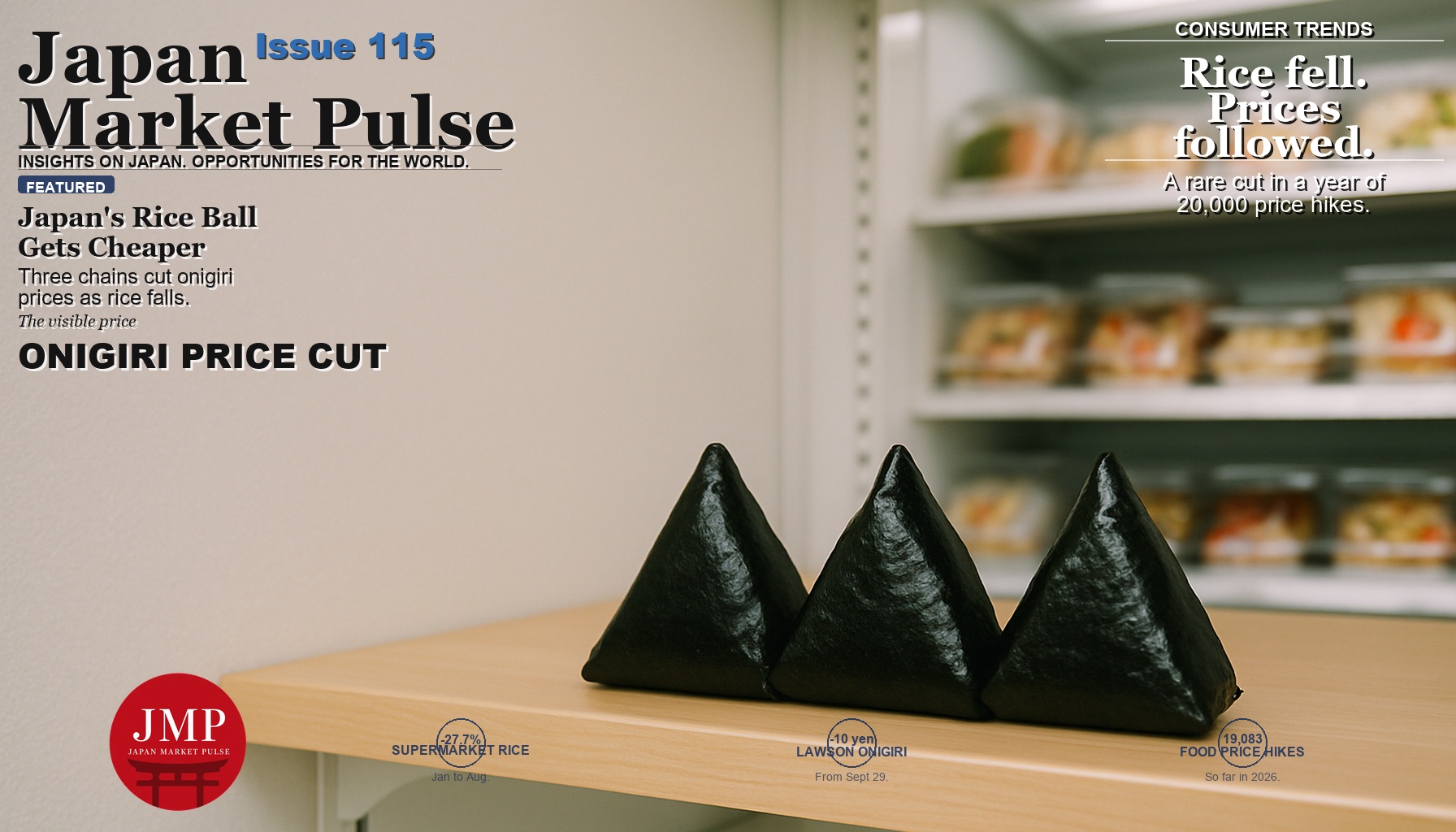
One of Japan’s most popular convenience-store snacks just did something it has barely done in four years: it got cheaper. From September 29, 2026, Lawson is taking ¥10 off its hand-rolled rice balls, dropping its tuna mayonnaise onigiri from ¥181 to ¥171 and its grilled salmon from ¥221 to ¥211. Seven-Eleven Japan is trimming about ¥19 from two of its rice balls, from roughly ¥232 to ¥214, and FamilyMart has already cut a large kelp-and-tuna musubi from ¥320 to ¥298.
Those are small numbers. The context makes them large. In the same year, price increases have been confirmed on 19,083 food and beverage items in Japan, according to Teikoku Databank, and the 2026 total is on track to pass 20,000. About 3,000 items are scheduled to rise in October alone. Against that backdrop, three of the country’s biggest retailers have chosen to move prices down on the one product every Japanese shopper uses as a mental price gauge.
This article looks at what actually changed, why rice is falling faster than the onigiri that contain it, and what the move tells international food and retail operators about how pricing power works in Japan.
What the Three Chains Actually Did
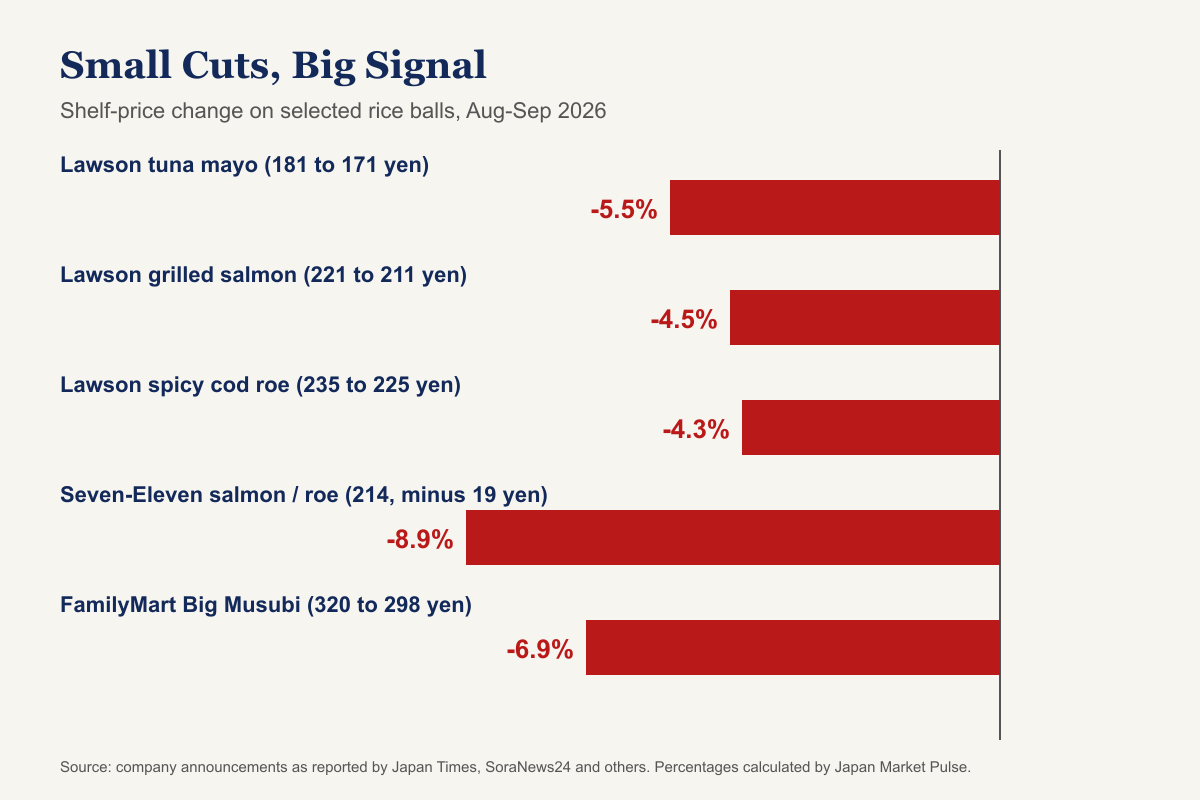
The cuts are modest, targeted and staggered, and the differences between them are worth reading closely.
Lawson is the broadest mover. From September 29 it lowers the after-tax price of its hand-wrapped (temaki) onigiri by about ¥10 (some items ¥11), covering about 20 varieties including region-exclusive items. The tuna mayonnaise ball goes from ¥181 to ¥171, plum, kelp and bonito flake versions from ¥194 to ¥184, grilled salmon from ¥221 to ¥211 and spicy cod roe from ¥235 to ¥225. The company says filling quantity and quality will not change. Lawson has raised its hand-rolled rice ball prices repeatedly over the past four years, so this is a genuine reversal and not a promotional blip.
Seven-Eleven Japan is cutting two items, salmon and spicy roe, by about ¥19, from roughly ¥232 to ¥214 including tax, starting September 8. It attributes the move to lower raw material procurement costs. The scope is narrower than Lawson’s.
FamilyMart reduced its large kelp and tuna mayonnaise Big Musubi from ¥320 to ¥298 from late August (August 24 to 25, depending on the report), a ¥22 cut.
None of these is a headline-grabbing discount. A ¥10 cut on a ¥181 rice ball is about 5.5%. But retail price cuts in Japan are usually temporary: a limited-time campaign, a coupon, a bundle. A non-promotional shelf-price revision on a core product is a different signal, because it suggests management expects the underlying cost to stay lower.
Why Rice Is Falling Faster Than Onigiri
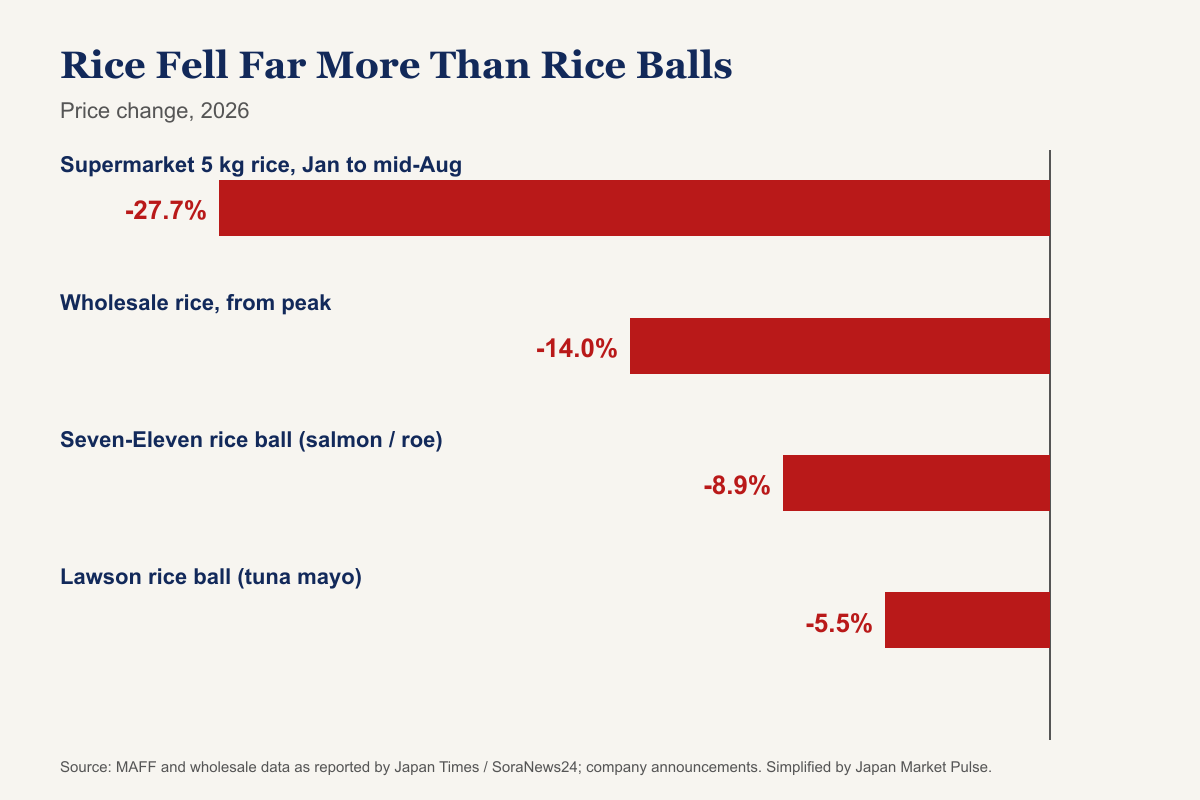
The reason is rice. After the shortage and price spike that dominated Japanese food news in 2025, rice has been getting cheaper. Wholesale transaction prices between businesses in the rice industry were reported down about 14% from their peak (per TBS), and retail prices have dropped by a larger percentage. The Ministry of Agriculture, Forestry and Fisheries reported that the average supermarket price of a 5-kilogram bag of rice was down 27.7% year on year in the latest weekly data the ministry published for late summer.
Convenience stores do not buy rice at supermarket shelf prices. They contract with wholesalers and producers, usually in advance, so the supermarket figure is indirect evidence rather than a measure of their own costs. Still, the direction is clear, and Lawson has said openly that it expects to lower its procurement cost for domestically grown rice.
The more interesting number is the gap. Supermarket rice is down by more than a quarter from a year ago. A Lawson rice ball is down about 4% to 6%, and a Seven-Eleven one about 8%. That gap is not a mistake. A rice ball is not just rice. It carries seaweed, fillings such as salmon and cod roe, packaging, labour, logistics and store rent, and many of those costs have not fallen. Rice is a large share of the ingredient bill, but a smaller share of the final price, so a big fall in the grain produces a small fall on the shelf.
I have watched this happen from the shopper’s side. In my neighbourhood Lawson, the rice ball chiller used to be where you went when you did not want to think about money. Over the last few years it became the place where you noticed it. A ball that once cost ¥120 to ¥140 now often costs roughly double that. A ¥10 drop will not send anyone home delighted, but it changes the feeling of picking one up.
A Price Cut in a Year of Price Hikes
The context is what makes this unusual. Teikoku Databank, which tracks planned price changes at major food and beverage makers, counts 19,083 confirmed increases for 2026, including those already announced for the coming months. September’s batch was the fourth largest on record, and about 3,000 items are scheduled to rise in October. It links the increases to higher packaging costs tied to the conflict in West Asia and to the weak yen, which pushes up the price of imported ingredients and materials.
October brings a wider set of rises. Metropolitan Expressway tolls go up by an average of 8.1%, and the basic charge for sending a Yu-Pack parcel rises 10%. Quasi-beer and heated tobacco also cost more, while beer prices edge down on a tax change.
So the picture is not “prices are falling”. It is a split economy of prices, where some inputs are easing and others are climbing, and companies are choosing item by item where to pass costs on and where to give relief. Rice is the clearest example of a commodity that has turned. Packaging, imports and logistics have not.
For an operator, the lesson is that Japanese retailers do not apply one pricing logic across the shelf. They look at each line’s cost structure and each line’s visibility to shoppers. The rice ball is one of the most visible prices in the country, which is exactly why it is among the first to come down.
Why Convenience Stores Move First on Onigiri
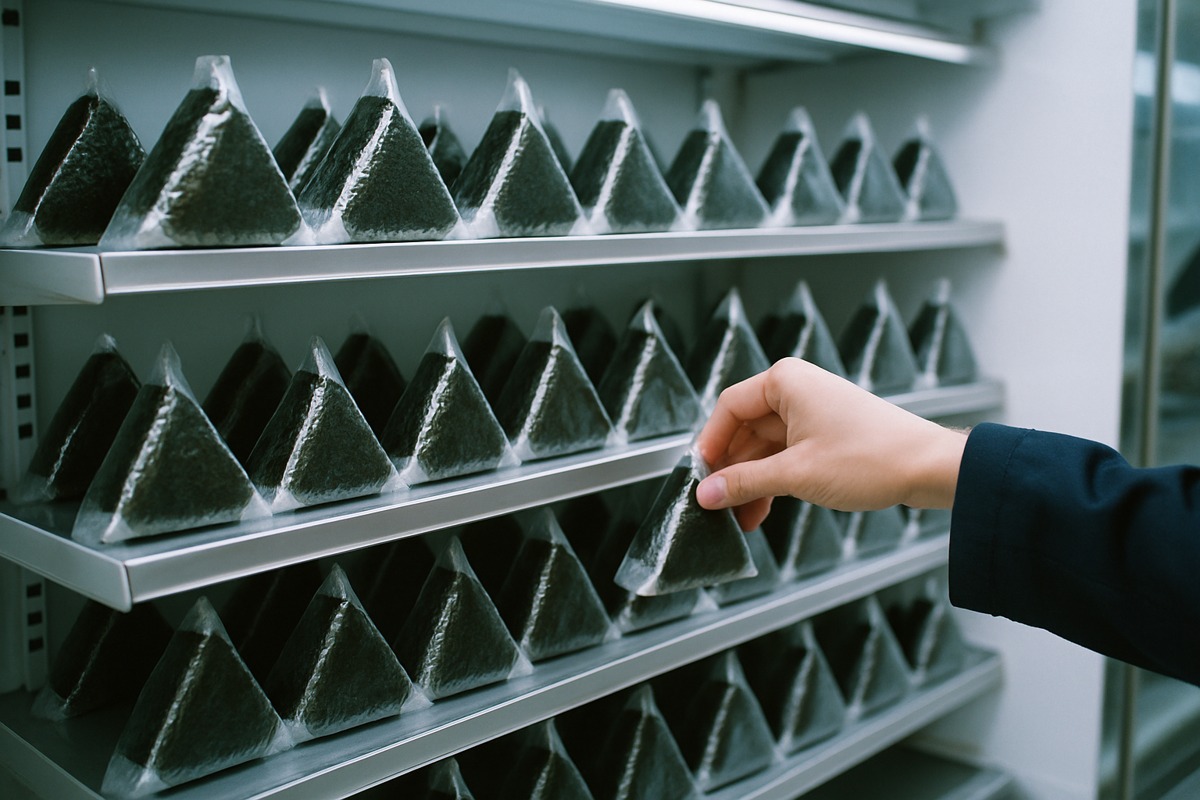
There are three reasons the rice ball leads.
The first is visibility. Everyone in Japan knows roughly what a rice ball costs, much as Americans know what a cup of coffee or a gallon of milk costs. When a visible price rises, shoppers feel inflation. When it falls, they notice that too, and it shapes their view of the store.
The second is cost transparency. Rice prices are public, reported and politically watched. In my view, retailers that keep prices high when rice falls risk being seen as profiteering, and reputational risk with everyday shoppers is taken very seriously in Japan.
The third is volume. Lawson says it hopes the cut will encourage more rice consumption. Many shoppers balked at higher onigiri prices, and some probably switched to bread, noodles or cheaper supermarket options. A modest cut on a high-frequency item is a cheap way to win back baskets. Convenience stores make money on frequency, so even a small shift in how often someone buys a rice ball matters more than the unit margin.
Competition also plays a role. Convenience-store chains watch each other’s prices closely, and reports noted that attention was turning to whether Lawson’s move would influence rivals. With Seven-Eleven and FamilyMart moving within days or weeks, the timing may reflect that competitive attention, although each chose a narrower cut.
What International Operators Should Take From This
If you sell food or consumer goods into Japan, or plan to, the rice ball episode offers several practical points.
Expect pass-through in both directions, but slowly. Japanese retailers raised prices reluctantly and in small steps, and they are lowering them the same way. Do not assume that a commodity falling 27% means a shelf price falling 27%. Plan for a partial, delayed and selective pass-through.
Know your visibility tier. Products whose prices every shopper knows, such as staples and convenience items, are watched and benchmarked. Specialist or premium items are not. If you are negotiating shelf price with a Japanese retailer, ask where your product sits on that scale, because it determines how much room you have to hold price.
Do not read one-off cuts as a trend. Lawson cut about 20 items, Seven-Eleven two, FamilyMart one. Meanwhile 3,000 other items go up in October. A sensible forecast assumes that costs for packaging, imports and logistics keep pressure on prices even as rice eases.
Value is communicated through grams as well as yen. Lawson stressed that filling quantity and quality would not change. In Japan, shrinkflation is a well-known tactic and shoppers are sensitive to it. A price cut that is explicitly “no change in specification” is a trust-building message as much as a financial one.
Watch the policy side. Rice is a politically sensitive commodity in Japan, and government stockpile decisions and production policy can move prices quickly. A sourcing plan that depends on stable rice costs should have a view on that.
What to Watch Next
Three signals will show whether this is the start of a broader easing or a one-time adjustment. The first is whether Seven-Eleven or FamilyMart extends its cuts to more of its rice ball lineup after Lawson’s September 29 start. The second is the next set of Ministry of Agriculture rice price data, which will show whether the supermarket decline continues or flattens. The third is Teikoku Databank’s tally for November and December, which will show whether the 20,000 mark for the year is crossed and how much of the pressure comes from packaging and imported goods rather than domestic staples.
A caution about the figures: the cuts are reported by news outlets and company announcements, the exact scope of Lawson’s cut is described differently across sources (some say 20 items, others most of the line), and the rice price figures are supermarket data, not the contract prices convenience stores pay. Treat the percentages as directional.
Frequently Asked Questions
Q. How much is Lawson cutting rice ball prices in Japan?
A. Lawson lowers the price of its hand-wrapped onigiri by about ¥10 starting September 29, 2026, covering about 20 varieties. For example, the tuna mayonnaise rice ball falls from ¥181 to ¥171 and the grilled salmon from ¥221 to ¥211.
Q. Are Seven-Eleven and FamilyMart also cutting prices?
A. Yes, on a smaller scale. Seven-Eleven Japan cuts two rice balls by about ¥19, from roughly ¥232 to ¥214, starting September 8, and FamilyMart lowered a large kelp and tuna mayonnaise musubi from ¥320 to ¥298 in late August.
Q. Why are rice ball prices falling in Japan?
A. Rice prices have eased. Wholesale prices between industry businesses are down about 14% from their peak, and the average supermarket price of 5 kilograms of rice was down 27.7% year on year in late summer, according to the agriculture ministry.
Q. Does this mean food prices in Japan are falling?
A. No. Teikoku Databank counts 19,083 confirmed food and beverage price increases for 2026, with about 3,000 items scheduled to rise in October, driven by packaging costs and the weak yen. Rice is an exception.
Q. What does it mean for foreign food companies?
A. Expect selective and slow pass-through of cost changes, high sensitivity to visible staple prices, and strong consumer attention to portion size and quality. Plan for different pricing logic by product visibility.
Conclusion
A ¥10 cut on a rice ball is a tiny event in a large economy. It is also a clean demonstration of how Japanese retail pricing works. Costs move at different speeds, retailers decide item by item where to absorb or pass on changes, and the most visible prices are the ones that respond first, in the smallest steps, with the most careful messaging.
For international operators, the takeaway is not that Japan is entering a deflationary phase. It is that the market rewards companies that understand which of their prices are being watched, which costs are really moving, and how to tell shoppers that value has not been quietly reduced. The rice ball is a small product with a big lesson.
If you’re interested in this topic, the Japanese market more broadly, or what KETCHUPs is working on, we’d love to hear from you — please reach out via our contact form.
Japan Market Pulse is a weekly read on what the Japanese consumer-tech, food, and mobility markets are choosing to do, written for international operators who want to know what is happening before it shows up in the global trade press.
Subscribe at ketchups.co/japan-market-pulse.