

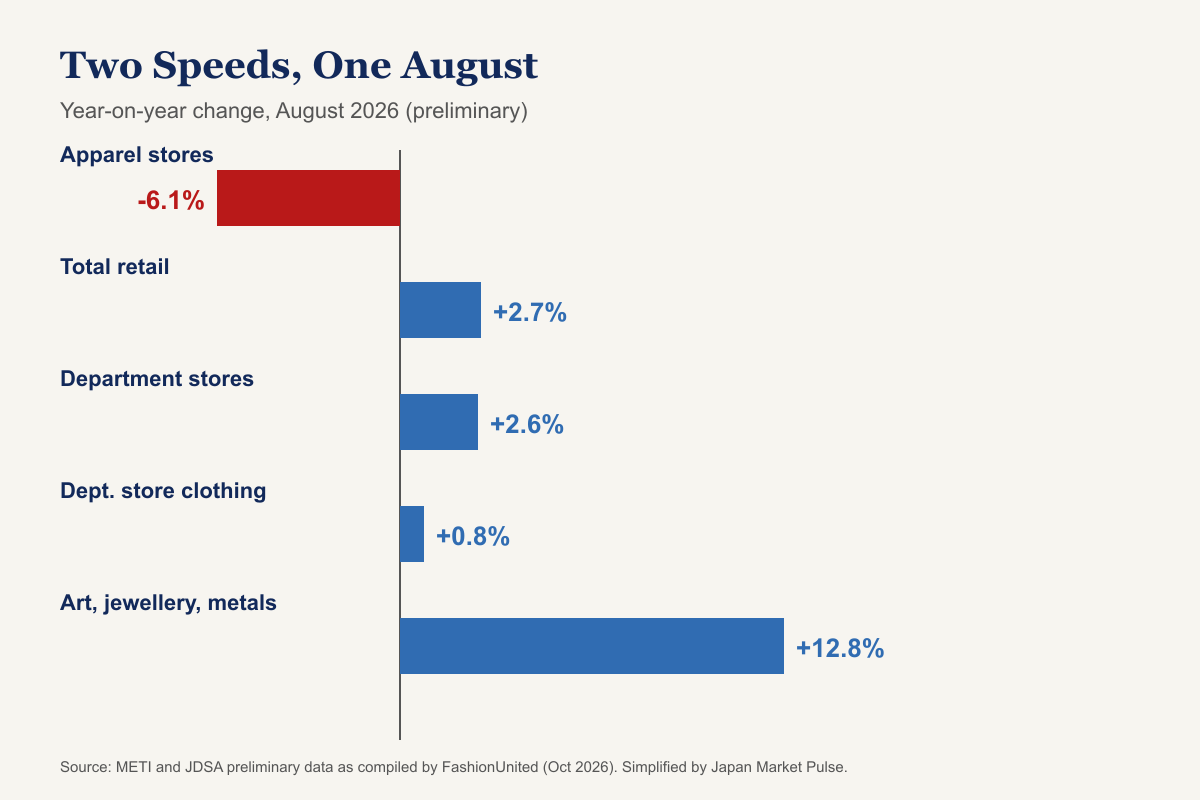
Here are two sets of Japanese retail numbers from the same month. In August 2026, sales at textile, apparel and accessories stores fell 6.1% year on year to about ¥520 billion, according to preliminary figures from the Ministry of Economy, Trade and Industry (METI). It was the twelfth consecutive monthly decline for the category. In the same month, department store sales rose 2.6% on a store-adjusted basis, the eighth consecutive monthly increase, according to the Japan Department Stores Association (JDSA).
Total retail sales across Japan grew 2.7% to roughly ¥13.05 trillion. Consumers were spending. They were just not spending in the same places.
If you sell fashion, accessories or any discretionary product into Japan, this split matters more than the headline inflation rate or the tourist count. It describes a market that has divided into two speeds, one for shoppers who trade up and one for shoppers who trade sideways, and the two groups respond to very different signals.
This article walks through the August data, explains what the department store numbers do and do not say about overseas visitors, looks at the weak yen as the quiet driver behind both trends, and closes with what international brands should do differently depending on which lane they are in.
The Numbers Behind the Split
A single month is a snapshot, not a trend, so it is worth noting why the streaks matter. Twelve consecutive declines at apparel stores means the category has been shrinking since roughly the summer of 2025. Eight consecutive gains at department stores means the premium channel has been growing for about the same period in which clothing specialists have been struggling.
The August figures, as compiled by the trade outlet FashionUnited from official sources, look like this:
– Apparel and accessories stores (METI, preliminary): down 6.1% year on year to about ¥520 billion, a twelfth straight monthly fall. – Department stores overall (JDSA, preliminary): up 2.6% on a store-adjusted basis, an eighth straight monthly rise. Domestic sales rose 2.4%. – Department store clothing: about ¥98.2 billion, up 0.8%. Menswear fell 0.8%, womenswear slipped 0.1% and childrenswear rose 4.2%. – Department store art, jewellery and precious metals: up 12.8%. – Total retail sales (METI, preliminary): up 2.7% to about ¥13.05 trillion, with non-store retail, which includes online, up 3.0%.
The pattern inside the department stores is the interesting part. Ordinary clothing barely moved. The growth came from the top of the price ladder: jewellery, watches, art and precious metals. In other words, the department store boom is not a clothing boom. It is a boom in objects that hold or gain value.
Prices Are Not the Explanation
The obvious guess is that clothing stores are suffering because everything is getting more expensive. The data does not support that. Japan’s headline consumer price index rose 1.9% in August, and clothing and footwear rose only 1.5%, below the overall rate. Within that, clothing prices rose 2.0%, footwear 1.1% and shirts and sweaters just 0.7%. In the Tokyo 23 wards, clothing and footwear prices rose 1.4%.
Put plainly, apparel is one of the categories where prices have been rising more slowly than the average basket. Price rises alone seem unlikely to explain the decline. They are choosing to buy fewer of them, buying them somewhere else, or buying them online.
That last point deserves attention. Non-store retail grew faster than the overall market, at 3.0% against 2.7%. Some of what looks like a collapse in store-based apparel is channel migration rather than lost demand, although the official figures do not isolate apparel inside the online total, so the size of that effect cannot be stated with confidence.
The Weak Yen Is the Quiet Driver
The JDSA attributed firm demand for high-priced goods to the weak yen, and the exchange-rate data supports the logic. According to figures cited in the same FashionUnited report, the dollar averaged about ¥158.81 in August, slightly stronger for the yen than July’s ¥162.45, but still around 7.0% weaker than the ¥147.64 average of August 2025.
A weak yen does two things at once, and they point in opposite directions for fashion.
First, it makes imported goods more expensive in yen. Brands that invoice in dollars or euros face higher landed costs, and they either raise shelf prices or accept thinner margins. That pressure lands hardest on mid-priced imported apparel, where the consumer is price-aware and the brand has the least pricing power.
Second, it makes Japanese luxury goods look cheap to anyone holding foreign currency, and it may make a gold watch or a diamond more appealing as a tangible asset for anyone holding yen. A jewellery counter in a Tokyo department store benefits from both the overseas buyer and the domestic buyer who would rather own something tangible while the currency is soft. The 12.8% jump in art, jewellery and precious metals is consistent with both effects, although the report does not break the figure down by buyer type.
The Tourist Paradox
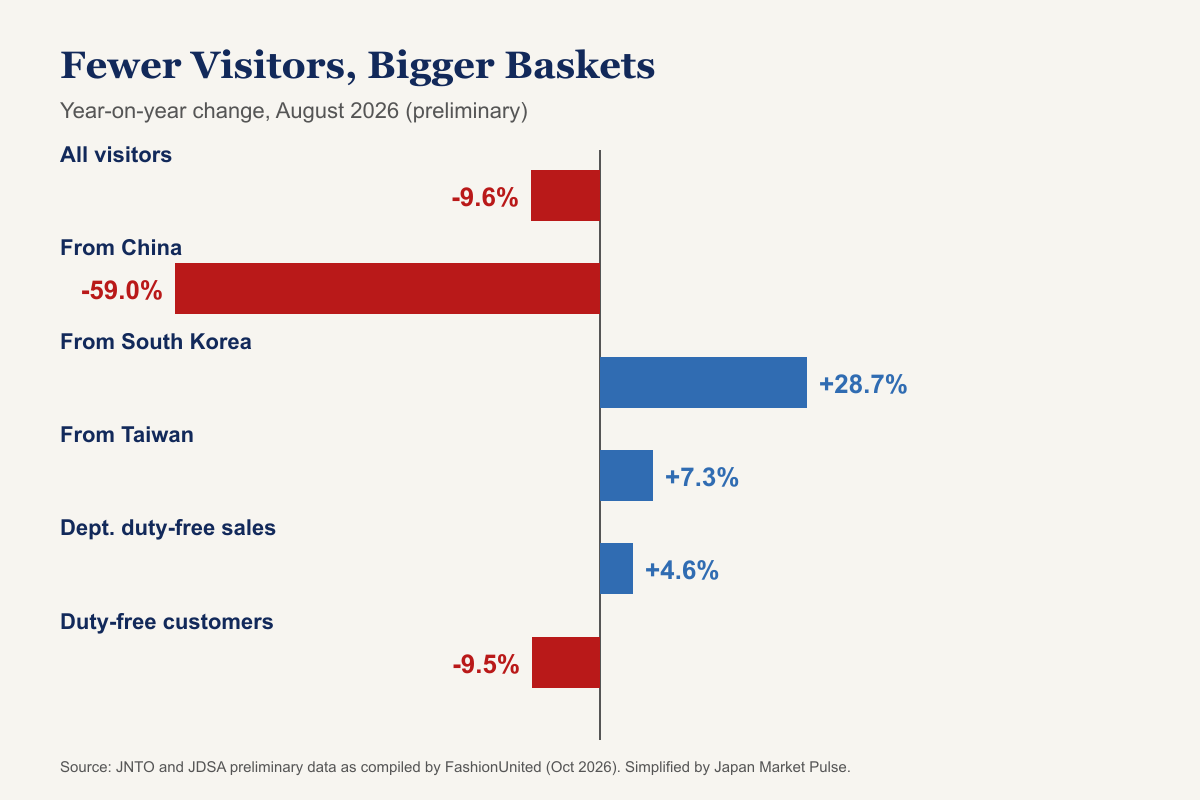
This is where the story gets more complicated than the usual “tourists are saving Japanese retail” narrative. According to preliminary figures from the Japan National Tourism Organization (JNTO) cited in the same report, international visitors in August totalled about 3.10 million, down 9.6% from a year earlier. Visitors from China fell 59.0% to about 418,000. Visitors from South Korea rose 28.7% to about 850,500, and visitors from Taiwan rose 7.3% to about 666,000.
Yet duty-free sales at department stores still grew. They reached about ¥46.1 billion, up 4.6%, even though the number of duty-free customers fell 9.5%. That arithmetic means each remaining tax-free shopper spent noticeably more. Fewer visitors, higher spend per head.
That is a very different tourism economy from the one that powered the retail recovery in earlier years. The group that used to arrive in large numbers and buy broadly has shrunk sharply, while the remaining shoppers appear to be buying fewer, more expensive items. For a brand that depended on volume from a single nationality, this is a warning. For a brand that sells a few high-value pieces, it is an opening.
It also connects to a policy change we covered recently. Japan’s move to a refund-based tax-free system, due in November 2026, may change how and where tourists shop, and department stores, with their dedicated counters and staff, may find it easier to absorb that administrative shift than small independent shops, although no official data compares the two.
A Consumer With Rising Confidence and Cautious Habits
You might expect a market with shrinking apparel sales to have gloomy consumers. The sentiment data says otherwise. The consumer confidence index stood at 35.5 on a seasonally adjusted basis in the report, up 0.6 points and the highest reading since February. The share of households expecting prices to rise over the next year fell to 89.0% from 92.8% in July. Unemployment was 2.5%.
Those are not the numbers of a household under acute stress. They describe a consumer who is employed, slightly more confident, and still very aware of prices. A shopper like that does not stop buying clothes, but does become more deliberate: waiting for sales, comparing online, and saving the budget for the occasional purchase that feels worth it.
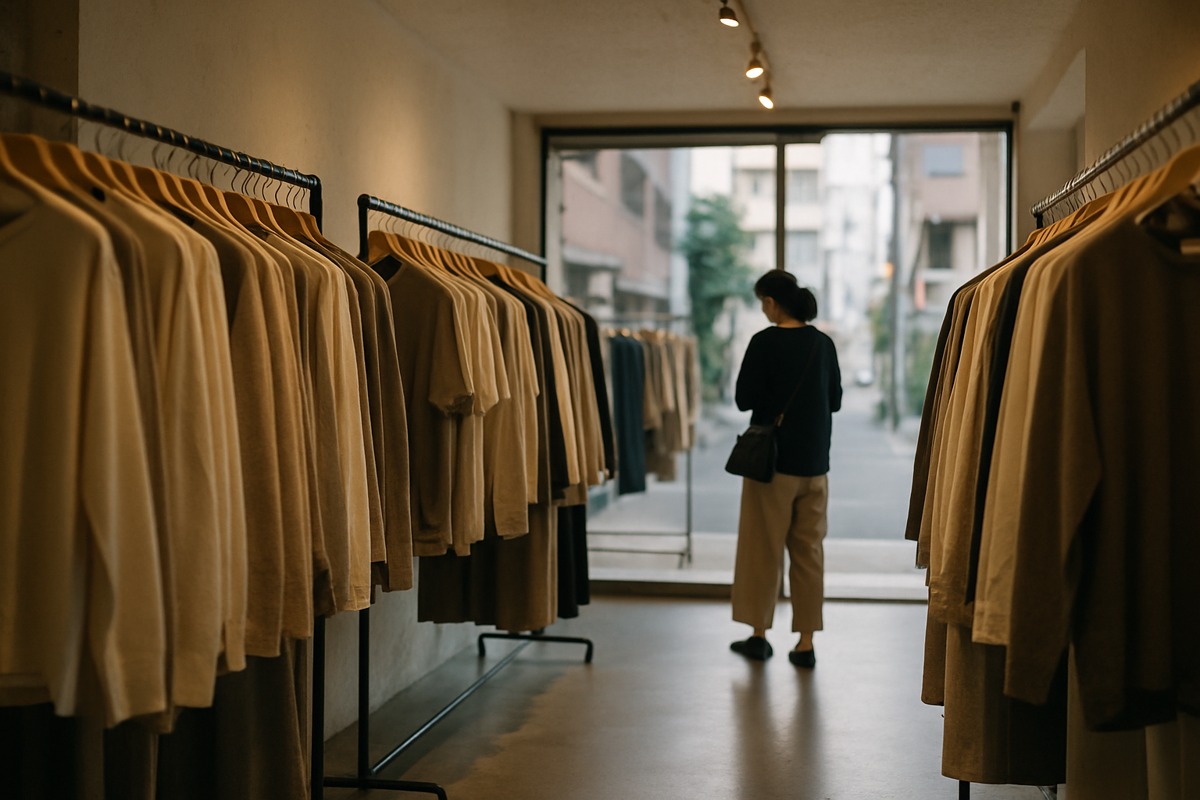
Living in Tokyo, I see this daily. A neighbourhood clothing shop on a weekday afternoon can be nearly empty, while the department store basement food hall and the watch counter upstairs are busy. The same person who walks past a rack of basics will queue for a limited-edition item. The spending has not vanished. It has concentrated.
What the Two Speeds Mean for Brands
The practical question for an international brand is which lane it is in. There are roughly three.
Lane one: premium and collectible. If your product is rare, durable or gives the buyer a story to tell, the current environment favours you. Department store channels are growing, and the shopper has a reason to buy something that holds value. Position the product as an object, not as a trend, and expect the buyer to want service, provenance and a point of sale where those things can be explained.
Lane two: mid-priced everyday apparel. This is the difficult lane. Sales in physical apparel stores are declining, import costs are higher because of the yen, and the shopper has shifted toward online comparison. Brands here need a credible online presence, local fulfilment that avoids long delivery times, and pricing discipline. Discounting will bring traffic, but a twelve-month decline suggests the problem is not a lack of promotions.
Lane three: gifts, kids and occasion purchases. Childrenswear was the one clothing category in the department store data that grew meaningfully, at 4.2%. That is only one month of data, so it cannot show whether gift or milestone purchases are more resilient than routine wardrobe replacement, but it is a pattern worth watching.
Whichever lane you choose, avoid assuming that a good tourist month will carry your Japan business. With visitor numbers down and one major source market down almost 60%, a plan built on inbound spending alone looks fragile.
A Practical Playbook for Each Lane
Knowing the lane is only useful if it changes what you do on Monday morning. Here is how the same August data translates into decisions for three kinds of overseas operator.
If you sell premium or collectible goods. The department store channel is the obvious route, but it is not a simple wholesale relationship. Many Japanese department stores expect brands to support the counter with trained staff, seasonal displays and a clear story, and often judge a concession by sales per square metre. A brand arriving with a small range and no on-the-ground team will struggle to hold a position. A better entry is a limited, well-documented capsule: a handful of pieces, each with provenance, materials and care information translated carefully into Japanese. The 12.8% rise in art, jewellery and precious metals suggests shoppers are receptive to objects they can explain to themselves and to others.
If you sell mid-priced everyday apparel. Treat the physical store as an expensive way to buy attention, not as the default channel. The sensible first step is an online presence with Japanese-language sizing guidance, free returns and delivery times that match domestic expectations. Japanese shoppers are unforgiving about sizing mismatches and slow shipping, and those two issues quietly drive more abandoned baskets than price. Keep your price architecture simple. When the yen is weak, resist the temptation to change prices every quarter. Shoppers who are already cautious read frequent changes as a sign that the brand is unsure of its own value.
If you sell gifts, childrenswear or occasion goods. The department store data shows childrenswear as the one clothing category with a clear gain. One month is not proof of a trend, but it is a reason to test. Packaging, gift wrapping and seasonal timing matter far more here than in routine fashion. Japan has a strong gift culture, with set moments such as year-end and the new school year, and a brand that is ready for those moments with presentation to match can earn a place that everyday apparel cannot.
Reading the Data Carefully
A good analyst argues against their own conclusion, so here are the main reasons the two-speed story could be overstated.
First, the apparel decline is measured at stores, and the official figures do not show how much of that spending moved online. If a large share of it simply shifted to websites, the underlying demand for clothing may be steadier than the headline suggests. Second, the department store gain is measured on a store-adjusted basis, which strips out openings and closures. That is the fairer comparison, but it also means the figure says nothing about whether the channel as a whole is growing in absolute terms. Third, a streak is a streak only until it breaks. A single month of recovery in apparel stores, perhaps helped by cooler autumn weather, would change the framing without changing the structural picture.
Finally, the data comes from a single compilation of preliminary releases. Revisions are normal and sometimes meaningful. The responsible reading is that the direction is clear and the precise size of each gap is not.
Three Questions to Ask Before Entering
For international operators weighing a move, three questions are worth answering before any budget is committed.
Where does your product sit on the price ladder? If the honest answer is “in the middle”, you need a reason for a Japanese shopper to choose it over a domestic mass-market brand on one side and a prestige label on the other. Without that reason, the data suggests the middle is where growth is hardest to find.
Who is your customer, and where do they shop? A product aimed mainly at inbound tourists should be planned around a visitor mix that is shifting, with fewer arrivals from one major market and more from others. A product aimed at residents should be planned around online discovery and a small number of well-chosen physical touchpoints.
What is your plan if the yen strengthens? A weaker yen has helped premium counters and hurt importers’ margins at the same time. If the currency moves back toward the levels of a year ago, some of that support for high-priced goods could fade while import costs ease. A plan that works in only one currency environment is a bet, not a strategy.
What to Watch Next
Three indicators will show whether the split is widening or closing. The first is whether the apparel store decline reaches thirteen months in September. The second is whether the department store run continues once the November tax-free changes take effect. The third is the yen: if it strengthens meaningfully, the argument for buying hard assets in Japan weakens, and imported apparel gets some relief on cost.
One caution about the data itself. The figures here are preliminary and come from different agencies reporting different periods, which the original compilation also notes. Treat them as directional rather than exact, and check final numbers before building a forecast around any single percentage.
Frequently Asked Questions
Q. Are Japanese consumers spending less on clothes?
A. In clothing specialty stores, yes: sales fell 6.1% year on year in August 2026, the twelfth consecutive monthly decline according to METI’s preliminary data. Overall retail sales still grew 2.7%, so the weakness is concentrated in the category and channel, not in spending as a whole.
Q. Why are department stores growing while apparel stores shrink?
A. The growth is led by high-priced goods. Art, jewellery and precious metals rose 12.8% in August, while department store clothing grew only 0.8%. The JDSA linked firm demand for expensive items to the weak yen.
Q. Are tourists still driving Japanese retail?
A. Less than before. International visitors fell 9.6% in August, with Chinese arrivals down 59.0%. Department store duty-free sales still rose 4.6% because the number of tax-free customers fell 9.5% while spending per customer rose.
Q. Is inflation the reason apparel is weak?
A. Unlikely. Clothing and footwear prices rose 1.5% in August, below the 1.9% headline rate. Shoppers appear to be buying less often or shifting to online channels rather than being priced out.
Q. Where should an overseas fashion brand focus?
A. It depends on the price tier. Premium and collectible goods have a growing channel. Mid-priced everyday apparel faces falling store sales and higher import costs, so it needs strong online fulfilment and pricing discipline.
Conclusion
Japan’s fashion market in autumn 2026 is not weak and it is not strong. It is divided. Twelve months of falling apparel store sales and eight months of rising department store sales are two descriptions of the same consumer: employed, moderately confident, price-aware, and willing to spend where the purchase feels permanent.
For international brands, the instruction is to choose a lane deliberately. Either build a product and a channel worthy of the shopper who trades up, or build an efficient, online-first offer for the shopper who trades sideways. The middle ground, a mid-priced product in a physical clothing shop with no reason to visit, is where the numbers are weakest.
If you’re interested in this topic, the Japanese market more broadly, or what KETCHUPs is working on, we’d love to hear from you — please reach out via our contact form.
Japan Market Pulse is a weekly read on what the Japanese consumer-tech, food, and mobility markets are choosing to do, written for international operators who want to know what is happening before it shows up in the global trade press.
Subscribe at ketchups.co/japan-market-pulse.