


On 30 September, according to trade reports, Fujifilm notified the market that prices on 16 products would rise the next morning. There was no transition period. On 1 October, the new prices applied to eight digital camera bodies and kits, one telephoto lens, five instax instant cameras and two instax smartphone printers, with increases ranging from roughly 6% to 23% depending on the product.
Camera enthusiasts focused on the flagship numbers. The GFX100 II medium-format body, according to one trade report, rose by about 14.6%, or roughly ¥186,000 compared with the previous week’s price. The X100VI, a compact camera that has been hard to buy at list price in Japan since launch, went up by about 12%. Those headlines are the obvious story.
The less obvious one is on the instax side. Five instant cameras and two smartphone printers were on the list, with camera increases of up to 23%. Fujifilm has spent four years expanding instax film capacity, and the brand is increasingly central to the company’s imaging profits. When a business with that much momentum raises prices at the same moment, it is worth asking what the company thinks the market will bear.
This article sets out what changed, why Fujifilm says it did it, why instax matters more to the company than its size suggests, and what international brands and importers can take from a price increase announced on a Wednesday and effective on a Thursday.
What Changed on 1 October
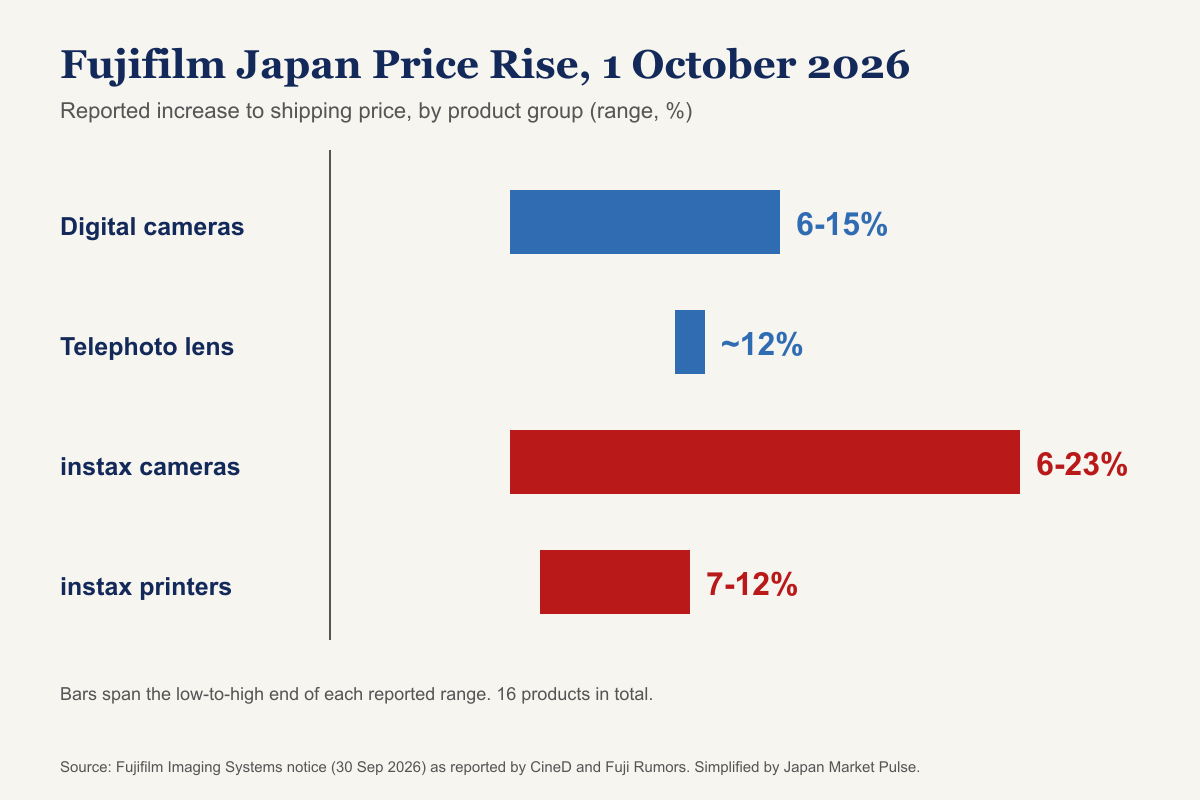
The notice came from Fujifilm Imaging Systems, the group’s domestic sales company, and covered “some” products rather than the full range. The reported breakdown is:
– Digital cameras: about 6% to 15%, covering the GFX100 II, GFX100S II, GFX100RF, X-T50, X-E5 and X100VI, including two lens kits. – Interchangeable lens: about 12% for the XF500mmF5.6 R LM OIS WR. – instax cameras: about 6% to 23% for the mini LiPlay, mini LiPlay+, mini Evo, mini Evo Cinema and WIDE Evo. – instax smartphone printers: about 7% to 12% for the instax mini Link 3 and instax SQ Link.
The percentages are changes to Fujifilm’s shipping price, not necessarily to the price a shopper pays in a store, because Japanese retailers set their own shelf prices. Fujifilm’s own online store listings, as captured by one trade publication, showed the GFX100 II body in a range of about ¥1.27 million to ¥1.46 million, and the X100VI at about ¥281,600 to ¥315,700. The trade report did not fully explain what each end of those ranges represents, so the precise before and after figures are best treated as approximate.
Just as telling is what was left out. The X-H2S, X-H2 and X-M5 bodies were not on the list, nor were the GFX ETERNA 55 or any lens other than the 500mm telephoto. Fujifilm has not said why these particular products were chosen. The company gave one reason: that it had tried to absorb higher costs through production efficiency and cost reductions, but rising material, manufacturing and logistics costs made it difficult to absorb them “through corporate efforts alone.”
For an international reader, the format matters as much as the numbers. A one-day notice period is short. A trade report noted that European dealers had a one-month transition period earlier in the year, with some keeping old prices until the end of August, and that Japanese buyers had no equivalent window.
Three Regions in Just Over a Year
This was not Fujifilm’s first increase. It is better read as the third step in a staggered, region-by-region repricing.
The United States came first. Fujifilm raised prices there effective 30 August 2025, citing tariffs. Europe followed in summer 2026 with a similar adjustment, and Japan now makes three regions in just over a year. Several models appear on both the European and Japanese lists, including the X100VI, X-E5, X-T50 and GFX100 II.
The reasoning differs by region. In the United States, the stated driver was tariffs. In Japan, the company points to materials, manufacturing and logistics. A weak yen has pushed up the cost of imported components for many Japanese manufacturers this year, and the same trade report points to a broader effect: AI data centers absorbing production capacity and lifting memory and component prices across electronics. That attribution comes from the publication’s analysis rather than from Fujifilm, and the company did not mention it in its notice.
The pattern is familiar from other categories covered by this newsletter. Japan has seen a long list of price revisions in October, from tens of thousands of food items to postal rates and tobacco. What stands out in Fujifilm’s case is that a premium brand with strong demand is behaving like a mass-market food producer: it moves prices when its costs move, and it does so in staggered waves rather than a single global list.
instax: The Engine Inside the Camera Maker
To understand why the instax portion of the notice matters, start with the scale. Fujifilm said in April 2025 that cumulative global sales of instax cameras and smartphone printers had passed 100 million units since the brand launched in 1998. It is sold in more than 100 countries, in three film formats: mini, SQUARE and WIDE.
Spread over 27 years, that works out to an average of roughly 3.7 million devices a year, though the pace has been much faster recently. For comparison, the Camera & Imaging Products Association reported about 8.5 million digital cameras shipped worldwide in 2024. The number of instax devices sold each year is therefore a meaningful fraction of the entire digital camera market, at much lower unit prices.
Revenue is the more interesting figure. Industry coverage reports that instax reached about ¥150 billion in sales in fiscal 2023, a year ahead of Fujifilm’s own target, and that fiscal 2024 set another record. One outside analysis (Fstoppers) estimates instax at roughly half of the imaging division’s revenue and more than 60% of its operating income. Fujifilm does not disclose instax revenue or profit separately, so treat that ratio with caution. But the direction is clear. The little camera that prints a credit-card-sized photo has become the profit anchor of the imaging business.
The group’s reported results are consistent with that. Fujifilm’s imaging segment revenue in the first nine months of the fiscal year ending March 2026 was ¥485.7 billion, with operating income of ¥135.5 billion, and the second-quarter segment revenue of ¥291.5 billion was up 13.3% year on year. Fujifilm has stated that its imaging business became the group’s biggest earner this year.
### The capacity bet
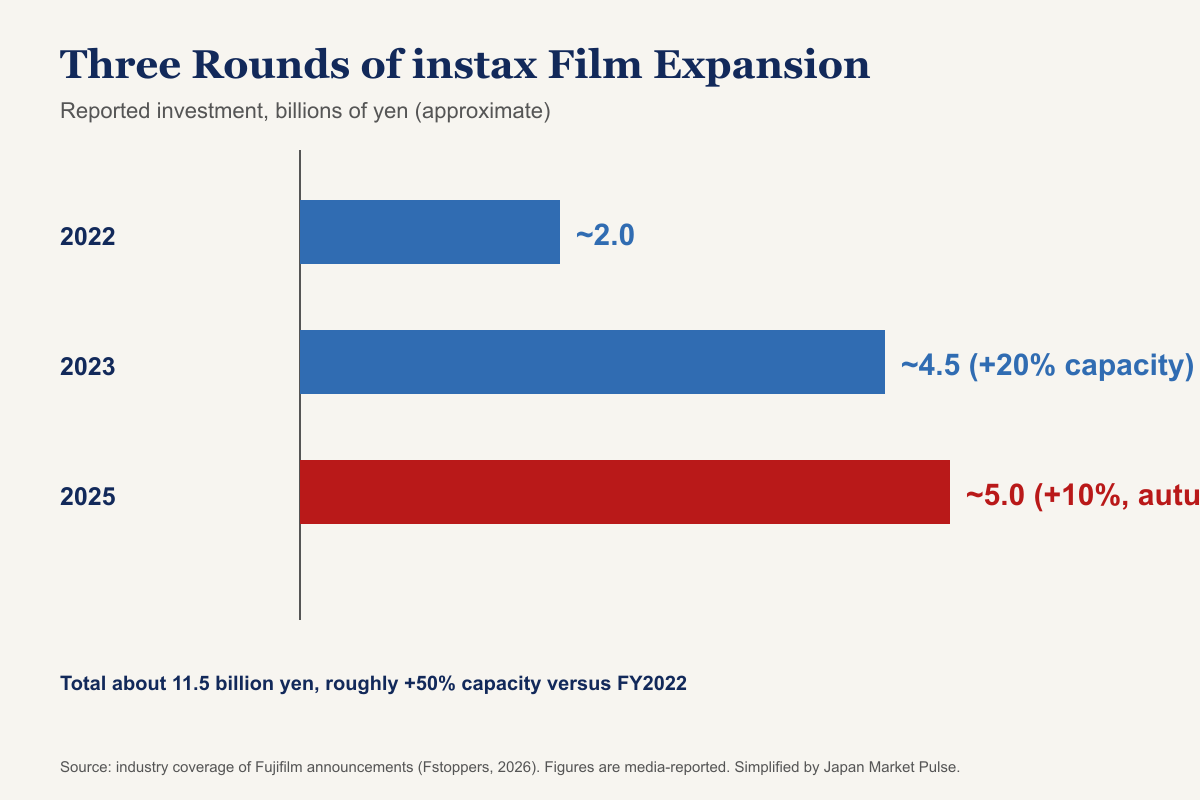
The strongest evidence of confidence is not in earnings but in factories. Industry coverage lists three rounds of instax film expansion in four years:
– 2022: about ¥2 billion, completed. – 2023: about ¥4.5 billion for a roughly 20% increase in capacity, operational in 2025. – 2025: about ¥5 billion for a further 10% increase, expected to come online in autumn 2026.
That adds up to about ¥11.5 billion and a roughly 50% increase over fiscal 2022 capacity. A company does not build capacity at that rate unless it expects demand to hold up. Adding a price increase on the camera side at the moment the third expansion comes online may suggest Fujifilm does not expect hardware prices to dampen film consumption.
That is the heart of the instax business model. The camera is the entry point, and the film is the recurring revenue. A shopper who pays a little more for a mini Evo buys film packs for years. Raising the price of the device matters less than keeping the device in people’s hands.
Why Instant Film Is Different From 35mm

The comparison with conventional film helps explain Fujifilm’s confidence. Over the last several years 35mm film has become more expensive and less available. One analysis puts average 35mm film prices up nearly 70% since 2018. Fujifilm itself suspended domestic supply of most of its remaining 35mm colour negative and slide films in March 2023, and Kodak has had its own financial difficulties, disclosing going-concern doubt in mid-2025 before a pension transaction eased the situation.
Instant film has moved in the other direction. According to the same analysis, an instax mini shot costs about $0.60 to $1.00 including development, and the print appears in about 90 seconds. A 35mm photograph, once film, development, scanning and printing are added, runs about $0.89 to $1.66 per finished print with a turnaround of days. Instax cameras start under $90. For a young user, the cost per image is lower than it appears, and the output is a physical object that can be handed to someone.
That physical quality is what Fujifilm’s tagline, “don’t just take, give,” points toward. The product is not a photograph. It is a small gift. In a market where every phone takes a perfect image, the scarcity of a single, imperfect, printed picture is the appeal. Collectors, concert-goers and event organisers have all adopted it, and Fujifilm has added an instax Biz app that lets businesses print photos with custom templates carrying a logo, phrase or QR code. That is a B2B expansion hiding inside what looks like a toy.
What This Means for Japanese Shoppers
For shoppers in Japan, the effects will arrive in layers.
The first is the direct one: anyone planning to buy an affected camera or instax device pays more, and anyone who delayed a purchase in September lost the chance to save. Retailers with stock bought at old prices may sell at old prices for a while, but replenishment will come at the new level.
The second is the secondary market. The X100VI has been difficult to buy at list price in Japan since launch, and a higher official price may also lift what used units fetch. A trade report noted that the GFX100 II rose by about ¥186,000 in a single step, which is large enough to change the purchasing decision for professionals who were close to committing.
The third is film. Fujifilm announced a separate revision to domestic instax film prices on 31 March 2026, and film is where recurring spending sits. The October notice covers devices only, so the full cost of ownership for a new instax user now includes both steps.
For visitors to Japan, the shelf price in a duty-free store may also move. Japan’s tax-free shopping system is being reformed from November, and a camera with a higher base price will interact with that change in ways that shoppers and retailers are still working out.
The Risks Fujifilm Is Taking
A price increase is a bet that demand is stronger than cost. There are three ways it could go wrong.
First, hardware is the funnel. Instax earns its money from film, and film purchases depend on a large installed base of cameras. A 23% rise on certain instax models could slow new users. If the installed base grows more slowly, film sales eventually follow. The hybrid models, such as the mini Evo, may be the most exposed because they are aimed at buyers who compare them with entry-level digital compacts.
Second, the competition is not standing still. Polaroid has a loyal following, though commentators note that its cameras generally cost two to three times as much as instax, and that the company has struggled to supply film. Smartphone-based printing, small portable photo printers from other makers and digital compact cameras all compete for the same buyer. Fujifilm’s own smartphone printers were included in the increase.
Third, the signal to consumers. A one-day notice with no explanation of why these 16 products were chosen invites speculation. Customers who feel they were not given a chance to buy at the old price may remember it. Fujifilm has strong brand goodwill, particularly among younger buyers, but goodwill is spent faster on communication problems than on price.
On the other side of the ledger, Fujifilm has demand to spare. The X100VI shortage showed that some buyers will pay far more than list price, and instax capacity expansions are being matched by strong results. The company is also not raising everything: the X-H2S, X-H2, X-M5 and most lenses were left alone. That selectivity suggests a deliberate choice to price up the models where demand is strongest.
What Overseas Brands and Importers Should Take From This
There are five practical lessons for international companies selling in or into Japan.
1. Expect cost pass-through to be staggered. Japanese companies increasingly move prices in waves by product and region. Overseas brands that import into Japan should model quarterly price reviews rather than annual ones and agree currency and cost adjustment terms with distributors up front. 2. Notice periods are short. Fujifilm gave one day. Retailers and distributors may receive little more. If your Japanese partner sells your product, keep a clear line of communication about stock bought at old prices and price-change dates. 3. Recurring revenue protects hardware pricing. Fujifilm can raise camera prices because film is the larger long-term business. Brands with a consumable, a subscription or an accessory ecosystem have more room to adjust the device price than those that sell a single product. 4. Selectivity beats across-the-board increases. Leaving popular but supply-constrained models out of the increase, and raising those with excess demand, is a sophisticated approach. Look at which SKUs are scarce and which have room. 5. Watch the yen and the supply chain together. Currency, memory prices and logistics cost all moved at once this year. Treat Japan pricing as a basket of three variables, not one.
There is also a more general point. Japan’s consumer market is entering a phase where price rises are normal and visible, from the shelf of a convenience store to the counter of a camera shop. Brands that have been waiting for a stable Japan before entering may find that stability now looks like steady, structured price movement rather than the long deflation of the past thirty years. That raises revenue opportunities as well as risk.
Frequently Asked Questions
Q. Which Fujifilm products went up in price in Japan on 1 October 2026?
A. Fujifilm Imaging Systems raised prices on 16 products: eight digital camera bodies and kits (including the GFX100 II, GFX100S II, GFX100RF, X-T50, X-E5 and X100VI), the XF500mmF5.6 lens, five instax instant cameras and two instax smartphone printers.
Q. How much did prices rise?
A. Digital cameras rose about 6% to 15%, the 500mm lens about 12%, instax cameras about 6% to 23% and instax smartphone printers about 7% to 12%. The percentages are changes to Fujifilm’s shipping price, so shelf prices vary by retailer.
Q. Why did Fujifilm raise prices?
A. The company said rising material, manufacturing and logistics costs could no longer be absorbed through efficiency gains and cost reductions alone. A previous US increase in August 2025 cited tariffs, and one trade report links component costs to AI data center demand, though Fujifilm did not say so.
Q. How important is instax to Fujifilm?
A. Very. Cumulative sales passed 100 million units in April 2025, and industry coverage reports about ¥150 billion in annual sales in fiscal 2023, with later years higher. One analysis says it accounts for roughly half of imaging revenue and more than 60% of operating income, but that is an outside estimate rather than a company disclosure.
Q. Will prices change outside Japan?
A. The October notice applies to Japan only. The United States saw an increase in August 2025 and Europe in summer 2026, so the three regions have each been adjusted separately.
Conclusion
Fujifilm’s October price change looks, at first, like a routine cost adjustment for cameras that were already expensive. It is more useful to read it as a signal about where the business is going. The company has built a consumer product that sells to young people, earns recurring revenue from film, is expanding factories on a three-step schedule and has enough demand to raise prices on its best-selling devices without a long warning.
For international operators, the lesson is not that every brand can do the same. It is that Japan rewards the companies that combine a distinct product with a recurring business model, and then punishes those who rely on discounts. Fujifilm has the former. Whether customers accept the price rise will become visible in the winter quarter, when sales of instax devices, film and the newly repriced cameras are reported.
If you’re interested in this topic, the Japanese market more broadly, or what KETCHUPs is working on, we’d love to hear from you — please reach out via our contact form.
Japan Market Pulse is a weekly read on what the Japanese consumer-tech, food, and mobility markets are choosing to do, written for international operators who want to know what is happening before it shows up in the global trade press.
Subscribe at ketchups.co/japan-market-pulse.