

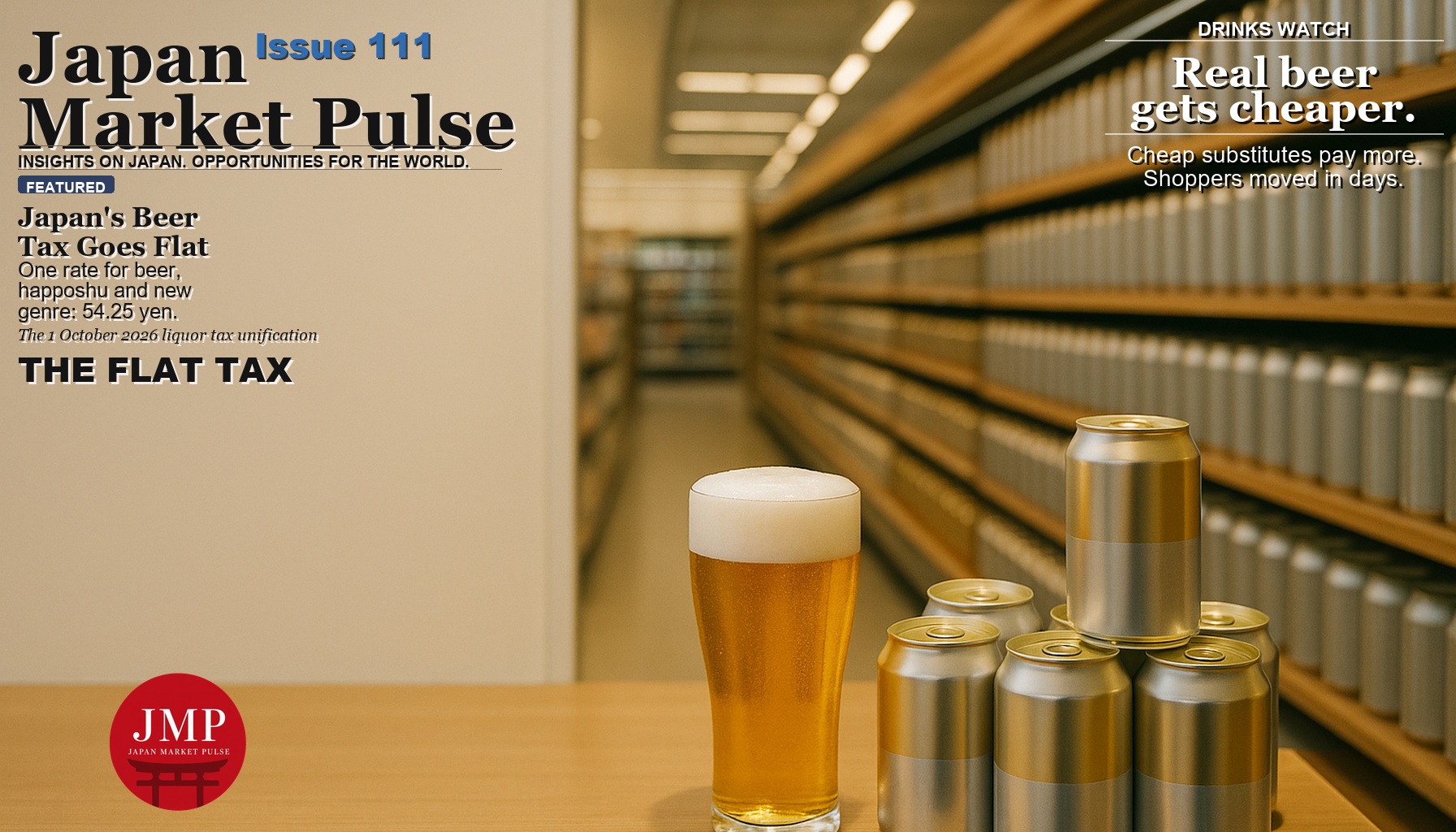
On 1 October 2026, the tax on a standard 350 ml can of beer in Japan fell from ¥63.35 to ¥54.25. On the same day, the tax on a can of low-malt happoshu or “new genre” beer, the cheaper imitations that Japanese drinkers have bought for decades, rose from ¥46.99 to the very same ¥54.25. For the first time in decades, three different kinds of beer-type drink now carry one and the same rate.
It is the final step of a staircase that Japan started climbing in 2020, and it is one of the most consequential tax changes in the history of the country’s beer market. Early supermarket data suggests that shoppers noticed within three days: unit sales of beer were reported up about 19.5% year on year, while happoshu (the category as a whole) fell about 25.6% and new-genre beer about 35.1%.
For international brewers, importers and drinks brands, this is not a local tax footnote. A market that spent thirty years engineering products around a tax loophole has just had the loophole removed. This article sets out what changed, how brewers and retailers are responding, what the first data says, and what overseas operators should take from it.
The Last Step of a Six-Year Staircase
Japan taxes alcohol by volume and by category, not by price. For decades, beer was taxed heavily, while products made with less malt, or with malt replaced by other ingredients, were taxed less. Brewers responded the way brewers respond to any incentive: they invented new categories. First came happoshu, a low-malt sparkling drink. Then came the “new genre” or third-category drinks, made from pea protein, soy or added spirits, which sat at the bottom of the tax ladder and at the bottom of the price list.
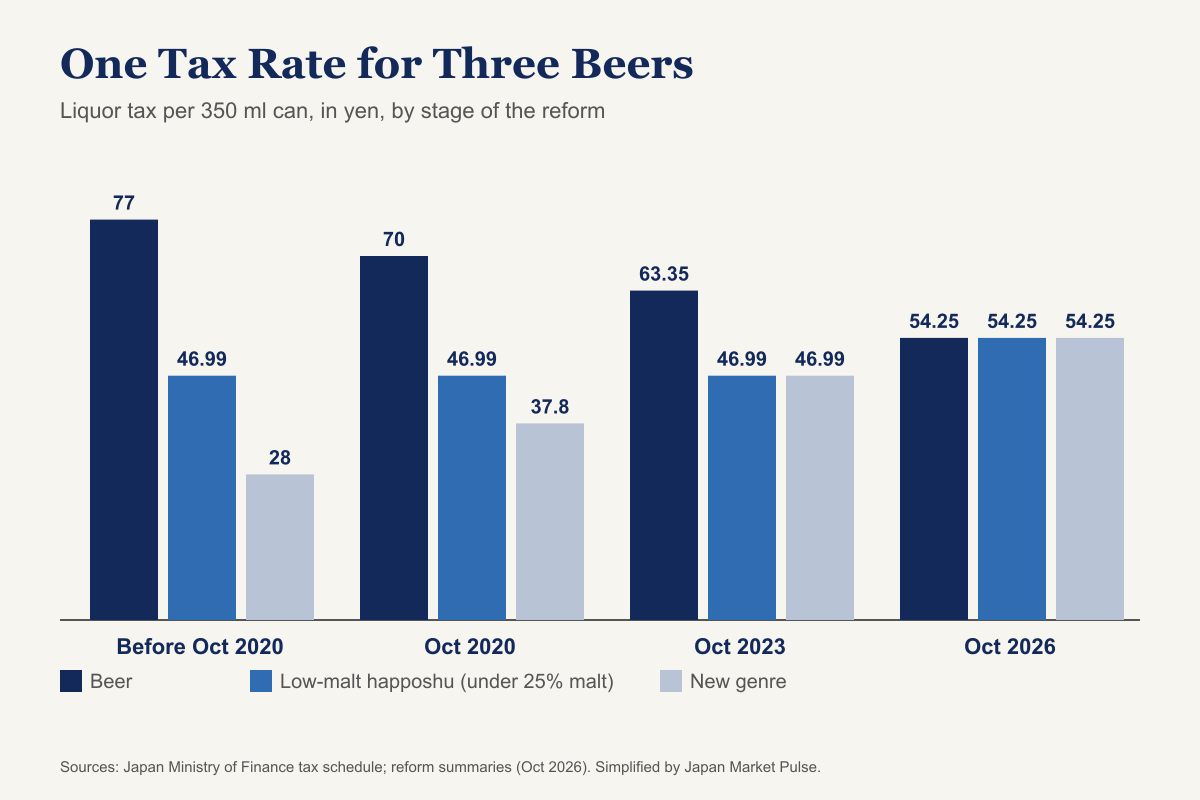
The government decided in 2016 to flatten this ladder in stages. The steps, per 350 ml can, look like this:
– Before October 2020: beer ¥77, low-malt happoshu ¥46.99, new genre ¥28 – October 2020: beer ¥70, low-malt happoshu ¥46.99, new genre ¥37.80 – October 2023: beer ¥63.35, low-malt happoshu ¥46.99, new genre ¥46.99 – October 2026: all three at ¥54.25
A note on terminology: happoshu with 25% to 50% malt was already taxed in a higher band and sat at ¥54.25 from 2023, so the October 2026 increase falls on happoshu with under 25% malt and on former new-genre products. The chart and figures here follow that lower band.
Put differently, the gap between the most heavily and the least heavily taxed beer-type drink was about ¥49 per can before 2020. Today it is zero. The tax equals roughly ¥155,000 per kilolitre for the whole beer family. The reform also lifted the tax on canned chuhai and sours from ¥28 to ¥35 per can, a ¥7 rise, because those drinks had become the next-cheapest way to get alcohol in a can.
It is worth keeping the size of the numbers in perspective. A standard can sells for roughly ¥180 to ¥210, so the tax is about a quarter to a third of the shelf price. A ¥9 tax cut on beer sounds small, but on a can priced at ¥200 it is more than 4% of the price. And a ¥7.26 increase on a can of low-malt happoshu priced at ¥130 to ¥140 is a rise of about 5%, in a market where shoppers who buy the cheapest option are by definition the most price-sensitive.
Who Wins and Who Pays

The reform is not neutral. It transfers cost from one group of drinkers to another.
Beer drinkers gain. The ¥9.10 cut is the tax part of the price. Whether it reaches the shelf depends on the retailer, as the next sections show. The benefit also flows to restaurants and bars: the cut applies to draft beer supplied in kegs, and reports suggest a keg becomes about ¥500 cheaper.
Drinkers of low-malt happoshu and former new-genre products pay. These are, by definition, price-conscious shoppers. Critics in Japan have pointed out that an equal rate is not necessarily a fair rate, because the burden lands most heavily on lower-income drinkers who traded down for years. That argument is sharper in October 2026, when more than 3,000 food and beverage products are also being repriced upward, according to the credit research firm Teikoku Databank, and core consumer prices (excluding institutional factors) rose about 2.6% year on year in August.
Brewers face a strategic reset. For three decades the cheapest, most heavily engineered products in the portfolio existed because of the tax gap. When the gap disappears, so does the reason for the engineering. Brewers have to decide what to do with brands that were designed to be cheap because the tax was low.
The long-run direction was already visible. Beer sales in Japan peaked in 1994 and standard beer volume has since fallen by roughly 60%. But within the beer-type market, real beer’s share had already been recovering as the tax gap narrowed: from about 41% in 2020 to about 55% in 2024, according to commentary on the reform (market definition not specified by the source). October 2026 is likely to extend that trend, not reverse it.
Brewers Re-Engineer the Cheap Beer
The most interesting corporate response is that brewers are not simply cutting beer prices. They are re-engineering the cheap tier into something that can be sold as beer.
Suntory is the clearest example. Its Kinmugi, a well-known third-category brand, has been reformulated: added spirits have been removed, malt content has been raised above the 50% threshold, and the product is being sold as a genuine beer with new branding. Suntory has said it is targeting about 35 million cases for the brand, roughly 18% above the 2025 level. Reports differ on its shelf price, with figures between about ¥195 and ¥206 per 350 ml can mentioned, which is a reminder that prices vary by retailer and pack size. The strategic point is that Suntory wants the former cheap-beer shopper to trade up into the beer category, rather than trade out to a cheaper alcoholic drink.
Kirin has taken a similar path. Its Honkirin, sold until now as a new-genre product, is being moved into the beer category and is due to be released in that form in November 2026. Kirin’s flagship Ichiban Shibori has had its expected shelf price trimmed, from about ¥237 to about ¥228 per 350 ml can in one report, which is in line with the tax cut.
Asahi and Sapporo are reported to be repositioning their economy lines, including Clear Asahi and Gold Star, by raising malt content and moving them nearer to standard beer. Detailed pricing for each brand is still emerging, and some brewers are adjusting prices on more than a hundred individual items, so operators should check current shelf prices rather than rely on any single announcement.
The common thread is a shift in competition. When every product pays the same tax, the cheapest way to win is no longer to find a cheaper tax category. It is to offer better taste, better branding, or a lower cost of production. That is a harder game, and one where scale and brand strength matter more.
The Retailers’ Private-Label Offensive
If brewers are repositioning their brands, retailers are using the reform as a weapon.
Aeon, one of Japan’s largest retail groups, announced on 30 September that its private-label Topvalu Premium Nama Beer would fall from ¥173 to ¥162 per 350 ml can, and from ¥228 to ¥214 for 500 ml. That is a cut of ¥11 and ¥14, larger than the ¥9.10 tax reduction. Aeon is, in effect, subsidising the shift from cheap beer to beer. At the same time, the price of its Topvalu Best Price Barreal Gran happoshu rose from ¥129 to ¥137, an increase of ¥8.
Aeon launched beer fairs at about 2,450 stores nationwide on 1 October and has said it is aiming for beer sales in the second half of its fiscal year to reach 1.5 times the previous year. The retailer is also leaning on direct imports: a 330 ml Krombacher German beer fell from ¥195 to ¥184, and promotional areas near store entrances at some malls were set up around imported, private-label and craft beers.
Other discounters are active too. Cainz sells a private-label imported Vietnamese lager at about ¥138 per can, and Don Quijote’s Passion Price beer is about ¥164. These are significant because they show the new floor for real beer. Real beer is now only a few yen above a taxed happoshu, and imports with low production costs can sit within the same price band.
For overseas brewers, this is the more important lesson. A price cut that comes from tax, rather than from the brewer, creates a window in which retailers are actively looking for beer they can promote. Aeon’s emphasis on direct imports suggests that retail buying teams are willing to give shelf space to products that can credibly sit within about ¥150 to ¥200 per can.
The First Three Days of Data
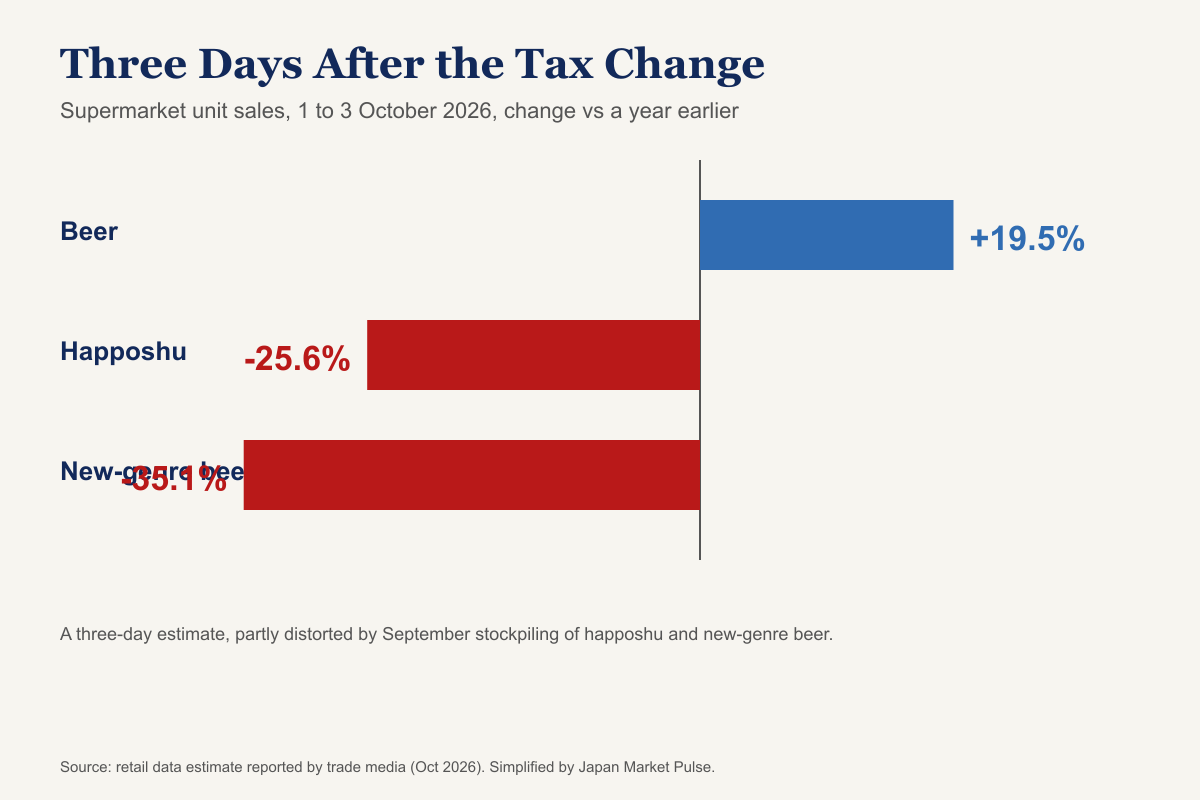
Data from the first three days of October, reported by trade media, shows how fast behaviour moved. Supermarket unit sales for 1 to 3 October, estimated against the same days a year earlier, showed:
– Beer: up about 19.5% – Happoshu: down about 25.6% – New-genre beer: down about 35.1%
The data provider cautioned that this is a three-day estimate, and a single weekend or a promotional calendar can distort it. Part of the pattern is also timing: many shoppers bought happoshu and new-genre beer in bulk in September before the increase. One supermarket in Fukuoka reported sales of those categories at about 1.4 times the year-earlier level before the change, with some customers buying two or three cases of a single brand at once. A post-stockpile dip in October is therefore not a pure measure of demand.
Even so, the direction is consistent with what the pricing implies. When the price gap between a real beer and a cheap imitation narrows to a few tens of yen, a meaningful share of shoppers will trade up. The question for the next quarter is how much of the 19.5% survives once promotions normalise. A figure of half that would still be a very large change in a category that has been shrinking for thirty years.
The Restaurant Reality
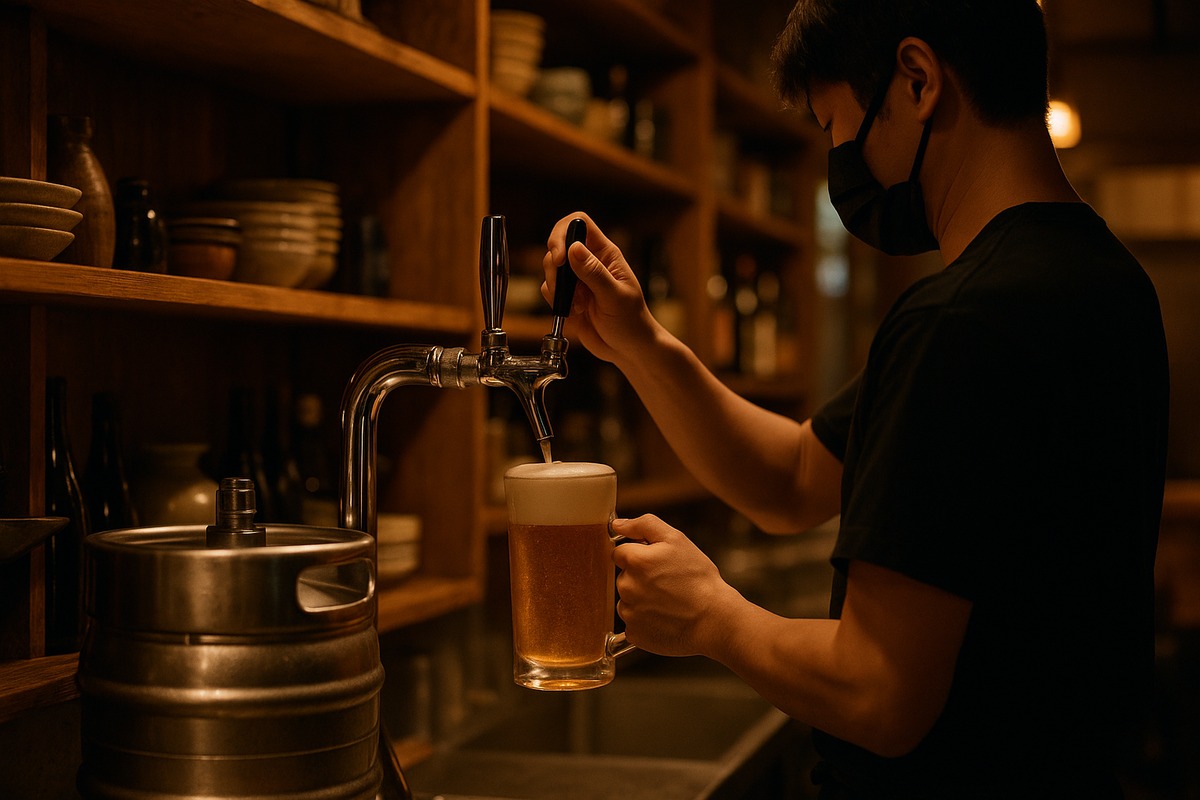
The picture is less clean on the on-premise side. The beer tax cut applies to kegs, and a keg should cost around ¥500 less. Yet a restaurant serving about 200 glasses of draft beer a day, quoted in Japanese media, said it will not cut menu prices, because other costs are rising faster. Its carbon dioxide costs, used to dispense draft beer, are projected to rise by more than ¥5,000 from October, more than doubling in some cases.
That is a useful reminder that a tax cut is not a price cut. Wholesalers, venues and consumers divide it among themselves, and in the restaurant channel the cut competes with labour, energy and gas costs. For foreign brands that sell through izakaya and bars, the practical implication is that a lower keg price is a negotiating point, not an automatic windfall for the venue.
There is one more administrative detail for the trade: businesses holding beer-type stock on 1 October have to file tax adjustments for stock on hand, with a deadline of 2 November. For importers and wholesalers, this is a cash flow item that needs attention.
What Overseas Operators Should Do
The reform opens a window, but windows close. Based on what is known so far, there are five practical moves.
1. Re-price against the new floor. The reference point for real beer on a discounter’s shelf is now roughly ¥140 to ¥200 per 350 ml can. An import priced well above that must justify itself with brand, origin or craft credentials. 2. Pitch retailers on the trade-up story. Aeon’s offensive shows that buyers are building beer fairs and entrance displays. Importers with ready promotional materials and stable supply have an advantage. 3. Watch the cheap tier, not just the premium tier. Happoshu and new-genre volume is moving into beer and chuhai. Brands that currently serve the low-price end may need a reformulation, a rebrand, or an exit. 4. Plan for the chuhai shock. Chuhai and sours rise by ¥7 per can. That narrows the gap with beer and may move some ready-to-drink volume back into beer-type products, but it may also push consumers toward non-alcoholic alternatives. 5. Talk to your distributor about stock and tax. Check who bears the stock-on-hand adjustment, and how the distributor intends to pass the tax change on to retailers and venues.
One more point is about timing. The first three days of data are a signal, not a verdict. The relevant test is the November to January period, when year-end parties and holiday promotions will show whether shoppers keep trading up or drift back to the cheapest can on the shelf.
Frequently Asked Questions
Q. How much is beer tax in Japan now?
A. From 1 October 2026, beer, happoshu and new-genre beer are all taxed at ¥54.25 per 350 ml can, equal to about ¥155,000 per kilolitre. Standard beer was previously ¥63.35, while low-malt happoshu and new-genre were ¥46.99.
Q. Is beer cheaper in Japan after the reform?
A. Beer is cheaper in most cases, but not by exactly the amount of the tax cut. Retailers set their own prices: Aeon cut its private-label beer by ¥11 per 350 ml can, more than the ¥9.10 tax reduction, while some other products moved by less. Happoshu and new-genre drinks are more expensive.
Q. What is happoshu and what is new-genre beer?
A. Happoshu is a low-malt sparkling alcoholic drink, and new-genre or third-category beer is made with ingredients other than malt, such as pea protein or added spirits. Both were designed to sit in lower tax categories than beer. The reform removes most of that advantage.
Q. Why does the reform matter to foreign brands?
A. It narrows the price gap between beer and cheap substitutes, which opens a window for imported and premium beer. Retailers such as Aeon are already running beer fairs with direct imports and private labels.
Q. Did Japan raise taxes on other drinks too?
A. Yes. Canned chuhai and sours rose from ¥28 to ¥35 per can, and the tax on heated tobacco also rose in October. Sake and wine were unified at ¥100,000 per kilolitre in 2023.
Conclusion
Japan spent thirty years teaching its drinkers to buy beer that was not quite beer, because the tax system rewarded it. On 1 October 2026 the reward ended. Three categories became one rate, cheap beer got dearer and real beer got cheaper, and shoppers began moving within days.
The story is not that drinkers love beer again. It is that a market designed around a loophole is now being redesigned around a flat tax and a fight for taste, brand and shelf space. Brewers are reformulating, retailers are cutting and importing, and restaurants are discovering that a tax cut does not pay for rising gas bills.
For international operators, that is an uncommon moment: a mature, declining category in which the price structure resets overnight, and where the buyers are actively looking for something new.
If you’re interested in this topic, the Japanese market more broadly, or what KETCHUPs is working on, we’d love to hear from you — please reach out via our contact form.
Japan Market Pulse is a weekly read on what the Japanese consumer-tech, food, and mobility markets are choosing to do, written for international operators who want to know what is happening before it shows up in the global trade press.
Subscribe at ketchups.co/japan-market-pulse.