

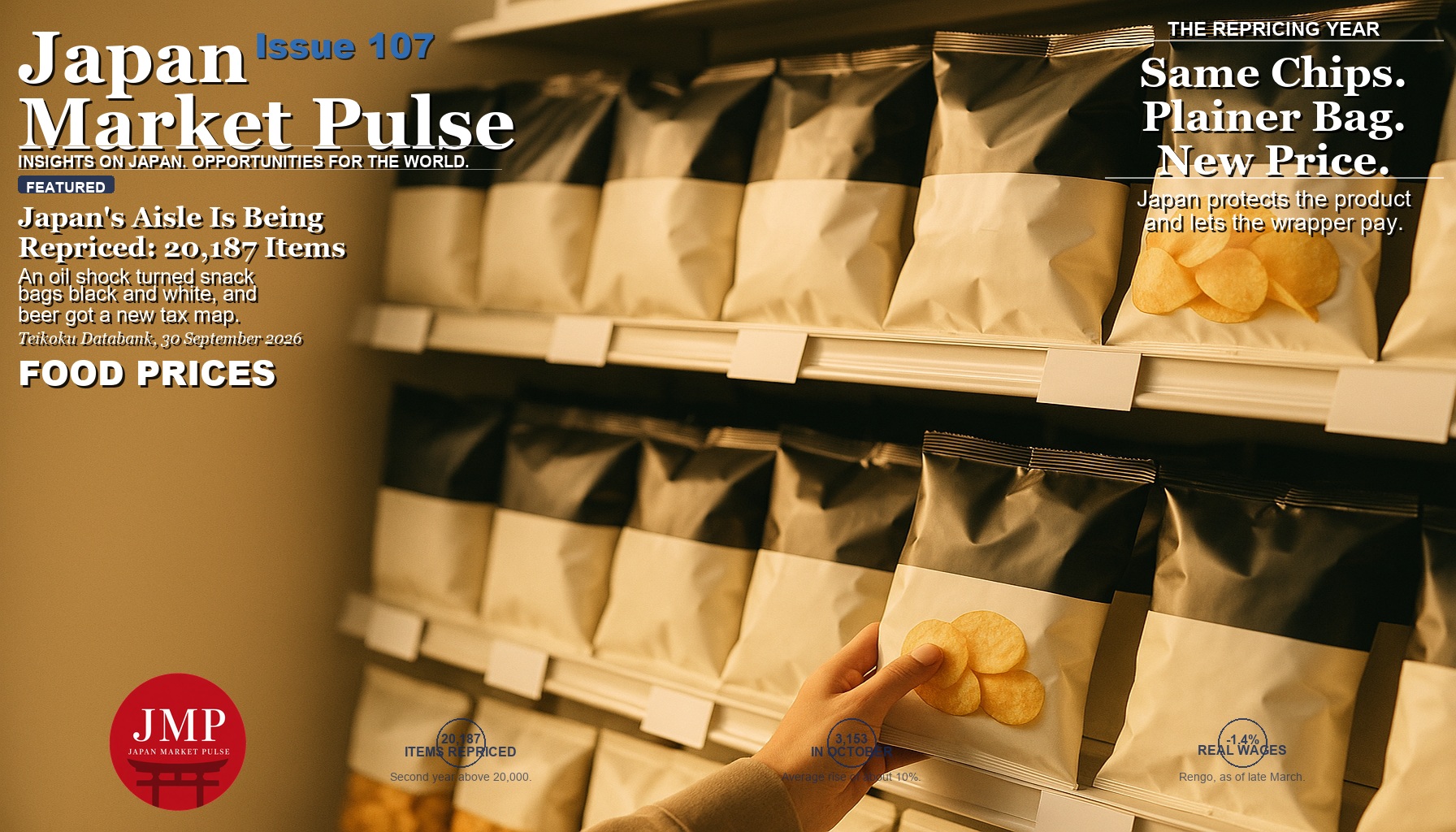
Inside the autumn of repricing: how an oil shock, a weak yen and a once-in-a-generation beer tax are rewriting the Japanese supermarket aisle — and what any company selling food or consumer goods into Japan should do about it.
On the last day of September, a research firm in Tokyo published a number that most of the world’s business press scrolled straight past. According to Teikoku Databank, which tracks price revisions at 195 major Japanese food makers, 20,187 food and beverage items have been, or are scheduled to be, repriced in 2026. It is the second year in a row above 20,000. Last year’s total was 20,609.
If you live in Japan, you do not need the survey to know this. You see it at the supermarket on the way home: the instant noodles that crept up, the mayonnaise that became a little lighter, the snack bag that quietly lost a few grams. What the survey adds is scale, and the realisation that this is not a one-off shock. It is a pattern with a calendar, a cause, and a very Japanese way of arriving — in waves, announced in advance, one manufacturer after another.
I have lived through several of these waves, and this one feels different in texture. The previous ones were about rice, wheat and the weak yen. This one has an unusual new ingredient: oil, and everything that is made from it. A war in the Middle East has reached into the packaging film, the can lining and the printing ink, and the most visible symptom is a potato chip bag that has lost its colour.
20,187 Price Tags: The Year the Aisle Was Rewritten
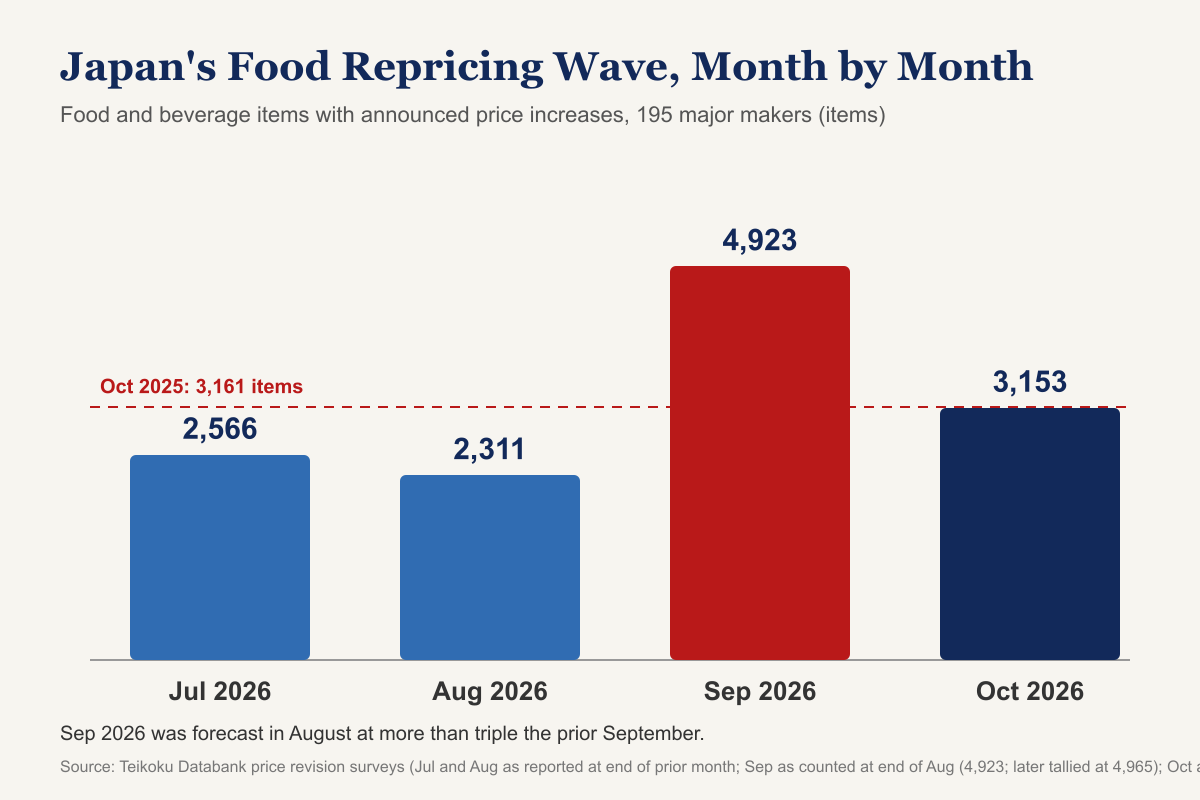
Start with the shape of the year. Teikoku Databank counted 2,566 food and beverage items scheduled for repricing in July, and 2,311 in August. Then September arrived with a spike: 4,923 items in the firm’s count at the end of August, later tallied at 4,965 — a number the firm described as a “wave of price hikes” and one that had been forecast in August to be more than triple the previous September.
October is the second-largest month of the year. Prices on 3,153 items are rising, set by 195 manufacturers, at an average of about 10 percent. That is a hair below the 3,161 items repriced in October 2025, which tells you something important: the wave is not accelerating, but it is not receding either. It is settling in at a level that, only a few years ago, would have been a record.
Context matters here. Since Teikoku Databank started this survey in 2022, the number of repriced items has topped 10,000 every year for five consecutive years. Two years ago, 10,000 felt like the shock. Now the base case is 20,000.
The mix is also worth reading. The July survey counted 5,780 repriced processed foods — instant noodles, canned goods, frozen meals — and flagged seasonings such as dashi, sauces and soy sauce, along with confectionery, dairy products, sugar and flour-based foods. Alcohol is in the frame too, which we will come to. In other words, this is not a luxury-goods story. It is the weekly shop.
From the Strait of Hormuz to the Snack Aisle
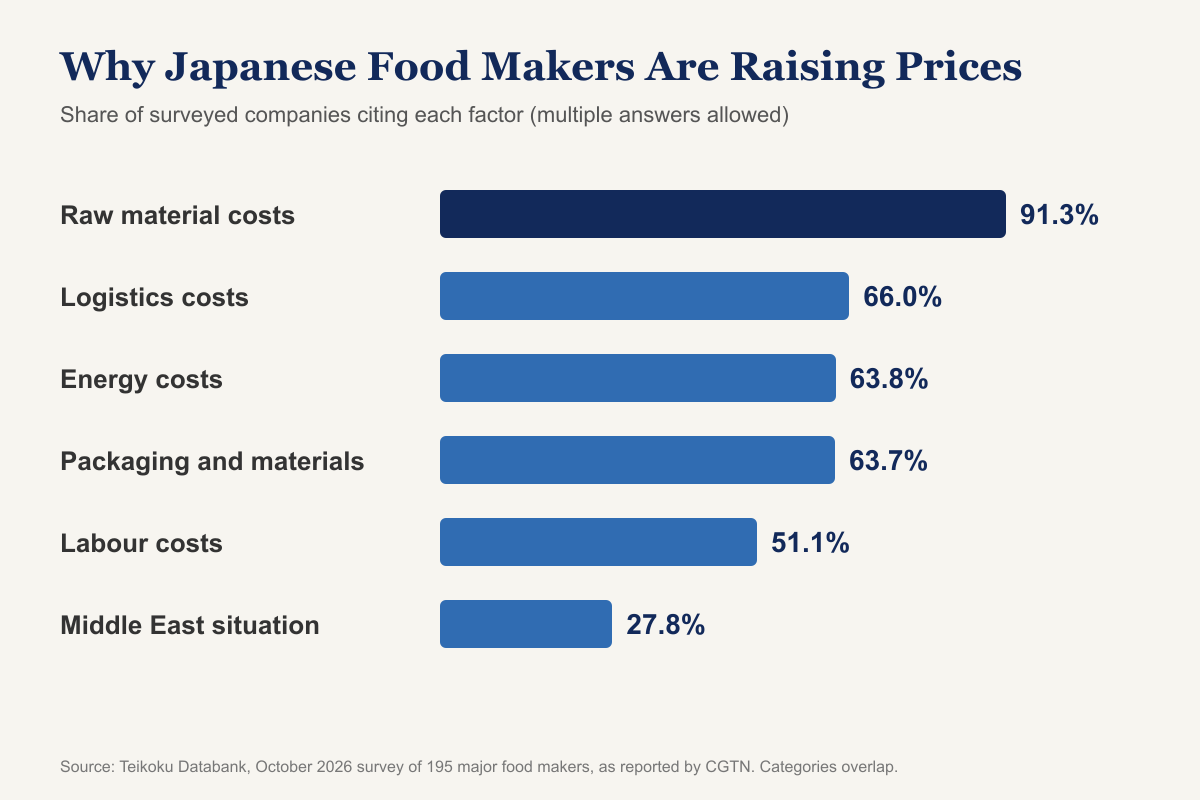
Why now? Ask the manufacturers and the answers are remarkably consistent. In the October survey, 91.3 percent of the companies cited raw material costs. Logistics was named by 66.0 percent, energy by 63.8 percent and packaging by 63.7 percent. Labour was cited by just over half, at 51.1 percent. And more than a quarter — 27.8 percent — named the situation in the Middle East explicitly. The answers overlap, because they are one story told five ways.
The chain is easy to trace. Japan imports more than 90 percent of its crude oil from the Middle East; the figure was 94.7 percent in fiscal 2023. Bank of Japan board member Kazuyuki Masu has said that more than 70 percent of Japan’s crude imports pass through the Strait of Hormuz. Crude is refined into naphtha, the petrochemical feedstock behind plastic film, can linings and the inks that print on both. Japan’s petrochemical industry therefore depends heavily on Middle Eastern crude, and once shipping through the strait was disrupted earlier this year, the cost of everything downstream began to climb.
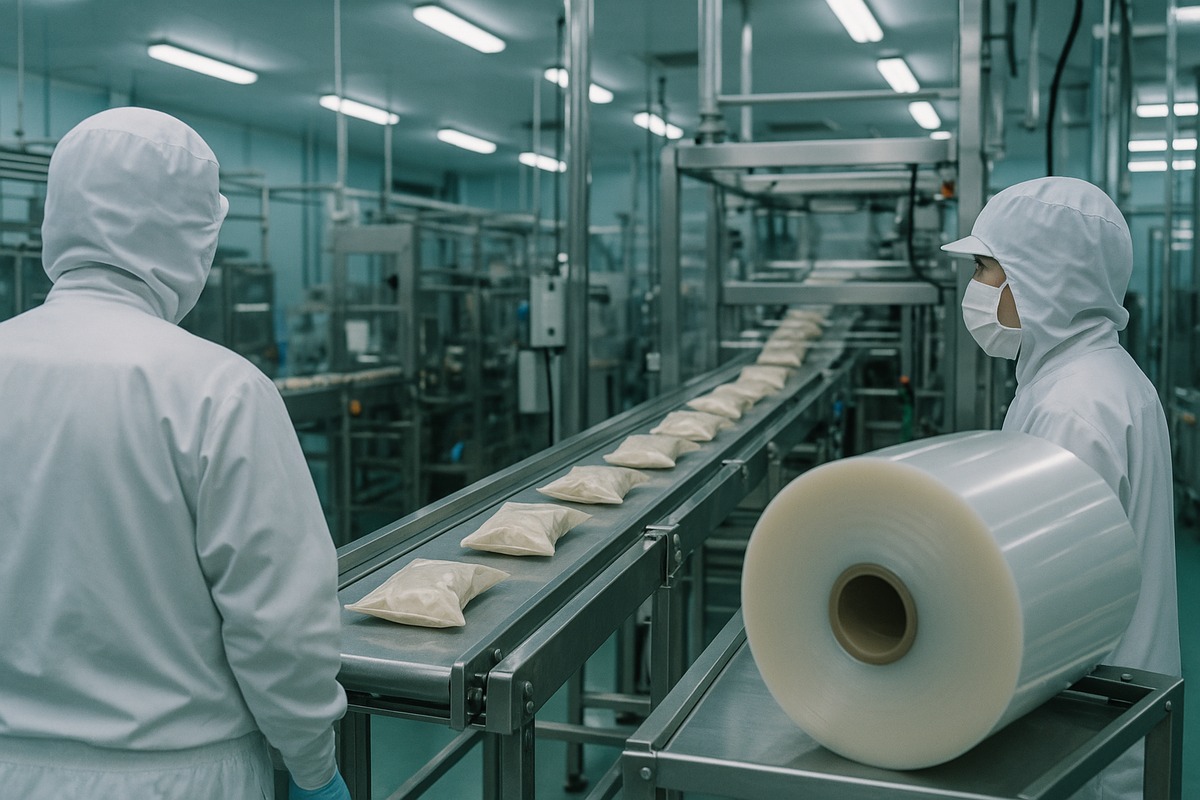
A snack is mostly corn, potato, oil and salt. But it is also a multilayer plastic pouch, a printed design, a carton, a pallet wrap and a truck journey. When the oil-derived part of that bill goes up, the whole product goes up with it. Economist Hideo Kumano of ABC Economic Research Institute put it simply: higher oil prices raise packaging and delivery costs, and “these higher costs are now affecting the entire food production chain.”
The yen makes it worse. It has repeatedly slipped below 160 to the dollar since July, which raises the price of imported wheat, edible oil, sugar and feed — the same inputs that were already expensive. The Bank of Japan’s governor, Kazuo Ueda, laid out three scenarios in a June speech, from a prolonged conflict that slows growth while pushing inflation higher, to a ceasefire that eases both. The food makers, understandably, are not waiting to find out which one arrives.
The Day Calbee’s Bags Lost Their Colour
If one object captures this autumn, it is a bag of potato chips.
In May, Calbee — Japan’s largest snack maker — announced that from May 25 it would print 14 products in just two ink colours, among them its flagship Potato Chips line, the Kappa Ebisen shrimp snacks and the cereal Frugra. The bright, instantly recognisable packaging was replaced by something closer to a newspaper. The reason was ink: printing inks depend on naphtha, and supply had become difficult. Ink maker Artience had already told its customers in April that it would raise prices on printing ink for plastic and paper packaging by 20 percent.
Calbee was careful to say the contents were unchanged, and the change was described as temporary. It was not alone, either. Another chip brand, Yamayoshi Seika, temporarily suspended production of a popular product. The government, for its part, insisted there was no cause for panic. Prime Minister Sanae Takaichi has sought to reassure the public that oil and naphtha supplies are being maintained.
What fascinated me about the Calbee episode was not the logistics but the psychology. A global snack brand might well prefer to raise prices rather than touch its packaging; the bag is the advertisement. In Japan, the company made the opposite call: protect the product, protect the price point, and let the wrapper take the hit. The shopper could see the problem — it was literally printed on the shelf — and accepted it with a shrug. That tells you a great deal about the relationship between Japanese consumers and brands. Trust here is built on what is inside the pack, and on predictability, not on how glossy the outside looks.
It also tells you something about the playbook. Price is only one of three dials. The other two — size and presentation — get turned first. NH Foods, one of the country’s largest meat processors, has announced revisions ranging from about 5 percent to 46 percent, including products where the price is held and the quantity is reduced. In a country where every yen in a shopper’s basket is counted, even a few grams matter.
A Beer Tax Map Redrawn on October 1
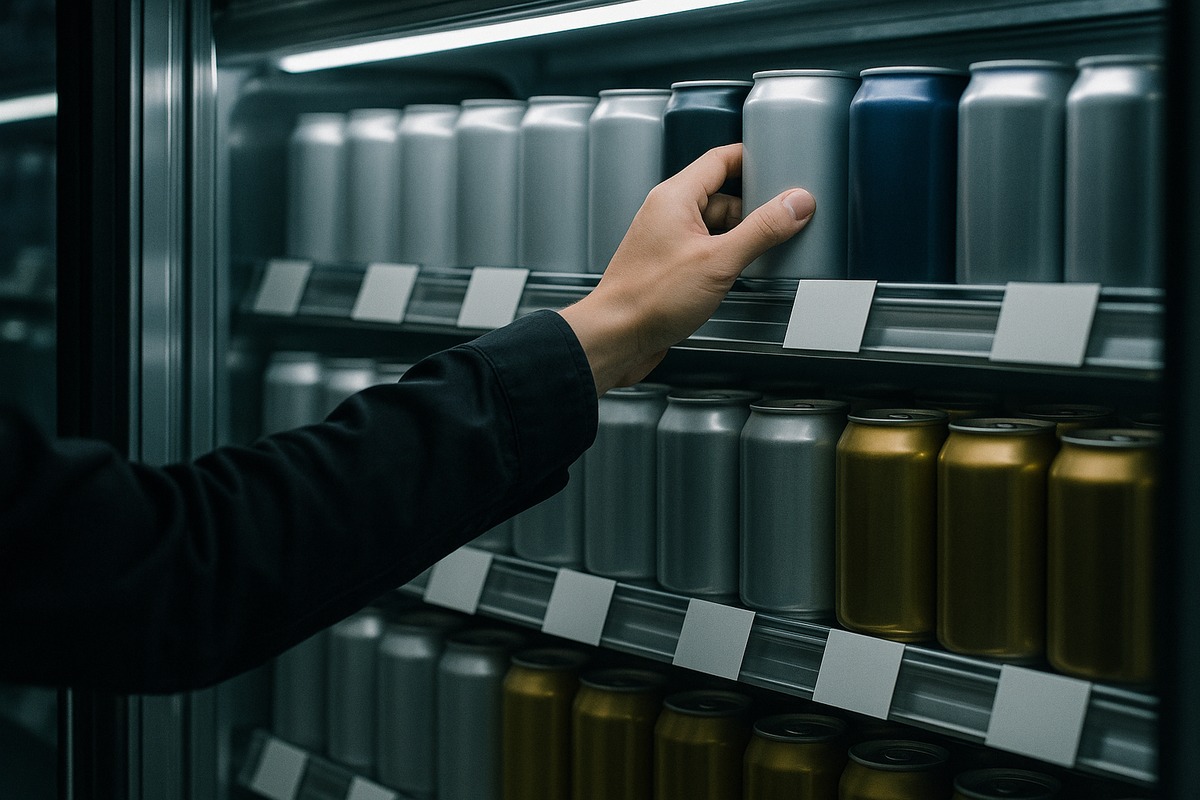
Layered on top of the cost wave is something that has nothing to do with oil: a tax change that Japan’s brewers have been preparing for since 2020.
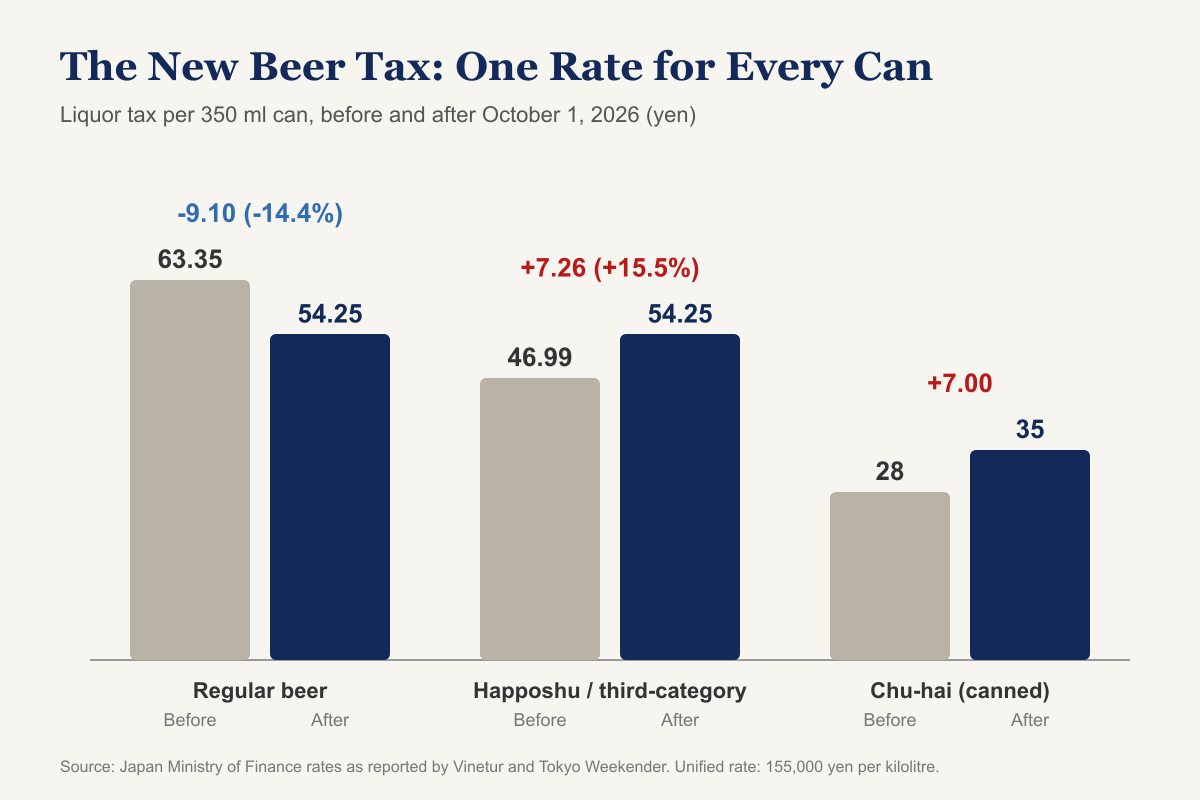
On October 1, Japan finished a three-stage reform of its alcohol tax. Regular beer, happoshu (the “low-malt” category) and the so-called third beer — a drink engineered to resemble beer while avoiding the higher tax — are now all taxed at the same rate: ¥155,000 per kilolitre, which works out to ¥54.25 on a standard 350 ml can.
The effect is a redrawing of the map. Regular beer’s tax per can fell from ¥63.35 to ¥54.25, a cut of ¥9.10, or 14.4 percent. The budget categories went the other way: from ¥46.99 to ¥54.25, an increase of ¥7.26, or 15.5 percent. Canned chu-hai goes from ¥28 to ¥35. One happoshu band, with a malt ratio of 25 to under 50 percent, did not move at all, because it had already reached the end point in 2023.
In the weeks before the change, shoppers stocked up on the cheaper categories while they still could. That sentence alone would have been science fiction ten years ago: a stockpile of drinks created to dodge a tax, in a country with millions of vending machines. But it is the reflex of a thrifty consumer, and it will matter in a moment.
One Can, Two Directions: The Arithmetic of the New Rate
The brewers’ response was to change the products rather than the prices. Asahi revamped Super Dry. Kirin updated Ichiban Shibori. Suntory increased the malt content of Kinmugi, formerly a third-category drink, so that it can legally be sold as beer. This is the strangest, most Japanese part of the story: a whole tier of products that existed only because of a tax loophole has been reformulated into the category it was designed to imitate.
Suntory has published estimated retail prices, which it stresses are not mandatory. Premium Malt’s moves from ¥254 to ¥245 per 350 ml can, a 3.5 percent cut, and Suntory Draft from ¥202 to ¥193, down 4.5 percent. The former third-category Kinmugi goes up, by about 4.5 percent in Suntory’s estimate, to ¥187 from ¥179. The lesson is that the “cheap beer” shopper is now paying more, and the premium shopper less. The market is expected to reorganise into three tiers — premium, standard and an everyday lower-priced segment.
One more detail: bars and restaurants. The tax cut on regular beer is unlikely to show up as cheaper draught in many places, because a number of venues plan to absorb the saving. After years of rising costs, the on-premise trade is treating this as a margin repair, not a promotion.
The beer story matters beyond beer because it shows how Japan handles price. Whether the driver is a tax, a naphtha shortage or a weak yen, the change arrives with a date, a published schedule and a visible rationale. Shoppers can plan around it. That is why a wave of 20,000 price hikes feels, on the ground, like a slow tide rather than a storm.
Thrift Is Not a Phase: What Shoppers and Aeon Are Saying
The more important question is how people respond, and the data is consistent: they spend carefully.
Real wages — what pay buys after inflation — have stayed under pressure for years. In 2025, real incomes fell 1.3 percent, with rice alone up about 60 percent at the peak. This spring’s wage negotiations were strong on paper — the union confederation Rengo reported an average increase of 5.26 percent for all company sizes as of late March — but prices have kept pace.
Households have adjusted. Officials describe a strong “frugality mindset” as the main theme of household spending this year, with food budgets watched most closely.
The clearest statement of what this means for retailers came from Aeon, Japan’s largest retail group, in its results for the quarter ended May. Group revenue rose 14.6 percent to ¥2.94 trillion, helped enormously by the January acquisition of the drugstore chain Tsuruha, which took its drugstore network to about 5,700 stores. But sales at its Japanese supermarkets fell 0.4 percent. Its chief financial officer, Hiroaki Egawa, said there had been “no major change in consumers’ tendency toward thrift and selective spending.”
And then the more revealing part. Executive officer Motoyuki Shikata acknowledged that Aeon had put too much emphasis on matching the prices of national brands at the expense of its own Top Valu private label. Top Valu will now be central to its pricing strategy, and the company wants to raise the number of “mega items” — products with annual sales above ¥1 billion — from 100 to 300.
Read that carefully. The country’s biggest retailer is telling the market that it will not chase a recovery in spending, because it does not expect one soon. It is rebuilding its price architecture around its own brand. For national brands, that is both a warning and an opening.
Announced Waves in Japan, a Steadier Drift in America
It helps to compare the shape of the problem with the one American readers know. In the United States, the August consumer price report showed groceries up about 2.2 percent over the year, with food away from home up 3.4 percent and overall inflation at 3.4 percent. American price pressure tends to show up more as a continuous drift, spread across thousands of small changes and visible mainly in the monthly index.
Japan’s headline numbers look calmer. Nationwide core consumer prices rose 1.7 percent in August, below the Bank of Japan’s 2 percent target for an eighth straight month, partly because government fuel subsidies are absorbing some of the oil shock. The measure that strips out fresh food and energy was 1.9 percent. Yet the supermarket shelf tells a more forceful story, because in Japan manufacturer-led revisions are often concentrated in announced batches. A manufacturer sets a date, notifies its retail customers, and the whole line moves at once.
Two policy points are worth noting. First, in April the agriculture ministry updated the Food System Act to help smaller food makers and farmers avoid below-cost transactions and pass on rising costs. The government is, in effect, encouraging the repricing. Second, the Bank of Japan is caught between persistent inflation that argues for faster rate rises and weak consumption that argues for patience. At its September meeting, some members wanted to move faster and others pointed to the cumulative effect of earlier increases.
Kumano’s view is that price hikes will continue at least through the end of 2026, and possibly until around March 2027 given the yen’s weakness. He also warned that prolonged high inflation could widen income gaps, with older people and non-regular workers hit hardest.
Seven Rules for Selling Into Japan’s Repricing Year
For international food and consumer-goods companies, this is a difficult moment to enter or expand in Japan — and also an unusually instructive one. Here is how I would read it.
1. Price in steps, and announce them. Japanese retailers and shoppers accept increases that come with a date, a reason and a schedule. They resent surprise. A clearly communicated revision, ideally to the trade several weeks ahead, travels better than a silent change.
2. Protect the inside of the pack. Calbee changed the ink, not the chips. Shoppers will forgive a plainer wrapper; they will not forgive a worse product. If you must make cuts, make them visible and temporary, and keep quality constant.
3. Treat size as a pricing tool, but do it honestly. Reduced quantities at held prices are common here, yet consumers who weigh every yen notice. Pack sizes that are clearly labelled and sensibly tiered will serve you better than a stealth cut.
4. Expect private label to take a larger share of the shelf. Aeon’s pivot to Top Valu is a signal to every national brand. If your product is a commodity in the eyes of the buyer, the retailer’s own brand will undercut you. Differentiate on something the private label cannot copy.
5. Look at the tax calendar, not just the cost curve. The October 1 beer reform shows how a regulatory date can move category economics more than any ingredient cost. Check what has already been legislated for your category.
6. Watch the yen and the naphtha chain together. Currency affects your landed cost; packaging and ink affect your local competitors’ costs. Both can shift your relative price position within a quarter.
7. Plan for a long tail. Analysts expect the repricing to run into the first quarter of 2027. Build your Japan margin model on that assumption, not on a return to the old price level.
Frequently Asked Questions
Q. How many food items in Japan are being repriced in 2026?
A. Teikoku Databank counts 20,187 food and beverage items, covering those already raised and those scheduled, from 195 major manufacturers. It is the second straight year above 20,000, after 20,609 items in 2025. October alone has 3,153 items, at an average of roughly 10 percent.
Q. Why did Calbee switch to black-and-white packaging?
A. Calbee moved 14 products to two-colour printing from May 25 because of difficulty securing naphtha-based inks, a supply problem linked to the disruption in the Middle East. The company said the contents were unchanged and described the change as temporary.
Q. What changed in Japan’s beer tax on October 1, 2026?
A. Regular beer, happoshu and third-category beer are now taxed at the same ¥54.25 per 350 ml can. Regular beer’s tax fell by ¥9.10, while the budget categories rose by ¥7.26. Brewers reformulated several brands to sell them as beer.
Q. Where can I buy Japanese snacks like Calbee potato chips outside Japan?
A. Many Japanese snacks are available through specialty Asian grocers and online. You can find a range of Calbee products on Amazon, though availability and pricing vary by seller.
Q. How long will Japan’s price increases last?
A. Economist Hideo Kumano expects increases to continue at least through the end of 2026 and possibly until around March 2027, depending on the yen and the Middle East situation. Teikoku Databank similarly describes food prices as susceptible to both factors.
Conclusion
The headline number — 20,187 — is large enough to be abstract. The real story is in the small, concrete objects: a chip bag in two colours, a beer can whose tax moved by nine yen, a supermarket executive saying aloud that his company has been matching the wrong competitor.
Japan is not in a crisis. It is in a long, orderly adjustment, handled with the transparency, patience and attention to detail that characterises the market at its best. Shoppers are cautious, retailers are rebuilding, and manufacturers are protecting the product while the packaging takes the strain. Companies that understand this rhythm — announce clearly, protect quality, respect the thrift — will do well. Those that expect the old price level to come back may be waiting a long time.
This article contains affiliate links. If you purchase through these links, we may earn a small commission at no extra cost to you.
If you’re interested in this topic, the Japanese market more broadly, or what KETCHUPs is working on, we’d love to hear from you — please reach out via our contact form.
Japan Market Pulse is a weekly read on what the Japanese consumer-tech, food, and mobility markets are choosing to do, written for international operators who want to know what is happening before it shows up in the global trade press.
Subscribe at ketchups.co/japan-market-pulse.