

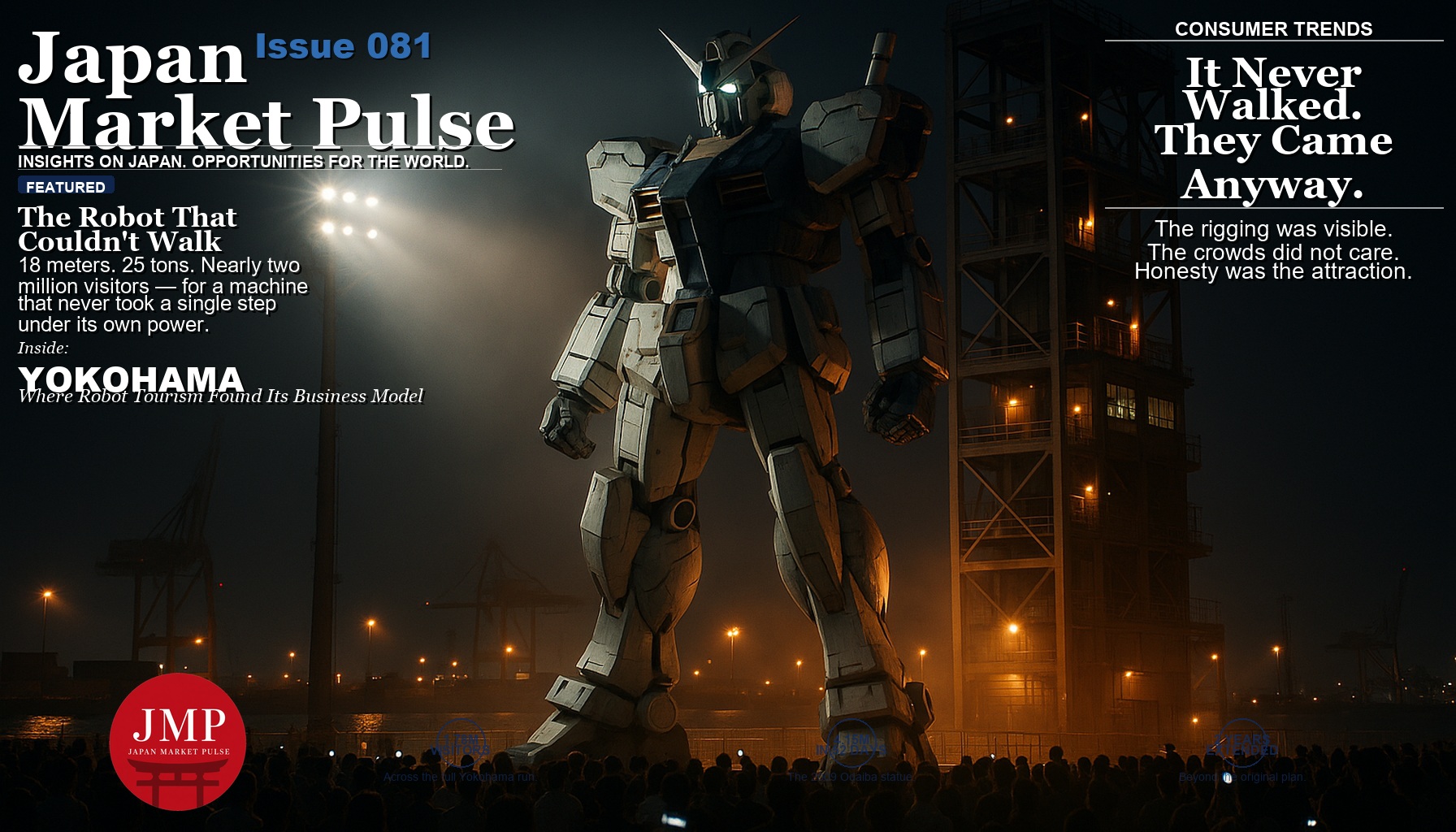
The first time I stood at the edge of Yamashita Pier and watched an 18-meter robot lower itself onto one knee, electric actuators humming, floodlights catching the steel and carbon-fiber plating, I did the thing every visitor does: I checked whether it was actually moving on its own. It wasn’t, not really. Somewhere behind that towering torso, a support carrier and a bank of reduction gears were doing the heavy lifting, quite literally, so the machine could bend its 25-ton body without collapsing under its own weight. And yet a few thousand people around me were cheering like they’d just watched a rocket launch.
That contradiction is the whole story of GUNDAM FACTORY YOKOHAMA. For three years and change, a Japanese consortium built an entire commercial district around a robot that, by any strict engineering definition, could not walk. It could kneel. It could wave. It could rotate its head and clench a fist and, with considerable mechanical assistance, lift one leg in a passable imitation of a step. What it could not do was locomote under its own power across open ground, the way its cartoon counterpart does in every episode of the 1979 anime that started this whole obsession. And more than 1.78 million people came through the gates before they finally closed in March 2024, most of them entering through the ticketed attraction to watch it try.
I’ve lived in Japan for twenty years now, long enough to have made the pilgrimage to nearly every large-scale robot attraction this country has built, and I’ve come to think GUNDAM FACTORY YOKOHAMA is one of the more interesting case studies in a category that barely existed a decade ago: robot tourism as its own line of business, distinct from theme parks, distinct from museums, and increasingly a tool that Japanese cities and corporations reach for when they want to put a place on the map.
Why Build a Robot That Can’t Walk
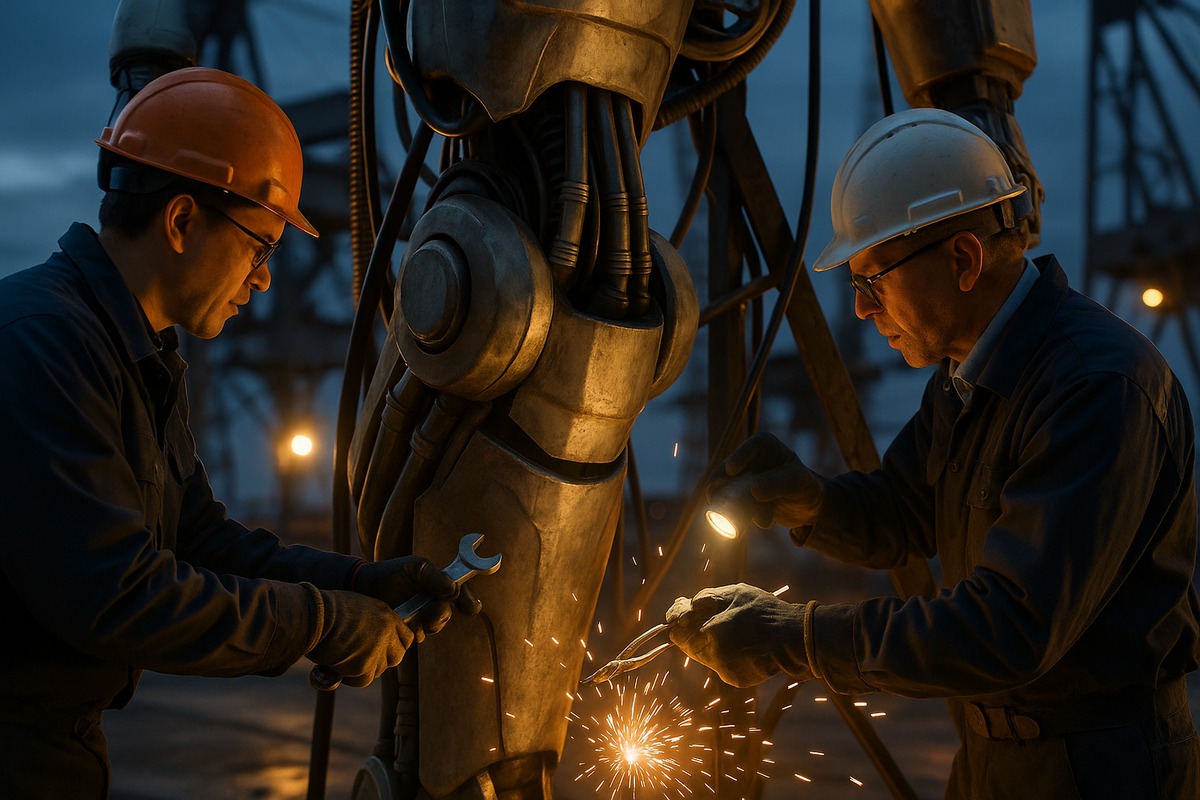
The honest answer, once you talk to enough people who worked adjacent to the project, is that nobody involved in GUNDAM FACTORY YOKOHAMA ever seriously planned to build a robot that could walk. The engineering brief was never “replicate the anime.” It was “build something at true scale that moves convincingly enough to feel alive,” which is a completely different, and in some ways harder, problem.
The project traces back to 2014, when Bandai, Sunrise, and the rights-holding company Sotsu launched something called the Gundam Global Challenge, an open call inviting engineers, roboticists, and enthusiasts anywhere in the world to submit ideas for how you might actually build an 18-meter humanoid that moves. That’s a scale where the physics stop cooperating. Square-cube law problems compound fast: double the height of a robot and its weight goes up roughly eightfold, while the strength of its joints and structural members only scales with cross-sectional area. A robot at Gundam scale that tried to walk unsupported would need actuators and a skeletal structure so massive that the machine would become, functionally, a different and far less interesting object. The organizers knew this going in. The point of the challenge was never to solve bipedal locomotion at 18 meters. It was to solve presence at 18 meters, and figure out what compromises made that presence convincing.
Nomura Co., a spatial design and exhibition-production company better known for museum builds and retail interiors than pop-culture spectacle, signed on to handle the structure, construction, and staging design, and the resulting five-year development process produced a machine reported as having roughly 24 degrees of freedom excluding the fingers, with the hands and support carrier adding more on top, all mounted on a steel-and-carbon-fiber frame anchored to a dedicated dock structure. The dock wasn’t a stage prop. It was structurally load-bearing, a support system that let the Gundam do things like kneel, stand, pivot at the waist, and take assisted steps without a fully autonomous lower body having to bear 25 tons of moving mass on its own. Visitors who paid close enough attention could see the rigging. Almost nobody cared.
What surprised me most, watching the performances repeatedly over a couple of years of visits, was how deliberately the choreography was built around the constraint rather than against it. The show never opened with an attempt to stride confidently across the dock, because that would have exposed exactly what the robot couldn’t do. Instead, it opened with stillness, a slow head turn, the low whine of motors spooling up, a single raised hand, building anticipation before the robot ever attempted anything resembling a step. By the time it lowered itself into that famous kneeling pose, arm extended, the crowd had already been primed to read the movement as triumphant rather than mechanical. That’s a choreography decision as much as an engineering one, and it’s the kind of detail that gets lost when the story becomes “Japan built a giant robot.” The real achievement was designing a performance that made a fundamentally assisted, tethered machine feel like agency.
The Business Logic Behind an Unwalkable Robot
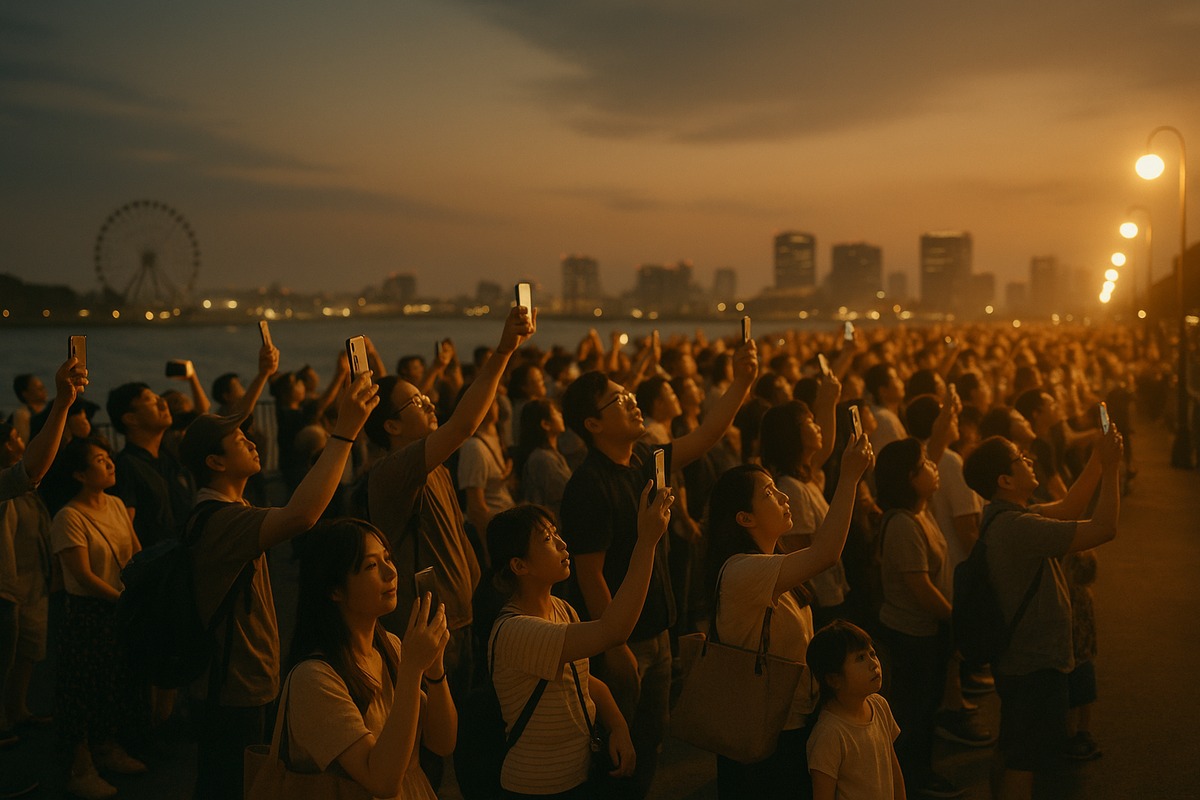
Here is where GUNDAM FACTORY YOKOHAMA stops being a robotics curiosity and starts being a genuinely interesting piece of tourism economics. The facility opened its gates on December 19, 2020, at Yamashita Pier, a working dockyard on Yokohama’s waterfront that the city had been quietly trying to reposition as a cultural and tourism zone for years. The opening had already slipped. General operation was originally announced for October 1, 2020, with pre-opening programs planned for July and August — a window that overlapped the Tokyo Olympics as originally scheduled, which would have delivered a captive audience of international visitors already primed to wander toward anything resembling a giant robot. COVID-19 erased that plan entirely. The Olympics were pushed back to 2021 and mostly closed to spectators, and the Gundam opened instead into a pandemic-era Japan where domestic travel had cratered and inbound tourism had all but stopped.
That timing should have killed the business case. Instead, the attraction found an audience that was, by all available context, largely domestic, at a moment when Japanese consumers, cooped up and starved for spectacle, were unusually willing to travel domestically for something that felt genuinely novel. Tickets ran a modest ¥1,650 for general admission, with a separate, pricier ¥3,300 pass for the dedicated observation tower that let visitors watch the robot’s performances at eye level with its torso. That’s a low per-ticket yield by theme-park standards, which tells you the real business model was never the turnstile. It was the merchandise store, the themed café, the Gundam-branded model kits sold on-site that fans could build in real time while the full-scale version loomed outside the window, and, less directly, the reputational value of associating Yokohama with one of the most recognizable pieces of Japanese pop culture on earth.
Originally slated to run only through March 2022, the attraction was extended twice, ultimately staying open two full years longer than planned, a clear signal that whatever the underlying unit economics were, they were working well enough that Bandai Namco and its partners kept betting on continuation rather than closure. By the time it shut for good on March 31, 2024, official figures from the Gundam franchise put total attendance at more than 1.78 million, a number that, spread across roughly three and a quarter years of operation in a single dockyard in a secondary Japanese city, is genuinely remarkable for an attraction built around a single, stationary-ish exhibit.
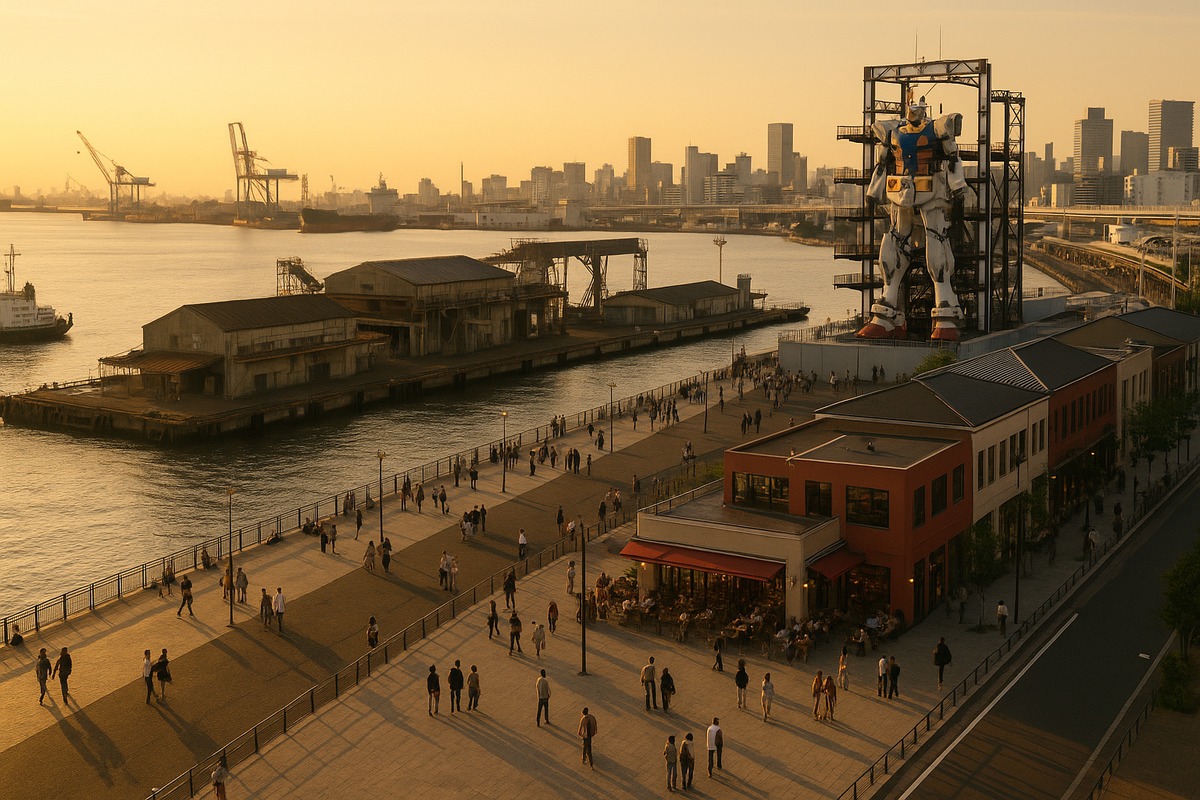
Yamashita Pier itself was not a neutral choice of venue. It’s a working dock, not a purpose-built entertainment zone, and Yokohama’s city government had spent years looking for a way to reintroduce the site to residents and tourists after decades of primarily industrial and event-hall use. Handing the site to a Gundam attraction wasn’t charity on the city’s part. Municipal tourism boards across Japan compete hard for anchor attractions that give visitors a reason to add an extra night, or an extra day trip, to a Tokyo-centered itinerary, and a 25-ton robot with a built-in fan base spanning multiple generations of anime viewers is about as close to a guaranteed draw as a city planner is going to find. Yokohama is a thirty-minute train ride from central Tokyo, close enough to be a same-day excursion and far enough that it needed its own gravitational pull to justify the trip. The Gundam provided exactly that, and the surrounding waterfront redevelopment, restaurants, event space, promenade improvements, benefited from the foot traffic whether or not those visitors ever bought a ticket to the dock itself.
Yokohama Wasn’t Improvising. It Was Following a Playbook.
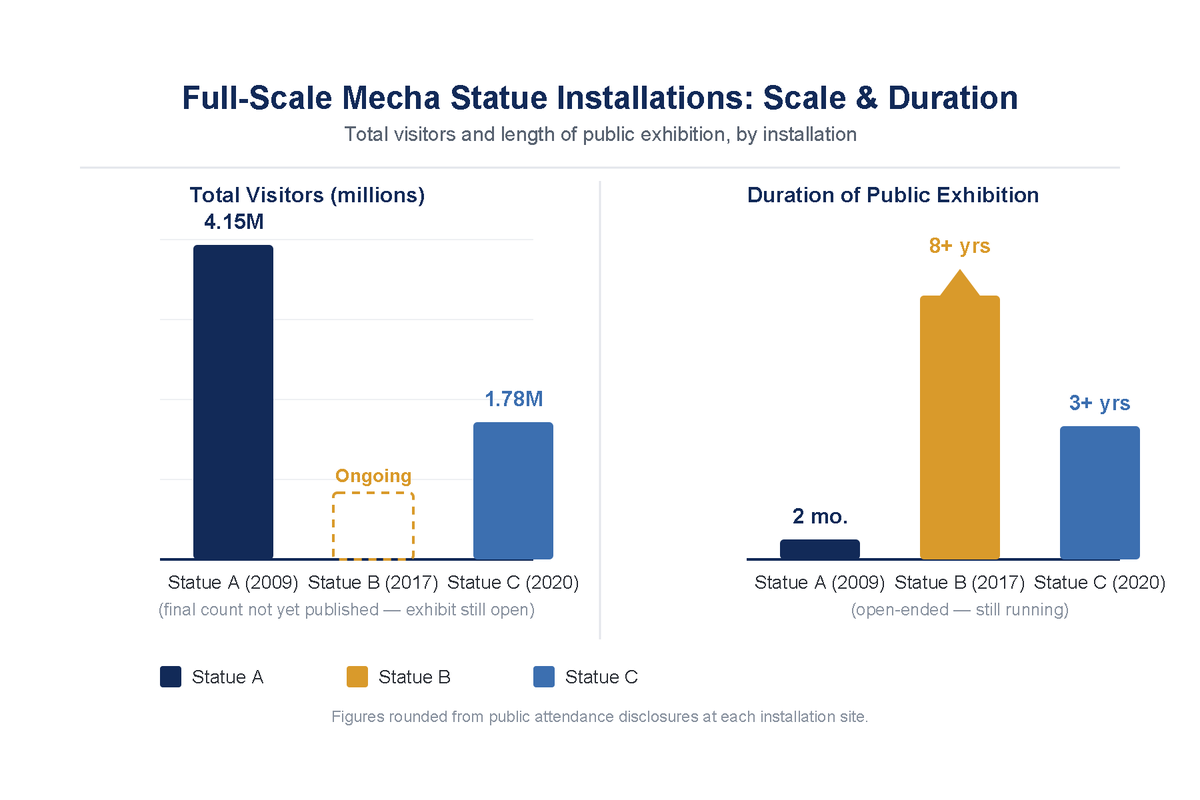
If you’re an American operator, the instinct might be to treat GUNDAM FACTORY YOKOHAMA as a one-off novelty that happened to work. It wasn’t. It was one act in a pattern Japan has been running for fifteen years — the Odaiba-to-Yokohama sequence — refining the formula each time.
The first full-scale Gundam statue went up in Tokyo’s Odaiba district in July 2009, for the franchise’s 30th anniversary, an 18-meter RX-78-2 that stood in Shiokaze Park for a grand total of about 52 days. It was largely static, with only limited head movement plus lighting and mist effects — nothing resembling locomotion. In that brief window, roughly 4.15 million people came to see it. Four million people, for a statue that essentially stood still, in under two months. That number should reframe how you think about the later projects: even a robot that does nothing but stand there, at true scale, generates footfall that most tourism attractions would consider a career-defining success. The statue then toured, spending time in Shizuoka before returning to Odaiba outside DiverCity Tokyo Plaza in 2012, where it stood until March 2017 and became a fixture of the neighborhood’s identity before being taken down to make room for its successor.
Later in 2017, Bandai Namco replaced it on the same site with a more ambitious machine: a 19.7-meter, roughly 49-ton Unicorn Gundam capable of a mechanized transformation sequence, plus scheduled light-and-sound performances. It’s still standing at the time of writing, and reporting suggests it’s slated to finally come down around August 2026, after nearly a decade in place. So by the time Yokohama’s engineers sat down to plan a machine that could actually bend its knees and take assisted steps, they weren’t inventing the category. They were the third iteration of a very deliberate, well-capitalized experiment in scaling up the presence and mechanical complexity of these statues, generation over generation, and watching what the market would bear each time.
What’s notable is how each iteration solved a different problem. Odaiba 2009 proved that scale alone, with essentially no motion beyond a moving head and some lighting, could pull millions of visitors in a matter of weeks. Odaiba 2017 proved that limited, scheduled motion could sustain an attraction for the better part of a decade. Yokohama tested whether a much larger commitment, an entire mixed-use facility with an observation tower, a lab, a café, and a robot capable of continuous, near-daily performances, could justify itself as a standalone tourism district rather than a statue bolted outside a mall. The answer, at 1.78 million visitors and a two-year extension of the original run, was a qualified yes.
What Happens to an 18-Meter Robot When the Lease Runs Out
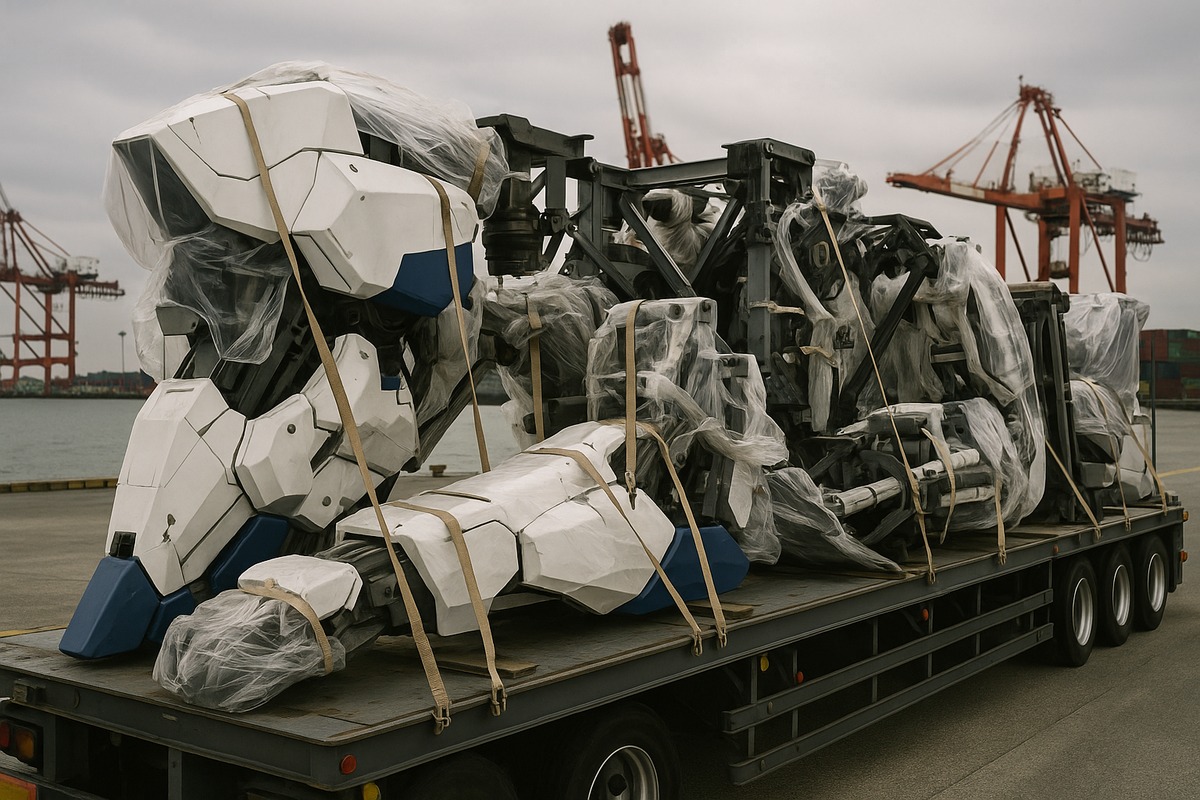
One of the more telling details about how seriously this category is now taken is what happened after Yokohama closed. The RX-78F00 wasn’t scrapped. Materials from the 25-ton Yokohama machine were reused in a new roughly 17-meter static statue, officially specced at 49.1 tons, built for the Gundam Next Future Pavilion at Expo 2025 in Osaka and posed kneeling with one arm raised, described by the organizers as a gesture reaching toward the future. The pavilion ran alongside the wider Osaka-Kansai Expo from April through October 2025.
That’s a capital allocation decision, not a sentimental one. Rebuilding and relocating a multi-ton structure between an entertainment district and a six-month national expo only makes sense if the underlying asset, brand association, engineering, physical materials, has residual commercial value worth preserving rather than writing off. Japan’s biggest entertainment conglomerates increasingly treat these full-scale statues the way other industries treat capital equipment: build once, redeploy across multiple revenue events, and only retire the asset when its marketing value is genuinely spent.
The Part That Should Interest Foreign Operators
I want to be direct about why this matters if you run tourism, retail, or brand-experience operations outside Japan, because “look at this cool robot” isn’t a business insight on its own.
The first lesson is that motion, even heavily assisted, artificial-feeling motion, converts differently than a static object, but static objects are not a consolation prize. Four million visitors came to Odaiba for a statue that did little more than turn its head. That’s the baseline case for any operator wondering whether a full investment in animatronics is necessary at all: scale and cultural resonance alone are extraordinarily powerful, and you should measure the incremental return of motion very carefully before assuming it’s required.
The second lesson is about honesty with your own audience. GUNDAM FACTORY YOKOHAMA never pretended its robot walked unassisted. The rigging was visible. Engineering write-ups explaining exactly how the reduction gears and support dock worked were published and widely read by fans, and it didn’t dent attendance in the slightest. Visitors weren’t there to be fooled into thinking a fictional robot was real. They were there to see a genuine, difficult, expensive engineering achievement performed live, transparency and all. Operators outside Japan sometimes over-invest in hiding the mechanism behind an experience, worried that revealing the trick breaks the spell. The Yokohama data suggests the opposite: for a certain kind of audience, the mechanism is the spell.
The third lesson is about the surrounding commercial architecture. The ticket price looks almost incidental to the business model. The operators have never broken out revenue, but the economics likely depended heavily on the ecosystem built around the exhibit — the café, the retail floor selling scale models of the very robot standing outside the window, the observation tower upsell, the halo effect on Yokohama as a destination worth an extra day on a Tokyo itinerary. Any operator building a single hero attraction without building the retail and hospitality layer around it is leaving the larger part of the revenue on the table.
And the fourth lesson, maybe the most transferable one, is about asset lifecycle. Japan’s approach treats these statues as reusable capital rather than disposable installations. If you’re planning a major physical spectacle for a limited run, the Yokohama-to-Osaka handoff is a useful model: design the thing to be disassembled and reborn somewhere else, because a second act can be nearly as valuable as the first.
Frequently Asked Questions
Q. Could the Gundam at GUNDAM FACTORY YOKOHAMA actually walk?
A. Not independently. The 18-meter, roughly 25-ton RX-78F00 could kneel, wave, rotate its head, and perform an assisted stepping motion, but a support dock and carrier, together with a set of reduction gears, did the structural work that a true bipedal walk at that scale and weight would require. Bandai Namco and its production partner, Nomura Co., were open about this from the start; it was never marketed as a robot that walked freely.
Q. How much did it cost to build, and was it profitable?
A. Neither Bandai Namco nor the Gundam Global Challenge consortium ever published a construction budget, and outside estimates vary widely enough that any specific figure would be guesswork. What is publicly verifiable is the behavior of the operators: an attraction originally planned to run about fifteen months instead ran for more than three years, extended twice, which is a much stronger signal of underlying profitability than any headline number would be.
Q. How many people visited before it closed?
A. Official figures put total attendance at roughly 1.78 million visitors across the attraction’s full run, from its December 2020 opening to its March 31, 2024 closing.
Q. Where did the robot go after Yokohama closed?
A. Its materials were rebuilt into a new, stationary, roughly 17-meter statue in a kneeling pose for the Gundam Next Future Pavilion at Expo 2025 in Osaka, which ran from April to October 2025.
Q. Can I still see a full-scale Gundam statue in Japan?
A. Yes. A 19.7-meter Unicorn Gundam statue has stood outside DiverCity Tokyo Plaza in Odaiba since 2017, with scheduled transformation and light shows, though reporting indicates it is expected to come down around August 2026. If you’d rather bring the experience home, a 1/144 scale Real Grade RX-78-2 model kit is one of the more faithful build-it-yourself versions of the original design available outside Japan.
Conclusion
This article contains affiliate links. If you purchase through these links, we may earn a small commission at no extra cost to you.
Standing at Yamashita Pier on my last visit, a few weeks before the facility closed for good, I watched a father lift his daughter onto his shoulders so she could see the robot’s face over the crowd, and I thought about how strange it is that this entire industry, robot tourism as a repeatable, capital-intensive business category, only really came into focus in the last fifteen years. Odaiba proved scale alone could pull crowds. Yokohama proved a city and a media conglomerate could build an entire commercial district around motion that everyone in the audience knew was assisted, and that the honesty about the assistance didn’t cost them a single visitor. Osaka proved the asset didn’t have to die when the lease ended. For operators anywhere else in the world weighing whether a hero physical installation is worth the capital outlay, Japan has now run this experiment through several iterations, at increasing scale and with increasing sophistication, and the answer keeps coming back the same: build it honestly, build the commerce around it properly, and build it to be moved. The robot never needed to walk. It just needed to be real enough, and big enough, that a million and a half people would show up to watch it try.
If you’re interested in this topic, the Japanese market more broadly, or what KETCHUPs is working on, we’d love to hear from you — please reach out via our contact form.
Japan Market Pulse is a weekly read on what the Japanese consumer-tech, food, and mobility markets are choosing to do, written for international operators who want to know what is happening before it shows up in the global trade press.
Subscribe at ketchups.co/japan-market-pulse.