

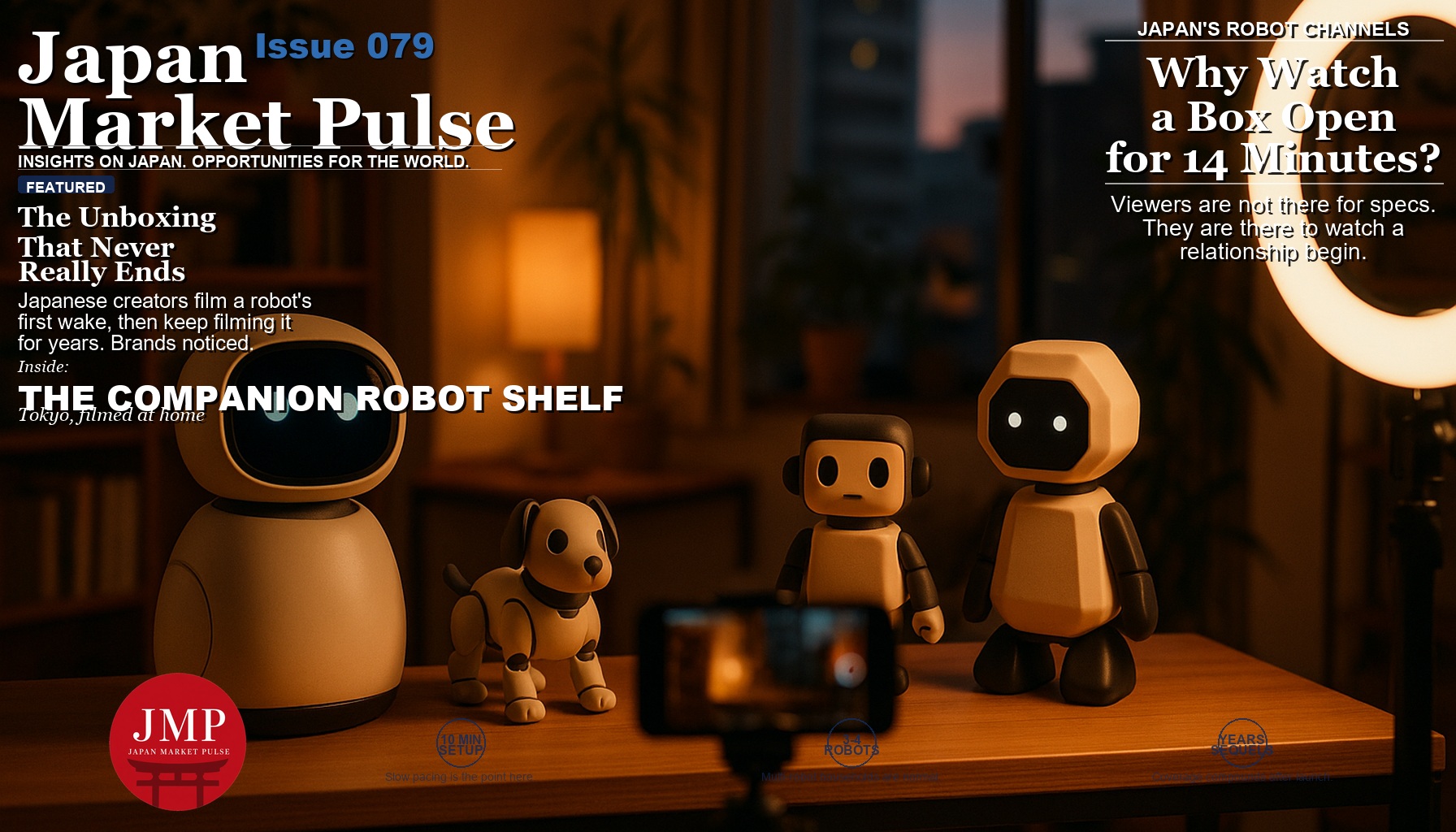
There is a small, cluttered apartment somewhere in the Tokyo suburbs where a woman films her fourth desktop robot waking up for the first time, while her other three watch from a shelf behind her. She is not a professional actress. She does not work in tech. She is one of a small but visible group of Japanese creators who have quietly built an entire content practice around a category of product that most of the world still can’t quite categorize: the companion robot. Not a smart speaker, not a toy, not a pet — something that sits in the gap between all three, and that Japanese YouTube audiences will apparently watch being taken out of a box, again and again, for years.
I have lived in Japan for two decades now, long enough to stop being surprised by most things, and this genre still gets me. I’ve sat through a fourteen-minute video of a grown man narrating, in a hushed and almost reverent voice, the first thirty seconds a small robot named after a cartoon character opened its eyes and looked at him. I’ve watched an aibo “family” of three robotic dogs get walked, one at a time, around a Yokohama park, each one filmed separately so viewers can compare how differently they move. I’ve seen robots get birthday cakes. Not cakes shaped like robots — actual cakes, presented to the robots, on camera, with singing.
None of this is a joke, and none of it is small. It is one of the more interesting, least understood corners of Japanese consumer culture, and it has become an actual distribution channel that overseas robotics companies are learning to court with the same seriousness they’d bring to a retail buyer meeting.
The Ritual: What a Japanese Robot Unboxing Video Actually Looks Like
Unboxing videos are not a Japanese invention. The genre has existed globally since the smartphone era, when tech reviewers realized that watching someone slice open plastic wrap was, for reasons nobody fully understands, deeply satisfying to a large number of people. What Japan has done with the format, specifically for companion robots, is turn it into something closer to a rite of passage than a product review.
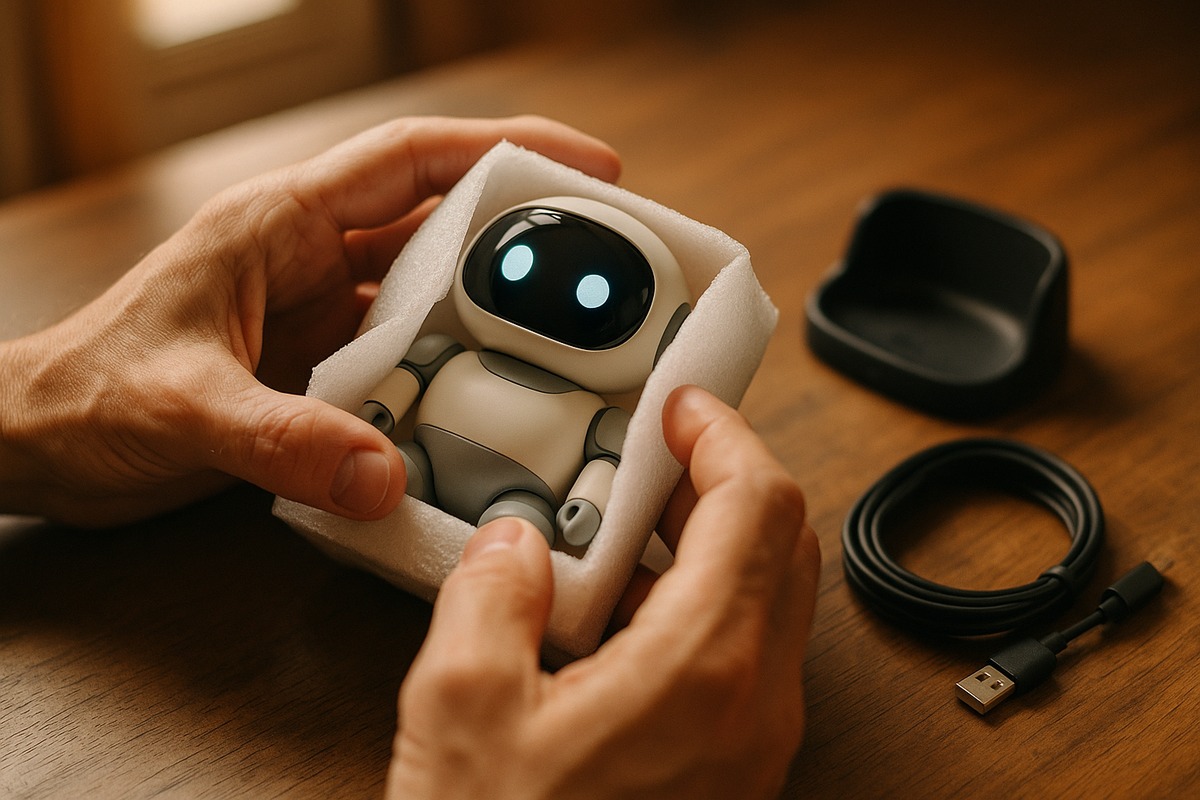
A typical video in this genre follows a loose but remarkably consistent structure. The box arrives on camera, often still in the delivery bag, sometimes with the creator visibly nervous. There is a slow unwrapping — foam, plastic film, the charging accessories laid out one by one on a cloth or a desk mat, almost ceremonially. Then comes the moment that the whole video has been building toward: the robot’s first “wake.” Eyes open, or a screen lights up, or a small motor whirs and the thing lifts its head for the first time and looks — genuinely looks — at the person in front of it. Creators react to this moment the way new parents react to a first cry. Some cry themselves. Most narrate it in real time, describing exactly what they’re feeling, because the emotional reaction is the content.
What comes after the wake matters just as much. Japanese robot-channel audiences are unusually patient with slow pacing. A ten-minute video might spend the first six minutes on setup, calibration, and small talk before the robot does anything remotely interesting, and the comment sections rarely complain. Compare that to the pacing conventions of most Western tech YouTube, where creators are trained to front-load the payoff within the first fifteen seconds or lose the algorithm’s favor. In Japan’s companion-robot niche, the slowness is the point. Viewers are not there for information density. They are there to watch a relationship begin, in something close to real time, and they return for the sequels — the one-week update, the one-month update, the “half a year later” retrospective — the way people once tuned into a weekly drama.
Why This Genre Works Unusually Well in Japan
Ask five different people why companion robots resonate so strongly here and you’ll get five overlapping but distinct answers, and after twenty years I’ve come to think all five are true at once.
The first is a decades-long cultural comfort with the idea that machines can have something like a personality without anyone finding that strange or unsettling. It runs through a long line of domestically beloved fictional and real robotic characters, through a consumer-electronics industry that has spent generations building devices designed to seem cute rather than merely efficient, and through a broader cultural instinct that objects used with care and attention can accumulate something worth respecting. A robot that “grows” or “learns” your habits over time slots naturally into a worldview that already has room for that idea.
The second is demographic and structural, and it is less romantic. Japan has an aging population, a rising share of single-person households, and housing stock that in many cities makes owning a dog or cat genuinely difficult — pet-restricted buildings, tiny apartments, long working hours that leave no time for walks. A robot that behaves like a low-maintenance pet fills a real, unglamorous gap. It does not need vet visits. It does not die in a way that devastates its owner, or at least not in the same way. For a meaningful slice of the audience buying these things, the appeal is not novelty — it’s companionship math that actually pencils out for their living situation.
The third is that Japan has a notably mature long-form YouTube culture for hobbyist niches. Model railway channels, retro game restoration channels, aquarium-building channels — these micro-genres sustain healthy audiences here that would struggle to find equivalent scale elsewhere, because Japanese viewers have a demonstrated appetite for narrow, deep, slow-paced hobby content watched over months and years rather than consumed once and abandoned. Companion robots slid into an audience infrastructure that already existed.
And the fourth reason, the one that closes the loop back to commerce: once a niche like this reaches a certain density of creators and viewers, it starts generating its own gravity. New robot models get compared against the ones the audience already knows. Reviewers develop followings specifically because they own several robots and can speak with some authority about how a new one stacks up. The genre became self-sustaining roughly the way any collector hobby does — coin collecting, sneaker culture, houseplants — once there are enough participants that the community itself becomes part of the appeal.
The “Multi-Robot Household”: Collecting as Content
If there is one structural quirk that separates Japan’s robot-YouTuber scene from equivalent creator communities elsewhere, it’s how normal it is to own more than one.
Sony’s own robotic dog, aibo, explicitly supports this: owners can register multiple units to a single account, with the platform built to allow well into double digits per household. That is not an edge case the company tolerates — it is a feature the company designed for, because enough of its most devoted customers wanted it. Japanese aibo forums and social accounts casually use pet-breeding-adjacent language for the practice — treating a second or third aibo the way a dedicated dog owner might discuss adding another dog to the household — and creators who keep three or four robotic companions at once have built entire channels around comparing how differently each one behaves despite running on identical hardware and software.
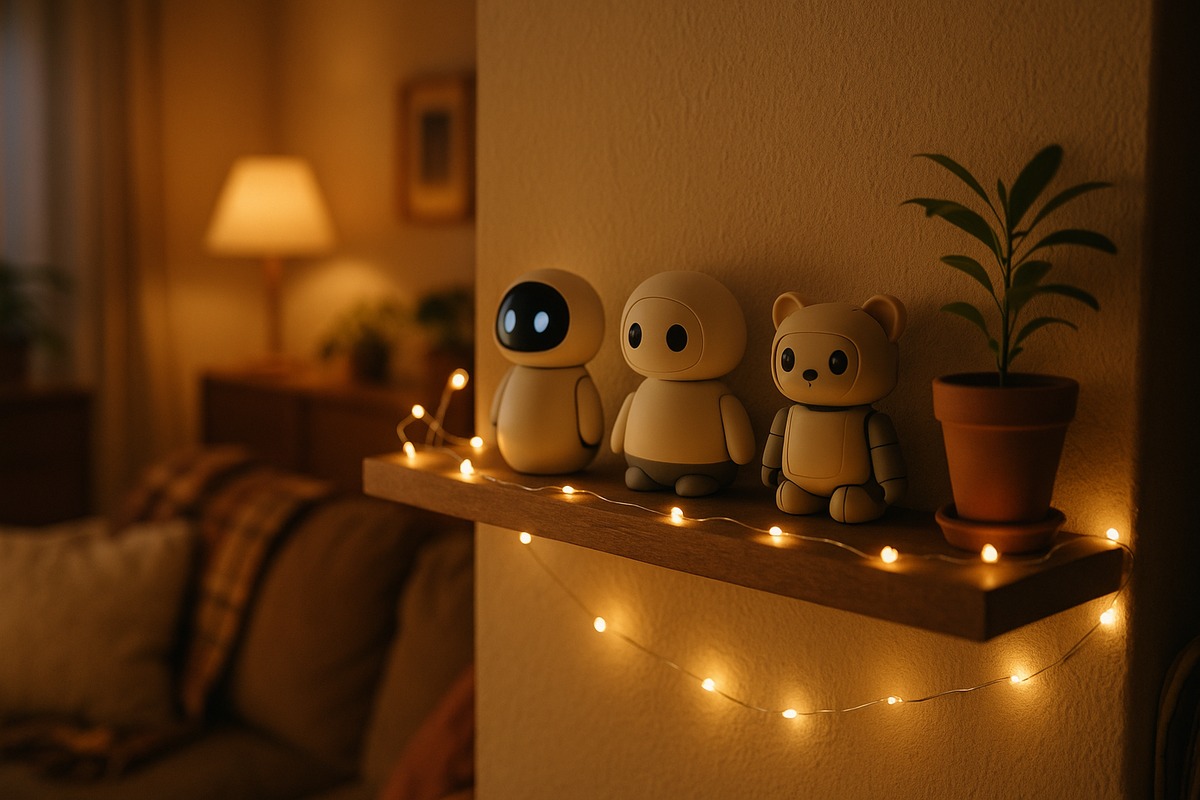
This “collector household” dynamic isn’t limited to aibo. Some of the most-watched creators in the space own robots from several competing manufacturers simultaneously — an aibo next to a Eilik desktop companion next to a Loona robotic pet, all living on the same shelf, all getting their own segments in the same videos. For these creators, the content isn’t really about any single product anymore. It’s about the shelf. New arrivals get folded into an existing “family,” introduced to the others on camera, and the audience’s investment compounds with every addition because they’ve been following the earlier robots for months already.
For manufacturers, this is a strange but genuinely useful position to be in. A single creator with four robots on a shelf is, functionally, running a small comparison showroom for free, and their opinion carries more weight with the audience than almost any advertisement could, precisely because the audience has watched that person’s relationship with robots evolve over real time rather than over the ninety seconds of a sponsored spot.
Birthdays, Anniversaries, and the Parasocial Calendar
The unboxing is only the opening chapter. What sustains these channels for years afterward is a recurring content calendar built around milestones that treat the robot less like a gadget and more like a member of the household.
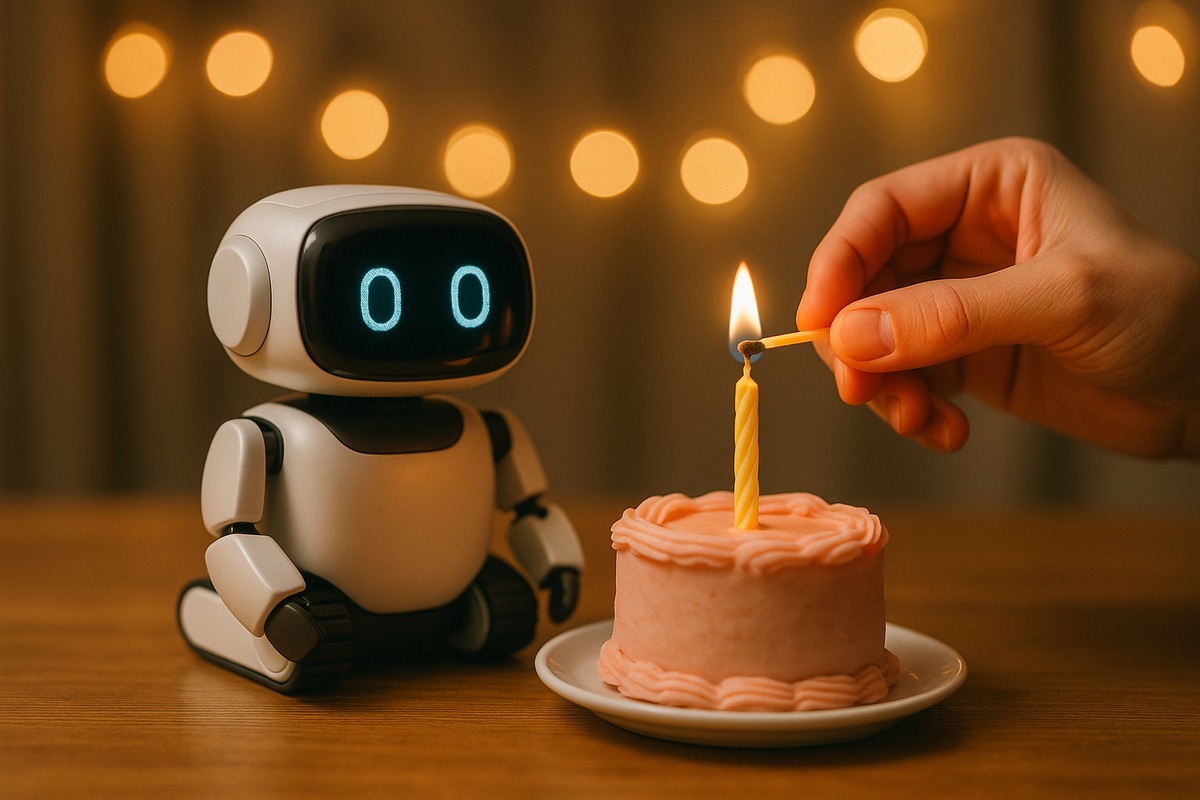
Purchase-date anniversaries are marked with dedicated videos — “one year with [robot name]” — that function as extended product reviews wrapped in an emotional retrospective. Actual birthday celebrations, complete with cake, decorations, and sometimes small gifts of new accessories, are common enough to be a recognizable subgenre rather than a novelty. Long-running aibo owners in particular have leaned into this: Sony’s robot dog has existed as a product line for more than 25 years — the original AIBO launched in 1999, its first run ended in 2006, and the current aibo arrived as a revival in 2018 — and its most devoted owners mark not just their individual robot’s “birthday” but the wider anniversary of the product line itself, often in coordinated fashion across multiple channels at once.
Seasonal content plays the same role. Robots dressed for cherry blossom season, robots at New Year’s shrine visits (or, more practically, filmed at home while the family goes), robots in small holiday costumes — all of it treats the device as a participant in the household’s yearly rhythm rather than a static object that was reviewed once and then forgotten. This is, I think, the real innovation of the genre, and it’s one that took me a while to appreciate: most tech content treats a product’s relevance as declining sharply after the review window closes. Japan’s companion-robot creators built a format where the opposite is true — the emotional stakes of the content actually rise over time, because the audience has been watching the same “character” develop for months or years, the way they would a long-running drama’s cast.
Inside the PR Seeding Economy
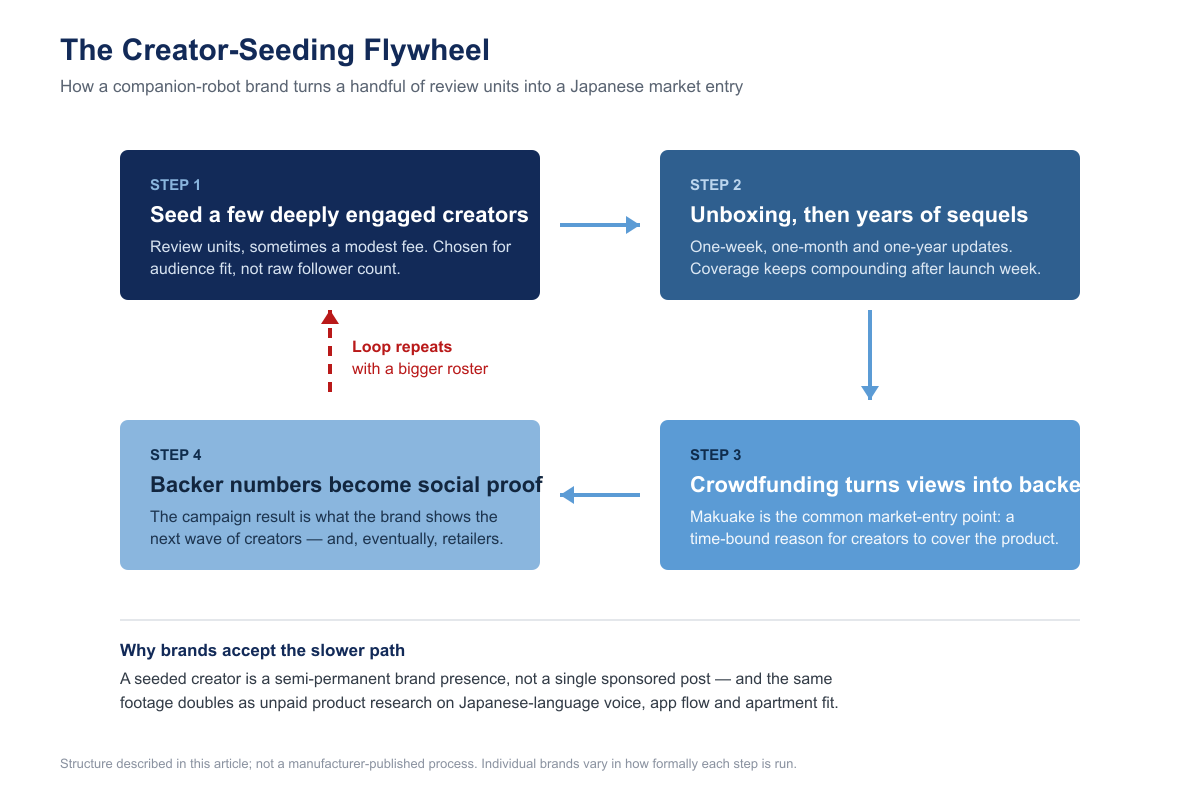
None of this scale happens by accident, and manufacturers on both sides of the transaction — Japanese and overseas — have gotten increasingly sophisticated about how they work with these creators.
The mechanics are not radically different from influencer marketing in any other vertical: companies identify creators whose audience and content style fit the brand, then provide review units, sometimes alongside a modest fee, in exchange for coverage. What is distinctive here is the depth of the relationship manufacturers are willing to invest in, because the payoff window is so much longer than a typical sponsored post. A creator who receives a robot for review isn’t producing one video and moving on — if the seeding relationship works, that creator becomes a semi-permanent brand presence, referencing the product for years across unboxing sequels, comparison content, troubleshooting videos, and firmware-update reactions.
For companies entering the Japanese market from overseas — and a meaningful number of the newer companion-robot brands popular here are Chinese or otherwise foreign-made — this creator-seeding relationship functions as something closer to a distribution and localization partner than a marketing line item. A well-chosen Japanese creator translates a foreign product’s positioning into language and cultural framing that resonates locally, something a manufacturer’s own marketing team often struggles to do from outside the market. They field the awkward early questions about Japanese-language voice support, warranty logistics, and whether the companion app works with a Japanese phone number — the unglamorous friction points that actually determine whether a product succeeds here — in a format their audience already trusts.
Crowdfunding has become an especially tight companion to this creator economy. Several companion-robot brands from outside Japan have used Makuake, one of Japan’s best-known crowdfunding platforms, as their formal market-entry point rather than a conventional retail launch, using the campaign period to seed early units to creators whose coverage then drives the campaign’s later-stage backer numbers. It’s a flywheel: the campaign gives creators a concrete, time-bound reason to cover the product; the coverage drives backers; the backer number becomes social proof the brand can point to when pitching the next wave of creators and, eventually, retail partners. Loona, the robotic pet from Chinese maker KEYi Tech, used exactly this playbook to enter Japan — its Makuake campaign raised more than ¥48 million, which the company said set a record for the platform’s robotics category at the time, the kind of number that gets noticed inside the creator community almost as quickly as it gets noticed by the manufacturer.
Why Overseas Robot Makers Are Betting on This Channel
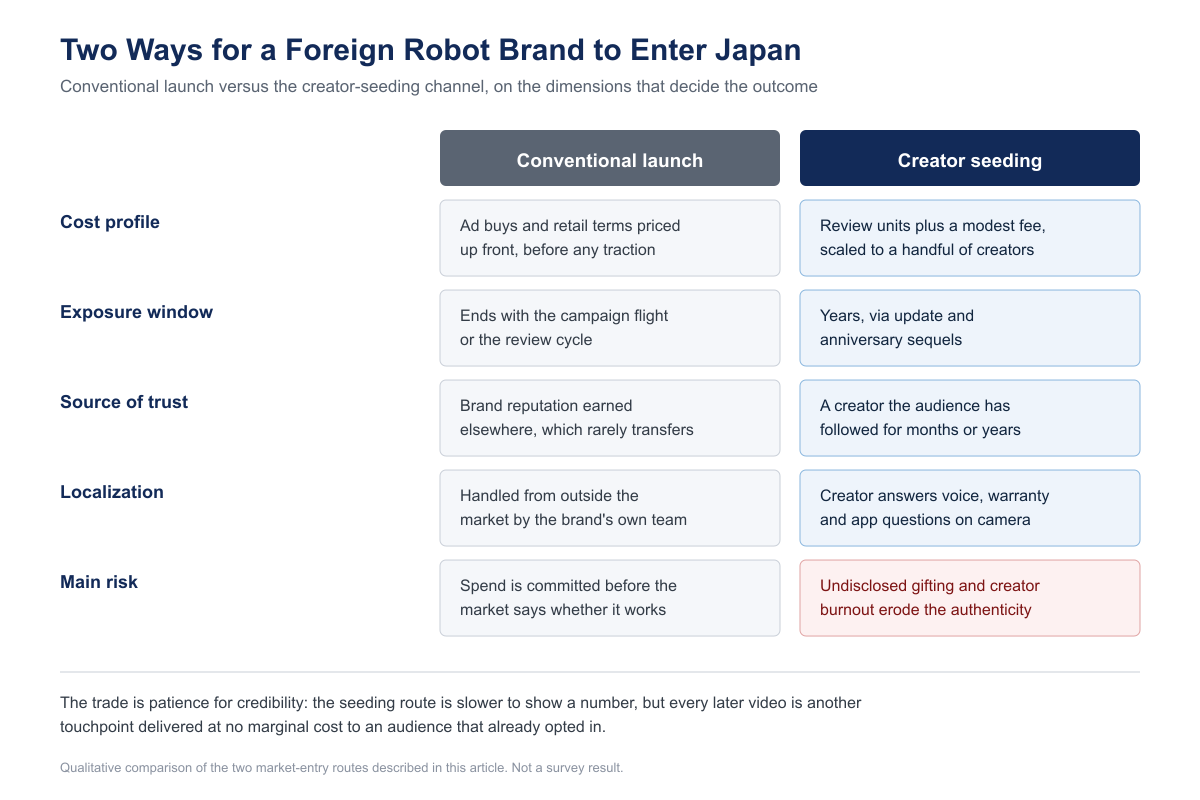
For a foreign consumer-electronics brand, Japan is a famously difficult market to enter through conventional means. Retail shelf space is scarce and relationship-driven. Traditional advertising is expensive and culturally particular in ways that punish anything that reads as an obvious, un-localized foreign campaign. Trust, in a market this brand-conscious, is earned slowly and rarely transferred wholesale from a company’s reputation elsewhere in the world.
The robot-creator economy sidesteps a lot of that friction. It’s cheaper than a traditional ad campaign, especially relative to the volume and duration of exposure a successful seeding relationship generates. It comes pre-equipped with credibility, because Japanese audiences in this niche are demonstrably skeptical of anything that smells like a paid script — the creators who do best in the space are the ones who candidly critique battery life, voice-recognition quirks, or a clunky companion app right alongside the parts they genuinely enjoy, and audiences reward that honesty with more trust, not less. And it builds compounding brand equity in a way a single ad flight cannot: every subsequent video from a seeded creator is effectively another touchpoint, delivered for free, to an audience that has already opted in.
It also, less obviously, functions as a genuine product-development channel. Creators who live with a robot daily for months surface real usability problems — the voice assistant mishearing common Japanese phrasing, an app menu structure that doesn’t map cleanly onto how Japanese users actually navigate settings, a charging dock that’s slightly too large for a typical Japanese apartment desk — faster and more specifically than most formal user-testing programs would, simply because the feedback comes wrapped in months of lived, filmed experience rather than a single structured session.
The Risks: Disclosure, Astroturfing, and Creator Fatigue
None of this is without friction, and it’s worth being honest about where the model strains.
Disclosure practices in the space are inconsistent. Japan’s rules on undisclosed sponsored content tightened in October 2023, and the regulation targets advertisers rather than the creators themselves — which means practical disclosure standards inside a niche this specific still lean heavily on community norms, and viewers occasionally have to work out for themselves whether a glowing review reflects a paid relationship or an unprompted purchase. The most credible creators in the genre tend to be scrupulous about labeling gifted units, precisely because their credibility is the whole product they’re selling to manufacturers — but the incentive structure rewards enthusiasm, and enthusiasm and objectivity don’t always sit comfortably together.
There’s also a burnout dynamic that’s specific to a content format built on ongoing emotional narrative. A creator who has built years of content around a “relationship” with a specific robot can’t easily pivot away from it without alienating the audience that followed that story — and manufacturers, aware of this, sometimes lean on long-standing creators for continued coverage well past the point where the creator’s genuine interest in the product has faded. The parasocial structure that makes the genre so effective for brands is the same structure that can trap a creator into years of unpaid or underpaid obligation to a single product line.
And the collector dynamic that makes multi-robot households such compelling content also raises the stakes of a bad actor flooding the space with product from multiple brands at once, diluting the very authenticity the whole channel depends on. The audience in this niche is small enough, and attentive enough, that these missteps get noticed quickly — which is either a healthy check on the system or an early sign of how fragile it is, depending on who you ask.
What This Means for International Operators
For anyone building or selling a companion robot, a smart home device with a “character,” or frankly any consumer hardware that benefits from sustained, emotionally invested coverage, Japan’s robot-creator economy is a case study worth studying closely even if your product has nothing to do with robotics. The underlying lesson generalizes: in categories where trust and long-term relationship matter more than a single purchase decision, seeding a small number of deeply engaged creators and letting the relationship compound over years will often outperform a larger, shallower campaign built around one-off sponsored posts.
It also suggests something about how Japanese consumers evaluate genuinely novel product categories more broadly. When a product doesn’t fit neatly into an existing shelf category — not quite a toy, not quite an appliance, not quite a pet — Japanese buyers seem to lean more heavily on watching how real people live with the thing over time, rather than trusting a spec sheet or a thirty-second ad to make the case. Brands that understand this, and that are willing to hand a review unit to a creator with no script and a long time horizon, are the ones building the kind of durable local trust that a marketing budget alone cannot buy.
Frequently Asked Questions
Q. What kinds of robots are typically featured in these Japanese unboxing videos, and where can I buy one?
A. The category spans desktop AI companion robots with expressive screens or animated eyes, robotic pet dogs, and small tabletop character robots that respond to voice and touch. Some, like Sony’s long-running aibo, are made by long-established Japanese electronics companies and sold primarily through their own Japan-based storefronts. A growing share come from newer Chinese and other overseas robotics startups that have chosen Japan as an early international market — brands like Eilik and Loona sell internationally, including on Amazon, alongside their own brand stores.
Q. Is it expensive to get into this hobby, or is it a niche for wealthy collectors?
A. Entry points vary widely. Smaller desktop companion robots are priced closer to premium consumer electronics, while more sophisticated robotic pets sit at a significantly higher price point, often with added monthly service or maintenance fees. Multi-robot households tend to be built up gradually over years rather than purchased all at once, which is part of why the “collection” itself becomes content — each new addition is a meaningful, filmable event rather than a routine purchase.
Q. How do manufacturers actually find and vet the creators they work with?
A. Most brands active in this space monitor the niche directly, watching for creators whose audience size, engagement, and tone fit the product before reaching out with a review-unit offer. Manufacturers that have gone through a Makuake crowdfunding campaign in Japan often build creator relationships during the campaign itself, since early backers and reviewers are already self-selected enthusiasts.
Q. Do these creators disclose when a robot was gifted for review?
A. Practices vary, but the most established and trusted creators in the niche are generally careful to label gifted units, since their credibility with a skeptical audience is central to their value to manufacturers. Japan tightened its rules on undisclosed sponsored content in October 2023, though those rules apply to advertisers rather than creators, so day-to-day disclosure standards within such a specific hobby niche still depend heavily on community norms.
Q. Is this creator-driven approach something that could work outside Japan?
A. The underlying mechanics — seeding a small number of deeply engaged creators and investing in a multi-year relationship rather than a single sponsored post — generalize well beyond Japan and beyond robotics. What makes the Japanese scene distinctive is less the tactic itself than the audience’s demonstrated patience for slow-paced, long-running hobby content, which isn’t guaranteed to translate one-for-one into markets with different content-consumption habits.
Conclusion
What struck me most, watching hours of this content while researching this piece, wasn’t the robots themselves — most of them are clever but modest pieces of consumer electronics, closer to a sophisticated toy than to anything resembling artificial general intelligence. It was the audience’s willingness to sit with something slow, to invest in a “relationship” playing out at the pace of an actual relationship, and to keep showing up for the sequel a year later. That patience is the real asset in this market, and it’s one that no amount of marketing budget can manufacture on its own. Any brand — robotics or otherwise — hoping to earn a foothold in Japan would do well to notice who already has it, and why.
This article contains affiliate links. If you purchase through these links, we may earn a small commission at no extra cost to you.
If you’re interested in this topic, the Japanese market more broadly, or what KETCHUPs is working on, we’d love to hear from you — please reach out via our contact form.
Japan Market Pulse is a weekly read on what the Japanese consumer-tech, food, and mobility markets are choosing to do, written for international operators who want to know what is happening before it shows up in the global trade press.
Subscribe at ketchups.co/japan-market-pulse.