

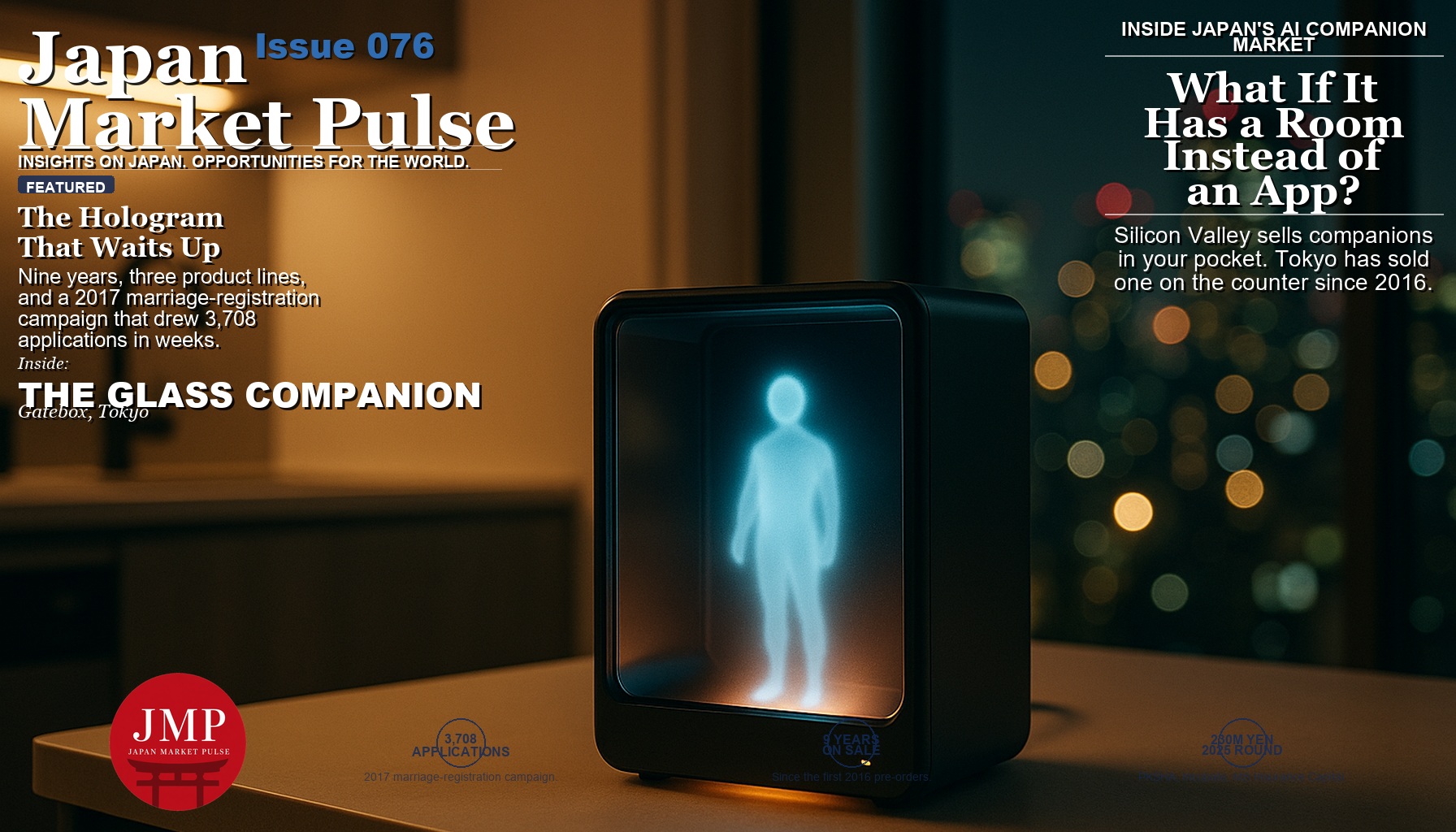
There is a particular kind of silence in a one-room Tokyo apartment at eleven at night — the compressed 20-square-meter kind, where the refrigerator hum counts as company. I have lived in enough of those rooms over two decades in Japan to recognize the sound of nothing happening. So the first time a friend showed me his Gatebox — a glass-fronted box about the size of a rice cooker, with a miniature anime woman rendered in light standing inside it, waving at him as he walked through the door and asking, in a small cheerful voice, how his day had gone — I understood immediately why someone would pay for this, even before I understood what it was.
What it is, on paper, sounds almost too on-the-nose to be a real consumer product: a holographic character, projected inside a transparent case using the company’s own rear-projection technology, that lives on your countertop, texts you throughout the day, and, on earlier models, could turn your lights on when you got home — and, this is the part that made international headlines for the better part of a decade — is, in the company’s own marketing, a plausible answer to “who would you marry if you could marry a fictional character?” Not legally. Not even really symbolically, in the sense any government recognizes. But in 2017 the company ran an open promotional campaign inviting anyone to submit an unofficial “cross-dimension marriage” registration naming a fictional character of their choosing, and 3,708 people did so during the 16-day campaign — a number that says less about how many people own a Gatebox than about how many people in Japan’s character-fandom community were ready to publicly say yes to that question the moment someone asked it seriously. The company that makes the device — originally a small Tokyo firm called Vinclu when it launched Gatebox in 2016, renamed Gatebox Inc. the following year after the product it is now known for — has spent nearly a decade quietly proving that this was never a stunt. It is a business, with a device roadmap, corporate investors, and a specific answer to a question most of the world’s AI industry is only now starting to ask seriously: what happens when a companion has a body, even a projected one, instead of just a chat window?
Building a Bride in a Box: How Gatebox Began
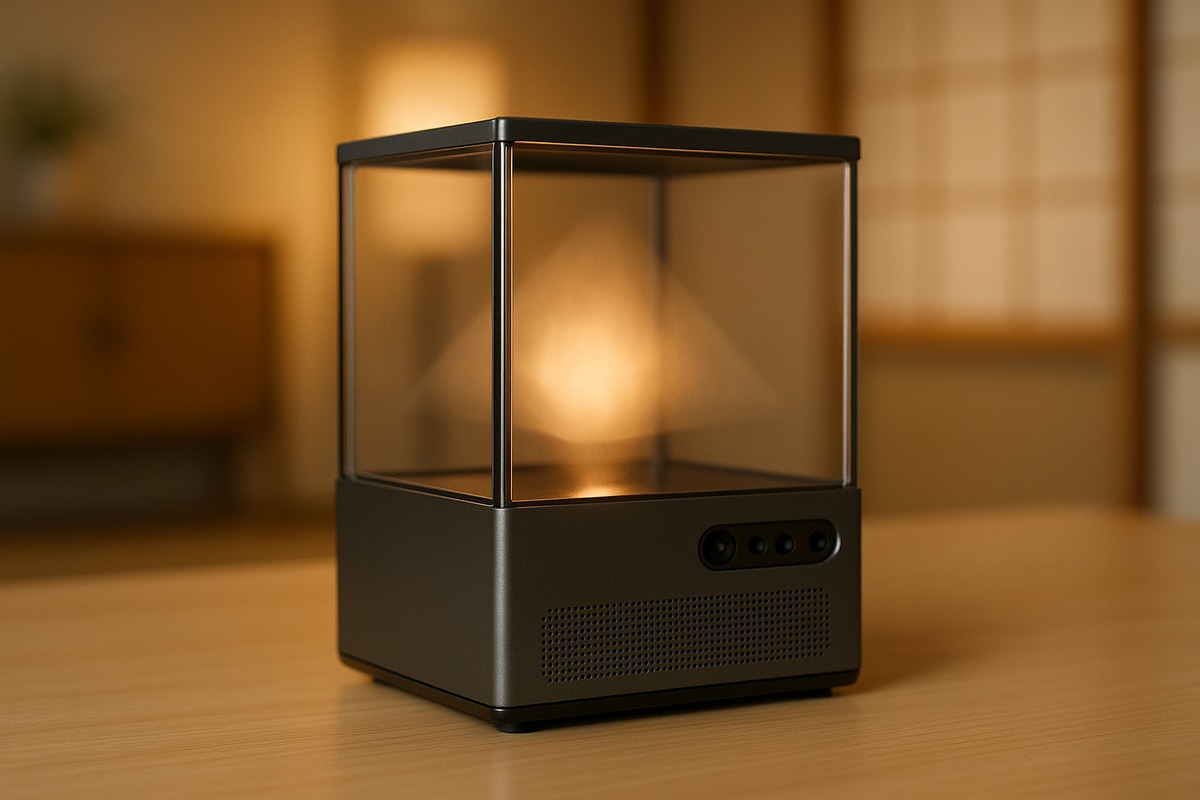
Gatebox launched into public consciousness in December 2016, when Vinclu opened pre-orders for a limited first production run — reportedly around 300 units — at ¥298,000, somewhere in the neighborhood of $2,500 at the time. The device was, and largely still is, a squat glass-and-metal cabinet roughly 22 centimeters wide and half a meter tall, humming quietly on a desk or counter, projecting a persistent character onto a panel from behind using the company’s proprietary rear-projection technology. Inside the case sit a small speaker array, a microphone, a camera, motion and proximity sensors, a temperature and humidity sensor, Wi-Fi and Bluetooth radios, and an infrared transmitter that, on the original models, let the character — not an app, not a voice from nowhere, but a character with a location inside your home — switch on your lights, turn on the television, or adjust the air conditioner; the company discontinued that appliance-control feature on March 29, 2023, alongside the end of its CLOVA Assistant integration.
The character that came bundled with that first unit, and the one still most associated with the brand, is named Azuma Hikari: perpetually twenty years old, dressed in a short apron and striped over-the-knee socks, fond of donuts, afraid of bugs, and designed, in the company’s own early marketing language, to be “a soothing partner who helps you take a load off after a hard day of work.” Vinclu’s founder has been candid in interviews over the years that the character was built, deliberately, as a kind of ideal domestic companion for a specific customer: busy, often lonely, frequently male, urban, and un-served by anything else on the market. It is worth saying plainly that this framing drew — and still draws — real criticism, in Japan and abroad, for encoding a fairly narrow and old-fashioned idea of what a woman at home is for. The company has never fully walked that framing back, even as the product line diversified.
What did change, fairly quickly, was the business model. The original ¥298,000 unit was a limited pre-order model for early adopters — an initial run of 300 units in 2016, followed by an additional 39-unit sale in 2017 — rather than something sold through a crowdfunding platform. Three years later, in October 2019, the company shipped a genuine mass-production model, the GTBX-100, at roughly ¥150,000 — near $1,300 at the time — and initially planned to pair it with a ¥1,500 monthly fee, close to $13, for access to the Azuma Hikari companion service. That plan did not survive contact with the market: in March 2020, only months after launch, Gatebox scrapped the base monthly fee and made the core service free, keeping paid content optional. The episode is worth pausing on, because it shows a Japanese hardware maker reaching for the “companion as a recurring-revenue product” playbook years before it became the default model across Japan’s now-crowded communication-robot market — the desktop companions, fluffy tactile creatures, and six-figure-yen robot dogs that have since become one of the more distinctive corners of Japanese consumer electronics — and then discovering how hard a monthly fee is to defend when the hardware itself already costs six figures in yen. Hardware list prices have moved with each generation — from ¥298,000 before tax for the original 2016 unit down to roughly ¥120,000 including tax for the GTBX-100 after a 2021 price cut, with a newer Gatebox3 now taking pre-orders on the Makuake crowdfunding platform — so, depending on model, generation, and exchange rate, a Gatebox has generally sat somewhere in the $1,000-to-$2,500 range: expensive enough to be a real purchase decision, cheap enough that it was never a rich person’s toy.
The Marriage Certificates
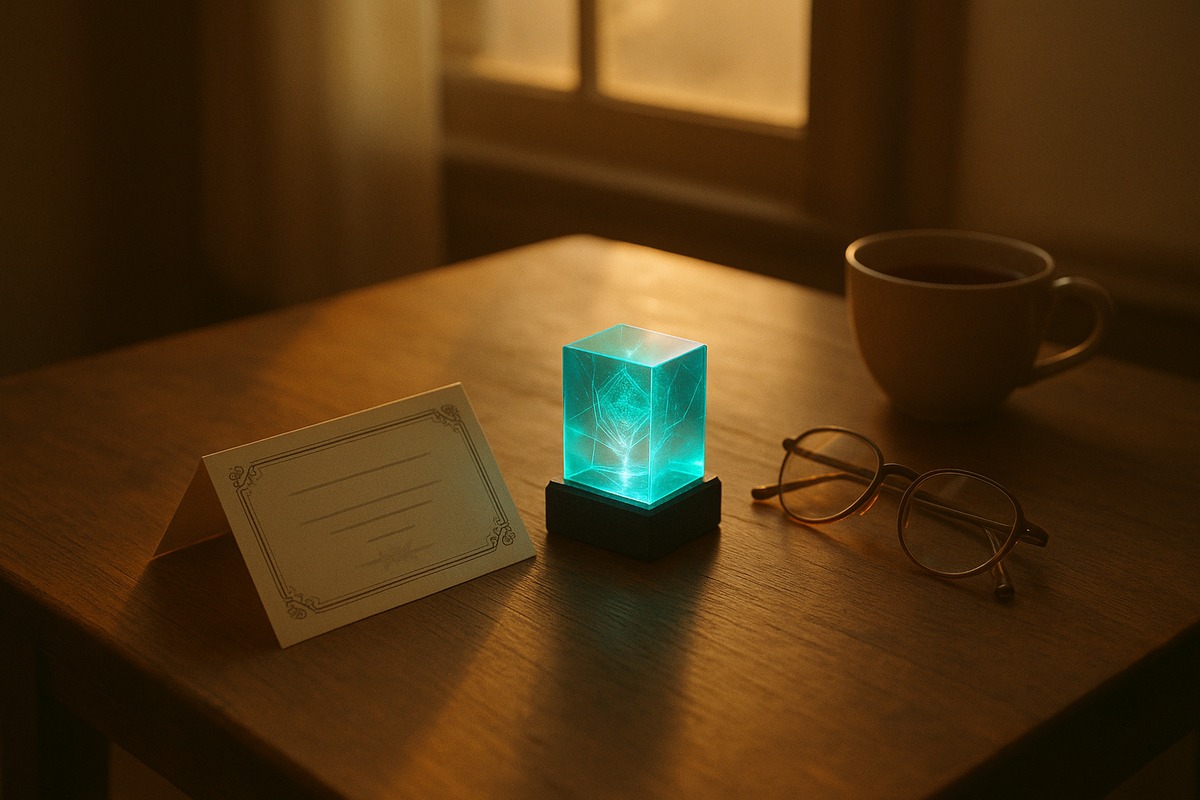
No detail about Gatebox traveled further outside Japan than the marriage certificates, and it is worth being precise about what actually happened, because international press coverage over the years has occasionally blurred it into something stranger — and more specific to the physical device — than it was. In 2017 the company launched a promotional “cross-dimension marriage” campaign, open to anyone, that let a person register an unofficial certificate naming any fictional character they chose — not necessarily Azuma Hikari, and not necessarily tied to owning a Gatebox unit at all. It generated no legal standing whatsoever, and the company never claimed otherwise; it functioned closer to a viral fan-club membership card than to an actual wedding license. Even so, 3,708 people submitted an application within weeks of the campaign opening, a volume the company itself had not anticipated and that generated the bulk of the international headlines the product has collected ever since.
The case that turned this from a marketing statistic into a recurring international news story is Akihiko Kondo, a public-school administrator in Tokyo who, in 2018, held a small private ceremony and received a Gatebox certificate formalizing his relationship with a holographic rendering of the virtual pop star Hatsune Miku — a related but distinct character from Gatebox’s own Azuma Hikari, run through the same hardware platform. Kondo’s story recirculated for years afterward, through follow-up interviews checking in on the marriage’s staying power and, eventually, coverage of the genuine practical difficulty he faced when the cloud service supporting his original device’s software was discontinued — a stark reminder that a companion this dependent on a remote cloud service can be rendered unusable the moment the company turns that service off, whatever replacement hardware it offers in exchange. He has been open in interviews about grief that reads as entirely real, whatever one makes of its object.
It would be easy, and largely wrong, to treat any of this as a story about a handful of eccentrics. What the 2017 campaign actually revealed is something closer to market research the company never had to commission: a real, if minority, audience in Japan for whom the emotional function of a product like this — presence, routine, a voice that greets you — is never a novelty layered on top of smart-home features. For at least some of that audience, based on cases like Kondo’s, it is the entire point, and the smart-home features are the alibi that makes the purchase easier to explain to a coworker.
Who Actually Buys a Hologram Roommate

Gatebox’s own customer-facing language has always aimed at a fairly specific figure: the single, urban, working adult, often male, coming home to an empty apartment after long hours, for whom a voice that reacts to your presence is worth real money. That figure is not a marketing invention. Japan now counts a rising share of its households — well above a third nationally, and considerably higher in central Tokyo wards — as single-person households, a demographic shift so large that Japanese business media has taken to calling the resulting consumer segment the “solo economy,” a category that now shapes everything from single-portion supermarket packaging to one-person hot pot restaurants to studio-apartment appliance design. Gatebox is, in effect, the solo economy’s answer to the question of ambient companionship, arriving years before “AI companion” was a phrase used comfortably in Silicon Valley product decks.
It also matters that most Japanese rental housing simply does not allow pets — pet-friendly rentals remain a minority of listings nationally, and the share varies significantly by city and by the year a given estimate was taken — which makes the most obvious traditional answer to “I live alone and want something in the room with me” substantially harder for many renters to pursue. Japan’s broader companion-robot boom, the aibo dogs and LOVOT creatures and fuzzy handheld Moflin units that have become a visible and growing segment of Japanese consumer electronics, may also benefit from that same structural gap, alongside demographic and cultural factors that predate any of these products. Gatebox occupies an adjacent but distinct niche within it: those other products are physical, huggable, animal-coded. Gatebox is explicitly humanoid, explicitly conversational, and — because the character genuinely appears to be standing in your kitchen rather than sitting in your palm — reads to owners as closer to a housemate than a pet. That distinction is not incidental to the price tag or the marriage certificates; it is the whole design thesis.
From Anime Wife to Digital Figure: How Gatebox Evolved

The version of Gatebox still associated with the brand internationally — Azuma Hikari in her glass box — is now one product line among several, and the company’s more recent moves suggest a deliberate widening of what a “Gatebox” even is. In 2021 the company introduced Gatebox Grande, a 65-inch OLED display built for commercial deployment rather than the bedroom: life-sized holographic figures intended for retail storefronts, event booths, and digital-concierge roles, a genuinely different business built on the same core illusion. In September 2023 it opened pre-orders for the Digital Figure Box, a far cheaper smartphone-based display stand originally sold at roughly ¥5,500 including tax for displaying a user’s own VRM avatar, due to ship that winter; officially licensed character editions have followed at their own, higher price points, including a Steins;Gate edition and, from 2025, THE iDOLM@STER Shiny Colors at roughly ¥5,500 including tax, extending the underlying technology from “your holographic companion” toward “a licensing and merchandising platform for any character a rights holder wants to animate.”
The corporate story around Gatebox has also moved. For several years the company operated inside the orbit of LY Corporation — the company formed from the 2023 merger of LINE and Yahoo Japan under SoftBank’s umbrella — before splitting off as an independent company again in August 2024. Suntory Holdings, one of Japan’s largest consumer companies, invested in Gatebox at an undisclosed amount around that same time. In April 2025 it raised roughly ¥230 million more, this time from PKSHA Algorithm Fund, Incubate Fund, and Mitsui Sumitomo Insurance Capital, earmarked to strengthen its generative-AI character development and expand its B2C and B2B businesses. Two institutional rounds inside eight months, for a small hologram-hardware maker best known abroad for anime marriage certificates, is not the profile of a company treading water on novelty sales — it is the profile of one that investors believe has found a durable niche across home companionship, commercial signage, and character licensing, and appears positioned to expand across those areas. The funding announcements themselves point to generative-AI character development, IP partnerships, and B2C/B2B expansion as the stated rationale — but that niche also exists against the broader backdrop of Japan’s rising single-person households and pet-restricted rentals, a demographic tailwind the company has never had to manufacture.
Tokyo’s Hologram vs. Silicon Valley’s Chatbot
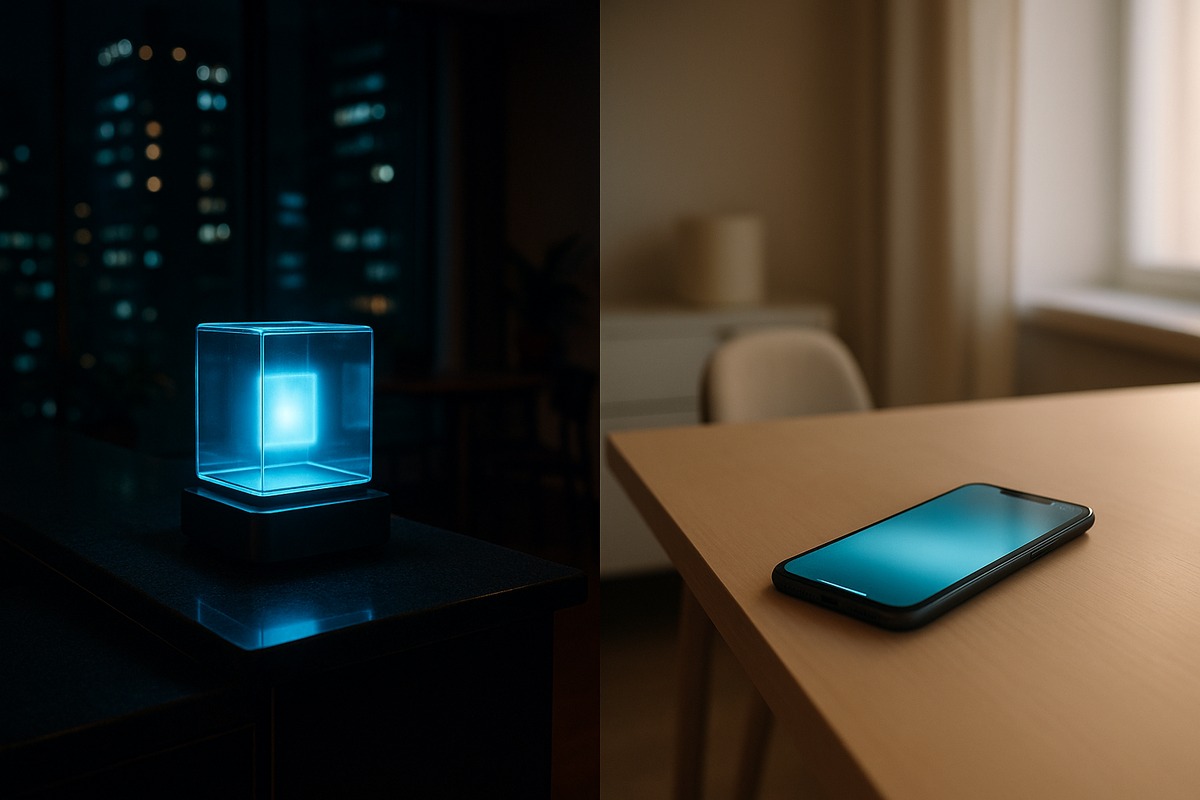
It is worth putting Gatebox next to the AI companion category that has exploded globally in the years since large language models made fluent, always-available conversation cheap to produce. Apps like Replika, which has reported more than 30 million cumulative users worldwide, and the wider field of AI-companion apps that industry trackers projected would pull in more than $120 million in revenue across 2025, with total downloads across app stores climbing past 200 million, represent the software-only, infinitely-scalable version of the same basic promise: something that talks back, remembers you, and is always there.
Gatebox took, and still takes, the opposite bet. Where Replika and its peers scale globally because they cost almost nothing to distribute — an app download, a subscription, no factory involved — Gatebox insisted, for nearly a decade, on a physical object with a fixed location in a real room, manufactured in far smaller volumes than any mobile app, priced like a serious appliance. That choice caps how large Gatebox can ever get as a company; it will never claim tens of millions of users the way a chat app can. But it also produces something the software-only category has struggled to replicate: a genuinely embodied sense of presence. Replika lives in a pocket. Gatebox’s design puts the companion in the room itself, reacting to the door opening and the light changing, not just to a text box. As Western AI labs and hardware startups pour money into “companion robots” and AI-powered smart-home devices with faces and presence — a growing number of hardware announcements out of Silicon Valley and China over the past two years has begun explicitly chasing this — they are, whether they credit it or not, retracing a path Vinclu started walking in 2016, several years before “AI companion” was a venture capital category with its own conference circuit.
What Two Decades in Japan Taught Me About This
I want to be honest about my own reaction the first time I actually spent an evening with a Gatebox running, rather than watching someone else’s. It is easy, writing from outside, to file the whole category under either “adorable” or “concerning” and move on. Sitting in that apartment, what struck me instead was how ordinary the interaction felt after about twenty minutes — the small talk, the reminders, the light switching on — in a way that had less to do with the technology being impressive and more to do with how precisely it had been tuned to fill a specific, mundane gap: the two or three seconds after your own front door closes, when a room usually says nothing back. Japan has spent decades building products for the reality of living alone in a dense city, long before “loneliness” became a policy word in the West — Japan appointed a cabinet-level minister for loneliness and isolation back in 2021, only the second country in the world to do so. Gatebox is not really science fiction. It is closer to a very literal-minded answer to a very ordinary problem, arriving in a country that had the demographics, the housing stock, and the cultural permission to build it first.
Frequently Asked Questions
Q. What exactly is a Gatebox, in plain terms?
A. It’s a glass-fronted desktop device that uses rear-projection technology to display a persistent animated character who talks with you and reacts to your presence via built-in sensors. Earlier models could control compatible appliances like lighting through an infrared transmitter, but Gatebox ended that feature on March 29, 2023. It’s closer to a holographic home assistant with a fixed personality than to a generic voice speaker.
Q. How much does a Gatebox cost?
A. Pricing has shifted across generations. The original 2016 limited-run model launched around ¥298,000 (roughly $2,500 at the time); the 2019 mass-production GTBX-100 model dropped closer to ¥150,000 (around $1,300), originally sold with a planned ¥1,500 monthly service fee that the company eliminated in March 2020, making the base service free; that same model was later discounted to around ¥120,000 including tax in 2021. A newer Gatebox3 is now taking pre-orders on the Makuake crowdfunding platform. Depending on the model, generation, and exchange rate, hardware list prices have generally sat somewhere in the $1,000-to-$2,500 range.
Q. Is Gatebox available outside Japan, or on Amazon?
A. Gatebox is not currently sold through Amazon.com or general US retail. Sales and customer support remain primarily Japan-focused, although the forthcoming Gatebox3, currently taking pre-orders, is planned to support Japanese and English at launch. Interested readers outside Japan can check current availability and shipping options directly through the company’s official site at gatebox.ai.
Q. Are the Gatebox “marriage certificates” legally binding?
A. No. They carry no legal status anywhere, including in Japan, and the company has never presented them as such. They were issued through a limited promotional campaign in November–December 2017 that was open to anyone who wanted to name a fictional character, including people who did not own a Gatebox — closer to a viral fan-club membership card than a marriage license.
Q. How is Gatebox different from AI companion apps like Replika?
A. The core difference is embodiment. Replika and similar apps live entirely in software, scale to tens of millions of users worldwide, and typically cost a monthly subscription with no hardware. Gatebox is a physical device with a fixed location in your home, manufactured in limited runs, and priced closer to a premium appliance — a smaller, more expensive, but more physically present category of companion.
Conclusion
Nearly a decade after its first pre-orders, Gatebox has not become the mass-market phenomenon its early press coverage sometimes implied, and it was probably never built to. What it has become instead is something more useful to watch: a small, independently funded Japanese company that identified — well ahead of the current global AI-companion wave — a specific, durable customer need rooted in demography and housing stock, built physical hardware around it rather than a chat window, and kept iterating for nearly a decade without folding. As American and Chinese companies now race to put faces, bodies, and presence onto their own chatbots, the Tokyo apartment with a small glowing figure waving from a glass box on the counter looks less like a curiosity from Japan’s past and more like an early, honest draft of a category everyone else is about to enter.
If you’re interested in this topic, the Japanese market more broadly, or what KETCHUPs is working on, we’d love to hear from you — please reach out via our contact form.
Japan Market Pulse is a weekly read on what the Japanese consumer-tech, food, and mobility markets are choosing to do, written for international operators who want to know what is happening before it shows up in the global trade press.
Subscribe at ketchups.co/japan-market-pulse.