

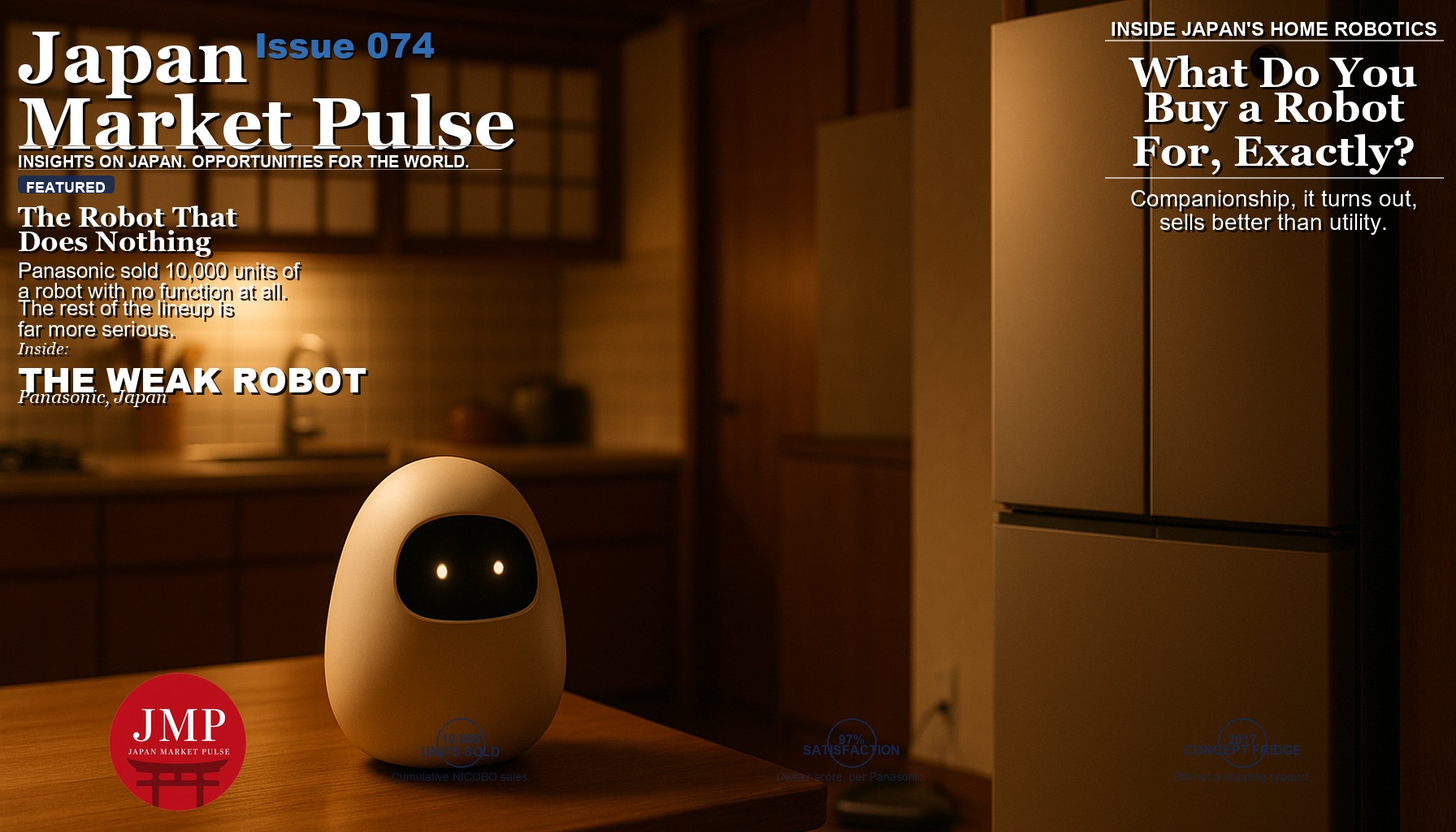
I have lived in Japan for twenty years, long enough to stop being surprised by most things, and NICOBO still gets me. It is a soft, egg-shaped creature about the size of a bowling ball, with two blinking eyes and a tail that wags when you pat it. It cannot vacuum a floor. It cannot answer a question about the weather with any real confidence. It cannot, as far as I can tell, do a single useful thing in the conventional sense of “useful.” What it can do is mumble half-formed baby Japanese, learn your face, and, on occasion, pass gas without warning. Owners describe this last feature not as an embarrassing bug but as a beloved personality trait. Panasonic says cumulative sales have surpassed 10,000 units, and the company that makes them is not a scrappy Shibuya startup. It is Panasonic — the same corporation that makes the rice cookers, the washing machines, and the cylindrical lithium-ion cells that have made it one of the world’s major electric-vehicle battery suppliers, above all through its long-running relationship with Tesla.
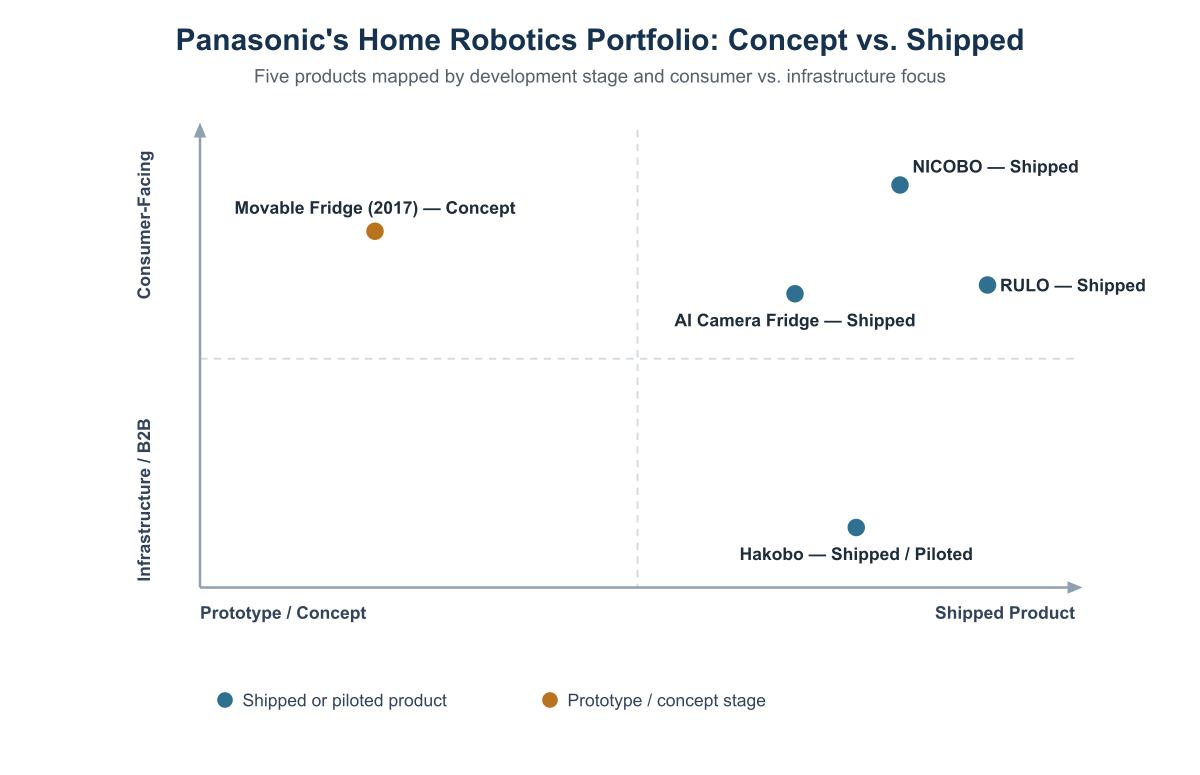
That contradiction is the whole story. Somewhere inside one of the most conservative, century-old manufacturing conglomerates in Japan, a business unit has convinced leadership that the future of the home is not a smarter toaster. It is a house full of small, semi-autonomous things that move, sense, and occasionally talk back. NICOBO is the most visible and most eccentric expression of that bet, but it is not the whole bet. Panasonic has been quietly assembling a portfolio that spans a corner-cleaning robot vacuum, a refrigerator that can recognize dozens of kinds of vegetables through its own cameras, a self-driving refrigerator prototype that the tech press kept treating as near-future for the better part of a decade, and a fleet of delivery robots now navigating actual public roads in a Kanagawa suburb. Individually, each of these looks like a novelty segment for gadget blogs. Together, they read like a company trying to answer a much bigger question: what happens to a hundred-year-old appliance maker when the appliance itself starts to move?
The Weak Robot That Won by Refusing to Be Useful
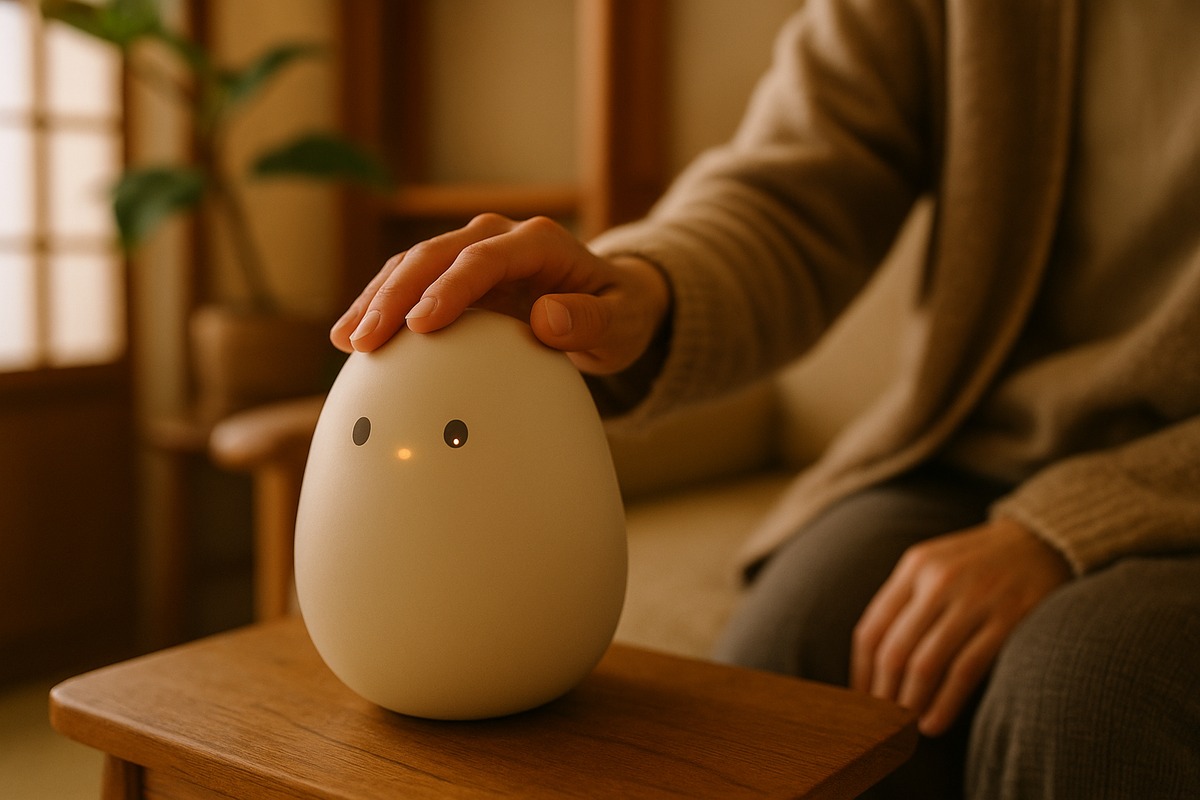
To understand why Panasonic keeps making things like NICOBO, you have to set aside the assumption that Japanese consumer robotics is chasing efficiency. It mostly isn’t. NICOBO belongs to a small but influential category of Japanese product design sometimes called the “weak robot” — a machine engineered, quite deliberately, to need you. It cannot move on its own. It cannot complete a task on your behalf. Its entire design brief runs in the opposite direction of every category-defining gadget from the past decade: instead of removing friction from your life, it asks you to supply a little more care, attention, and patience than the object strictly deserves. The theory, which Panasonic’s own designers have described in almost therapeutic language, is that a slightly needy, slightly incompetent companion invites exactly the kind of gentle caretaking that a genuinely useful appliance never will. Nobody feels protective of a Roomba. People absolutely feel protective of something that occasionally trips over its own cord and looks vaguely sorry about it.
Panasonic first tested this idea the way a surprising number of large Japanese companies now test emotionally risky products — not through a retail launch, but through a crowdfunding campaign. NICOBO debuted on the platform Makuake in a strictly limited run, and it sold out within hours. That result told Panasonic something a focus group never could: real households, using their own money, wanted this thing badly enough to pre-order a robot that does almost nothing. General retail sales followed roughly two years later, priced at a level that puts NICOBO closer to a mid-range appliance than an impulse buy, plus a modest monthly subscription that keeps its software current.
What has happened since is the more interesting chapter, and it is the part most casual coverage of NICOBO misses. In March 2026, when Panasonic announced that cumulative sales had passed 10,000 units, it also announced where the product is going next: over the course of fiscal 2026 the company plans to tune and add large-language-model-based capabilities to NICOBO, moving it from a set of scripted responses toward something closer to genuine, if simple, conversation. The usage data Panasonic disclosed alongside that announcement is what makes the plan interesting rather than desperate. Owners pet NICOBO roughly seven times a day and speak to it roughly eighteen times a day. Around 7,000 weekly active users are engaging with it through the companion app — a meaningful number for a hardware product with a four-figure price tag and no obvious utility — and Panasonic reports owner satisfaction north of 97 percent. Ask NICOBO, in the company’s own demo exchanges, whether it is actually helping you, and it might answer that you’re making it happy, or that you’re becoming its friend. That is not a punchline. It is the product.
From the Corner of the Room to the Inside of the Fridge
If NICOBO is Panasonic’s most emotional robotics bet, the kitchen is where the company has been making its most practical one, and for far longer than most people realize. Panasonic’s robot vacuum line, sold under the name RULO, has been on the market since the middle of the last decade, distinguished mainly by a genuinely clever piece of industrial design: instead of the circular puck shape every other robot vacuum copied from the original Roomba, RULO is built as a Reuleaux triangle, a rounded three-sided shape that can actually reach into square corners a circle physically cannot touch. It sounds like a minor gimmick until you have lived with a robot vacuum that leaves a perfect ring of dust in every corner of every room, which is to say, until you have lived with almost every other robot vacuum. RULO has since picked up smartphone scheduling and remote activation, the kind of incremental software layer every appliance category eventually gets, and it remains one of Panasonic’s steadiest, least attention-grabbing robotics products — proof that not everything in this portfolio needs a personality.
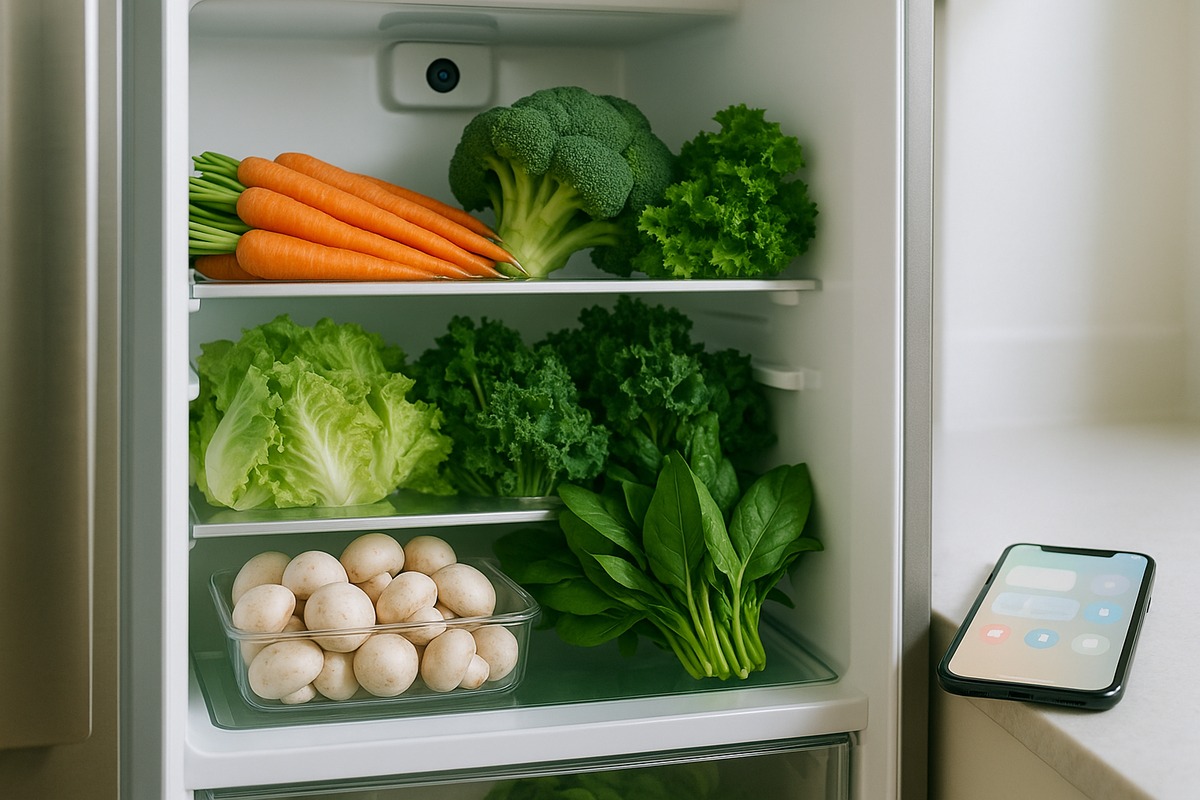
The refrigerator is where Panasonic decided to bring that same sensing technology up out of the floor and into the kitchen counter. In 2024 the company launched an AI-equipped refrigerator line in Japan, model numbers NR-F53CV1-K and NR-E46CV1-K, built around a pair of external cameras — one wide-angle, one telephoto — mounted to watch the interior shelves and door pockets every time the door swings open far enough. The system launched with the ability to recognize roughly forty-five distinct types of vegetables, a figure Panasonic has since expanded to around sixty on its current product pages. It tracks how long each item has been sitting in the crisper and pushes recipe suggestions that prioritize whatever is closest to spoiling — originally through a companion app called Live Pantry, whose functions Panasonic folded into its main KitchenPocket app in October 2025. Panasonic has framed this explicitly as a food-waste tool, running a pilot with the city of Yokohama to measure whether households actually throw away less food when their fridge nags them about the wilting spinach before they forget it exists. It is a genuinely unglamorous use of computer vision, and that is precisely why it is the most commercially serious thing in this entire article: it shipped, it is priced like a premium appliance rather than a toy, and it solves a problem — food waste, and the guilt that comes with it — that a huge number of households actually have.
The Fridge That Was Always Five Years Away
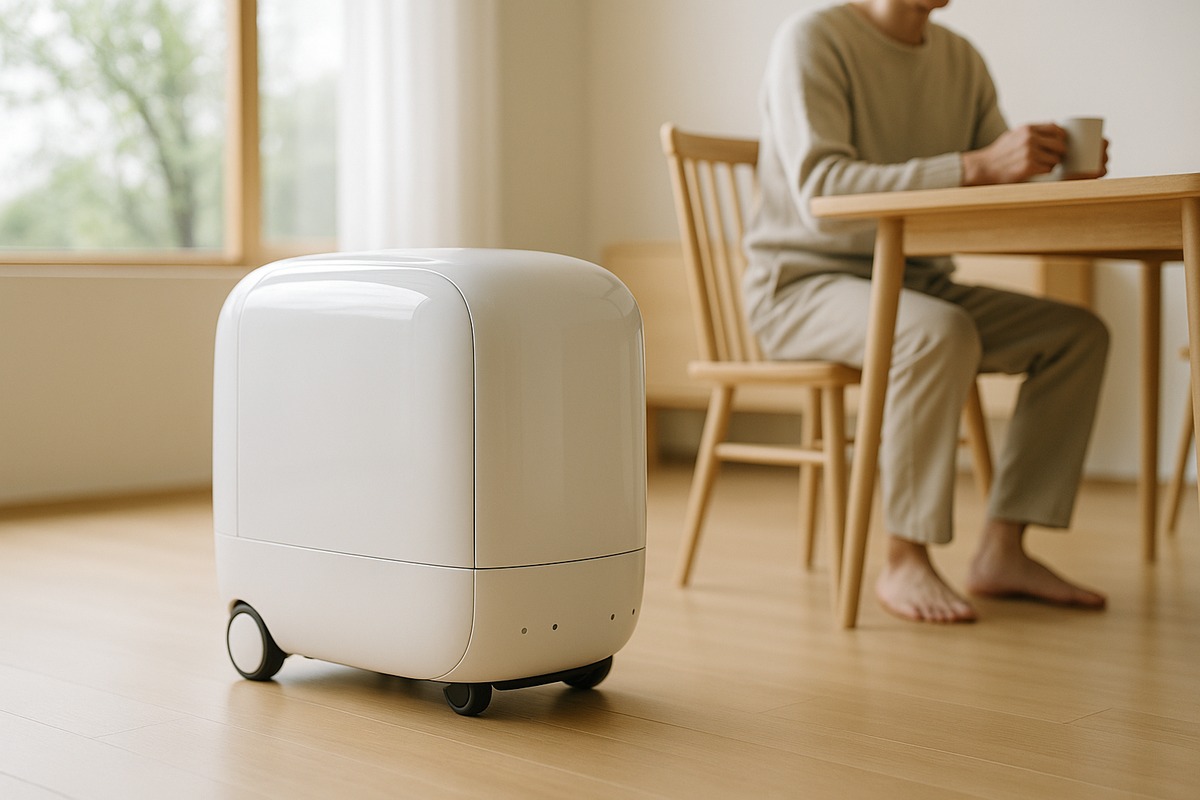
Not every experiment gets that far, and Panasonic’s history offers an instructive counter-example sitting right next to the vegetable-recognizing refrigerator: a self-driving refrigerator prototype the company unveiled at Berlin’s IFA electronics show back in 2017, built around the same basic promise Silicon Valley was making about self-driving cars at the time. Using onboard LIDAR and depth sensors, the concept fridge was designed to map a home’s layout, roll itself out of a dedicated charging nook, and travel to wherever it was summoned by voice — call its name, and it would trundle over to the dining table under its own navigation, steering around chair legs and children along the way. Panasonic even demonstrated a version that could ferry dirty dishes to the dishwasher. The pitch, then as now, centered on households where full mobility is not a given: older residents, people managing an injury, anyone for whom crossing the kitchen twenty times a day is a bigger burden than it sounds.
It never shipped. Nearly a decade later, the self-driving refrigerator remains exactly what it was at the Berlin show — a concept, a proof of what the underlying navigation technology could someday support, not a product on a Japanese showroom floor. I bring this up not to mock the idea, which is genuinely appealing on paper, but because the gap between that unrealized prototype and the AI camera fridge that actually reached stores says something useful about how to read robotics announcements out of Japan generally. A trade show demo and a shipping SKU are not the same signal, and Japanese electronics makers, Panasonic included, have historically been happy to let flashy concept hardware do marketing work for years without any near-term intention of manufacturing it at scale. The vegetable-counting camera fridge is boring by comparison and considerably more important, because it is the one you can actually buy.
Robots That Never Enter the Living Room
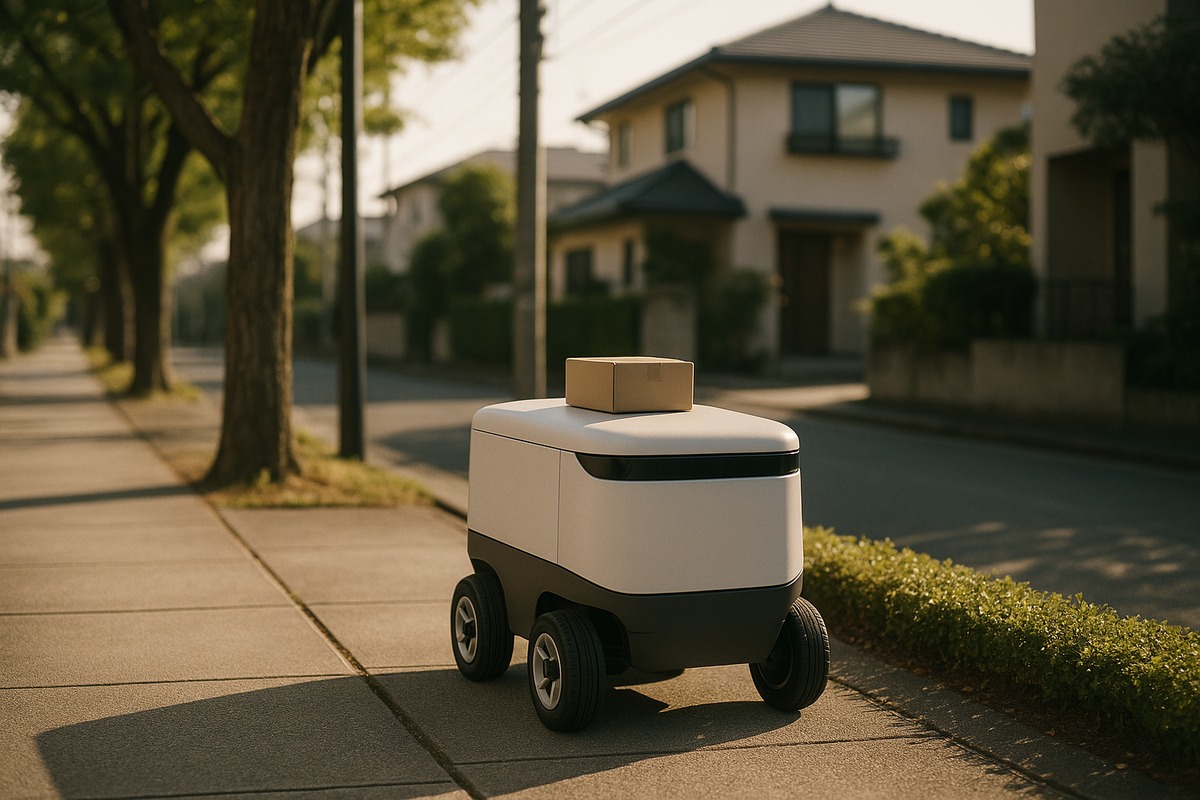
The most strategically telling part of Panasonic’s robotics push barely touches the inside of a house at all. Since 2020, the company has been running an autonomous delivery robot called Hakobo through the streets of a planned residential development outside Tokyo, using it to bring medication and small packages directly to residents’ doors along public roads shared with pedestrians and cars. The operational detail that matters here is not the robot itself, which looks like a modest wheeled box, but the way Panasonic is allowed to run it: full remote monitoring, no on-site safety attendant walking alongside as a legal chaperone, and a single human operator overseeing four robots simultaneously — a regulatory and logistics arrangement that took years of pilot programs to earn and that puts Panasonic well ahead of most consumer robotics companies on the unglamorous, unsexy work of actually getting machines cleared to move through shared public space unsupervised. A related delivery robot, HOSPI, has been quietly ferrying medicine and supplies through hospital corridors for years, with Panasonic now talking about extending the same platform into airports, restaurants, and security patrol work.
Layered on top of both is something Panasonic showed at Japan’s International Robot Exhibition, called Robo Sync — a control platform built to operate robots from multiple different manufacturers through a single interface, rather than requiring every robot on a factory floor or in a building to run its own proprietary software stack. None of this is a consumer product you will ever unbox at home, and that is exactly the point. It signals a company that sees robotics less as a single hit gadget and more as horizontal infrastructure — the pipes and wiring of a robot-populated built environment, sold to hospitals, municipalities, and property developers as much as to individual households.
Why a Rice Cooker Company Is Betting This Big on Robots
None of this happens by accident inside a company Panasonic’s size, and the internal numbers suggest a deliberate, well-funded strategic push rather than a side hobby for a few engineers with too much budget. Panasonic Holdings has built a sizable in-house AI organization, has stood up an internal AI ethics committee to review products before launch, and folds its robotics work into a broader corporate framing around what the company calls “safe, secure, and convenient living.” At its CES 2025 keynote, Panasonic Holdings’ leadership laid out a growth strategy explicitly built around AI and robotics as pillars alongside the company’s more traditional battery and energy businesses — a signal, aimed as much at investors as at consumers, that this is not a legacy appliance maker dabbling in gadgets on the side.
The demographic logic underneath all of it is very Japanese and, frankly, hard to argue with. Japan is one of the world’s oldest major economies and carries one of the heaviest ageing burdens among wealthy countries, its rural and suburban labor pool for caregiving and delivery work is shrinking, and a meaningful share of households — including a fast-growing share of people living alone — are looking less for efficiency gadgets and more for something that reduces isolation or physical strain. A robot that keeps an elderly parent company between phone calls, a fridge that nags a busy household about food before it spoils, a delivery robot that can restock a shut-in resident’s medication without needing a human courier to make the trip: these are not luxury conveniences dressed up as robots. In the context of where Japan’s population curve is heading, they start to look more like infrastructure. Panasonic’s circular-economy work reinforces the same instinct from a different angle — the company has also built AI-guided robotic systems to automatically disassemble old air conditioning units for recycling, part of a broader sustainability initiative the company calls Green Impact, which treats robotics as a tool for closing material loops rather than just entertaining people in their living rooms.
An American’s Honest Reaction
I will be candid about where my own instincts land on this, because it is relevant to how an international reader should weigh everything above. If a major American appliance brand announced a four-figure robot whose headline feature was that it occasionally farts, the reaction from most U.S. consumers and most U.S. retailers would range from bemused to hostile. American consumer electronics culture, even in its most playful corners, still wants a return-on-investment story: what does this do for me, and how fast does it pay for itself. Japan’s relationship with companion robotics runs on a different current entirely, one shaped by decades of friendly robot characters in popular culture, a well-established therapeutic tradition of robotic companionship in eldercare settings, and — I think underestimated by most outside observers — a general cultural comfort with objects that are allowed to be imperfect, even a little embarrassing, without that being a flaw to fix.
That gap is not a reason to dismiss what Panasonic is doing; it is a reason to read it carefully. NICOBO would almost certainly fail if Panasonic tried to sell it into the American market exactly as it exists in Japan today, at the price point it exists at, with the subscription model it currently carries. But the underlying pattern — hardware paired with a lightweight ongoing service fee, sold on emotional or caregiving grounds rather than pure utility — is not a Japan-only phenomenon; it is closer to what American consumers already accept from streaming devices, smart-home hubs, and pet-tech products. The lesson for operators outside Japan is not “sell fart robots.” It is that Japan is currently running one of the clearest real-world experiments anywhere on what households will actually pay for companionship-as-a-service hardware, and the data Panasonic is generating — weekly active usage, satisfaction scores, subscription retention — is a preview of questions Western appliance and consumer-electronics brands will be asking themselves within the decade, whether or not the answer ends up looking anything like an egg-shaped robot with a tail.
What International Operators Should Actually Watch
For brand and product teams outside Japan tracking this space, the useful takeaway from Panasonic’s playbook is not any single device, it is the structure of the bet itself. Test emotionally risky hardware through limited crowdfunding drops before committing to mass retail, the way NICOBO was tested. Separate the flashy concept demo, built mainly to generate press coverage and internal momentum, from the boring, well-priced version that actually reaches consumers — the Movable Fridge concept and the vegetable-camera fridge both reflect the same corporate willingness to put sensing and automation into appliances, but only one of them is real. Treat robotics infrastructure — delivery permissions, multi-vendor control platforms, remote-monitoring regulatory approval — as a slower, less glamorous but ultimately more defensible business than any single consumer gadget. And take seriously the idea that Japan’s aging, increasingly solo-household population is not a niche market quirk; it is closer to a leading indicator for what a lot of other wealthy, aging economies are going to need from their appliance makers over the next twenty years.
Frequently Asked Questions
Q. Is NICOBO available for purchase outside Japan?
A. Not currently. NICOBO is sold through Panasonic’s own Japanese retail channels and requires a Japanese-language monthly subscription to keep its conversational features running, so it has not been positioned for export. It is not listed for sale on Amazon.com or other major international marketplaces at this time.
Q. How much does NICOBO actually cost, including the subscription?
A. The robot itself retails in Japan for roughly ¥60,500 (a little over $400), on top of which owners pay a monthly service fee of around ¥1,100 (about $7–8) to keep its software active and updated. That subscription is also the channel through which Panasonic says it will deliver the LLM-based conversation upgrade it has scheduled for fiscal 2026.
Q. Is Panasonic’s self-driving “Movable Fridge” a real product you can buy?
A. No — and this is worth being clear about. It was shown as a working prototype at a European electronics trade show back in 2017, using LIDAR and depth sensors to navigate a home autonomously, but it was never brought to market and Panasonic has not announced production plans. It remains a technology demonstration rather than a purchasable appliance, even years later.
Q. Where can I buy a Panasonic robot vacuum like RULO in the U.S.?
A. Several RULO models, including the Panasonic RULO MC-RS800-W robot vacuum, are sold as imported units through Amazon.com. Because these are Japan-market products sold internationally by third-party sellers, buyers should check voltage compatibility and warranty coverage before ordering.
Q. Why do Japanese consumers seem more open to companion robots than American consumers?
A. It is a mix of cultural and structural factors: decades of friendly robot characters in Japanese media, an established track record of robotic companionship in eldercare and therapeutic settings, and a broader cultural comfort with imperfect, needy objects that isn’t as strongly present in U.S. consumer culture, which tends to reward pure utility over companionship in hardware purchases.
This article contains affiliate links. If you purchase through these links, we may earn a small commission at no extra cost to you.
If you’re interested in this topic, the Japanese market more broadly, or what KETCHUPs is working on, we’d love to hear from you — please reach out via our contact form.
Japan Market Pulse is a weekly read on what the Japanese consumer-tech, food, and mobility markets are choosing to do, written for international operators who want to know what is happening before it shows up in the global trade press.
Subscribe at ketchups.co/japan-market-pulse.